Stop the War in Iran! Eight Months and Counting is too long!
I just completed my first long Electric Vehicle (EV) trip in my 2025 Hyundai Ioniq 5. I have wanted to take a long trip in my EV to get an understanding of the charging infrastructure and my EV range in the mountainous western states. I’ve taken several shorter trips from Seattle to Portland and those worked out just fine. It was now time for a longer trip – from Seattle to Boulder, CO and back – to visit my oldest daughter and her family.
My daughter (Liz) and her husband (Dave) were early EV trail blazers when they bought a Tesla and documented their long EV trips. Their first long trip was 2000 miles to Phoenix. For their second trip (3500 Miles in a Tesla … With Kids) they decided to add some challenges:
For our first EV road trip in 2019 (2000 miles in a Tesla…with a 3 year old) we played it safe, planning our route around Tesla Superchargers and booking hotels that touted Tesla destination chargers. Very straightforward. All good.
Range anxiety thus diminished with that success, we decided to branch out a bit for our recent 3500 mile round-trip from Boulder, CO to visit family in Seattle, WA (via several National Parks). We unlocked scenic routes away from Tesla infrastructure by scouting out novel charging options at RV parks, using a fast-charging CHAdeMO adapter, and even powering up overnight via parking lot light outlets.
Given that they had done these trips over seven years ago, I figured that the EV charging infrastructure between Seattle and Boulder had gotten much better so I shouldn’t have very many challenges making the 3000 mile round trip. Wrong!!
Over the last ten years we’ve made tens of trips by gas powered cars to Boulder. There are essentially three routes to Boulder from Seattle – one through Montana, one through Wyoming (the shortest), and one through Grand Junction, Colorado (the longest).
Our Ioniq can use the Tesla Supercharger infrastructure so I looked at my Tesla App map and found there were plenty of chargers between Seattle and Boulder. Dave suggested that the Colorado path had the most Tesla chargers that I could use (an important caveat that came back to bite me) and that Wyoming had essentially no Tesla chargers. Either the Montana route or the Colorado route would be the best choice for my Ioniq with a NACS charging port. Since I was making the trip in early November, I wanted to be as far south as I could to worry less about snow in the mountains. The Colorado route would be the choice.
While I was driving, Liz would be flying back from India as part of a multi-week business trip, so my point of contact for EV driving expertise would be Dave.
When I got to Boulder about the same time that my daughter arrived by airline, I was sharing what a miserable driving experience it was. She exclaimed “Didn’t you read my blog post from five years ago?” She may have used a few other derogatory words. Sheepishly, I said “no I had not. I figured with all the long trips you have made, EV driving wouldn’t be much different than driving a gas car. Now I know differently.”
Liz shook her head and said “You just drove an EV on a long trip in the hardest possible way. No wonder you now have EV range anxiety.”
She listed the four reasons that it was the hardest possible way to make a long EV trip:
“First, you winged it.
Second, you didn’t have a copilot.
Third, you weren’t driving an actual Tesla.
Fourth, you did not load all the helpful apps onto your iPhone.”
Yes, guilty as charged your honor.
The following sections will explore the details of the four ways I made the EV long trip a lot harder than it should have been.
Winging It
Because I’d been listening to Liz and Dave talk about all the long EV trips they have made, I thought the trip would be like a gas car. I clearly never really listened to or understood all the details and experiences they tried to share. I thought I was prepared as I looked at the map in the Tesla app and saw that there were charging stations regularly spaced on the route I planned to take. What I didn’t understand is that my Ioniq could only use about 1/3 of the chargers in the Tesla app. I vaguely remember Dave saying something a year ago that the Ioniq could only use the Superchargers and couldn’t use the version 1 and 2 types of Tesla chargers (like the Destination chargers) as they used a different communications protocol than the Superchargers.
-
- Tesla V3 and V4 Superchargers: Direct plug-in compatibility via the car’s built-in NACS port and managed through the Tesla App.
- Incompatible Chargers: Older V2 Superchargers and legacy urban Tesla Superchargers are not supported.
Why It Works (and How It Behaves)
-
- Native Port Design: Unlike older model-year Ioniq 5 vehicles that used CCS ports, the 2025 model comes with NACS built right into the body, matching the physical plug shape of Tesla’s hardware.
- Voltage Architecture Difference (The Speed Limit): The Ioniq 5 uses an advanced 800-volt battery architecture, while most Tesla V3/V4 Superchargers output up to 500 volts. Because of this mismatch, the Ioniq 5 must use its internal motor windings to step up the voltage, capping peak charging speeds around 125 kW to 135 kW rather than the ultra-high speeds it can hit on 350-kW Electrify America stations (which can reach over 250 kW).
- Session Management: Charging sessions, payment, and monitoring are handled directly through the Tesla App or via plug-and-charge features where supported.”
My first charging station was in Prosser, WA, where I tried to charge the Ioniq to 100%. The estimated time for charging was going to be an hour. That was not acceptable so I lowered the charge to 90% and it was going to take 30 minutes. I decided to go get a Subway sandwich.
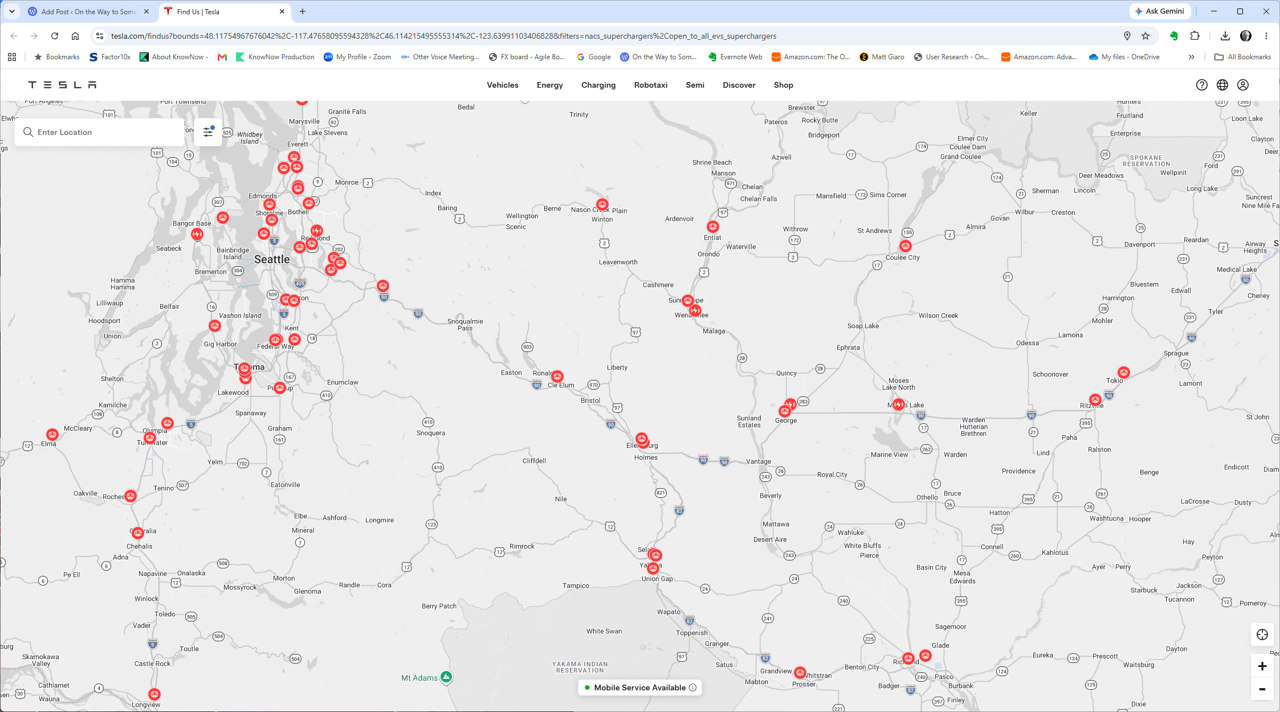
When I tried to use my Ioniq mapping function to find the next Tesla charger, the mapping function said that charger was incompatible. Oh crap, I think this is what Dave was trying to warn me about (see above about V1 and V2 Tesla chargers). So I texted Dave and he said yes, that indeed is what I was trying to warn you about. He then very kindly sent me a map from the Tesla website (not the Tesla app), which had the Ioniq compatible chargers. Unfortunately, the next charger was in Ontario, OR which I knew I couldn’t make on a single charge.
At this point, I got seriously worried about being able to complete the EV drive and thought about going back to Seattle and flying to Boulder. But I calmed down and persevered. It looked like the next charging place with a CCS coupling was an Electrify America station in Hermiston, OR. I had meant before the trip to try out a CCS charging station to understand how they worked, but I was seduced by all the Tesla chargers in the Tesla app that I decided I didn’t need to try it out.
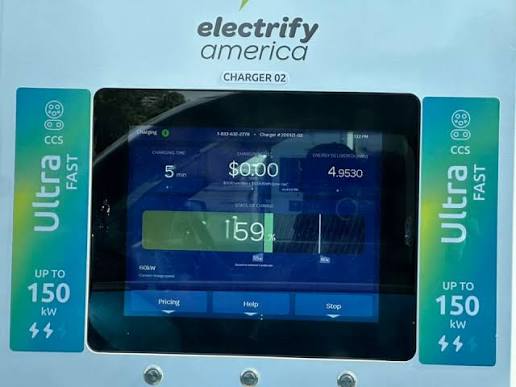
I arrived at the charging station to find that several of the chargers were out of order. So I pulled into a charger that had another gentlemen charging off of it. I opened up my trunk to find the CCS adaptor and couldn’t find it. WTF? Where did it go? I was in full panic mode now and ready to turn around when I reached farther back in my trunk and found the CCS adapter. After struggling I managed to get it on to the charging station cable and get the plug into my car. Then I started trying to use the WORST user interface I have encountered in a while. After punching the screen for five minutes only to figure out that to answer a question you had to use the physical buttons below the screen I managed to get to a pay screen. But in the process, I stopped the charging session of the guy next to me.
The gentleman very kindly said “Is this the first time you have used an Electrify America charger?” Yes. “Well even though the charging station has two cables you can only use one at a time.” OMG. Can I pay for you to continue? “No, I am almost done.” He was so kind to this newbie.
Yes, I was indeed winging it.
I managed to get the charging session paid for, but decided to charge up to 80% so I wouldn’t be here forever.
But this charge would only get me to Baker City, OR. I figured Baker City was a large enough place to have several chargers. Nope. I could only find a 40 kw Chargepoint charger which meant it was going to take an hour to get enough charge to make it to Ontario, OR where I decided to stop for the night.
I don’t like driving at night any more, but I figured I knew the highway well enough to make it to Ontario. About 30 minutes from Ontario, I saw about 10 cars and trucks with their hazard flashers on and looked ahead of them and saw a jackknifed truck blocking the road. Well, just great. The accident just happened which meant it was going to be hours before they got it cleared. It took 2.5 hours before one lane got opened up and I could continue. Meanwhile, the Holiday Inn Express that I reserved for that evening sent me a text asking how my check-in was. I just started laughing at the absurdity. I texted back and said it would be a couple of hours before I got there.
The nice part of staying at the Holiday Inn Express in Ontario, OR, is that they had Tesla superchargers in the parking lot. This stay was the easiest charging experience of the whole trip.
I am going to break the travelogue for a bit to go through the other ways Liz said that I had made this trip as hard as possible.
No Copilot
Over the last four years, my wife and I have taken several long trips to Europe and even visited all Lower 48 State Capitals a year ago. I did all of the driving on these trips and Jamie did all of the navigating. With Google maps on our iPhones, we are easily able to get around the US and foreign language countries and my wife kindly gives me the next turn instructions in a timely manner.
However, on this trip, Jamie really didn’t want an education in EV long distance driving and had some meetings that she needed to stay home for so she decided to fly to Boulder (great choice).
Liz and Dave always take their long trips together so that they always have somebody doing the driving and somebody doing the navigating AND figuring out where the next charger is. Liz’s blog posts do a nice job of pointing out how much time it takes to figure out chargers.
During this first day of EV driving, it became very clear how important a copilot is.
While at a charging station, I spent a lot of time flipping between the Tesla website for Ioniq compatible chargers, my Google Map on my iphone for distances, and the map on the Ioniq navigation system. As I charged up at each stop it would take me 10-15 minutes flipping between the three mapping functions to find the next charging station. None of the apps has all the information that you need.
I wasn’t driving an actual Tesla
The Tesla charging network is great if you are driving an actual Tesla. They are not so great if you are not driving an actual Tesla.
The first reason for not being great in an Ioniq is that less than half of the chargers are available for use as described above. You can’t use the Version 1 and 2 of the Tesla chargers even though the Ioniq has a NACS compatible plug.
The second reason is that the electrical system of the Ioniq is not compatible with the high speed DC charging of the Tesla superchargers. So it takes the Ioniq about twice as long to charge as it does a Tesla.
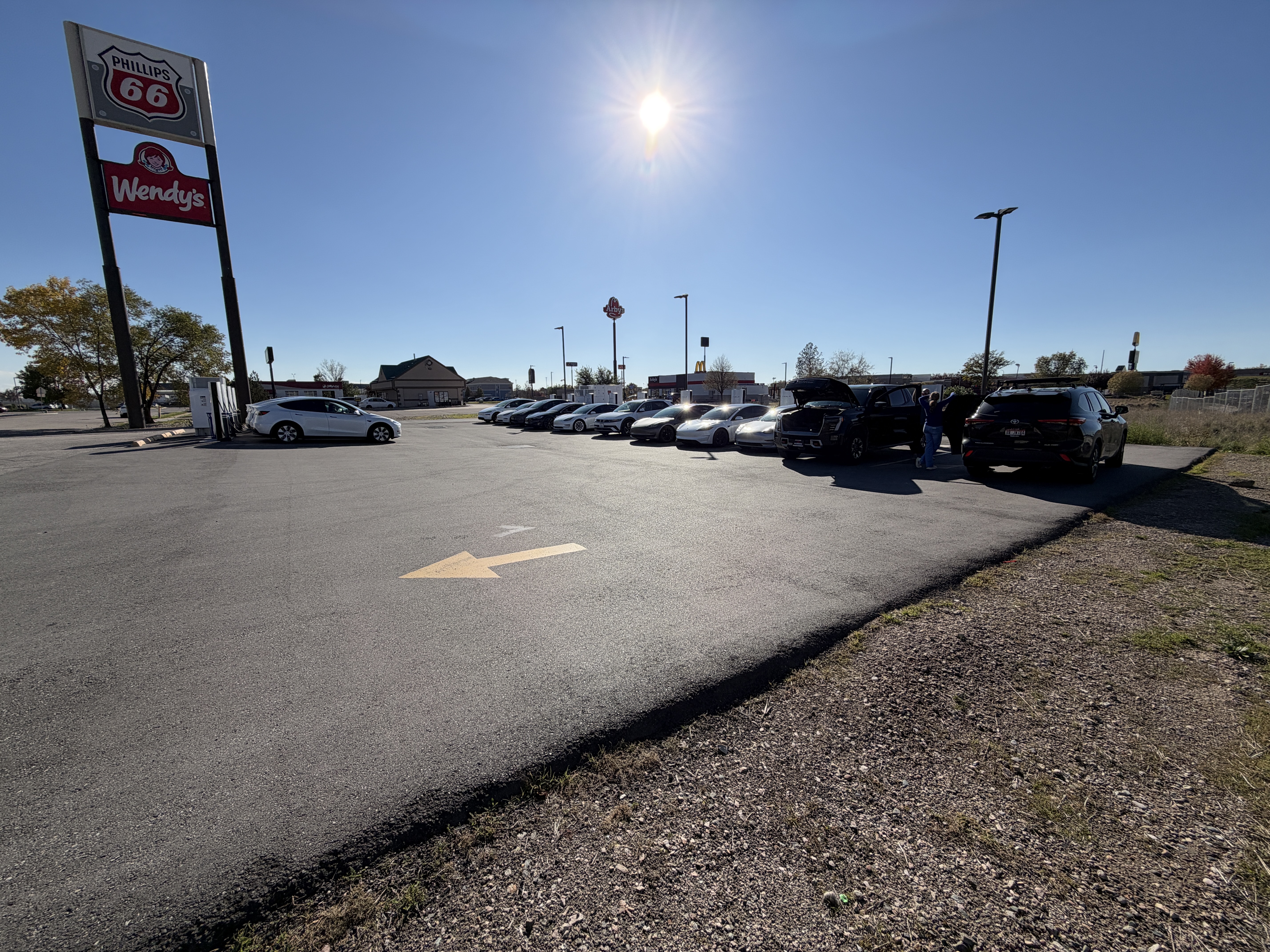
The third reason is that Teslas have their charging port on the left side of the car and the Ioniq has its charging port on the right side. The Tesla chargers have very short cables. So often times in the Ioniq I end up taking two spaces in the charging area. As you can see in the photo above, often the charging area is full of other Teslas trying to charge their car.
I lived in fear that someone would get irate at me for taking up two charging spaces.
I didn’t have all the useful apps
Just before the trip I had upgraded my iPhone from the iPhone 16 Pro to the iPhone 18 Pro. I had not noticed that the Apple login information had changed and that the account was using an email address that I no longer had access to. I tried to download the apps like Plugshare and ABRP (A Better Route Planner) that Liz recommended, but I kept getting locked out of my Apple account. When I got to Boulder it took me two hours and the use of three different apple devices to finally get the account login straightened out. You might imagine that I used a few “F words” directed at Apple.
In addition to the planning apps, Dave recommended I get the payment apps for Electrify America, EVGO and ChargePoint.
As I found getting ready for the return trip, you have to use a combination of all of these apps to actually plan out a complete trip. Planning is better done in a relaxed manner at home, than when you are in the middle of a trip and panicked about not finding a working charger.
One of the benefits of apps like Plugshare is that you get relatively recent information about which chargers are actually working. I’ve had good luck with the Tesla chargers which seem to be maintained quite well. The other charging stations always had at least one charger not working.
Things I Didn’t Think About
An EV charging station is only sometimes near a gas station. I forget all the things that we use a gas station for on a long trip. A gas station is a place to fill up the car, a place to wash the car windows, a place to go to the bathroom, a place to get snacks and drinks, and a place to get fast food for quick meals.
At several of the stations I stopped at there was no place to go to the bathroom so I had to make an extra stop at a rest area.
Because it takes so long to charge a car from 80% to 100% and you should always have 20% reserve in case a charging station isn’t working, one only has 60% of the useful range of the battery for practical purposes. So my 280 mile range EV Ioniq 5 was practically only a 160 mile range EV. This limited range means that I would be stopping to charge at least every two hours.
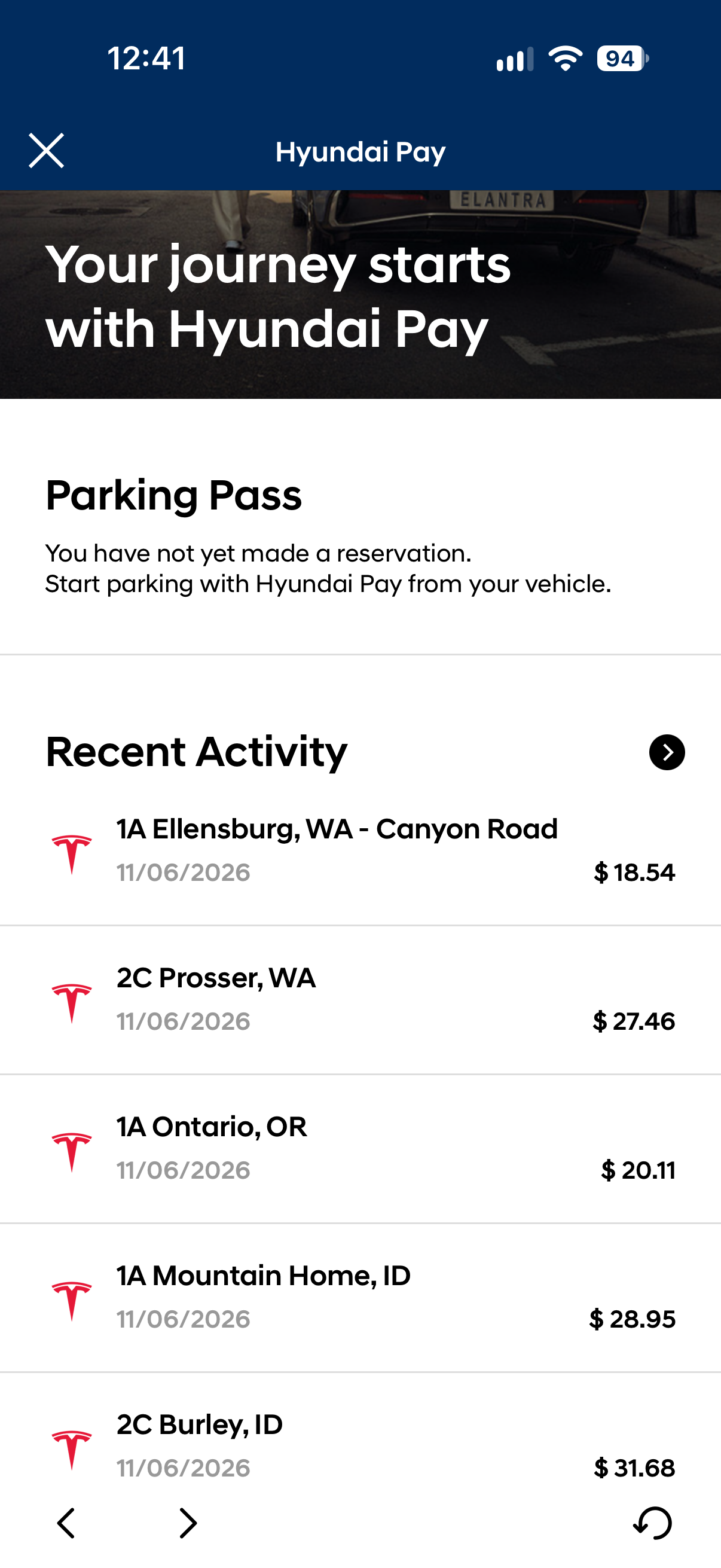
It took me a while to find where my Hyundai Pay app keeps records. I do like that when I can use Hyundai pay I have a good record of where and which charger I used and how much it costs.
The Ioniq Map and Navigation System Sucks
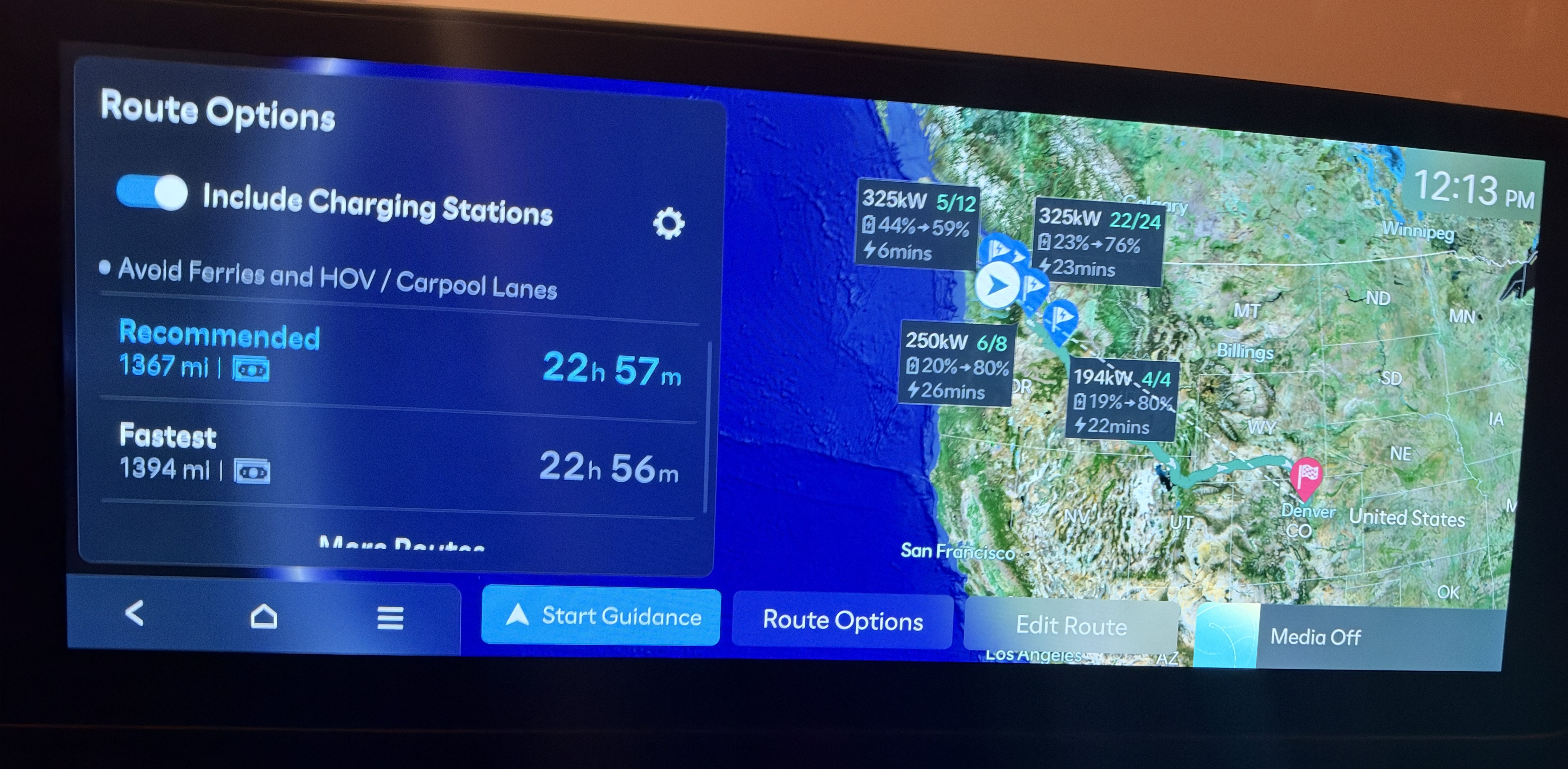
Prior to the trip to Boulder, I used the mapping system all the time and never had any real problem. But I never used the system to find chargers. The first time I used the system to find chargers, the display disappeared after 10 seconds. And you can’t get it to stay on the screen. Since the display doesn’t have distances between chargers, I need to use my iPhone Google map to find distances. I’m pretty good with the iPhone, but I can’t find the distance in 10 seconds.
So I had to use the Tesla website with compatible chargers to find which ones I could use but it doesn’t have distances between chargers either.
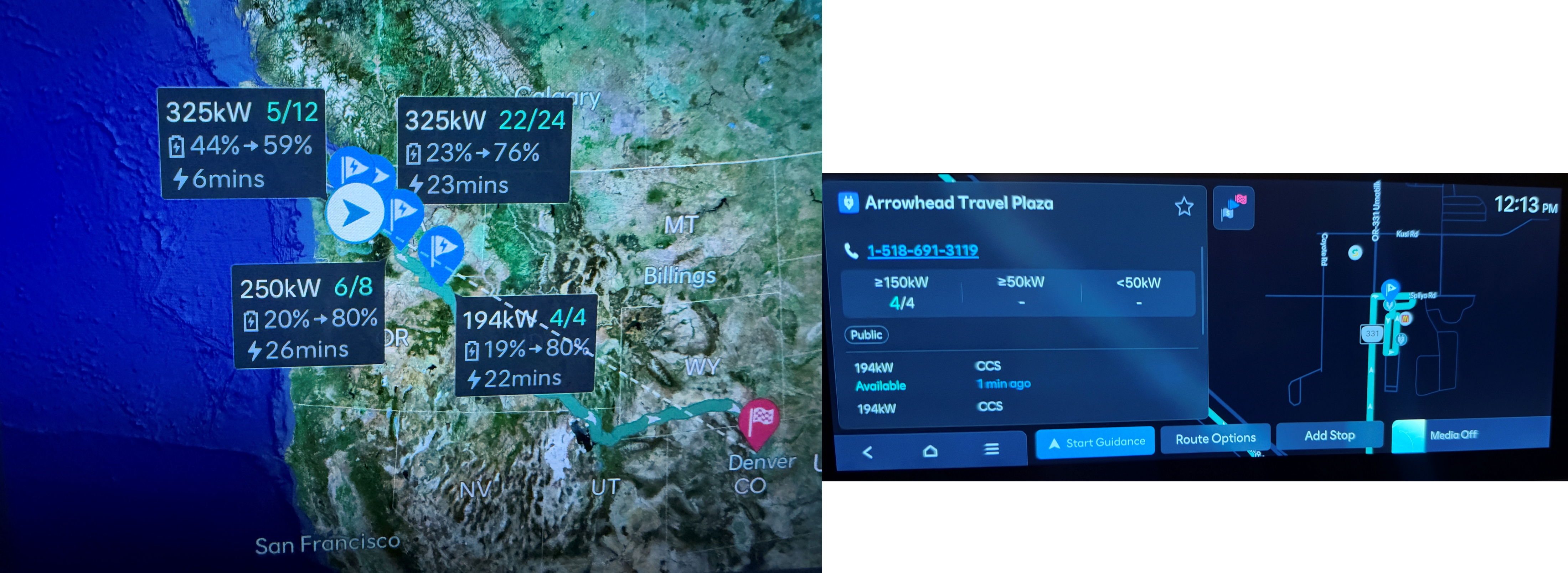
The couple of times I decided I could estimate distance on the Ioniq map I couldn’t figure out where to hit the charger information (the flag, the info square, something else?) to get the charger station to become a stop or a destination. So I had to use the Tesla website to get a specific address then type that specific address into the Ioniq map (and you can only do this with the car in Park), and then select that address as the destination. Most of the time this would work and the pre-conditioning of the battery would work appropriately, but several times the navigation map took me someplace other than the Tesla chargers and therefore the battery pre-conditioning didn’t operate.
It took me forever to get the Ioniq full map and the small map to be laid out like I wanted – the big map for the overview of where I was headed and the little map for the turn by turn directions. I still have no idea what I did to get this layout like I wanted.
Trying to change destinations sometimes took the patience of Job. Trying to delete a current destination and enter a new one often times would take several circular trips of button pushing to get to where I wanted to go in the interface. At 11pm at night in the darkest of the wilds of a charging station I wanted to let out primal screams.
I have read the instruction manual now and watched countless Youtube videos and I still cannot figure out the Ioniq Map and Navigation system.
As a side note, the car’s time changed when I crossed into the Mountain Time Zone just west of Ontario, OR (both coming and going). However, the car’s time did not automatically change when Daylight Savings changed back to Standard Time.
Day 2 – From Ontario to Price Utah
I got an early start the next day and hoped to make it to Grand Junction, CO. It appeared that there were Tesla Super Chargers all along the route. My first stop was Mountain Home, ID. I was surprised at how much battery charge I used to travel from Ontario to Mountain Home. I texted Dave to see what was going on. If I had to stop every 90 minutes for charging this was going to be a very long journey.
Dave came back with the best advice which should have been blindingly obvious “go slower if you want to go farther.” I had been driving at the speed limit of 70 or 75 or 80 like I would do in my gas powered car. But at those driving speeds I am really going through the battery discharge quickly. Dave suggested driving at Truck speed of 60 or 65.
Driving slower worked. I could go farther.
I could now go 2 to 2.5 hours between charges. And two hours was about the time I needed between rest room breaks.
It is frustrating to drive that slowly, particularly in the wide open spaces of the Western United States. But going that slow and keeping the charge level between 20% and 80% extended the driving range just enough not to be totally irritating.
I was making good time and then I hit Salt Lake City at Rush Hour. It took me 2.5 hours to go 60 miles from Salt Lake City to Provo, Utah. The good news is that with all the traffic I didn’t use much charge. The bad news was that I was going to have to climb the mountain from Provo Utah to Price Utah in the dark.
I got to Price Utah at 10 PM and was delighted to see 10 Tesla chargers in the parking lot. As I checked with my Tesla website and my car map I found that they were the destination Tesla chargers which were not compatible. I was too tired to go 10 miles down the road to charge, so I would do that in the morning.
Day 3 – From Price to Boulder CO
The good news on this leg of the trip was that I would be able to find lots of Tesla Super Charger stations along the way. I knew I would be stopping a few more times than normal as I had two very high mountain ranges to cross – Vail Pass and Eisenhower Tunnel.
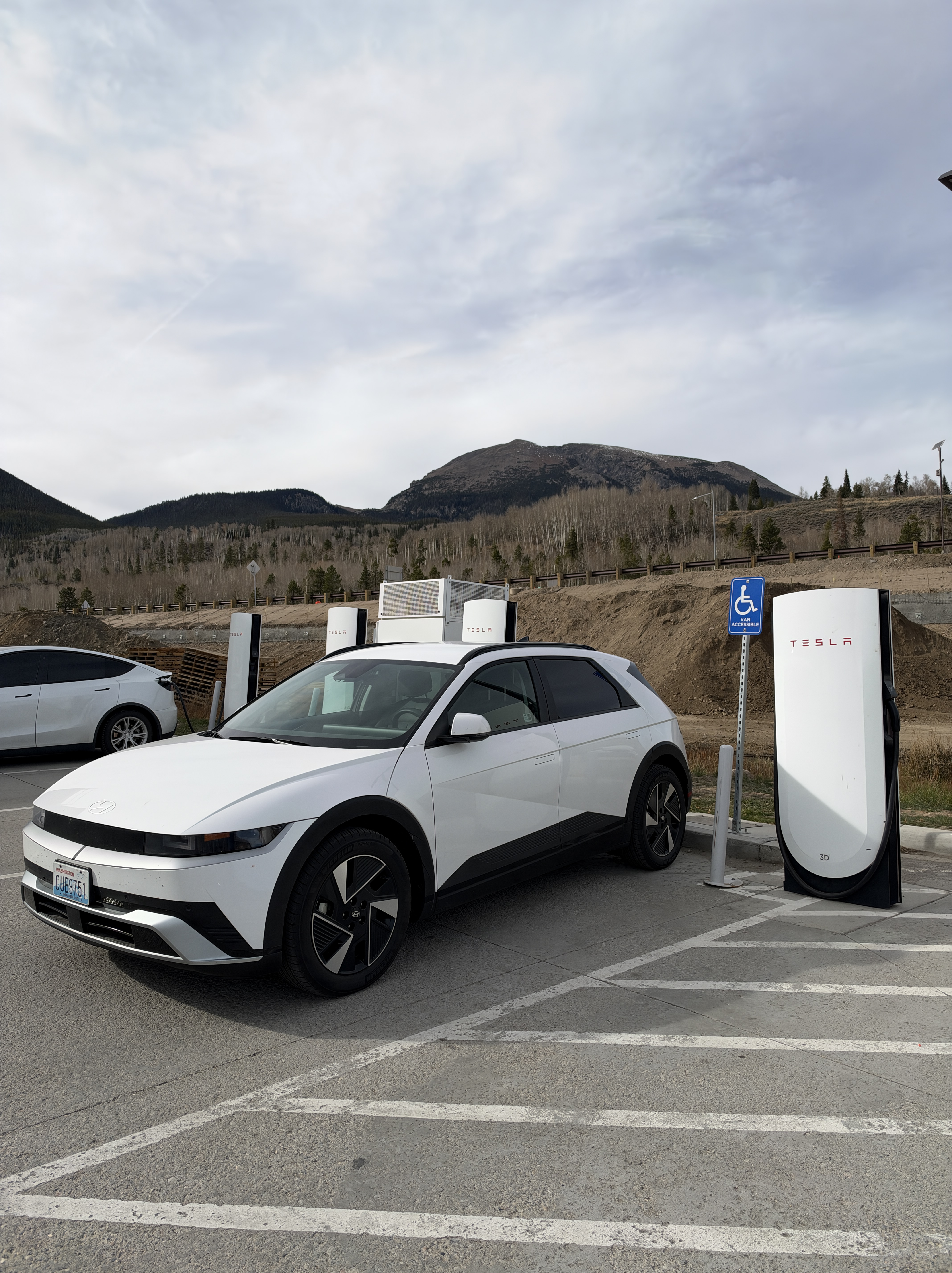
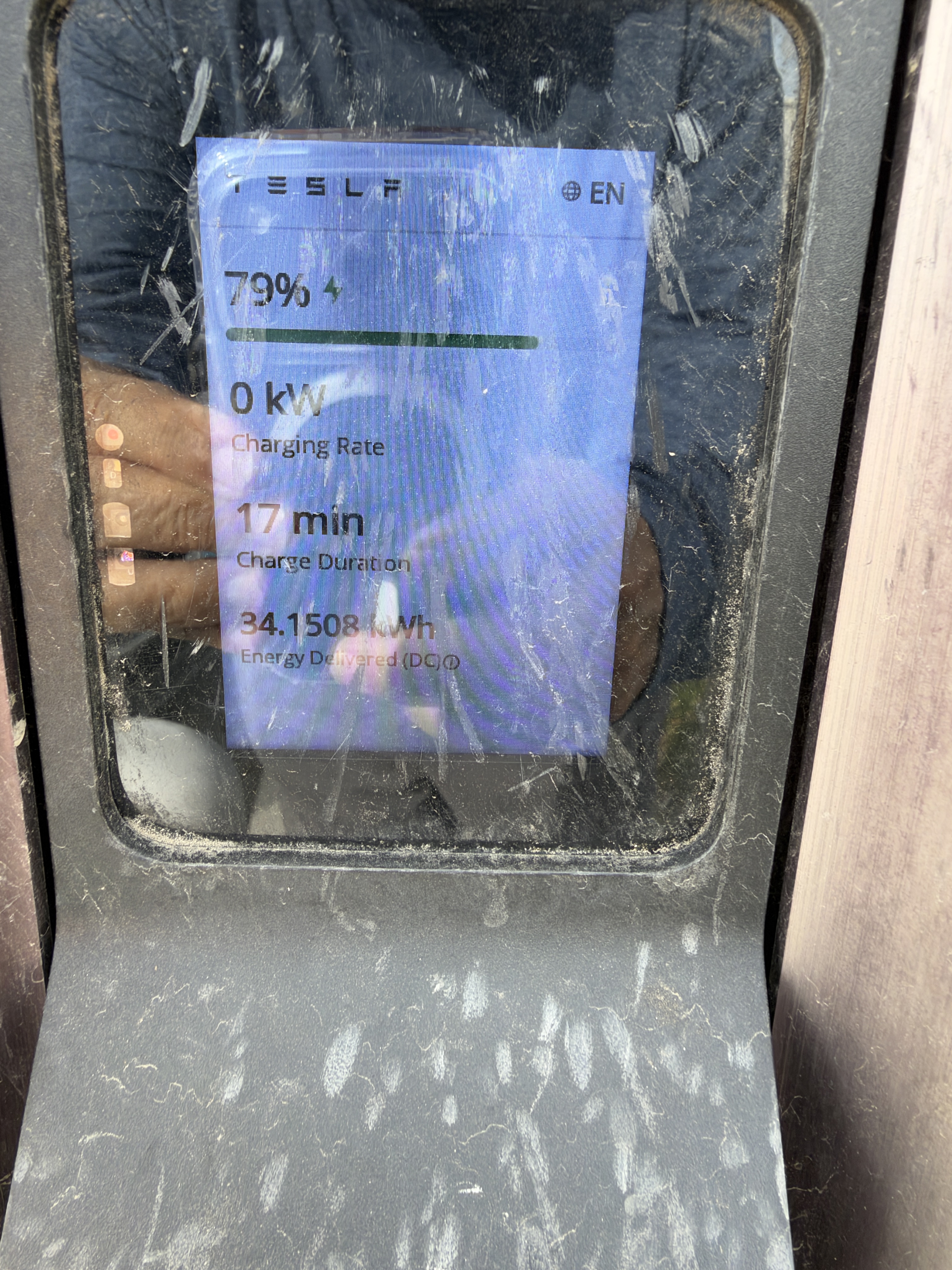
Since I have a handicapped pass, I found that several of the Tesla charging stations had a handicapped space where I could use my right side plug and not take up two Tesla charging spaces. I didn’t realize until charging in Frisco, that some of the chargers had a display of how much charge I was using.
I made stops in Green River, UT, Rifle, CO, and Frisco, CO. It was fun coming down the eastern slope of the front range and travelling 25 miles only using 1% of my battery.
I got to Boulder and was delighted to see my two wonderful grand children and express my deepest appreciation to Dave for all of his help in getting me through the 1400 miles of EV Range Anxiety over three days.
Dave was happy to let me use their Level 2 charger so that I didn’t have to pay to recharge the car. I started laughing when my Ioniq said “Incompatible Charger.” It turns out Dave’s Level 2 charger was from Tesla and was a first generation protocol that didn’t work with the Ioniq 5. Oh well.
The Journey From Boulder to Seattle
During the week I was in Boulder, I downloaded all the different apps I would need to plan the return trip and have the different charging station apps (Electrify America, EVGO, ChargePoint). This time I would try to remedy some of what made the first half of the journey so hard (not winging it and having the Apps). I couldn’t do anything about not driving a Tesla or having a CoPilot (my wife was going to fly back to Seattle).
I really wanted to go through Wyoming on the way back as it is shorter and I could avoid the traffic around Salt Lake City. But as I continued to stare at the map and see that my only options were CCS places with Electrify America and EVGO, I was nervous about the distance between charging stations.
I finally decided to return the way that I came. However as the return day got closer it was clear that snow was going to hit the Colorado mountains and I may not have a choice. Vail Pass was scheduled to get several inches of snow. Fortunately, on the departure day the snow warnings were lifted (at 4am for the front range and 7am for Vail Pass). As I had to drop my wife off at the Denver Airport on my journey home, I wouldn’t be hitting Eisenhower Tunnel until 11am.
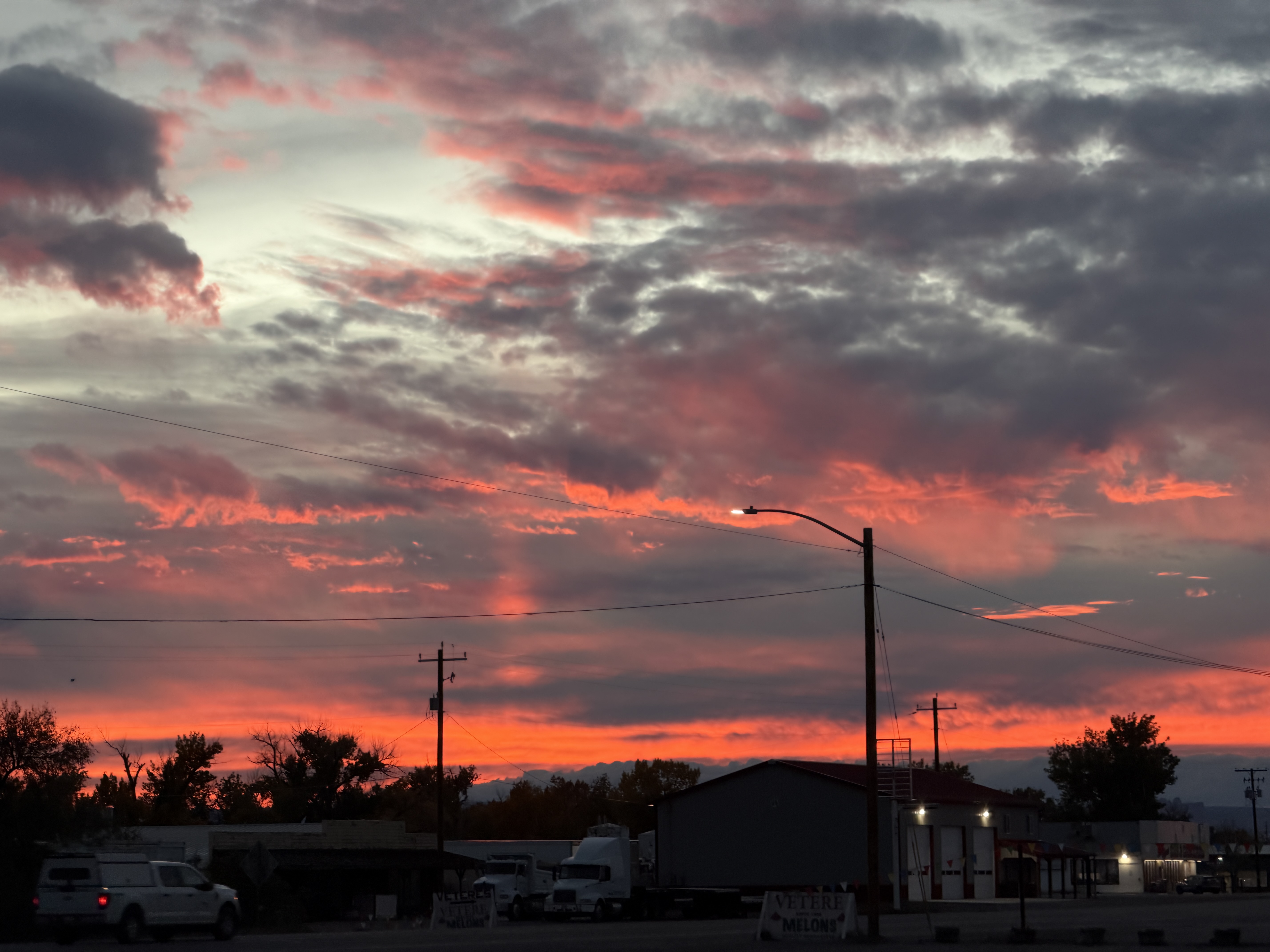
I retraced my charging stops and recharged at Frisco, Rifle, Green River, and Wellington, Utah. I was treated to a spectacular sunset in Green River while charging. Since it was so flat, I couldn’t find an unobstructed photo of the beautiful pinks and oranges.
If possible, I wanted to make it to Ogden, Utah for the night and I hoped that I was late enough to miss the rush hour traffic of Salt Lake City. I got enough charge in Wellington,Utah, to make it to the Holiday Inn Express in Ogden, Utah. I got up before sunrise the next morning to get moving. I had to laugh when I got to the car and the windshield was covered with frozen ice. In another example of winging it, I had forgotten to add an ice scraper to my car. To make matters worse, once I started driving every warning signal in the car went off because the front camera was iced over as well.
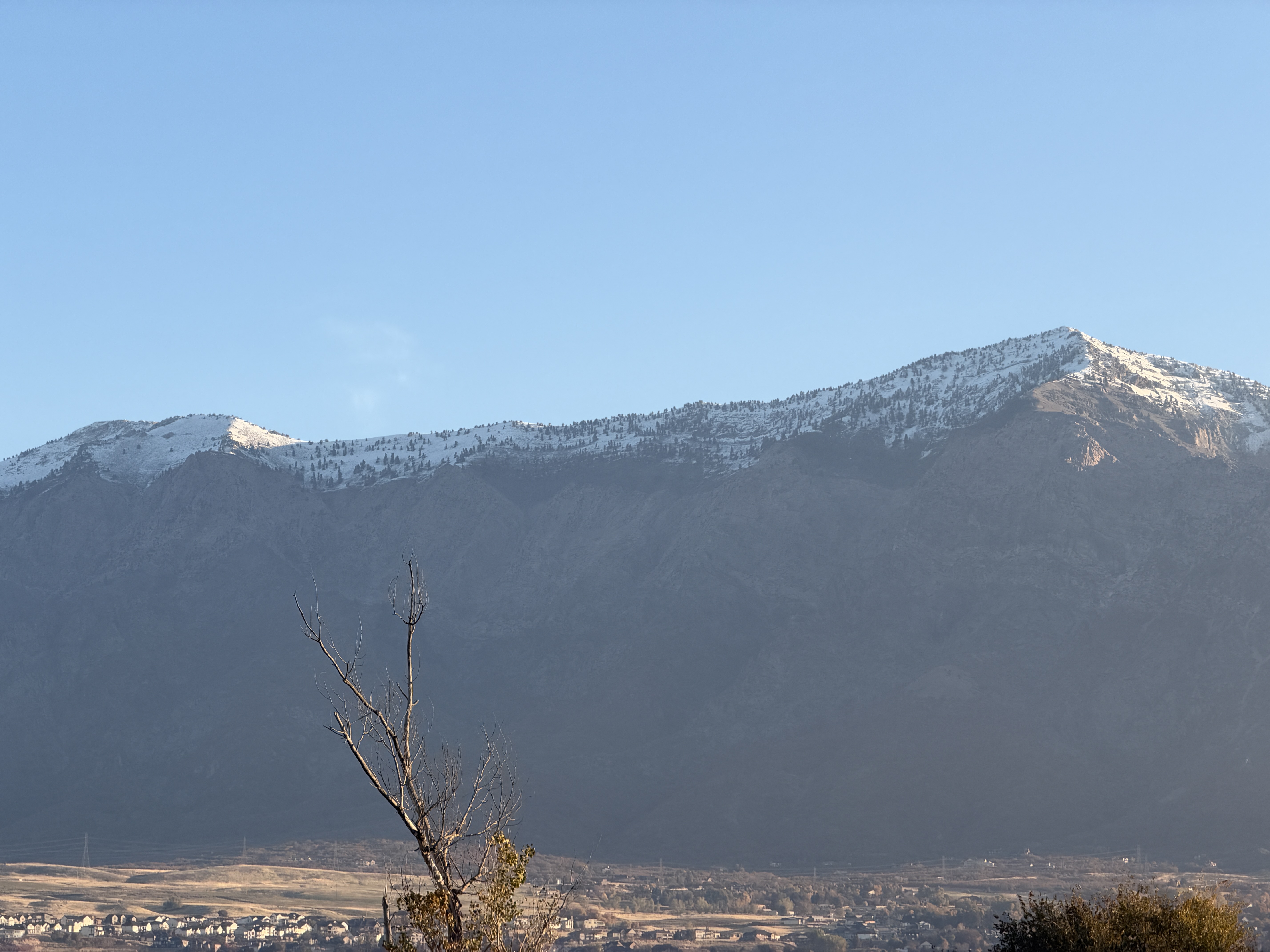
As I drove to the Farr West charging station, I was treated to a beautiful sunrise over the Wasatch mountain range. I missed capturing the pretty colors, but I was able to photograph the snow capped peaks. I did a 90% charge here as there is a long barren stretch of interstate highway between Farr West and Burley, ID, which was my next stop. I continued to retrace my stops at Burley, Mountain Home and Ontario, OR.
The journey from Ontario to Prosser, WA, would require a stop with a CCS charger. In planning the journey I elected to stop in La Grande, OR. Knowing the maintenance problems of CCS chargers and seeing on the Plugshare app that one of the Electrify America high speed charging stations at the Walmart in La Grande wasn’t working, I wanted to make sure there was a fall back with other chargers nearby.
Sure enough the Electrify America chargers were a mess. I tried three different chargers (one 300kw and two 150kw) and I couldn’t get any of them to work. I tried using the app to pay and tried paying with a credit card and nothing worked. I finally gave up and went a mile down the road to a Starbucks/Volvo Chargepoint+ that was relatively fast.
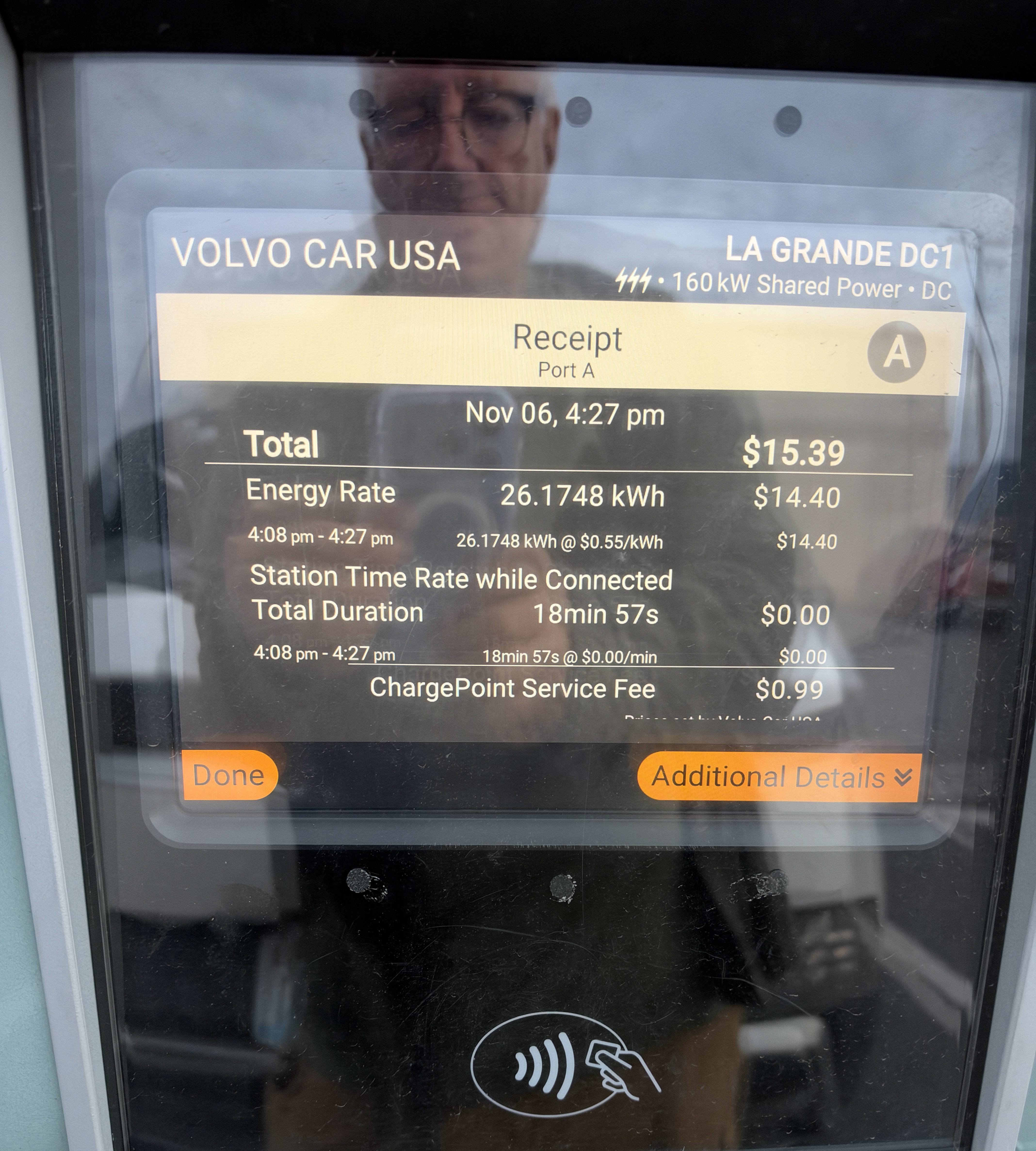
I had hoped to use the Hyundai Pay app for this charge, but I couldn’t make that work. However the standalone credit card button above worked. When I am not able to use Hyundai Pay, I always take a photo of the screen to know how much I was charged.
I was now good to go through the Blue Mountain passes and long downhill near Pendleton, OR, to get to Prosser, WA. Of course, the minute I hit the border between Oregon and Washington the rains started. There was nothing on this November journey that was going to be easy.
Since I only charged to 80% in Prosser so I could keep going, I added an extra stop in Ellensburg, WA to top up the battery to make it to Seattle. I followed my map instructions to what I thought were Tesla Superchargers, but quickly was informed by my car “voice” that the charger was incompatible. As it turns out several of the motels near the interstate in Ellensburg have Tesla chargers, but only one was a Supercharger.
The rains continued on and off and then as I got close to Snoqualmie Pass I encountered fog. I slowed dramatically, but when I got to the pass, the weather cleared and I made it to Seattle in time to catch the last ferry of the day to Bainbridge Island.
I was pleasantly surprised that I made the trip back home in two days instead of three. The two days were long and harder in the dark in the winter time, but I made it.
Learning Experience
Now that I have safely navigated the 3000 miles of a round trip between Seattle and Boulder, I have fulfilled the learning experience of taking a long EV road trip. I still have and will probably always have EV range anxiety (at least until solid state EV batteries finally become available).
The biggest learning for a long trip is from Dave “Go slower to go farther.“
It is clear to me that you can’t be in a hurry with an EV on a long trip until either the charging stations become more plentiful and more reliable or we get the longer range and faster charging of solid state batteries.
EV trips require up front planning (no winging it) and constant monitoring of charging stations (it really helps to have a copilot).
The apps and an EV’s map/navigation system still require lots of improvement. I was really frustrated when I found out that both for planning and for enroute navigation I had to be checking at least three and often five different apps. This state of affairs is ridiculous.
A charging station is not a gas station. It is easy to forget that a gas station now has many more features (windshield cleaning, restroom, food, snacks …). Sometimes charging stations are located near a gas station and often they are not. At a minimum you need to carry windshield cleaning materials with you in the car.
All charging stations are not created equal. By far the easiest to use, particularly with my Hyundai Pay app, are the Tesla Super Chargers. The rest, at least on this trip, are relatively random and a crap shoot on how to pay and whether your EV and the Charger can link up with whatever protocol they use.
I do love my Ioniq 5 EV. It has been a terrific choice for local driving. I love passing by the $5.50 per gallon gas stations and being able to charge the EV at home with our Level 2 charger. The Ioniq 5 is very easy to drive and comfortable for a very long trip. I have one year left on my lease and my fondest dream is that solid state batteries for EVs will start showing up soon.
I won’t hold my breath, but I hope somebody solves the mess of apps that are required to plan and execute a long EV trip.


