
Stop the coup in the United States! Vote! Resist! Persist!
I love the following quote from Enlightened Aging:
“The path to healthy aging is not centered on the consumption of health care services. The path is instead centered on developing the ability to adapt to changing circumstances—the ability to bounce back from an illness, injury, loss, or any other setback. In a word, resilience. Don’t be fooled by the ads. You don’t procure resilience; you build it.“
Over the course of the last seven years after my serious auto accident, I worked hard at building resilience.
To build resilience, I put together a “team” of healthing professionals to work on my physical, cognitive and spiritual practices. All of these team members are in their own special ways constantly pushing me to go past any real or perceived boundaries. My cognitive therapist after hearing about my resilience building efforts immediately asked “for what? You can’t stop at resilience building. You must push on to the next level of transformation,” she urged.
As you might guess, I am not catching any sympathy from my wonderful therapists.
From this wheelchair in April 2018 at Harborview Medical Center:
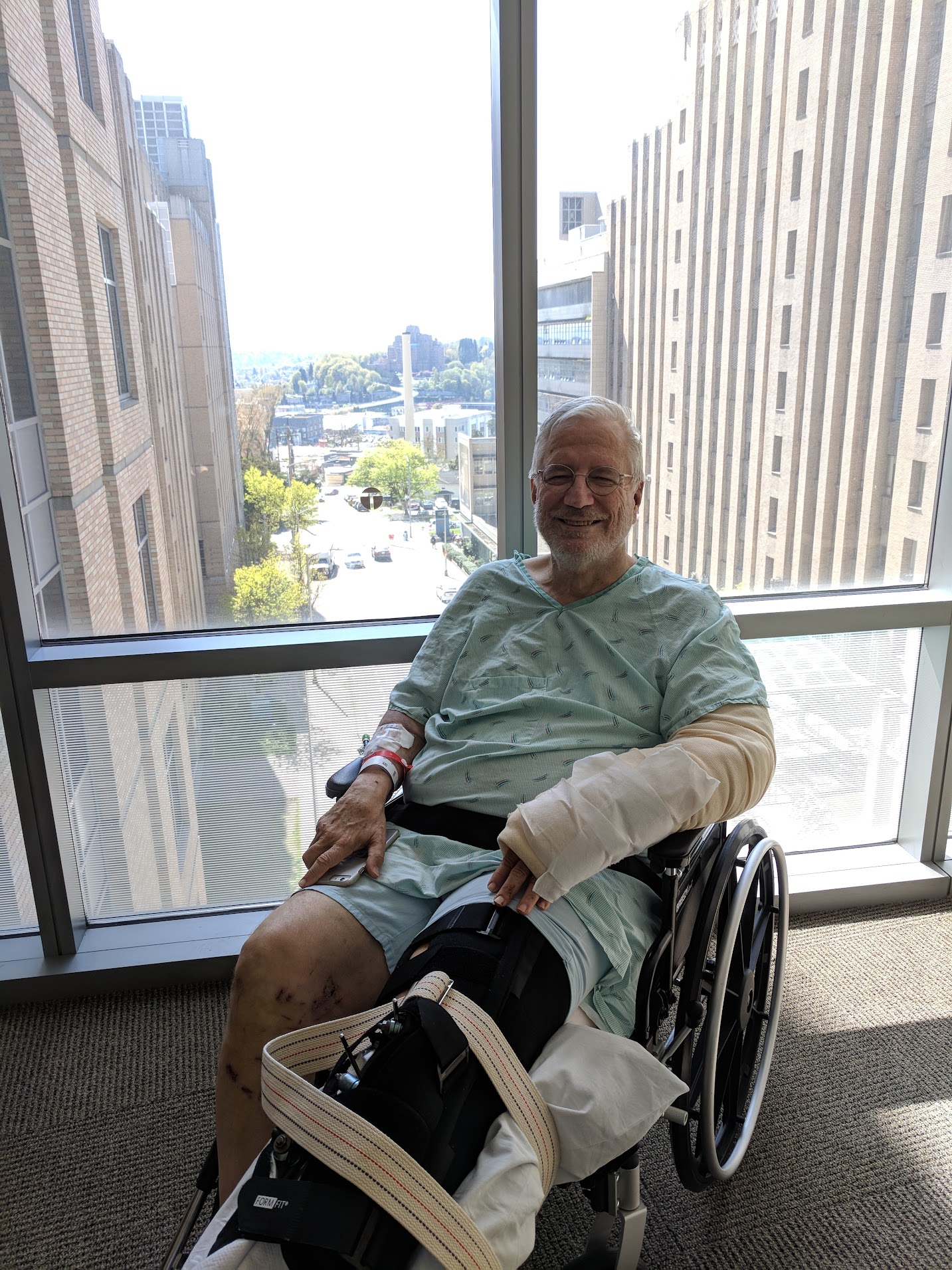
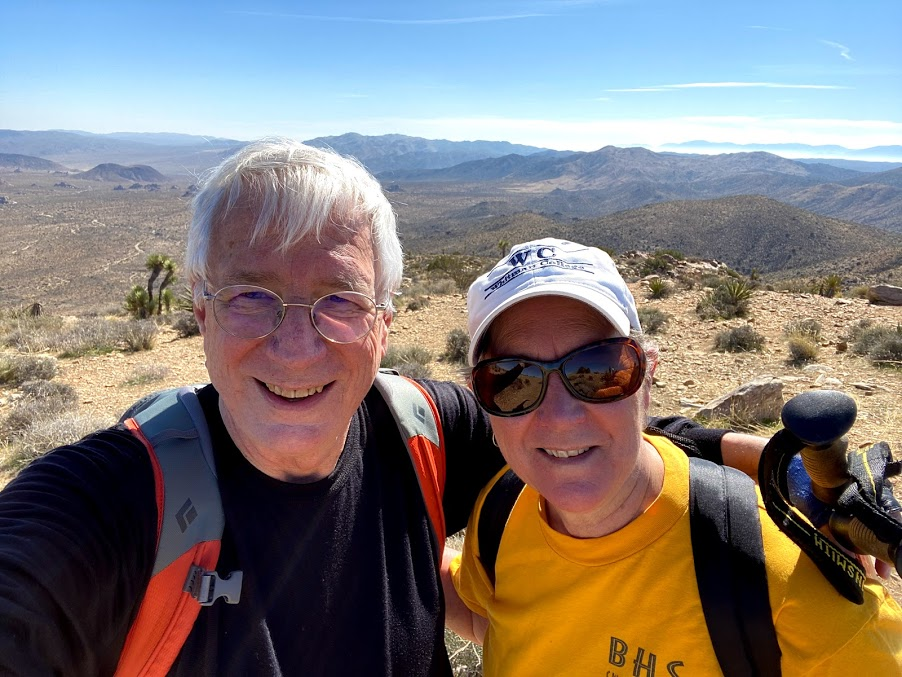
To this hike in February 2020 at Joshua Tree National Park:

While laying in my hospital bed at Harborview hospital after my third major surgery to reconstruct my left ankle in May 2018, the pain was close to unbearable. I’d never experienced pain of that magnitude. It took over 24 hours to get the pain under some kind of control through a mixture of drugs and a nerve block in my left calf above the ankle incisions.
As the pain subsided, I looked at my leg immobilizer, my ankle cast, and my left arm cast and despaired of ever walking again. When I was by myself, usually in the middle of the night, I would quietly sob, thinking that I would never be able to walk normally again, let alone hike in some of my favorite places. I thought I would have to be satisfied with the memories of a lifetime of hiking in the Presidential mountains in New Hampshire, the Smoky Mountains of North Carolina, the Olympic Mountains of Washington, the National Parks in Utah, and my beloved high desert of Joshua Tree National Park.
However, with all of the unbelievable skills and patience and dealing with my hard headedness, my team of medical professionals and therapists helped me walk again. While it took two more major surgeries to get my left femur stabilized, I was able to start walking and hiking on Bainbridge Island in 2019. I was still limited to about three miles on any given hike before the pain in my ankle and knee would rise to a level where I needed a dose of Advil.
After two months of slow painful hiking, I decided to try a different type of compression sock (Copper Fit knee high) and purchased some ankle high Hoka lightweight hiking boots. Slowly but surely I pushed through the three mile barrier without any increased pain or need for Advil. Over two months I was able to build up to hiking 8 miles at a time.
However, it was a challenge to get long walks in while it was raining so much during the month of January 2020. As I wrote this in 2020, it was the first official sunny day in 80 days. For months I knew I needed to get out of the PNW weather. I wanted some heat and sunshine. I needed some heat and sunshine. Joshua Tree beckoned. It took a couple of weeks to find a date that we could sandwich between a family friend’s funeral and my son needing some help transporting household goods to his new home in Santa Barbara, CA. Finally, on February 9th we got away and headed south.
We arrived at Joshua Tree late on February 12. I couldn’t wait to get up early the next morning to climb Ryan Mountain with Jamie. This hike was Jamie’s first in Joshua Tree. I neglected to tell her how hard it would be. While a relatively short hike (3 miles round trip), it is pretty steep (1500 feet elevation gain in 1.5 miles). The entire trip is composed of an endless series of stone steps.
We made it to the top in good shape. Jamie and I celebrated the 360 degrees of views from the top of Ryan Mountain with trail mix and lots of water. In the background you can see the smog that rolls in from the LA Basin to cover Palm Springs. Not only did I make it to the top, but I carried a backpack for the first time since I started hiking again.
I knew that the easy part was over. With each step up, I tried not to think about the degree of difficulty coming back down. I can walk up steps relatively easily now. But going downhill requires much more work from my right leg.
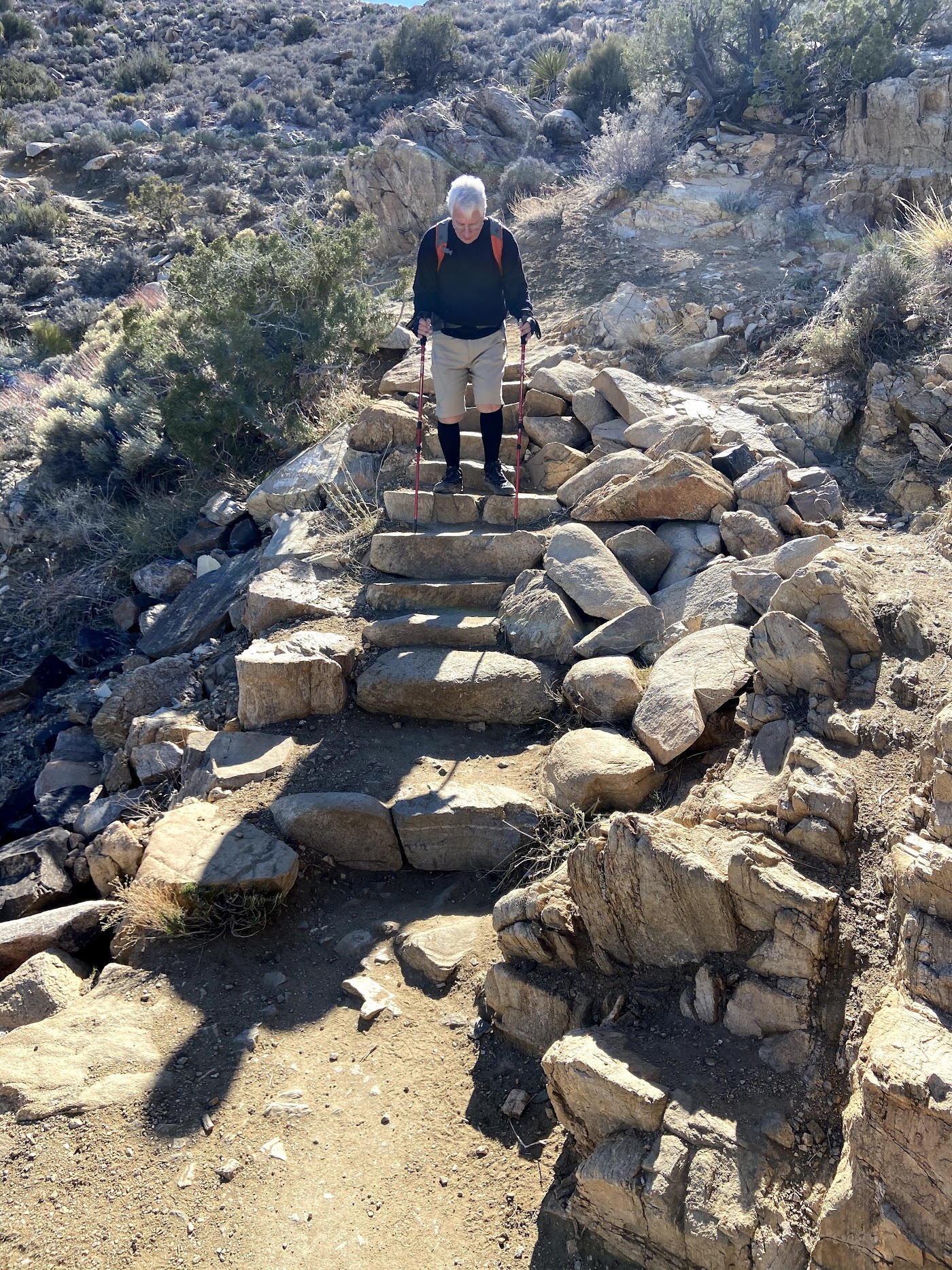
The concentration required to place my hiking poles in just the right spot and place my feet correctly and safely gets quite tiring. My right quad still needs a bunch of strengthening for this kind of downhill workout.
Over the last seven years and seven major surgeries, my constant mantra is: I will get out of my wheelchair. I will walk again. I will hike again.
I will walk again.
Building Resistance
When I became somewhat conscious after my first four days of surgery, I looked at the cast on my forearm, the external fixator on my ankle, and the full left leg brace, and it occurred to me that I wasn’t going to be getting on a plane to go to Denver, NYC, Paris, Orlando, London, and Sydney Australia over the next three months for planned business trips. I knew I had to adopt something very different than my professional skeptic cynical analytic personality. In an instant I realized I already had an inspiration in Kathryn Hardie who I had worked with for 18 years at Attenex and FTI Consulting.
Kathyrn fought cancer for 10 years with the most positive attitude and full of life force I ever experienced. I figured if she could fight cancer that long, I could be positive during the surgeries and the rehab for a year. I wanted to let her know what an inspiration she was for me so I sent her several emails and she so kindly replied and sent a hand written note to Jamie. Unfortunately, she died suddenly during my third week in the hospital. It took me awhile to realize that her inspiration will always be with me.
About three weeks into my stay at Harborview, the PT folks showed me how to get from my bed into a wheelchair. I roamed the halls of the sixth floor somewhat at will a couple of times a day. One day Nurse Felma stopped me and shared “you know studies have shown that if you have a positive attitude after severe trauma or disease your chances of healing much faster increase dramatically. And you are off the scale with your positive attitude. None of us can believe it.”
I looked around to make sure that she was talking to me. I am not exactly known for a positive attitude. There was nobody else there. I guess she was talking to me.
While I am no medical or health expert, I am an expert on my own recovery. I have gone far beyond what my orthopedic surgeon expected. I have gone far beyond what the US health care “system” supports or even encourages.
I believe resilience building starts with having a positive, creative forward looking attitude.
In my corporate consulting I often share/teach my clients and colleagues about the Blame Frame versus the Outcome Frame that I first heard from Robert Fritz and John Grinder.
As I reflect on the hundreds of processes that I’ve learned or created for the needs of a particular group, there seems to be two primary forms. One form relies on what Robert Fritz calls “structural tension.” This form is most powerful when combined with Gregory Bateson’s “difference that makes a difference.”
- What is the current reality?
- What is the desired future state?
- What are the differences between the two?
- What is the difference that makes the biggest difference?
Once the important difference that makes a difference is identified, then that difference becomes the place to start for implementation of the vision/goals.
The other primary form springs from the work of John Grinder who created what he describes as the Outcome Frame orientation.
- What are we trying to create?
- How will we know we created it?
- What resources do we have to get started now?
- What other opportunities does this lead to?
Every time I use the Outcome Frame process, I am amazed at the creative energy that is released in a group.
Grinder contrasted the Outcome Frame with the process that most of us had drilled into us in our schooling or business careers – the problem or blame frame:
- What is the problem?
- How did it get this way?
- Who caused it?
- What are you going to do to fix it?
The normal “me” would have wallowed in the Blame Frame. However, it was very clear to go through the rehabilitation to be able to walk and hike again I needed a serious change of attitude. I had to rigorously adopt the Outcome Frame in order to Build Resilience.
I will walk again. I will hike again.
The difference that will make the biggest difference that I can visualize is making it to the top of Joshua Tree’s Ryan Mountain AND descending.
A Resilience Building Model
In my professional life I am always synthesizing and building models to try and understand the world around me. As I reflected on the complexity of creating a resilience building model, I needed a starting point that could quickly show the interlinkage and flow of the resilience building complexity. My starting point for such models is the Enneagram.
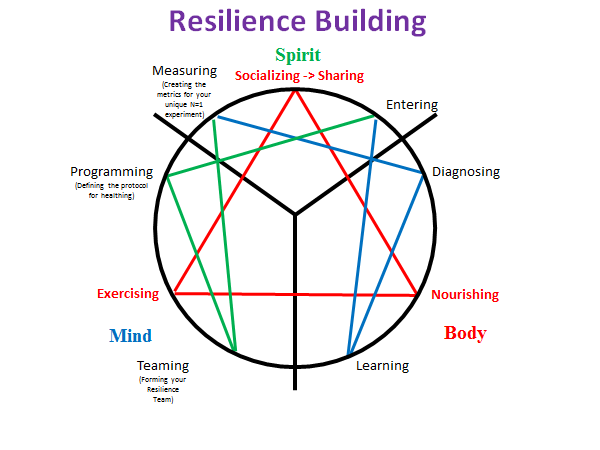
- Socializing – it takes a village to build resilience and to support someone building resilience. This is community. This is my Catholic parish praying for me each day. This is all the visitors and those bringing meals to me. It is the interaction with other sentient souls.
- Entering – this is the Alcoholics Anonymous (AA) sense of reaching the bottom. I’ve now fallen so far in my health, I recognize that I need to change. This is Rohr in Falling Upward talking about moving from Life 1 to Life 2. This is the challenge. Being there when somebody hits bottom and is looking to change.
- Diagnosing – have I reached the bottom of this life pit? While I am focused on trauma resilience, what is the diagnosis of my other health problems (like looming Alzheimer’s) so that I can begin to make the life style changes that will help me move upward and forward. The changes needed are to switch to a completely Vegan diet or Mediterranean diet and exercise more.
- Nourishing – there is a positive and negative to this. What kind of food do I need to take in to reduce the risk of all chronic diseases? What does my body need to reduce my chronological age to a younger biological age? I need to work against no carcinogens in my life – the no smoking, no heavy metals, no exposure to mold – any of the things that cause bodily harm. What kind of nourishing do I need to do for my mind and spirit?
- Learning – now that I have a diagnosis and have started nourishing my body what do I need to learn more about. What is the unique learning I need to do for my N=1 healthing system. What are the resources I need to learn about to help me form my Team Resilience. UltraLearning is a good process model to follow. This is learning with the intensity of getting to a life worth living instead of being warehoused in a nursing home. I started writing again and began experimenting with acrylic painting.
- Teaming – now that I have learned about my situation, what is the Resilience Team I need to put together that can translate their expertise into what I uniquely need for my n=1 health. For me the team looks like:
- Jamie – my spouse, my partner, my friend, and my nurse. She is the foundation of the Journey of the Foot and all that has transpired during the last seven years.
- Orthopedic Surgeons and all the nurses and residents that supported them
- Physical Therapist
- Occupational Therapist (while I only had three weeks of interaction with an OT, I received a lifetime of expertise and encouragement) and Health Coach
- Lee Hood – model of biological age (69) versus chronological age (82)
- Right brain psychotherapist
- The grand kids – Katherine James Schuitemaker pointed out that they are my mentors for understanding the next generation.
- Family – our children, their families, my brother and sister, Jamie’s siblings – all have been beyond amazing in helping me recover.
- Exercising – to build resilience, all aspects of body, mind, spirit need to be exercised. The body aspects are to build aerobic and strength capabilities. The Mind component is to exercise the brain through work or hobbies or life’s passions. Ultralearning is a good process for intense brain exercise. Spiritual learning runs the gamut from mindfulness to the different spiritual traditions and their exercises. Cursillo exercises are in the categories of piety, study and action.
- Programming – taking the diagnosis and teaming resources and learning to develop the unique “protocol” for making the life style changes to reduce risks of chronic disease and reduce biological age. For Alzheimer’s the starting point is Bredesen’s Recode protocol. A key component of programming is to take into account all aspects of body, mind, spirit. This protocol is the synthesis and meta level of the nourishing, exercising and socializing creative triangle.
- Measuring – if you can measure it, you can improve it. If you can’t measure it, you don’t know where you are going. Peter Drucker shares “you can’t manage what you can’t measure.” With all of the mobile digital devices like the Apple Watch, you can monitor passively and log many of the steps in any protocol.
- Sharing – and the cycle repeats at a higher level of organizing. Once you have gone through the loop and are measuring progress, share the results with others. Step 12 of AA – spiritual awakening and delivering the AA message – share with others. This is the most powerful of the socializing activities.
Now that I have a model for Building Resistance and have tested it through seven (and soon eight) major surgeries, it is time for me to start Sharing. My original intent was to write a book. However, in this modern age a more appropriate medium is the mobile app. Now that AI application building tools exist, I can build that app without needing a staff of programmers.
The next phase of my Building Resilience Journey begins – helping others to build their resilience after serious trauma. Maybe I am finally pushing on from resilience building to transformation.
We all need to build resilience to combat the current administration and their commitment to killing the citizens of the United States. In 2020 during the Covid crisis, Trump, his administration and the Republican party killed 750,000 Americans through their wrong headed Covid policies. Now through the Trump administration and the Republican party with very specific policies (Project 2025 Playbook), the US Government is trying to kill even more citizens. By stopping Covid vaccine approvals, allowing measles and salmonella outbreaks to go unchecked, stopping USDA and Agriculture department safety policies and inspections, and hundreds more unlawful actions, the current Republican administration aims to kill more citizens than they did with Covid.
Today is May Day. It is another day of protest. We must stop the coup and the policy led killing of Americans.
Build Resilience.
Vote! Resist! Persist!


 On the Way to Somewhere Else