Stop the coup in the United States!Vote! Resist!Persist!
Living on Bainbridge Island, we travel by Washington State Ferries several times a week. Over the years, we’ve travelled on many different types of ferries, including the tiny Wheatland Ferry in Oregon.
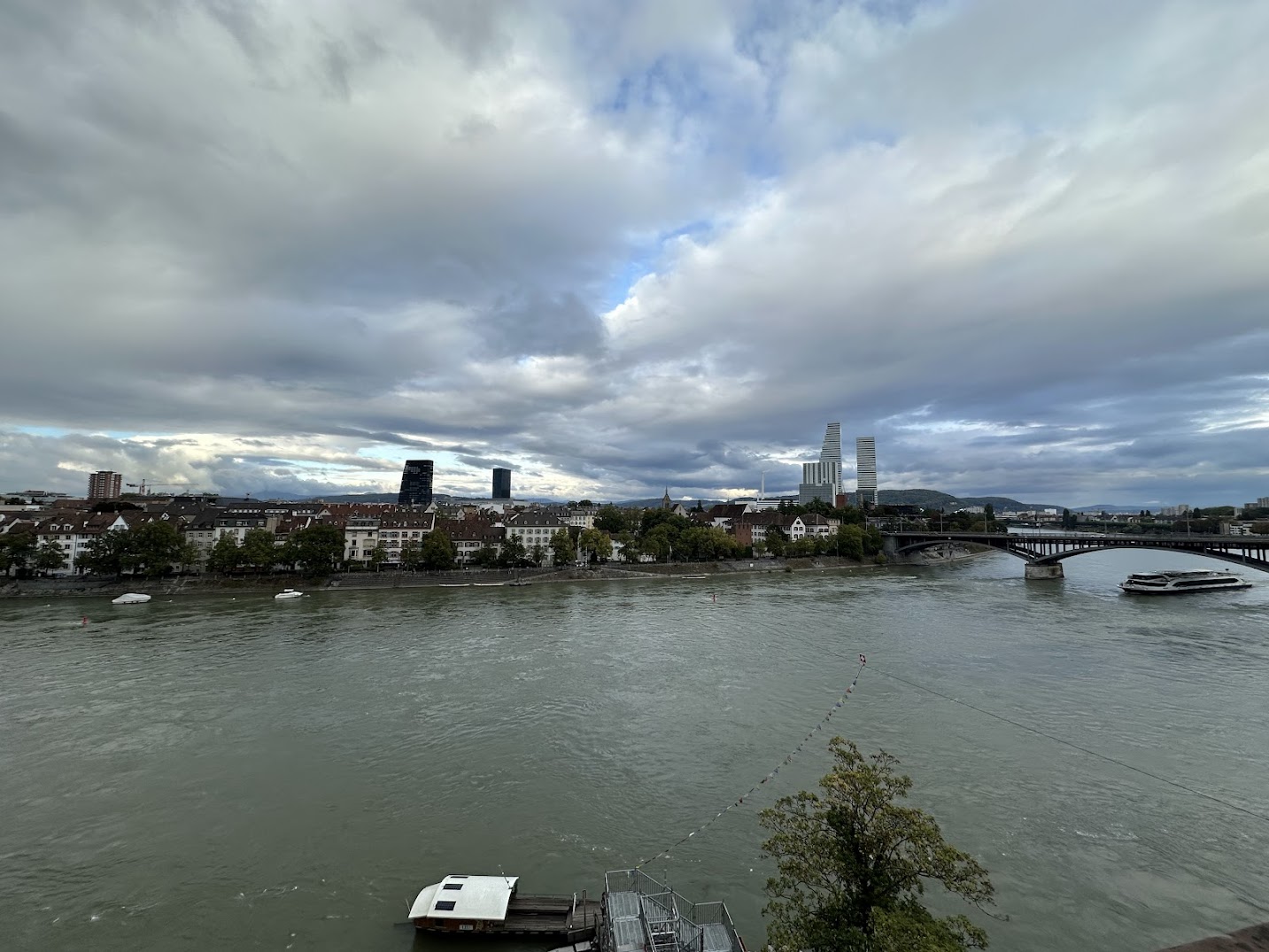
On our recent trip to Basel, Switzerland, to visit my wife’s college roommate, we enjoyed a nice walking tour of Basel. Bonnie showed us around old and new Basel. As we walked to the river bank, I asked how we were going to get across the river. Bonnie laughed and pointed down to the small wooden unpowered ferry called the “Ueli”.
The four Rhine river ferries “Wild Maa”, “Leu”, “Vogel Gryff” and “Ueli” link Grossbasel (Old Basel) to Kleinbasel (New Basel). They are attached to a long wire cable and are driven purely by the current of the Rhine itself. The “driver” simply moves the rudder to steer us into the current and across the river.
“The ferries will silently bring you to the opposite shore all year round. Experience the way in which time seems to stand still during this brief crossing.”
Ferry Ueli in Basel crosses the Rhine River
With my balky surgically repaired left leg, I was a bit worried about getting into the wobbly ferry from the unstable dock. However, Bonnie wanted to introduce us to her favorite brew pub in Old Basel. Knowing there was alcohol in my future, I braved the unsteady steps onto the ferry. We enjoyed our river current driven fun ride across the Rhine.
Ferry Ueli in Basel Crosses the Rhine River
We safely crossed the Rhine and walked through the narrow streets of Old Basel to find our brew pub.
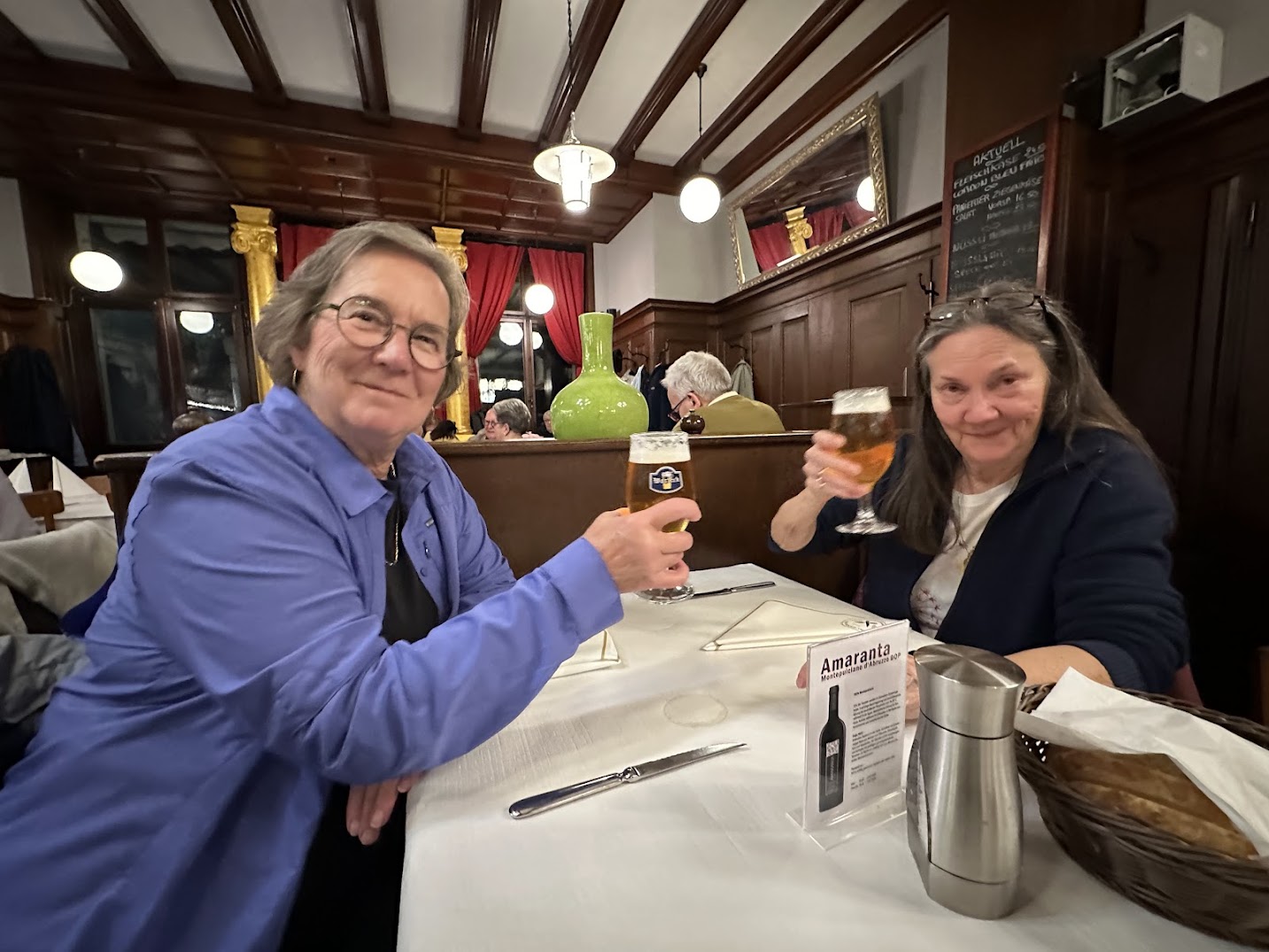
Longtime friends. Good beer. Great food. And a foot ferry ride on the Rhine. Life is good.
No matter how long I live, I am always amazed at how friendships forged fifty years ago are easily rekindled even when many years have passed between interactions.
Stop the coup in the United States!Vote! Resist!Persist!
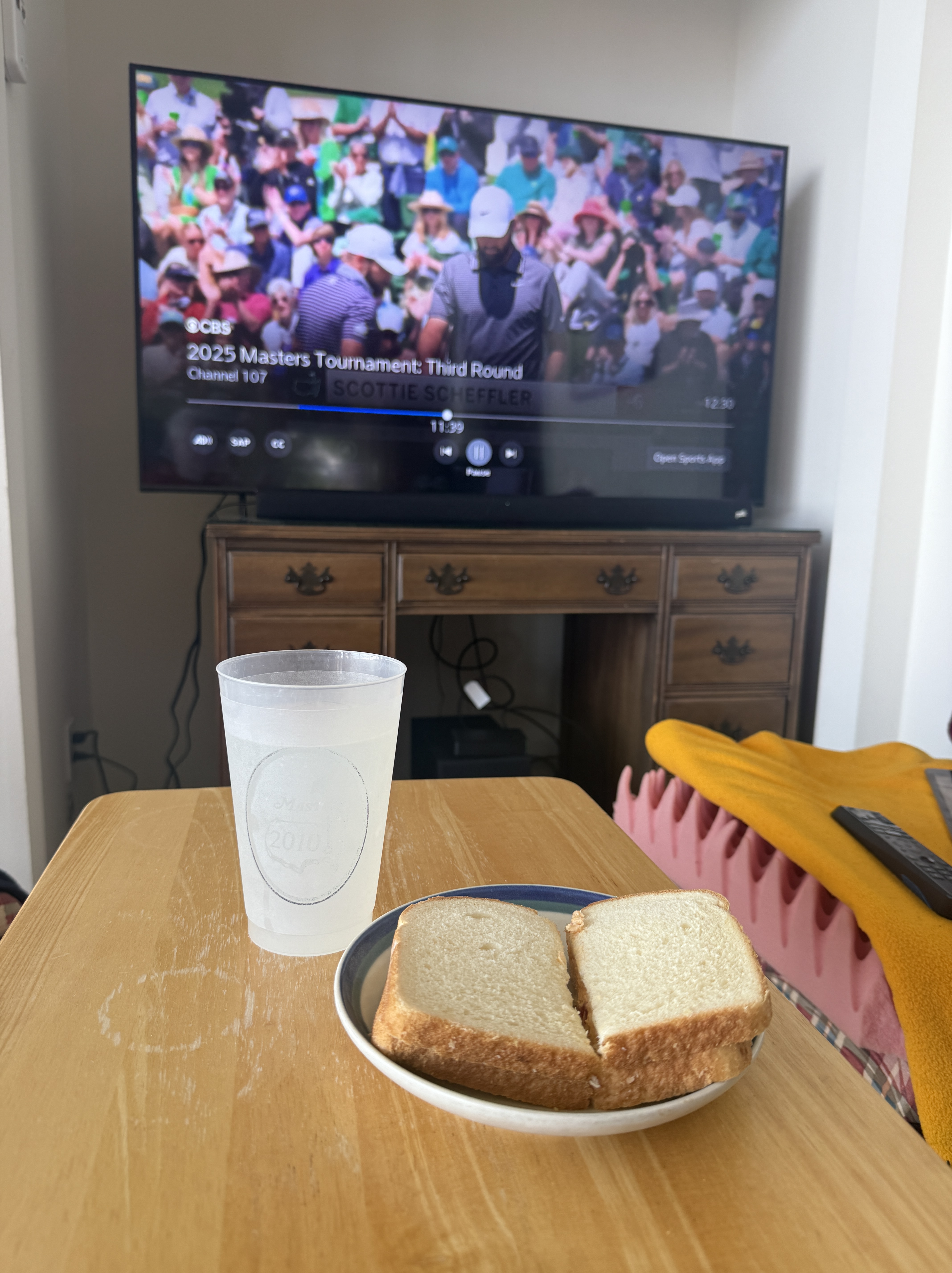
I love the Masters Golf Tournament at Augusta National Golf Course. Every year, I eagerly watch and listen to Jim Nance describe “a tradition unlike any other.” I scramble to find some pimento cheese for my “Masters pimento cheese” sandwich and pull out my worn 2010 Masters plastic glass for my beer. Then I sit back and enjoy the golf.
When the action reaches the eighth green, one of the announcers will share “Bruce Devlin made a double eagle on this hole in 1967.” I shout back at the TV “I was there. I saw it go in. I was there.”
It took more than 30 years after Sarazen’s feat for another to be recorded. That came in the first round in 1967 by Australian Bruce Devlin, who called it a “perfect golf shot.”
“It hit on the front of the green, rolled right around the corner and went right in the hole,” said Devlin, who used a 4-wood from 248 yards on No. 8. “I could understand it if the flag was in the middle of the green, but it’s almost impossible to get a wedge up there.”
But Devlin never saw the ball hit the green or roll into the cup. He was 200 yards back down the fairway below the top of the hill. What he described was accurate. There were only 10 of us standing around the green as it was early in the day. We saw this ball come from out of nowhere, hit at the front of the green and it was like the ball had radar. It rolled in an arc and rolled and rolled and slowed, hit the flag and plopped into the hole.
Because it is the Masters where no electronic devices are allowed and no patron cameras are allowed, we didn’t know who hit the ball. We also didn’t know if it was their second or third shot. And we didn’t know it was a double eagle until 10 minutes later when the manual scoreboards were changed to show Devlin’s score. The other golfers congratulated Bruce, but nobody made a big deal out of it.
I was there, but I didn’t know what I had seen.
There were no TV cameras trained on the green so there was no proof that it happened. Ten of us saw it. But nobody knew what we saw.
We saw Bruce Devlin on the scoreboards gain the three shots of the double eagle. And then we watched him bogey the next four holes giving all the shots right back.
I was there. And I have no way to prove the memory.
That memory was 57 years ago. I was with my dad and he saw it as well. But he died 30 years ago so he can’t confirm the memory.
I am of an age where I can’t remember what I had for breakfast yesterday, but I can remember that double eagle by Bruce Devlin on the Par 5 eighth hole at the Augusta National Golf Course.
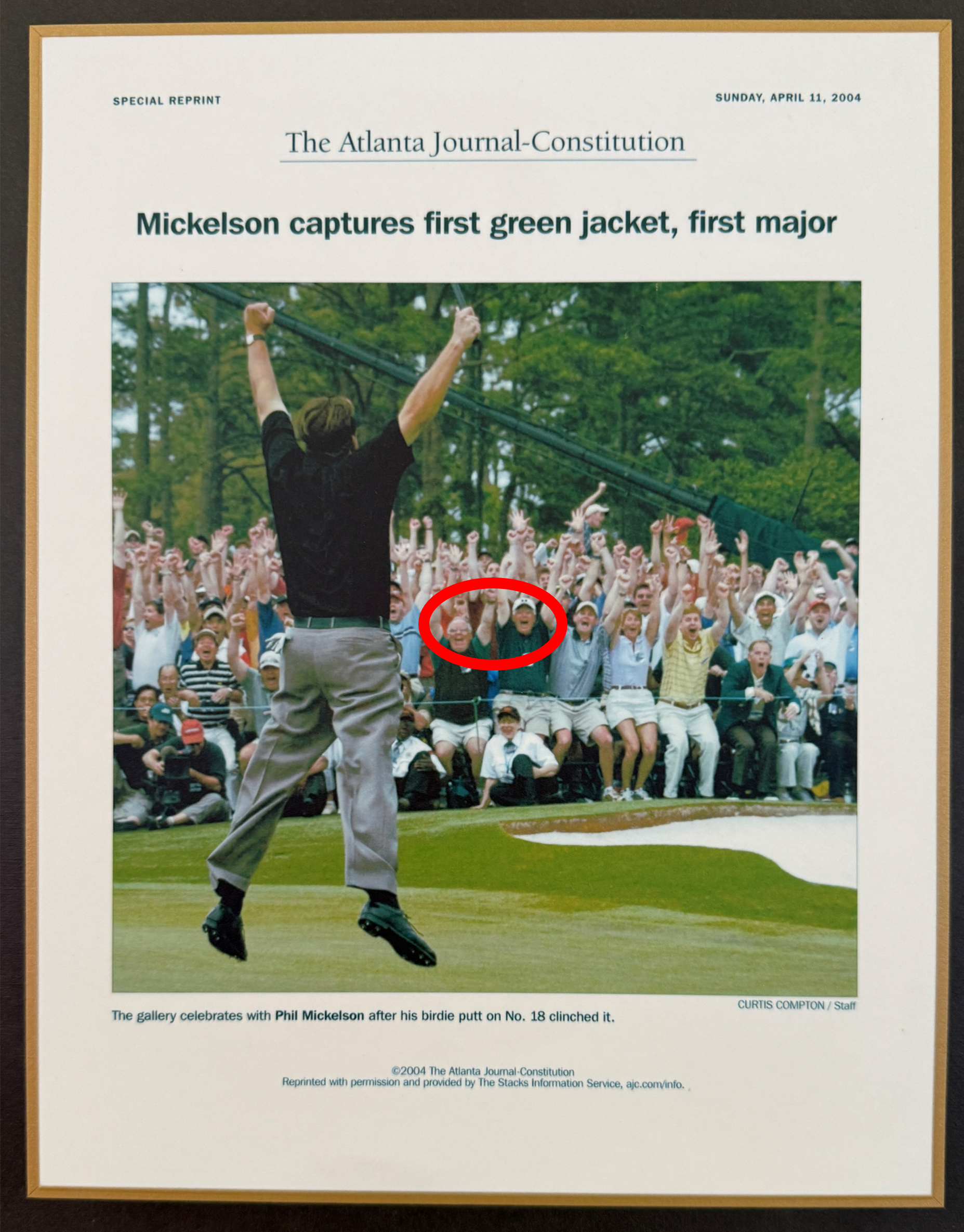
While I have many memories of the Masters tournament, at least I have proof of another great day at the Masters. At the 2004 Masters we had the great fortune to attend with one of the members of Augusta National who offered to put our chairs on the 18th green for us for the Sunday finale. As a member he got to stay in one of the “cabins” (in reality a 4000 square foot six bedroom home) behind the Butler cabin. He said he would get up at 6am and place our chairs by the green.
In the photo below, I’ve circled the location of my brother and me in the first row. We were in the process of leaping to celebrate Phil Mickelson’s made putt to win his first green jacket in 2004.
Thanks to a photographer from the Atlanta Journal-Constitution and the publishing of the photo on the first page of the Monday paper, I have a record of this Masters memory. I can prove it.
But I’ll never be able to prove the memory of seeing Bruce Devlin getting a double eagle on the eighth hole at the 1967 Masters.
Fortunately, I will always have the memory of that beautiful spring day amongst the azaleas of Georgia.
Stop the coup in the United States!Vote! Resist!Persist!
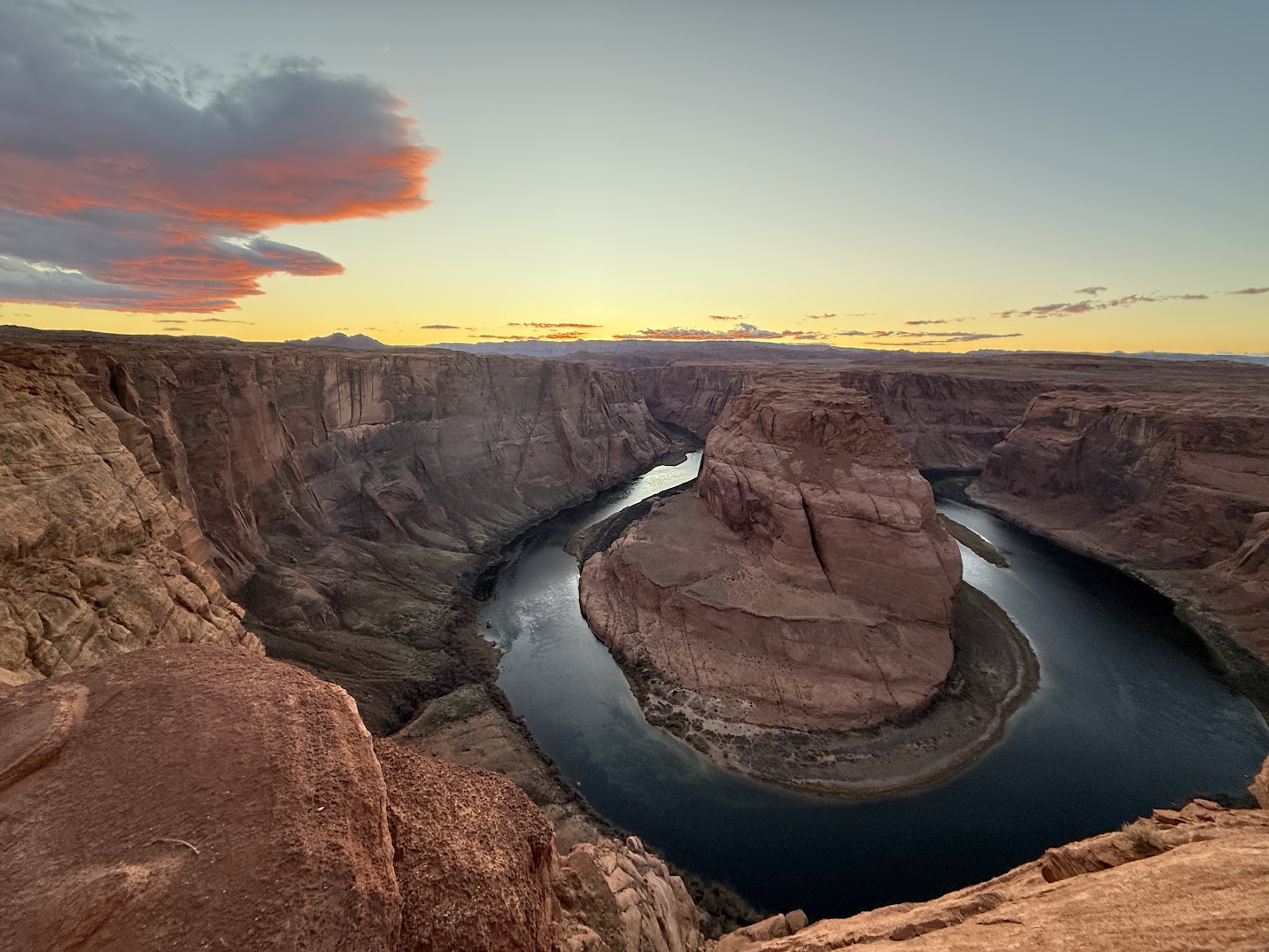
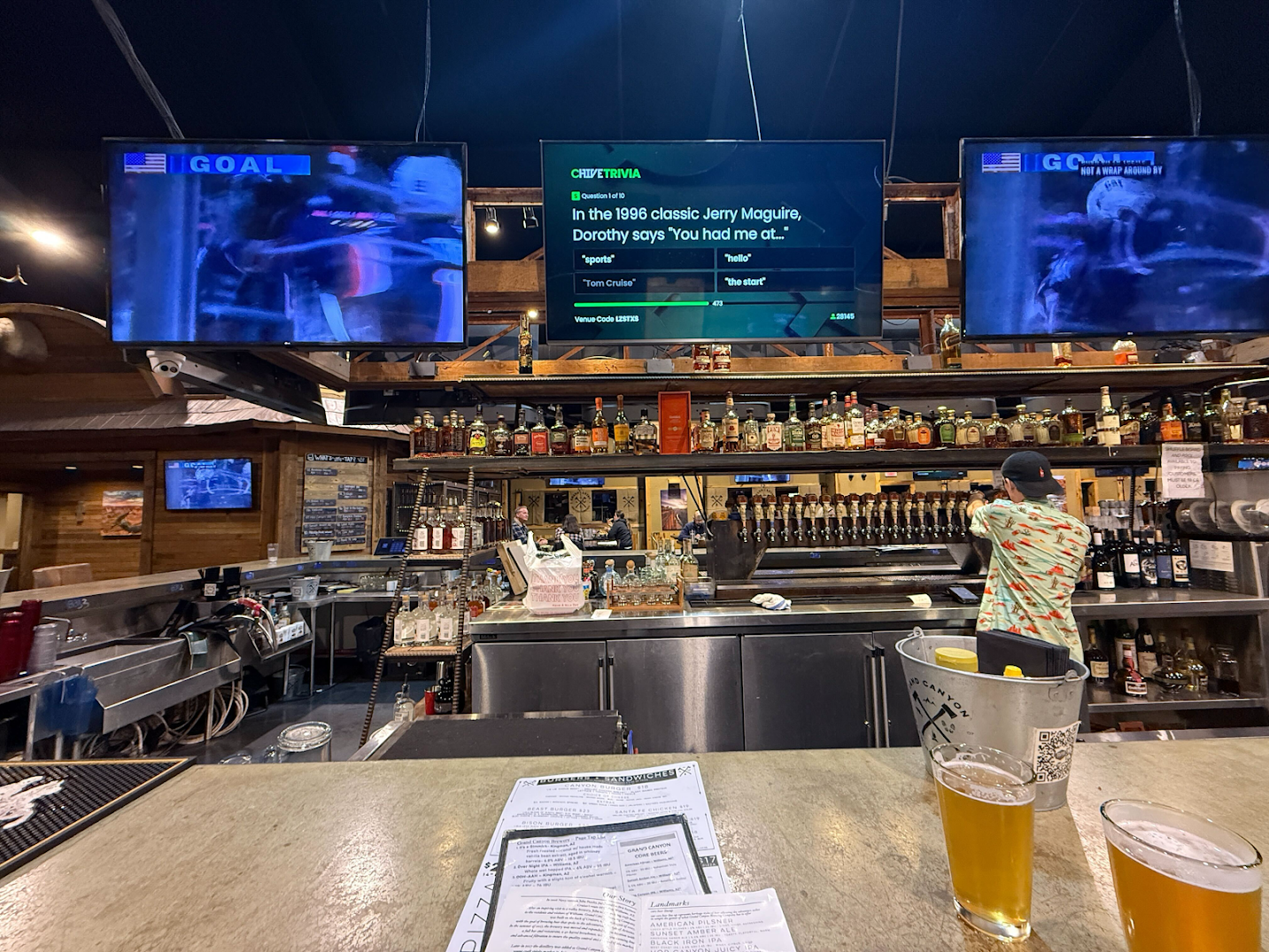
After taking several photos of Horseshoe Bend near Page, AZ, I was ready for a craft beer. Consulting Google Maps I found that Grand Canyon Brewery had a restaurant nearby. I settled into a seat at the bar and started watching the US-Canada hockey game from the Four Nations Tournament.
Marcus, the bartender, introduced himself and started sharing the wonders of their different beers. I made my order and sat back in my introverted bubble. But the place wasn’t busy, so Marcus kept asking me a bunch of questions to get a conversation going.
He asked me where I was from and what I was doing in Page, AZ. I laughed and shared “Probably what everyone else who is visiting is doing. I want to see Antelope Canyon.”
“Oh wow. The Upper and Lower Canyons are my favorite places. I particularly like Lower Antelope Canyon. You will love the Navajo guides. They are so knowledgeable and entertaining. I hope you get the guide I had recently. He told this great story about a young Navajo man courting eligible young women.”
“Evidently, it is a Navajo tradition for the young males to carve a flute and then learn to play it. As they get accomplished with the flute they compose and perfect a tune that is uniquely theirs. Then when they find the right young lady, they play their unique tune on the flute. If the young lady responds, the young man gives her the flute. If she accepts the flute, that is a sign of their engagement. If she does not want to accept the marriage proposal, she breaks the flute over her knee and hands the pieces back to the young man.”
Marcus’s guide shared that “he had recently found the woman of his dreams and had practiced and practiced his unique tune. When the appropriate time came, he played his tune so beautifully for his chosen woman. He then handed her his flute. Without hesitation, she broke the flute over her knee and handed the pieces back to the young man. He was heartbroken.”
“But the young woman couldn’t just walk away after the rejection. She shared ‘you played your flute so beautifully and your tune was a heavenly composition. You must have practiced a long time.”
“The guide shared ‘that was my fifth flute.'”
We both had a good laugh.
A little dinner and a few beers later, I left the brewery to return to my hotel.
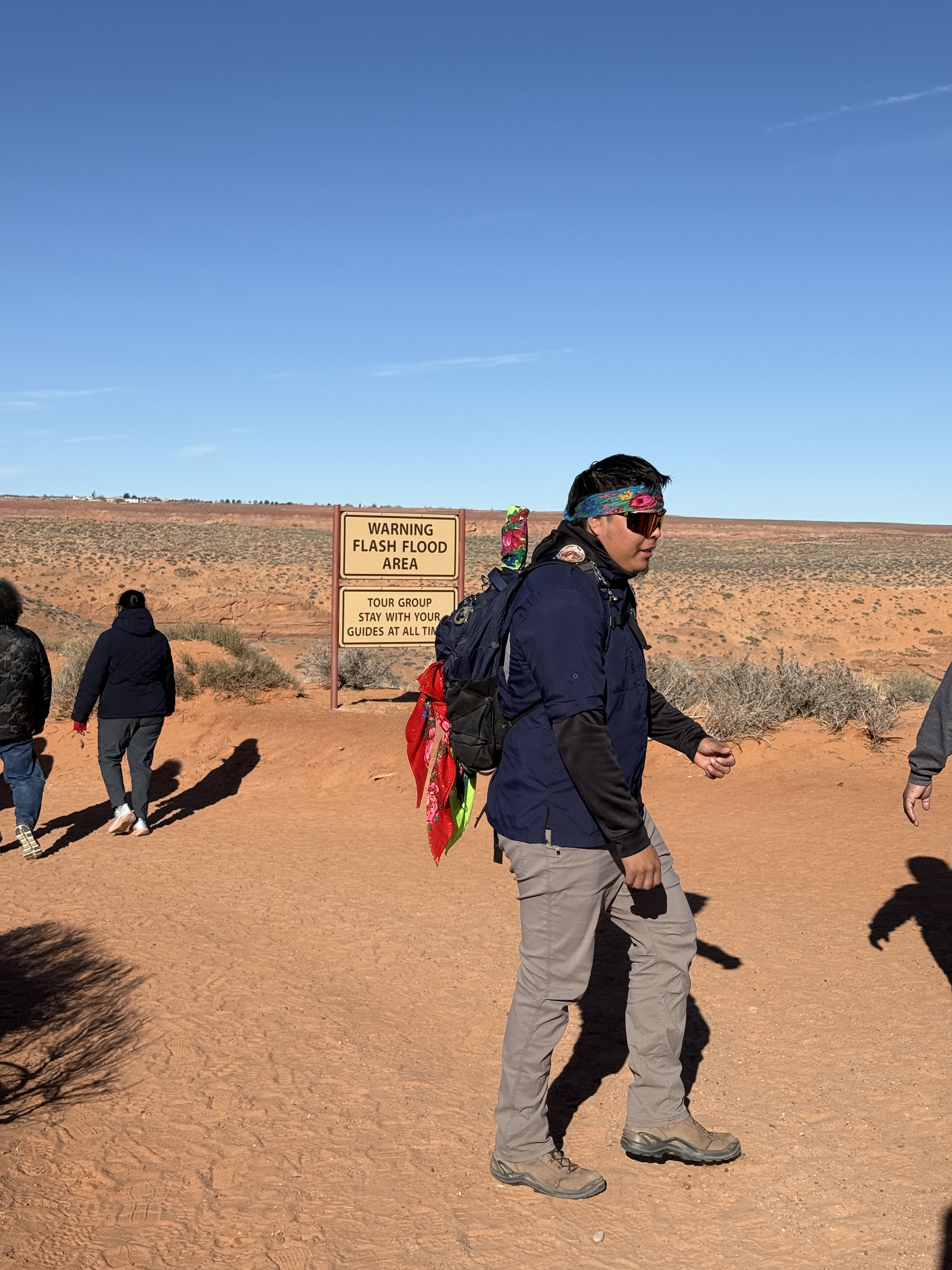
The next morning I awoke to a beautiful Arizona day and headed out to my scheduled tour at Lower Antelope Canyon. Soon I was assigned a guide and our group of 10 visitors set off for the beginning of the hike. Our guide had a backpack on and I could see a large flute poking out of the pack.
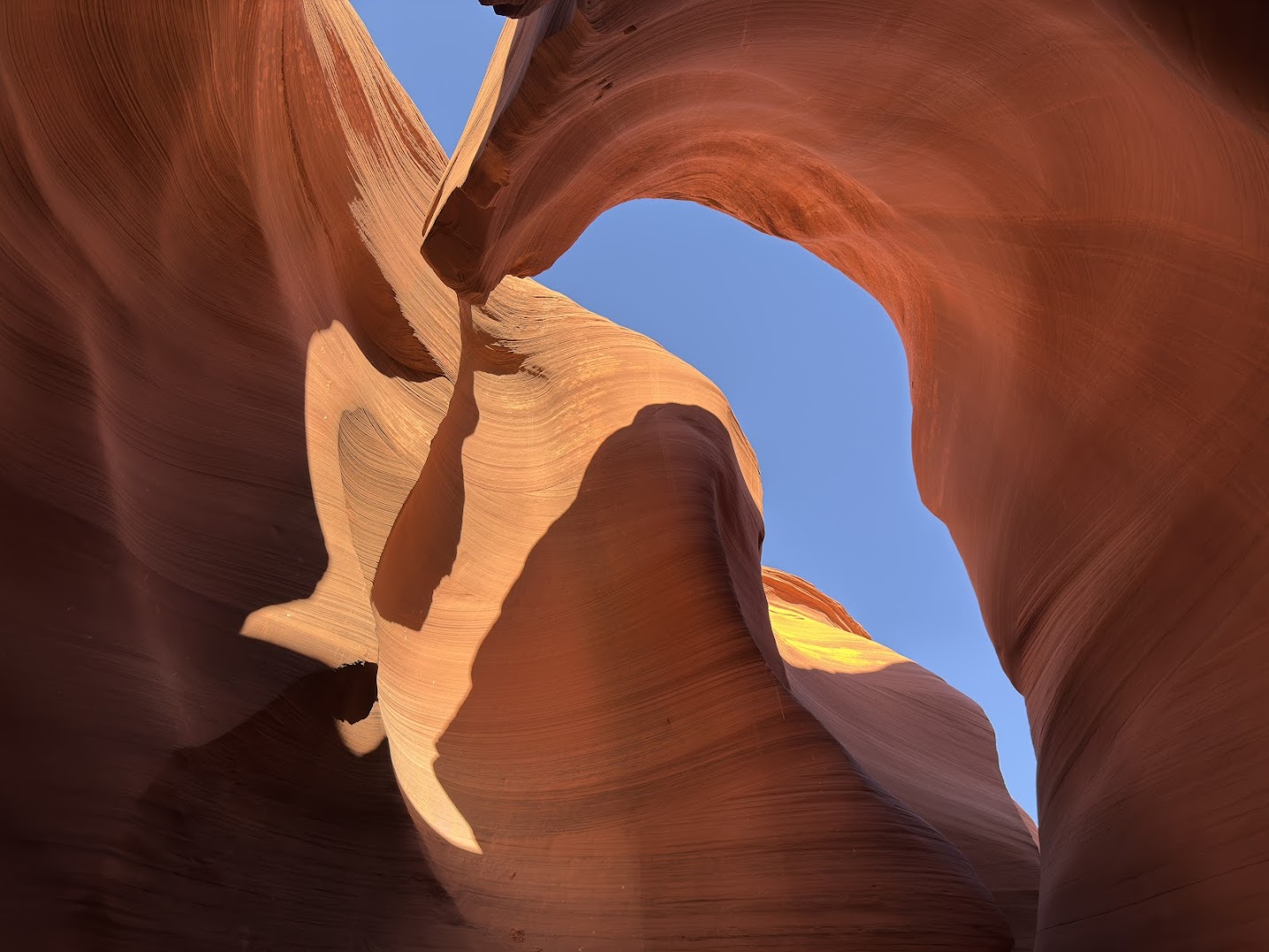
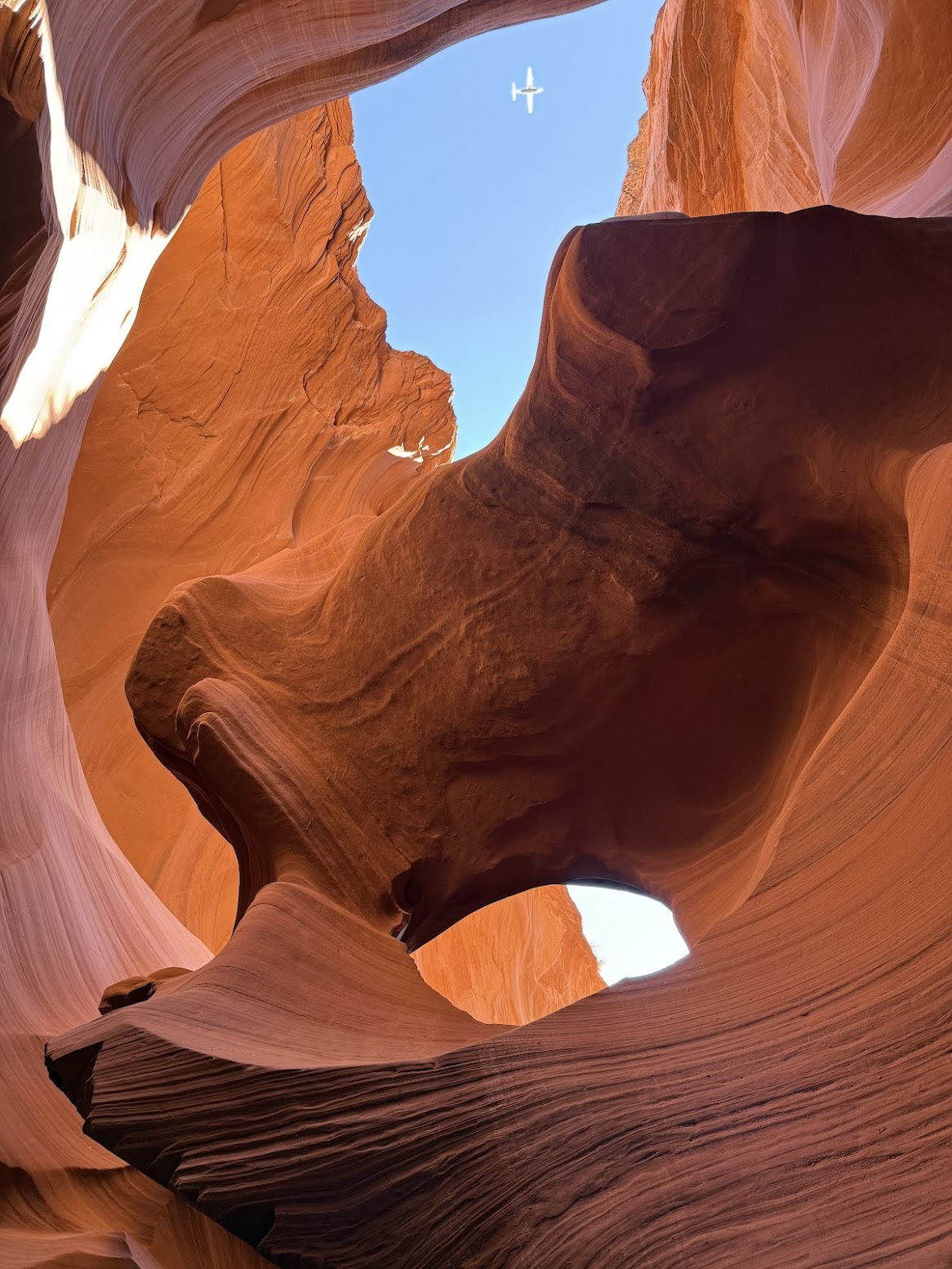
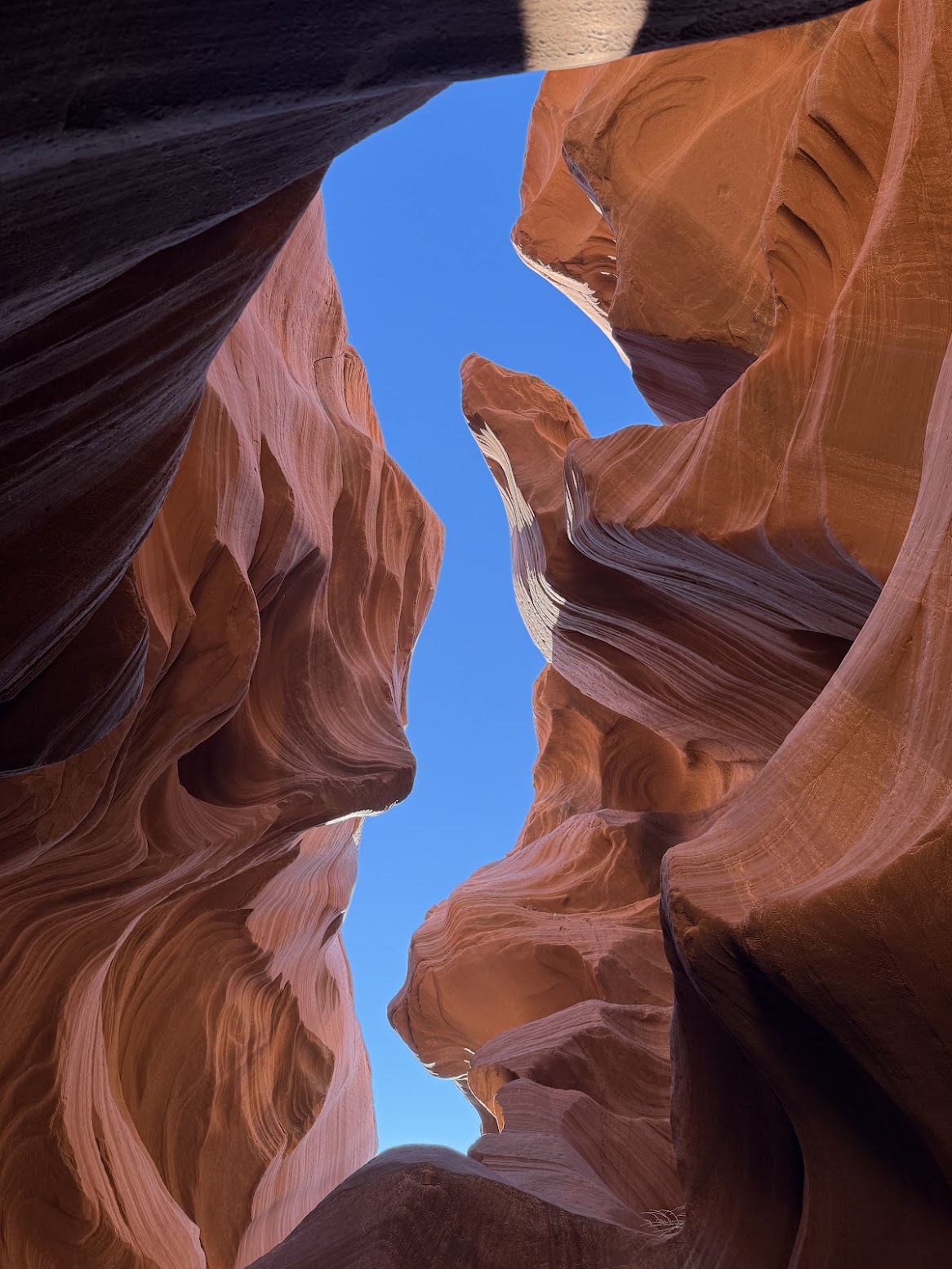
We descended into the hidden canyon and I was awestruck by the colors and shapes and patterns of Antelope Canyon. With every step I had to take another photo.
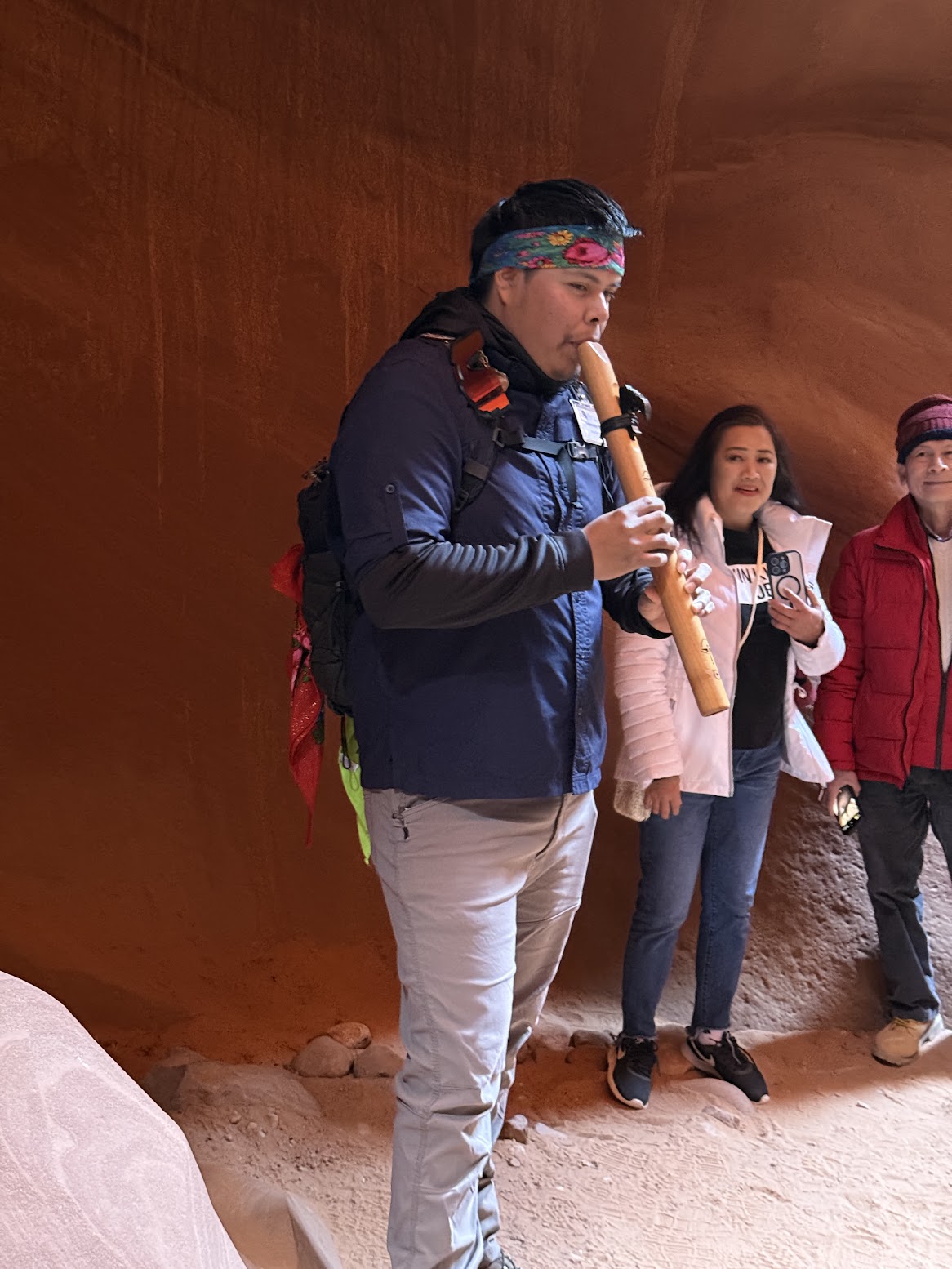
When we got about halfway through Lower Antelope Canyon in a larger hollowed out section, our guide stopped and pulled out his flute, shared about the tradition of the courting flute, and played a wonderful haunting melody for us.
Navajo Guide for Lower Antelope Canyon
Our guide was more serious about the sacred tradition than the bartender last night. Having heard both stories, I thought I learned more about this wonderful tradition.
With a little searching on the Internet, I learned a bit more about the Navajo courting flute:
“The ‘courting flute’ in Navajo and other Native American cultures, also known as a love flute or courtship flute, is a tradition where a young man uses a flute to express his affection for a woman, often serenading her under the stars. While stories can vary, they often involve the flute being seen as a gift from the spirit world or a tool that can help a man connect with his chosen one. The humor in this story likely comes from the contrast between the seriousness of the courting tradition and the number of flutes, suggesting the man may be a bit of a romantic or a bit desperate, or maybe just has a strong affinity for flute making.
“The ‘this is my fifth flute’ part adds a humorous layer. It implies the man has tried a few times to express his affection through flutes, suggesting he might be a little too eager or even a bit clumsy in his approach. It also hints at a potential love story or a playful teasing between the man and the woman he is trying to court.”
While I expected to be amazed at the beauty of Antelope Canyon, I was delighted to experience the beauty of the Navajo Guides so keen to help us non-natives understand the traditions of their culture.
Stop the coup in the United States!Vote! Resist!Persist!
During the February gray, cold, rainy season in Seattle, I had enough. I had to go find some sun and 80 degree weather. At this time of year, about the only place I could drive to for this kind of weather is my favorite Joshua Tree National Park. Since my wife was going to be on the east coast for three weeks visiting family, I realized I could travel to Joshua Tree and do a photo scouting trip to Antelope Canyon Arizona. We could then meet back together at our daughter’s house in Boulder, CO, and then drive back to Seattle. I figured I would have plenty of time and could work around any inclement weather (it was winter and I would be above 4000 feet for much of the trip).
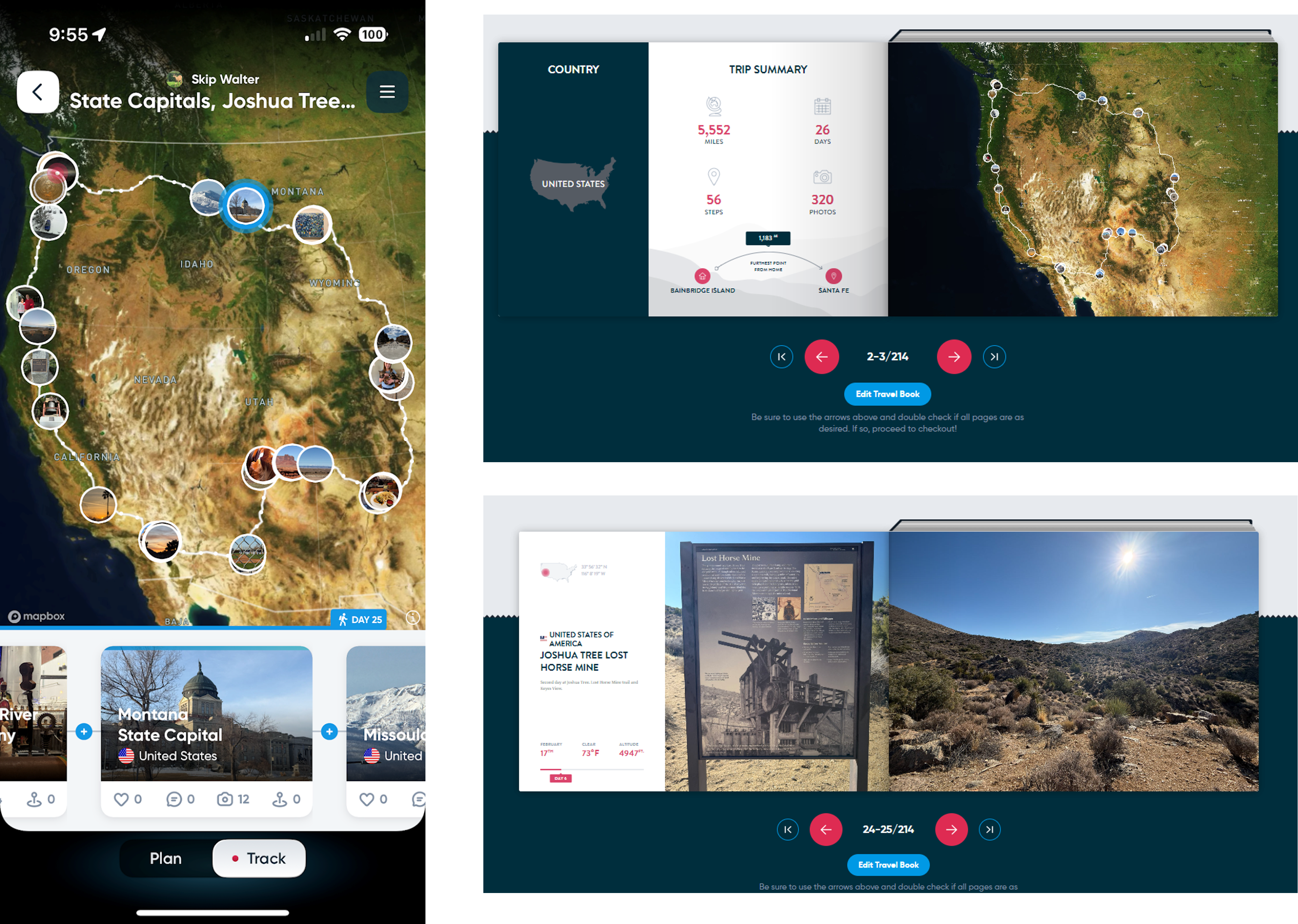
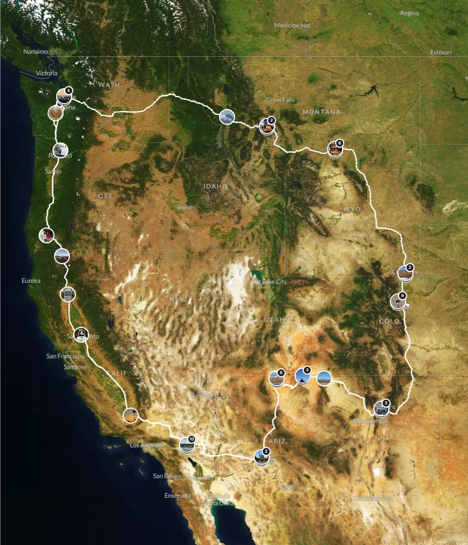
I use the app Polarsteps to both plan and record photos and comments from our trips. When I get back home, I can then curate, edit, and comment on the high points of the trip and then choose to print a photobook. I love the way that Polarsteps automatically captures the route of the whole trip along with statistics like how many miles were driven and what was the longest distance between the beginning and midpoint. For each section of the “book”, Polarsteps captures the altitude, the latitude/longitude of the photo, and weather on that date.
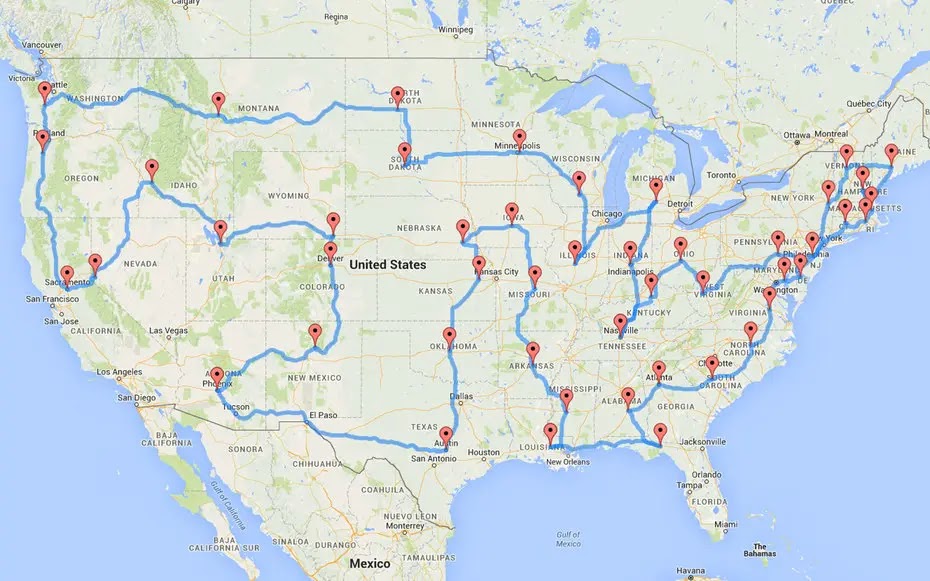
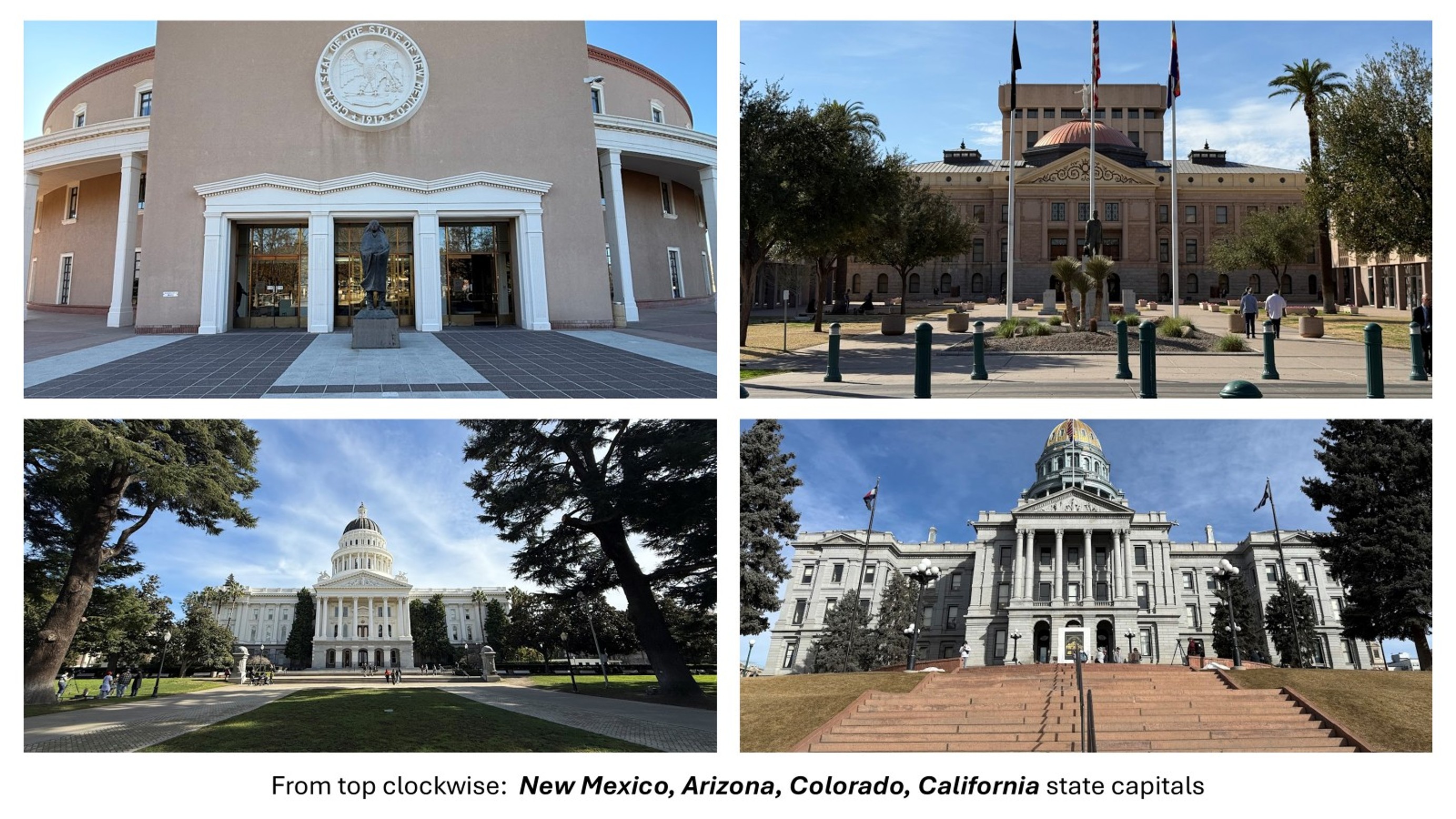
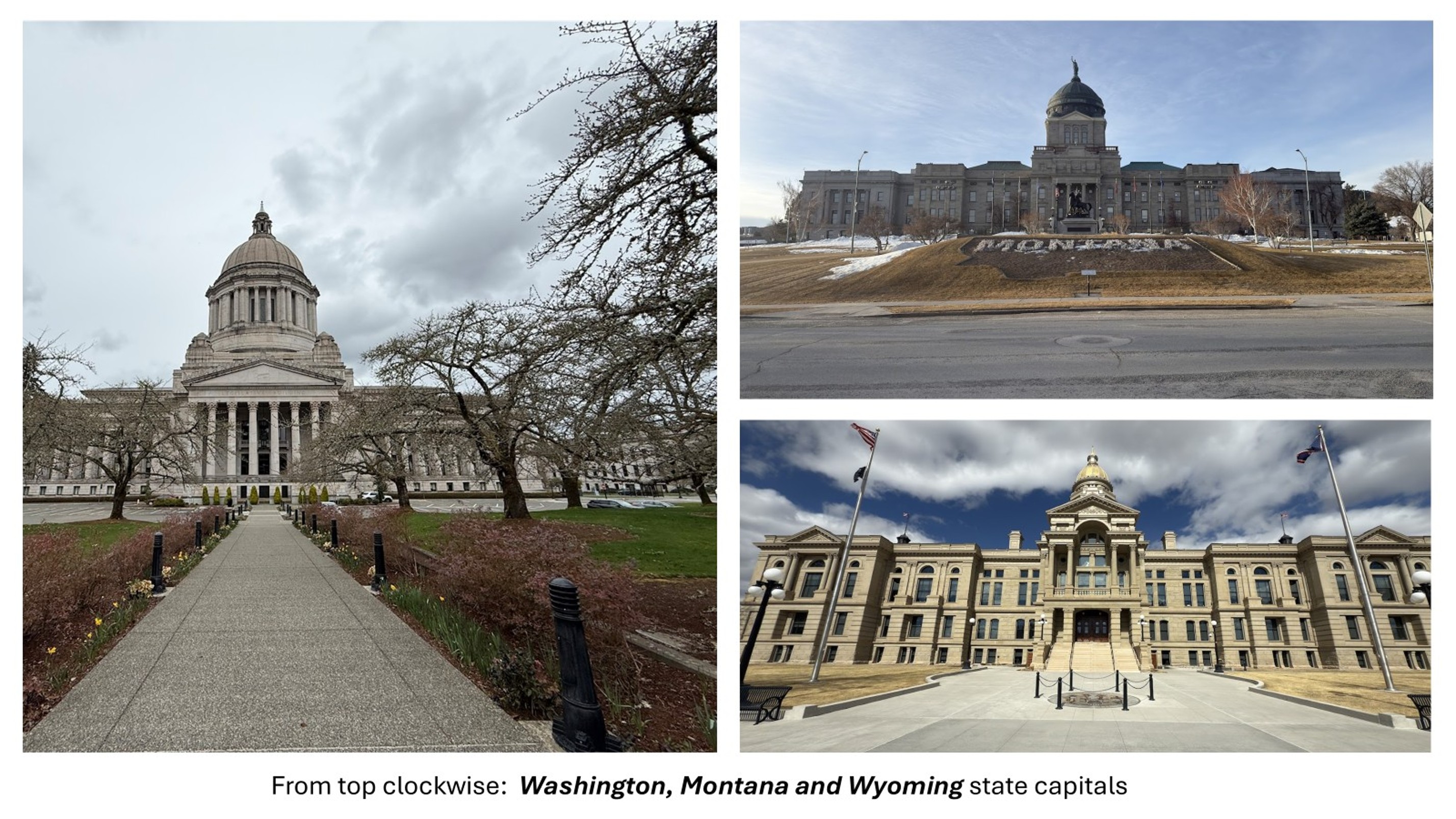
As with most of the things I do, I had to add several additional goals to my time away. The first addition was to start the clock on visiting all 50 state capitals in the United States during 2025. Given the rough outline of the trip I had in mind I could visit eight of the lower 48 state capitals on this trip without going too far out of my way. A few months ago when I was thinking about trying to visit all the state capitals I came across this optimized map for how to see all 48 state capitals in 8-9 days.
As luck would have it, the weather in Seattle was clear as I got ready to leave. Why can’t it be rainy and cold so I can say good riddance to PNW winter weather.
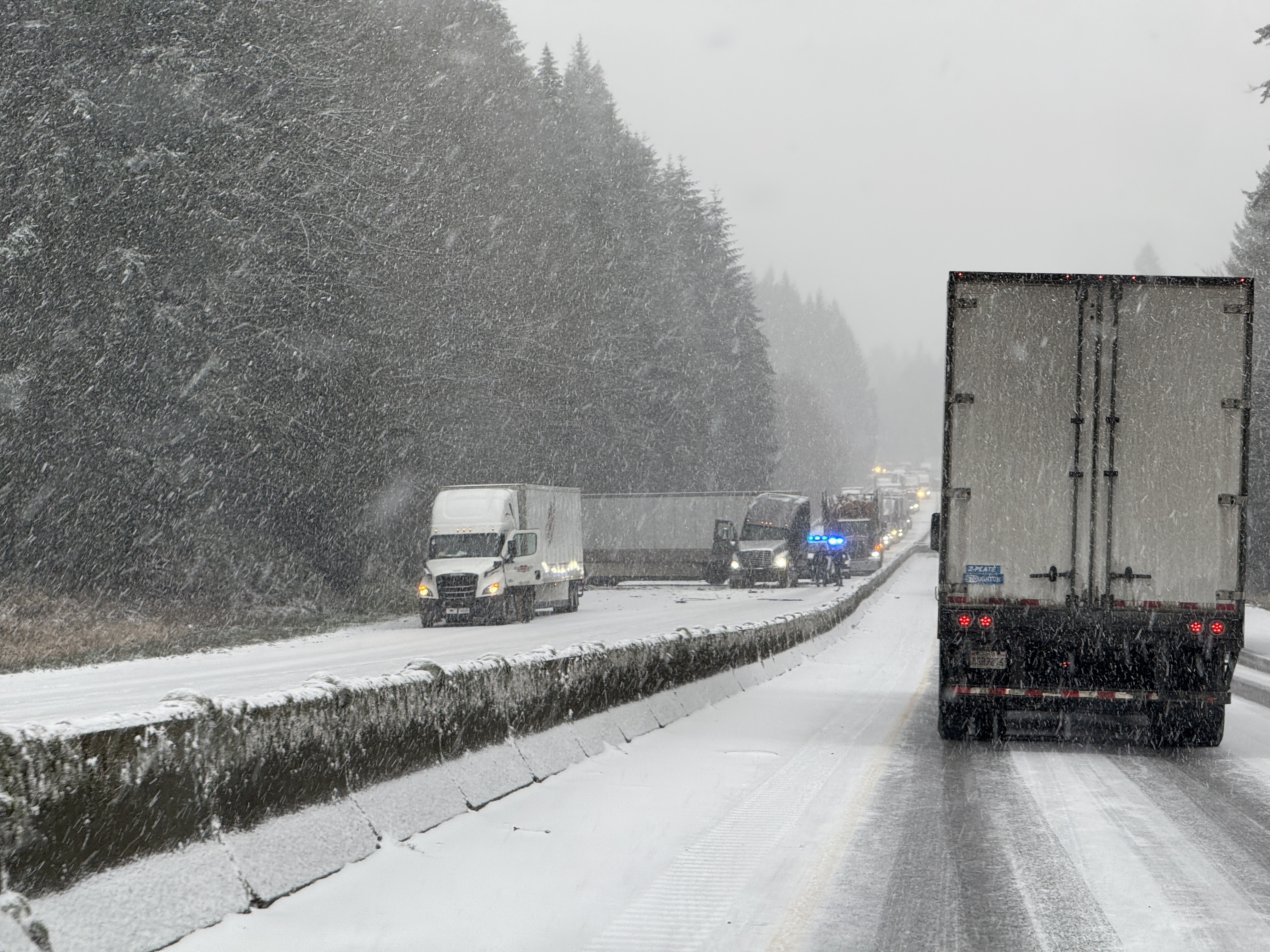
I expected that I would encounter snow on my trip. I didn’t expect that it would occur within three hours of leaving Seattle. A sneak snow and ice storm hit Oregon and Washington and I had to stop for the night in Vancouver WA. I didn’t know if this was a good or bad omen, but I persisted. Because I had arranged to meet a former colleague in Grants Pass, OR, and because of the snow and ice conditions I decided to bypass Olympia WA and Salem OR. I realized I could visit those close by capitals any time. As luck would have it, I was able to visit Olympia WA on the last day of my trip.
What started out as a lark – visiting state capitals – turned into an informative adventure. Each state capital that was open when I visited was very welcoming. The docent in Arizona was so excited that I was visiting so many capitals. She shared “I completed my first visit to all the state capitals twenty years ago. I am so delighted you are going to try and see all of them in a single year.” She then asked “what is your favorite state capital so far?”
What an interesting question. It never occurred to me that I might have a favorite. Or even how I would decide what was my favorite. Without thinking too much, I said “my favorite has to be Washington state. The capital looks out on the working port of Olympia and the Puget Sound.” She smiled. I think she suspected I would change my mind as my journey progressed. As I thought about it some more, I realized that my favorite state capital was in Boston. I’ve always loved the Golden Dome and the closeness to the origin of our country (it is the 250th anniversary of Paul Revere’s ride and the battle on the Lexington/Concord Green). I now look forward to creating criteria to help sort out my favorite state capital.
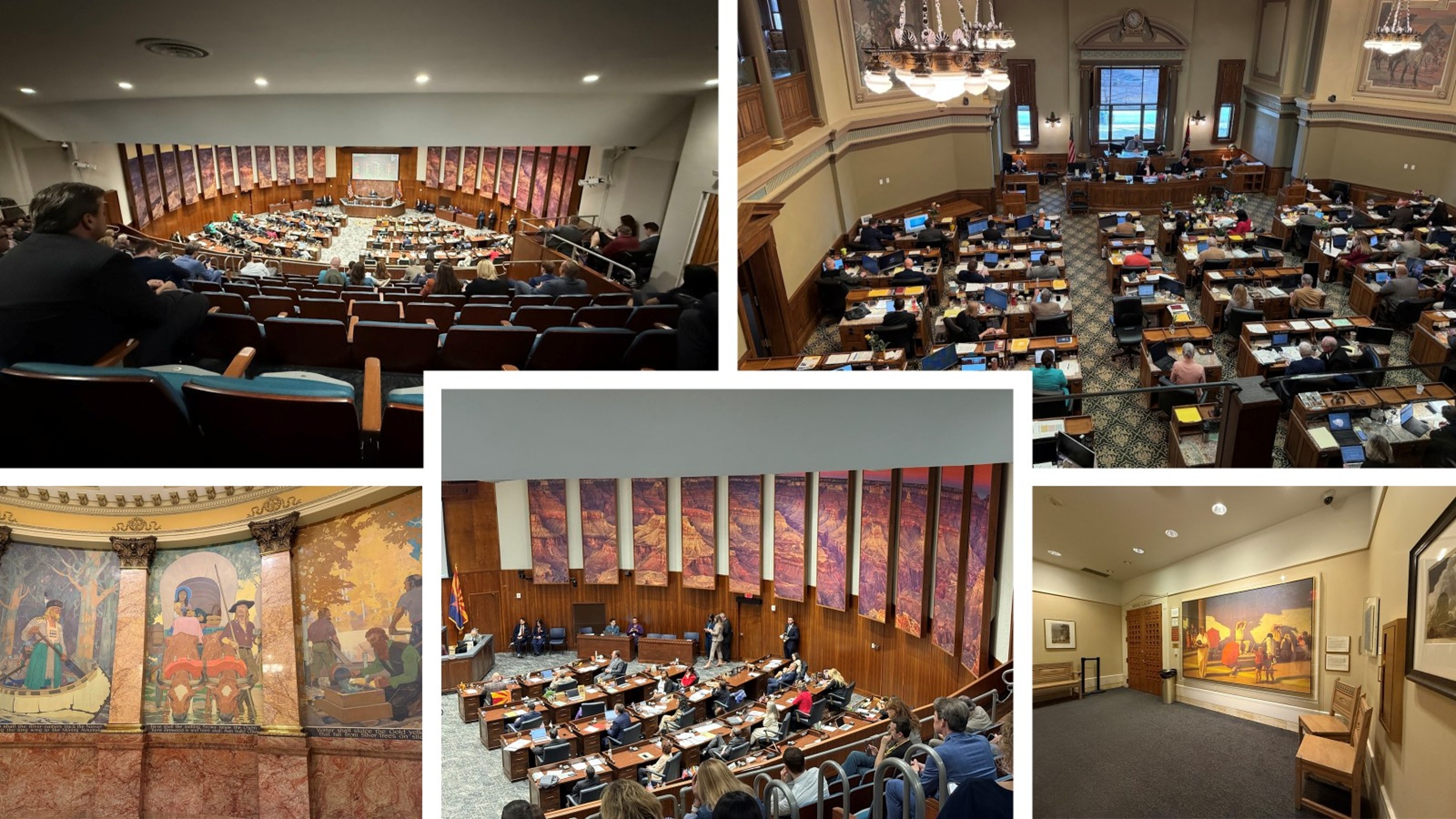
When I first thought of visiting the state capitals, I was mostly interested in getting photos of the outsides of each state capital. I wasn’t paying attention to which days I would be showing up at each capital and whether the state legislatures would be in session. When I visited the Arizona state capital, both bodies of the legislature were in session. I spent thirty minutes listening to position statements by representatives for why they were voting a certain way. I couldn’t believe I was able to just walk in and take a seat in the gallery to listen to the debates. Clearly I am going to have to adjust how much time I expect to spend for each capital visit.
As I listened to the legislators carry on the mundane business of each state, I was fascinated with the photos and art work that adorned each of the capital buildings.
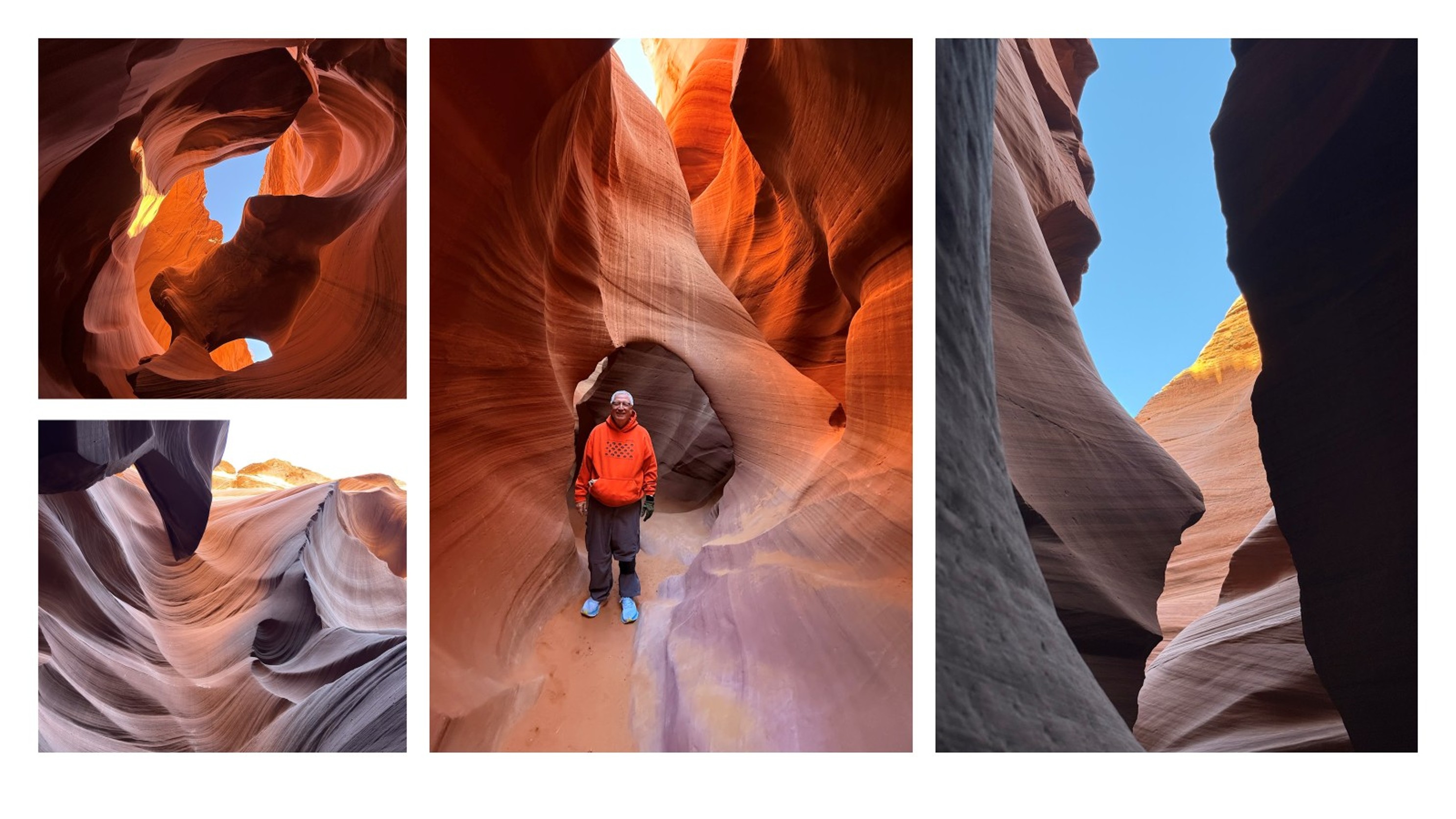
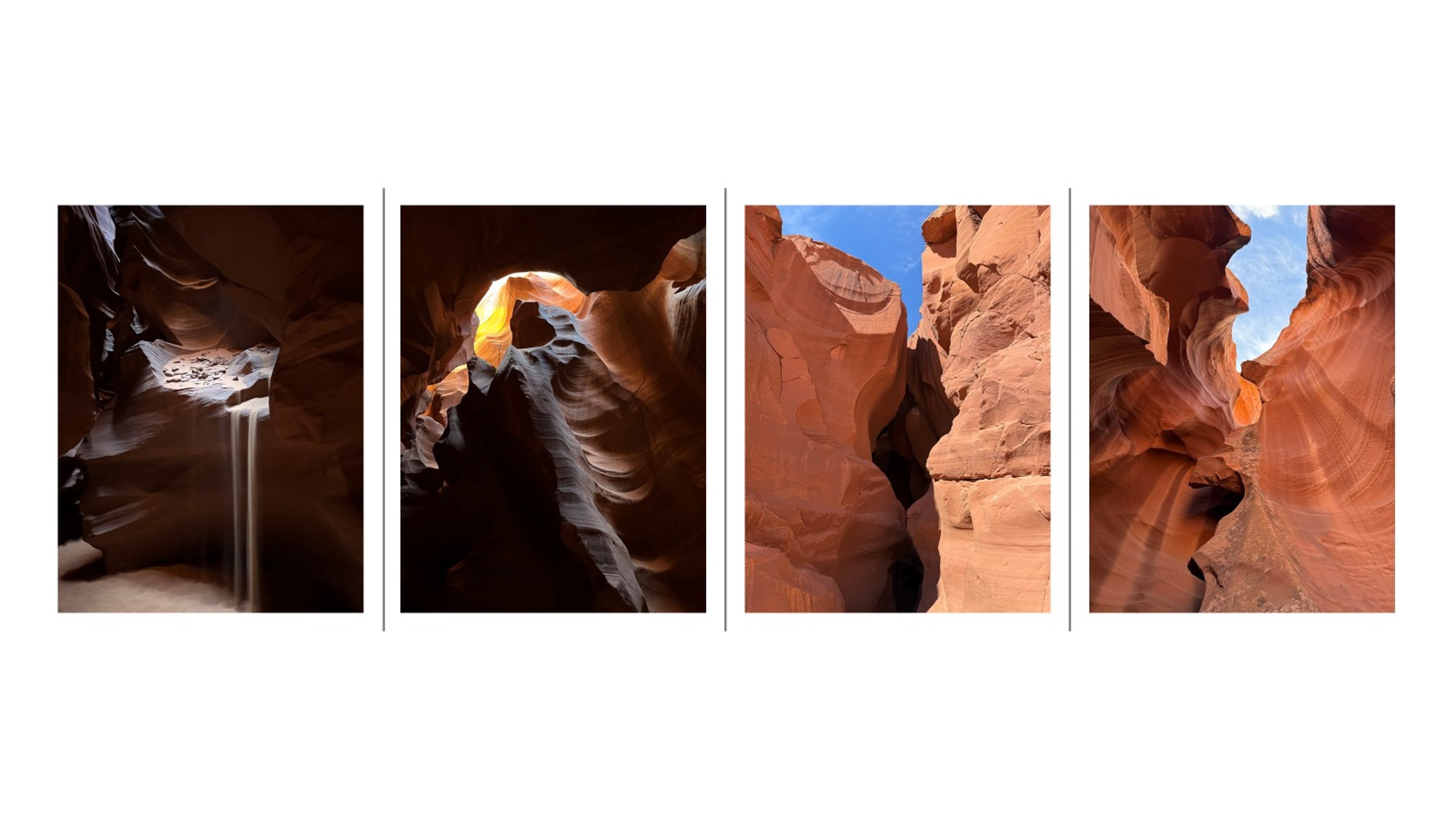
The high point of the trip for me was hiking through the Lower and Upper Antelope Canyons outside of Page, Arizona. For years, I’ve seen amazing photos from professional and amateur photographers of these canyons. It was time I saw them for myself. After researching the best times to visit to get the sunlight just right, I realized I was visiting at the wrong time of the year. So I viewed this as a scouting trip and I would return with my wife at a better time of year (summer months). I could not believe my eyes. With each step I took, I wanted to take another photo. Not knowing how difficult the hikes would be, the only camera I would have is my iPhone 16 Pro. I am so glad I had just upgraded to the higher resolution camera. The results were so far beyond my highest expectations.
From Lower Antelope Canyon:
From Upper Antelope Canyon:
While reviewing my photos, I realized I captured a small plane flying overhead. I didn’t see it when I was taking the photo. I love serendipity.
One of the most famous photos of Antelope Canyon is the “seahorse”. Just about every Tshirt in the tourist shops had this photo imprinted. The guide insisted that we had to take this photo.
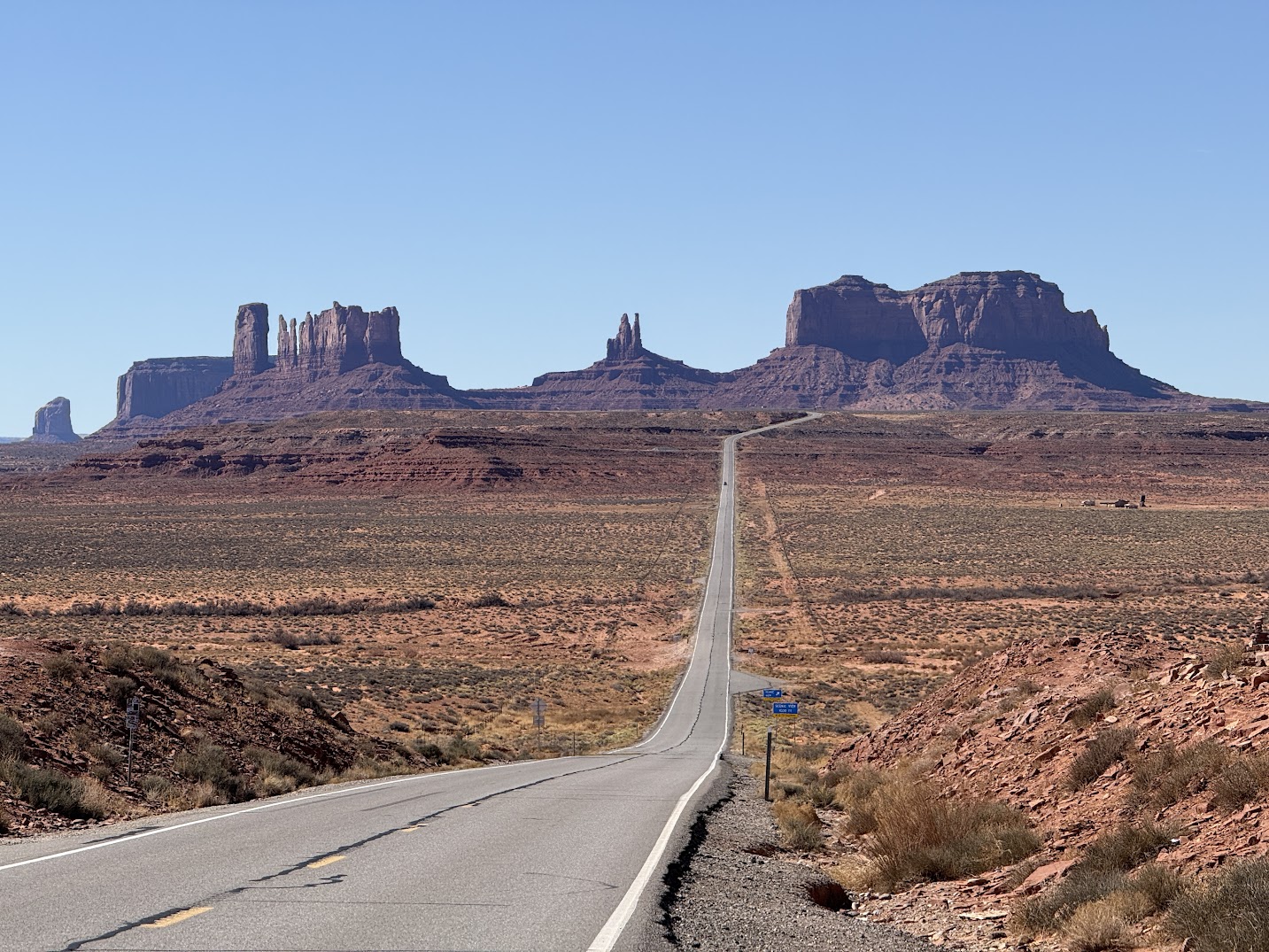
While in Page, AZ, I was required by state law 🙂 to photograph Horseshoe Bend and Forrest Gump Hill in Monument Valley.
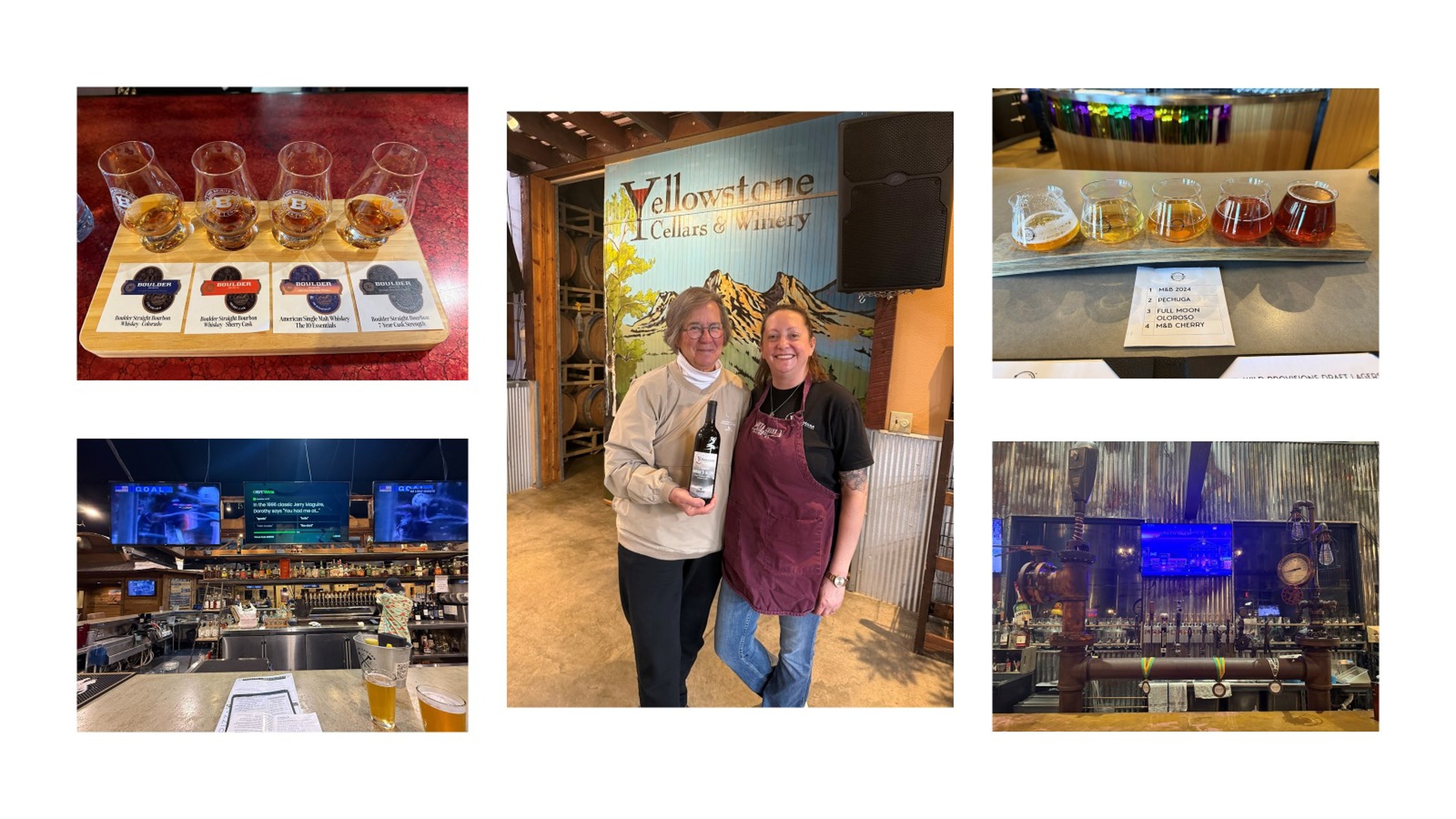
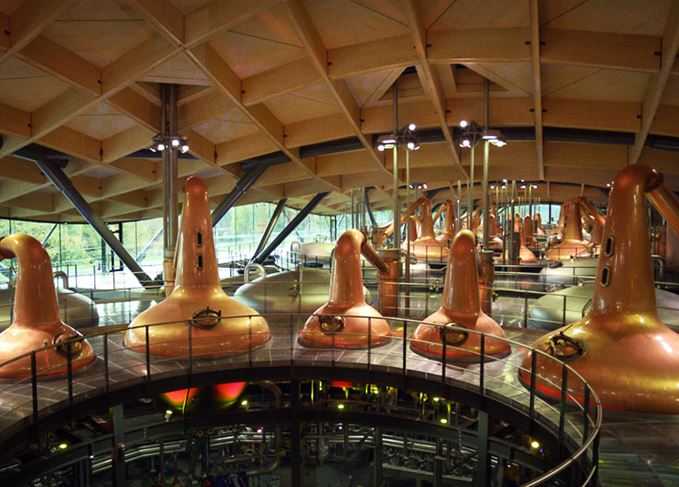
For me no trip is complete without sampling local craft distilleries, craft breweries and small wineries. The craft alcohol creators in Boulder, Billings, Page, and Helena did not disappoint.
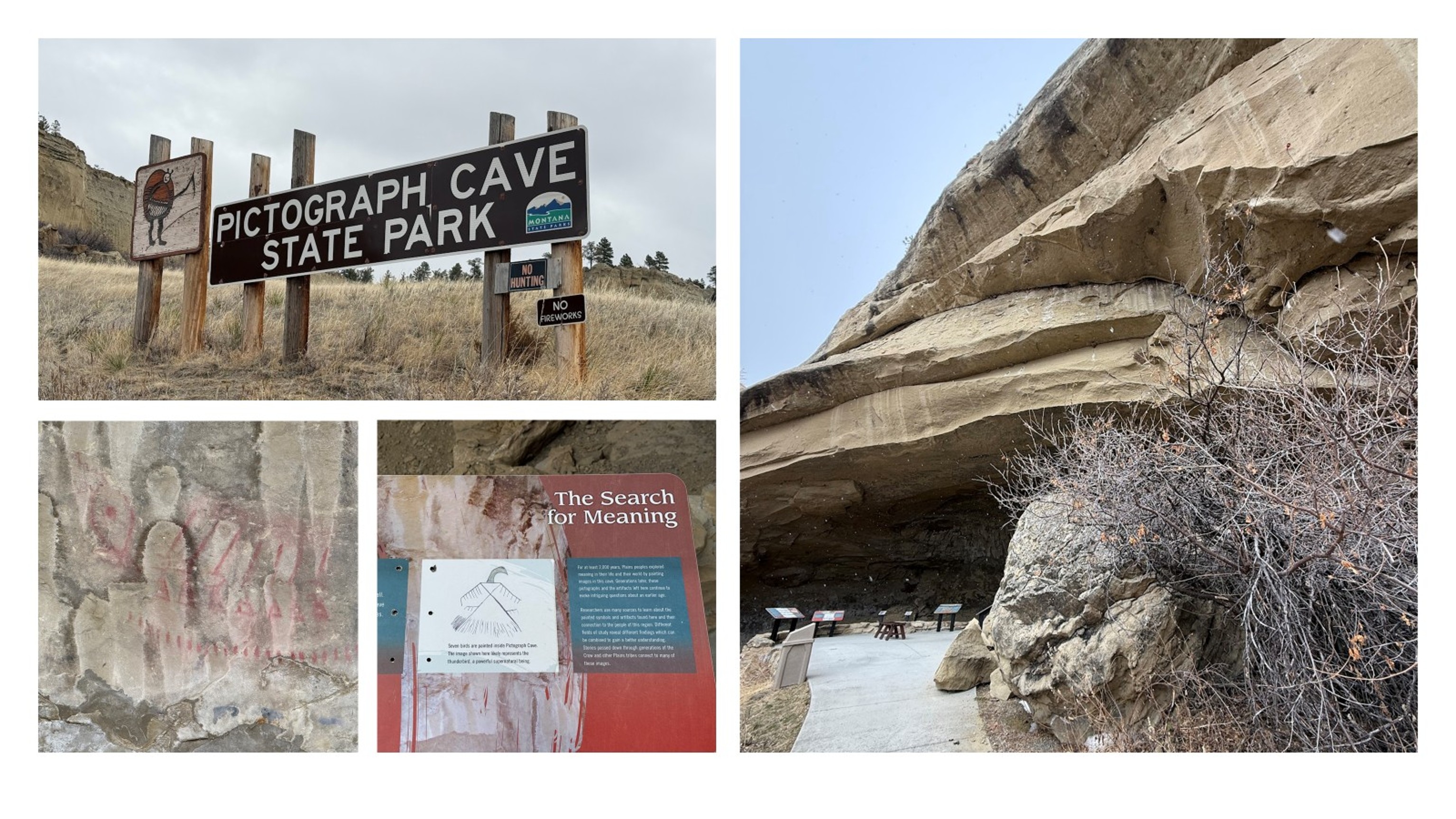
On every extended trip, there is always a surprise. In Billings, Montana, while we waited to see the orthopedic surgeon who will be doing my full ankle replacement this summer, we toured Pictograph Cave State Park during a snow shower. This small state park was a joy to behold. As my oldest daughter shared “we love pictographs and seek them out on all our trips through the west.” If you have a spare couple of hours in Billings, MT, I would strongly recommend stopping by to see the pictographs.
With all the craziness that is going on in our country today, it is trips like this where I can shut the larger world noise out and just be with the majesty of nature and the history of America that surrounds us.
Stop the coup in the United States!Vote! Resist!Persist!
I am planning our next trip to Europe – our fifth in the last four years. I never realized how much harder it is to plan a lengthy leisure trip than it was to plan a business trip. For 40+ years of business travel covering 100,00+ air miles per year, planning was never a big deal. I knew where I was going. I knew where I needed to be and when. I was usually meeting colleagues or customers or suppliers. Someone would recommend where I should stay and good places to go eat. Once I got to where I was going, I spent countless hours in a bland conference room and stayed in yet another nameless business hotel. No sight seeing got in my way of doing business. Planning for one of these trips took no more than an hour of getting a plane reservation, a hotel reservation and maybe a rental car reservation. I was rarely gone for more than a week.
Leisure travel for 4-6 weeks at a time outside of the US requires a different type of research and planning. I could make it easy and go on a cruise or sign up with a tour company or have a travel agent do all the planning. But I hate travelling with other people (other than family) and having to follow a rigid schedule (“bags out at 7 am tomorrow everyone!”). I also like to mix historical and cultural visits with side trips to wineries, breweries and distilleries.
Foreign travel is still different than my leisure travel in the US. I recently embarked on a 5000+ mile drive around the west and southwest US. My planning consisted of checking to see if my daughter and family would let me stay with them for a week later in the journey and packing the car. Since I didn’t know how far I would get each day, I didn’t make hotel reservations until late each day. Because this was a winter trip, I didn’t know how much snow and ice would affect my journey. I knew many places I would like to visit and hike but I didn’t know how long I would stay in each location. The image below from Polarsteps captures the route I took and where I captured a lot of photos. I am not yet as comfortable in being as completely unplanned when visiting Europe. I want to at least make sure we have a place to stay each evening.
When planning foreign travel, I don’t want to make the same kind of mistake that tours do and schedule everything so tightly that there is no time for the synchronicity of visiting a different culture. My purpose for leisure travel is very different than business travel. I want to go to a place that is rich in history and art and that is different than my day to day life on Bainbridge Island, WA.
The challenge for these trips is to achieve a balance between being a tourist versus a traveler versus a pilgrim versus a student of other cultures. Panama Jack defines the difference:
“Are you a Tourist or a Traveler? Well, let’s see here, what is the difference between the two words? The Merriam-Webster dictionary seems to think that they are nearly one and the same. The trusted book defines a tourist as “one that makes a tour for pleasure or culture” and a traveler as “one that goes on a trip or journey.” There really isn’t much of a distinction between the two.
However, in the pompous travel community, a big, intimidating line has been drawn between these two similar terms. Being called a tourist is more condescending than being called a traveler. The tourist has been distinguished as a sort of amateur traveler, and a traveler has been distinguished as more of an experienced tourist. It sounds strange, but let’s see if we can clear things up a bit.
You need to be a child before you can be an adult, likewise, you need to be a tourist before you can be a traveler. An all-grown-up traveler knows what it’s like to be a tourist and actively avoids most (if not all) “tourist activities.” Tourist activities are things like planning a short week-long trip out weeks in advance and hitting all the popular sights, it’s staying in a nice hotel, eating at fancy restaurants, taking photos of yourself so it looks like you’re holding up the Leaning Tower of Pisa…just to show your friends back home.
The traveler avoids these over-crowded activities and seeks the road less travelled as to appreciate the real culture of the destination. Trust me, you want to be a traveler if you want respect from both the locals and other travelers alike.
All in all, the most important difference between a traveler and a tourist is time. A tourist is only on a vacation with little time. Resulting in a rushed, consumer oriented, crowded, sight-seeing, and photo heavy vacation. A traveler has more time; time to get lost and not miss a flight, time to understand a region through all the senses, time to learn the language, and time to be carefree and unburdened by a trip planner.”
While I spend a lot of time planning a trip, I try to leave large blocks of time free to adjust to the weather and to spontaneity. Once we get to a place, the things listed in my itinerary provide a range of options which we can decide on as our physical state and the weather guide us.
“Culture hides much more than it reveals, and, strangely enough what it hides, it hides most effectively from its own participants. Years of study have convinced me that the real job is not to understand foreign culture but to understand our own. I am also convinced that all that one ever gets from studying foreign culture is a token understanding.”
“The ultimate reason for such study is to learn more about how one’s own system works. The best reason for exposing oneself to foreign ways is to generate a sense of vitality and awareness – an interest in life which can come only when one lives through the shock of contrast and difference.”
From Rick Steves:
“But more important than the “how” we travel is the “why” we travel: Thoughtful travelers do it to have enlightening experiences, to meet inspirational people, to be stimulated, to learn, and to grow.”
The first challenge in planning is to figure out where we want to go. Over the years we have had the good fortune to take vacations to Australia, London and Southern England, Israel, the primary tourist spots in Italy (Rome, Florence, Venice), Paris and Burgundy in France, Japan and most of the states and provinces in the US and Canada. These trips were mostly as tourists quickly seeing the main attractions in a compressed period of time.
Now that we are retired, we want to spend four to five weeks in a single country at a time or a part of a country and take our time to slow down and experience their unique culture. We have a long list of primarily European countries we want to visit and revisit. We prioritized our first set of countries to visit:
Portugal and the edges of Spain (Santiago de Compostela, Seville, Barcelona) [2023]
France (Normandy, Bordeaux, the Rhone River, Reims, Loire Valley, Paris) and Belgium [2024]
Ireland and Scotland [2025]
Germany, Austria and Czechia
Denmark, Norway, Sweden
England and Wales
Poland and Hungary
Southern Italy and Sicily
Greece
Turkey
Southern Spain and Morocco
I shared our way of planning with another retired colleague who is more analytical than I am. He shared his process for how many extended trips he takes a year. Steve shared “I made a list of all the places in the world that I wanted to visit. I then consulted actuarial tables for my life expectancy and how long I am likely to be healthy enough to travel. I then divided the places I wanted to visit by the number of years I have left and calculated that we needed to take three trips per year.”
I loved it. But that is too analytical for me.
At the beginning of a year we decide on the two places we want to visit that year and then plan for two “shoulder” season trips – one in May and one in September/October. I’ve learned through my business travels and a couple of shorter vacations that travelling to Europe in the summer is a non-starter. There are just too many tourists and the local citizens take their vacations. It is harder to be a traveler.
Once we decide on a destination, we look at our schedules to find a 4-5 week window when we don’t have any family, community or medical obligations. I start looking for airline reservations to a city near where we want to go and look for the days that are likely to have the cheapest airfares. I then purchase one or more of the Rick Steves books to get an overview of what the more interesting attractions are. I also sign up for email notifications for the country and city tourist bureaus. The Ireland and Scotland tourist bureaus have been fantastic in helping plan for off the beaten path locations for our upcoming Spring 2025 trip. I love the regular emails that showcase the history and natural beauty of each country.
We’ve learned over the last two years that as we get older jet lag seems harder to deal with. So we try to spend 5-7 days in a larger city at the beginning of our trip where we can gently overcome jet lag and not have to have a rental car. We then rent a car to tour the rural areas of a country and then try and finish in a larger city where we won’t need a car. Our first long trip to Portugal showed us how important it is to get into the rural parts of a country. A colleague, who owns a part of a vineyard in Burgundy, calls these rural agricultural areas “profoundly France.” By making a priority to visit wineries, agritourismos, and rural distilleries we prioritize getting to experience the non-touristy “profound” areas of a country.
The next decision stream is to pick the places where we want to spend 2-4 days in the middle part of the trip. For me this is the hardest set of decisions to make as there are so many different places and things I want to experience – visiting cathedrals, absorbing museums, seeing ancient Roman artifacts, tasting the local wines, experiencing a wide range of restaurants that have authentic and profound food, taking cooking classes and doing some day hikes weather permitting. Once the locations are selected, then I look for accommodations. Surprisingly, this step requires the most research. When doing business travel, I never had to worry about where to stay. There was always a colleague who would make a recommendation based on quality and convenience to our meetings. With personal travel, I have to rely on a wide range of ratings and recommendations on Google Maps, Expedia, Booking.com, Forbes and many more. Calibrating the recommendations and reading between the lines is an art form.
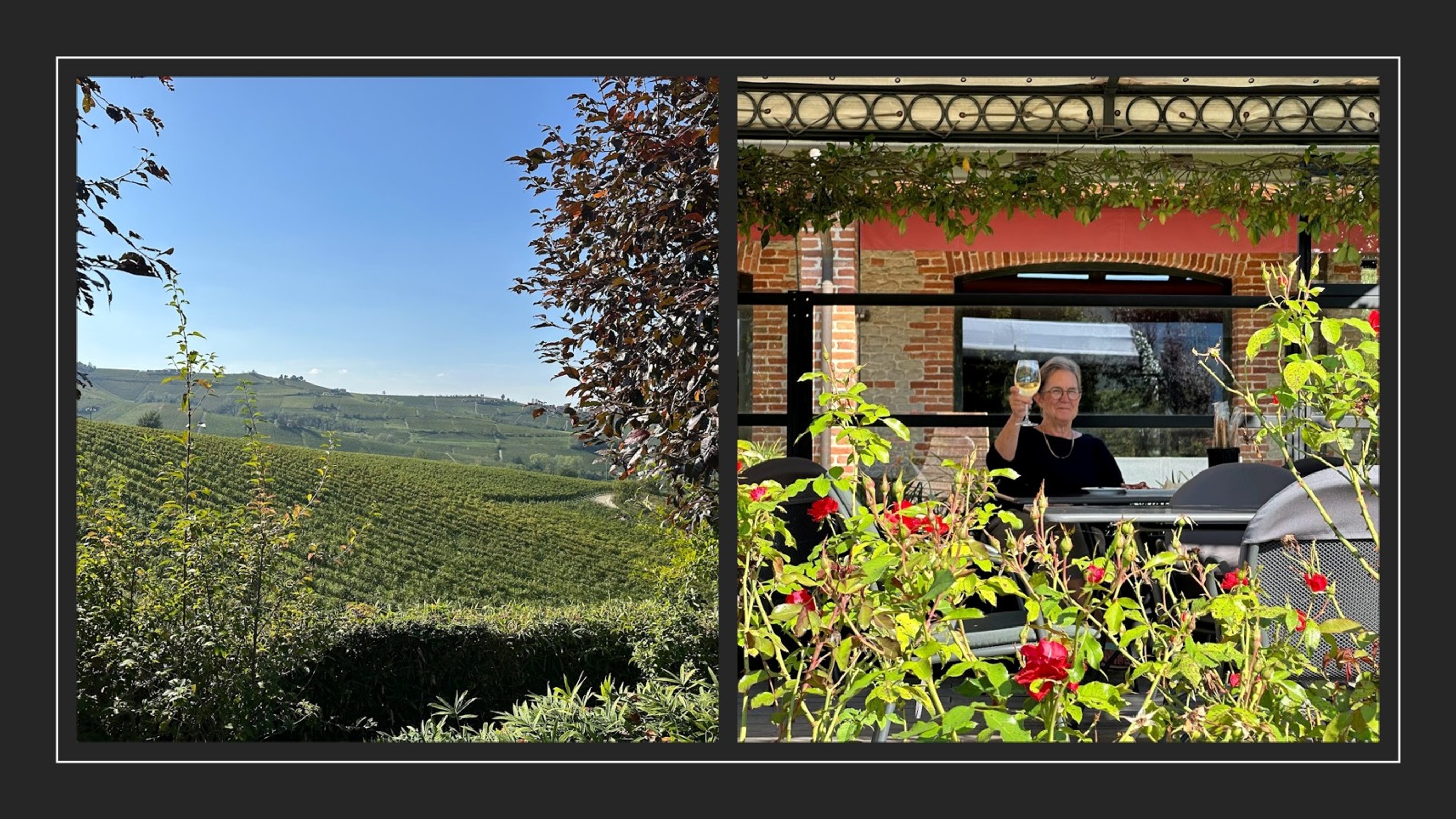
After picking the intermediate places and the time allocation, it is time to start making reservations. I lock in the airline reservations first and then start with the hotels and rural agritourismos. We’ve grown to love agritourismos, particularly in Italy. With our interest in wines and viticulture, we try to find a smaller facility that also has vineyards and a winery attached. If the agritourismo has a restaurant, that is even better. We’ve learned that most agritourismos with a restaurant offer cooking classes from the chef. Over the years we’ve found that we learn more about local cultures from the cooking classes than we do in museums. Waking up and being able to walk in a vineyard just after sunrise is an exquisite pleasure for me. Coming back to the agritourismo after wandering the countryside and sitting on the veranda with a glass of the hosts unique wine as the sun sets is a special pleasure.
The next set of planning goes on at a more leisurely pace. I now look for what are the things that we could do when we get to a specific place. I list them in our “itinerary document” with pointers to websites along with comments from reviews or travel writers. The list is generally far longer than we could or would ever attempt to accomplish. This list is the preparation for the synchronicity when we get to where we are going. When we begin each day on the trip we let the weather and our stamina determine what we should do that day. We mostly try to do just one thing from the list or at most two. We also add to the list from recommendations by others we encounter along the way. When we are in a city, we like to wander and experience the neighborhoods and parks along the way.
Finally the day arrives for us to embark on our “voyage.” We are finally ready for the synchronicity part of our journey. The synchronicity almost always involves either encounters with “new friends” along the journey or alcohol or both. Here are a few of the “unplanned” encounters we really enjoyed.
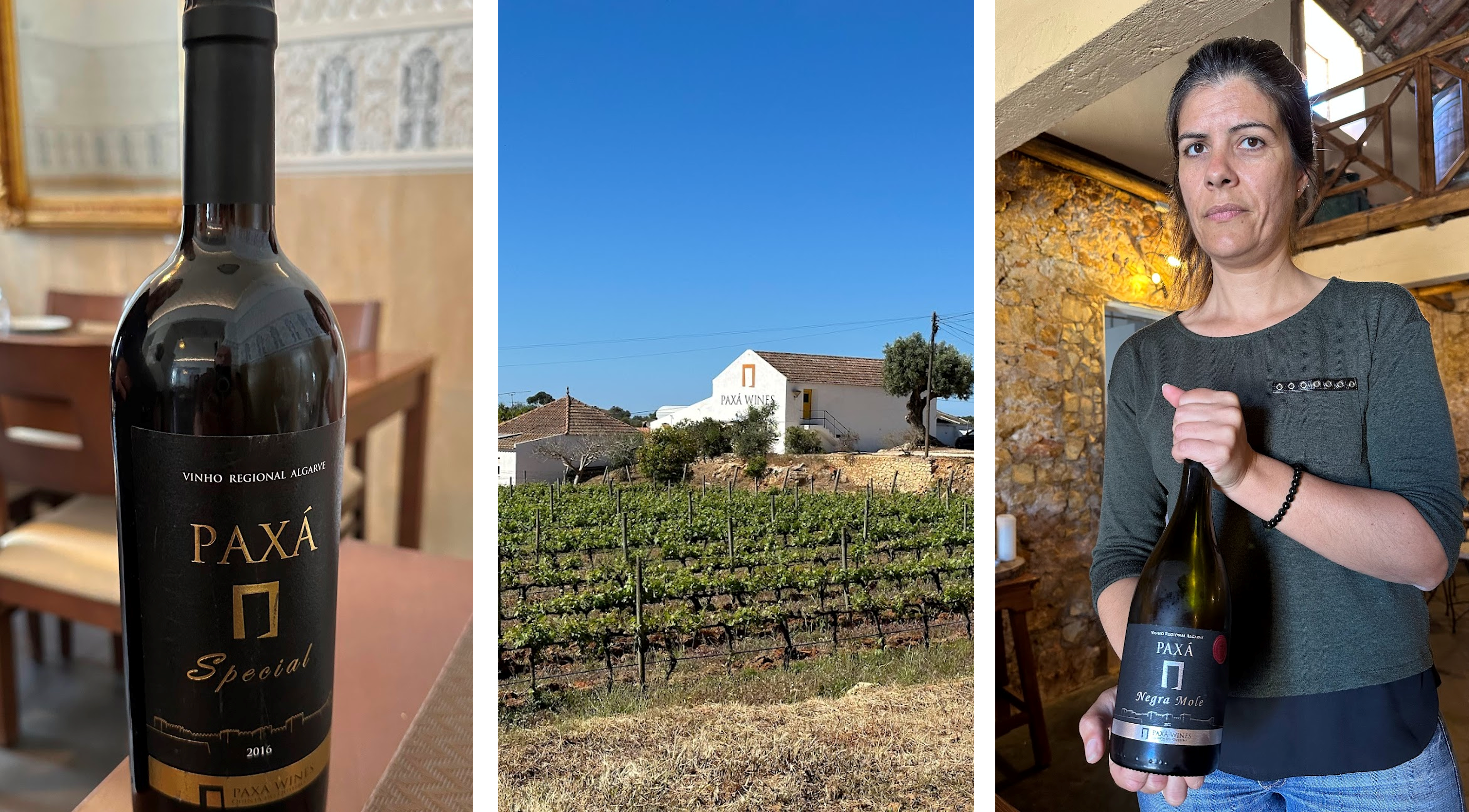
Paxa Winery Portugal
As part of the planning for our Portugal trip, we knew we wanted to experience the wines of the Douro Valley so we planned on staying at Quinta de la Rosa for a few days. But we didn’t know much about Portuguese wines so we didn’t plan on visiting any other wineries outside of the Douro Valley and Porto. As we wandered the narrow streets of Olhao in southern Portugal, we came across an inviting little seafood restaurant. We wanted to try a local Algarve wine. Our waitress recommended a wonderful Paxa reserve wine. It was fantastic. So I looked up the winery and found that it was close by. I made a reservation for the next day and off we went.
To get to the winery, we really had to get off the beaten path. The journey to the winery was quite different than the expressways that we used to travel around Portugal and Spain. While we rely heavily on Google Maps, my wife and navigator decided to take a short cut. As we got on narrower and narrower roads and the pavement turned to dirt and I found myself in the middle of a vineyard, I expressed a wee bit of frustration. We could see the winery, but we couldn’t get there. So we backtracked to the original Google directions and arrived safe and sound at the winery.
What a pleasant surprise we encountered. Paxa has a wide range of white and red wines. Each wine we tried was better than the next. For our last wine taste, we tried the Negra Mole varietal which I’d never heard of. It tasted somewhere between a Pinot Noir and a Gamay Noir. I didn’t want to order any wine to send home but we did grab a few bottles to have on our remaining journey. The really good news is that Paxa had recently joined the Yon Wine distribution company to the US. So we are able to order their wines whenever we want.
Our host for the visit was quite knowledgeable and spoke excellent English. Since we were the only visitors that day, we had plenty of time to enjoy the wines and learn more about our hostess. We complimented her on her fantastic English. She laughed and shared that she hated taking required English classes in school. But now most of the people who visit the winery are from England or America. She shared that when somebody from Portugal visits she has to translate her presentations and answers in her head from English back to Portuguese. How amazing it would be if I could ever learn another language and have to do something like she did so naturally.
The visit was not planned but we followed our curiosity and found a part of Portugal we were glad we’d travelled to.
Futbol Conversations in a Beer Garden in Seville Spain
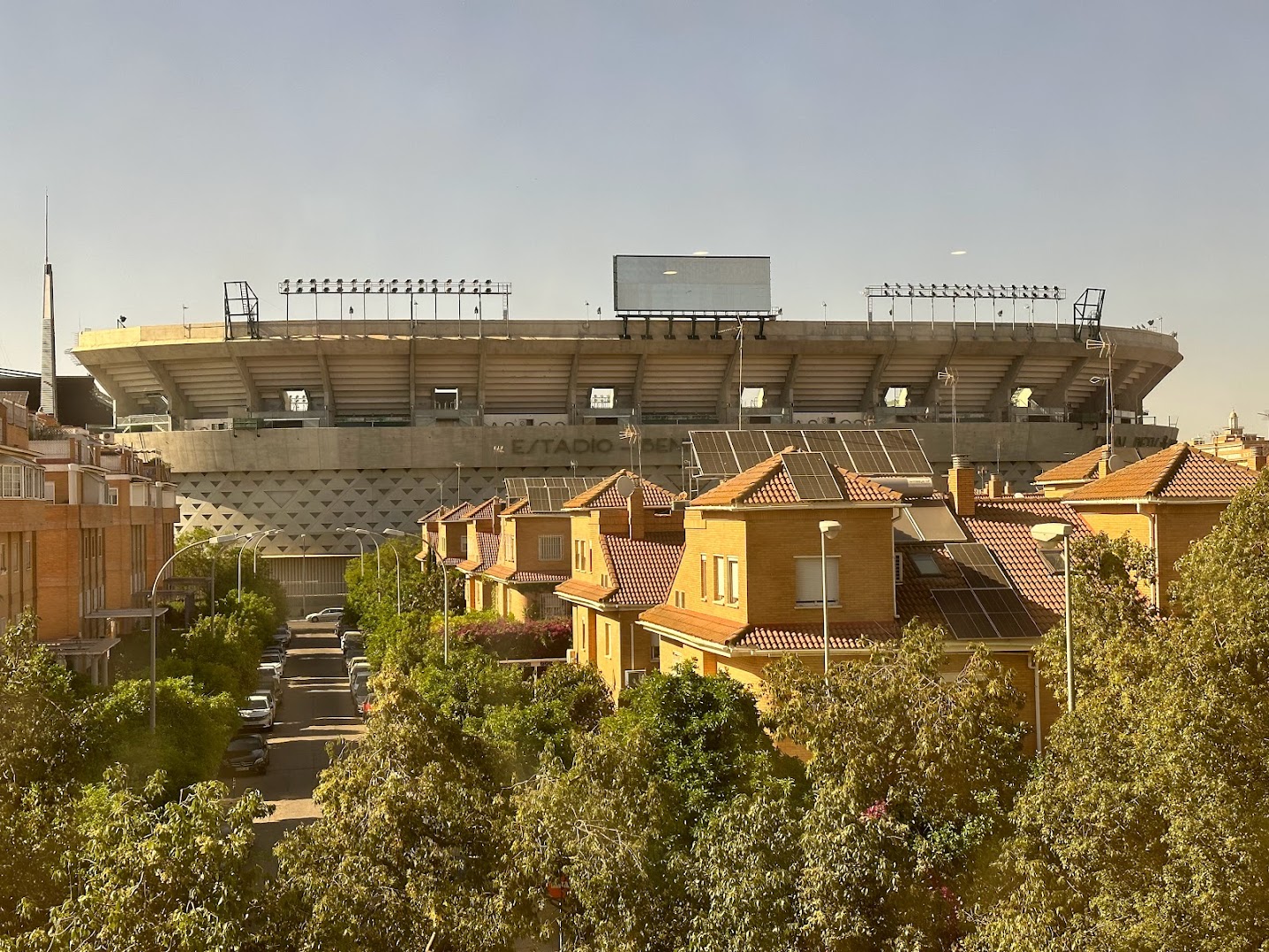
When I did my research on where to stay in Seville, Spain, I had no idea that our hotel would be a block from the Real Betis futbol stadium. I also had no idea that Manchester United would be in the city to play a UEFA Champions League Match against Sevilla.
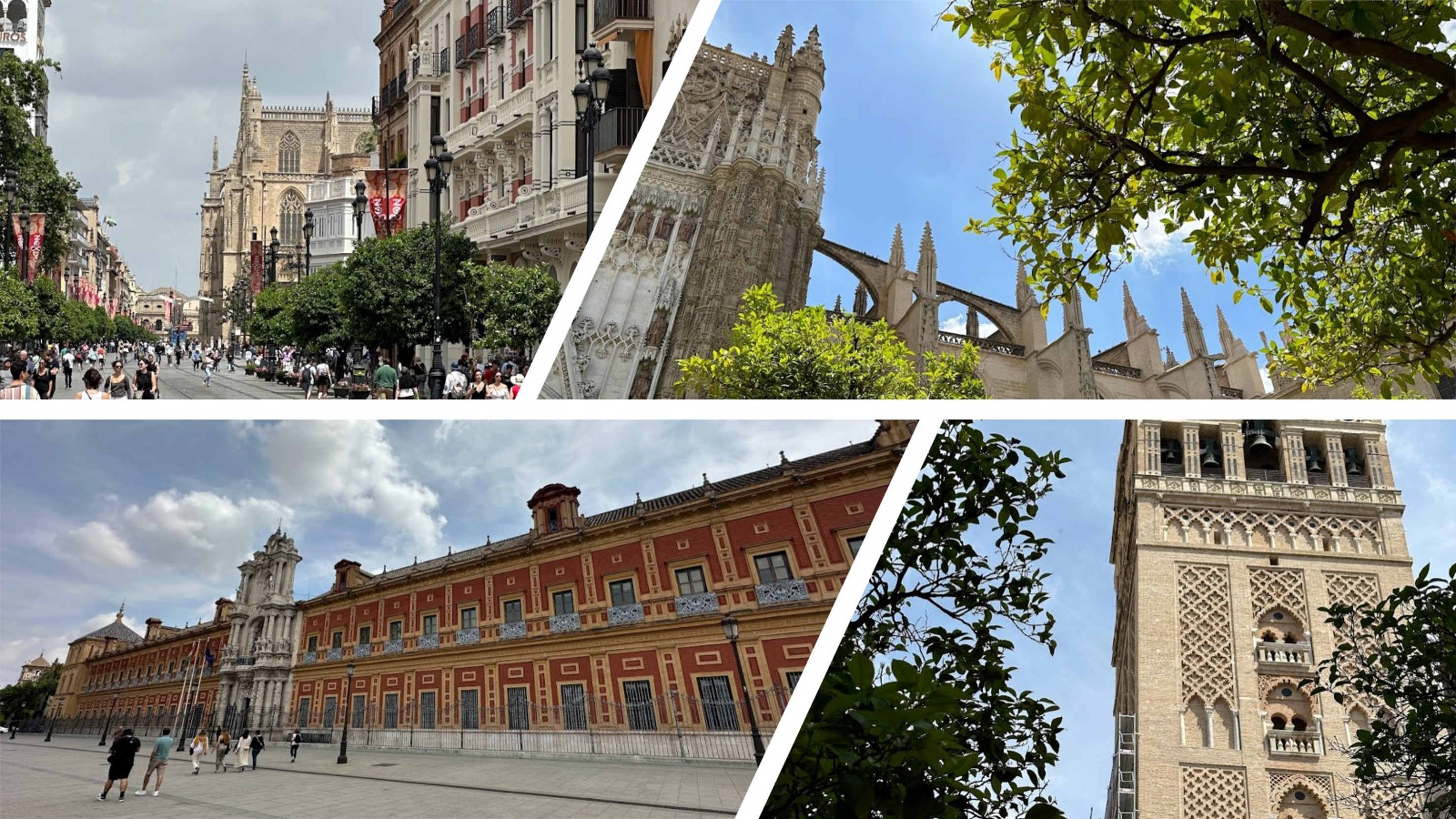
After a long hot day of wandering around Seville and visiting the Cathedral and a few museums we came back to our hotel to rest a bit before dinner. Before going to our room, we declared that it was “Beer O’clock” and we needed to find the beer garden near the swimming pool.
As we walked into the deserted bar area, I heard a distinctive deep English accent uttering the “F word” several times.
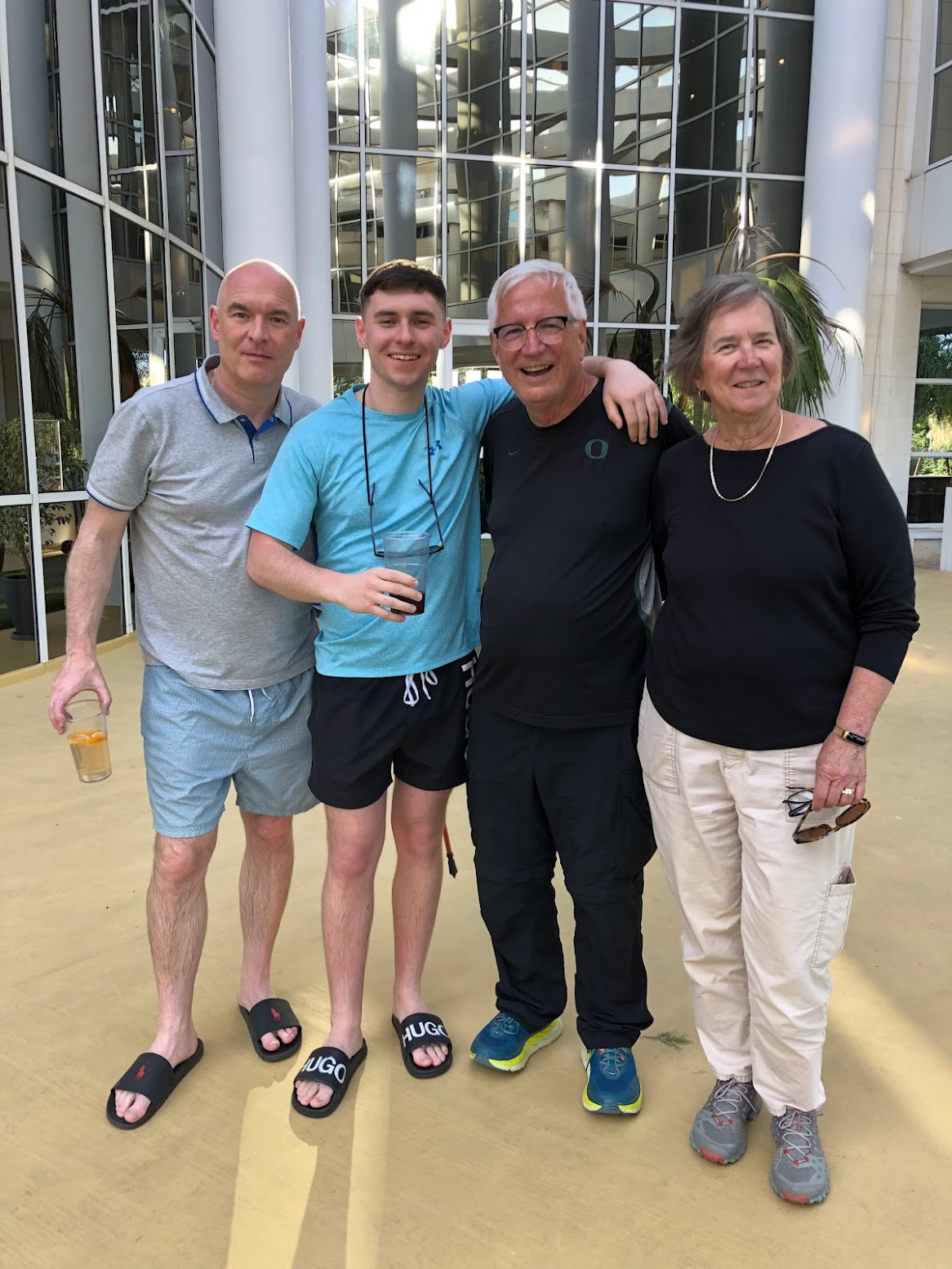
I was really confused as I looked around because I could swear it was the deep bass voice of Roy Kent from Ted Lasso played by Brett Goldstein. As Sean looked up and saw these two old fart Americans enter the beer garden, he said to his son “Jonny, you need to watch your language. There are others present here.”
I laughed and said “That’s OK, I thought I heard the voice of Roy Kent.”
Jonny immediately shouted “Wow. A Ted Lasso fan here in Seville.”
We all had a good laugh that started a great conversation and a lasting connection.
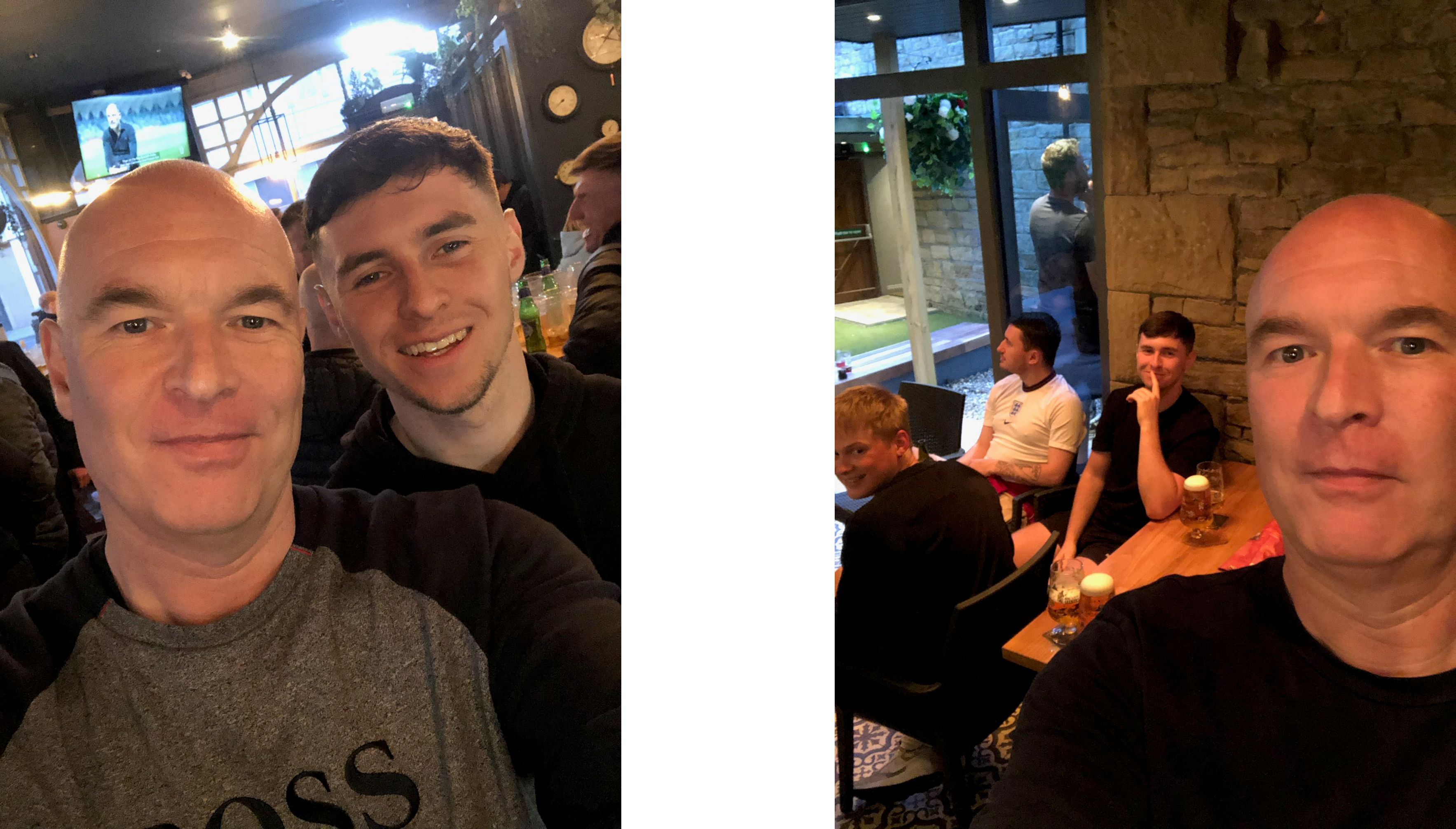
We quickly found out that Sean and Jonny were rabid Manchester United fans and were in Seville for the Champions League match. I debated whether to share that I was a Manchester City fan and then decided to go for it. For the next 30 minutes we gave each other a hard time. Sean accused me of not knowing any of the Man City players and of course my mind went blank. I was finally able to name a few of the players and prove that I indeed did watch some of their matches. Sean shared that the two of them have season tickets to Man U and try to go to as many Champions League matches as possible. Of course he is an England national team fan as well.
I asked if he is coming to the World Cup 2026 in the US, Mexico and Canada. Sean and Jonny both got excited and explained that they were going to spend the whole summer in the US following the England Team. I knew that there were going to be six world cup games in Seattle so we all hoped that England would be in one of the games in Seattle. Of course, I invited them to come visit us on Bainbridge Island. Suddenly it was time for the two of them to go to the match. We exchanged mobile phone numbers.
After we said our goodbyes, my lovely bride turned to me and said “who are you? I don’t think I know you. You are such an introvert and you just spent 30 minutes talking with complete strangers as if they were long lost friends.”
“Welcome to the ‘hail fellow well met’ that I so enjoy about travelling Brits,” I laughed.
Sean and I text all the time now, particularly during the English Premier League season. I give him grief about Man United and he gives me all kinds of nonsense about Man City. When we are on one of our Europe trips I will send photos of the Futbol stadiums that we visited and the matches that we able to get tickets for. Sean shares photos of he and Jonny as they travel by train to away matches or gathering in a local pub for the away games they can’t get to.
The meeting was not planned but the synchronistic long distance connection remains. And yes, there was a little alcohol involved.
Guernica
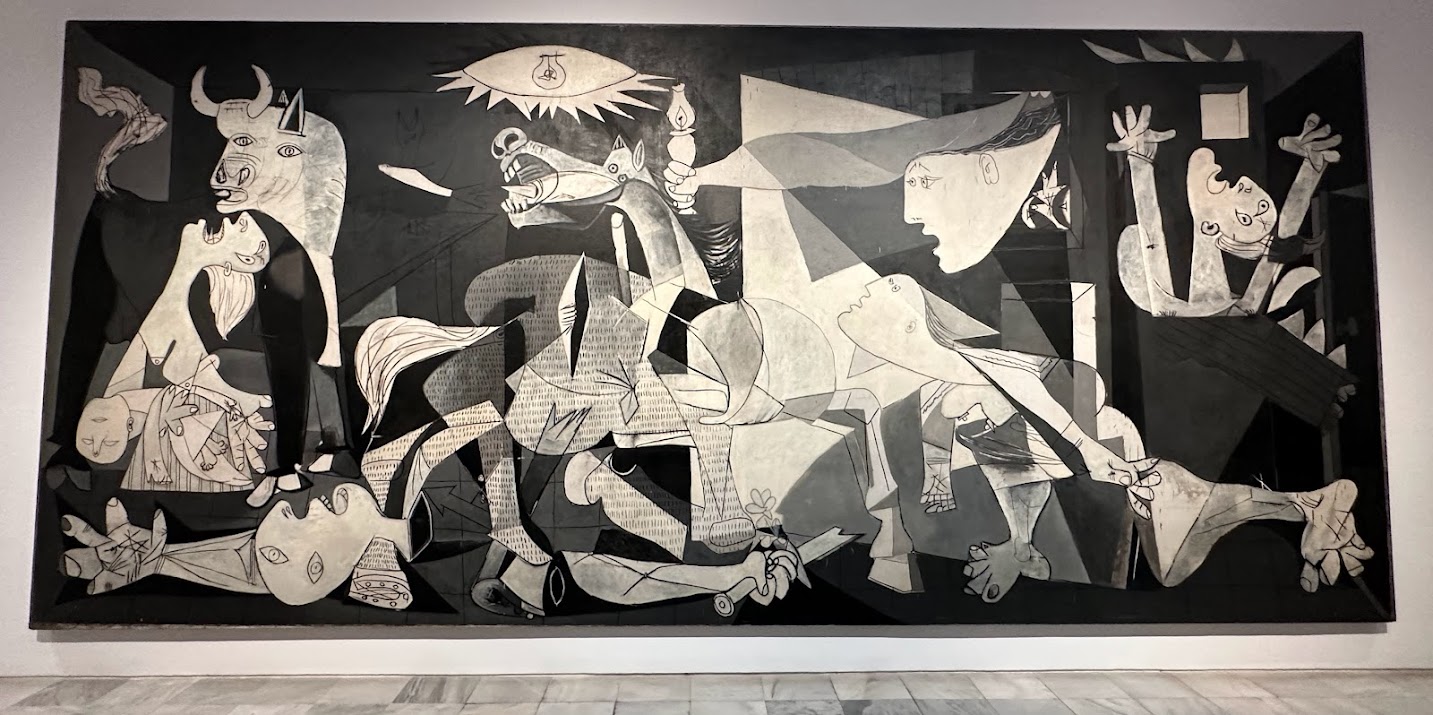
One of my all time favorite paintings is Picasso’s Guernica. Therefore it was a priority when we visited Madrid to see the painting in the Museo Nacional Centro de Arte Reina Sofia. I am drawn to the black and white and many shades of gray in this stark abstract painting. Seeing it in person made me want to learn more about the history behind the painting.
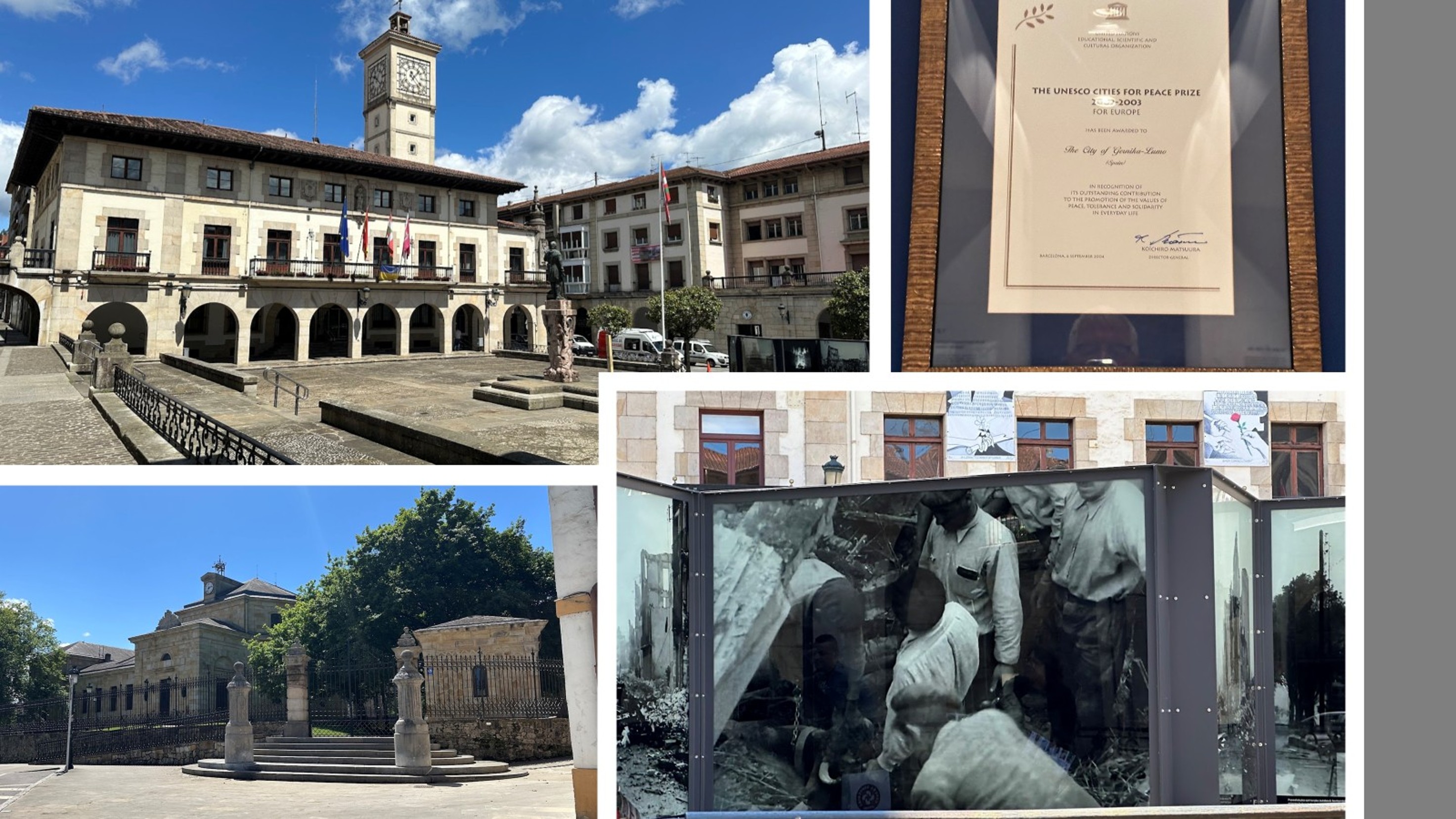
I downloaded a couple of books about the painting and the history of the events in Gernika in Basque country. I looked at a map and realized that it was close to Bilbao which we would be visiting later on the trip. Visiting Gernika wasn’t in our plans, but now it was a priority.
We spent most of our time in Gernika at the Gernikako Bakearen Museoa. It was the first museum I ever entered where we had to go through an interview to make sure we were entering with the right mindset.
While I have viewed photos of the Guernica painting many times, I was stunned at how deeply it touched me. However, going through the history museum and seeing the awful photos and seeing videos from the survivors was even more moving.
While the research for planning is important, having the time and flexibility to follow up on that which surprises me is so worth the travelling slowly.
Normandy and D-Day
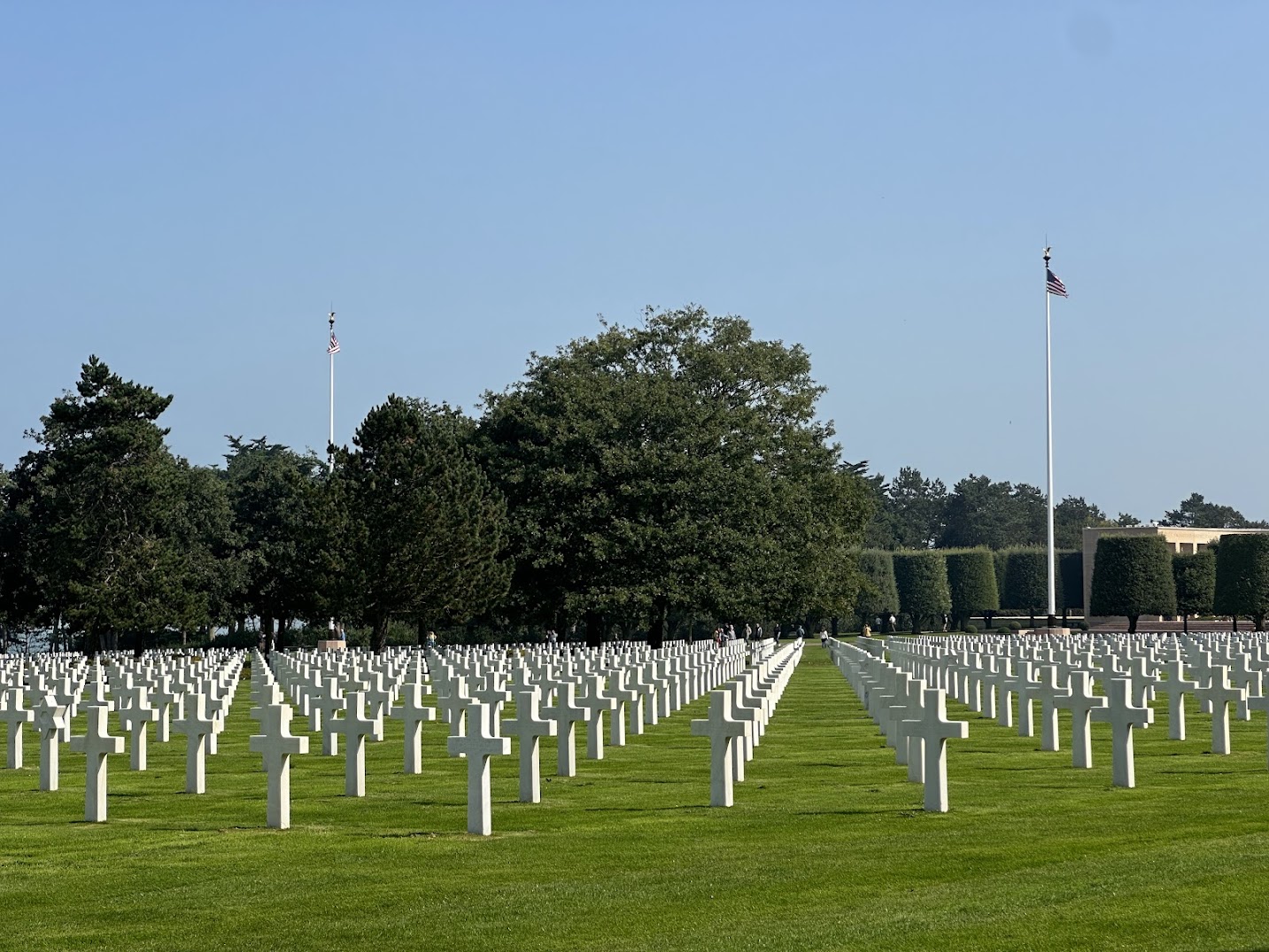
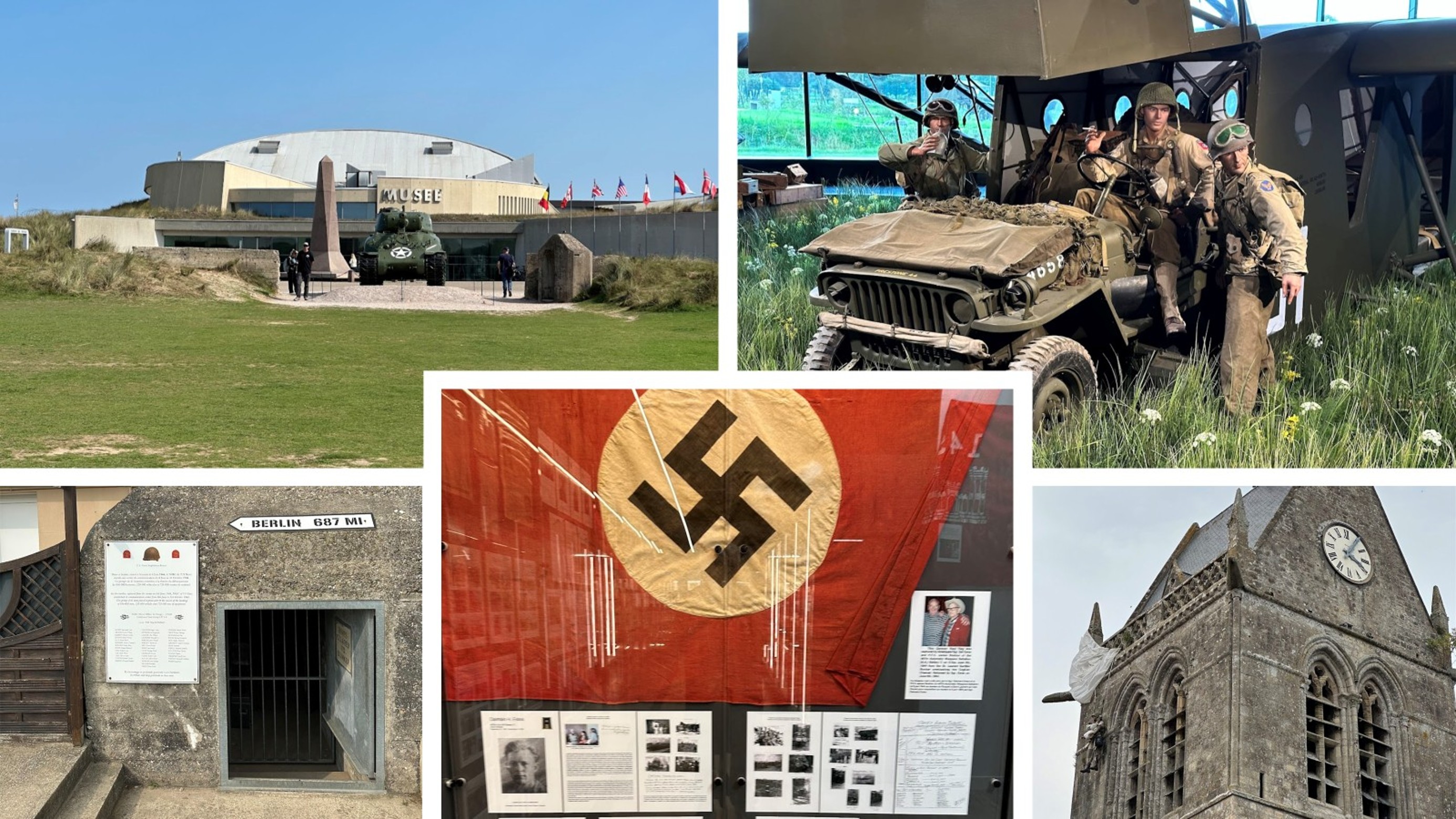
Our Fall 2024 trip to France had a primary objective of experiencing D-Day by staying right on Omaha Beach. We also wanted to loosely follow the Band of Brothers story arc by visiting Normandy and then Bastogne, Belgium, to get a sense of the Battle of the Bulge. We also stopped by the Luxembourg American Cemetery where General Patton is buried. At the Normandy beaches we expected to see the cemeteries and to walk the beaches.
What we didn’t expect was the wide range of small museums that dotted the villages behind the beaches. Each of these little museums was a treasure trove of local memories of what D-Day was like. There were captured artifacts and first person stories. Each museum put together a short video that captured local residents talking about what it was like on D-Day and the aftermath.
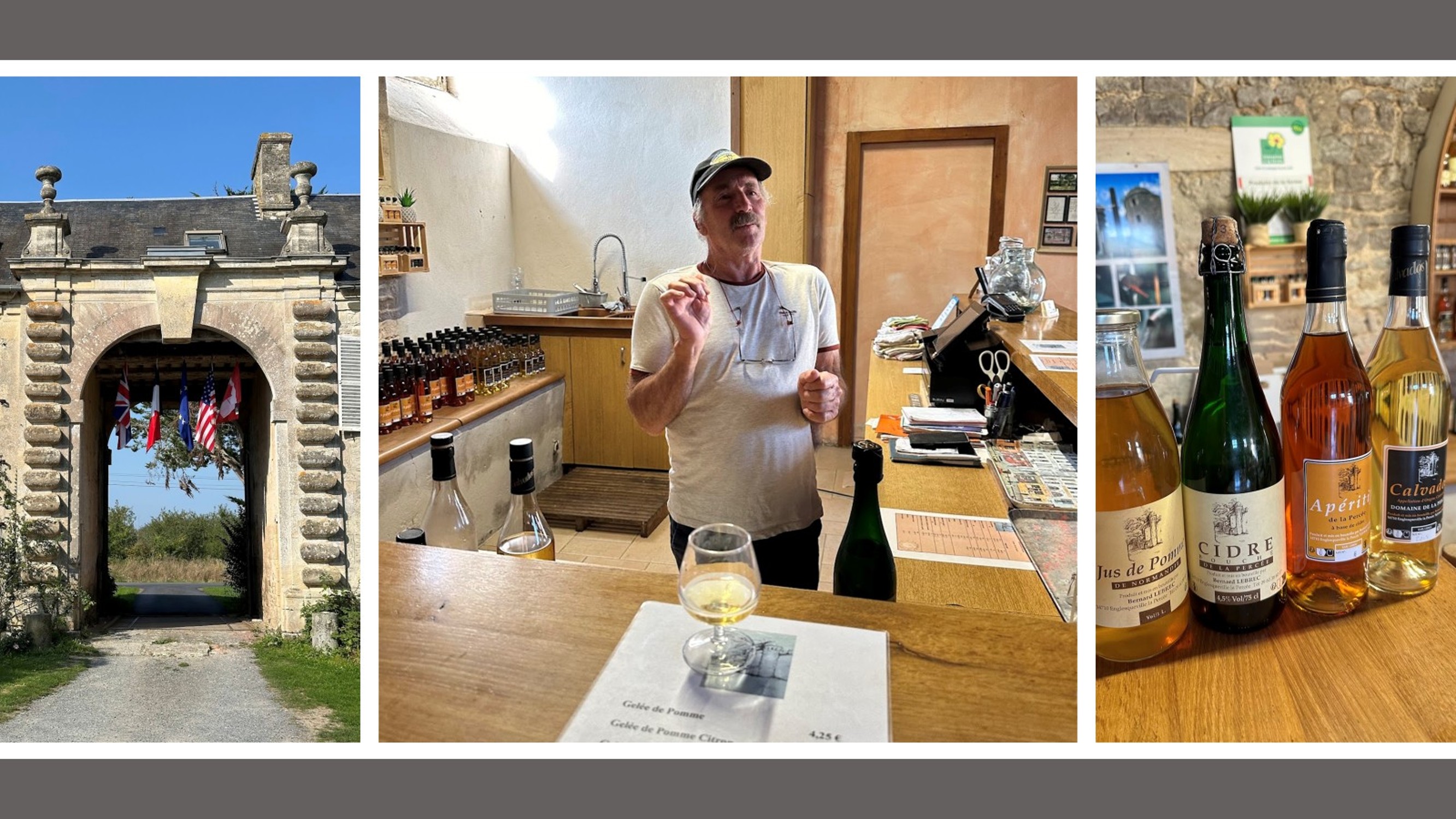
On our way back from Pont du Hac to Omaha Beach we stopped at a cidery to taste their range of products – cider, hard cider and Calvados. Bernard was a fountain of information. He was the bar keep, the owner, an apple grower, and a wonderful historian. His chateau served as Allied HQ after the D-Day invasion and an airfield was created across the street to carry medics and nurses in and wounded back to England. There was an excellent restaurant onsite that we never managed to get to.
Bernard easily switched languages for the many guests he was serving – English for us and German and French for the other patrons at the bar.
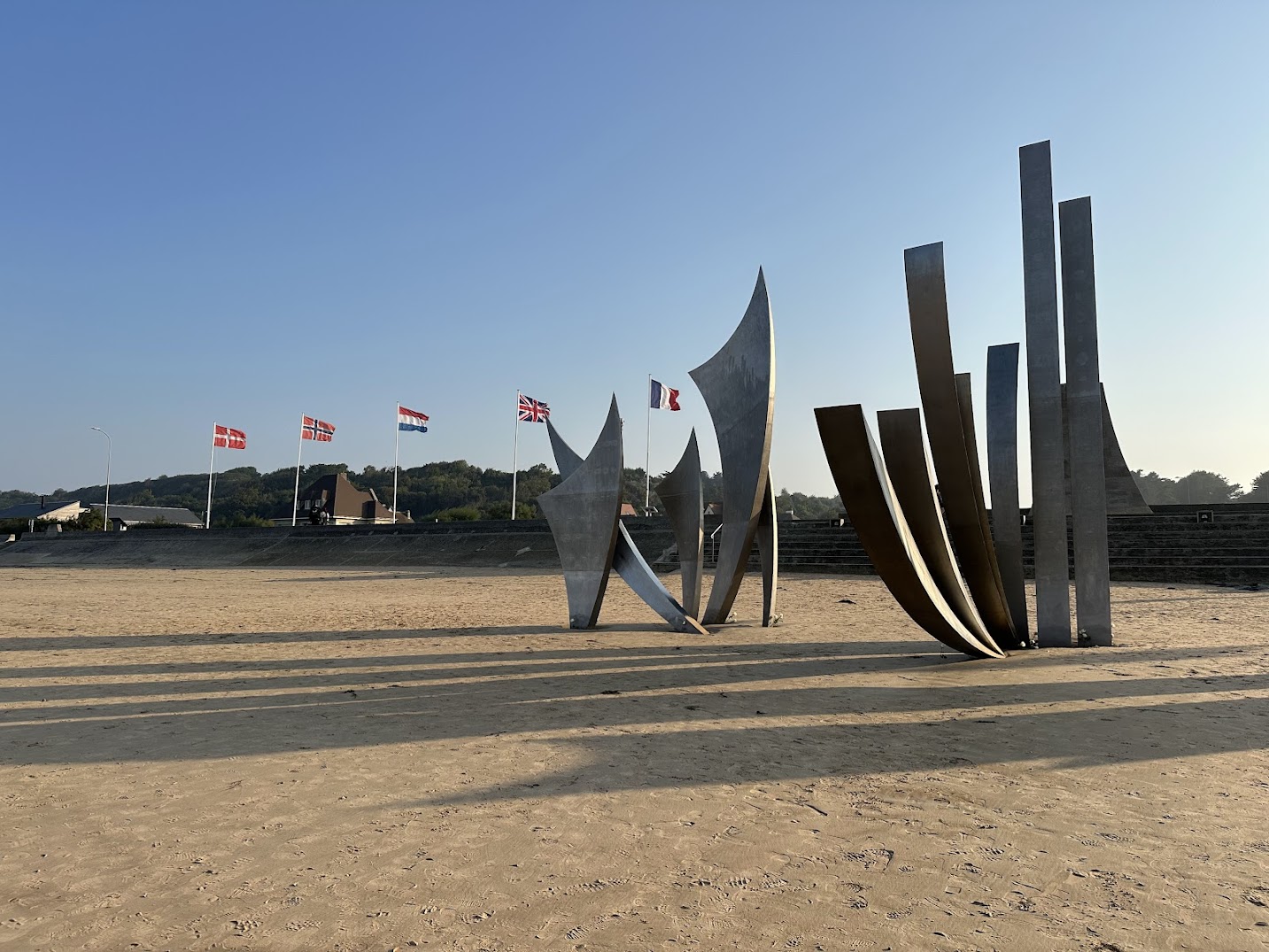
It is hard to believe that it was 80 years ago that so much death and destruction littered this beautiful wide beach in Normandy. This simple sculpture that shows itself fully at low tide and is half underwater during high tide captures so much of what the Allies endured so that we could have our freedom today.
We remember the welcoming people of Normandy with great fondness. They were so gracious to share what their grand parents and older neighbors had gone through.
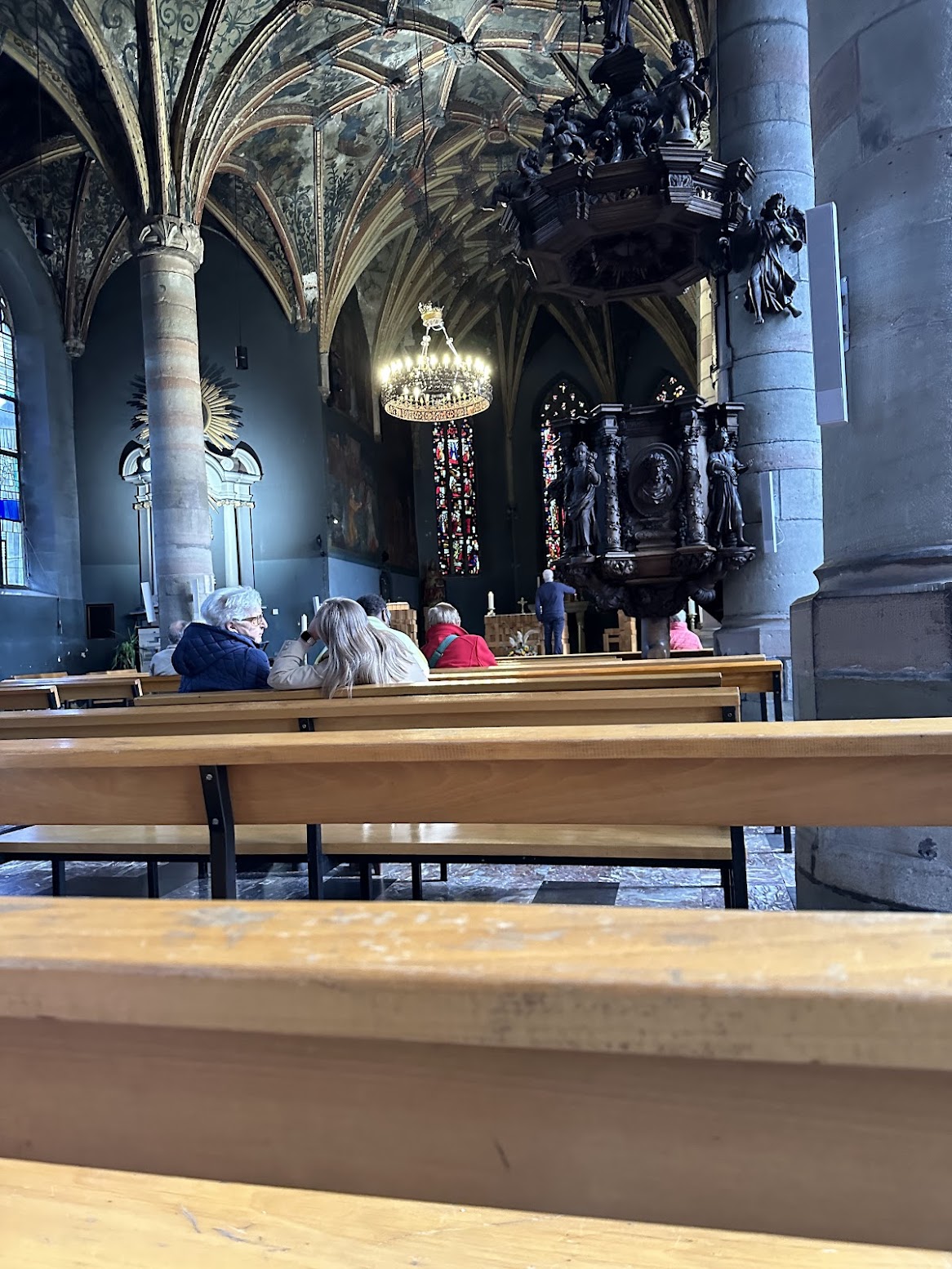
However, it was while sitting in a mass at the church in Bastogne that served as a hospital during the Battle of the Bulge, that I looked around me and realized there were several parishioners who could have been alive here 80 years ago. History comes alive through the people we meet when we travel.
“Color is an essential part of how we experience the world, both biologically and culturally. One of the earliest formal explorations of color theory came from an unlikely source — the German poet, artist, and politician Johann Wolfgang von Goethe (August 28, 1749–March 22, 1832), who in 1810 published Theory of Colors, his treatise on the nature, function, and psychology of colors.
“One of Goethe’s most radical points was a refutation of Newton’s ideas about the color spectrum, suggesting instead that darkness is an active ingredient rather than the mere passive absence of light.
Light and darkness, brightness and obscurity, or if a more general expression is preferred, light and its absence, are necessary to the production of color… Color itself is a degree of darkness.
“But perhaps his most fascinating theories explore the psychological impact of different colors on mood and emotion — ideas derived by the poet’s intuition, which are part entertaining accounts bordering on superstition, part prescient insights corroborated by hard science some two centuries later, and part purely delightful manifestations of the beauty of language.”
My mood and emotions are uplifted when I bask in the colors and majesty of stained glass windows in a cathedral, or the tangled cultivated vines of a vineyard, or the creativity of an abstract artist. In each case I am surprised by joy as I contemplate the genius and creativity that goes into these labors of love.
“Europe is a continent of vibrant diversity, where every corner offers a kaleidoscope of colors waiting to be explored. From the ethereal dance of the Northern Lights to the playful mosaics of Park Güell, the continent’s colorful palette is a feast for the senses.”
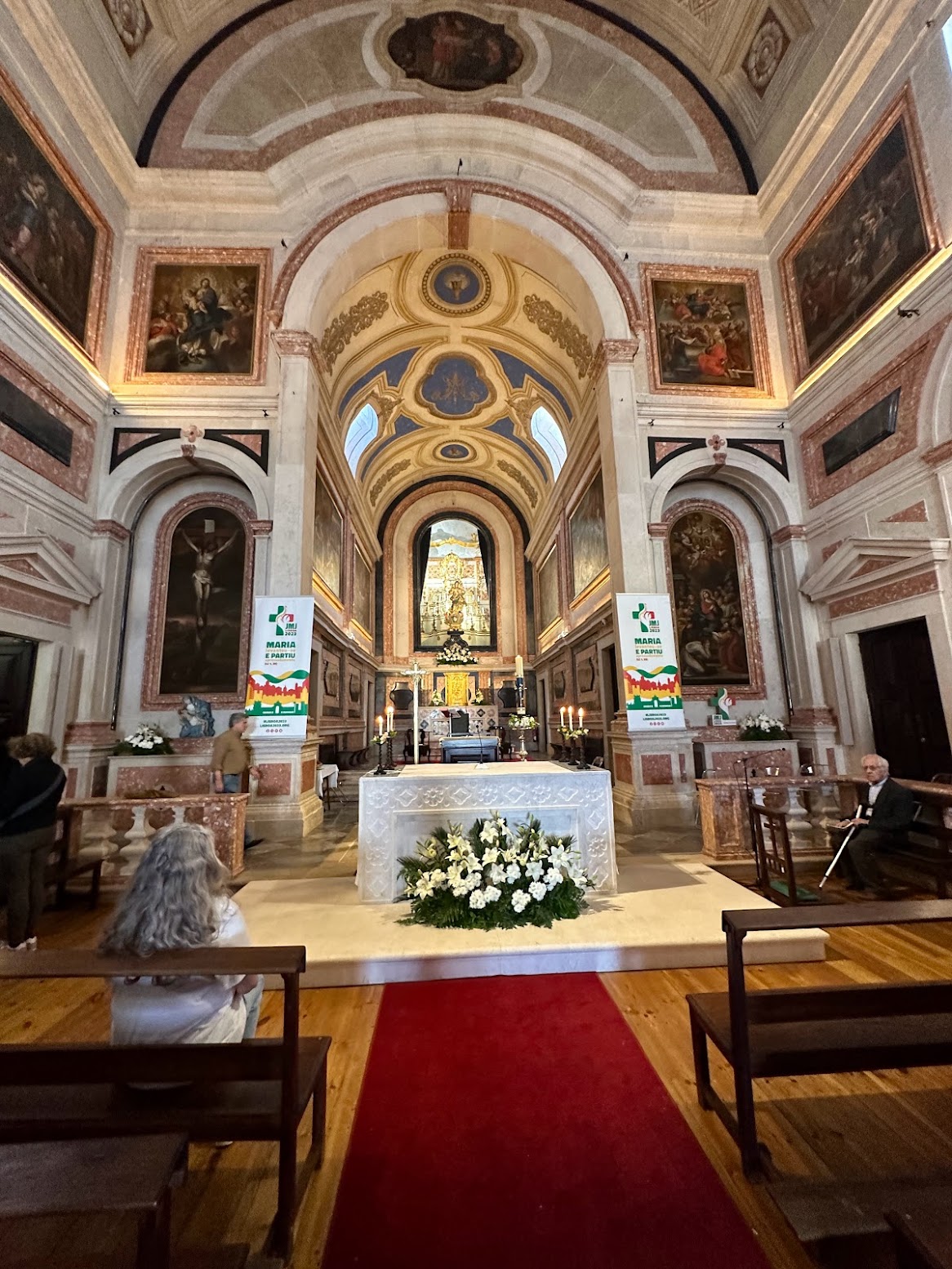
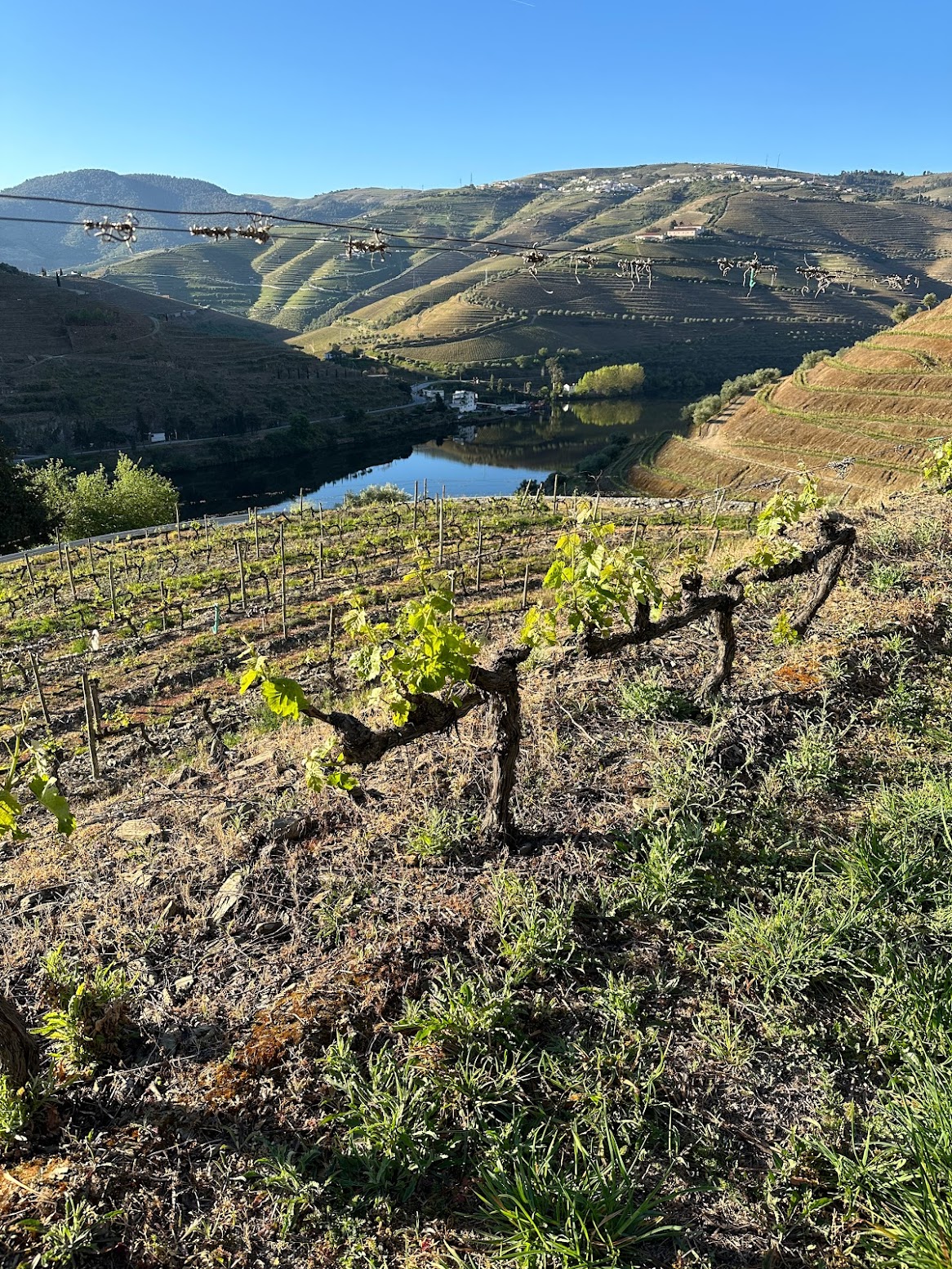
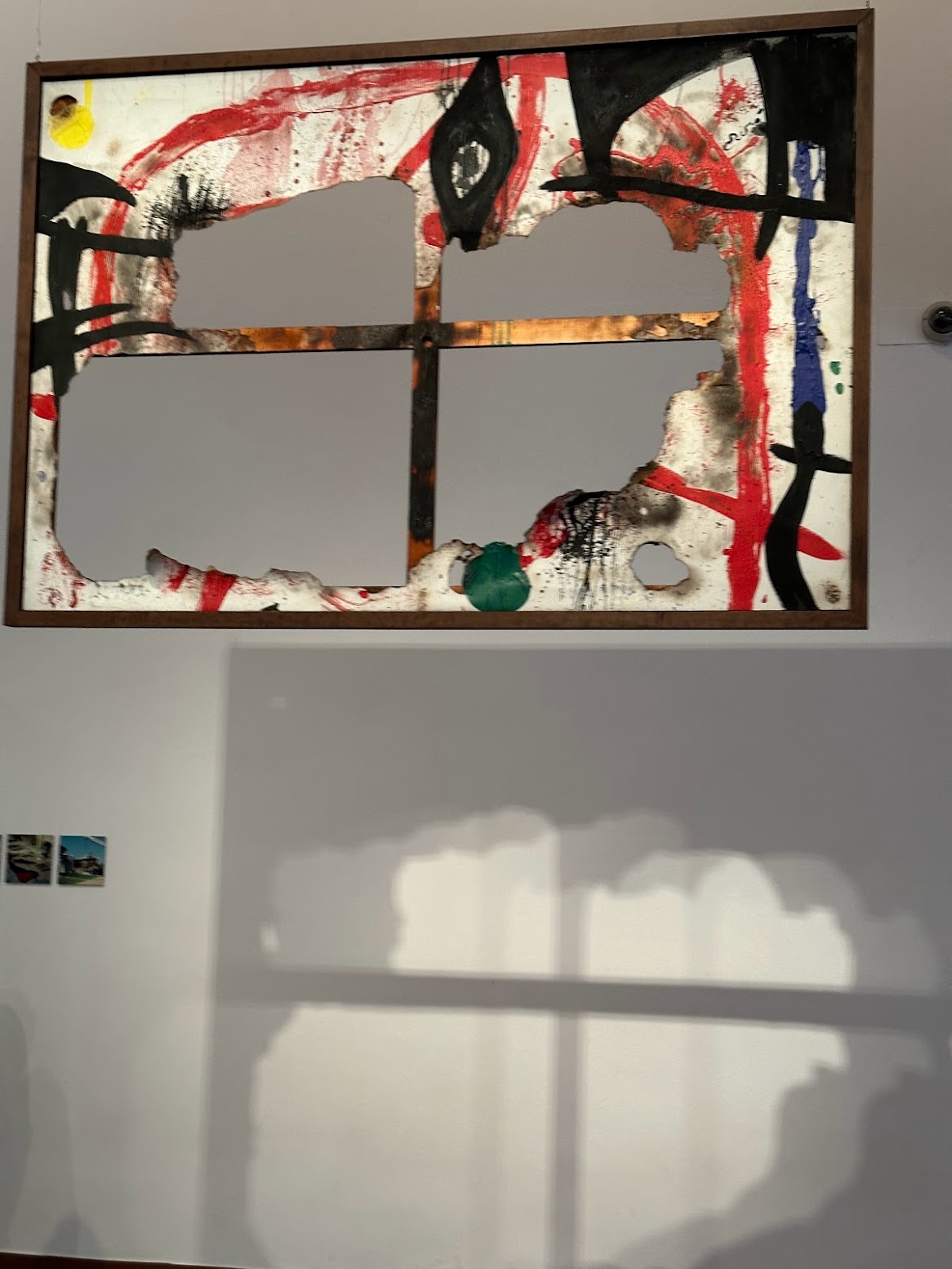
Three of the surprises on our 2023 trip to Portugal and Spain were a local parish church in Oeiras Valley Portugal, a steep hillside vineyard in the Douro Valley, and a unique work of art by Jean Miro in Barcelona.
We wanted to stay away from the bustle of Lisbon, yet be close enough to visit by commuter train. Little did we know that the Oeiras Valley was the “Silicon Valley” of Portugal. Yet, when it came time to attend Easter Mass at the local parish church, we were awed by the art and vibrancy and colors that surrounded me as I listened to the mass in Portuguese. This church was just a small out of the way gathering place, yet as awe inspiring as a great museum.
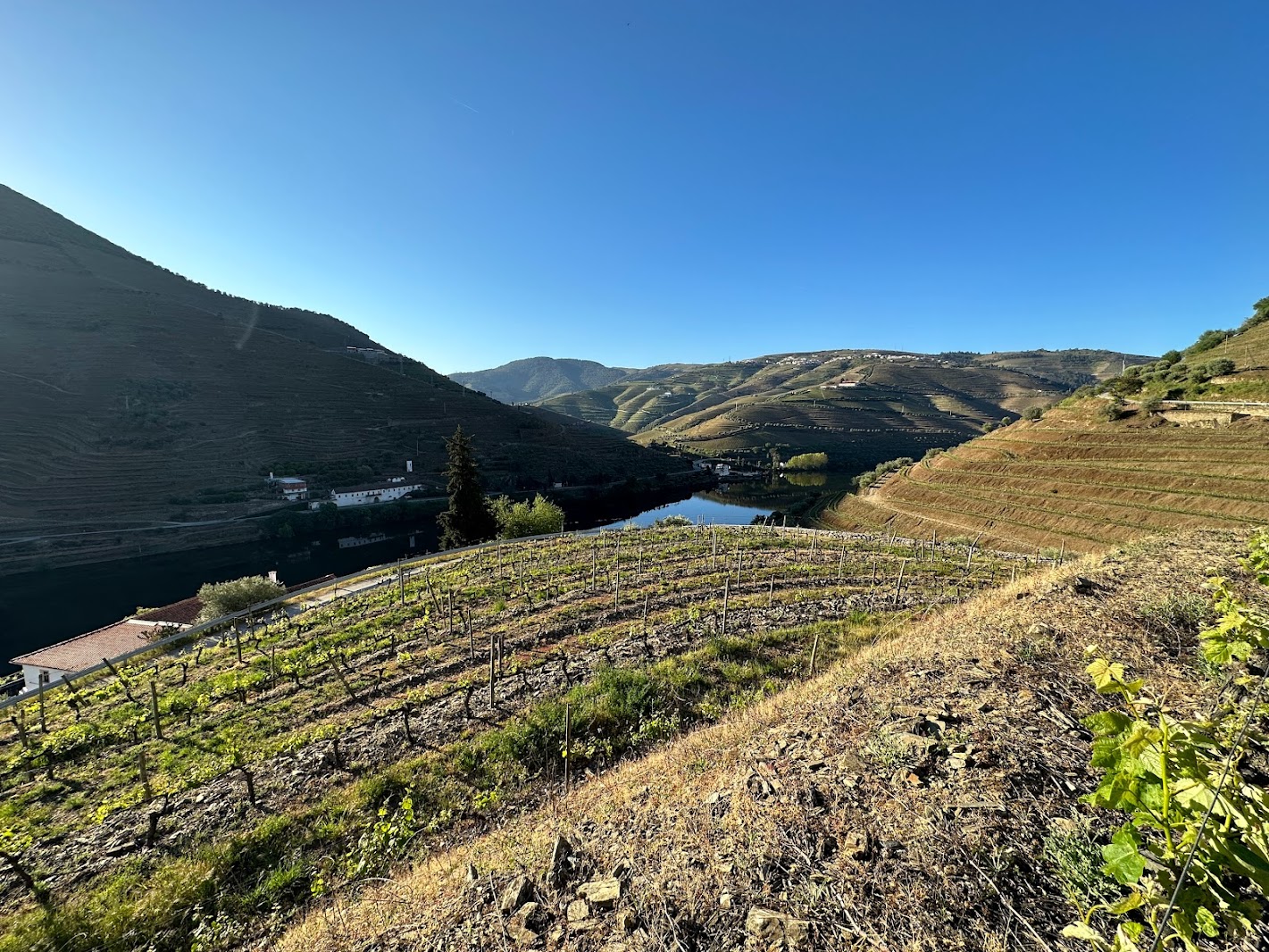
We drove north to Porto and to a stay at a winery up the Douro Valley. Nature has a very different color scheme than the works of man. As I walked up the steep hillsides the leaves were just starting to emerge on these 70 year old vines. In every direction I looked there were vines covering the hills just emerging into the springtime. The greens of the vines merged with the dusky browns of the rocky hillsides. This intersection of natures geological forms and man’s tending of the vines in their regular patterns shower my eyes with color.
After touring through many great cathedrals in Portugal and Spain, we ended up in Barcelona at a museum collection of Jean Miro. This “anti-painting” and its shadow mesmerized me for 30 minutes. I couldn’t leave. I really didn’t want to know what it was about or Miro’s meaning. I had never seen a “creation” and its shadow that so captured the colors and shadows of Europe.
I travel to find these juxtapositions of color and pattern and shapes that man and nature and creators share with us.
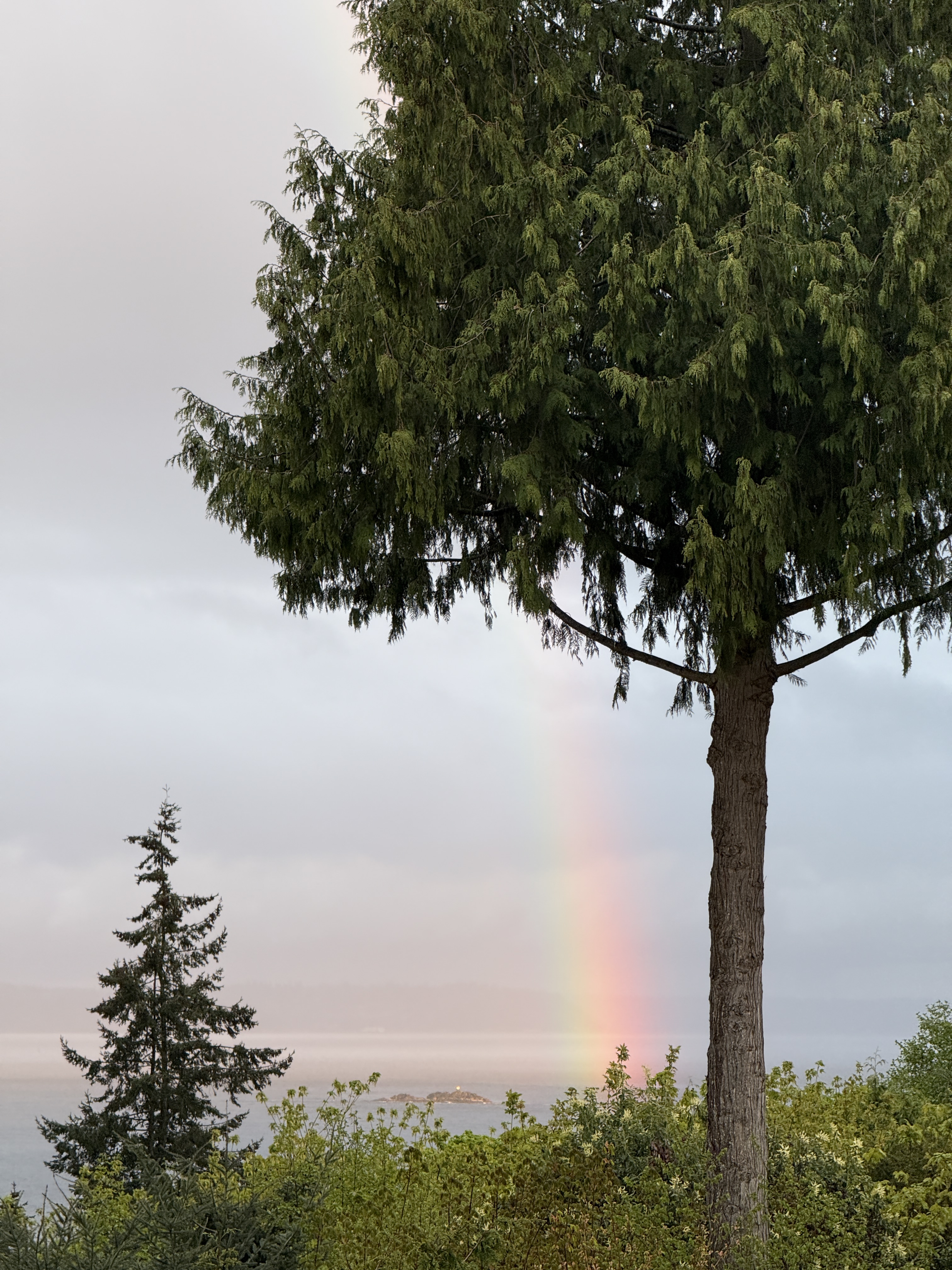
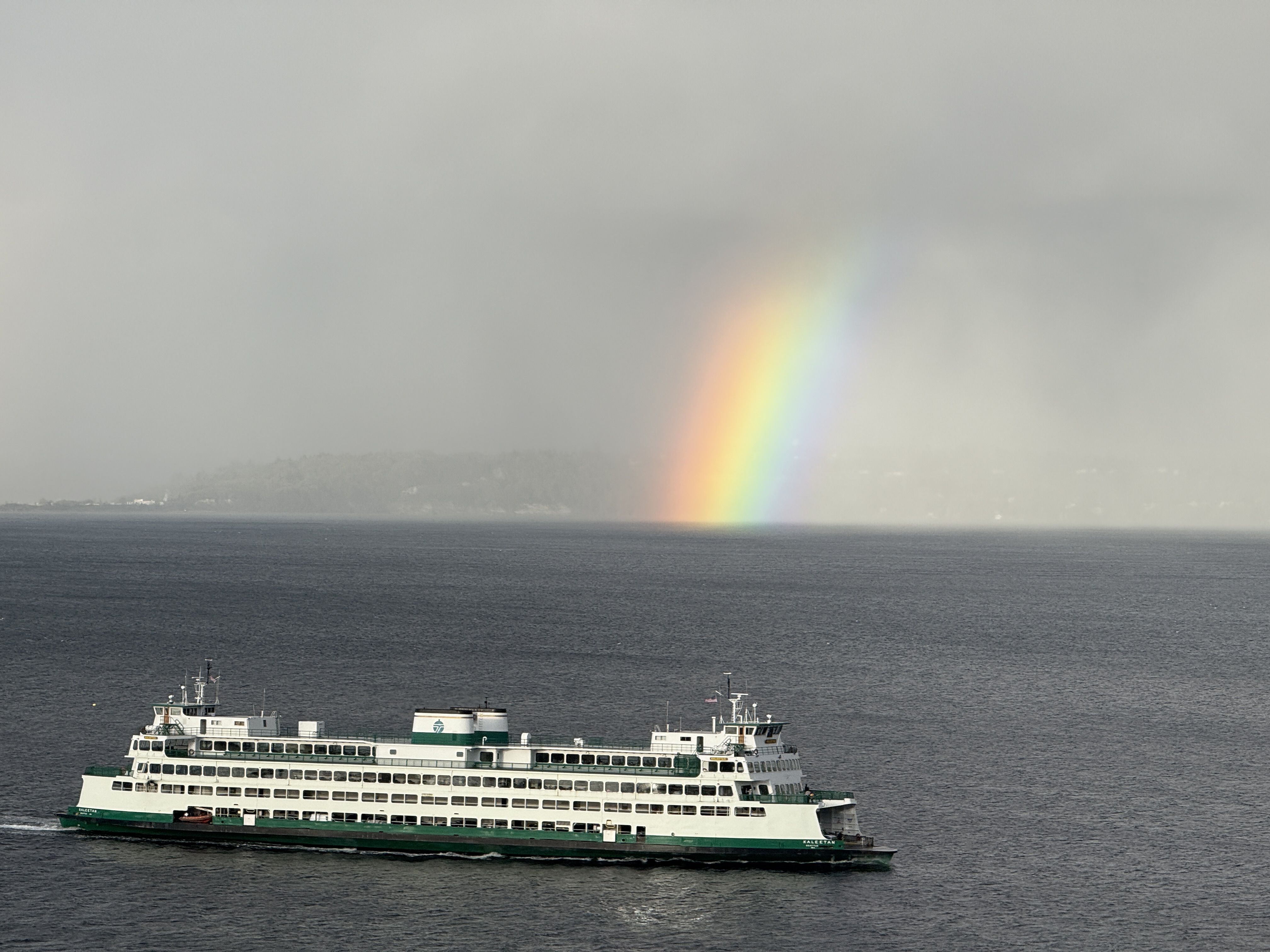
Yesterday a rainbow appeared in a place we’ve never seen one before – behind a tall tree on our island’s bluff.
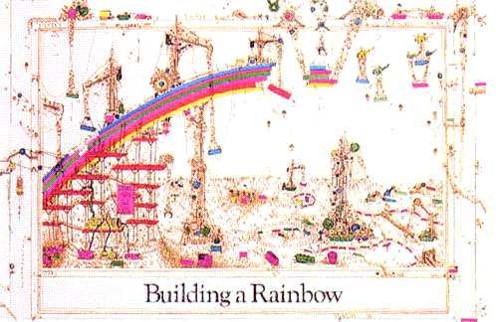
A very long time ago a colleague gave me one of my favorite images – Building a rainbow.
It had never occurred to me that I could build a rainbow.
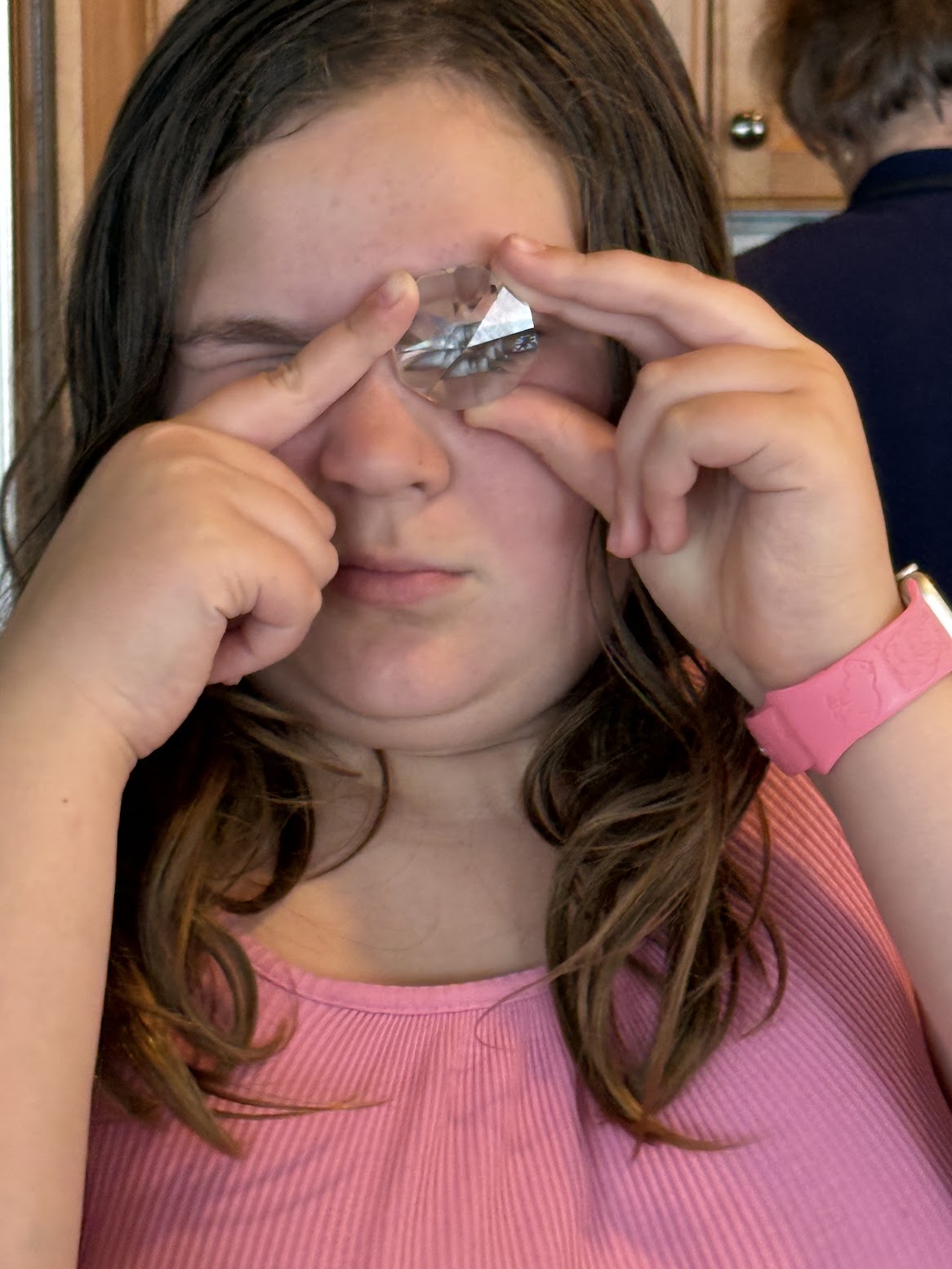
Yesterday my oldest grand didn’t want to wait for the heavens to build a rainbow outside after a rainstorm. She went seeking for them inside our kitchen as she worked with her grandmother on an Easter bunny cake.
Somedays the rainbows are very faint. Some days the rainbows are bright and bold.
Always the rainbows are meant to be enjoyed for the few minutes that the sun breaks through the clouds and drops of rain.
In this time of darkness that our country is suffering through as we are lead by grifters and felons and mental midgets, I need the rainbows to remind me to always hope.
While we waited for the rest of our tour to show up, I looked up the Palladino website:
“An ancient building in the center of Serralunga d’Alba, where the vocation for wine-making is rooted in the past that our winery still preserves tones of today.
“The tradition lives on in a working method that respects the time of the wine, in the long process of fermentation, and in the choice of materials capable of enhancing the characteristics of the grapes, without ever altering their nature.”
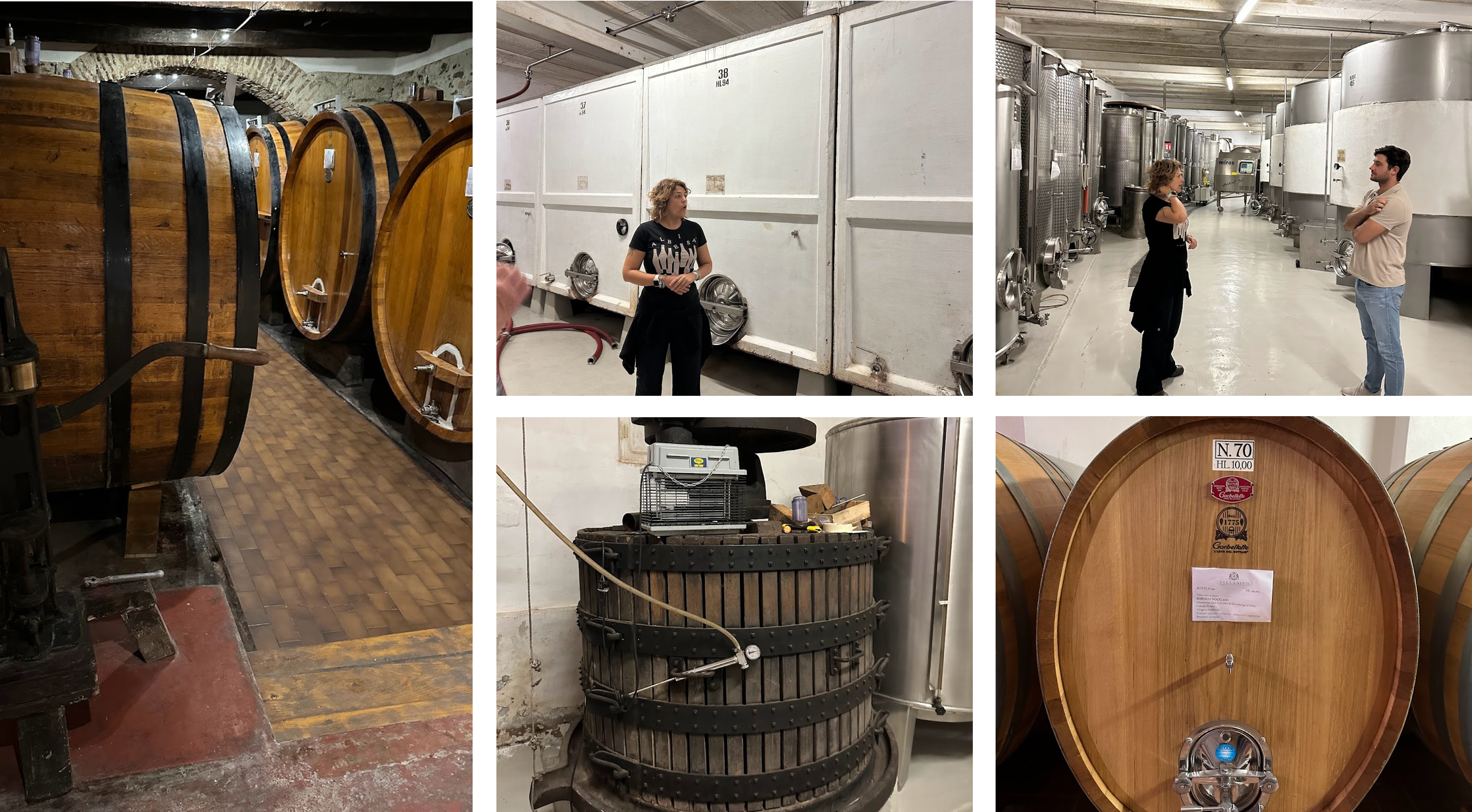
What a great foreshadowing of what we were to experience. Veronica, one of the family owners, greeted us and provided a fantastic tour of the subterranean and quite old cellars (even though the winery was started in 1974).
We slowly made our way down to the cellars with Vernoica explaining each step in their process of making wines. As we got to the lowest part of the winery, the opening in the brick cellar wall allowed us to break off and sample the clay that lies under the vineyards in the Serralunga d’Alba area.
Cellars of Palladino Winery in Seralunga d’Alba
I was fascinated once again by the mixture of the very old and the new in this region of wine for the kings. Now to taste the fruits of Veronica’s family labors.
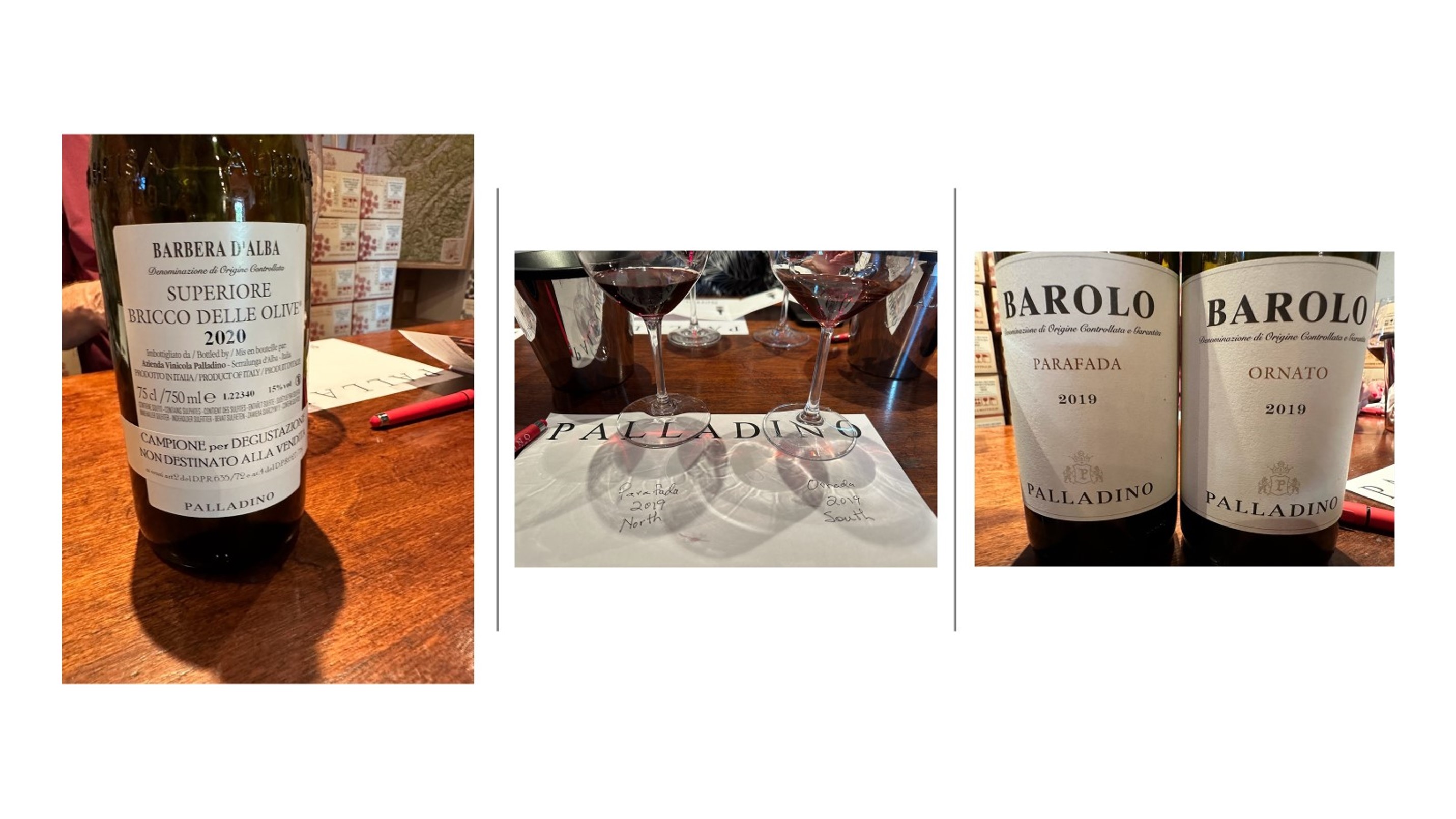
We adjourned to the tasting room by wandering back through the winery and the bottling room. As we tasted through the many Barolo and Barbera wines that Palladino had to offer, Veronica shared the backgrounds of the vineyards that Palladino owns.
Description of the Barbera Vineyards
The wines were luscious. We quickly decided that the Parafada and the Ornato wines were what we would order and ship home.
I can’t resist capturing the light that flows through a crystal wine glass that has a red wine inside.
We are deeply appreciative of Pier and the great folks at OneOnTheHill for creating a wonderful experience in the hills of the Piedmont Italy region. Their enthusiasm, knowledge and knowing where to visit added another layer of depth to our wine knowledge.
As part of planning a trip to the Piedmont and Tuscany areas of Italy in October 2023, I came across OneontheHill Homes. I reached out to Chiara to find out about the homes. They all looked inviting but were outside of my allocated budget. However, as I looked through their website I found that they provided Sommelier Wine Tours and Cooking Classes.
As I perused the “One Day in Langhe with a Somm” I was hooked. While touring Portugal and Spain, we encountered a very different process for visiting a winery than I am used to in Napa/Sonoma or Washington or Oregon. In the US, I visit a winery mostly to walk in the vineyards and observe their viticultural practices. Then, I go inside the tasting room to do a quick tasting of the wines. I usually find the tasting room servers know very little about the wines and their terroir. I just want to get a sense of the wine quality and maybe buy a few bottles. I rarely call ahead for a reservation.
When we got to Portugal and Spain, it turns out everyone wants you to have a reservation. They also expect you to visit for several hours and eat some food along with tasting the wine. On our Italy trip, I decided I needed an education on how to visit a European winery. The more I looked at the OneOnTheHill somm tour, the more I decided I would engage Pier to guide us on our tour. As luck would have it, Pier was guiding a wine club couple on our arranged day, so we got to meet Nicola.
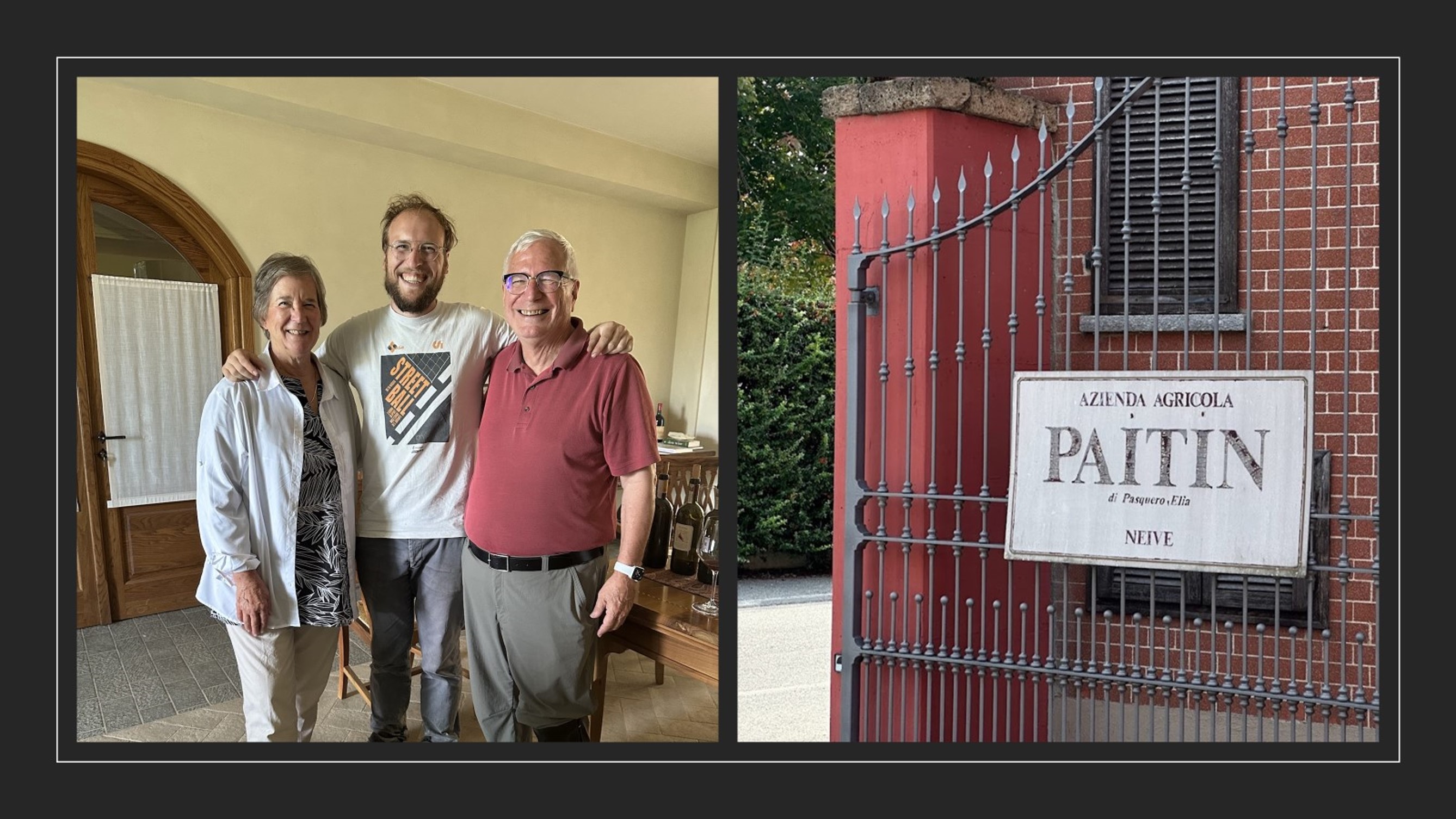
Pier and Nicola at Paitin
Nicola picked us up at our agriturismo (Cascina Barac) and drove us to our morning winery visit at Paitin in Neive, Italy. The winery was founded in 1796. Luca is the 8th generation of the Elia family to carry on the art of wine making.
Luca welcoming us to Paitin
In the small world synchronicity, Luca had just arrived back in Nieve from Seattle where he was meeting with his US wine distributor.
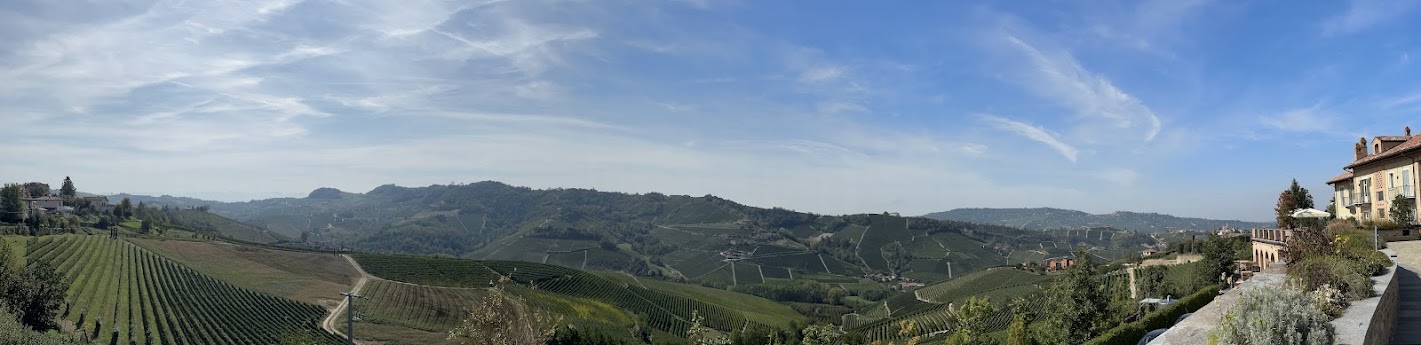
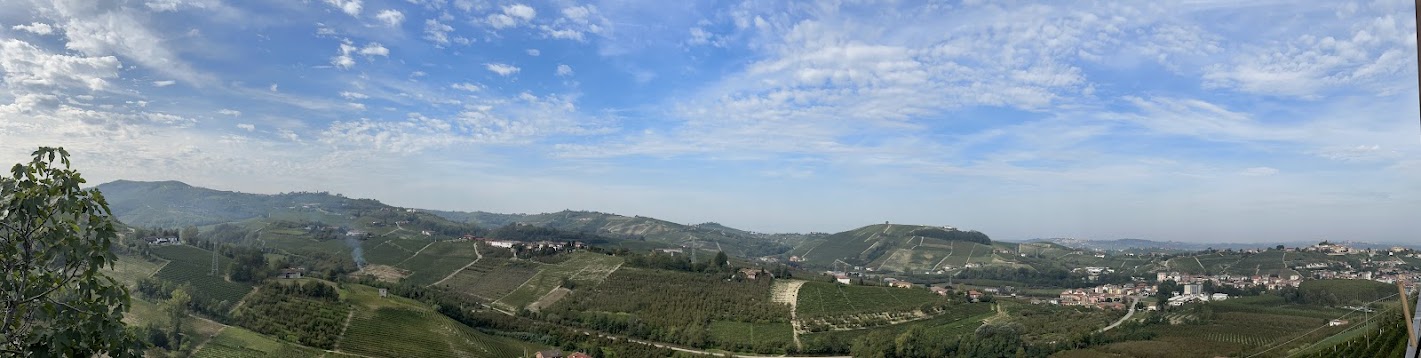
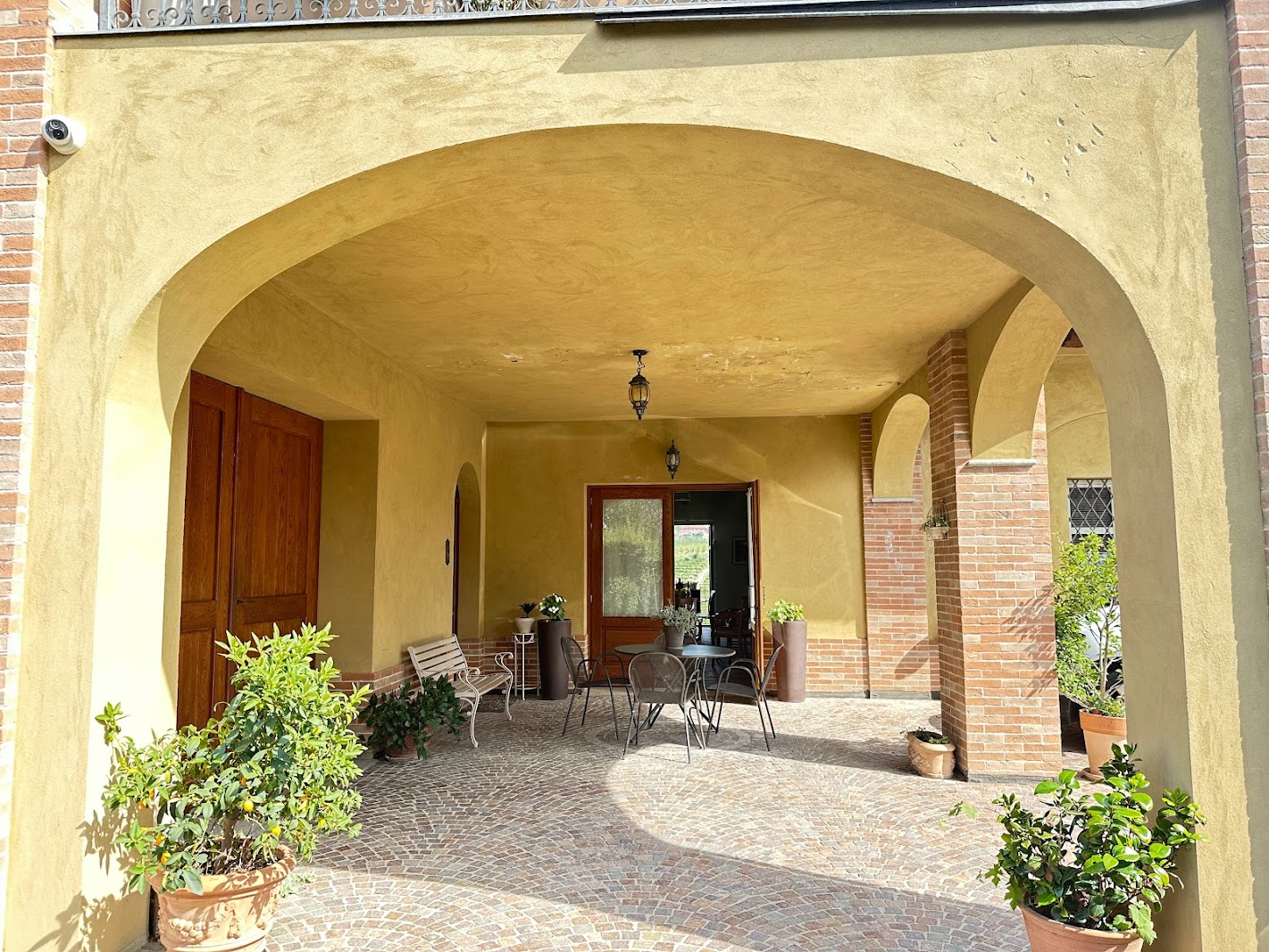
We started our tour on the patio overlooking the hills of Barbaresco. As with most of the Langhe region, there are vineyards in every direction.
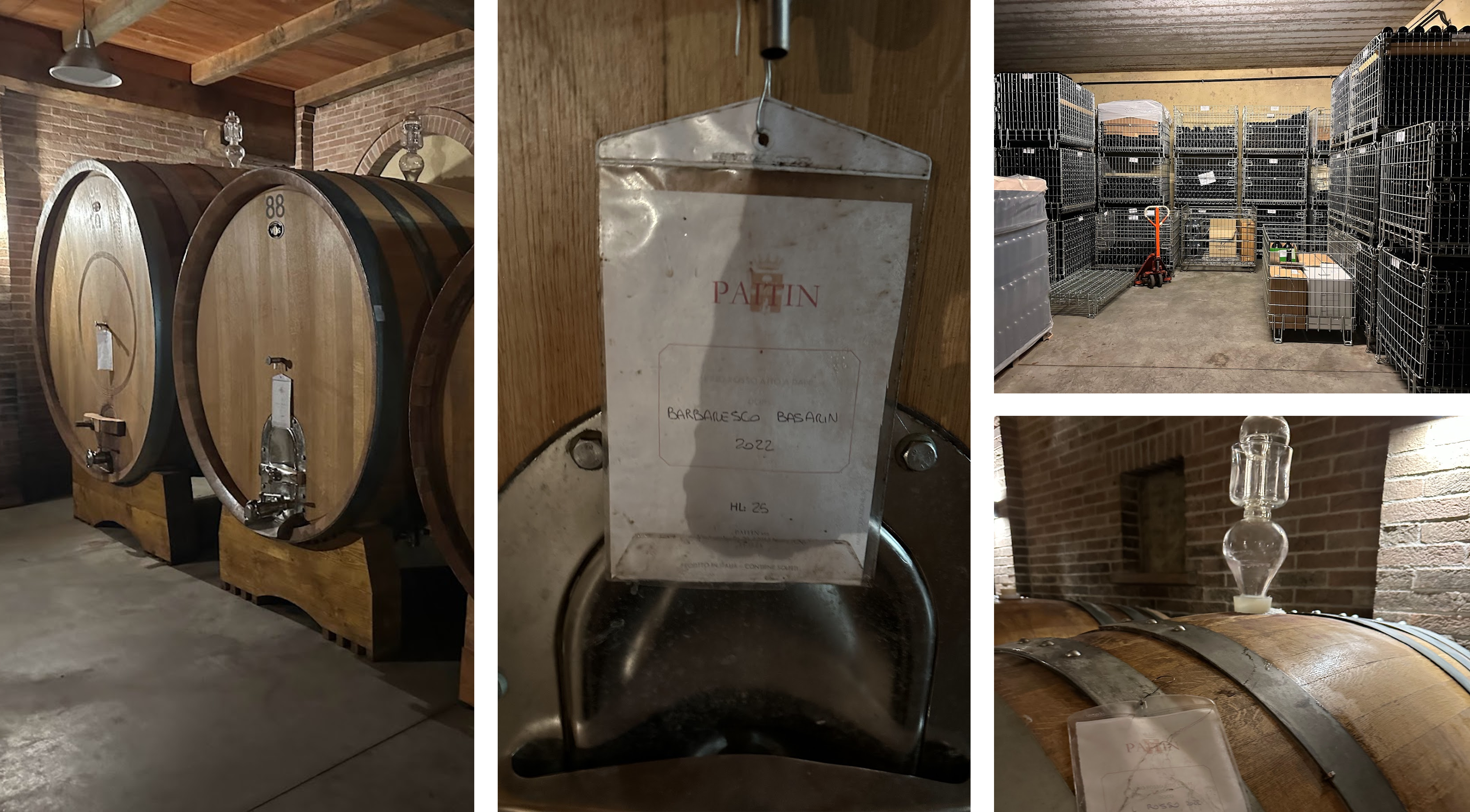
The tasting room manager took us on a tour of a blend of the old and new in winemaking.
The history was fascinating, but I wanted to taste the artistry that this multi generation family puts into their wines. We adjourned to the tasting room.
Presentation of “place” for the Paitin vineyards
As we were introduced to the many fantastic wines, we also experienced a new Riedel glass variant for Nebbiolo.
The wines were fabulous. We realized that this was going to be an expensive wine tasting as we had to ship back home some of this wine and acquire some Nebbiolo wine glasses.
Even though we were only halfway through our day of wine tasting, I knew we had to join the OneOnTheHill wine club. We were only going to experience two wineries in the Langhe region on this day. The wine club would allow us to experience several more each year.
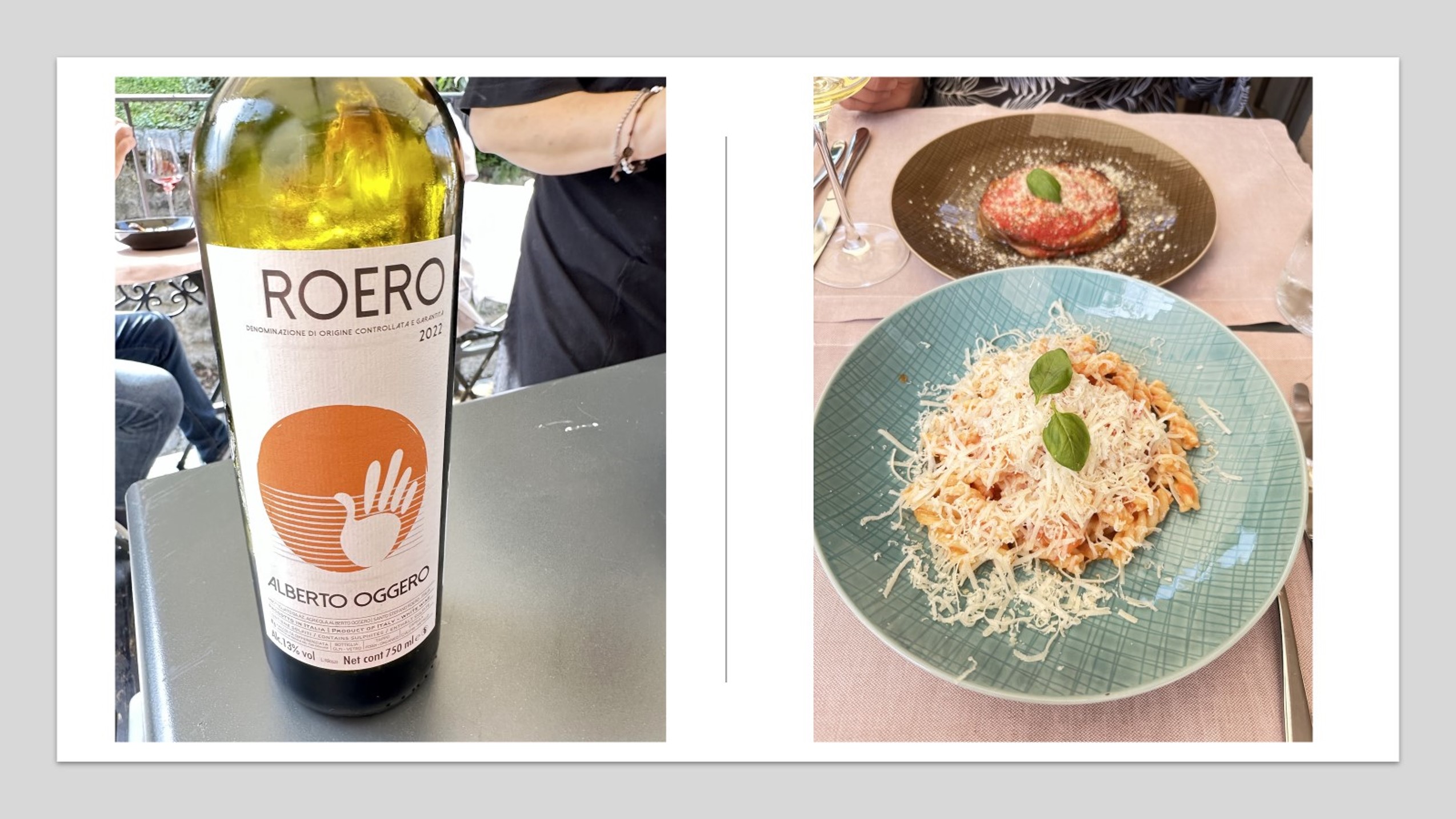
What do you do after a fabulous morning wine tasting in Barbaresco? Have an amazing Italian lunch in Barolo. After drinking red wines all morning, it was time for an interlude with a white wine (Arneis) from Roero. Our sommelier, Nicola, dropped us off at a restaurant in Seralunga d’Alba near where our afternoon wine tasting would occur. My lovely bride and I enjoyed a tasty meal of pasta and eggplant parmigiana.
In the small world department, I received an email a few days later from our favorite Oregon wine seller, that they just received some Paitin Barbaresco:
95 points Antonio Galloni, Vinous: “A regal, elegant wine. Powerful yet delicate, with tones of understated power, The Sori Paitin is a textbook example of what fine Barbaresco can be. Sweet red cherry fruit, kirsch, mint, blood orange, spice, hard candy, and orange peel soar out of the glass, framed by silky yet incisive young Nebbiolo tannins. The balance here is just sublime. For my money, this is the Paitin Barbaresco to buy in 2020.”
Us: Regal elegance is the Paitin style—perfectly expressed through their flagship Barbaresco. Already singing gracefully and with a long long life ahead of it, take Galloni’s advice and ours: put your money behind this fantastic expression of Nebbiolo.
I immediately sent a note to Marcus Looze, Avalon Wine proprietor, to share that we’d just visited the winery. He responded:
“Yes, lovely people and wines. My last visit there was the afternoon of my arrival in Milan and Luca was wrapping up with another group so…I hung out with his father for an hour. He’s delightful but speaks mostly Piemontese (and no English) and I’m the opposite, so it was quite an hour. We circled back to the picture of John McCain they have displayed many, many times and he would say “John McCain” and it became a universal bonding language as we sipped wines.”
No matter how far we travel, we continue to be amazed at what a small world we live in.
The prompt I used was “Riding a train in the Douro Valley in Portugal to go for a wine tasting.”
Pretty darn close. And it picked autumn for the ride. In practice, the actual train is much lower on the valley hillside, but a pretty cool video for a first test.
Here is a photo as I walked through the vineyards high above the actual train tracks in April 2023.
The Douro Valley is a beautiful place. The wines are even better.






 On the Way to Somewhere Else