Working in Teams – Part 2

While I was at Aldus (now Adobe), we worked with an organizational consultant (Bob Crosby) to improve our organizational effectiveness.  One of the better tools that Bob brought to the organization was the Ask and Tell process for transitioning between managers within an organization.  Bob had come across this technique while he was consulting to the US Navy.  It is standard for the Navy to rotate Captains between naval ships on a relatively frequent basis (every 1-2 years).  During one of their organizational effectiveness studies, the HR department noticed a disturbing pattern.  For those ships which had high overall effectiveness ratings, every time they switched captains the ship’s effectiveness plummeted on average for six months before returning to their previous high levels.  The Navy started a study to understand why.

In summary, what the study found is that every ship’s captain has their own unique leadership style and unaided it takes a while for a ship’s crew to adapt to the new captain and for the captain to adapt to the unique capabilities of each crew.  Through experimentation the Navy found that the simplest of processes shortened the performance gap from six months to about two weeks.

The following section provides a little bit of theoretical background and a model for how teams perform at high levels in order to set a context for the Ask and Tell session.

There is a great deal of discussion about team work and team building these days.  So much so that the assumption is that everything must be accomplished within a team.  The art of teamwork is knowing when to engage in the team process and when to perform as a collection of individual contributors.  The short form answer to this is if one person can accomplish the task don’t invoke the overhead of a team.  Part of the advance of technology is improving the tools so much that a single person can take on quite involved and complicated tasks with appropriate tools.  Teams are most useful for those situations where a single person does not have the capability or capacity to tackle a problem by themselves.  A team is useful when a multi-disciplinary approach is needed or when there is a period of high change.  The collective wisdom of a group is powerful for making sure that diverse viewpoints are incorporated and for seeing patterns of change that a single discipline might miss.

While there are many situations where teams are useful, there is a clear overhead or cost for working in a team.  Those of you who have studied communication theory or played the children’s game of “telephone” know that the longer the chain of communication, the more “noise” is injected into the signal.  The most effective communication occurs when the ideas don’t have to leave the brain of an individual.  The additional cost of a team versus an individual can be summarized in the three concepts:

  • Communication
  • Coordination
  • Change Management

While there are a host of technology devices that are useful for communication (electronic mail, the world wide web, Lotus Notes) and coordination (project management tools, Lotus Notes), the challenge for a team is to remember that these tools are not the whole answer.  Communication is the results that you get, not the words that you speak.  So often we think that if we utter a string of words, that the meaning of those words is clear and that the intended actions will result.  Indeed that is true of a team that reaches the performing state, but it is not true of teams that are in the formative stage.  Words mean something but almost never the same things to two different people.  As we get into more and more abstract concepts or into the realm of creativity where we are trying to bring something into being that never existed before, surrogates and metaphors are the medium of exchange.  These surrogates are very difficult to accomplish through the written word or even through illustrations.  It is the power of the full communication and presence of the individual that makes the ideas come alive and communication occur.

Coordination requires that tasks be identified, defined, sequenced, and distributed to people with the skills to carry those tasks out.  This requires planning and attention.  If I’m the only one that is involved in the task I can easily bounce from situation to situation because the context is always with me.  The minute someone else is involved it is very non-obvious what I’m doing, let alone why, let alone in a particular sequence.  Part of coordination is also being clear about the nature of any communication that is occurring.  John Searle as part of his speech-act theory suggests that we be more explicit about what a communication is about.  For example, is this document a conversation about possibilities or one that requires action?

Change management is about helping the team participants change the way they behave for the duration of a project or of a task.  Change is about understanding how we ourselves go through change and how our team members go through change and how the recipients of our product and services go through change.  Fortunately there are well developed bodies of knowledge for each of the three concepts:  communication, coordination, and change management.

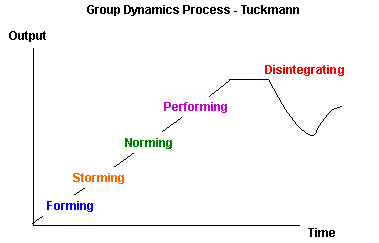
A model that I find helpful for thinking through the stages of team development is:

  • Forming – the establishment of identity, purpose, outcomes, and roles
  • Storming – the coming to grips with the scope of the task, the capabilities of the individuals, the shared values and the meaning of the roles that each person is expected to perform.  This is the start of the change process.
  • Norming – acceptance of each person’s role and specificity of the work to be accomplished
  • Performing – each person performs in their role to accomplish the desired tasks.
  • Mourning (Adjourning, celebrating) – acknowledge completion of the task and affirm the efforts and performance of the team members.
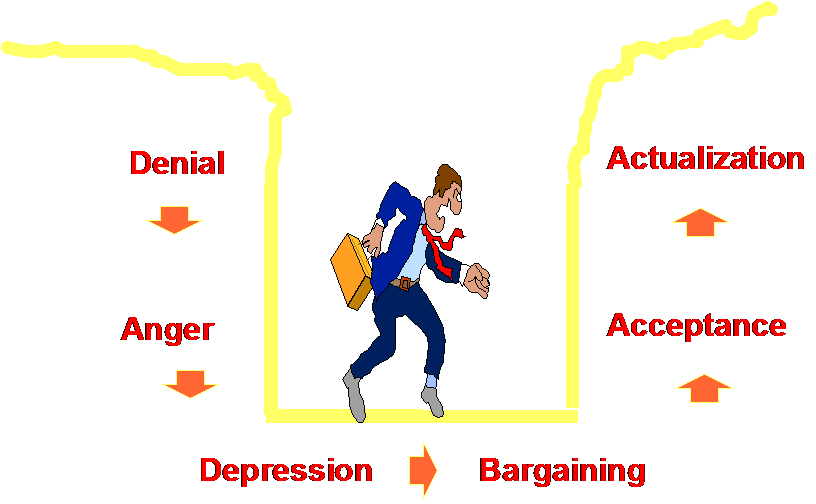
A more complete model that draws on the insights of Kubler-Ross  in her seminal work On Death and Dying:

Stages                                              Leader’s Actions

  • Forming                                       Goals and Roles
  • Storming
    • Denial                                     Confront
    • Anger                                     Contain
    • Depression                            Collaborate
  • Norming
    • Bargaining                             Clarify
    • Acceptance                            Catch Winners
  • Performing
    • Actualization                        Celebrate success
  • Mourning                                    Acknowledge and affirm

The leader’s job is to keep the team moving through the process.  Things to remember:

  • Any time a person is added or subtracted to a team, the team starts over at forming.
  • Any time roles change or shift, the team starts over at forming.
  • People cycle and recycle through the change stages (denial, anger, depression, bargaining, acceptance, and actualization)
  • Men and women tend to behave differently, especially with respect to anger/depression.
  • It does no one a favor to allow them to stay “stuck” in one stage or another.
  • It does no one a favor to allow one team member to “contaminate” their colleagues with their negative feelings.
  • This is very hard work and you MUST take extra good care of your mind/body/spirit at the times of high stress during the storming and norming phases.

A more complete description of the change stages is provided by Bob Watt, formerly Deputy Mayor of Seattle, President of the Seattle Chamber of Commerce, VP of State and Local Government Relations at Boeing and currently Board Member at Group Health cooperative:
Reaction    Response

   Denial               Confront

The evidence that an individual or an organization is in denial about the need to undertake a change process can vary dramatically.  From the relatively subtle to the remarkably dramatic, the human capacity to face the need to go through a change process by denying that the need exists at all is remarkable.  A friend’s father, to cite a relatively dramatic (and personal) example, walked out of an appointment with his radiologist, where he had just been told that his lung cancer had not responded to the radiation therapy and told his family that the tumor was gone.  At that moment he fully believed what he had just told us, he was not seeking to “protect “ us from the news.  The organization that fails to continuously scan the external environment, work hard at helping it’s people learn new skills and consistently reinvent it’s future via some form of goal setting process, is engaging in a (perhaps) more subtle form of denial about the need to change.

It does no one a favor to leave them in a state of denial when they have to face a change.  The change managers job is to plan and carry out a response appropriate to the intensity of the denial involved.  The “confrontation” has to be done with great respect and a genuine sense of caring.  If the change manager is bearing any anger at the individual or organization that they are seeking to confront, they must shed that anger before the process begins.  If they do not shed their own anger, they risk reinforcing the denial.   The confrontation can be as “gentle” as hiring a consultant to review the competition and suggest several response options.  Or it can be much more direct, such as gathering a group of family and friends together to tell a substance abusing person that they love them, but will no longer tolerate the behavior and they want that person to begin a course of treatment right now!

Timing is important and so are “people” and place issues, but leaving someone in a state of denial, without having made any attempt to confront them, is simply not helpful.  An individual or an organization which later discovers that you decided not to help them face something which needed to be faced, is unlikely to be grateful.  Denial is a powerful reaction and should not be underestimated.   Some individuals/organizations get stuck in this mode and never break out, but the change managers’ job is to try to keep the process moving.  Goals set by individuals/organizations in denial often bear astonishingly little relationship to the actual situation.  They may be wildly optimistic or just plain “off the mark”.

Anger            Contain

The feelings of anger that occur when unexpected or unwanted (often the two are the same) change enters a life can be intense.  They are a normal, natural (some will argue biological) response to the stress that comes up when facing the unexpected.  Generally this anger manifests itself in one of three ways:

  • Direct verbal lashings out at other people, often for “reasons” that bear no overt relationship to current events.
  • Deep and consistent cynicism and disrespect directed at the people who are perceived to be the “cause” of the need to change, often behind their backs.
  • Self destructive, impulsive acts, out of character with prior behavior.

Combinations and permutations of these three basic patterns attest to the variety of human spirit.  It should also be pointed out, that some individuals faced with unwanted change react with violence.  Change managers must also be aware of this potential and be prepared to protect themselves and their people from this possibility.

Regardless of the nature of the manifestation of the anger, allowing it to persist for a long time is not helpful.  People who get stuck in the anger phase of this process are hard on themselves and usually everyone else around them too.    Specific to our topic, the evidence is piling up that angry people are expensive people, medically speaking.  The toll that child and spousal abuse exact on family members is quite high.  Non (physically) abusive people exact a real toll on people too, but they also do much long term harm to their own well-being.  When someone is stuck in anger, it is the change managers’ job to work to contain that anger, because the act of containing the anger helps move the person through the process.  Containment strategies vary, depending on the nature of the situation and the individuals involved.

Sometimes the anger can be mobilized into productive efforts.  A person with an unexpected and unwelcome assignment to a new team often will move quickly out of denial and into a form of anger that focuses his/her attention on “proving” that the reassignment is wrong or inadequate.  The change managers’ response is to act as a knowledge navigator, steering the efforts so that the individual conducts a broad-based exploration of the options and does not prematurely or mistakenly foreclose reasonable and effective solutions.  This form of containment is very effective in many circumstances.  Certainly for an organization, a change manager can sometimes turn the anger aroused by an unwelcome need to change into a dynamic strategy to develop a new understanding of emerging competition so that “we can beat those people at their own game.”  When initial attempts to contain the anger into productive outlets fail, it may be necessary to take a more direct approach to the situation.

A fairly common and successful strategy with an individual is to sit the person down for a brief “heart to heart” that might go like this:  “You know Bob, I understand that you are really mad about this change.  However I think you are stuck and the fact that you are spreading your anger out to so many people is not helping you cope with this change and it sure is not helping them.  So from now on, when you feel like saying angry or critical things about the way things are going you will say them directly to me and in private.  I will call you once a week and you can tell me everything you are mad about when we talk.  If you persist in spreading your angry feelings around to everyone else, I will take further steps to help you better manage your feelings.”

Another useful strategy for someone stuck in anger is to help him or her get involved in a formal change process like psychotherapy.  Often people who get stuck in this part of the process have reasons that transcend the current reality.  There can be real value in a careful contained expression and exploration of the anger in a psychotherapeutic setting.  For some people psychotherapy, with a well trained professional, is the only real option to move from this “stage”.  Sometimes group approaches such as anger management classes or groups for abusive spouses or parents can be very helpful and for some individuals the life long 12-step process these groups typically offer is a genuine help.

If the person you are dealing with is an employee, you may need to make an EAP referral, or to actually move into your progressive discipline process to help them get unstuck.  Goals set, if any, by an individual/organization at this point in the change process often reflect cynicism or outright hostility.  This is a stage where a change manager may have to be very directive in the goals setting process.  Participant or employee, efforts to move someone through this part of the process can be difficult, but are essential if they are to have a chance to return to feeling more in control of their life.

An organization stuck in this phase of the change process is truly an unpleasant experience for employees and customers alike.  The atmosphere is openly hostile, “war games” are an every day occurrence and little effort is made to set or reach positive goals.  Less full blown manifestations of this stage of the process occur frequently in care giving organizations where the workload is crushing and the support for existing personnel is very low.    In either case it is best to bring in an outside person to help the organization begin to contain the anger enough to move itself through the process.  An “internal” change agent is less likely to be able to maintain effective long term working relationships with their colleagues.

Depression         Collaborate

 The signals that an individual or an organization is experiencing this part of the process can vary dramatically.  Full-blown clinical depression episodes can be triggered by an unexpected need to change.  Episodes of sleeplessness, failure to eat, inability to enjoy formerly pleasurable activities, inability to concentrate, increased disorganization and even suicidal thoughts and plans are to be watched for as a signal that a serious clinical depression is underway.  Thoughts and feelings of this magnitude need to be attended to by a well-trained mental health professional.  New anti-depressant medications are often very helpful to someone in a full blown clinical depression.  More commonly, an individual or organization stuck in this part of the process will manifest feelings of powerlessness (“nothing I do really matters”) or hopelessness (“I really don’t see how I can effect the outcome of this situation”).  They will also generally demonstrate low energy, increased feelings of isolation, lack written goals and will spend more time on process and less time on outcomes.

Though many change managers find this depressive phase easier to tolerate than anger or denial, leaving an individual or organization in this phase for a long time has serious consequences.  Even low-grade depressive episodes take a physical toll on individual health and an organization mired in depression is not just an unpleasant place to work, it is at high risk for mistakes and failures.  The manager’s response is to find an important and achievable goal that can be set in collaboration with the individual group experiencing this part of the process.  Furthermore the manager needs to be directly involved in the accomplishment of that goal.  I mean this quite literally: if it is a group that is stuck in depression, having the manager and team working side by side to achieve something has the potent effect of reducing isolation and increasing people’s feeling that they can be successful if they collaborate on a task.  The task could even be extra-organizational like participating in some community service work.  Physical exercise has been found to be a useful anti-depressant, so group efforts to walk or run together or work together to clean up a park are a particularly valuable collaboration approach.

Bargaining        Clarify

 When people involved in a change process start to negotiate, it is a very good sign because it means they are starting to try and regain control of the process.  They have begun to accept that the change is necessary and they are seeking to put their own unique stamp on the process by finding ways, large and small, to effect the outcome.  Whether they are seeking to bargain with Upper Management for a little more time, or to bargain with you as manager for some change in their routine, the meaning of the bargaining is that they are now trying to become a part of the process, because they have started to accept the need to change.  It is an important and delicate stage in this process and if the manager is not properly prepared for this moment it is very easy to throw the team or individual back into anger and/or depression.

The preparation needs to be in two dimensions.  First the manager has to be in good emotional shape themselves, because if they exhibit their own feelings of anger, frustration or powerlessness now it is a safe bet that the team or client will immediately join those feelings and much damage will be done to the nearly completed process.  Second the manager has to be crystal clear BEFORE the bargaining begins what goals need to be reached as part of this change process.  This clarity is needed because the bargaining, whether overt and organized (as with a labor union over new working conditions) or subtle and casual in appearance (I’d like to ask you to help me with…) must result in a new set of circumstances that both parties to the negotiation feel are acceptable to them.  Negotiations are often about the nature, type, duration and the level of challenge of the goals the individual/organization is about to set.  This is a moment when a person’s mind and spirit is more easily engaged in the process.  Participant education materials may be utilized at this point as information to assist the negotiation.  Regardless of the nature of the negotiation, nothing kills a negotiation more quickly than one side being unclear about it’s goals.  So do whatever is necessary (research, consulting experts, asking top management for clarification, seeking advice from an experienced colleague) but be clear about the goals before this stage is reached.

Acceptance    Catch people doing things right

 The process is not yet done, but there is a definite feeling that progress has occurred.  Individuals progressing through the change process will not yet fully “own” their new status, but they are starting to feel less like a victim and more like a survivor.  You may hear them say things like: “well I never dreamed I would have to go through all that crap, but I guess I found out who my friends were!”  In an organization, the same sorts of feelings are reverberating around the coffeepots and hallways. “ I thought this was a totally bizarre scheme cooked up by top management to make us all look bad, but I’m beginning to think this is not such a bad idea after all.”

At this point in the process the manager is probably a little tired because of all the hard work undertaken to get things this far.  In this weary and vulnerable state, it would be very tempting to jump all over those kinds of remarks and even more tempting to try and stomp on some behavior that was an example of the “old bad behavior” (OBB) which was undoubtedly part of the reason that the change was needed in the first place.  The care managers job at this point is to absolutely resist the normal and understandable urges to focus (negative) attention on the OBB and to work very hard to (borrowing a phrase from the “one-minute” folks): catch people doing things right. 

 Think of it this way.  The manager has done everything in their power to keep the process moving towards actualization.  Things are actually getting there and everyone has some sense that progress has been made.  Focusing attention on extinguishing the remaining OBB sends a rather clear, if unintended message that the care manager is paying more attention to the OBB than the fact that there has been tremendous positive progress towards reaching actualization.  The real trick here is to keep the process moving towards actualization by sending a clear and important message that the “new right behavior” has been noticed and is very much appreciated.  Goals set at this point tend to be clear and relatively easy to accomplish as a reflection of people’s need to feel successful in the new environment they are creating.

Actualization          Celebrate

 This is the state we all aim to be in all of the time.  Though, sadly enough, some individuals have never achieved this state even momentarily during their lives.  Briefly put: actualization feels good!  We feel responsible and in charge.  We know where we are going even if we don’t know exactly how we are going to get there.  We appreciate how far we’ve come.  Our goals are clear and challenging.  We do not feel like victims of an uncaring universe, even if we are facing one of life’s most difficult transitions.  Instead we have made our “peace” with the need to accomplish this change at this moment and we are ready to see what comes next.  We are productive, we view outcomes data (even if the details are disappointing) as a welcome piece of feedback, giving us information to further improve our performance.

We typically feel stronger for the change we have been through, even if we still have some regrets about having to face this change.  We have a healthy perspective on the fact that other people may not have completed the change process yet and often we act as guides and supporters for those who have yet to finish the journey we have now completed.   This is the point when people move from participation in support groups, to leadership and mentorship roles.  Inside an organization any remaining OBB sticks out like a sore thumb and seldom needs management attention, because colleagues will make the intervention.  When an individual engages in OBB, their own new perspective on the matter usually causes a rapid realization of what is going on and a self-correction.  When that fails to occur a light touch reminder intervention from a friend or the manager usually precludes the full return of the OBB.

The manager who has been helpful in this transition is appropriately fading into the background as the individual or organization takes more and more of their own destiny.   However before disappearing from view the manager has one last important job to play in assuring that this change process comes to a useful conclusion.  When an individual or an organization has successfully completed the passage through a change process, it is the change manager’s job to insure that there is an appropriate celebration of that fact.

Accomplishing significant change is hard work and it deserves to be celebrated!  Individual and organizational cultural issues must be attended to in the process of carrying out this celebration, but a celebration, however small or large, must be accomplished in order to fully prepare the individual or organization for the next change.  For distributed teams, the celebration may involve two people shouting “yahoo!” at the same time while on the phone together, or a written letter of  “graduation” complete with appropriate celebratory words.  For an organization the celebration may be just a pause at the regular meeting to clap and cheer, or it may be a more organized (and expensive) formal celebration complete with food.  Too often life’s difficult changes go by without any recognition that the passage has been successfully traversed.  If the real goal of organization change is to assist individuals and organizations in moving into a continuous improvement mode (and I for one believe that this is the real goal), then all important changes that lead towards that goal must be recognized, reinforced and enjoyed!

Ask and Tell

Any time there is a large organizational change, it is a signal that an organizational transition is underway.  One of the most expensive and challenging changes is when there is a formal leadership change in an organization.  This is where the Ask and Tell session is valuable.

The ideal situation for an Ask and Tell session is to have a facilitator who doesn’t know the group very well and who is skilled in the art of asking questions that will draw out even the quietest group and people.  The key for the facilitator is to be non-judgmental about the responses from the participants and to record everything on flip chart paper for all to see.

The group should be comprised at the start of the session by the team of direct reports and the new manager.  The boss of the new manager should not be present so that there is more of a chance for the group to be open in their comments.  There will be an opportunity for the new manager’s boss to participate at the end of the process.  Ideally the existing (leaving) manager should not be present.  However, I have participated in a process where the old manager has stepped aside and will be reporting to the new manager or there was an acting manager for a long period of time who is now reverting to their old role.  In a case where the previous manager is present in the room, the facilitator has the extra burden of drawing out all positive and negative comments about the previous manager while preserving the integrity and dignity of the previous manager.

See the article on Ask and Tell for the steps for facilitating the session and preparing the participants.


Posted in organizing, Working in teams | Tagged , | 2 Comments

Working in Teams – Part 1

Over the years of managing and teaching, we regularly have to form teams to get something done.  Most of the time we just do it, rather than being intentional about it. When I am at my best, I remember to spend time at the beginning establishing a context and some “rules for being” while working in teams.  This is the first post of several on the context for working in teams.

The following are a set of heuristics for working in teams:

    • Communication is the results that you get, not the words that you speak.  If what you are doing isn’t working, TRY something else.
    • People can’t not communicate.
    • People need what they need, not what we happen to be best at.
    • We unconditionally accept where you are, but respect you enough to help you strive for your ideal.
    • Listen without the motor running.
    • Move from “No, but…” to “Yes, and …”  Be generative, not blocking of creative energy.

However it is hard to beat Lewis Carroll in Alice’s Adventures in Wonderland for getting at the fundamental challenge that faces any team or project:

“Would you tell me, please, which way I ought to go from here?”

 “That depends a great deal on where you want to get to,” said the cat.

“I don’t care much where . . .” said Alice.

 “Then it doesn’t matter which way you go,” said the cat.

 “. . . so long as I get somewhere,” Alice added as an explanation.

 “Oh, you’re sure to do that,” said the cat, “if you only walk long enough.”

Rules for Being Human

One of my esteemed Human Resources executive colleagues, Barney Barnett, starts his team building sessions with the following rules for being human:

  1. You will receive a body.  You may like it or hate it, but it will be yours for the entire period this time around.
  2. You will learn lessons.  You are enrolled in a full-time informal school called life.  Each day in this school you will have the opportunity to learn lessons.  You may like the lessons or think them irrelevant and stupid.
  3. There are no mistakes, only lessons.  Growth is a process of trial and error experimentation.  The “failed” experiments are as much a part of the process as the experiment that ultimately “works.”
  4. A lesson is repeated until it is learned.  A lesson will be presented to you in various forms until you have learned it.  When you have learned it, you can then go on to the next lesson.
  5. Learning lessons does not end.  There is no part of life that does not contain its lessons.  If you are alive, there are lessons to be learned.
  6. “There” is no better than “here.”  When your “there” has become a “here,” you will simply obtain another “there” that will, again, look better than “here.”
  7. Others are merely mirrors of you.  You cannot love or hate something about another person unless it reflects to you something you love or hate about yourself.
  8. What you make of your life is up to you.  You have all the tools and resources you need.  What you do with them is up to you.  The choice is yours.
  9. Your answers lie inside you.  The answers to life’s questions lie inside you.  All you need to do is look, listen, and trust.
  10. You will forget this.

The following principles are important for staying creatively engaged while working in a team and are intended to help us BE:

    • In Context
    • In Contact
    • In Command

A principle is a thought used to direct actions.  The dictionary defines a principle as “a governing law of conduct by which one directs one’s life or actions.”  The following principles have been found to be important in ensuring success in team meetings:

  1. If you are feeling uncomfortable, this is a sign that you are about to move to a place you want to be.  The reason behind this principle is that discomfort indicates a disconnect between new information and the way you operated in the past.  By not bringing the discomfort to conscious attention, you are robbing yourself of energy.
  2. If you are feeling confused, this is a sign that you are about to learn something.  The reasoning behind this is that we are taught from birth to kill the process of creation that flourishes within us.
  3. Take stewardship for the context and the quality of your own learning by raising questions about anything you don’t understand.  The reasoning behind this principle is that an amazing amount of energy is wasted if you build on a foundation of misunderstanding.
  4. Self-accountability for staying in contact with the desired outcomes and the integrity of the process of an interaction before starting.   The reason behind this principle is that we want our minds to be creative toward accomplishing our purposes, not interrupted or dissipated by lack of clarity or what we are doing, or why or how we are doing it.
  5.  Being responsible for being in command of your own motivation by testing for personal and organizational relevance of what we are working through.  The reasoning behind this principle is that without maintaining a personal connection, the subjects we are working on will not be understood or adequately put into action.

The Rabbi’s Gift

To form any lasting group of people, there must be an abiding and enduring respect that each of the participants has for others and for themselves.  Scott Peck in A Different Drum relates a story he calls The Rabbi’s Gift that gets at the heart of the extraordinary respect that must be a part of all of our valued relationships.

“There is a story, perhaps a myth.  Typical of mythic stories, it has many versions.  Also typical, the source of the version I am about to tell is obscure.  I cannot remember whether I heard or read it, or where or when.  Furthermore, I do not even know the distortions I myself have made in it.  All I know for certain is that this version came to me with a title.  It is called “The Rabbi’s Gift.”

“The story concerns a monastery that had fallen upon hard times.  Once a great order, as a result of waves of antimonastic persecution in the seventeenth and eighteenth centuries and the rise of secularism in the nineteenth, all its branch houses were lost and it had become decimated to the extent that there were only five monks left in the decaying mother house:  the abbot and four others, all over seventy in age.  Clearly it was a dying order.

“In the deep woods surrounding the monastery there was a little hut that a rabbi from a nearby town occasionally used for a hermitage.  Through their many years of prayer and contemplation the old monks had become a bit psychic, so they could always sense when the rabbi was in his hermitage.  “The rabbi is in the woods, the rabbi is in the woods again,” they would whisper to each other.  As he agonized over the imminent death of his order, it occurred to the abbot at one such time to visit the hermitage and ask the rabbi if by some possible chance he could offer any advice that might save the monastery.

“The rabbi welcomed the abbot at his hut.  But when the abbot explained the purpose of his visit, the rabbi could only commiserate with him.  “I know how it is,” he exclaimed.  “The spirit has gone out of the people.  It is the same in my town.  Almost no one comes to the synagogue anymore.”  So the old abbot and the old rabbi wept together.  Then they read parts of the Torah and quietly spoke of deep things.  The time came when the abbot had to leave.  They embraced each other.  “It has been a wonderful thing that we should meet after all these years,” the abbot said, “but I have still failed in my purpose for coming here.  Is there nothing you can tell me, no piece of advice you can give me that would help me save my dying order?”

“No, I am sorry,” the rabbi responded.  “I have no advice to give.  The only thing I can tell you is that the Messiah is one of you.”

“When the abbot returned to the monastery his fellow monks gathered around him to ask, “Well, what did the rabbi say?”

“He couldn’t help,” the abbot answered.  “We just wept and read the Torah together.  The only thing he did say, just as I was leaving — it was something cryptic — was that the Messiah is one of us.  I don’t know what he meant.”

“In the days and weeks and months that followed, the old monks pondered this and wondered whether there was any possible significance to the rabbi’s words.  The Messiah is one of us?  Could he possibly have meant one of us monks here at the monastery?  If that’s the case, which one?  Do you suppose he meant the abbot?  Yes, if he meant anyone he probably meant Father Abbot.  He has been our leader for more than a generation.  On the other hand, he might have meant Brother Thomas.  Certainly Brother Thomas is a holy man.  Everyone knows that Thomas is a man of light.  Certainly he could not have meant Brother Elred!  Elred gets crotchety at times.  But come to think of it, even though he is a thorn in people’s sides, when you look back on it, Elred is virtually always right.  Often very right.  Maybe the rabbi did mean Brother Elred.  But surely not Brother Phillip.  Phillip is so passive, a real nobody.  But then, almost mysteriously, he has a gift for somehow always being there when you need him.  He just magically appears by your side.  Maybe Phillip is the Messiah.  Of course the rabbi didn’t mean me.  He couldn’t possibly have meant me.  I’m just an ordinary person.  Yet supposing he did?  Suppose I am the Messiah?  O God, not me.  I couldn’t be that much for You, could I?

“As they contemplated in this manner, the old monks began to treat each other with extraordinary respect on the off chance that one among them might be the Messiah.  And on the off, off chance that each monk himself might be the Messiah, they began to treat themselves with extraordinary respect.

“Because the forest in which it was situated was beautiful, it so happened that people still occasionally came to visit the monastery to picnic on its tiny lawn, to wander along some of its paths, even now and then to go into the dilapidated chapel to meditate.  As they did so, without even being conscious of it, they sensed this aura of extraordinary respect that now began to surround the five old monks and seemed to radiate out from them and permeate the atmosphere of the place.  There was something strangely attractive, even compelling, about it.  Hardly knowing why, they began to come back to the monastery more frequently to picnic, to play, to pray.  They began to bring their friends to show them this special place.  And their friends brought their friends.

“Then it happened that some of the younger men who came to visit the monastery started to talk more and more with the old monks.  After a while one asked if he could join them.  Then another.  And another.  So within a few years the monastery had once again become a thriving order and, thanks to the rabbi’s gift, a vibrant center of light and spirituality in the realm.”

I unconditionally accept where you are, but respect you enough to help you strive for your ideal.

Posted in Ask and Tell, organizing, Working in teams | 3 Comments

Kids Say the Darnedest Things

As I was writing a previous blog about Russ Ackoff, I remembered the many wonderful interactions I had with Russ.

While we were working on the Idealized Design of the University, Russ and three of his graduate students came up to Merrimack, NH to work with my staff.  I invited everyone over to our house for dinner and drinks on a delightful snowy winters NH evening.  I had shared with the kids that a famous Ivy League University professor was coming over to dinner.  When we showed up and every one had a chance to settle in with a drink before a roaring fire, Russ pulled out his pipe and was very professorial with all of us eager students surrounding him.  My never shy seven year old oldest daughter Elizabeth (the PhD in Cognitive Psych) walked over to Russ and asked him if he was such a famous author had he ever won a Newbery Medal Award or a Caldecott Medal Award.

Russ had no idea what she was talking about, so I encouraged Elizabeth to go to her book case and get a couple of the Newbery and Caldecott award books that she had.  She brought them back to Russ and he quickly realized these were awards for children’s books.  So he shared that he never had won one of those awards.  Elizabeth in her inimitable way, turned around and looked at me and said “I thought you said he was a famous professor.  He hasn’t even won a Newbery Award.  What good can he be?”  Out of the mouth of babes.  We all laughed till we cried and everything loosened up for the rest of the evening.

Many years later when Elizabeth was a freshman at Dartmouth she did a similar thing with Professor Mike Gazzaniga who is one of the leading professors in Cognitive Neuroscience.  She was wandering around the Psych Department and walked right into Mike’s office and simply said “What do you do here?”  She had no idea who he was.  He just laughed and told her to sit down and he spent 30 minutes with her.  She then asked him if he had any part time jobs and he said as a matter of fact he did.  So she joined his research group as a freshman and she got to program and run subjects on the new fMRI machine that Mike had just gotten for the Psych department.  She loved the work with the fMRI machine and that’s what she ended up using to study the VisualSpatial system of the human brain for her dissertation at U of O and four years of post doc at Stanford.

Now she takes that same curiosity to her work as a User Experience researcher at AnswerLab in San Francisco.

Posted in Idealized Design, Russ Ackoff | Tagged , | Leave a comment

Russ Ackoff on An Idealized Design for a University

In 1986, while managing Digital Equipment Corporation’s ALL-IN-1 $1B per year office automation development efforts, a colleague sent me a copy of Russ Ackoff’s Creating the Corporate Future (1981).  To paraphrase Russ’s famous introductory lectures on how he came across the process he turned into his Idealized Design methodology through his work with Bell Labs (the story is an introduction to his book Idealized Design:  How to Dissolve Tomorrow’s Crisis …Today), I really wished she had not sent me the book as I spent most of the next year interacting with Russ and his team at the Wharton School instead of doing what I was supposed to do at DEC.

After reading the book and a previous book The SCATT Report:  Designing a National Scientific and Technical Communication System (1976), I immediately called Russ and asked if I could visit him to learn more about his methods and his way of systems thinking.  I shared with him many of the challenges we were facing at Digital Equipment with our rapid growth and with the dramatic impact that the PC revolution and the networking revolution were having on our business.  He graciously agreed to meet and the next day I went to Philadelphia to meet him at the University of Pennsylvania’s Wharton School.

For most of the next year, I consumed all of Russ’s publications and the many videotapes of his corporate seminars.  In addition, Russ introduced me to several of his corporate clients and included me in some of his consulting engagements.  I was able to see his systems thinking and idealized design methods come to life with his corporate clients as frameworks turned into profitable action.  Along this journey, Russ and I discovered that we were both frustrated with the institution called the university.  He always reminded me that if I wanted to understand the university that I had to realize that it was designed for the professors, not for the students.  I shared with him that my most robust learning at Duke University was my part-time job programming computers in a psychophysiology laboratory in the medical center and with my peer students, not the dull and drab lecture environments in the formal courses I attended.

Out of this shared frustration, we realized that there was an opportunity at Digital Equipment Corporation (then known as DEC which  was acquired by Compaq and then acquired by HP) to revive the falling revenues and profits of our Educational Services business by rethinking both corporate educational units and the university.  I found funding in my budget to hire Russ and his team of graduate students to work on an Idealized Design of a University.  I was not sure whether DEC would be open to the results of the design, but I knew that my extended staff would learn a lot about thinking differently about our enterprise software business.

The final report that Russ and his team provided for the project was completed in January 1987.  As you skim through the document, you can see that the thoughts are somewhat dated.  Yet, between this work and the previous two books mentioned, the foundational thinking for the world we find ourselves in today with the Internet has come to pass.  This foundational thinking is similar to the large scale Idealized Design that Russ performed with the Bell System in the early 1950s that led to almost all of the telecommunications advancements we’ve experienced in the last 60 years.

As I re-read this report, the introduction is as fresh today as it was 25 years ago:

“One who attempts to improve existing universities is very likely to become preoccupied with removing current deficiencies. Unfortunately, getting rid of what one does not want does not necessarily yield what one does want. This is apparent to those who get rid of television programs they do not want by changing channels. They have a high probability of getting programs they want even less. Therefore, effective design of a university must be directed at getting what one wants. not at getting rid of what one does not want.”

“Moreover, improving the performance of parts of a system taken separately – and universities are systems – does not necessarily improve the performance of the system taken as a whole. The performance of a system is never the sum of the performances of its parts; it is the product of their interactions. Therefore, efforts to improve universities should begin with preparation of a comprehensive design of what one would like a university to be ideally.”

“We cannot predict accurately how many of each type of college graduate will be required a decade from now. Even if we could, we would still have the problem of allocating these requirements to individual autonomous institutions. Our ability to forecast manpower requirements is not likely to improve because the rate of technological change will continue to increase.  This will augment an already considerable tendency of college graduates to switch fields after completing their formal education. For example, almost 30 years ago W. G. Ireson (in Peirson, 1959) reported that surveys over a period of thirty years revealed ‘that more than 60 percent of those persons who earned engineering degrees in the United States, either became managers of some kind within ten to fifteen years or left the engineering profession entirely to enter various kinds of business ventures …’ ” (p. 507).

Last spring, I had the pleasure of teaching 80 MBA students a class on technology commercialization.  I really enjoyed the energy and enthusiasm of the students who had come up with new business ideas the previous quarter in their entrepreneurship class and entered their plans into the UW Business Plan competition.  I spent a great deal of time outside of class working with ten of the teams and it was clear that they learned far more in this activity then they were learning in my formal class.  I was excited that a new crop of exciting entrepreneurs were interested in starting their own companies.

I took an informal survey and found  that 75% of the students were using the program to give them the skills to leave their current large employer to start their own company.  It hit me that these companies were spending ~$70,000 to send their employees to a program that was energizing them to leave their company.  What is wrong with this picture – for both the university and for the corporations?

In parallel with the discussions with David and Alan,  I am having discussions with a Seattle Venture Capitalist about how broken the startup funding model is.  One of the things that we’d both observed is how the amount of money to start a successful company continues to drop.  Ten years ago when we founded Attenex (sold to FTI Consulting for $91M in 2008), we needed $12M to get to a cash flow positive state.  Today, with advancements in Open Source Software and cheap cloud computing, we could recreate the same company for $1-2M.  It occurred to me that the cost of starting a company is falling rapidly while the cost of a university education (particularly private >$200K) continues to rise rapidly.  We are not far from a cross over point where it costs more to go to university than it does to start a company.

Recently, I’ve shared the Ackoff design with several academic and business professionals.  One of their criticisms is “Well, this might work for professional degrees, but it will never work for an undergraduate degree or a student interested in liberal arts.”  I used to think that as well.  However, in the last several months consulting for a high technology client, I have had the opportunity to interact with their pool of “research analysts.”  These analysts do the background research on markets and products and companies for the rest of the organization.  It turns out that in this very technical company, this group of employees are all very recent graduates of Bay Area schools.  None of them has a technical degree.  They are all history, English, political science and other liberal arts degreed students.  They were hired for their ability to research, think and write.  They are far better than technically trained analysts I’ve worked with in other companies.

I enjoy straddling the university and industry worlds.  I view my teaching in the Human Centered Design and Engineering (HCDE) Department at UW and the Foster Business School as a way to “pay it forward” in return for all of the wonderful mentors who have given me so much over the years.  Yet, as we’ve started re-kindling the “Idealized Design of a University” ideas, I started thinking about how the financial model of a university is so broken in the world of the Internet.  Why do we continue to invest in bricks and mortar when we have the ability to narrowcast any video any time any place?  I made the mistake last week of looking out on my HCDE class and realizing that the students were collectively paying $65,000 to take my class, and my compensation as a part time lecturer was $5,000.  Then it occurred to me that there are several excellent user experience (UX) design studios (not being used in the evening) around Seattle that would be a much better environment to teach in than any generic UW classroom for far less money than a university building.

While the capabilities of the Internet are certainly shaping new ways of thinking about a “university without walls”, there is another not so subtle change occurring all around us.  It is the switch from the content centered world of previous media (in the McLuhan sense) like books, music, TV and movies, to the app centered world of the iPhone, Android, and iPad.  Our content is now becoming dynamic, socialized, and contextualized by becoming an app.  Our content is now alive in ways that those of us who have grown up in a text based world have a hard time coming to grips with.  I now keep asking myself “are we finally seeing the death of the linear book?”

What would the world of work and learning be if at every turn we had “alive” content in context that is easily socialized and distributed?  What if we had expert mentors available for in context consulting for immediate problems and for longer term “degrees”?Fortunately, there are terrific professionals not just thinking about these ideas but testing them and putting them into action.  Cathy Davidson, Duke University, is researching, writing and practicing several of the core ideas related to innovation and the future of learning and work.

Like all good ideas, “An Idealized Design of a University” needs a rich set of colleagues to join in the conversation.  Recently, Professors David Socha and Alan Wood of UW Bothell have joined the dialog.  We look forward to others joining in.

Posted in Idealized Design, Russ Ackoff, University | Tagged , , , | 21 Comments

Lunch with Allen Shoup

One of the delights of the ZINO Society is brightening up a dreary, rainy January day with a great speaker, great food, and networking at an intimate KEYNotable luncheon.  Twelve of us gathered at the John Howie Steak restaurant in Bellevue to listen and engage with Allen Shoup, formerly CEO of Ste. Michelle Wine Estates and currently founding CEO of Long Shadows in Walla Walla, WA.

For too many years I’ve wanted to meet Allen to understand his life’s journey with fine wine and to thank him for all that he has done to promote Washington State wines.  Through his work and instilled ethos at Ste. Michelle, Allen shared sponsored research and technology with Washington wineries as he noted “anybody making good wine in the state helps our brand and anybody making poor wine in the state hurts our brand.”

Allen immediately made everyone feel welcome and like an old friend.  As he grasped my hand and looked me in the eye, he observed “You look a lot like Joe Gallo.  Are you related to the family?”  I laughed and replied “I can only wish.”  I watched him so graciously greet each of us around the table as if we were doing him a favor by coming by to share a meal.

During the next two hours, Allen cut a wide swath over forty years of his professional life with stories about his career in marketing at Amway personal care products, Gallo Wine, Max Factor cosmetics, Boise Cascade, Ste. Michelle Wine Estates and Long Shadows.   He shared “One of my greatest memories is being selected to give a eulogy at Bob Mondavi’s  funeral.  I consider him to be a very important mentor of mine.  Bob was the one that realized that to gain instant credibility for US wines he should partner with the famous European houses.  He partnered with the Rothschild’s to do Opus One.  It is one of the big reasons that we partnered with the Antinoris and the Loosens at Ste Michelle.  I wanted to name my new winery venture after Bob Mondavi, but we couldn’t get through the legalities.  So I named it Long Shadows as Bob cast such a “Long Shadow” on the wine industry.”

There was a lively interaction between Allen and our group.  One attendee asked “Why don’t you have the Long Shadows name on your facility near Walla Walla, WA?”  Allen gently replied “I’m trying to brand the individual wines, not the facility.  For those of you who have been to Bordeaux you’ll note that Chateau Lafite  does not have a name on its property as well.  It’s a quiet marketing thing.  I want to put all my time and effort into the packaging and promotion of each individual wine.  At heart I’m a packaging guy.”

Allen continued “I try to edit out all the superlatives in our own literature.  I think that it is wrong for you to talk about your own wines and use superlatives.  The superlatives are for the critics and the wine experts and the customers. “

After the session I went online to search for additional biographical information on Allen and came across a wonderful lesson on his approach to quiet marketing and letting others speak to his wines.  In episode 407  of Gary Vaynerchuk’s Wine Library TV, Gary gave a very negative review of Long Shadows Pedestal 2004.  A week later, Gary generously acknowledged Allen’s response on the show by reading Allen’s letter to him on the air about 18 minutes in.   Instead of arguing about the negativity of the review, Allen expressed strong support for what Gary does to promote wine and how his show is “changing the wine world”.  Allen went on to acknowledge how Gary is constantly urging his viewers to develop their own palate and his review of the Pedestal wine was a good example of Gary’s palate.  Gary was blown away.  This lesson in encouragement and extraordinary respect in the face of very direct negativity will stay with me in my future business interactions.

During the lunch, Cathi Hatch complimented Allen on his direct contribution to the ZINO Society.  “I’ve always appreciated Allen’s ability to market and brand products.  So when we were coming up with the idea for this group, we selected the name ZINO.  As Allen listened to our aspirations, he suggested adding ‘Society’ to the name to clearly indicate that we were a group that likes working and socializing together.”

One of the attendees asked Allen about starting or investing in a winery.  Before he answered he looked over at Shannon Jones from Hestia Cellars, shook his head, and got very direct:  “Whenever somebody comes up and asks me ‘should I start a winery?’  I just want to grab them by the collar and shake them.  The wine business is the world’s most competitive.  There are 500,000 labels from tens of thousands of wineries.  Externally the wine business is seen as a romantic life.  The analogy I use is people wanting to start out as a hobby and then the hobby overwhelms and consumes them.  I have a good friend who got into orchids.  He quickly built a green house.  But then it got to the point where he couldn’t travel.  He was a captive of his orchids, his hobby.  Hundreds of things can go wrong and you have to be ever vigilant.  The wine business is a lot like that.  You start to fear leaving.  You have to always be there.  I thought I could delegate lots of the work.  But people always want to meet the winemaker and the owner.”

Allen then turned to Shannon and asked for his thoughts.  Shannon confirmed that starting a winery was the hardest work he has ever done.

John Howie walked in to thank us for coming to his restaurant and Allen immediately went into market research mode asking John to share with us how John was seeing wine ordering trends in his Seattle restaurants.  A lively discussion ensued about the relationships between John’s different restaurants and the types of wines he selects for each restaurant and how consumers purchasing habits vary.

John observed:  “There are a lot more educated wine palates in our consumers than we’ve ever seen before.  The sommeliers are a lot more respected and I have more and more of my wait staff getting certified as a sommelier.  The comfort level with wine of the wait person has a lot to do with how much wine is sold.”

As John left to attend to his other guests in the restaurant, Allen took another question from the group:  “What do you think of Charles Smith’s wines and his branding and packaging?”

Allen looked wistful for a minute and then answered:  “I saw my parents grow old and inflexible in their ways when I was growing up and I vowed never to let that happen to me.  I’ve always tried to stay abreast of the latest trends.  But when I was with Charles on a recent marketing jaunt, I realized I was getting old.  I know that what he is doing is right, but I could never do the same thing.”

“I am more interested in creating the classic wine.  But that is very difficult.  Think about the things we think of as classics – fragrances and novels.  With wine you are always hoping for a classic.  Wineries can transcend from a business to something sacred.  Think about Chateau Latour – the French government would never let them be sold.  It’s a classic.  I’m still hoping I can build a classic.  Charles is not trying to do that.  He’s also a lot more successful than I am.”

All too quickly our two hours were over – great company, great food, great lessons.

Thanks Allen Shoup for all you are doing to promote fine Washington wines.  Thank you ZINO Society for creating intimate KEYNotable events for learning, working and socializing.

[NOTE:  This post was originally published on the ZINO Society blog in February, 2010]

Posted in Learning, Wine | Tagged , , | Leave a comment

Social Networking and Organizing

One of my favorite pundits on community, social networking and the Internet is Clay Shirky.

He hasn’t been active in his blogs lately probably because he was writing this book. It is a quick read and captures in one place some of the important differences between social networks and community.

Here Comes Everybody: The Power of Organizing Without Organizations by Clay Shirky

I particularly like the author starting each chapter with a story that illustrates his topic of social media and then exploring the phenomena and why it is important.

A few of the more interesting quotes:

  • Every institution lives in a kind of contradiction: it exists to take advantage of group effort, but some of its resources are drained away by directing that effort. Call this the institutional dilemma – because an institution expends resources to manage resources, there is a gap between what those institutions are capable of in theory and in practice, and the larger the institution, the greater those costs. . . Self-preservation of the institution becomes job number one, while its stated goal is relegated to number two or lower, no matter what the mission statement says. p. 19-20 & 30.
  • If markets are such a good idea, why do we have organizations? Why can’t all exchanges happen in the market? . . . Activities whose costs (time, money, attention) are higher than the potential value for both firms and markets simply don’t happen. . . . New social tools are altering this equation by lowering the costs of coordinating group action? p. 30 – 31.
  • The key components of group activity – Sharing, Cooperation, Collective Action
  • “The alternative to institutional action was usually no action. Social tools provide a third alternative: action by loosely structured groups, operating without managerial direction and outside the profit motive.” p. 47

Some key tidbits from the book(p. 49 -51):

  • Sharing creates the fewest demands on the participants. Knowingly sharing your work with others is the simplest way to take advantage of the new social tools.
  • Cooperating is harder than simply sharing, because it involves changing your behavior to synchronize with people who are changing their behavior to synchronize with you. Unlike sharing, where the group is mainly an aggregate of participants, cooperating creates group identity.
  • One simple form of cooperation is conversation – conversation creates more of a sense of community than sharing does, but it also introduces new problems. . . for any group to maintain a set of communal standards some mechanism of enforcement must exist.
  • Collaborative production: The litmus test for collaborative production is simple: no one person can take credit for what gets created.
  • Collective Action, the third rung, is the hardest kind of group effort. It requres a group of people to commit themselves to undertaking a particular effort together, and to do so in a way that makes the decision of the group binding on the individual members. All group structures create dilemmas, but these dilemmas are hardest when it comes to collective action, because the cohesion of the group becomes critical to its success. Information sharing produces shared awareness among the participants, and collaborative production relies on shared creation, but collective action creates shared responsibility, by tying the user’s identity to the identity of the group.

There is lots more here in a wonderfully readable book so hopefully the above will entice you into Here Comes Everybody.

For those who haven’t read any Clay Shirky here are a few online article pointers and videos:

Posted in Clay Shirky, organizing, social networking | Leave a comment

Spiral Wine Cellars – The Journey Begins

My wife Jamie shouted down to me in my home office on a lazy Sunday morning “Skip, did you see the Sunday Seattle Times magazine section on the wine cellars?”

“Nope. Sure didn’t. Why? Should I have?” I answered.
“Take a look. I think it is the answer to what you’ve been looking for,” she replied.

I wandered upstairs and read the article about a Seattle couple who had installed a Spiral Cellar in their home. With each paragraph I got more excited. Finally, an answer to what we needed to keep from ruining my good wines in a house that has very rapid temperature shifts. We already had a great place for entertaining with a great view of the Puget Sound. We just needed a good place to store wines that could be installed in our house for a reasonable price and not a lot of construction disruption. At first blush, the design seemed to fit our needs.

So I jumped on the Internet to look at the information on the website. I found out that it was a UK company that had just set up a U.S. distributor who happened to be in Redmond, WA. The website was actually very informative including videos of the one week installation process. They also had a 30 page brochure which showed a number of installations along with one of the key features which is a completely passive cooling system for keeping the temperature relatively constant year round. The pricing looked good.

OK. I want one. So I immediately sent off an email to the US contact early Sunday morning. Within a couple of hours I had a response from the owner, Scott. We started an email dialogue about being able to visit an actual installation. Jamie pointed out that it wasn’t very clear from the photos how large the actual wine cellar was and could my increasingly overweight body actually get down to the bottom of the cellar and place bottles on the last row. Scott arranged a visit to an installation in West Seattle for the next week.

One of the things I love about the wine culture is the willingness of those who are passionate about wine to share their passions and what they are currently excited about. Rob was a most gracious host as we entered the house to look at his spiral cellar. They placed their Spiral Cellar right in the entry way which is where we were thinking of putting ours. We couldn’t believe what a great piece of carpentry work the installers had done retaining their hardwood floor and placing the pieces back in the door so that everything matched.

We lifted the door up and I couldn’t believe how spacious the cellar was. We slowly and carefully descended to the bottom of the cellar and there was plenty of room for both Jamie and I to stand comfortably at the bottom of the cellar. All of the “bins” were easily reachable. I couldn’t believe how cool the cellar was from such a simple passive air movement system. We were sold.

Scott and Rob were then kind enough to show us the whole installation below the floor level to see how they were able to put the cellar into even a six foot crawl space. About that time Rob’s wife came home and he was kind enough to invite us to share a bottle of 2004 Quilceda Creek Columbia Valley Red Wine. Twist my arm.

As we left, we let Scott know that we were ready to buy. The next step was for a site visit to see how viable an installation site we had. That was arranged for the following week. Scott was still in start up mode so not only was he looking for customers, but for customers that would be willing to be showcase sites for Spiral Cellars. He also shared that his installer was going through the next level of training in the UK so it would be a while before we could get a set of plans and installation schedules set up.

Scott and Joel came by on a Saturday to take a look. I showed them where I wanted to place the cellar which was in our entry hallway. My ideal placement was to have the cellar with a see through glass door that would have the wine underfoot and my 13 feet high wall of books with a library ladder to the side. When guests would come to the house both of our passions would be on display in the entry way – books and wine – to set the tone for our entertaining. I also wanted the wine cellar in the hallway so that as we needed more wine I could go to the cellar in full view of our guests and pick the next wine.

The site visit indicated that there was enough room to place the cellar in the entry way and that there was an easy way to run the PVC pipes to the west wall for passive ventilation. Everything looked good and Scott shared that it would be a couple of weeks before we could write up a contract. He wanted to have his installer go through the two weeks of training in the UK so that we could do all of the estimates and planning accordingly. OK, but could you just hurry it up. I’m ready. “I want it ALL!” (to quote the Queen song).

After Scott left, Jamie and I reflected on the visit. It hit me like a ton of concrete blocks (or three tons as the case may be). It’s going to take months to get this installed. The special concrete blocks for the cellar are only manufactured in the UK which means not only do we have to go through a custom order but we have to wait for the blocks to be shipped from the UK to Seattle, WA. Arrghh! So we had just entered the old material realm of the global economy in “World Wide Wait” mode.

Posted in Wine | 5 Comments

Computing Utility – the Next Big Thing?

The recent cover article in Business Week about Google becoming the foremost computing utility reminded me of an article by David Warsh in the Boston Globe circa 1990 as he described research by Paul A. David, a Stanford Economist. The Business Week article and the new book by Nicholas Carr entitled The Big Switch: Rewiring the World, from Edison to Google, build on the theme that Paul David described in 1990.

One of David’s key points is that this kind of transformation from one technology paradigm to another takes a minimum of 20-30 years. The Warsh article is particularly interesting as since that time the Dot.com and the Dot.bust have occurred.

Let’s look at what Warsh and Paul David had to say in 1990:

“Many people in the computer business are feeling a little blue as the new decade begins, and not just International Business Machines Corp., either. Earnings at Digital Equipment Corp. and Apple Computer Inc. are down, too. IBM’s plans to seed a merchant semiconductor consortium have collapsed, the Japanese are said to be tightening their hold on the market for commodity chips. The software industry is out of the headlines. Maybe the good days are over.

“That means it’s a good time to step back and search for a little perspective. That’s what Paul David has done. In a recent study, the Stanford economic historian has drawn a relatively tight historical comparison between the way the computer has made its way into everyday life so far in the 20th century, and the way the electrical revolution unfolded through the advent and adoption of the dynamo, starting in the 19th.

“The episodes lend themselves to analogizing, he says, for both the computer and the dynamo are “general purpose engines,” capable of being engineered in sizes ranging from tiny to immense, the computer tossing off information as the dynamo tosses off power. Moreover, we have travelled just about the same distance today from the invention of the idea of the computer as the world stood in 1900 from the first mechanically generated electricity – about 60 years on.

“So what does David’s analysis of the coming of the age of electricity tell us about what to expect of the computer revolution?

“Well, for one thing, it suggests that much of the unfolding of the benefits of the information age still lies ahead. And it casts intriguing new light on the riddle of lagging US productivity as well. Indeed, his very use of the quaint old fashioned word “dynamo” for what today we know as an electrical generator, suggests that we may have to say goodbye to the very word computer, before we know its age has truly arrived.

“A little history is in order.

“Electricity clearly dominates the story of the last third of the 19th century, but (as with computers) the initial run-up from idea to practical invention took just as long – about 30 years. At first there were chemical batteries and telegraphy, but only after mechanical generators – “magnetos” and “dynamos” – were created did the technology begin to truly gather force. The first direct current magneto was invented in 1841; a more efficient version in 1856 – the first light was generated in a lighthouse in 1858. Soon thereafter followed a series of dramatic breakthroughs. The ring-winding dynamo was invented in 1870; the incandescent light bulb dates to 1879; and Thomas Edison had the first central generating stations up and running in New York and London in 1881. The first electric tram service began in 1885.

“At first dynamos were confined to the sites they served. But the superiority of alternating current was demonstrated in the 1890’s, and the electricity business began to evolve into a series of centralized power sources and decentralized systems with many customers, many uses. Thus dynamos were not a novelty by the turn of a century but a ubiquitous urban fact – even if the universal utility form the system would soon take wasn’t apparent to many outside the industry. Surveying the great Paris Exhibition of 1900, Henry Adams felt he was standing at the pinnacle of the age. He wrote, “It is a new century and what we used to call electricity is its God.”

“Yet if you looked at the situation in 1900 through the lens of present-day economists, you might have had reason to worry then, David notes. Labor productivity had sunk to its lowest levels in England since the 18th century; it was declining in the United States, too, as waves of immigration from southern Europe entered the labor markets. Financial wizards were engaged in a binge of “paper entrepreneurism,” peddling stock and arranging mergers, rather than pursuing technological improvements or bringing new products to market. True, the science and technology establishments of the industrial nations were expanding vigorously. But the industrial and economic leadership of the world was shifting from England to the United States, and the “Edwardian boom” of the first 15 years of the century was interpreted as a kind of Indian Summer by many commentators at the time. In short, it was a period very much like today, and those who, like Henry Adarns, felt they had already seen the fulfillment of the promise of electricity, had some reason to be disappointed.

“According to economist David, Adams was suffering from a tendency that might be called “technological presbyopia,” or far-sightedness. It is a diagnosis deserving wider fame, for it is frequently to be found in the vicinity of new “generic” or systemic technologies – biotech, say, or the revolution in materials science. Its central symptom, according to David, is its misplaced focus: “on the arrival and not the journey,” is the way he puts it. Technological presbyopia causes analysts to lose sight of the enormous complexity of the processes they are studying – the ways that new businesses tie into the economic, social, political, and legal transformations that they trigger. His prescription is for a set of economic lenses designed to correct for buoyant techno-optimism on the one hand, for the “depressing conviction that something has gone awry” on the other.

“For in fact, the “dynamo revolution” was just getting started in 1900, David writes. The building of the great grid that would connect cities and whole continents had barely begun. For a time, innovative businesses installed electrically-driven systems on top of pre-existing power trains, with thoroughly mixed results. Power costs didn’t begin to fall sharply until 1907-1917. The great productivity-enhancing powers of the new techniques became unmistakable only after World War I. Then, at last, businesses went on a building binge. Not until the great investment boom of the 1920s did electrical power – secondary motors, in particular – penetrate deep into modern factories. It was then that productivity began to soar.

“In his essay, David takes pains to locate his comparison of computers and electrical generators in the context of the current debate about lagging American productivity. It’s well-known that American productivity fell well behind its post-war trend during the 1970s. And though many experts see the brilliant record of the 1950s and 1960s as a kind of unrepeatable “great leap forward” stemming from the sustained doing-without of the Great Depression, combined with World War II, there is still widespread puzzlement about the effect of computers on America’s economic strength. “We see computers everywhere but in the economic statistics,” as MIT’s Robert Solow has put it. Does that mean that the much ballyhooed productivity-enhancing effects of computers are so much hot air? Not necessarily.

“On the experience of the coming of electricity, David thinks the good news on productivity may be yet to come – that is, when manufacturers begin truly switching over from present-day methods of record keeping and control to fully electronic systems, in everything from airplane and automotive controls to bank accounts. “You don’t get the full productivity effects until about two-thirds of the way into the diffusion process,” he told a session of the American Economic Association last month. “The productivity surge is located in that period.”

“If David is right, of course, it means there is good news up ahead for the computer industry in particular – and for the United States in general – though not necessarily for the companies that dominate the industry now. Hardware makers could see their opportunities subside as quickly as did the big dynamo manufacturers in the 1930s. Does anybody now remember General Electric’s many competitors at the turn of the century? Mightn’t IBM someday become as slim a splinter of the total market for computer gear as Thomas Edison’s GE is in the electricity business today?

“As memories become cheaper, and architectures become more complex, and fiber-optic transmission becomes more efficient, computing could follow the example of electricity: towards utility-style organization, with artfully distributed processing nodes scattered wherever needed. “Computers” then might be everywhere and nowhere; networks might become the economically important item. Who knows, in time, maybe the most basic everyday terminology itself may change. If everything you buy has a certain degree of computer “smartness” built into it, maybe your monthly “processing” bill becomes the important thing.

“Whatever the case, it seems likely that there will continue to be plenty of demand for new information-processing goods and services. That means investment opportunities and jobs, if not tomorrow, then in due course. As the computer revolution proceeds, manufacturing employment as a percentage of the total American work force might then be expected to come down from its present 25 percent, with no more ultimately adverse consequences than were suffered during the dramatic decline in farm jobs from around 40 percent of the total in 1940 to less than 3 percent today. If Paul David’s analogy with the history of the electrical revolution is as fruitful as it seems, then it is merely half-time in the information revolution. The biggest opportunities (if not the greatest hoopla) are still ahead. ”

The original source articles by Paul A. David are:

One of the major challenges that Google has is getting its new software engineers to understand the scale of a computing utility. Christophe Bisciglia illustrates the problem by sharing a question he asks in interviews “Tell me what you would do if you had 1,000 times more data?” Since that time Bisciglia has developed courseware to help develop these skills while young engineers are in college. An overview of this courseware is online at Google.

This notion of the the “cloud” is the new computer yields an insightful observation captured in the Business Week article:

“As the sea of business and scientific data rises, computing power turns into a strategic resource, a form of capital. ‘In a sense,’ says Yahoo Research Chief Prabhakar Raghavan, ‘there are only five computers on earth.’ He lists Google, Yahoo, Microsoft, IBM, and Amazon. Few others, he says, can turn electricity into computing power with comparable efficiency. ”

Carr in The Big Switch points out that what is making the computing utility come to life is the repeal of Grove’s Law. Grove’s Law stated that telecommunications bandwidth doubles only every century. Carr states:

“The network barrier has, in just the last few years, begun to collapse. Thanks to all the fiberoptic cable laid by communications companies during the dotcom boom – enough, according to one estimate, to circle the globe more than 11,000 times – Internet bandwidth has become abundant and abundantly cheap. Grove’s Law has been repealed. And that, when it comes to computing at least, changes everything. Now that data can stream through the Internet at the speed of light, the full power of computers can finally be delivered to users from afar. It doesn’t matter much whether the server computer running your program is in the data center down the hall or in somebody else’s data center on the other side of the country. All the machines are now connected and shared – they’re one machine. As Google’s chief executive, Eric Schmidt, predicted way back in 1993, when he was the chief technology officer with Sun Microsystems, ‘When the network becomes as fast as the processor, the computer hollows out and spreads across the network.'”

Thomas Friedman in The World is Flat: A Brief History of the Twenty-first Century also chronicles the repeal of Grove’s Law and looks at the many ways business has gone global as a result of cheap network bandwidth.

The challenge for those of us creating disruptive business plans for our clients is how to think differently about the impact on our business models with the interaction of not having to invest in an IT infrastructure combined with having far more than 1000s of time the data that I have access to today. It’s rare for a business when an innovation can affect both the expense side of the equation (reduced IT expenses) and the revenue side of the equation (scaling to a far higher level of useful data). This intersection of insights is what Ian Ayres describes in SuperCrunchers: Why Thinking by Numbers is the New Way to Be Smart.

Posted in Big Data, Paul David | Leave a comment

Knowledge versus Information

As I was wandering into a client today, Greg asked one of those questions that lead to a teachable moment: “So Skip, it’s clear from our working sessions that you think that knowledge and information are two different things. I’ve always thought of them as interchangeable. What is the difference?”

What a great question. It took me a long time and a lot of work by one of my mentors, Russ Ackoff, to help me see that these two concepts are very different. My simple definition of information versus knowledge is that information is structured data and knowledge is information in action. However, to put the question in a larger context, I then introduced Ackoff’s hierarchy which I’ve come to call WUKID – Wisdom, Understanding, Knowledge, Information and Data.

The following are my practical definitions of WUKID:

  • Data – the raw stuff of the world. It could be a temperature reading 67 degrees or the price of a book or any of the raw things that we encounter each day.
  • Information – provides structure for data. A weather report puts the temperature (data) in context. The outside air temperature in Seattle, WA on July 10, 2007 was 67 degrees at 2PM and the sun is shining. Each of the components of the previous sentence is data put together to form a glob of information.
  • Knowledge – is actionable information. Given the above weather information string I would know that it is going to be a nice day but cool for that time of year so I would carry a light sweater or jacket if I were to go outside.
  • Understanding – is seeing patterns in knowledge and information. If the above weather string were combined with 20-30 days of similar strings of information and I had lived in Seattle for 10 or more years, I would be able to see a pattern of it being a cool summer. Understanding has a longer time component than information and knowledge. Understanding incorporates double loop learning as described in Schon’s The Reflective Practitioner.
  • Wisdom – is going beyond the levels of understanding to see larger scale systems and be able to predict behaviors and outcomes in the longer term future (5-15 years) based on seeing the patterns that arise through understanding. When lots of data over many years was refined into information, knowledge and understanding patterns, scientists were able to see long term weather patterns like el nino and la nina. Based on these patterns weather forecasters can predict longer term trends in Seattle and act accordingly.

Elizabeth Orna in Making Knowledge Visible: Communicating Knowledge Through Information Products describes the process whereby information is transformed into knowledge and vice versa. She claims that information lives in the outside where it becomes visible and available to others and be able to feed their knowledge. But knowledge is not something that I can give to someone else, because information has to be transformed into something that lives only in a human mind. We are constantly and generally invisibly transforming information into knowledge and back into information for others to consume. Orna’s diagram of this transformation can be seen in Slide 2 of a presentation I gave at the KM Summer Institute.

Lakoff and Johnson in Metaphors We Live By and Philosophy in the Flesh go further in their distinctions between information and knowledge claiming that knowledge only results when we have a physical body that can sense and act in the world.

Greg wrestled with these ideas for a few minutes and then it was clear that an “Ah Hah” experience dawned. “So if I understand these definitions, then what you did with Attenex Patterns was to design and create software that functioned at all of the levels of WUKID. Am I missing something?”

I love it when somebody connects information from multiple discussions and then achieves a meta level of understanding. I shared with Greg that we intentionally designed the system to work at the UKID levels of operation with the proviso that we couldn’t provide the knowledge layer directly. Rather we had to design the system so that it takes very little time for the user to be able to act on the patterns of information and understanding that the system generates. However, as much as I would like to, the Attenex Patterns software does not act at the Wisdom level.

To help Greg continue his transforming information into knowledge, I pointed him to other resources online that provide additional information and context on WUKID:

The real test for Greg will be to see if he can transform the insights, information and knowledge of this discussion into designs for the software products that he is working on to incorporate the many layers of WUKID.

Posted in Knowledge Management, organizing, Russ Ackoff, WUKID | 3 Comments

Upgrading my Notebook

For the last four years I’ve carried a desktop masquerading as a laptop causing no end of shoulder and back pains from lugging the thing around. While I valued having a wide screen (1920 X 1200) the weight was just getting too much to carry. Having recently acquired an Amazon Kindle to reduce the weight of having to carry lots of books, I decided it was time to get a new lightweight laptop.

I finally settled on the Sony Vaio VGN-SZ660 series. In reading through the reviews and testing what was in stock at local Best Buy and Fry’s Electronics stores, it was clear that the tradeoff was between weight and performance. The Sony Vaio was right in the middle of the tradeoff. It wasn’t as light as the 2 pound laptops, but they only had 1GB of memory and a 40GB hard drive. The selected laptop came in at four pounds with a core 2 duo processor and a 160GB hard drive.

The real selling point was the integrated Sprint Broadband WWAN card and a free month of services. I’d been wanting one of these devices for a while as no single local wireless seemed to be dominant enough to buy a monthly service. With a free month of services I could try it out on several business trips to see if the Sprint coverage was nationwide enough for my travels.

The hardest part of going through the acquisition of a new computer is getting everything copied over to the new system and getting all my core applications of installed. The first crisis came when I tried to find the license keys for my home version of Microsoft Office. The system came with a trial version of Microsoft Small Business, but I already had a copy of the Student Edition which allows for multiple installs as my wife is a school teacher. After several hours of trying to get it to work, I realized that I was going to have to un-install all of the trial office versions before I could install the Student Home version. That was fun.

Then I hit the most frustrating customer support problem I’ve ever had. I followed the directions to get the Sprint service enabled. For several hours I tried to get all the way through the process to get to the activation code session. I kept getting different outcomes. No luck. I finally read the fine print and saw that you could activate by phone. I tried that route but it was a Sunday and therefore outside of normal business hours. So I waited until Monday to call. Same message. So I tried the technical support line and explained my problem. The support engineer was nice but after a half-hour he said that I would have to call the activation line. I explained that they appeared to be closed so that was why I was calling him. He gave me another number and there was somebody there. The first words out of her mouth were “Oh, the online activation doesn’t work. Don’t beat yourself up. It just doesn’t work.” There went three wonderful hours of my life I’ll never get back.

So the nice Sony Vaio activation lady led me through the steps to get the right serial numbers and then asked me to hold on while she called Sprint. After three tries at getting different activation numbers from Sprint (which took 45 minutes), she threw her hands up and said “You’ll have to call Sprint directly.” In the middle of this process, I heard one of the all time great excuses – “it seems that things are taking so long on the Sprint side because the Phillipines (where their technical support is) are experiencing severe winter storms and the support centers power went out.” You have to love Tom Friedman’s The World is Flat.

I then called Sprint and went through their layers of support and finally found someone who would help me out. After several lengthy reboots, she couldn’t figure out what was going on so she passed me to the super duper technical support folks. This super expert led me through the same things that the previous person did and somewhere in the process it started working. Clearly, this activation process is not ready for prime time consumer usage.

I then tried to install my Outlook/Exchange application that is hosted through 1and1. I’d installed it on two of my other computers and the first time took 45 minutes with technical support to get everything just right. I went through the same process and couldn’t make the connection. Argggh! I just don’t have the energy to work through this process with 1and1’s technical support right now.

Forgetting about technical support for the moment, it was time to test the Sprint Broadband WWAN out on my commute from Bainbridge Island to Seattle. The Washington State ferry system had recently installed a wireless LAN system but they wanted $30 per month for the service. For $59 a month I can get Sprint’s unlimited U.S. Wide capability. The only question was whether it would work on the ferry as there are several cellular dead spots on the trip across the sound. I was astounded – the network stayed connected all the way across the sound and I was able to get blogging and email done on the trip.

Next I took the laptop into a client meeting and was pleasantly surprised to see that even in an inside conference room I had a good signal. I was able to stay connected to the Internet for the entire three hours of the meeting. On the way back to Bainbridge I sat on the other side of the boat and was able to access the network the whole way across.

All in all, the purchase was a big step forward in lightening the load of my backpack while providing constant access to the Internet. Now if I could just get Outlook/Exchange working.

Posted in Sony Vaio | Leave a comment