The Lost Power of Why

Way too many moons ago I was introduced to the Deming “Five Whys” through interactions with the Digital Equipment Corporation Manufacturing Division as part of the Japan Study Mission:

“Systematically asking why an event occurs or a condition exists. The question ‘why?’ is applied to each response until the root cause of the event or condition is found. Sometimes the root cause is identified by the 2nd or 3rd “why.” In other situations it may take 6-7 ‘why’s’ to get to the root cause. Try to get to the 5th level without getting to an absurd level of detail.

“At the heart of this simple tool is the belief that real problem solving occurs when the cause, rather than the symptom, of the problem is addressed. This is often referred to as ‘drilling down’ to the heart of the problem. Dr. Kano refers to this ‘drilling down’ as ‘going an inch wide and a mile deep into a problem’ (real understanding leading to targeted solutions) rather than ‘going a mile wide and an inch deep into a problem’ (superficial understanding leading to shotgun solutions). At a more philosophical level, the 5 Why’s also demonstrate Dr. Deming’s principle that the real problem usually lies in the deeper system rather than in the performance of an individual who is working within that system.”

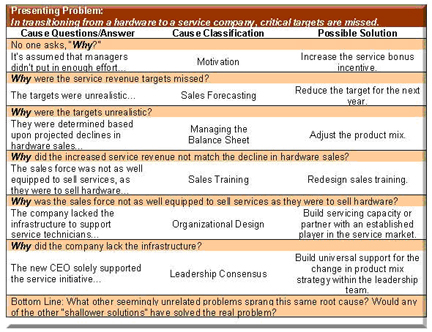
An example of the Five Whys:

fivewhys services

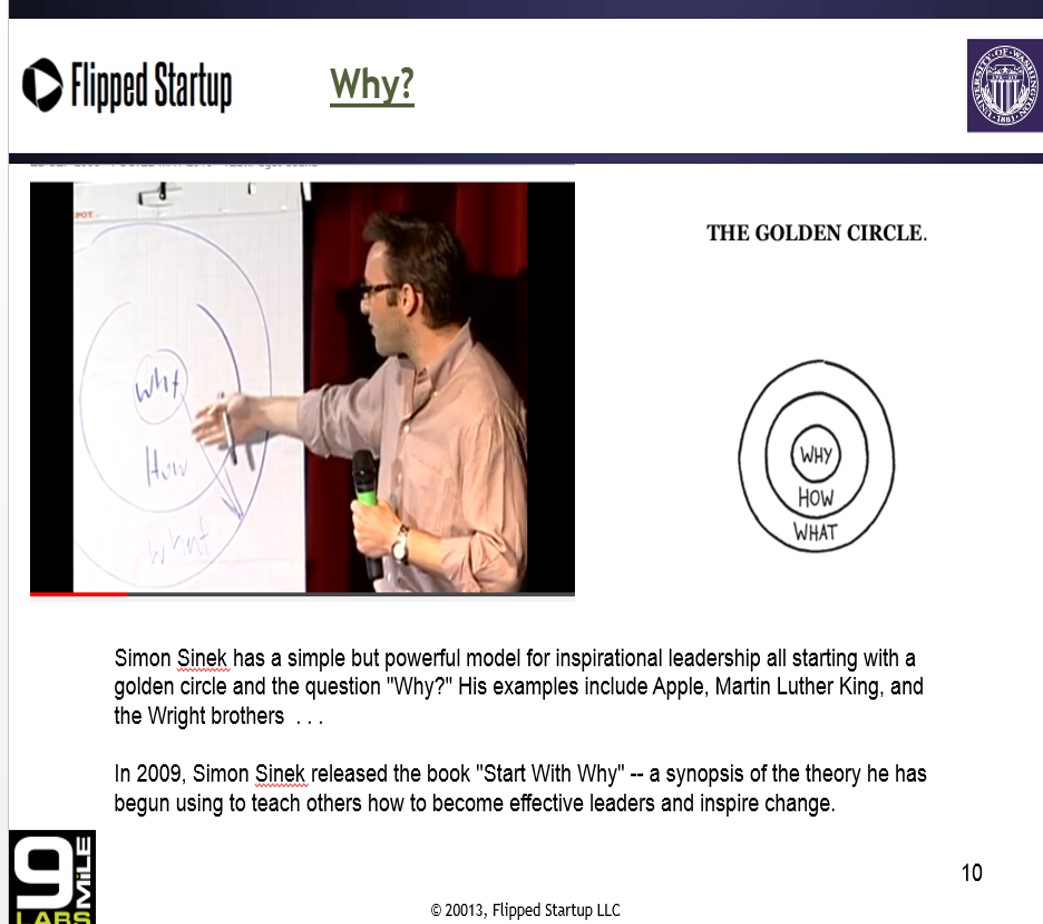
More recently, Simon Sinek has written about Start with Why: How Great Leaders Inspire Everyone to Take Action.  His Ted talk on “How Great Leaders Inspire Action” gets quickly to the core of being clear about your “why.”

simon sinek talk

I was reminded of this video while listening to Nathan Gold, The Demo Coach, at the Citrix StartupAccelerator, as he asserted that professionals spend 90% of their time on the WHAT, 7% of their time on the HOW, and less than 1% of their time on WHY.

Why is thinking about “Why” so difficult?

Sherril Small asks the same kinds of questions of entrepreneurs while working through their customer positioning thinking. Delightfully she asks the entrepreneur to think through the “why” questions from the customer perspective:

  • Why Me?
  • Why Now?
  • Why This Product?

If you find yourself buried in yet more of the same WHAT and HOW questions, break through the clutter with one or more variants of the “lost power of WHY.”

For a humorous look at the wonderful world of innovation and new ventures, checkout Fl!p and the gang at Fl!p Comics.


Posted in Content with Context, Curation, Entrepreneuring, Flipped Perspective, Patterns | 1 Comment

Lifelet: Kickin’ it in Silicon Valley

One of the treats of collaborating with a wide range of entrepreneurs is the occasional working trip to Silicon Valley. Enjoy a few images from the many forms of “creative environments” to bring out the best of the entrepreneur.

For a low res view of the working life in Silicon Valley click here.

Lifelets are brief glimpses of daily life that are small creative acts of bringing new life to my inert digital media captured over a lifetime.

For a humorous look at the wonderful world of innovation and new ventures, checkout Fl!p and the gang at Fl!p Comics.

Posted in Entrepreneuring, Lifelet, Lifelogging, User Experience | Leave a comment

Lifelet: UX joy of the day

Now that I am returning to road warrior status, I am reminded of the “joys” of travelling. Getting a hotel room in Silicon Valley is getting to be a challenge. Here is what awaited me at the Days Inn last night:

toilet UX

I am guessing the construction folks who “recently upgraded” this motel have never heard of the profession of User Experience Design. And the toilet was only 9 inches off the floor.

Lifelets are brief glimpses of daily life that are small creative acts of bringing new life to my inert digital media captured over a lifetime.

For a humorous look at the wonderful world of innovation and new ventures, checkout Fl!p and the gang at Fl!p Comics.

Posted in Lifelet, Lifelogging, User Experience | Leave a comment

Lifelet: Travelling Protected?

During this time of government shutdown, it is always fascinating to experience what is essential and non-essential government work. On my trip to the airport to spend a week in Palo Alto, CA, we started our journey on the Seattle-Bainbridge Island Ferry.

Right away the Coast Guard convoy joined us for our journey to Seattle.

Then when I got to the airport, I encountered a new experiment. For the privilege of having my hands rubbed with some high tech cloth and run through some kind of scanner to test for explosive residue, I got to do an old school journey through TSA. I didn’t have to take off my shoes, or jacket or belt and I didn’t have to unload my computers or toiletries. I just passed everything through the scanner and walked on through. I  think that I used to think this was a hassle.  Smooth sailing today.

Then I got to wondering if I was more protected or less. I guess I will figure that out if I make it safely to San Francisco.

So enjoy a video snapshot of public transportation for the journey down the west coast. And don’t miss the “laugh out load” advertisement from Zoho on the way to the airport tram.

For a low resolution version of the video click here.

Lol. Got my attention.

Lol. Got my attention.

Lifelets are brief glimpses of daily life that are small creative acts of bringing new life to my inert digital media captured over a lifetime.

For a humorous look at the wonderful world of innovation and new ventures, checkout Fl!p and the gang at Fl!p Comics.

Posted in Lifelet, Lifelogging, Travel | Leave a comment

Lifelet: Sancho Panza Time

Just a day after posting one of my favorite drawings of “Building a Rainbow,” along comes an image of the reverse of rainbow time:

Tilting at a windmill

Every life needs a little Don Quixote and Sancho Panza to make the world a more interesting place. The problem for most of us is figuring out whether we are “building a rainbow” or “tilting at a windmill.”

Lifelets are brief glimpses of daily life that are small creative acts of bringing new life to my inert digital media captured over a lifetime.

For a humorous look at the wonderful world of innovation and new ventures, checkout Fl!p and the gang at Fl!p Comics.

Posted in Humor, Lifelet | 1 Comment

Lifelet: Rainbows

We are blessed with a view of the Puget Sound looking at the kaleidoscope of colors that dance between water and sky minute by minute. Of particular joy are the rainbows that show up in the spring and fall. I’ve always been attracted by rainbows. Don’t know why. Just love the color spectrum and the gentle curve.

My friends and colleagues who know that I love rainbows are always sending me different variants of rainbows. One of my favorites is a Bruce Johnson print entitled “Building a Rainbow.”

building a rainbow

I use this image to introduce myself at the start of a class or a seminar. I also use it to describe to new ventures I create how I view the journey of shaping a new company and a new product and innovating our way into our customers lives.

So here are a few of the rainbows from around the Puget Sound (high res):

For a low res view of the rainbows click here.

Lifelets are brief glimpses of daily life that are small creative acts of bringing new life to my inert digital media captured over a lifetime.

For a humorous look at the wonderful world of innovation and new ventures, checkout Fl!p and the gang at Fl!p Comics.

Posted in Lifelet, Lifelogging, Nature | 1 Comment

Lifelet: Climbers in Yosemite

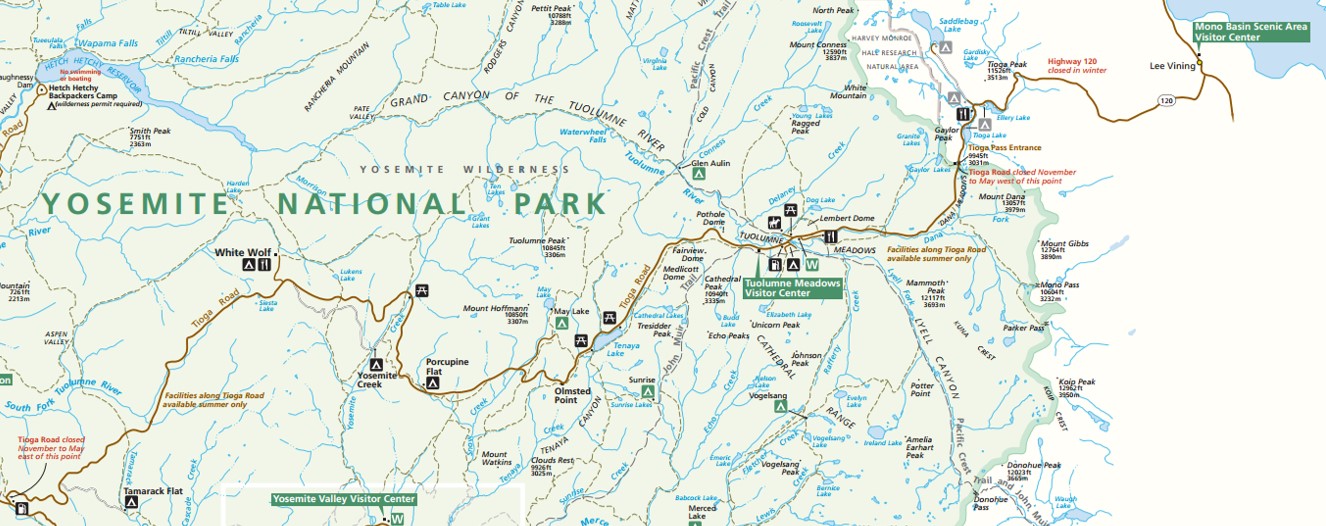
On a beautiful July day, we entered Yosemite National Park through the east entrance at Tioga Pass. I wanted to stop every 100 yards and capture photos of the amazing acts of nature from the the snow fed streams to the majestic rock formations.

We finally stopped at Tuolumne Meadows Visitor Center and took a ranger guided hike through the meadows and up a granite rock face. For our lack of physical conditioning, it was the right amount of exercise. As we continued west along Tioga Road, we saw these “ants” on a cliff face and realized they were rock climbers. We pulled over and watched the ebb and flow of climbers going up the rocks. Best free entertainment we’d had in years.

For the high res video of the climbing experience click below:

For the low res video, click here.

Lifelets are brief glimpses of daily life that are small creative acts of bringing new life to the inert digital media captured over a lifetime.

For a humorous look at the wonderful world of innovation and new ventures, checkout Fl!p and the gang at Fl!p Comics.

Posted in Lifelet, Lifelogging, National Parks, Nature | Leave a comment

Dyslexia – the invisible fuel of entrepreneurs?

Once again, Malcolm Gladwell offers us many “flipped perspectives” in David and Goliath: Underdogs, Misfits, and the Art of Battling Giants.  For those of you who like oral story telling you can find Malcolm telling the story (Ted – Ideas worth spreading) of David and Goliath reinterpreted that capture his imagination.

As I devoured the book upon release, I was stunned to come across the following:

“Can dyslexia turn out to be a desirable difficulty? It is hard to believe that it can, given how many people struggle with the disorder throughout their lives— except for a strange fact. An extraordinarily high number of successful entrepreneurs are dyslexic. A recent study by Julie Logan at City University London puts the number somewhere around a third. The list includes many of the most famous innovators of the past few decades. Richard Branson, the British billionaire entrepreneur, is dyslexic. Charles Schwab, the founder of the discount brokerage that bears his name, is dyslexic, as are the cell phone pioneer Craig McCaw; David Neeleman, the founder of JetBlue; John Chambers, the CEO of the technology giant Cisco; Paul Orfalea, the founder of Kinko’s— to name just a few. The neuroscientist Sharon Thompson-Schill remembers speaking at a meeting of prominent university donors— virtually all of them successful business people— and on a whim asking how many of them had ever been diagnosed with a learning disorder. “Half the hands went up,” she said. “It was unbelievable.”

“There are two possible interpretations for this fact. One is that this remarkable group of people triumphed in spite of their disability: they are so smart and so creative that nothing— not even a lifetime of struggling with reading— could stop them. The second, more intriguing, possibility is that they succeeded, in part, because of their disorder— that they learned something in their struggle that proved to be of enormous advantage. Would you wish dyslexia on your child? If the second of these possibilities is true, you just might.”

In the middle of a longitudinal research study on what are the factors leading to new venture success, it never occurred to me to survey the participants for the presence of learning difficulties. If true, this research would explain so much of the observations of the nature of entrepreneurs and their apparent lack of interest in reading anything or studying anything in a traditional book learning manner.

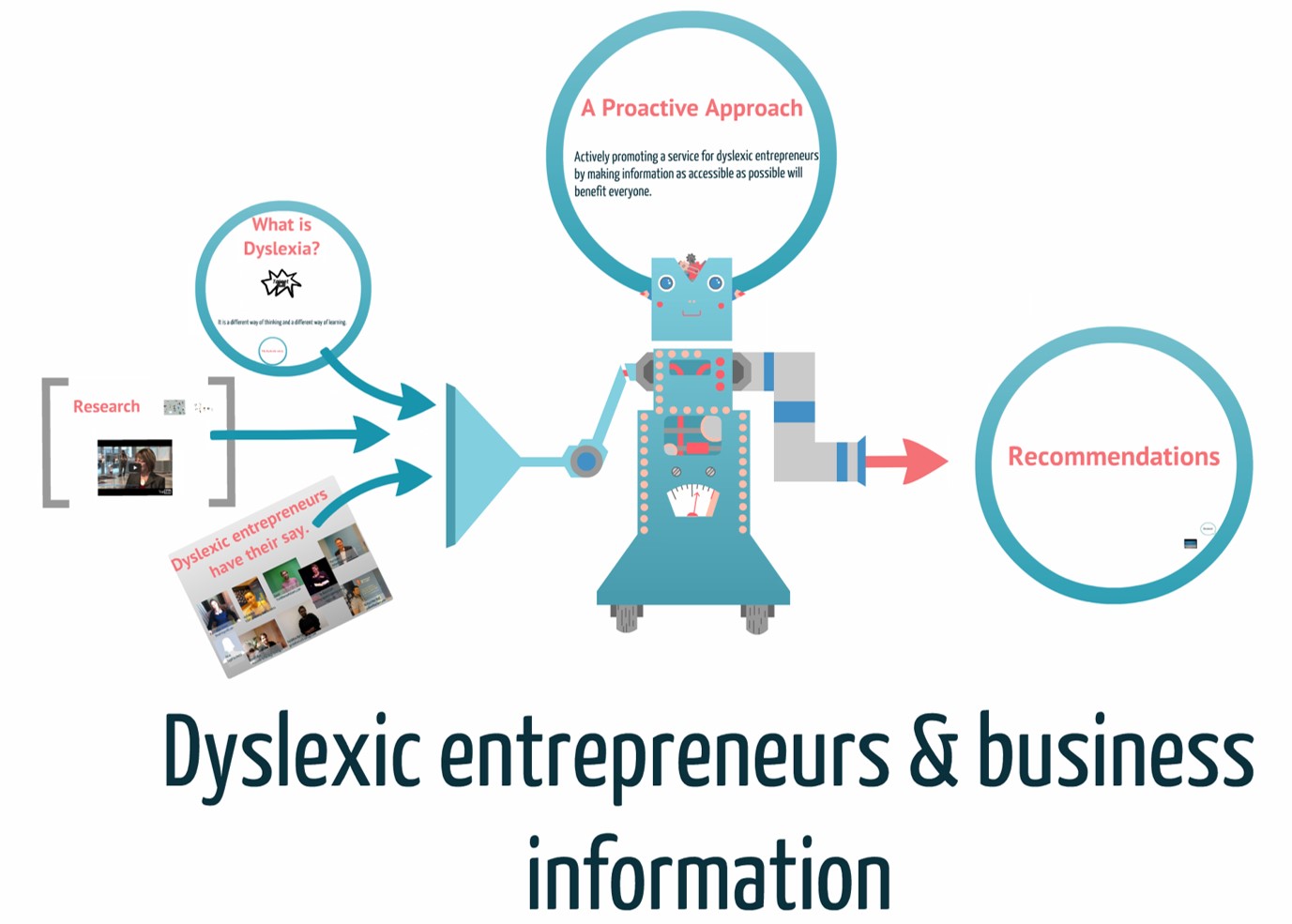
Sally Ann Clarke sheds light on dyslexic entrepreneurs in her presentation:

dyslexic entrepreneurs

It’s not that the participants are disinterested, it’s that reading is so hard and a dyslexic entrepreneur has to be very parsimonious with what they read. They’d much rather spend their time doing, making or selling, rather than traditional learning.

Stay tuned.

For a humorous look at the wonderful world of innovation and new ventures, checkout Fl!p and the gang at Fl!p Comics.

Posted in Entrepreneuring, Flipped Perspective | 1 Comment

Strategic Networking with the Benziger Green Team

Several years ago, I encountered an excellent article in the Harvard Business Review which researched “How Leaders Create and Use Networks.” The authors made the distinction between Operational Networks, Personal Networks and Strategic Networks. Most of our time is spent working within Operational or Personal Networks. The authors presented the importance of spending significant time creating and nurturing your strategic network.

The more I reflected on the article the more I realized that the notion of “strategic networking” should be extended well beyond the author’s observations. My first extension was to include strategic networking as a major yearly goal for my direct reports. I realized that they were so focused on operational networking and the “here and now” that they weren’t paying enough attention to the “there and then.” Amazing what a little “expect what you inspect” and manipulating the compensation system does to generate better organizational performance.

I then included strategic networking as a core reading for my UW graduate classes and for the entrepreneur mentoring work I engaged in. I even used strategic networking as the class project for one of my UW HCDE courses. While the article quickly became an active part of my work, I found that students and entrepreneurs rarely glimpsed the importance of strategic networking. They viewed it as just another form of operational networking and didn’t see the important differences.

As I spent more time with David Robinson, I realized that what was missing in my trying to evangelize the power of strategic networking is that I was violating the “experience first, make meaning second” mantra. David kindly agreed to demonstrate a different path for my grad students to understand these concepts through a series of kinesthetic group exercises.

David started by drawing the Chaos -> Order trajectory and then his story cycle on the white board.  He shared that “chaos” is the source of all story and the movement to create order.  He pointed out the following:

  • Business is all about chaos
  • Companies get stuck when they focus on the “order” or the product that they created rather than continuing to loop back to the chaos.
  • Learning is about not knowing.
  • Having to know before we act comes out of causal thinking.  Having the capacity to act without knowing comes out of effectual thinking.
  • Another way of looking at this cycle is are you oriented towards a question or oriented towards an answer?
  • Story is about when a yearning meets an obstacle.
  • Organization change can be thought of in the same way as personal change.  So as we explore personal change processes they are very similar to organizational change processes.

During class, we went through the following exercises:

ANGEL/DEVIL Exercise

Objective: To demonstrate through movement the bunching or binding that occurs naturally when anything is framed in terms of a duality.

Caveats: Have the experience first, and then we’ll make meaning of it afterwards. All learning happens at your edges.

      • If you come to a discomfort edge that is where you are learning.
      • Judgment is your edge. Suspend your judgment.
      • Put yourself into an entrepreneurial and effectual mindset.
      • Recognize that you are making choices and you are choosing all the time.

Directions/Process:

This works well when used in sequence with the Triangle exercise. In some cases, this is also a good warm up exercise. We use it because of how it works with Triangles (which demonstrates both interconnectedness and the ease and flow that occurs naturally when anything is framed in triads).

Everyone stands in a circle.

Secretly, each participant chooses two other participants, identifying one as their “angel” and the other as their “devil.”

Their goal is to move so that their “angel” is always between them and their “devil.”

Debrief:

In almost every case, the group will bunch up, lock up, and then explode. Then, they will repeat the pattern if you let the movement go long enough. Ask first what they noticed, what was their experience? If this was a sculpture (it is) what do they notice about the use of space, locations, textures. Etc.

TRIANGLE Exercise

Objective: To demonstrate through movement the interconnectedness and flow that occurs naturally when something is framed in terms of a triad.

Directions/Process:

This works well when used in sequence with Angel/Devil. In some cases, this is also a good warm up exercise. We use it at the end of a session because of how it works with Angel/Devil (which demonstrates the bunching and binding that occurs naturally when anything is framed in duality).

Everyone stands in a circle.

Secretly, each participant chooses two other participants, identifying them as the two other points in a triangle (the participant doing the choosing is the third point). The goal is to move so that they always maintain an equilateral triangle (If the two points move apart, the third point must adjust to keep the triangle equilateral).

Tell participants that, at one point during the movement, you will touch one person on the shoulder; that person must sit down immediately. The rule is that, if one of your points sits, you must also sit down immediately. This stops the movement so that participants can see how interconnected they are (you touch one person and the whole group sits), also they will be able to see the pattern they create.

Debrief:

In almost every case, the group will use the whole space (unlike Angel/Devil), forming a circle, looking towards a common center. Ask first what they noticed, what was their experience? Ask them to look at the patterns and positions of people in the room: if this was a sculpture (it is) what do they notice about the use of space, locations, etc..

The Angel/Devil and Triangle exercises helped the graduate students to experience and “see” the networks that they are a part of (with our class projects and in their work environments). And they see the different structures depending on how they frame the question that their network is interacting with.

Not needing much of an excuse to visit Sonoma Wine Country, David and I agreed to do a strategic networking lunch and learn seminar for the Benziger Family Winery Green Team.

Our sponsor for the Strategic Networking engagement was Barney Barnett, a long time organizational consultant for the Benziger Family Winery. Barney prepared the green team for the workshop with this teaser:

“We will begin with two short 5 to 7 minute experiential exercises.  These will involve walking/moving around as a whole group in the barn.  We will have lunch, debrief and make meaning of the experiences.  The focus will be to understand strategic networking as a different way to think about what we normally do for operational networks.  This new conceptualizing turns around how we (as a Green Team, a member of Benziger and our other networking) create something new to attract others to see how they want to have the influence of the Green Team’s (or Benziger’s) values as part of what is important to their networking strategies.  We may use other storytelling, light guided meditation or dialogue to deepen the wrap up and implications for action of this one hour brown bag symposium/experience. “

As we thought about how to wrap the above exercises (Angel/Devil and Triangle) into a stand alone workshop, we started with yet another variant on strategic networking – how to set it up as a two way process – what do you need to learn from others and what do others need to learn from you? This simple addition to the strategic networking helps transform the teacher/student dysfunction to thinking through how the participant needs to be both a student and a teacher.

Benziger Barn Meeting Room

Barney and David explore the Benziger “Barn” Meeting Space

We started the Green team session with a brief introduction to the HBR Strategic Networking article. I shared my own experiences of learning so much from the Benzigers about biodynamics and observing how many different ways it takes to walk the talk of being green and sustainable.

IMG_5718

The joys of an open creative space

We posed the following thought experiment to the participants “who does the Benziger Green Team need to learn from and who in the outside world really needs to learn about what the Benziger Family winery is doing with biodynamics and day to day sustainability?”

As we did our initial quick introductions of the participants it became obvious that many of the participants didn’t know each other. Taking this into account, David started with a different exercise – introducing yourself as a problem.

We stood in a circle and David had us think of some small problem (not a large devastating type of problem). We paired up and introduced ourselves as our problem (rather than extolling our virtues to make ourselves look good to a stranger). After 2-3 minutes with our initial partner, we then shifted to new partners a couple of times. During the debrief we all laughed at how difficult it was.

We then reformed the circle and David started us with a different exercise – introduce ourselves by what we bring. What is our gift? We then spent a couple of minutes with several different pairs – with the instruction to introduce ourselves to someone we knew the least. The energy in the room rose dramatically. Nobody wanted to leave their current pair because they were having such a lively discussion. During the debrief David asked us to reflect on the differences between introducing ourselves as a problem versus the introduction of what we bring. Most of us experienced how much easier and engaging the conversation was with what we bring. Most of us wanted to have lots more time to continue sharing.

After the energy generated through the pairwise and movement pattern exercises, we returned to the circular tables. I observed that Benziger had done a great job over the years of learning from the best of the best about biodynamics and what it means to create a green company. Since we had just a little time left, I asked the participants to focus on who (besides the wine consumers who visit the winery) needs to strategically network with the Benziger Green team.

Who do you need to learn from? Who needs to know what the Benziger Green Team is doing?

Pretty quickly a consensus emerged that CEOs and corporate executive teams could really benefit from some experiential seminars that focused on biodynamics and sustainability rather than on just the great wine products that Benziger produces. It was exciting to see the energy released when each of the team members realized that they had something to teach (bring) others as well as strategically networking to learn from others.

Who should you be including in your strategic network? To learn from? To bring to (teach)?

For a humorous look at the wonderful world of innovation and new ventures, checkout Fl!p and the gang at Fl!p Comics.

Posted in Content with Context, Entrepreneuring, Flipped Perspective, Learning, User Experience | 2 Comments

Whiteboarding: Designing a software team

Not knowing what I was getting into (a common state lately), I joined some former colleagues to catch up on their new venture. They asked me how I would go about designing a software team for their new pivot. They were going from a B2C product to a B2B (B2B2C) variant based on their recent customer discovery process.

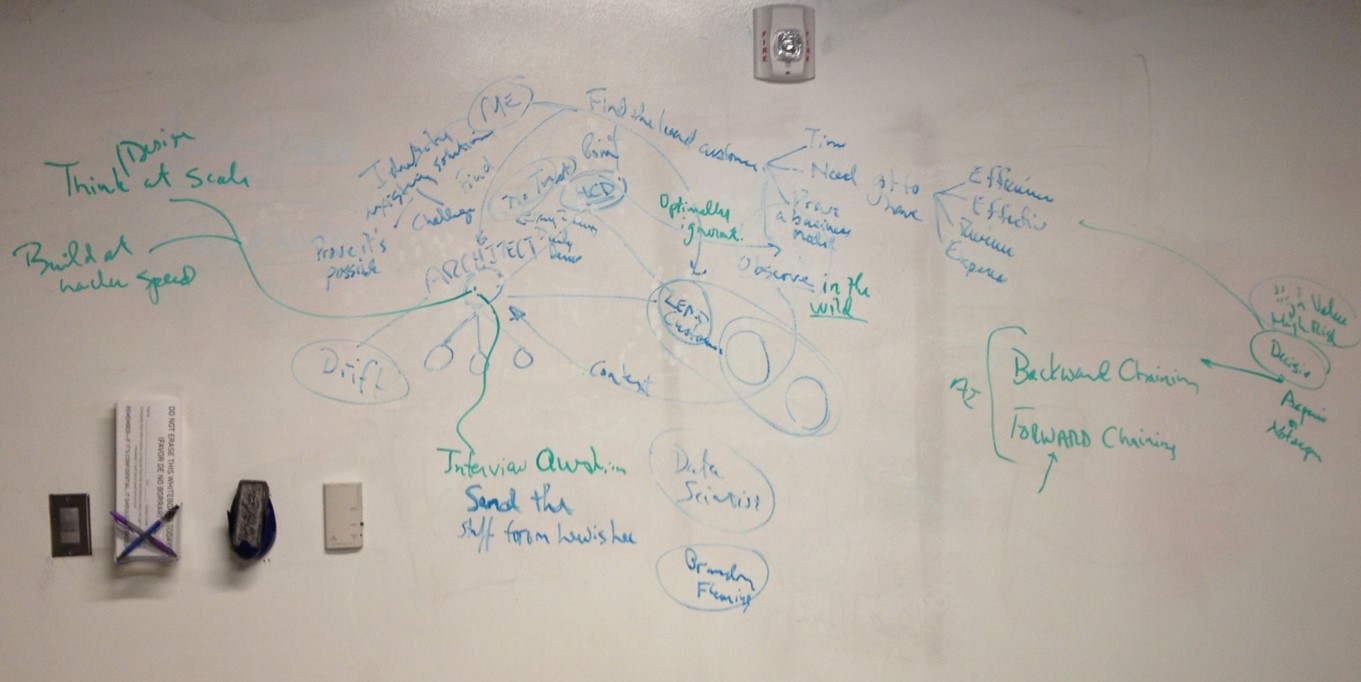
whiteboarding software development

I allowed as how I couldn’t think through the question without standing at a white board so we found the nearest vacant room and a few white board pens and started in.

As they were in Silicon Valley, I started by paying homage to the latest craze of hacker, hustler, designer and visionary that is making the rounds. But with several twists.

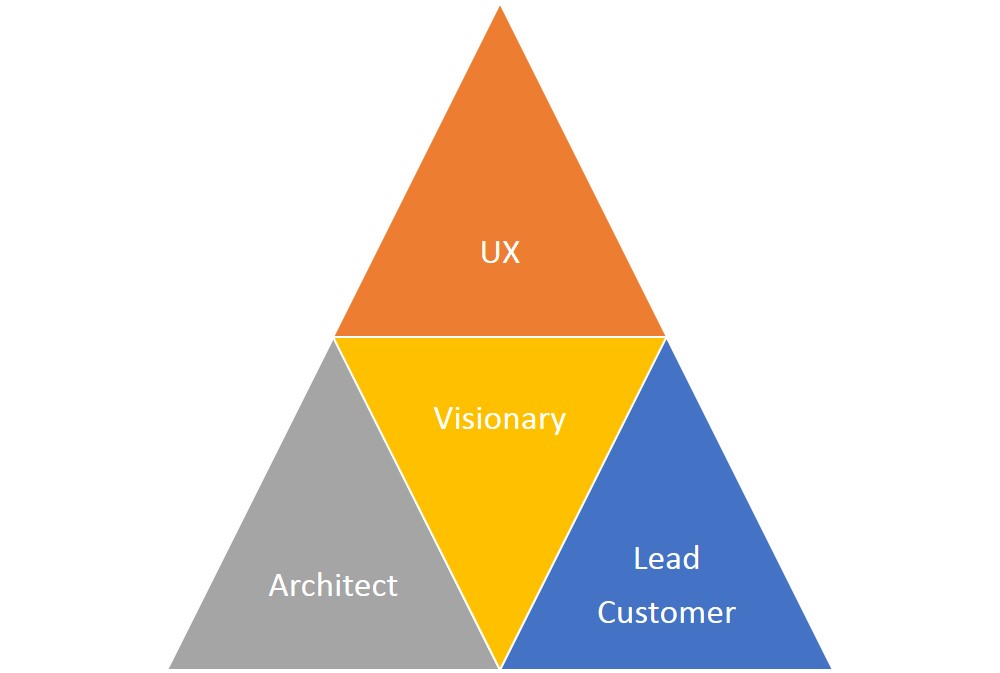
I started by drawing a draft of the diagram below:

software development team

Then I realized that I was once again violating the “experience first, make meaning second” mantra. So I put my magic marker down and told a story.

After we’d gotten good and cash flow positive at Attenex, we were looking for additional markets. One of the many reasons I was interested in creating Attenex Patterns was so that I could have a personal version to make meaning out of my 8TB of digital detritus on my desktop computer. While we knew that we couldn’t do a stripped down version of our enterprise level product, we didn’t know what were the necessary and sufficient features for a Personal Patterns.

So I pulled in my lead architect to spend a month researching and building a personal patterns prototype. Eric was the architect and UX designer. I filled the roles of visionary, UX researcher and hustler. We made good progress in three weeks and a part of my hustler role was talking about and demoing the prototype to anyone I could grab (trying to find a lead customer). Everyone nodded and patted us on the proverbial heads and said “that’s nice” but there was no energy in the engagements.

So we went back to the drawing board and I went and did a little user research with Marty Smith (one of the lead customers for our Attenex Structure product), a contracts and Intellectual Property attorney at Preston Gates. Not really knowing what I was looking for, I asked Marty if I could just sit and observe him working on contracts for a couple of hours.

One of the lessons I learned at the Institute of Design in Chicago is that observing people in the wild (their actual work or living environment) is far better than trying to interview them. People make stuff up (mostly because they don’t want to appear stupid) when you interview them and most of the time they don’t really understand what they actually do (tacit knowledge). However, they are incredibly “articulate” when you can just observe them in their natural work habitat.

Marty was working on his third draft of a licensing contract for a very large software company headquartered in our area. There was a lot of client discussion around a patent indemnity clause. He knew that he’d had to rework that clause for a couple of different clients in his previous ten years, but he couldn’t remember which clients nor which parties the contracts were for.

Marty’s primary tools are Microsoft Word and Outlook/Exchange. He organizes his file foldering systems (both on the hard drive and in Outlook Exchange) by client and then by year and then by the company name of who a contract was with. One giant hierarchical mess. He could have used a primitive Boolean search engine (but his law firm IT group wouldn’t allow such a thing – corporate security and all). Even if he’d had a search capability, by searching for “patent indemnity” he would have gotten 1000s of hits.

So I watched for thirty minutes as he walked the folder hierarchy, trying to use the client folder names and the contracting party names to jog his memory for one of the three or four contracts he’d modified in the past. He’d drill down through folder after folder; select a contract; scan through the contract in MS Word to see if there even was a patent indemnity clause; find nothing; and then go back to the folder hierarchy. No joy. So after thirty minutes, he gave up and went back to crafting a new clause.

I knew I was seeing something important here, but didn’t know quite what. So I asked a few business model questions.

Skip: How many times a week does this happen to you where you can’t find a clause you are looking for?

Marty: 3-4 times a week.

Skip: How many times a week does it happen to the other 20 IP attorneys in the firm?

Marty: Probably the same amount for each of us. And we never find what we are looking for so we have to draft from scratch. We try for a while, but never find anything.

My back of the envelope business calculation was the extra cost to clients of $500 per hour * 20 attorneys * 2 hours (search plus redrafting time) * 3 times per week = $60,000 per year. In this one law firm we had $60,000 per year of savings for what I was thinking we might price at $20 per seat. Oops, missed the value equation on this one.

I bounced down the stairs to share my findings with Eric. I described what I’d seen (unfortunately because Marty was doing client legal work I couldn’t use video ethnography to record and analyze his interactions). We realized that the difference that would make a difference was if Marty could do clause level searching rather than try and guess at a couple of keywords that might be needed.

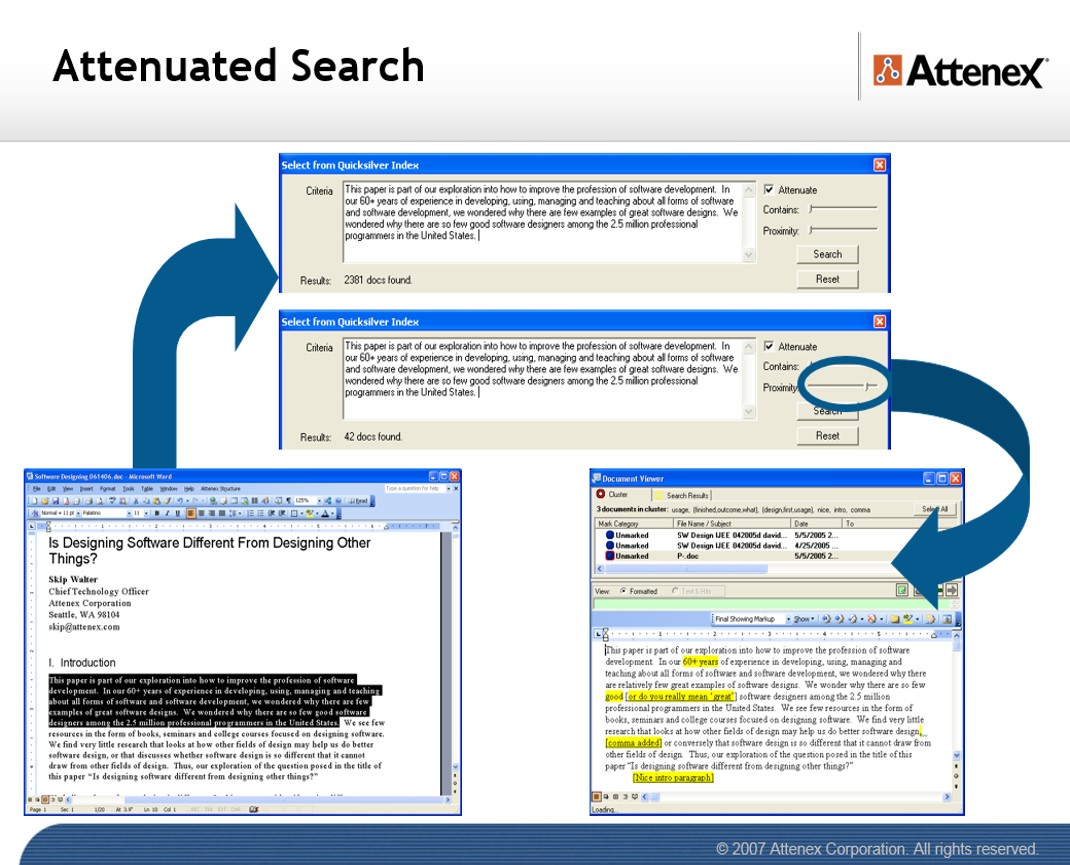
We put some straw designs together on the whiteboard and then I left Eric to do a prototype. After a few iterations, Eric worked his brilliance and came up with the following:

attnenuated search

On the bottom left, the user selects a range of text to use as the search string. The selected text could be a couple of sentences, a paragraph or pages of text. The text is then copied into the search box (top of slide) and the text is treated as if it were a series of “OR” statements. Some 2381 documents were returned. That is clearly too many to look at. So either the slider bar for “Contains” is moved to the right or the “Proximity slider bar” is moved to the right until a more limited number of documents is identified (in the example 42 documents are returned). [NOTE: For those of you interested in the gory details of the search technique you can look at the Attenuated Search patent application.]

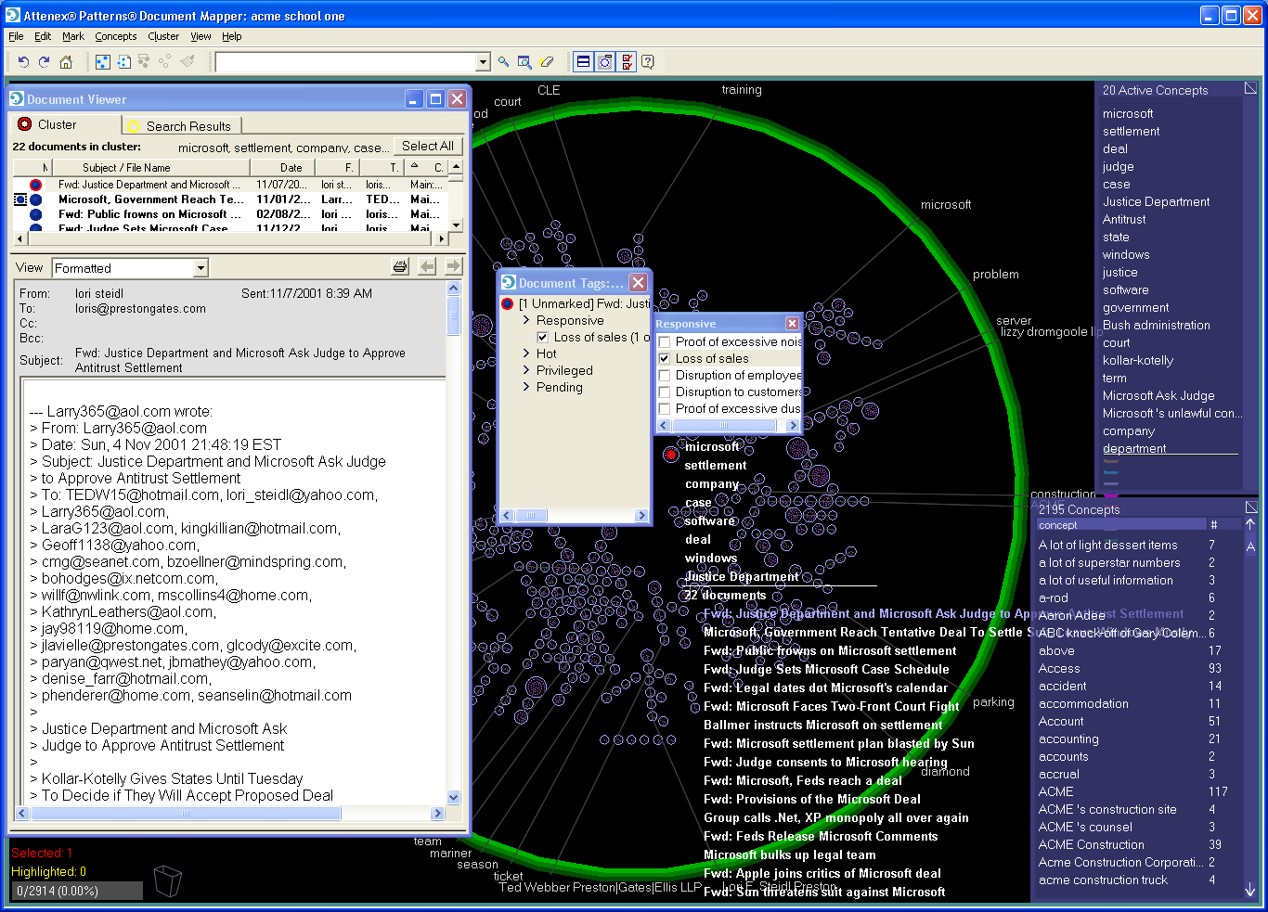
Once you get to a reasonable number of documents to look at you can display them with one of the standard visual analytics view of Attenex patterns (semantic network view, social network view, or timeline view).

attenex patterns interface

Well, the fun was just starting. I went into my hustler persona and took the opportunity while we were interviewing the CIO at Bell South for a board position to demo the new prototype. I was unprepared for the result. He grabbed my laptop out of my hand and said “I’ll take it back with me.” Momentarily defaulting to my designer role, I objected “But you can’t; it’s just a prototype.” A tug of war with my poor laptop ensued as we both chuckled.

Quickly going back to my hustler persona to see if I could glean some more marketing data, I asked the CIO how much he’d pay if the prototype were indeed a product. He thought for a few seconds and said “I’d want this for the top 100 executives and managers (and our assistants) at Bell South, so I think an enterprise license of $300,000 per year would be appropriate.”

With just the addition of the “clause level” searching, we’d gone from no interest to a “got to have” application that senior managers were willing to pay quite a bit for.

While Eric and I were lucky enough to have the skills to play all four roles of hacker, hustler, designer and visionary, most teams will need three to four professionals in these roles.

What gets missed with the above story is a really critical team member – the lead customer. Most people assume that the UX person (designer and researcher) can be the customer surrogate. However, I’ve found that it is crucially important to view the lead customer as a member of the team and invite them inside the product development bubble. The key to having the lead customer as a team member is to be able to regularly visit the customer’s work environment. Their work site is where the observation action is.

Let’s look at the four key roles of the ideal software product development team:

beginners_mind_experts-mind

  • Visionary – the visionary sees the opportunity and imagines what technology is capable of solving the customer need. In an ideal world, the visionary sees not just a “nice to have” but a “got to have” solution and a business model that makes money quickly. A good visionary will have a big dose of hustler in them – the ability to “engineer exchanges to separate customers from their money (time/attention) willingly by creating, communicating and delivering unique value” (thank you Dan Turner for this definition). As Dan Pink shows in To Sell is Human, the hustling skills can be learned (and most of us are tacitly already “selling” most of our time).
  • Architect – builds the prototype and foundation for the product. While the term of the moment is “hacker,” I prefer someone that can go beyond prototyping and design at scale. They are able to translate the visionary opportunity and designer wireframes into something that works. An ideal software architect will build at hacker speed and think/architect for scale.
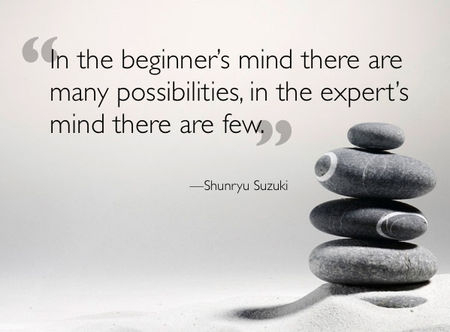
  • User Experience Designer – observes customers and translates the observations into human computer interaction designs and thinks more broadly about the full user experience design. The UX researcher needs to exhibit “beginner mind” and be optimally ignorant while observing customers “in the wild” and in their natural work habitat. A key role of the UX researcher is to See Organizations.
  • Lead Customer – the ideal customer is the manager who has the direct need and the budgetary authority to buy your product or services. They should have the time, expertise and commitment to see the project through. The “got to have” need has to have one or more (preferably all) the characteristics of increases efficiency, increases effectiveness, increases revenue, and decreases expenses.

It is the responsibility of the Visionary/Hustler to find the lead customer. They need to go beyond seeing the opportunity and find the customer who can help them create the solution. Once they get the lead customer working with the architect and the UX Designer, the visionary/hustler needs to identify the business model that will not only grow their own business but help the customer grow their business (see Growth Partners).

To help identify good opportunities, the visionary uses a form of “backward chaining” by finding workflows that have a clear valued outcome and then working backwards to the starting point. A really good opportunity will have a decision point which leads to high value and/or a high risk outcome. Inserting a product into a high value or high risk workflow allows you the opportunity for value based pricing. The realization that the eDiscovery market was very high risk and high value allowed us to build a value priced solution with Attenex Patterns.

Through hard won experience, I’ve found that you can’t just trust the architect and UX designer to stay focused on what is necessary. They drift. No matter how experienced they are, they drift. The visionary needs to check constantly on the progress of the product team. The easiest way is with the daily demo (not the agile daily check-in where the developers talk past each other, but an actual demo of what exists). I describe the daily demo process in Advice to a Non-Technical CEO of a Software Start-up. An even better way is to bring the lead customer to these daily demos on a weekly basis.

With a good team and good process (daily demo), you are ready to race to a Minimum Viable Product (not minimally valued product as newbies misstate) in parallel with your customer discovery process. Of course someone needs to manage this process and balance the Four Developments. That’s fodder for a future post.

For more information on this human centered product design process check out the following resources:

For a humorous look at the wonderful world of innovation and new ventures, checkout Fl!p and the gang at Fl!p Comics.
Posted in Content with Context, Design, Entrepreneuring, Flipped Perspective, Human Centered Design, Innovation, organizing, User Experience, Working in teams | 3 Comments