How do you create a product vision? Part 1

Day 147 of Self Quarantine             Covid 19 Deaths in U.S.:  160,000

Developing a Product Vision in an Early Stage Startup

While coaching an early stage startup CEO, she asked:

How do you come up with a product vision?

I have written a lot about entrepreneurs and intrapreneurs, but I have not written about how to get to a product vision.  Sometimes this question is asked as “how do I develop a product roadmap?”

I was silent for quite a while as I searched my memory, but all that came back were examples of product visions.  I have a lot of those.  I tried to recall an explicit description of how I arrived at those product visions.  I could not.

Since I love good questions, my work for the next several days became clear.

This question arose out of an interaction with a CEO where she thought the first focus of her CEO coaching would be on how to manage a software product development team.  She was not a technical founder or a scientist, so she was not sure how her skills as a marketer would translate to managing technical talent.  As we talked about what this meant, we realized that creating, managing, and evolving a product vision was a precursor topic to understand how to manage software product development.  Understanding how to create a product vision for a single product is a precursor to understanding how to manage a portfolio of product visions.

Getting to a product vision for an innovative product is a five step process:

  1. Understanding what a good one looks like
  2. Becoming an expert quickly in the knowledge domain of your product innovations
  3. Using an influencer centered design process to collaborate with domain experts and customers on your product vision
  4. Creating the product vision using service dominant logic and an outcomes orientation
  5. Communicating the Product vision – to employees, to customers, to investors

The following discussion assumes that you have gone through the initial steps of a startup that include:

The first step involves identifying what a good product vision looks like.  While most of the public product visions are after the fact and well crafted, they help to understand what you should be trying to achieve.  The following are some of the more famous product visions.  Some are written and some are product launch videos for the first product in what will be a stream of products.

As you read and watch these presentations, identify for yourself the patterns of what a good product vision looks like.  The challenge is not getting lost in the weeds or the details of the product vision.

The Outcome frame orientation is a starting point for capturing the essence of each of these presentations and then comparing the product visions:

    • What are they trying to create?
    • How will we know that they created it?
    • What resources did each company have to get started right away?
    • What other opportunities will their product vision lead to?

Because each of these visions is older, we can see through the passage of time how the product vision played out.

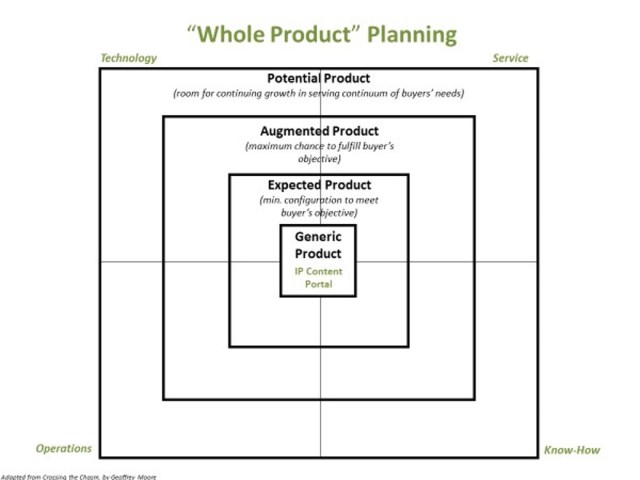
Geoff Moore popularized the Whole Product concept in his book Crossing the Chasm.  A brief description of the Whole Product is:

Whole Product = Whole Experience

“To help our understanding, let’s use a car as an example. If you buy a car that has the features that you want but it doesn’t have some of the other critical components of your ownership experience, like a nearby service center, an adequate warranty, availability of parts, etc. then you won’t be happy. The whole product is the entire experience, not just the features of the product.”

Katherine James Schuitemaker extended the Whole Product diagram to include four other dimensions of the whole product – the Technology, Operations (what does it take to operate the product), Service (what services help the customer get started), and Know How (what is required by the customer to make use of the product).


The early stages of a startup are focused on the core product and getting to a product market fit.  The product vision should include components of the Whole Product like the augmented and potential products.

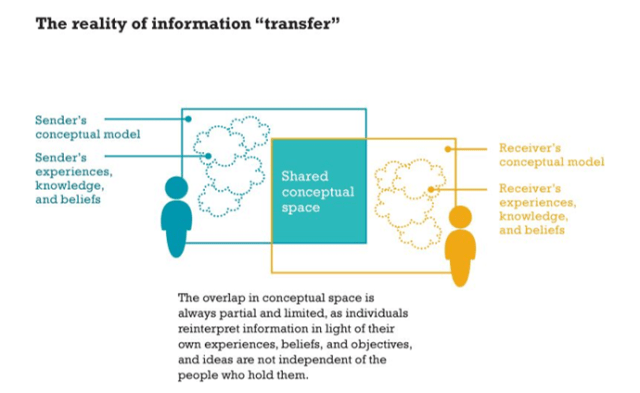
After you make notes on what a good product vision looks like, revisit the product vision resources to identify how the authors or presenters communicated their innovations and visions.  Kim Erwin in her book Communicating the New, shares the challenge of presenting a product vision – getting from the sender’s conceptual model to the receiver’s conceptual model:

In communicating the product vision you need at least three of these maps:

    • For an employee
    • For a customer
    • For an investor

With an understanding of what a good one looks like, we move on to the second step – becoming an expert in your product’s knowledge domain.


The five parts of this series on how to create a product vision are:

  1. Understanding what a good one looks like
  2. Becoming an expert quickly in the knowledge domain of your product innovations
  3. Using an influencer centered design process to collaborate on your product vision
  4. Creating the product vision using service dominant logic and an outcomes orientation
  5. Communicating the Product vision – to employees, to customers, to investors
Posted in Content with Context, Design, Entrepreneuring, Human Centered Design, Idealized Design, Innovation | Leave a comment

Lifelet: Culling and rearranging a lifetime of books

Day 145 of Self Quarantine             Covid 19 Deaths in U.S.:  158,000

I love books.

I don’t love organizing my books.

I hate culling my books.

I really hate finding that I bought the same book multiple times.

My brother urged me on my organizing quest by sending several articles from the Washington Post book critic, Michael Dirda.  Michael realized that the pandemic lock-down might be a good time to start culling his books:

My books are scattered all over our house.

Skip’s Library of Books

Inspired by Dirda, I decide that most of my mystery and thriller fiction books need to go.  For the last ten years, my kindle library holds all of the fiction books I acquire.  I box the hard copy and paperback books up to free at least one bookcase to consolidate random piles of my professional books.

Reorganizing in progress

As I start the re-arranging, I encounter fives years of accumulation of dust on every surface including every book.  Deep cleaning needs to occur in parallel with the great re-organizing.  My lovely bride “volunteers” to help with the cleaning.  Thank you Jamie.

Dirda shares:

“So, picture me two weeks ago, as I sat on a white plastic lawn chair inside a gigantic metal oven, picking up book after book and only occasionally feeling a Kondoesque spark of joy amid many spasms of regret. The whole process made me feel old. I was almost certainly taking a last look at novels and nonfiction I would never read or never return to. I no longer had world enough and time.”

The fiction books were easy to part with for me.  They are mostly mysteries, thrillers and spy novels.  I don’t think I have a classic fiction book anywhere in my collection (or should I say hoard).  The Excel for Dummies and HTML Programming books are easy fodder for the great give away.

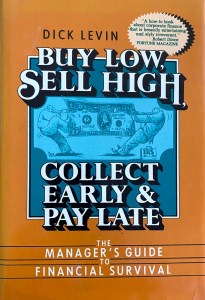
But there is no way I could part with:

I never read the book, but the title says it all.  I keep finding books that I forgot I had.

With great mental fortitude I refrain from opening any of my treasured friends.

I take a break.

Moving all the books to and fro in this one room is back breaking.  Taking the occasional author series of books upstairs to the “main book case” begins to strain.  Yesterday, I got 10,000 steps on my Fitbit and I never left the house.

I pull out Dirda’s latest column to find some inspiration:

“Over the past two months, I’ve been sorting and culling the vast number of books I’ve accumulated in a lifetime of reading and collecting. What do I mean by vast? It’s hard to say precisely, but, overall, we’re talking the equivalent of a small, but not that small, neighborhood library. Given that I also own several hundred LPs and CDs, a substantial number of movies on DVD and many oversize illustrated volumes devoted to the major artists of the world, this modest, overstuffed brick Colonial can also function — if you possess a seriously vivid imagination — as a concert hall and art museum.”

Head slap to forehead.  I forgot about all my CDs, DVDs, and VHS movie tapes.  That is two more rooms that have to be reorganized.

Clearly, this is a first world problem.

I am privileged that I was able to afford all of these escapes from reality.

I need this activity to put all the existential crises and doom scrolling out of my “groundhog day” mental anguish for a few hours.

I hope my children and grand children will appreciate The Great Re-organizing when I am gone.

Posted in Amazon Kindle, Content with Context, Curation, Lifelet | 4 Comments

The folly of growing an avocado tree

Day 144 of Self Quarantine             Covid 19 Deaths in U.S.:  158,000

In month two of the never ending ground hog days of the Covid 19 pandemic, I decided to grow an avocado tree.  While on my vegan diet, I’ve grown to love avocados.  I started with one seed and when it sprouted a tap root, I decided to grow six more.

I tried different experiments.  I tried small avocado seeds and large avocado seeds.  The large ones never grew a tap root.  I tried scraping the bottom of the seed and not scraping the bottom.  I had better success with the scraping.

Of course, being a guy I never looked up online how to actually grow an avocado seed into a tree.  Nor did I look to see what the likely success will be of my seed turning into a tree which produces an avocado.  And I certainly didn’t look to see how long it takes for an avocado “fruit” to mature into something that I could eat.

What I do have is time.

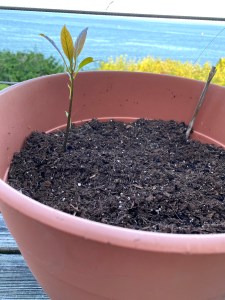
So it was a pleasant surprise when one of the seeds got a long enough tap root to plant and I could see a stem start to emerge.  After a few skirmishes with the squirrels and raccoons trying to dig up my fragile little avocado plant, I was amazed to see leaves start to appear.  And within a week, the fledgling plant was above the rim of the planter.  My wife suggested that I put a little cayenne pepper around the plant to keep the squirrels away.  So far that has worked.

With the patience of being quarantined, I watch my avocado plant grow each day.   It’s not much, but it is my attempt to add a little green to my life.

Now that I’ve gotten this far, I figured it was time to look in the Googlesphere for what I might expect of my future avocado “tree.”

Will my avocado trees ever grow fruit?

Hard to say! Sometimes avocado plants will begin growing fruit after they’re 3 or 4 years old, others take 15+ years to grow fruit, and some never do. It helps to have several avocado trees growing together to aid with pollination. However, don’t expect the fruit to be anything like the avocado that yielded your seed. Commercial avocados are grown from grafted branches to control the outcome of the fruit – a naturally grown avocado may be very different than its parent!

I guess I should have checked with the Interwebs to see what my future probability of fruit would be.  Oh well, I guess I will go plant something sure fire like zucchini.

As I watch my avocado grow, I read  We are the Weather by Jonathan Safran Foer.  Once again, I encounter the power and the problem of not having a good narrative for something like climate change that moves forward oh so slowly.

“It is natural to assume that if we are to summon the necessary will to meet the planetary crisis, we will have to summon the necessary care. We will need to regard Earth as our only home — not idiomatically, and not intellectually, but viscerally. As the Nobel Prize– winning psychologist Daniel Kahneman, who pioneered the understanding that our minds have a slow (deliberative) and a fast (intuitive) mode, put it, “To mobilize people, this has to become an emotional issue.” If we continue to experience the struggle to save our planet as a midseason away game, we will be doomed.

“Clearly, facts aren’t enough to mobilize us. But what if we can’t summon and sustain the necessary emotions? I’ve wrestled with my own responses to the planetary crisis. It feels obvious to me that I care about the fate of the planet, but if time and energy invested are expressions of caring, it’s undeniable that I care more about the fate of a specific baseball team on the planet, my childhood-hometown Washington Nationals. It feels obvious to me that I am not a climate change denier, but it is undeniable that I behave like one. I would let my kids skip school to participate in the wave at opening day of baseball season, but I do virtually nothing to resist a future in which our home city is underwater.”

This paragraph so painfully describes my stepping into the world of advocating for trans-formative changes in our behavior to do everything we can to reverse climate change:

“When researching this book, I was often shocked by what I learned. But I was rarely moved by it. When I was moved, the feeling was transient, and it was never deep enough or durable enough to change my behavior over time.”

Foer, Jonathan Safran. We Are the Weather (p. 27). Farrar, Straus and Giroux. Kindle Edition.

Read those words again:

I was often shocked . . . but I was rarely moved.”

So much of my “Ground Hog Day” life in the Age of  Tя☭mp, replays over and over the shock, but not enough to move.

It is time to move.  It is time to transform.

But first, I will go for a walk in the woods.

Posted in Biodynamic, Climate Change | Leave a comment

The Future Earth by Eric Holthaus

Day 142 of Self Quarantine             Covid 19 Deaths in U.S.:  157,000

At the top of my existential crisis list is the climate change dynamic disaster.  To see he who shall not be named ( Tя☭mp), not only be a science denier and a climate change denier, but also a strong supporter of the coal industry is beyond repugnant.  As we see an expanding range of climate anomalies around the world, we no longer have to imagine what the future holds for humanity.

My oldest daughter, Elizabeth, is constantly after me to get more involved in helping with climate activism.  She urged me to join the Citizen’s Climate Lobby (CCL).  I’ve enjoyed the companions on the journey of learning and advocating for legislation like the carbon dividend act.  I admire all that Representative Derek Kilmer is doing for our congressional district to advocate not just for climate change, but for the native Americans living along WA state coastal lands adversely affected by rising seas.

Recently, Elizabeth urged me to read The Future Earth: A Radical Vision for What’s Possible in the Age of Warming by Eric Holthaus.

“Dad, it is the first book that gives me some hope that I/we can make a difference and that we have some time to make the critical changes,” she said.

Holthaus grabbed me by my “time to make some changes” ethos early in the book and didn’t let go:

“Scientists are now certain that our use of fossil fuels and our destruction of the planet’s ecosystems are quickly bringing the future of human civilization into doubt. My goal with this book is to help you imagine your own part in building a better world that works for everyone, regardless of status or class or gender. And to remind you that you were born at exactly the right time to help change everything.”

Holthaus, Eric. The Future Earth (p. 5). HarperOne. Kindle Edition.

I posted the following on Facebook:

Reading the following as I gaze out on the Puget Sound:

“The projections have been clear for a long time: more than $ 1 trillion of coastal real estate in the United States is expected to be literally underwater by 2050—almost 10 percent of our current economy.”

Holthaus looks at the next 30 years of change we need in 2 to 10 year increments.  He shares the thoughts of many current change activists, the innovations that climate scientists are proposing, and then narratives of what the earth could be like if we get started transforming now.

The path forward will not be easy.  Experiencing all the science denier loons who will not even wear a mask to protect themselves and others in the middle of a global pandemic does not give me confidence that humans can collaborate to bring about a “future earth.” Yet, anything that can recommend actions that I can do is desperately needed.

I love any author who can explain difficult topics so elegantly:

“Climate change itself is simple. I can explain it in one paragraph: by a quirk of physics, fossil fuels are an almost perfect store for energy, and their discovery helped accelerate centuries of colonialism, locking us into an extractive relationship with our planet and one another. The subsequent imbalance in resources was exploited by those with economic or military power, enriching the few at the expense of the many.

“But the fix is not simply technical. The too-familiar apocalypse narrative leaves no room for justice or regeneration. We must do better. Somehow we must also learn to treat one another better.”

Holthaus, Eric. The Future Earth (p. 197). HarperOne. Kindle Edition.

While I can’t do all of his recommendations, I regularly walk in the woods “across our island.”

“In the meantime, my most immediate advice is to go outside and enjoy your present Earth. There are physical and mental benefits of getting outdoors. Do a bunch of these things (or at least a few of them):

Go for a walk in the forest.     

Make art (outside).       

Go snorkeling.       

Actually meet another living person with shared interests.       

Look at the bugs.       

Go bird-watching.       

Go to a star party and ponder your place in the universe.       

Go kayaking.       

Hike across an island.       

Go to an orchard and pick fruit at peak season.     

 Stay in a tree house.       

Go to a baseball game.

Thank you, Eric Holthaus, for giving me hope for my future, my children’s future, and my grandchildren’s future.

Posted in Biodynamic, Citizen, Climate Change, Curation, Grand parenting, Health Care, Idealized Design, Innovation | Leave a comment

A Case for the American People by Norm Eisen

Day 141 of Self Quarantine             Covid 19 Deaths in U.S.:  156,000

As I begin another “Groundhog Day” in self quarantine, I am gobsmacked that the impeachment of he who shall not be named occurred in 2020.  It was this year.  It seems like two decades ago.

Norm Eisen wrote a page turner of a book to present his case to the American people for why he who shall not be named must be VOTED out of office.  Having watched the Mueller investigation fail to dislodge the Trump crime family and the impeachment and Senate trial fail to move the Senate Republicans to impeach and remove the president, Eisen presents the facts to America in A Case for the American People: The United States v. Donald J. Trump.

“If Trump had been removed on February 5, his denial and deflection, his refusal to deal with the virus, could have been avoided. Tens of thousands of American lives could have been spared, and millions of American jobs. If any other president were in the White House, surely there would have been an effort to address the discrimination and police violence that have led millions of Americans to protest. Instead, Trump inflamed tensions and responded to complaints of excessive force with more of the same, denying it all the while. He went so far as to claim tear gas was not fired on peaceful protesters outside the White House even though the world saw it with their own eyes. In the months since the impeachment trial, we have the latest turns in Trump’s endlessly repeating pattern of abuses and obstructions. As a commentator once said, there are not many Trump scandals. There is just one. And it has turned deadly.

“You have the power to stop the next scandal, and the one after that too. By voting. By doing so in such large numbers that there can be no challenging the results or our message. By turning out across the country and making your choices known not just at the top but all the way down the ballot. By ousting not just Trump but his enablers in the Senate and the House.

“Will that solve all our nation’s problems— the underlying ills that gave us Trump? No. But until the uncivil war is over, the peace cannot begin. Judging the president in numbers too large to ignore is our starting point. The electoral judgment must be so vast that even he cannot deny it or attack it. A vote that will be loud and overwhelming is the first step to reclaiming America. Many people have worked to get you all the evidence you need about the high crimes and misdemeanors of President Trump. I have been proud to be one of them. Now it is up to you. Justice and the future of our country depend on it.

Eisen, Norman. A Case for the American People (pp. 277-278). Crown. Kindle Edition.

Eisen brings us directly into the hundreds of rooms where it happened.  My favorite images are of Eisen and his partner in the endeavor, Barry Berke, retiring to their windowless office at the US Capital for a few sips of Widow Jane bourbon to reprise the ups and downs of their day.

The impeachment was in January of 2020.  Just six months ago.  How could this be?

156,000 Americans would still be alive if he who shall not be named was removed from office.  We would not have to watch another 200,000 Americans die while we wait until January of 2021 for Trump’s removal from office.

“SHORTLY BEFORE MITT ROMNEY GAVE his historic February 5 speech, and just hours before the final impeachment votes were cast in the Senate, a group of senators from both parties gathered with senior members of the administration in a Capitol Hill briefing room. The secretary of health and human services, Alex Azar, filled them in on a new, deadly disease that had spread from Wuhan, China. A few hours later, one of the senators who had attended the briefing, Connecticut’s Chris Murphy, headed to the floor to explain why he was voting to convict the president of impeachment. It was the moving speech that I was lucky enough to catch, sitting among scattered press and a handful of others in the near-empty chamber. Murphy was already anticipating the next Trump disaster. He had laid it out earlier that day on Twitter right after leaving the briefing, stating, “Bottom line: they aren’t taking this seriously enough. Notably, no request for ANY emergency funding, which is a big mistake. Local health systems need supplies, training, screening staff etc. And they need it now.”

Eisen, Norman. A Case for the American People (p. 268). Crown. Kindle Edition.

On the same day of the impeachment vote, the administration warned of the pandemic but didn’t take it seriously.  The next waves of the Trump crime family dysfunction just kept rolling along.

I enjoy finding out what happens behind the scenes of important events.  How Jerry Nadler led the proceedings while his wife Joyce was diagnosed and treated for cancer. How Adam Schiff persevered by pounding Advil for days before he could get a root canal for a terrible tooth ache.  How so many staffers worked 24 x 7 to make sense of the volumes of information in spite of NO DOCUMENTS coming from the White House or the Executive Branch.

If you want a good insider view of a continuing very painful episode in American democracy I strongly recommend this book.

Thank you Norm Eisen for spending the time to make the case against he who shall not be named.

Posted in Citizen, Content with Context | Leave a comment

Lifelet: We interrupt our normal programming for

Day 140 of Self Quarantine             Covid 19 Deaths in U.S.:  154,000

Lifelet: We interrupt our normal programming for …

Until I met Russ Ackoff‘s graduate students, I didn’t understand what an existential crisis was.  Russ’s grad students kept talking about their Ackovian existential crises.  A concise definition from Wikipedia:

“Existential crises are moments when individuals question whether their lives have meaning, purpose, or value.[1] It may be commonly, but not necessarily, tied to depression or inevitably negative speculations on purpose in life (e.g., “if one day I will be forgotten, what is the point of all of my work?”). This issue of the meaning and purpose of human existence is a major focus of the philosophical tradition of existentialism.”

As I reflect on the deep dark hole of 2020, I disagree with the definition.  Most of the existential crises that I list out each day are externally generated.  These existential crises are felt by more than half of the US population – each and every day.

Funn captures these feelings in an elegant diagram:

Me in Crisis by D. J. Funn

My list of existential crises with different time horizons and different impacts would include:

    • The Climate Crisis
    • The Covid 19 pandemic and potential future pandemics
      • The 150,000 dead and counting on the way to 300,000 lives and families destroyed in 2020 in the US
    • The economic destruction due to the pandemic
    • The impending death of American Democracy due to he who shall not be named and his sycophant enablers
    • The Black Lives Matter movement – none of us can be free until all of us are free and treated equally
    • The depravity and immorality of the Catholic Church and their continuing cover-up of the horrors of sexually deviant priests and nuns
    • The education crisis for our K-12 students due to the botched Covid 19 pandemic response by he who shall not be named
    • My personal journey to rebuilding resilience

As an introvert, I love the internet memes of “I am an introvert.  I’ve been training for self-quarantine all my life.”

But I miss interacting with my four grand children and my three children.  And my siblings, and colleagues and friends.

I try to free write each day on what all these crises mean and can the American experiment hold on long enough for a regime change.

Our world is awash in simultaneous existential crises.  Each of these crises has a different time horizon.  The longest-lived existential crisis is the original sin of the American experiment – structural racism.  On a shorter horizon but with cataclysmic effects for humans is the climate crisis.  In our immediate time horizon is the global Covid 19 pandemic which killed 700,000 humans in six months with no end in sight. Due to the pandemic, we have an economic crisis which has put 40 million American citizens out of work.  Due to the pandemic we have an education crisis that is affecting the socialization of our youngest citizens and limiting the education of our university students who are paying high tuition for a poor online experience.  Meanwhile our poorest paid “essential workers” are putting their lives at risk at work, while highly paid higher tech workers can work from home.  The increasingly polarized political parties and extremes of actions by the current administration show the checks and balances we thought were in our American Democracy do not afford governance protections leading to another existential crisis.

Each of these existential crises has a different subset of the population that is out demonstrating in the streets working against the problem, but not offering solutions that are more than bandaids.  The demonstrators do look to the government to fund solutions, but each crisis requires on beyond trillions of dollars.  Yet, with enough civil unrest, governments do respond:

“While researching for her book Why Civil Resistance Works, Harvard political scientist Erica Chenoweth discovered a surprising and empowering truth about the science of revolution: throughout the twentieth century, every single nonviolent movement to create political change that received active participation from at least 3.5 percent of the population succeeded. Every single one. And many succeeded with many fewer people.

“What’s more, Chenoweth and her colleagues found that nonviolent movements tend to help foster democracy. That’s a clear sign that what the climate movement is doing is already working— they just need your help.”

Holthaus, Eric. The Future Earth (p. 56). HarperOne. Kindle Edition.

However, 40% of us can’t take to the streets to demonstrate due to disabilities or fear of contracting Covid due to underlying health conditions.

In conjunction with these existential crises, religious affiliation is decreasing dramatically while those who declare themselves to be evangelical are also science deniers.  The post truth economy, conspiracy theories, #Metoo culture wars make it hard to carry on civil discourse.

These existential crises and siloed proposed solutions to these crises indicate that something needs to change AND soon.

The question that keeps coming up for me is:

      • We will get back to a normal life, right?

I have learned a new term for the first hours of my every day – doom scrolling.  As I check in with the Washington Post, the New York Times, the Seattle Times, and the twitterverse, I come across a constant stream of:

“Wait, it gets worse. Trump, his officials and their allies in the Senate have been totally committed to the idea that the U.S. economy will experience a stunningly rapid recovery despite the wave of new infections and deaths. They bought into that view so completely that they seem incapable of taking on board the overwhelming evidence that it isn’t happening.” – NY Times, Paul Krugman

The dark side of my existential crises sees Civil War II emerging either before or after election day as the deep cultural divide wants a regime change on one side and an authoritarian fascist on the other side.

Contrast between the culture warriors – racist fascists with long guns at Michigan State capital versus the wall of moms in Portland, OR

I’ve lived through the racism of George Wallace, the dark days of Nixon, the Vietnam War, the President Reagan Alzheimer’s cover up by his sycophants to keep him in office, Gulf Wars I and II, and race riots in many cities at many different times.  Yet, I always believed that our democracy had checks and balances.  During the last four years, I find that those checks and balances were only there if the women and men elected and appointed operated with good will and understood their oath to the constitution.

So each morning and evening, I wait for the Breaking News of “we interrupt this program to …” to see what stupid, disastrous, and criminal wrong doings he who shall not be named has done today.

I am bone tired.

I want 2020 to end so I can get back to my personal resilience building.

I want to be able to freely and without fear of Covid 19 be able to hug my grand kids again and again.

Posted in Citizen, Lifelet, Reflecting | Leave a comment

Emails to a Young Entrepreneur: The 12 Steps of Entrepreneurs Anonymous

Day 139 of Self Quarantine             Covid 19 Deaths in U.S.:  153,000

The 12 Steps of Entrepreneurs Anonymous

I have great respect for all the forms of the AA 12 Step Program to aid in recovery from addictive behaviors.  Several colleagues and family members are alive today because of the value of 12 Step Programs.

A decade ago, I realized I was “addicted” to entrepreneuring.  I love innovation and starting with a clean sheet of paper to design a product, a business model, recruit a team, and produce an innovative product.  I am a serial entrepreneur.  My humorous definition of a serial entrepreneur is someone who has failed multiple times with a startup and finally had one succeed.

When I am asked to speak at gatherings of entrepreneurs or wannabe entrepreneurs, I start with a quick run through of the 12 Steps of Entrepreneurs Anonymous to provide a thinly veiled attempt at revealing our foibles.

Hello.
My name is Skip and
I’m a recovering
Entrepreneur.

Response:

Hello Skip, welcome to the irregular
meeting of 12 Steps to
Entrepreneurs Anonymous.


The Entrepreneur’s Serenity Prayer

God grant me the serenity to accept my team, my investors and my suppliers as bringers of opportunity;

the courage to change my understanding of what the customer truly needs; and

the wisdom to know the difference between what is right and what the VCs, the board and the bankers want.


The 12 Step Program for Serial Entrepreneurs

  1. We admitted we were powerless over our addiction to entrepreneuring – that our lives had become unmanageable.

  1. Came to believe that a Power (VCs) greater than ourselves could restore us to sanity

  1. Made a decision to turn our will and our lives over to the care of our VC as we understood a VC

  1. Made a searching and fearless moral inventory of ourselves

  1. Admitted to VC, to ourselves and to another human being (HR Manager) the exact nature of our wrongs

  1. Were entirely ready to have VC remove all these defects of character.

  1. Humbly asked VC to remove our shortcomings

  1. Made a list of all persons we had harmed (employees, customers, suppliers, angel investors) and became willing to make amends to them all

  1. Made direct amends to such people wherever possible, except when to do so would injure them or others

  1. Continued to take personal inventory and when we were wrong promptly admitted it (in every board meeting)

  1. Sought through prayer and meditation to improve our conscious contact with VC as we understood VC, praying only for knowledge of VC’s will for us and the power to carry that out

  1. Having had a spiritual awakening as the result of these steps, we tried to carry this message to other entrepreneurs, and to practice these principles in all our affairs


You can find a PDF of the full book here.

You can find the introduction to the Cosmos of the New Venture here.

You can find the full Cosmos of the New Venture here.

Posted in Content with Context, Emails to a Young Entrepreneur, Entrepreneuring, Flipped Perspective, Learning | Leave a comment

Emails to a Young Entrepreneur: Resources and References

Day 138 of Self Quarantine             Covid 19 Deaths in U.S.:  152,000

Resources and References

Throughout the book, I included links to many different resources for the young entrepreneur.  Fifty years ago, there was a dearth of startup literature.  Today there is a rich educational ecosystem for anyone thinking about taking the leap of discovery into entrepreneuring.  This section provides resources that I have found helpful.  These resources are books, articles, websites, educational experiences and videos.  The best of the expertise comes from those who have created both successful and unsuccessful startups.  I find that over the years I learn relatively little from my successes.  Each failure provides a PhD in learning why.

I am particularly delighted that there is a growing literature for the Institute of Design insights, methods and processes.  This literature was only available to students like Mikhail that could afford to take two to three years of courses and move to Chicago, IL.  I highly recommend the books from Vijay Kumar, Larry Keeley, Kim Erwin and John Heskett.  These four and many others at the Institute of Design changed my thinking about how to get a product market fit for a V1 product.

Books

David Aaker, Brand Leadership: Building Assets in an Information Economy (Free Press, 2009).

Russ Ackoff, Ackoff’s Best: His Classic Writings on Management (Wiley, 2008).

Russ Ackoff, Creating the Corporate Future (Wiley, 1981).

Russ Ackoff, Re-Creating the Corporation: A Design of Organizations for the 21st Century (Oxford University Press, 1999).

Christoper Alexander, The Nature of Order: An Essay on the Art of Building and the Nature of the Universe series (Center for Environmental Structure, 2002).

Christopher Alexander, Timeless Way of Building (Oxford University Press, 1979).

Marc Allen, Visionary Business: An Entrepreneur’s Guide to Success (New World Library, 2010).

Genrich Altshuller, And Suddenly the Inventor Appeared: TRIZ, The Theory of Inventive Problem Solving (Technical Innovation Center, 1996).

Chris Anderson, Makers: The New Industrial Revolution (Currency, 2012).

Daniel Andriessen, Making Sense of Intellectual Capital: Designing a Method for the Valuation of Intangibles (Butterworth-Heinemann, 2003).

W. Brian Arthur, Increasing Returns and Path Dependence in the Economy (University of Michigan Press, 1994).

W. Brian Arthur, The Nature of Technology: What it is and How it Evolves (Free Press, 2011).

Jay Barney and Trish Clifford, What I Didn’t Learn in Business School: How Strategy Works in the Real World (Harvard Business Review Press, 2010).

John Bennett, Enneagram Studies (Bennett Books, 2012).

Warren Berger, A More Beautiful Question: The Power of Inquiry to Spark Breakthrough Ideas, (Bloomsbury, 2014).

Ken Blanchard, Managing by Values (Berrett-Koehler Publishers, 1996).

Steve Blank, The Four Steps to the Epiphany: Successful Strategies for Product that Win (Wiley, 2020).

Steve Blank, The Startup Owner’s Manual: The Step-by-Step Guide for Building a Great Company (Wiley, 2020).

Julia Cameron, The Artist’s Way (TarcherPerigee, 2002).

Julia Cameron et al, The Artist’s Way at Work: Riding the Dragon (William Morrow, 1999).

Lewis Carroll, Alice’s Adventures in Wonderland and Through the Looking Glass (Digireads.com Publishing, 2015).

Carlos Casteneda, A Separate Reality: Conversations with Don Juan (Atria Books, 2013).

Carlos Casteneda, Teachings of Don Juan: A Yaqui Way of Knowledge (Washington Square Press, 1985).

Clayton Christensen, How Will You Measure Your Life (Harper Business, 2012).

Clayton Christensen, The Innovator’s Dilemma: When New Technologies Cause Great Firms to Fail (Harvard Business Review Press, 2015).

Clayton Christensen, The Innovator’s Solution (Harvard Business Review Press, 2013).

Jim Clifton, The Coming Jobs War (Gallup Press, 2013).

Paulo Coelho, The Alchemist (HarperOne, 2014).

Paulo Coelho, The Pilgrimage (HarperOne, 2008).

Paulo Coelho, Warrior of the Light: A Manual (HarperOne, 2004).

Brant Cooper, The Lean Entrepreneur: How Visionaries Create Products, Innovate with New Ventures, and Disrupt Markets (Wiley, 2016).

Stephen R. Covey, The 7 Habits of Highly Effective People: Powerful Lessons in Personal Change (Mango, 2016).

Cathy Davidson, Now You See It (Penguin Books, 2012).

Steve Denning, The Springboard (Routledge, 2012).

Brian Doyle, The Grail: A year Ambling and Shambling through an Oregon Vineyard in Pursuit of the best Pinot Noir Wine in the Whole Wild World (Oregon State University Press, 2006).

Peter Drucker, The Practice of Management (Harper Business, 2010).

Leif Edvinsson, Intellectual Capital: Realizing Your Company’s True Value by Finding Its Hidden Brainpower (Harper Business, 1997).

Kim Erwin, Communicating the New: Methods to Shape and Accelerate Innovation (Wiley, 2013).

Michael Gerber, The E-Myth Revisited: Why Most Small Businesses Don’t Work and What to Do About It (Harper Business, 2004).

Eli Goldratt, The Goal: A Process of Ongoing Improvement (North River Press, 2014).

Eli Goldratt, Theory of Constraints (North River Press, 1990).

John Grinder, The Origins of Neuro Linguistic Programming (Crown House Publishing, 2013).

Mack Hanan, Competing on Value (AMACOM, 1991).

Mack Hanan, Consultative Selling: The Hanan Formula for High-Margin Sales at High Levels (Amacom, 2011).

John Heskett and Clive Dilnot, A John Heskett Reader: Design, History, Economics (Bloomsbury Academic, 2017).

John Heskett and Clive Dilnot, Design and the Creation of Value (Bloomsbury Academic, 2017).

Yuji Ijiri, The Foundations of Accounting Measurement (Scholars Book, 1978).

Guy Kawasaki, APE: Author, Publisher, Entrepreneur – How to Publish a Book (Nononnia Press, 2012).

Larry Keeley, Ten Types of Innovation: The Discipline of Building Breakthroughs (Wiley, 2013).

David Kolb, Experiential Learning: Experience as the Source of Learning and Development (Prentice Hall, 1983).

Vijay Kumar, 101 Design Methods: A Structured Approach for Driving Innovation in Your Organization (Wiley, 2012).

A.G. Lafley and Roger Martin, Playing to Win: How Strategy Really Works (Harvard Business Review Press, 2013).

Theodore Levitt, The Marketing Imagination (Free Press, 1986).

Gordon MacKenzie, Orbiting the Giant Hairball: A Corporate Fool’s Guide to Surviving with Grace (Viking, 1998).

Paul P. Maglio et al, Handbook of Service Science (Springer, 2010).

Ash Maurya, Running Lean: Iterate from Plan A to a Plan That Works (O’Reilly Media, 2nd Edition, 2012).

Ash Maurya, Scaling Lean: Mastering the Key Metrics for Startup Growth (Portfolio, 2016).

Jim and Michelle McCarthy, Software for your Head: Core Protocols for Creating and Maintaining Shared Vision (Addison-Wesley Professional, 2002).

Marshall McLuhan, Gutenberg Galaxy (University of Toronto Press, 2017).

Marshall McLuhan, Understanding Media (Routledge, 2001).

Geoffrey Moore, Crossing the Chasm (Harper Business, 2014).

Geoffrey Moore, Zone to Win: Organizing to Compete in an Age of Disruption (Diversion Books, 2015).

Alexander Osterwalder et al, Business Model Generation: A Handbook for Visionaries, Game Changes and Challengers (Wiley, 2010).

Alexander Osterwalder et al, Business Model You: A One-Page Method for Reinventing Your Career (Wiley, 2012).

Alexander Osterwalder et al, Testing Business Ideas: A Field Guide for Rapid Experimentation (Wiley, 2019).

Alexander Osterwalder et al, Value Proposition Design: How to Create Products and Services Customers Want (Wiley, 2015).

Scott Page, The Difference: How the Power of Diversity Creates Better Groups, Firms, Schools and Societies (Princeton University Press, 2008).

Ann Patchett, What Now? (Harper Collins, 2009).

Scott Peck, The Different Drum: Community Making and Peace (Touchstone, 1998).

Basil Peters, Early Exits (Meteor Bytes, 2009).

Dan Pink, To Sell is Human (Riverhead Books, 2012).

Mary Pipher, Writing to Change the World (Riverhead Books, 2007).

Byron Reeves and Clifford Nass, The Media Equation: How People Treat Computers, Television and New Media Like Real People and Places (Center for the Study of Language, 2015).

Eric Ries, The Lean Startup: How Today’s Entrepreneurs Use Continuous Innovation to Create Radically Successful Businesses (Currency, 2011).

Eric Ries, The Startup Way: How Modern Companies Use Entrepreneurial Management to Transform Culture and Drive Long-Term Growth (Currency, 2017).

Rainer Maria Rilke, Letters to a Young Poet (WW Norton and Company, 1993).

David Robinson, The Seer (Amazon, 2014).

Sir Ken Robinson, Out of Our Minds: The power of Being Creative (Capstone, 2017).

Saras Sarasvathy et al, Effectual Entrepreneurship (Routledge, 2016).

Edgar Schein, Helping: How to Offer, Give, and Receive Help (Berrett-Koehler Publishers, 2009).

Tanya Schlatter, Visual Usability: Principles and Practices for Designing Digital Applications (Morgan Kaufmann, 2013).

Peter Schwartz, The Art of the Long View: Planning the Future in an Uncertain World (Currency, 2012).

Simon Sinek, Find Your Why: A Practical Guide for Discovering Purpose for You and Your Team (Portfolio, 2017).

Simon Sinek, Start with Why: How Great Leaders Inspire Everyone to Take Action (Portfolio, 2009).

Adrian Slywotzky, Demand: Creating what People Love Before They Know They Need It (Currency, 2011).

Adrian Slywotzky, How Digital is Your Business? (Currency, 2001).

Adrian Slywotzky, Profit Patterns: 30 Ways to Anticipate and Profit from Strategic Forces Reshaping Your Business (Crown Business, 1999).

Adrian Slywotzky, The Art of Profitability (Business Plus, 2002).

Keri Smith, How to Be an Explorer of the World (Penguin, 2008).

Thomas A. Stewart, The Wealth of Knowledge: Intellectual Capital in the Twenty-first Century Organization (Currency, 2007).

Karl Erik Sveiby, The New Organizational Wealth: Managing and Measuring Knowledge-Based Assets (Berrett-Koehler Publishers, 1997).

Peter Thiel, Zero to One: Notes on Startups, or How to Build the Future (Currency, 2014).

David Whyte, Pilgrim (Many Rivers Press, 2012).

Doug Wilde, Teamology: The Construction and Organization of Effective Teams (Springer, 2008).

Articles

John Boyd, “The Tao of Boyd: How to Master the OODA Loop.”

Brant Cooper, “Mentoring Startups is Hard: Five Ways to be a Better Mentor.”

Kimberly Elsbach and Roderick Kramer, “Assessing Creativity in Hollywood Pitch Meetinsg: Evidence for a Dual-Process Model of Creative Judgements.”

IDEO “Design Kit: The Human Centered Design Toolkit.”

Kauffman Foundation, “Making of a Successful Entrepreneur.”

Sean McNee, “A Primer on Visual Analytics.”

NfX “NfX Framework Collection for Founders.”

Scott Peck, “The Rabbi’s Gift.”

Saras Sarasvathy, “What makes entrepreneurs entrepreneurial?”, 2005.

Adrian Slywotzky, “The Art of Hassle Map Thinking,” 2011.

Pierre Eack, “Scenarios: Uncharted Waters Ahead,” Harvard Business Review, 1985.

Doug Wilde, “Personalities into Teams,” 2010.

Websites, Blog Posts and Email Newsletters

Ash Maurya’s Leanstack and Lean Canvas.

Startup Digest, The personalized insider newsletter for all things startup

Videos

Russ Ackoff

Russ Ackoff, “If Russ Ackoff had Given a TED Talk.”

Sir Ken Robinson, “Do schools kill creativity?”, TED.

Simon Sinek, “How Great Leaders Inspire Action,” TED: Ideas worth spreading.

Simon Sinek, “Leadership is Not a Rank, it’s a decision,” 99U.

Online Courses and Experiential Learning

Pragmatic Institute: Comprehensive Education for Product and Data Teams

Product School: Become a certified product manager

Startup Lean Machine: Learn to build a successful business in three days.

Startup Weekend: Learn, Network, Startup


You can find a PDF of the full book here.

You can find the introduction to the Cosmos of the New Venture here.

You can find the full Cosmos of the New Venture here.

Posted in Content with Context, Emails to a Young Entrepreneur, Entrepreneuring, Flipped Perspective, Learning | Leave a comment

Emails to a Young Entrepreneur: Acknowledgements

Day 137 of Self Quarantine             Covid 19 Deaths in U.S.:  150,000

Acknowledgements

On my first Outward Bound experience, one of the participants was an English professor at the University of New Hampshire. I asked him what the secret to writing a book was. He gave me his three rules for writing:

  1. Read a lot.
  2. Before writing, create the architecture for what you want to write about.
  3. Keep your butt in the chair.

We both laughed and I felt energized because I have accomplished the first two rules many times over. For me, the third rule is the hardest.

After reading thousands of books and creating hundreds of outlines for possible books on a wide range of topics, I finally managed to keep my “butt in the chair” long enough to write these emails to a young entrepreneur.

To my lifelong companion, my wife Jamie, I thank you for all that you have put up with on my effectual entrepreneuring journey these 45 years. As I remind her occasionally – we’ve never missed a meal and we’ve always had a roof over our heads. She always reminds me that she is flexible as long as I don’t change anything.

To my three exceptional children, Elizabeth, Maggie and John, who have taught me about parenting and what it means to raise a child. To our grandchildren –  Alice, Hazel, Zoe, and Rowan – and our sons-in-law, David and Brian, who are allowing me to see parenting in wonderful new ways.

To my father, Harry Walter, who taught me more by example than I was ever able to express to him. Dad was one of those hail fellow well met salesmen who never met anybody who didn’t immediately become a friend. When I became old enough to travel with him and accompany him to a bar, my introverted self looked on in amazement at the many ways he would introduce himself. Introducing himself as a parsley salesman was my favorite. He would immediately get these strange looks. He would add “You have to be an incredible salesman to sell parsley that nobody charges for and no customer actually eats.”

I vowed I would never be a salesman. When I was 45, I woke up laughing one day when I realized that all I did everyday was sell. I was either selling equity to investors, or my products to enterprises, or talent on why they should join our fledgling company.

The greatest gift that Dad gave me was his intrapreneuring efforts to invent a fetal heart monitor when he was at Taylor Instrument Company. Every night after finishing a day of selling, he would come home and work on his invention. As a medical device salesperson he had seen the need in hospitals and OB/GYN offices for a fetal heart monitor that could amplify and put the fetal heart sounds through a speaker system so that multiple professionals could hear the sounds at the same time. He wouldn’t take no for an answer from his superiors who told him to focus on selling. When the company saw the evidence of demand from Dad’s customers, they finally agreed to produce the product. It quickly became a hot selling product. I was only ten years old at the time and got my first experience of the whole product development cycle from user research to product launch and go to market.

My mother, Marge Walter, gave me the gift of loving to read.  I was surrounded by books and being read to by my mother from my earliest memories.  Books were my play toys.  Books were my gateway to imagined worlds.

This book would never have happened if it weren’t for the relentless encouragement of David Robinson. Only a few times in my life has someone entered from left field and turned into such an incredible collaborator that the course of my life changed. When the student is ready, the master will appear. David is the master I desperately needed to reorient my approach to teaching and mentoring and thinking.  He changed my work from a purely intellectual frame to a focusing on direct experience. For too much of my life, I lived in my head and tried to pass knowledge along that way. In a hundred different ways, David showed me a different path – using movement and experiential exercises to do the heavy lifting.

I learned so much about the author, publisher, and entrepreneur path explained by Guy Kawasaki by participating in David’s journey to produce The Seer. I marveled at his ability to keep his butt in the chair and turn chapters and revisions out in a couple of days. The conversations surrounding the book that moved back and forth between the book and our teaching and consulting were ever joyful. David returned the favor through his early reading, discussions, carefrontation, and support for my writing Emails to a Young Entrepreneur. Thank you, David.

The Email on Branding and the concept of branding as love are my special tribute to the colleague who hit me upside the head to understand what marketing and branding are really about. Thank you, Katherine James Schuitemaker,  for tolerating my ignorance and skepticism as you guided me to glimpse how to think like a marketer. Katherine is my go-to person for all things marketing. She takes all the book learning I’ve waded through and artfully demonstrates the practices. Her greatest gift was helping me discover, develop and trust my inner guidance system. Katherine, I affirm you for being such a force of nature, a valued colleague and a trusted friend for these twenty years.

At the beginning of my first foray with a Silicon Valley startup in 1990, I encountered Barney Barnett. Barney was a member of our kitchen cabinet at Focus Systems along with Gordon Bell (now at Microsoft). I was enthralled with the quality of the questions that Barney asked of our executive team. His probing helped us clarify our why and our strategy. I began to suspect that Barney was a Sufi Master in disguise. One late evening over a glass of fine wine, we looked at each other and almost said simultaneously “I’ll show you my sword, if you’ll show me yours.” We both laughed and our developmental paths intertwined ever since. Barney introduced me to the biodynamics of fine wine growing through Domaine de Clarke and the Benziger Family Winery. Barney’s patient guidance of my learning about wine has transferred in many ways to the journey of guiding young entrepreneurs. The living metaphor of biodynamics transfers to the foundations of how I think and make meaning of the new venture ecosystem. He constantly reminds me that the role of the vineyard manager is not to grow grapes but to develop the best soil possible. He keeps me from losing sight of what you don’t see.

While developing the outline and architecture for Emails to a Young Entrepreneur, a longtime colleague, Bill Knight, founded startup, Percognate. Bill was my CTO at Attenex and a senior leader at FTI Consulting after the acquisition. After leaving FTI, Bill would come by every couple of weeks to share his progress and seek my thoughts and advice about how he should proceed with Percognate. I knew I needed to write this book when Bill asked me one day how we went to market and sold the Attenex Patterns product. Even though Bill sat in the office next to me for much of the Attenex journey, his jaw dropped at the depth of thought and strategy we put into marketing and sales. I realized that I’d never written about that part of the journey (thank you again Katherine, that was mostly your work). So much of what found its way into the Emails to Mikhail, started with a conversation with Bill. I am so excited about the rapid rate of progress Bill and his team have made in 18 months. Thank you, Bill, for taking time out of your impossible demands to read through and comment on an early draft of Emails.

The five executives at Digital Equipment who saw something in my youthful energy and passion for innovation that turns into meaningful revenue were a gift beyond ever being able to repay.

    • Gerry Bryant, the regional VP for Software Services, was the first executive to believe in what John Churin and I could do in the office automation market. His sponsorship, friendship, and guidance meant so much when we were clueless for how to proceed.
    • Don Busiek, Executive VP for Software Services, was smart enough to turn me loose on his worldwide organization. I thank Don for throwing me into so many sink or swim situations where I mostly swam. He would introduce me as “Skip Walter – he makes me think.” I loved it. Later, Don let me know it wasn’t a compliment. All the rest of his direct reports answered his questions directly. I would ask him a question to help him think through the problem more strategically. Don tolerated it.
    • David Creed, Senior VP for US Software Services, made me think. I found his simple questions like “who is our customer?” to be some of the hardest questions I ever had to answer.
    • David Stone, Senior VP for European Software Services, developed my abilities to go from a good idea to making it happen at scale. David had a wonderful gift of thinking strategically and then translating those strategic thoughts into action, mostly profitable actions.
    • Jack Shields, Executive VP for Worldwide Sales and Services, showed me the power of having one simple business rule – find every cost in the organization and figure out how to turn it into a revenue center. Shield’s Law has guided my observations of business processes ever since.

The analogy of conceiving of a new venture like the conceiving of a child and the parenting that ensues is an outgrowth of observing the daily life of Alice and Hazel. For the purposes of simplicity or narrative, I’ve synthesized the experiences of our daughters and granddaughters into the life of Hazel and Alice.

To those colleagues who’ve put up with my irrationality while pursuing my inner entrepreneurial muse – GEMISCH (Ed Hammond, Bill Stead), ALL-IN-1 at DEC (John Churin, Steve Forgey, Ken Mayer, Marilyn Elrod) Katherine James Schuitemaker (Aldus, Attenex, Conenza), Institute of Design (Patrick Whitney, Larry Keeley, John Heskett, Eli Blevis), Attenex (Eric Robinson, Dan Gallivan, Bill Knight, Marty Smith, Gerry Johnson, Martha Dawson, David McDonald), and UW (Jan Spyridakis, David Socha, Jennfier Turns, Alan Wood).

To the members of my visible and invisible university, I owe more than I can ever give back. Thanks to Russ Ackoff, Eli Goldratt, Adrian Slywotzky, Chris Alexander, Geoff Moore, Tom Stewart, Robert Fritz, Harold Nelson, Erik Stolterman, Stan Davis, Edward Tufte, Steve Blank, Eric Ries, and Ash Maurya.

A special thank you to Jim Clifton of the Gallup Organization for writing The Coming Jobs War.  I took Jim’s challenge of trying to figure out how to create 1.5 billion living wage jobs throughout the world as my North Star for the next ten years of professional life. Since new ventures are the key driver of new job growth, everything I can do to reduce the friction of starting a venture and increasing the success rate helps achieve the overarching goal of sustainable job growth.

To the hundreds of graduate students and thousands of entrepreneurs I’ve had the pleasure of interacting with, you’ve provided me with a wealth of insights into the challenges and different ways of starting and succeeding with a new venture.

Thank you to my “village” of mentors for everything that you have contributed to understanding the joys of starting a venture, creating new jobs, bringing opportunities to customers and investors, and generally living the innovative life.

Skip Walter
Bainbridge Island, WA
March 3, 2014

About the Author – Skip Walter

I am a naturally curious person who loves to read, who is an addicted lifelong learner, who loves to get distracted on the Internet (thank you Cathy Davidson for researching the value of this activity), who loves to find interesting topics and new insights, and finds great joy in sharing the discoveries with others.  Over the years, I find myself entering “On the Way to Somewhere Else” as the subject for many emails to colleagues, family and friends that are the fruits of my distractions.

I have over 45 years of experience in executive management, executive coaching, software engineering, product development, high technology mergers and acquisitions, organizational development, joint venture development, designing, architecting, producing, and delivering software solutions for the legal industry, publishing industry, health care industry, multi-national Fortune 500 companies, high technology startups and wineries. Along the way I was the Vice President of Engineering for Aldus (now Adobe) Corporation known for PageMaker software and the Father of ALL-IN-1, Digital Equipment Corporation’s $1 billion per year integrated enterprise office automation system.

A lifetime of study and executive management experience led to the founding of Attenex where we achieved a cash flow positive state within three years.  Attenex was sold to FTI Consulting in 2008 for $91 million.  In the process of being a serial entrepreneur, I raised more than $25 million in new venture funding for software companies in the office automation, medical, and legal industries.  The products we designed, created, and developed are used by over five million customers.   As part of my commitment to “pay it forward” to all of those who so graciously mentored me in my management juvenile period, I taught strategic design and product design planning at the Institute of Design (ID) of the Illinois Institute of technology for ten years and was a member of the ID Board of Overseers for two years.  I was selected for the Dean’s Advisory Council for the School of Informatics at Indiana University in 2005 serving for two years.   I served as the Chairperson for the External Advisory Board for the Human Centered Design and Engineering Department at the University of Washington for two years.

Now that the pandemic has severely restricted travel, I spend a lot of time observing the world from my chair above the Puget Sound.  I alternate between observing, reading. writing and zooming.

Posted in Content with Context, Emails to a Young Entrepreneur, Entrepreneuring, Flipped Perspective, Learning | Leave a comment

Emails to a Young Entrepreneur: Joining the Entrepreneurial Pilgrimage

Day 136 of Self Quarantine             Covid 19 Deaths in U.S.:  149,000

Joining the Entrepreneurial Pilgrimage

Like the discussion with the young entrepreneurs at Duke’s InCube, all of us who become entrepreneurs are joining the long tradition of the entrepreneurial pilgrimage. A key part of a pilgrimage is seeing the world with new eyes. Keri Smith in her wonderfully eclectic How to be an Explorer of the World lays out our path:

As I reflect on the emails that I’ve exchanged with thousands of Mikhails and graduate students, I am reminded of David Whyte’s book of poetry Pilgrim:

“In his seventh volume of poetry, David Whyte looks at the great questions of human life through the eyes of the pilgrim: someone passing through relatively quickly, someone dependent on friendship, hospitality and help from friends and strangers alike, someone for whom the nature of the destination changes step by step as it approaches, and someone who is subject to the vagaries of wind and weather along the way.”

CAMINO

The way forward, the way between things,
the way already walked before you,
the path disappearing and re-appearing even
as the ground gave way beneath you,
the grief apparent only in the moment
of forgetting, then the river, the mountain,
the lifting song of the Sky Lark inviting
you over the rain filled pass when your legs
had given up, and after,
it would be dark and the half-lit villages
in evening light; other people’s homes
glimpsed through lighted windows
and inside, other people’s lives; your own home
you had left crowding your memory
as you looked to see a child playing
or a mother moving from one side of a room to another, your eyes wet
with the keen cold of Navarre.

But your loss brought you here to walk
under one name and one name only,
and to find the guise under which all loss can live;
remember, you were given that name every day
along the way, remember, you were greeted as such,
and you needed no other name, other people
seemed to know you even before you gave up
being a shadow on the road and came into the light,
even before you sat down with them,
broke bread and drank wine,
wiped the wind-tears from your eyes:
pilgrim they called you again. Pilgrim.

I was reminded of the connection between “Camino” and the effectual entrepreneuring path when I encountered Ann Patchett’s What Now? at my favorite brain candy blog “Brain Pickings.

“Echoing Steve Jobs, who in his own fantastic commencement address famously cautioned that “you can’t connect the dots looking forward; you can only connect them looking backwards,” Patchett urges these new graduates to be sure to return at some point – this, she argues, would let them reflect on the series of small choices which, as William James put it a century ago, “[spin] our own fates, good or evil, and never to be undone.” Patchett writes:

“Coming back is the thing that enables you to see how all the dots in your life are connected, how one decision leads you to another, how one twist of fate, good or bad, brings you to a door that later takes you to another door, which aided by several detours – long hallways and unforeseen stairwells – eventually puts you in the place you are now. Every choice lays down a trail of bread crumbs, so that when you look behind you there appears to be a very clear path that points straight to the place where you now stand. But when you look ahead there isn’t a bread crumb in sight – there are just a few shrubs, a bunch of trees, a handful of skittish woodland creatures. You glance from left to right and find no indication of which way you’re supposed to go. And so you stand there, sniffing at the wind, looking for directional clues in the growth patterns of moss, and you think, What now?”

Ann Patchett continues to explore What Now?:

“Nothing at all is very much out of fashion these days, as are stillness, silence, and studied consideration. Studied consideration is hard to come by with those little iPod buds stuffed in your ears and the cell phone competing with the Internet. Perhaps we avoid the quiet because we’re afraid that the answer to What now? will turn out to be I don’t know.

“It took me a long time of pulling racks of scorching hot glasses out of the dishwasher, the clouds of steam smoothing everything around me into a perfect field of gray, to understand that writing a novel and living a life are very much the same thing. The secret is finding the balance between going out to get what you want and being open to the thing that actually winds up coming your way.

“There’s a time in our lives when we all crave the answers. It seems terrifying not to know what’s coming next. But there is another time, a better time, when we see our lives as a series of choices, and What now? represents our excitement and our future, the very vitality of life. It’s up to you to choose a life that will keep expanding. It takes discipline to remain curious; it takes work to be open to the world—but oh my friends, what noble and glorious work it is.”

Many moons ago I encountered Paulo Coehlo’s Pilgrimage: A Contemporary Quest for Ancient Wisdom. The novel describes a journey on the Camino in Spain.  I inhaled this book as I realized it was the backstory behind Cursillo.  Majorcan priests created the Cursillo three day process because they were not able to walk the Camino with the young men from their villages during the war years of World War II.

The very start of the book captured me:

“’AND NOW, BEFORE THE SACRED COUNTENANCE OF RAM, you must touch with your hands the Word of Life and acquire such power as you need to become a witness to that Word throughout the world.’

“The Master raised high my new sword, still sheathed in its scabbard. The flames of the bonfire crackled—a good omen, indicating that the ritual should continue. I knelt and, with my bare hands, began to dig into the earth.

“It was the night of January 2, 1986, and we were in Itatiaia, high on one of the peaks in the Serra do Mar, close to the formation known as the Agulhas Negras (Black Needles) in Brazil. My Master and I were accompanied by my wife, one of my disciples, a local guide, and a representative of the great fraternity that is comprised of esoteric orders from all over the world—the fraternity known as “the Tradition.” The five of us—and the guide, who had been told what was to happen—were participating in my ordination as a Master of the Order of RAM.

“I finished digging a smooth, elongated hole in the dirt. With great solemnity, I placed my hands on the earth and spoke the ritual words. My wife drew near and handed me the sword I had used for more than ten years; it had been a great help to me during hundreds of magical operations. I placed it in the hole I had dug, covered it with dirt, and smoothed the surface. As I did so, I thought of the many tests I had endured, of all I had learned, and of the strange phenomena I had been able to invoke simply because I had had that ancient and friendly sword with me. Now it was to be devoured by the earth, the iron of its blade and the wood of its hilt returning to nourish the source from which its power had come.

“The Master approached me and placed my new sword on the earth that now covered the grave of my ancient one. All of us spread our arms wide, and the Master, invoking his power, created a strange light that surrounded us; it did not illuminate, but it was clearly visible, and it caused the figures of those who were there to take on a color that was different from the yellowish tinge cast by the fire. Then, drawing his own sword, he touched it to my shoulders and my forehead as he said, “By the power and the love of RAM, I anoint you Master and Knight of the Order, now and for all the days of your life. R for rigor, A for adoration, and M for mercy; R for regnum, A for agnus, and M for mundi. Let not your sword remain for long in its scabbard, lest it rust. And when you draw your sword, it must never be replaced without having performed an act of goodness, opened a new path, or tasted the blood of an enemy.”

“With the point of his sword, he lightly cut my forehead. From then on, I was no longer required to remain silent. No longer did I have to hide my capabilities nor maintain secrecy regarding the marvels I had learned to accomplish on the road of the Tradition. From that moment on, I was a Magus.

“I reached out to take my new sword of indestructible steel and wood, with its black and red hilt and black scabbard. But as my hands touched the scabbard and as I prepared to pick it up, the Master came forward and stepped on my fingers with all his might. I screamed and let go of the sword.

“I looked at him, astonished. The strange light had disappeared, and his face had taken on a phantasmagoric appearance, heightened by the flames of the bonfire.

“He returned my gaze coldly, called to my wife, and gave her the sword, speaking a few words that I could not hear. Turning to me, he said, “Take away your hand; it had deceived you. The road of the Tradition is not for the chosen few. It is everyone’s road. And the power that you think you have is worthless, because it is a power that is shared by all. You should have refused the sword. If you had done so, it would have been given to you, because you would have shown that your heart was pure. But just as I feared, at the supreme moment you stumbled and fell. Because of your avidity, you will now have to seek again for your sword. And because of your pride, you will have to seek it among simple people. Because of your fascination with miracles, you will have to struggle to recapture what was about to be given to you so generously.”

“The world seemed to fall away from me. I knelt there unable to think about anything. Once I had returned my old sword to the earth, I could not retrieve it. And since the new one had not been given to me, I now had to begin my quest for it all over again, powerless and defenseless. On the day of my Celestial Ordination, my Master’s violence had brought me back to earth.”

The Pilgrimage continues with the author’s search for his sword along the Camino with Petrus, his new mentor. The author’s journey is one of overcoming obstacle after obstacle set before him by Petrus to provide the transformation so sought after.  Near the end of the book, the story reaches a climax as the protagonist finally transforms his yearning:

“I awoke feeling more optimistic and took to the Road early.  According to my calculations, that afternoon I would reach Galicia, the region where Santiago de Compestela was located.  It was all uphill, and I had to exert myself for almost four hours to keep to the pace I had set for myself.  Every time I reached the crest of a hill I hoped that it would mark the point of descent.  But this never seemed to happen, and I had to give up any hope of moving along more rapidly.  In the distance I could see mountains that were even higher, and I realized that sooner or later I was going to have to cross them.  My physical exertions, meanwhile, had made it impossible to think much, and I began to feel more friendly toward myself.

“Come on now, after all, how can you take seriously anyone who leaves everything behind to look for a sword?” I asked myself.  What would it really mean to my life if I couldn’t find it?  I had learned the RAM practices, I had gotten to know my messenger, fought with the dog, and seen my death, I told myself, trying to convince myself that the Road to Santiago was what was important to me.  The sword was only an outcome.  I would like to find it, but I would like even more to know what to do with it.  Because I would have to use it in some practical way, just as I used the exercises Petrus had taught me.

“I stopped short.  The thought that up until then had been only nascent exploded into clarity.  Everything became clear, and a tide of agape washed over me.  I wished with all my heart that Petrus were there so that I could tell him what he had been waiting to hear from me.  It was the only thing that he had really wanted me to understand, the crowning accomplishment of all the hours he had devoted to teaching me as we walked the Strange Road to Santiago: it was the secret of my sword!

“And the secret of my sword, like the secret of any conquest we make in our lives, was the simplest thing in the world: it was what I should do with the sword.

“I had never thought in these terms.  Throughout our time on the Strange Road to Santiago, the only thing I had wanted to know was where it was hidden.  I had never asked myself why I wanted to find it or what I needed it for.  All of my efforts had been bent on reward; I had not understood that when we want something, we have to have a clear purpose in mind for the thing that we want.  The only reason for seeking a reward is to know what to do with that reward.  And this was the secret of my sword.”

In The Alchemist, Coehlo discusses the obstacles to obtaining the courage to reach our own dream:

“All I know is that, like Santiago the shepherd boy, we all need to be aware of our personal calling. What is a personal calling? It is God’s blessing, it is the path that God chose for you here on Earth. Whenever we do something that fills us with enthusiasm, we are following our legend. However, we don’t all have the courage to confront our own dream.

Why?

“There are four obstacles. First: we are told from childhood onward that everything we want to do is impossible. We grow up with this idea, and as the years accumulate, so too do the layers of prejudice, fear, and guilt. There comes a time when our personal calling is so deeply buried in our soul as to be invisible. But it’s still there.

“If we have the courage to disinter dream, we are then faced by the second obstacle: love. We know what we want to do, but are afraid of hurting those around us by abandoning everything in order to pursue our dream. We do not realize that love is just a further impetus, not something that will prevent us going forward. We do not realize that those who genuinely wish us well want us to be happy and are prepared to accompany us on that journey.

“Once we have accepted that love is a stimulus, we come up against the third obstacle: fear of the defeats we will meet on the path. We who fight for our dream, suffer far more when it doesn’t work out, because we cannot fall back on the old excuse: “Oh, well, I didn’t really want it anyway.” We do want it and know that we have staked everything on it and that the path of the personal calling is no easier than any other path, except that our whole heart is in this journey. Then, we warriors of light must be prepared to have patience in difficult times and to know that the Universe is conspiring in our favor, even though we may not understand how.”

Coelho, Paulo (2009-10-13). The Alchemist – 10th Anniversary Edition. Harper Collins, Inc.

One of my favorite quotes that sheds light on the process of lifelong learning comes from Carlos Casteneda:

Overcoming Life’s Fears

“When a man starts to learn, he is never clear about his objectives.  His purpose is faulty; his intent is vague.  He hopes for rewards that will never materialize for he knows nothing of the hardships of learning.

“He slowly begins to learn – bit by bit at first, then in big chunks.  And his thoughts soon clash.  What he learns is never what he pictured, or imagined, and so he begins to be afraid.  Learning is never what one expects.  Every step of learning is a new task, and the fear the man is experiencing begins to mount mercilessly, unyieldingly.  His purpose becomes a battlefield.

“And thus he has stumbled upon the first of his natural enemies:  Fear!

“And thus he has encountered his second enemy:  Clarity!  That clarity of mind, which is so hard to obtain dispels fear, but also blinds.

“But he has also come across his third enemy: Power!  Power is the strongest of all enemies.  And naturally the easiest thing to do is to give in; after all, the man is truly invincible.  He commands; he begins by taking calculated risks, and ends in making rules, because he is a master.

“The man will be, by then, at the end of his journey of learning, and almost without warning he will come upon the last of his enemies: Old Age!  This enemy is the cruelest of all, the one he won’t be able to defeat completely, but only fight away.”

– Carlos Casteneda, The Teachings of Don Juan: A Yaqui Way of Knowledge, p. 83-87.

As you finish your journey through Emails to a Young Entrepreneur, David Whyte helps us finish the entrepreneurial pilgrimage:

FINISTERRE

The road in the end taking the path the sun had taken,
into the western sea, and the moon rising behind you
as you stood where ground turned to ocean: no way
to your future now but the way your shadow could take,
walking before you across water, going where shadows go,
no way to make sense of a world that wouldn’t let you pass
except to call an end to the way you had come,
to take out each frayed letter you brought
and light their illumined corners, and to read
them as they drifted through the western light;
to empty your bags; to sort this and to leave that;
to promise what you needed to promise all along,
and to abandon the shoes that had brought you here
right at the water’s edge, not because you had given up
but because now, you would find a different way to tread,
and because, through it all, part of you could still walk on,
no matter how, over the waves.

– David Whyte

Camino de Finisterre


You can find a PDF of the full Preface, Forward, and Chapters 1 – 10 here.

You can find the introduction to the Cosmos of the New Venture here.
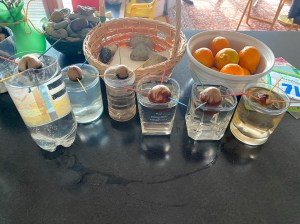
Posted in Content with Context, Emails to a Young Entrepreneur, Entrepreneuring, Flipped Perspective, Learning | Leave a comment