Emails to a Young Entrepreneur: Acknowledgements

Day 137 of Self Quarantine             Covid 19 Deaths in U.S.:  150,000

Acknowledgements

On my first Outward Bound experience, one of the participants was an English professor at the University of New Hampshire. I asked him what the secret to writing a book was. He gave me his three rules for writing:

  1. Read a lot.
  2. Before writing, create the architecture for what you want to write about.
  3. Keep your butt in the chair.

We both laughed and I felt energized because I have accomplished the first two rules many times over. For me, the third rule is the hardest.

After reading thousands of books and creating hundreds of outlines for possible books on a wide range of topics, I finally managed to keep my “butt in the chair” long enough to write these emails to a young entrepreneur.

To my lifelong companion, my wife Jamie, I thank you for all that you have put up with on my effectual entrepreneuring journey these 45 years. As I remind her occasionally – we’ve never missed a meal and we’ve always had a roof over our heads. She always reminds me that she is flexible as long as I don’t change anything.

To my three exceptional children, Elizabeth, Maggie and John, who have taught me about parenting and what it means to raise a child. To our grandchildren –  Alice, Hazel, Zoe, and Rowan – and our sons-in-law, David and Brian, who are allowing me to see parenting in wonderful new ways.

To my father, Harry Walter, who taught me more by example than I was ever able to express to him. Dad was one of those hail fellow well met salesmen who never met anybody who didn’t immediately become a friend. When I became old enough to travel with him and accompany him to a bar, my introverted self looked on in amazement at the many ways he would introduce himself. Introducing himself as a parsley salesman was my favorite. He would immediately get these strange looks. He would add “You have to be an incredible salesman to sell parsley that nobody charges for and no customer actually eats.”

I vowed I would never be a salesman. When I was 45, I woke up laughing one day when I realized that all I did everyday was sell. I was either selling equity to investors, or my products to enterprises, or talent on why they should join our fledgling company.

The greatest gift that Dad gave me was his intrapreneuring efforts to invent a fetal heart monitor when he was at Taylor Instrument Company. Every night after finishing a day of selling, he would come home and work on his invention. As a medical device salesperson he had seen the need in hospitals and OB/GYN offices for a fetal heart monitor that could amplify and put the fetal heart sounds through a speaker system so that multiple professionals could hear the sounds at the same time. He wouldn’t take no for an answer from his superiors who told him to focus on selling. When the company saw the evidence of demand from Dad’s customers, they finally agreed to produce the product. It quickly became a hot selling product. I was only ten years old at the time and got my first experience of the whole product development cycle from user research to product launch and go to market.

My mother, Marge Walter, gave me the gift of loving to read.  I was surrounded by books and being read to by my mother from my earliest memories.  Books were my play toys.  Books were my gateway to imagined worlds.

This book would never have happened if it weren’t for the relentless encouragement of David Robinson. Only a few times in my life has someone entered from left field and turned into such an incredible collaborator that the course of my life changed. When the student is ready, the master will appear. David is the master I desperately needed to reorient my approach to teaching and mentoring and thinking.  He changed my work from a purely intellectual frame to a focusing on direct experience. For too much of my life, I lived in my head and tried to pass knowledge along that way. In a hundred different ways, David showed me a different path – using movement and experiential exercises to do the heavy lifting.

I learned so much about the author, publisher, and entrepreneur path explained by Guy Kawasaki by participating in David’s journey to produce The Seer. I marveled at his ability to keep his butt in the chair and turn chapters and revisions out in a couple of days. The conversations surrounding the book that moved back and forth between the book and our teaching and consulting were ever joyful. David returned the favor through his early reading, discussions, carefrontation, and support for my writing Emails to a Young Entrepreneur. Thank you, David.

The Email on Branding and the concept of branding as love are my special tribute to the colleague who hit me upside the head to understand what marketing and branding are really about. Thank you, Katherine James Schuitemaker,  for tolerating my ignorance and skepticism as you guided me to glimpse how to think like a marketer. Katherine is my go-to person for all things marketing. She takes all the book learning I’ve waded through and artfully demonstrates the practices. Her greatest gift was helping me discover, develop and trust my inner guidance system. Katherine, I affirm you for being such a force of nature, a valued colleague and a trusted friend for these twenty years.

At the beginning of my first foray with a Silicon Valley startup in 1990, I encountered Barney Barnett. Barney was a member of our kitchen cabinet at Focus Systems along with Gordon Bell (now at Microsoft). I was enthralled with the quality of the questions that Barney asked of our executive team. His probing helped us clarify our why and our strategy. I began to suspect that Barney was a Sufi Master in disguise. One late evening over a glass of fine wine, we looked at each other and almost said simultaneously “I’ll show you my sword, if you’ll show me yours.” We both laughed and our developmental paths intertwined ever since. Barney introduced me to the biodynamics of fine wine growing through Domaine de Clarke and the Benziger Family Winery. Barney’s patient guidance of my learning about wine has transferred in many ways to the journey of guiding young entrepreneurs. The living metaphor of biodynamics transfers to the foundations of how I think and make meaning of the new venture ecosystem. He constantly reminds me that the role of the vineyard manager is not to grow grapes but to develop the best soil possible. He keeps me from losing sight of what you don’t see.

While developing the outline and architecture for Emails to a Young Entrepreneur, a longtime colleague, Bill Knight, founded startup, Percognate. Bill was my CTO at Attenex and a senior leader at FTI Consulting after the acquisition. After leaving FTI, Bill would come by every couple of weeks to share his progress and seek my thoughts and advice about how he should proceed with Percognate. I knew I needed to write this book when Bill asked me one day how we went to market and sold the Attenex Patterns product. Even though Bill sat in the office next to me for much of the Attenex journey, his jaw dropped at the depth of thought and strategy we put into marketing and sales. I realized that I’d never written about that part of the journey (thank you again Katherine, that was mostly your work). So much of what found its way into the Emails to Mikhail, started with a conversation with Bill. I am so excited about the rapid rate of progress Bill and his team have made in 18 months. Thank you, Bill, for taking time out of your impossible demands to read through and comment on an early draft of Emails.

The five executives at Digital Equipment who saw something in my youthful energy and passion for innovation that turns into meaningful revenue were a gift beyond ever being able to repay.

    • Gerry Bryant, the regional VP for Software Services, was the first executive to believe in what John Churin and I could do in the office automation market. His sponsorship, friendship, and guidance meant so much when we were clueless for how to proceed.
    • Don Busiek, Executive VP for Software Services, was smart enough to turn me loose on his worldwide organization. I thank Don for throwing me into so many sink or swim situations where I mostly swam. He would introduce me as “Skip Walter – he makes me think.” I loved it. Later, Don let me know it wasn’t a compliment. All the rest of his direct reports answered his questions directly. I would ask him a question to help him think through the problem more strategically. Don tolerated it.
    • David Creed, Senior VP for US Software Services, made me think. I found his simple questions like “who is our customer?” to be some of the hardest questions I ever had to answer.
    • David Stone, Senior VP for European Software Services, developed my abilities to go from a good idea to making it happen at scale. David had a wonderful gift of thinking strategically and then translating those strategic thoughts into action, mostly profitable actions.
    • Jack Shields, Executive VP for Worldwide Sales and Services, showed me the power of having one simple business rule – find every cost in the organization and figure out how to turn it into a revenue center. Shield’s Law has guided my observations of business processes ever since.

The analogy of conceiving of a new venture like the conceiving of a child and the parenting that ensues is an outgrowth of observing the daily life of Alice and Hazel. For the purposes of simplicity or narrative, I’ve synthesized the experiences of our daughters and granddaughters into the life of Hazel and Alice.

To those colleagues who’ve put up with my irrationality while pursuing my inner entrepreneurial muse – GEMISCH (Ed Hammond, Bill Stead), ALL-IN-1 at DEC (John Churin, Steve Forgey, Ken Mayer, Marilyn Elrod) Katherine James Schuitemaker (Aldus, Attenex, Conenza), Institute of Design (Patrick Whitney, Larry Keeley, John Heskett, Eli Blevis), Attenex (Eric Robinson, Dan Gallivan, Bill Knight, Marty Smith, Gerry Johnson, Martha Dawson, David McDonald), and UW (Jan Spyridakis, David Socha, Jennfier Turns, Alan Wood).

To the members of my visible and invisible university, I owe more than I can ever give back. Thanks to Russ Ackoff, Eli Goldratt, Adrian Slywotzky, Chris Alexander, Geoff Moore, Tom Stewart, Robert Fritz, Harold Nelson, Erik Stolterman, Stan Davis, Edward Tufte, Steve Blank, Eric Ries, and Ash Maurya.

A special thank you to Jim Clifton of the Gallup Organization for writing The Coming Jobs War.  I took Jim’s challenge of trying to figure out how to create 1.5 billion living wage jobs throughout the world as my North Star for the next ten years of professional life. Since new ventures are the key driver of new job growth, everything I can do to reduce the friction of starting a venture and increasing the success rate helps achieve the overarching goal of sustainable job growth.

To the hundreds of graduate students and thousands of entrepreneurs I’ve had the pleasure of interacting with, you’ve provided me with a wealth of insights into the challenges and different ways of starting and succeeding with a new venture.

Thank you to my “village” of mentors for everything that you have contributed to understanding the joys of starting a venture, creating new jobs, bringing opportunities to customers and investors, and generally living the innovative life.

Skip Walter
Bainbridge Island, WA
March 3, 2014

About the Author – Skip Walter

I am a naturally curious person who loves to read, who is an addicted lifelong learner, who loves to get distracted on the Internet (thank you Cathy Davidson for researching the value of this activity), who loves to find interesting topics and new insights, and finds great joy in sharing the discoveries with others.  Over the years, I find myself entering “On the Way to Somewhere Else” as the subject for many emails to colleagues, family and friends that are the fruits of my distractions.

I have over 45 years of experience in executive management, executive coaching, software engineering, product development, high technology mergers and acquisitions, organizational development, joint venture development, designing, architecting, producing, and delivering software solutions for the legal industry, publishing industry, health care industry, multi-national Fortune 500 companies, high technology startups and wineries. Along the way I was the Vice President of Engineering for Aldus (now Adobe) Corporation known for PageMaker software and the Father of ALL-IN-1, Digital Equipment Corporation’s $1 billion per year integrated enterprise office automation system.

A lifetime of study and executive management experience led to the founding of Attenex where we achieved a cash flow positive state within three years.  Attenex was sold to FTI Consulting in 2008 for $91 million.  In the process of being a serial entrepreneur, I raised more than $25 million in new venture funding for software companies in the office automation, medical, and legal industries.  The products we designed, created, and developed are used by over five million customers.   As part of my commitment to “pay it forward” to all of those who so graciously mentored me in my management juvenile period, I taught strategic design and product design planning at the Institute of Design (ID) of the Illinois Institute of technology for ten years and was a member of the ID Board of Overseers for two years.  I was selected for the Dean’s Advisory Council for the School of Informatics at Indiana University in 2005 serving for two years.   I served as the Chairperson for the External Advisory Board for the Human Centered Design and Engineering Department at the University of Washington for two years.

Now that the pandemic has severely restricted travel, I spend a lot of time observing the world from my chair above the Puget Sound.  I alternate between observing, reading. writing and zooming.

Posted in Content with Context, Emails to a Young Entrepreneur, Entrepreneuring, Flipped Perspective, Learning | Leave a comment

Emails to a Young Entrepreneur: Joining the Entrepreneurial Pilgrimage

Day 136 of Self Quarantine             Covid 19 Deaths in U.S.:  149,000

Joining the Entrepreneurial Pilgrimage

Like the discussion with the young entrepreneurs at Duke’s InCube, all of us who become entrepreneurs are joining the long tradition of the entrepreneurial pilgrimage. A key part of a pilgrimage is seeing the world with new eyes. Keri Smith in her wonderfully eclectic How to be an Explorer of the World lays out our path:

As I reflect on the emails that I’ve exchanged with thousands of Mikhails and graduate students, I am reminded of David Whyte’s book of poetry Pilgrim:

“In his seventh volume of poetry, David Whyte looks at the great questions of human life through the eyes of the pilgrim: someone passing through relatively quickly, someone dependent on friendship, hospitality and help from friends and strangers alike, someone for whom the nature of the destination changes step by step as it approaches, and someone who is subject to the vagaries of wind and weather along the way.”

CAMINO

The way forward, the way between things,
the way already walked before you,
the path disappearing and re-appearing even
as the ground gave way beneath you,
the grief apparent only in the moment
of forgetting, then the river, the mountain,
the lifting song of the Sky Lark inviting
you over the rain filled pass when your legs
had given up, and after,
it would be dark and the half-lit villages
in evening light; other people’s homes
glimpsed through lighted windows
and inside, other people’s lives; your own home
you had left crowding your memory
as you looked to see a child playing
or a mother moving from one side of a room to another, your eyes wet
with the keen cold of Navarre.

But your loss brought you here to walk
under one name and one name only,
and to find the guise under which all loss can live;
remember, you were given that name every day
along the way, remember, you were greeted as such,
and you needed no other name, other people
seemed to know you even before you gave up
being a shadow on the road and came into the light,
even before you sat down with them,
broke bread and drank wine,
wiped the wind-tears from your eyes:
pilgrim they called you again. Pilgrim.

I was reminded of the connection between “Camino” and the effectual entrepreneuring path when I encountered Ann Patchett’s What Now? at my favorite brain candy blog “Brain Pickings.

“Echoing Steve Jobs, who in his own fantastic commencement address famously cautioned that “you can’t connect the dots looking forward; you can only connect them looking backwards,” Patchett urges these new graduates to be sure to return at some point – this, she argues, would let them reflect on the series of small choices which, as William James put it a century ago, “[spin] our own fates, good or evil, and never to be undone.” Patchett writes:

“Coming back is the thing that enables you to see how all the dots in your life are connected, how one decision leads you to another, how one twist of fate, good or bad, brings you to a door that later takes you to another door, which aided by several detours – long hallways and unforeseen stairwells – eventually puts you in the place you are now. Every choice lays down a trail of bread crumbs, so that when you look behind you there appears to be a very clear path that points straight to the place where you now stand. But when you look ahead there isn’t a bread crumb in sight – there are just a few shrubs, a bunch of trees, a handful of skittish woodland creatures. You glance from left to right and find no indication of which way you’re supposed to go. And so you stand there, sniffing at the wind, looking for directional clues in the growth patterns of moss, and you think, What now?”

Ann Patchett continues to explore What Now?:

“Nothing at all is very much out of fashion these days, as are stillness, silence, and studied consideration. Studied consideration is hard to come by with those little iPod buds stuffed in your ears and the cell phone competing with the Internet. Perhaps we avoid the quiet because we’re afraid that the answer to What now? will turn out to be I don’t know.

“It took me a long time of pulling racks of scorching hot glasses out of the dishwasher, the clouds of steam smoothing everything around me into a perfect field of gray, to understand that writing a novel and living a life are very much the same thing. The secret is finding the balance between going out to get what you want and being open to the thing that actually winds up coming your way.

“There’s a time in our lives when we all crave the answers. It seems terrifying not to know what’s coming next. But there is another time, a better time, when we see our lives as a series of choices, and What now? represents our excitement and our future, the very vitality of life. It’s up to you to choose a life that will keep expanding. It takes discipline to remain curious; it takes work to be open to the world—but oh my friends, what noble and glorious work it is.”

Many moons ago I encountered Paulo Coehlo’s Pilgrimage: A Contemporary Quest for Ancient Wisdom. The novel describes a journey on the Camino in Spain.  I inhaled this book as I realized it was the backstory behind Cursillo.  Majorcan priests created the Cursillo three day process because they were not able to walk the Camino with the young men from their villages during the war years of World War II.

The very start of the book captured me:

“’AND NOW, BEFORE THE SACRED COUNTENANCE OF RAM, you must touch with your hands the Word of Life and acquire such power as you need to become a witness to that Word throughout the world.’

“The Master raised high my new sword, still sheathed in its scabbard. The flames of the bonfire crackled—a good omen, indicating that the ritual should continue. I knelt and, with my bare hands, began to dig into the earth.

“It was the night of January 2, 1986, and we were in Itatiaia, high on one of the peaks in the Serra do Mar, close to the formation known as the Agulhas Negras (Black Needles) in Brazil. My Master and I were accompanied by my wife, one of my disciples, a local guide, and a representative of the great fraternity that is comprised of esoteric orders from all over the world—the fraternity known as “the Tradition.” The five of us—and the guide, who had been told what was to happen—were participating in my ordination as a Master of the Order of RAM.

“I finished digging a smooth, elongated hole in the dirt. With great solemnity, I placed my hands on the earth and spoke the ritual words. My wife drew near and handed me the sword I had used for more than ten years; it had been a great help to me during hundreds of magical operations. I placed it in the hole I had dug, covered it with dirt, and smoothed the surface. As I did so, I thought of the many tests I had endured, of all I had learned, and of the strange phenomena I had been able to invoke simply because I had had that ancient and friendly sword with me. Now it was to be devoured by the earth, the iron of its blade and the wood of its hilt returning to nourish the source from which its power had come.

“The Master approached me and placed my new sword on the earth that now covered the grave of my ancient one. All of us spread our arms wide, and the Master, invoking his power, created a strange light that surrounded us; it did not illuminate, but it was clearly visible, and it caused the figures of those who were there to take on a color that was different from the yellowish tinge cast by the fire. Then, drawing his own sword, he touched it to my shoulders and my forehead as he said, “By the power and the love of RAM, I anoint you Master and Knight of the Order, now and for all the days of your life. R for rigor, A for adoration, and M for mercy; R for regnum, A for agnus, and M for mundi. Let not your sword remain for long in its scabbard, lest it rust. And when you draw your sword, it must never be replaced without having performed an act of goodness, opened a new path, or tasted the blood of an enemy.”

“With the point of his sword, he lightly cut my forehead. From then on, I was no longer required to remain silent. No longer did I have to hide my capabilities nor maintain secrecy regarding the marvels I had learned to accomplish on the road of the Tradition. From that moment on, I was a Magus.

“I reached out to take my new sword of indestructible steel and wood, with its black and red hilt and black scabbard. But as my hands touched the scabbard and as I prepared to pick it up, the Master came forward and stepped on my fingers with all his might. I screamed and let go of the sword.

“I looked at him, astonished. The strange light had disappeared, and his face had taken on a phantasmagoric appearance, heightened by the flames of the bonfire.

“He returned my gaze coldly, called to my wife, and gave her the sword, speaking a few words that I could not hear. Turning to me, he said, “Take away your hand; it had deceived you. The road of the Tradition is not for the chosen few. It is everyone’s road. And the power that you think you have is worthless, because it is a power that is shared by all. You should have refused the sword. If you had done so, it would have been given to you, because you would have shown that your heart was pure. But just as I feared, at the supreme moment you stumbled and fell. Because of your avidity, you will now have to seek again for your sword. And because of your pride, you will have to seek it among simple people. Because of your fascination with miracles, you will have to struggle to recapture what was about to be given to you so generously.”

“The world seemed to fall away from me. I knelt there unable to think about anything. Once I had returned my old sword to the earth, I could not retrieve it. And since the new one had not been given to me, I now had to begin my quest for it all over again, powerless and defenseless. On the day of my Celestial Ordination, my Master’s violence had brought me back to earth.”

The Pilgrimage continues with the author’s search for his sword along the Camino with Petrus, his new mentor. The author’s journey is one of overcoming obstacle after obstacle set before him by Petrus to provide the transformation so sought after.  Near the end of the book, the story reaches a climax as the protagonist finally transforms his yearning:

“I awoke feeling more optimistic and took to the Road early.  According to my calculations, that afternoon I would reach Galicia, the region where Santiago de Compestela was located.  It was all uphill, and I had to exert myself for almost four hours to keep to the pace I had set for myself.  Every time I reached the crest of a hill I hoped that it would mark the point of descent.  But this never seemed to happen, and I had to give up any hope of moving along more rapidly.  In the distance I could see mountains that were even higher, and I realized that sooner or later I was going to have to cross them.  My physical exertions, meanwhile, had made it impossible to think much, and I began to feel more friendly toward myself.

“Come on now, after all, how can you take seriously anyone who leaves everything behind to look for a sword?” I asked myself.  What would it really mean to my life if I couldn’t find it?  I had learned the RAM practices, I had gotten to know my messenger, fought with the dog, and seen my death, I told myself, trying to convince myself that the Road to Santiago was what was important to me.  The sword was only an outcome.  I would like to find it, but I would like even more to know what to do with it.  Because I would have to use it in some practical way, just as I used the exercises Petrus had taught me.

“I stopped short.  The thought that up until then had been only nascent exploded into clarity.  Everything became clear, and a tide of agape washed over me.  I wished with all my heart that Petrus were there so that I could tell him what he had been waiting to hear from me.  It was the only thing that he had really wanted me to understand, the crowning accomplishment of all the hours he had devoted to teaching me as we walked the Strange Road to Santiago: it was the secret of my sword!

“And the secret of my sword, like the secret of any conquest we make in our lives, was the simplest thing in the world: it was what I should do with the sword.

“I had never thought in these terms.  Throughout our time on the Strange Road to Santiago, the only thing I had wanted to know was where it was hidden.  I had never asked myself why I wanted to find it or what I needed it for.  All of my efforts had been bent on reward; I had not understood that when we want something, we have to have a clear purpose in mind for the thing that we want.  The only reason for seeking a reward is to know what to do with that reward.  And this was the secret of my sword.”

In The Alchemist, Coehlo discusses the obstacles to obtaining the courage to reach our own dream:

“All I know is that, like Santiago the shepherd boy, we all need to be aware of our personal calling. What is a personal calling? It is God’s blessing, it is the path that God chose for you here on Earth. Whenever we do something that fills us with enthusiasm, we are following our legend. However, we don’t all have the courage to confront our own dream.

Why?

“There are four obstacles. First: we are told from childhood onward that everything we want to do is impossible. We grow up with this idea, and as the years accumulate, so too do the layers of prejudice, fear, and guilt. There comes a time when our personal calling is so deeply buried in our soul as to be invisible. But it’s still there.

“If we have the courage to disinter dream, we are then faced by the second obstacle: love. We know what we want to do, but are afraid of hurting those around us by abandoning everything in order to pursue our dream. We do not realize that love is just a further impetus, not something that will prevent us going forward. We do not realize that those who genuinely wish us well want us to be happy and are prepared to accompany us on that journey.

“Once we have accepted that love is a stimulus, we come up against the third obstacle: fear of the defeats we will meet on the path. We who fight for our dream, suffer far more when it doesn’t work out, because we cannot fall back on the old excuse: “Oh, well, I didn’t really want it anyway.” We do want it and know that we have staked everything on it and that the path of the personal calling is no easier than any other path, except that our whole heart is in this journey. Then, we warriors of light must be prepared to have patience in difficult times and to know that the Universe is conspiring in our favor, even though we may not understand how.”

Coelho, Paulo (2009-10-13). The Alchemist – 10th Anniversary Edition. Harper Collins, Inc.

One of my favorite quotes that sheds light on the process of lifelong learning comes from Carlos Casteneda:

Overcoming Life’s Fears

“When a man starts to learn, he is never clear about his objectives.  His purpose is faulty; his intent is vague.  He hopes for rewards that will never materialize for he knows nothing of the hardships of learning.

“He slowly begins to learn – bit by bit at first, then in big chunks.  And his thoughts soon clash.  What he learns is never what he pictured, or imagined, and so he begins to be afraid.  Learning is never what one expects.  Every step of learning is a new task, and the fear the man is experiencing begins to mount mercilessly, unyieldingly.  His purpose becomes a battlefield.

“And thus he has stumbled upon the first of his natural enemies:  Fear!

“And thus he has encountered his second enemy:  Clarity!  That clarity of mind, which is so hard to obtain dispels fear, but also blinds.

“But he has also come across his third enemy: Power!  Power is the strongest of all enemies.  And naturally the easiest thing to do is to give in; after all, the man is truly invincible.  He commands; he begins by taking calculated risks, and ends in making rules, because he is a master.

“The man will be, by then, at the end of his journey of learning, and almost without warning he will come upon the last of his enemies: Old Age!  This enemy is the cruelest of all, the one he won’t be able to defeat completely, but only fight away.”

– Carlos Casteneda, The Teachings of Don Juan: A Yaqui Way of Knowledge, p. 83-87.

As you finish your journey through Emails to a Young Entrepreneur, David Whyte helps us finish the entrepreneurial pilgrimage:

FINISTERRE

The road in the end taking the path the sun had taken,
into the western sea, and the moon rising behind you
as you stood where ground turned to ocean: no way
to your future now but the way your shadow could take,
walking before you across water, going where shadows go,
no way to make sense of a world that wouldn’t let you pass
except to call an end to the way you had come,
to take out each frayed letter you brought
and light their illumined corners, and to read
them as they drifted through the western light;
to empty your bags; to sort this and to leave that;
to promise what you needed to promise all along,
and to abandon the shoes that had brought you here
right at the water’s edge, not because you had given up
but because now, you would find a different way to tread,
and because, through it all, part of you could still walk on,
no matter how, over the waves.

– David Whyte

Camino de Finisterre


You can find a PDF of the full Preface, Forward, and Chapters 1 – 10 here.

You can find the introduction to the Cosmos of the New Venture here.

Posted in Content with Context, Emails to a Young Entrepreneur, Entrepreneuring, Flipped Perspective, Learning | Leave a comment

Emails to a Young Entrepreneur: The Cosmos of the New Venture

Day 135 of Self Quarantine             Covid 19 Deaths in U.S.:  149,000

The Cosmos of the New Venture

While performing ethnographic research at a Seattle B2B startup accelerator, I agreed with the managing partners to just research and not to mentor any of the nine companies. I wanted to have a baseline of how an accelerator works before introducing interventions to test different approaches to accelerating the development of a new venture.

One of the companies wouldn’t let me get away with being a passive ethnographic researcher. They went to my LinkedIn profile and found my blog and confronted me with “you were introduced to the nine companies as simply a UW professor doing research. We all dismissed you as a useless academic and then we found out that you are an accomplished serial entrepreneur. Can you help us get some funding and find the talent we need to accelerate our product development?”

As much as I wanted to stay neutral, I was fascinated that one company actually did some research on who they were encountering within the accelerator. Over several ferry rides to Bainbridge Island and many engaging evenings at The Pub, I agreed to help them. I liked their product and their approach. They were the only company that valued design with one of the co-founders being a very accomplished designer.

I introduced two of the co-founders to three of Seattle’s Super-Angels and a VC. Of the $750K the team raised during their six-month tenure at the accelerator, $700K came from three of the four introductions. The team did a super job of bringing their opportunity to these investors and gaining early interest. Yet, the team had no idea what the “selling” process and documentation (term sheets, investment documents) and strategy for closing the investors were.

Over several more beers at The Pub, I shared that with investors it is all about “warm armpit” face to face selling. Emails and phone calls don’t cut it. It took a lot of pestering on my part to keep them engaged with the investors.

Over time it became clear that the founders didn’t understand how networks work and what trust relationships mean. Their focus was on the core triangle of Conceiving, Designing, and Bringing.  After a lot of prompting they still didn’t see the behind the scenes context that was guiding the investors to part with their resources of money and time. They never figured out that three of the four investors knew each other from their formative years at Salomon Brothers. They didn’t understand that by connecting these four investors with the team, that the investors were trusting our previous relationships and that if I recommended this company (the only one out of the nine) that I thought the company was pretty good. In the small world of the entrepreneurial ecosystem a recommendation from a trusted advisor is of great value.

The founders also never saw the many interactions behind the scenes of the ways that the investors “checked out” the company and the founders. The founders still believe that the money they received was because they did such a good job pitching their product and company. Similarly, the founders didn’t see that the same kind of network effect was in play with selling to their enterprise customers. The co-founders couldn’t “see” the many reputations of respected professionals that went into their customers actually purchasing.

The Cosmos of a New Venture is a way to prompt the entrepreneur to look beyond the core triangle of work – Conceiving, Designing and Bringing. The core triangle is the daily work. However, it is the surrounding context that enables the “meal” to be served and the consumer satisfied with the experience.

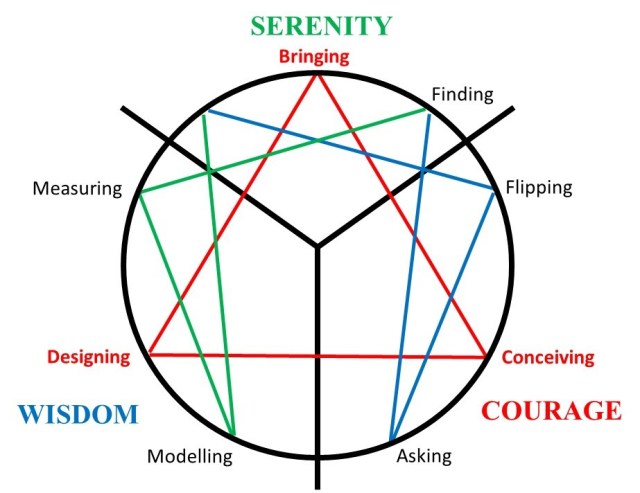
Throughout the Emails, I build a meta-model of the new venture cosmos similar to Bennett’s description of the enneagram of the three fold way of a cook in a kitchen preparing a meal. The Cosmos of the New Venture is a model of both energy flow and the multiple layers of context in any human activity.

With all the emphasis on “lean” and formulaic approaches to a new venture and successful entrepreneurs trumpeting “do it the way I did it,” the entrepreneur loses sight of a new venture being about marshaling and managing energy in a threefold context.


All models are false; however, some are useful.

The short definitions of each of the points on the enneagram are;

    • Conceiving is COMMITTING.
    • Flipping Perspective is OBSERVING with a spirit of inquiry.
    • Finding talent is VALUING DIFFERENCES.
    • Modeling is the EXCHANGING of value.
    • Designing for humans is OBSERVING, PROTOTYPING and ITERATING.
    • Asking for help is about OVERCOMING fear.
    • Bringing opportunity is about PITCHING and CATCHING.
    • Measuring is KNOWING.
    • Branding is LOVING.
    • Exiting is CAPTURING your rightful valuation.

The challenge of sharing any system, framework or model is that the mode of explaining it, whether in writing or speaking or in Socratic conversation, is inherently linear. Yet, there is nothing linear about the effectual entrepreneuring process. The nine-term system of the Enneagram is a way to explore the many interactions of the nine elements of The Cosmos of the New Venture.

The more astute among you realize that there are ten elements to our system with Exiting. In the Bennett explanations of the Enneagram model, Exiting is the start of the next cycle up. Exiting is the bringing not of an opportunity (product or service) to a customer, but of the business itself to another set of investors or acquirers. The cycle repeats at a higher level of organization.

Let’s look at the new venture cosmos in a similar fashion to how Bennett looked at the cooking of food in a kitchen. The entrepreneur becomes our “cook” who takes the raw materials (food) to conceive the opportunity she wants to bring to her customers (guests) by designing the product offering. In today’s digital connected world, physical products and digital products are produced and distributed in much the same way as Chris Anderson describes in Makers: The New Industrial Revolution. The major resource for the transformation is the intellect of the talent inside the organization (kitchen). The kitchen is the “place” that is created by the resources of the investors. It may be a physical place or increasingly a virtual place in the cloud.

As the entrepreneur visionary conceives the core triangle of work, first in mind and then in practice, it is time for the entrepreneur to FIND the talent and work a process to flip the perspectives of the talent, customer and investors. An effectual entrepreneur starts this process by asking for help and graciously receiving the help that passes the muster of their inner guidance system. This next triangle surrounding the core work is the Finding, Asking and Flipping acquiring of resources to “cook” the meal (product).

As soon as the entrepreneur envisions these two triangles, the conceiving goes to the branding thinking. How will the entrepreneur help the customer experience the love and caring that goes into providing the consumer with both a promise and a fantastic brand experience. What will the entrepreneur “stand for” to their customers? What can the customers trust the entrepreneur to provide?

Pretty soon the mind of the entrepreneur flows to how to model the experience and the Geoff Moore Whole Product that surrounds the generic product that they are delivering. What can the entrepreneur do to enhance the presentation of the cooked meal with table cloths, flowers on the table, and the good silverware and china? Is there an appropriate wine in the right Riedel glass to compliment the food? As Moore and Ted Levitt pointed out, customers aren’t just buying a particular product like Microsoft Word, they are trying to produce a good looking resume or business plan. As the focus shifts to a model of the whole experience, the business mind cuts in to make sure there is a profit model that works for their “meal” so they can stay in business.

As the business mind chimes in, the entrepreneur begins to think about how to measure how their product is going to help the well-being of their customers (guests). The entrepreneur wants to know how they are doing so they can improve their product for the next encounter with the customer.

The cycle is complete as we move back to Finding the additional talent, customers and investors to help us continue to grow the business and most importantly grow our customers’ businesses. The threefold way of the Cosmos of the New Venture is continuously working. The challenge is how aware and how intentional the entrepreneur is about the cycle to anticipate and avoid breakdowns in the energy flow.

The threefold processes of the Cosmos of the New Venture are:

    • The raw materials (primarily the intellect and will of the talent)
    • The product (conceiving, designing, bringing)
    • The customer (receiving a loving and engaging experience)


You can find a PDF of the full Preface, Forward, and Chapters 1 – 10 here.

You can find the introduction to the Cosmos of the New Venture here.

Posted in Content with Context, Emails to a Young Entrepreneur, Entrepreneuring, Flipped Perspective, Learning | Leave a comment

Emails to a Young Entrepreneur: Paying it Forward

Day 134 of Self Quarantine             Covid 19 Deaths in U.S.:  148,000

Paying it Forward – Email from Mikhail

Dear Entrepreneur Skip,

The last year was a whirlwind. I hope you saw the good news that we sold our company recently. We really appreciate your guidance throughout our entrepreneurial journey. In the end game, your deep wisdom on Valuation Capture and your strong recommendation to really understand Basil Peters Early Exits was invaluable for deciding to sell the company now at 10X of our revenue.

I really appreciated the many ways you used the flipping perspective exercise. Whenever I found myself feeling lost, I would do the exercise with the theme of what was bothering me.

I want to share one of the many letters that I’ve received since the sale of our company was announced.

Dear Mikhail,

I was excited to see that you recently sold your company after just a year. I am impressed with your quick success. How did you do it?

I would love to learn how you accomplished your rapid path from idea to exit. I’ve got a great idea for a new patent analytics tool that builds on the work of the Russian patent examiner, Genrich Altshuller, who developed TRIZ, the theory of inventive problem solving.

Can you be my mentor for becoming an entrepreneur to build my product and make it a success in the market?

Sincerely,

Boris Polyakovsky

I’ve met with Boris and several of the other entrepreneurs who’ve reached out to me. I find myself either sharing the steps (our formula) we went through with our startup or worse – acting like an Entrepreneur Assassin – by disparaging their incredibly naïve business and product plans.

How were you able to be patient with me and never disparage my ideas?

Everybody wants to know my secret. They kind of roll their eyes when I share that I needed to discover, develop and trust my inner guidance system – my inner entrepreneur North Star.

I need to go back and re-read your emails but this time from the point of view of a mentor paying it forward rather than an entrepreneur. Is it OK if I pass on your emails to Boris and other young Russian entrepreneurs?

Yours in entrepreneuring,

Mikhail


You can find a PDF of the full Preface, Forward, and Chapters 1 – 10 here.

You can find the introduction to the Cosmos of the New Venture here.

Posted in Content with Context, Emails to a Young Entrepreneur, Entrepreneuring, Flipped Perspective, Learning | Leave a comment

Emails to a Young Entrepreneur: Exiting

Day 133 of Self Quarantine             Covid 19 Deaths in U.S.:  147,000

Exiting

Flip Comic created by David Robinson

“Intention. A man’s intention is not a thought or an object or a desire, but what makes him go forwards even when everyone is telling him he will be defeated or that his chosen course of action makes no sense. Having a clear intention helps the warrior to be invulnerable, to behave like a shaman, capable of walking through walls and touching the infinite.

“The choice of path. Nothing in this world is given to us as a gift. The most important lessons are always learned with great effort and difficulty. With this in mind, the warrior-hunter never despairs or wastes his time blaming others, because he knows that whatever he does, he bears sole responsibility for his choices. A warrior cannot complain or have regrets: his life is a constant struggle, and the challenges he meets are neither good nor bad, they are merely challenges.”

Carlos Castaneda and the Sacred Lineage – a selection based on texts by Carlos Casteneda, 1925 – 1998.


Vancouver, British Columbia Canada August 30, 2013

Dear Mikhail,

Every year or so I must make a pilgrimage to Vancouver to listen to Basil Peters explain his Early Exits approach to new ventures. It reminds me of Covey’s second habit – “Begin with the End in Mind.”

I really enjoyed reading the results of your exercises for exploring “branding is everything.” I really appreciate your taking these exercises to heart and am humbled by the insights that you are generating for your new venture. I am unable to select the best brand or logo or brand promise or set of experiences for your new venture. Only you can do that selection.

As I mentioned in my first email, in my forty years of innovating by creating new ventures, I did not understand what game I was playing. I didn’t understand the game board or the rules or even what the goal of the game was. Like a new mother I made the decision to conceive a new venture (well, many new ventures as it would turn out), but I didn’t know what the end game was. I didn’t understand the game of parenting a new venture. It was like I was doing a jig saw puzzle with no picture on the cover of the box to guide my putting the pieces together.

I went through the typical progression of an entrepreneur. My first focus was on the product idea. The business focus was on the cost side – how much money would I need to create the product. The next focus was on finding customers – how much money would it cost me to get to market and generate revenue. Once we had customer and revenue traction the focus shifted to becoming cash flow positive. By the time I got through these stages I was like an exhausted parent trying to move from parenting that sweet infant to surviving an out of control teenager.

By the time you get to the cash flow positive state you have raised external capital and you now have a board of directors to deal with along with your employees, customers, suppliers, investors, competitors and influencers. There aren’t enough hours in the day to deal with the urgent, let alone the important. All of the stakeholders want large portions of your time.

At this point you start to think about exiting – either a personal exit from the company by turning it over to “professional managers” or a company exit (IPO or acquisition). In your more reflective moments you reflect on the joy that you had in conceiving the idea for the company and the peace of the gestation time. Most of us gather hundreds of ideas for the next thing that we would like to conceive. These are our day dreams.

The professional part of you tries to keep in mind what is best for the company. Should you add a new product line?  Should you expand into services? Should you find a new set of partners? All of these questions swirl around you. You start seeking counsel from your board members, investors, bankers, and consultants. Yet all of these third parties have some other agenda and you don’t know how to absorb all of their advice.

More importantly you realize that you don’t have a way to think about the advice that you are getting or a framework to represent the options.

Seven years into the successful expansion of Attenex, I felt I was missing something basic. In spite of all the reading that I do on ways to think about business and strategic networking with the best business minds I could find, I still didn’t have a way to reconcile all of the wisdom I was encountering.

Twenty years ago I encountered the Intellectual Capital approach to valuing a company along with Ijiri’s Triple Entry Accounting to capture the momentum of a company. I also liked the scenario planning matrix and methods of the Global Business Network. But I couldn’t synthesize these frameworks into something that would help me think through the next evolution of Attenex.

One night I awoke with a start and sat bolt upright in bed. Fortunately, I sleep with a yellow pad and a pen next to my bed and I quickly sketched what became the following matrix:

I’d finally reconciled the key components of Intellectual Capital with the product and services options we had for moving Attenex forward. Intellectual Capital is a framework and method for answering why the valuation of knowledge based companies (Google, Microsoft, CitiCorp, KPMG, McKinsey) were so much higher than their book value. Sveiby, Edvinsson, and Stewart had written extensively on the topic and asserted that traditional financial methods don’t measure key contributors to Intellectual Capital – the delta between traditional financial measures and stock market valuation. These authors describe the three types of intellectual capital:

  • Human Capital (Talent) – the talent base of employees skills that includes measures like the ratio of talent with advanced degrees to workers with high school education.
  • Structural Capital – the non-human storehouses of information that reside within the facilities of a company. These include the knowledge that resides in information systems and file cabinets.
  • Relationship Capital – the knowledge embedded in the business social networks (customers, suppliers, influencers) along with strategic networks.

The artificial number representing these three abstractions is typically captured in a spread sheet cell within traditional financial statements called “goodwill.” It is unmeasured and unmanaged. In a knowledge based company, these three forms of intellectual capital are the primary assets.

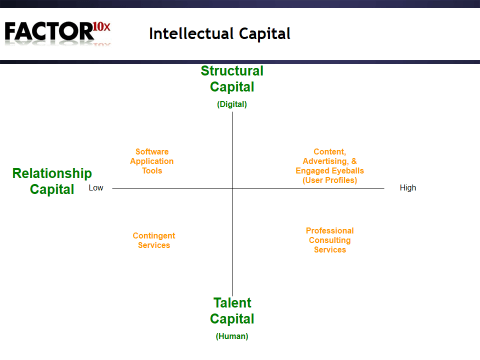
In the 2×2 matrix above, the vertical axis illustrates the spectrum of Talent Capital (what resides in employees’ heads) to Structural Capital (what remains in the company when employees go home at night). The horizontal axis represents a spectrum of Relationship Capital from low to high. Mass produced products (like hardware or software) typically have low relationship capital as they are more of the form “one size fits all.” On the high side of relationship capital the product or service is highly customized to the needs of the customer in order for it to be useful.

The top half of the matrix represents those products that can be mass produced and are mostly in digital form. The bottom half of the matrix is for the services arena and is mostly provided by human beings. From a product/service standpoint three of the quadrants were pretty easy to identify – software, contingent services and professional services.

What should be in the upper right quadrant? That question occupied most of the rest of the early morning. Finally, it hit me that the upper right quadrant is the realm of content. Content is mass produced, particularly digital content. However, in order for content to be useful it has to be somehow tailored to the individual consumer. The big breakthrough of the last twenty years is the search engine (Google, Yahoo, Bing). The search engine is the customizer of the mass content to my unique needs. The search engine is the vehicle for creating high relationship value. By profiling the users of content (and the content itself), search engine companies achieve high relationship capital with their consumers. The content is even more valuable the more often the user accesses the tool so another aspect of the upper right quadrant is how sticky the content site is.

A way to understand this framework (2×2 matrix below) is to place some existing companies on the matrix. Try placing the following companies – Microsoft, Google, Facebook, KPMG, Twitter, and Kelly Services. The most valuable companies are the ones that are able to monetize their content through advertising with a very large number of engaged users (millions to billions).

After using the framework to position existing companies, I took a quick look at the eDiscovery market that we were a part of. I identified the following products and services:

    • Contingent Services – the part time lawyers and paralegals (often hundreds at a time) that review documents and are hired by the project, not permanently.
    • Professional Services – the partners and associates at the law firms hired for a given matter, the project managers in all the companies associated with collecting, processing and reviewing the matter.
    • Software – all the software tools that are used to process a matter like Attenex Patterns, FTI Ringtail, Summation, and Relativity.
    • Content – the client’s private and confidential data like email and the publicly available data like case law, case summaries, and lawyer databases.

The matrix worked. I could represent any product in our market space. Now I needed to add some numbers to the matrix to see if I could quantify the relative value of each quadrant.

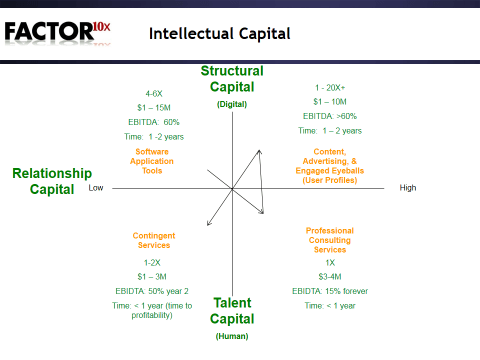
I started with some estimates of what the valuation multiple (company valuation divided by revenue) for companies in each quadrant. The software quadrant had valuation multiples ranging between 4-6X meaning that if a company was generating $30M in revenue it could expect an acquisition price of $120M – $180M. Professional Services firms typically have a low multiple like 1X. Depending on the business they are in,  Contingent Services businesses can have multiples that range from 1-2X.

Again, the real surprise was the Content Quadrant – the multiples ranged from 1X to much greater than 20X. No wonder Google was valued so highly.

The numbers in the matrix quadrants represent from top to bottom:

    • Valuation Multiple
    • Amount of investment money needed to get to cash flow positive
    • Earnings before interest, taxes, depreciation and amortization (EBITDA) as a percentage of revenue
    • Time frame to go from idea to cash flow positive

Over the previous six months, I’d advocated that the going forward strategy for Attenex should be to develop a review services and hosting business (Contingent Services). I watched our service provider partners generate >$300M in services business based on our software tool. If we had been able to have a services business (since we were owned by a law firm we couldn’t), we could be generating $300M in revenue. However a services business is a lot harder to manage than a software business.

Armed with this framework, it was obvious we should go into the Content Quadrant. Yet we couldn’t in the eDiscovery space. Our key content was very private and confidential and belonged to our customers. The public content that is in the space like case law and case data is primarily owned and distributed by the duopoly of Lexis Nexis and Thompson Reuters. And those businesses were closer to the 1X level because the content didn’t lend itself to advertising, nor did the users want to have their searches profiled.

Several times during our business evolution I looked at the potential of the patent marketplace. Now I had the framework to see that the patent market was the next place to move strategically. Our Attenex Patterns software could be used without any extra development. We just needed to ingest the free and publicly available patent database. Through a variety of value adding means we could do valuable unobtrusive professional advertising to increase the valuation multiple. If we invested a little bit of resources, we could add the missing database in this space – product data. Combining the USPTO database, the SEC financial database of S1 and 10K reports, and our proprietary product database, we should be able to get to a 10X multiple of revenue within a year.

Within a few short hours (after ten years of unconscious incubation), I had a framework for representing the state of a company, and I had a game board to think through the strategic options for our company.

As I presented the framework to colleagues, we realized that the matrix also provided a way to think through the process of evolving our company.

Remembering Shields Strategy, I shared the path through the four quadrants with my colleagues as a starting point. Jack Shields, Executive Vice President of Sales and Services for Digital Equipment had one simple strategy – take every expense item and figure out how to turn it into a revenue generating business. Using this precept, we realized our quickest way (at almost no cost) to get to the content quadrant was to hire a few patent experts and sell a few professional services projects to generate the content that would be valuable. We didn’t even have to look very hard for the customers as 20% of the litigation our product was used for was patent litigation.

Then we could generalize the content and analysis techniques from the professional services projects to be the basis of our missing “product database” which is a key to determining patent infringement. That would allow us to move to the higher multiples of the content quadrant. To keep the different databases updated and normalized, we would hire contingent labor (probably offshore) to add value to our content.

The arrows in the above matrix indicate this movement from the software quadrant to professional services to the content quadrant to contingent services. We’d taken an R&D cost and turned it into professional services revenue and then by moving to the content quadrant we could dramatically increase our company valuation. And we’d get lots more users of our product.

As we worked through this process, I saw that we’d moved from understanding how to think about intellectual capital and how it affects valuation, to a way to think about corporate strategy to developing the levers for how to increase valuation.  With the valuation capture framework, we had a way to prioritize new products and product features.  We could estimate which new products and new features would lead to higher valuations.

At every opportunity I started sharing what I now call the Valuation Capture framework to entrepreneurs. You can imagine my disappointment at the lack of understanding and the eye rolling that entrepreneurs showed towards my brilliance. The only folks that sort of “got it” were serial entrepreneurs who’d actually gone through an exit. These are also the only folks who deeply understand Saras Sarasvathy’s effectual entrepreneuring framework. Like most adult learning, if you haven’t experienced it, it is hard to make meaning. Once again, I ran right into the challenge of “experience first; make meaning second.”

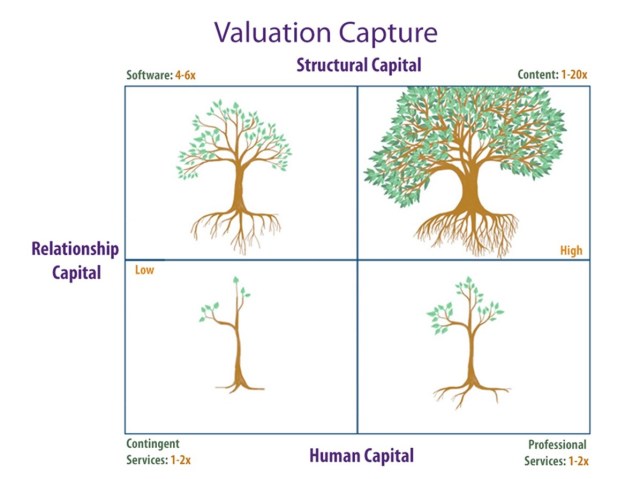
In one of these sessions, I bemoaned the problem with Christine Martell, CEO of VisualsSpeak. Once she understood what I was presenting she asked if she could play with the design of the diagram. In a couple of days, she shared with me the visualization below:

I couldn’t believe the difference a well-designed diagram made. Instead of belaboring the topic for an hour to entrepreneurs, they take one look at the diagram and go – “Oh, we should be in the upper right quadrant shouldn’t we? So how do we get there?”

Bingo. The right question.

Mikhail,

Being the astute entrepreneur I’ve gotten to know over the last several months, I know you’ve already realized that you have to start now to work on your Valuation Capture. You can’t wait until it is time to exit. By then it is too late.

Begin with the end in mind.

Starting at the end of the new venture process – the exit – is what I’d missed for forty years. During the new venture journey the concept of valuation is often present, particularly when you are doing an investment round. You have to deal with concepts like pre-money and post-money valuation. However, these are just simple arithmetic formulas that are devoid of any real understanding.

Through all these years of intrapreneuring and entrepreneuring, I had failed to recognize what game I was playing – the valuation game. Nobody ever shared with me how I could increase my valuation (other than generating more revenue) and that some product efforts are much more valuable in the end game than others.

Begin with the end in mind.

Mikhail, I’ve enjoyed the opportunity to participate in your journey of discovery as to what you are conceiving and the business that you are creating. Thank you for the gift of your questions, your responses to the exercises, and your patience in letting me share some of the concepts I’ve discovered on my journey of effectual entrepreneuring.

I am going to be “off the grid” for quite a while so this will be our last email.

My fondest hope is that during our shared journey you’ve discovered, developed, and are trusting your inner entrepreneur North Star.

God grant me the serenity to accept my team, my customers, my investors and my suppliers as bringers of opportunity;

The courage to change my understanding of what the customer truly needs;

and

The wisdom to know the difference between what is right and what the investors, the board and the bankers want.


As I’ve done for you, the best gift you can give me is to take your acquired wisdom and  “pay it forward” to a young entrepreneur.

Yours in entrepreneuring,

Skip Walter


Applying Exiting

The theme for the flipping perspective this week is to look at large and small recent startup exits and understand their exit value from a flipping perspective view.

    • Select an exit that is documented in the press (Instagram, Whatsapp …)
    • Capture an image of the founders or their products
    • Free write on what the factors were in their receiving the valuation they did. What can you do to enhance your valuation in a similar manner to the exit under study?


The Cosmos of the New Venture

The beauty of the enneagram is that it is a recursive model. Exiting is the 10th step in a nine step system. It begins the cycle again. By exiting, your company is bringer of opportunity to another group of investors.

Exiting is CAPTURING your rightful valuation.


You can find a PDF of the full Preface, Forward, and Chapters 1 – 10 here.

You can find the introduction to the Cosmos of the New Venture here.


Posted in Content with Context, Emails to a Young Entrepreneur, Entrepreneuring, Flipped Perspective, Learning | Leave a comment

Emails to a Young Entrepreneur: Applying Branding

Day 132 of Self Quarantine             Covid 19 Deaths in U.S.:  145,000

Applying Branding

The theme of this week’s flipping perspectives is to observe other brands and your brand with deep feeling – love or hate.

For seven days, alternate between well-known brands and different ways you might brand your company and products.

    • Select a brand to focus on – during the week select both brands you love and hate and ways that you might brand your own product
    • If a known brand, capture an image from the branding work of the company you selected. If your own brand, capture or sketch an image of your brand experiment
    • Free write about the emotions you feel with your selected brand or brand experiment and identify ways those feelings affect your brand experience.

The Cosmos of the New Venture

Branding is part of the serenity cycle as it captures the ease with which company, talent and customers interact with each other. Branding is about the serenity of a promise and the serenity of lifetime of great brand experiences.

Branding is LOVING.


You can find a PDF of the full Preface, Forward, and Chapters 1 – 6 here.

You can find the introduction to the Cosmos of the New Venture here.


Posted in Content with Context, Emails to a Young Entrepreneur, Entrepreneuring, Flipped Perspective, Learning | Leave a comment

Emails to a Young Entrepreneur: Branding

Day 131 of Self Quarantine             Covid 19 Deaths in U.S.:  144,000

Branding

Flip Comic created by David Robinson

“People often assume the brand is the logo or symbol—and there’s no doubt that if that’s done well, it can give you a flavor for who the company is, whether they’re contemporary or traditional, and so forth. But I really see the brand as more than that logo or mark—it’s the totality of the way in which the company talks to its public.”

Kit Hinrichs


Bumpass Hell, Lassen Volcanic National Park, California, USA August 15, 2013

Dear Mikhail,

Your email reached me while I am enjoying a “Ring of Fire” high at Bumpass Hell in Lassen Volcanic National Park.  I can’t believe that it is mid-August and we are having to hike through two feet of snow in places.

I understand the difficulty of finding metrics for your products and services in your new venture. I’ve had to discontinue product development on several products that we couldn’t find good metrics for. I suspect you have found some good metrics, but only you can sort out which ones matter for guiding your future product development.

Shortly before we started merger discussions between Aldus and Adobe, we were interviewing for a new Director of Marketing Communication. As an executive I was asked to interview some of the candidates. Near the end of the process, Katherine James Schuitemaker showed up in my office in the middle of a typically frantic day. Knowing that there were several of my managers waiting for meetings, I thought I could gain back a little time by doing a perfunctory interview. Little did I know I was about to meet one of the finest collaborating colleagues of my life.

In my previous 25 years of management, I worked with a wide range of corporate marketing and agency talent. While marketing is not my area of expertise, I was rarely impressed with marketing folks.  As a result, I did not have a skills template for a good marketing person, let alone a Director of Marketing. All I knew is that marketing folks had these outlandishly large budgets which they always spent – to little effect.

Running down my stock list of interview questions, I asked Katherine “what is your philosophy and understanding of branding?” I expected some lametard answer about designing cool logos (my feeble understanding of branding). Instead I got an education that started with “Branding is everything!” expressed with every energetic fiber in Katherine’s being.

Whoa! I had to challenge that. “Excuse me, but product is everything. Marketing is just the gloss and expensive budget that is spent without any controls. What do you mean branding is everything.”

Talk about waving a red flag in front of a charging bull. Katherine launched.

“Branding is everything. What you build as a product is just one component of the brand. The brand is the essence of everything Aldus needs to do as a company. Brand is the promise that is made to every customer. Brand is the experience that every customer has with every aspect of the product. From the first minute that the customer becomes aware of Aldus, to the out of box experience, to the trial of the product, to learning to use the product, to calling customer support when they have a problem, to receiving and installing product updates, to how you help the customer tell their friends about how wonderful your product is – branding is everything.”

I was having a hard time taking notes with the fire hose of passion that Katherine unleashed.

To slow Katherine down, I asked for an example.

Katherine explained to me her conception of branding by telling the story of her work in promoting the HP LaserJet.  While doing scores of buyer and user interviews, she kept hearing the customers say “I love my LaserJet.”  It took her a while to realize that the customers might actually mean they really had an emotional relationship with an object instead of a person.

When the customers were asked specifically about using a verb like “love”, they just laughed and said “of course, we don’t really mean that we love it in that sense.”  Yet, customer after customer kept saying those words.  So Katherine and her team decided to try out some print and TV advertisements using exactly that theme.

Long before I met Katherine and to this day, I remember those ads with enterprise customers talking about how they loved their HP Laserjet.  I remember a business manager sitting at his desk in white shirt and tie enthusiastically sharing “I love my LaserJet.”  I thought it was the dumbest ad.  Yet, what have I done since seeing those ads?  I have only bought HP LaserJets – for twenty plus years.  Those ads that Katherine generated increased LaserJet sales by over ten times to billions of dollars per year.

Katherine used those insights as a core part of her Value Exchange Relationship process.  Some of the questions that she asks (in oh so many ways) are:

Katherine took the customer research and turned it into the core of how she has helped countless companies since – people are in deep relationship with the objects of their life in a very similar manner to how they are in relationship with other people.

Reeves and Nass in the Media Equation:  How People Treat Computers, Television, and New Media Like Real People and Places performed a wide range of detailed, scientific studies to amplify what Katherine found through her research.  Despite countless denials, the research subjects treated the new media and objects of the information age as if they were dealing with people.  Yet, this research has not really made it into the design of objects and software.

As I reflected on the “brand is everything” assertion, I started paying attention to my favorite brands and started deconstructing them with Katherine’s point of view.  The first powerful experience that came to mind is the occasional experiences over fifty years attending the Masters Golf Tournament.

While the world has changed in myriad ways since my first visit to the Augusta, Georgia slice of heaven, the experience of the Masters is as magical today as it was when I attended my first Masters in 1967 with my father. The beauty of the hundreds of Pantone shades of green come to life with the interspersing of the multi-hued azaleas providing the backdrop for the world’s best golfers.

In 1967 we walked the 18 holes of the course and rested after the long climb up the fairway of the 8th hole. We noticed a little white ball come bouncing onto the green with no golfers in sight. As if drawn by a magnet the ball went straight for the hole and dropped in. There were only 20 of us standing around the green to witness Bruce Devlin’s double eagle (only the second recorded at the Masters).  Cool.

As we continued around the course, I didn’t want to leave the bank below the sixth hole where all the University of Georgia coeds were sun bathing on this warm spring day. Dad dragged me away to the food tent where we filled up with $.50 pimento cheese sandwiches and $.75 beer. This beautiful course flows with great looking women and inexpensive food. Can I come back every year, Dad?

Fifty years later, the golf holes are different to accommodate the changes in golf equipment and the skills of Tiger Woods, but the experience represents the best of the old South. The azaleas and coeds are still spring time beautiful and the food a tasty and amazing bargain (sandwich $1.50 and beer $3).

In spite of several generations of Augusta National managers and professional golfers and a wide range of external criticism for not accepting people of color and women as members, the organization has grown the brand, evolved their membership rules, and increased the number of tickets (from 40,000 to 150,000 for the four day tournament) while still keeping the brand, brand promise and brand experience the same.

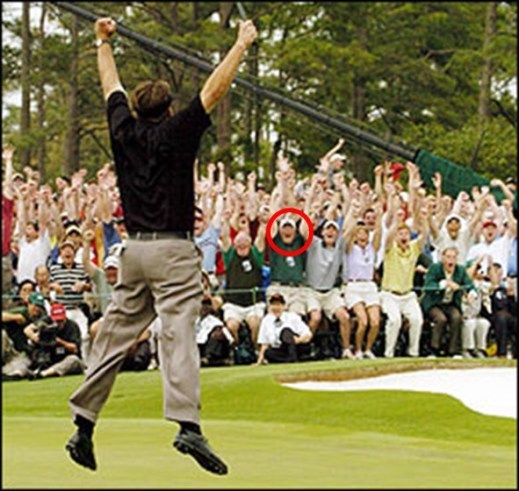
Skip celebrating Phil Mickelson’s First Masters Victory

An important part of the Masters tradition and experience is that no cameras or phones or electronic equipment are allowed on the property.  The “patrons” are here to focus on great golf and masterful golfers and enjoy being a guest of the Masters golf club members. There are no distractions. A special part of the event is that you can only track the scores from the scoreboards and follow the loud cheers or groans when a golfer does something great or poor somewhere on the course. The cheers tell you that something happened but you have to wait for the score to be updated on the manual scoreboards to understand what just occurred. We have to use our imagination to create the remote experiences on the course. Returning to a simpler time of pure imagination is part of the charm.

At the core of the Masters experience is recreating the values of Bobby Jones, the last great amateur golfer, who designed the Augusta National course and established so many of the traditions. The club members strive to have each patron be transported to the world of Bobby Jones each April. No matter who you are and how famous or rich you are, you are still just a patron. In the photo above, I was just a few feet away from another one of my sports heroes – Jeff Gordon of NASCAR fame. Like the rest of us, Jeff sat in his fold up green Masters chair. For the five hours we all watched the golfers finish their final round  at the 18th green in 2004, Jeff was just one of us patrons. Not a single patron bothered Jeff for an autograph. We are all special during those four days.

How do they do that?

Clues to how the Masters achieves their brand promise and brand experience can be found in the Email on Conceiving – being clear about their “why” and their values.

While one of our family tragedy stories is of the year that we lost our Masters tickets by failing to renew them, I married into the Keleher family and their two annual Masters tickets. Once Jamie’s parents got older they would give the tickets to one of their children to go to the Masters. So every six years we got to visit Augusta National again. Not knowing how many times we might continue to visit due to Grandma Barb’s poor health, during our last visit we took our three kids so that they could each have a day to experience the Masters. And not a single member of my family is a golfer. The Masters experience transcends sports.

I love the Masters.

I love the Masters so much it was important to pass the Masters experience of my father and Jamie’s father to our three children – three generations of Masters experience. Different years, different interests, and different attitudes and the depth of the Masters brand, promise and experience transcends all.

Sound familiar – I love my HP Laserjet printers.

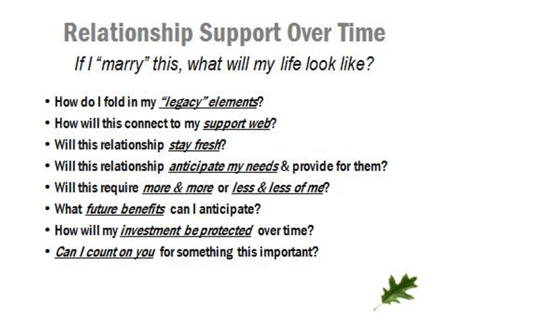
If I marry the Masters golf tournament, what will my life look? Looking back, my life is filled with fifty years of deep memories – both of being at the event eight times and watching the tournament on TV the rest of the time. Watching the Masters on TV is different than watching any other event as I’ve been to the actual golf course. I’ve experienced the dramatic undulations of the greens and the unfathomable distance and hazards of Amen Corner.

Katherine went on to share the fundamental questions that an entrepreneur needs to think through when creating your brand.  Your brand is your company. Your brand is what you stand for. Your brand is your relationship with all your stakeholders.

From the very start of your “branding is everything” journey, these are the core questions. None of us gets these “right” at the beginning. You are only guaranteed to get them wrong if you aren’t deeply explicit about the answers at each stage of your journey.

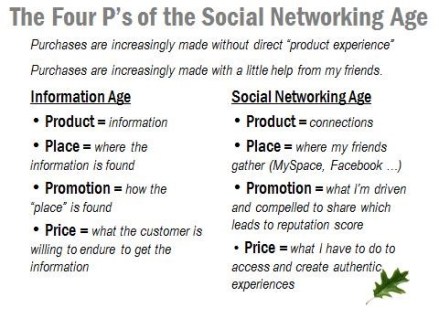
As Katherine worked her clients through the Value Exchange Relationships, she realized that the 4Ps which are a cornerstone of brand thinking were changing. The traditional 4Ps of the industrial age were shifting with the advent of the information age and the Internet.

Working with Katherine at a couple of new ventures, we realized that with the advent of social media the 4Ps were shifting again:

The other starting point for thinking about your branding is the Positioning and Value Proposition that Geoff Moore describes in Crossing the Chasm. The elements of the positioning statement are:

    • For (target customer)
    • who (statement of need or opportunity)
    • the (product or company name)
    • is a (product or company category)
    • that (statement of key benefit / compelling reason to buy) .
    • Unlike (primary “competitive” alternative) ,
    • our product (statement of primary differentiation).

An example of the positioning statement from the early PC days when Windows 3.0 released was:

“For PC users who want the advantages of a Macintosh-style graphical user interface, Microsoft Windows 3.0 is an industry-standard operating environment that provides the ease of use and consistency of a Mac on a PC platform. Unlike other attempts to implement this type of interface, Windows 3.0 is supported by every major PC application software package.”

A more recent example of a positioning statement is the Google search engine:

“For web users who want an easy way to find the right information fast, Google is a simple yet highly discerning search engine that turns content on the web’s 1.3 billion sites into just what you wanted to find. Unlike other search engines, Google delivers only the most relevant results in less than a second, without the delay and distraction of downloading a page full of advertising or useless links.”

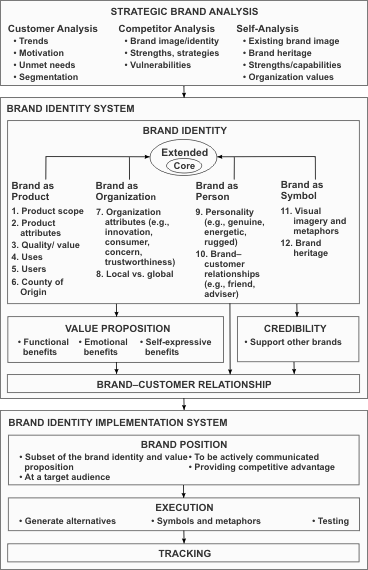
David Aaker is a prolific author on the many aspects of branding. His Brand Identity Planning model is a deep and formal look at branding.

In a blog post Aaker shares his Top 10 Brand precepts:

“Out of my five brand books, what precepts stand out as one of the top ten? Which are most critical “to do” tasks for someone charged with creating or managing a business? What do you need to know to excel at building a brand? Here is my top ten list:

  1. Treat brands as assets.Acceptance of the concept that brands are assets and have equity really changes not only branding and marketing but also business strategy. No longer is branding a subset of marketing to be managed as a communication problem. It becomes strategic, both reflecting and enabling the business strategy. Importantly, a brand is more than image and awareness—it also includes the size, the engagement, and the loyalty level of the customer base. That means that brand strategy needs to be developed in tandem with the business strategy, both need to be clear on the target market, the value proposition, and the investment priorities over time.
  2. Show the strategic pay off of brand-building.Part of the challenge of getting brands accepted as strategic is to demonstrate that they pay off. Unlike tactical marketing which can demonstrate short-term results, the long-term effects of brand building are difficult to demonstrate. One way is to observe the success of a business strategy and show how dependent that strategy was on brand assets. Another is to use surrogates for long-term impact such as measures of customer loyalty. But it is reassuring to know that, on average, brand building does pay-off. I have conducted four studies with Professor Bob Jacobson of the University of Washington which explored the relationship between brand building and financial returns. Our study of brand equity and stock return is typical. A well-known fact in finance is that there is a strong relationship between earnings changes and stock prices. We found that the impact of building a brand on stock return was nearly as great as earnings, actually 70% as much effect.
  3. Recognize the richness of brands – go beyond the three-word phrase.Brand building starts with determining the aspirational associations, what associations should come to mind when the brand is cued. In general, this set should be from six to twelve associations. Of this set, two to four should be identified as the most important and the most able to drive effective marketing programs, and the most likely to resonate with customers. In the brand identity model, they are termed the core identity elements. There may be a unifying concept termed the brand essence that provides an umbrella summary of the brand’s thrust but in some cases, it just gets in the way.
  4. Get beyond functional benefits.There is a tendency to focus on attributes and functional benefits because they are assumed to be what customers are buying and because market research is often functionally focused. The fact is–customers are not logical and functional benefits rarely provide a basis for sustainable differentiation or a deep customer relationship. Look instead toward emotional and self-expressive benefits. Thus, a customer can feel safe in a Volvo, excited in a BMW, energetic with Coca-Cola around, or warm when receiving a Hallmark card. A person can be cool by buying clothes at Zara, successful by driving a Lexus, creative by using Apple, a nurturing mother by preparing Quaker Oats hot cereal, frugal and unpretentious by shopping at Kmart, or adventurous and active by owning REI camping equipment. Consider also brand personality. Should the brand be confident, competent, fun, warm, or energetic, or some combination of these? Sometimes a brand is best expressed through a personality.
  5. Consider organizational associations.While most offerings struggle to be differentiated, an organization will have people, programs, values, strategies, and heritage that will almost always be unique. Further, the organizational characteristics can be meaningful to customers. They can provide credibility with respect to the offering by demonstrating or suggesting that the firm has the capability and will to deliver on its promise. Consider the visible commitment of Zappos.com to Wow! Service. Further, organizational values and programs can provide a basis for a relationship. The SalesForce.com policy of providing one percent of their product, time, and sales to public service. For some, that policy reflects shared values that lead to a respect-driven relationship that goes beyond products.
  6. Look to role models.Knowing aspirational associations is a crucial first step, but how to get there is a practical issue. Looking at role models that can be adapted or leveraged nearly always provides useful insights. Suppose a brand aspired to be considered warm and friendly. Find other brands that have succeeded in doing so, including brands in disparate industries. How did they get that reputation? Can anything they did be adapted? Or look within your own firm. What people or programs best exemplify those characteristics to customers? Can their efforts be expanded or extended to other parts of the organization?
  7. Understand the brand relationship spectrum.Brand portfolios can be so messy and dysfunctional that a firm’s new product process is paralyzed because there is no concept of which brand to use on a new offering. Customers may be so confused that they can’t even buy. The brand relationship spectrum can help create clarity, leverage, and synergy in the portfolio. The idea is that a master brand may work for a new offering if its associations are consistent and helpful and will be reinforced by the new role. However, there are times in which the master brand will be inconsistent or confining and the new offering requires some separation. The spectrum suggests that a sub-brand will generate some separation, an endorsed brand more, and a separate brand the most. The challenge is to find the right degree of separation and to create brands that can perform these roles.
  8. Look for branded differentiators.It is difficult to create differentiation especially involving functional benefits because a competitor will quickly copy or appear to copy or otherwise neutralize the advantage. Unless you brand it. A competitor cannot copy the brand. If the innovation is branded and the brand established, the competitor’s task of creating and communicating an enhancement will be formidable. When Westin created a superior bed and sleeping experience and branded it the Heavenly Bed, they changed the way that many looked at the hotel experience and the branded differentiator made it difficult for imitators to get traction.
  9. Use branded energizers.We now know that brands across the globe have declined in terms of perceived quality, loyalty, and visibility over the last decade. The exceptions, those brands that have energy, have resisted the decline and still drive financial results. Energy may be the most important imperative for brand builders. The best form of energy, innovative new products, is not available on a regular basis for most firms and not available at all if you your offering is an unexciting one like hot dogs or life insurance. In that case, an option is to find some branded program or person, a branded energizer, and attach your brand to it. Avon’s Walk for Breast Cancer is an example of a program that added energy for a brand that could never achieve it with products.
  10. Win the brand relevance battle.The way to gain market position, often the only way, is to develop offerings so innovative that they create new categories or subcategories making competitors irrelevant. The goal is to encourage the customer to select a new category or subcategory for which your brand is the only one with credibility and visibility. In virtually every industry, an analysis will show that market positions are very stable in the absence of such innovation. Relevance is also a threat to the leading brands who must be concerned with having customers — who respect and maybe love their brand — decide that they no longer want to buy what the firm is making, its brand has become irrelevant.”

Apple is recognized as one of the best brands for user experience and innovation. Most authors at some point use Apple as an example, usually in breathless admiration. Once you have established a valued brand, each day is an exercise in increasing the value of the brand. And when the brand experience fails miserably, it is beyond jolting to the customer.

Apple is not without its faults. While the Apple iTunes and Apps Stores are fantastic business drivers, the application software “sucks beyond multiple levels of suckiness” (a phrase coined by Dean Dan Turner, UW marketing professor to describe his brand experience with BMWs).

A couple of months ago I dropped my iPad and cracked a corner of the retina display. I knew that Apple was going to be releasing a new iPad in November 2013. As the release date showed up, I didn’t have the time to order and pickup my iPad before I left on a trip to the east coast. I figured I’d just buy one while I was visiting my brother in Columbia, MD.

I arrived at the store 15 minutes before opening and was one of the first to gain the attention of one of the sales people. They had the 32GB white iPad that I wanted and the salesperson brought it out. I handed him my credit card and was delighted to be through in just a few minutes with the delightful Apple in store experience.

The dreaded words “Sorry, sir your credit card is denied” hit me like a hard slap to the face. How could that be? I just used it. OK, “try this one” as I handed him another credit card.

“That one is denied too, sir.”

Then the Apple genius asked me “you’re not from around here are you?”

“No. As a matter of fact, I’m travelling here from Seattle.”

“In that case, none of your credit cards will work. Apple has an arrangement with all the credit card companies to declare any transactions that are more than 50 miles from your home invalid due to fraud concerns. Apple is one of the biggest targets for fraudulent credit cards.”

I was livid. I hate Apple today.What should be an exciting purchase day to get my new iPad that I’ve waited months for was turning into “I really hate Apple today” experience.

I asked the clerk (he was way below a sales person at this point) if we could do it manually. So we found one of my credit cards that would allow us to call and verify the transaction the old fashioned way. I was surprised that the Apple store had an old fashioned credit card mechanical swiping machine. I waited very impatiently while the clerk took 20 minutes to fill out the paper receipt, called the credit card company to verify that I was who I said I was, and then completed the transaction manually. What should have been a 5 minute transaction took 30 extra minutes. The only way I kept my sanity was to take photos of the manual process in the ultra-hip innovative Apple store.

Manual capture of my credit card

As I remind myself of my love/hate relationship with Apple, I remember my colleague David Robinson sharing that to better design a brand or brand experience, it is helpful to start by designing the negative experience. How would Apple design the store experience if they wanted to negatively affect their “brand is everything”?

The airline and air travel industry is one of the best examples of how to make dealing with a brand a miserable experience. I sometimes think there is a group of airline industry marketing executives who gather each month in collaboration with the TSA to make air travel as miserable as possible. At least we no longer have smoking on flights.

Vijay Kumar in his 101 Design Methods describes the Compelling Experience Map:

In many ways, this micro brand experience design method provides a road map for how to think about designing the brand, brand promise, and brand experiences you want to provide your customers. The “brand is everything” is a collection of designed experiences where your employees and customers are key participants.

A few months ago I participated in a Nordstrom’s Innovation Bootcamp. I was excited by the excellence of the workshop and the compelling experience design the facilitators employed. I was surprised by how large the Nordstrom’s technology group had become as their online business expanded. I noticed that there were quite a few Amazon and Google executives now at Nordstrom. What was going on?

When I think of Nordstrom’s I think of the store experience I came to know twenty years ago shortly after we moved to Bainbridge Island.

I hate buying clothes, particularly business suits.  But I have added a lot of weight, so it is time to get a new business suit.  But still I delay.  Then, Greg Kent, a neighbor who is the Men’s Department Manager at the Seattle Nordstrom’s, talked me into at least trying his store.  “It’ll be painless.  I promise.”

I went the next day.  We started with the basics, a blue suit and a blue blazer.  In twenty minutes they were selected, tried on, fitted by a tailor, and I was ready to go.  “What time next week should I pick these up?” I asked.

Greg laughed and said, “I’ll stop by your house and deliver them tonight on my way home.”  I think my jaw must have hit the floor.  Each month Greg lets me know what’s on sale that I might like.  Nordstrom now has a customer for life.

Yet, there are things that I value and buy quite a bit of — books, wine and software.  I spend several thousands of dollars a year on each.  Most of this money is spent with a few stores or companies (Eagle Harbor Books, Cayuse Winery, Microsoft, Frys).  As far as I can tell, none of them knows or cares that I exist.  None of them knows me except through the occasional mailing list trying to get me to buy something.  None of them bothers to communicate with me as a unique individual.  None of them comes close to the Nordstrom model of perfecting customer service — one customer at a time.

As I listened to the Nordstrom Bootcamp participants, I realized that Nordstrom was no longer competing with other retail stores. As a large eCommerce retailer, they were now competing with Amazon. How does their in store brand, brand promise and brand experience translate to the web? How does Greg Kent translate online?

The Nordstrom Bootcamp was a great reminder that even when you have mastered brand, brand promise and brand experience, the world changes.

I love my HP Laserjet.

I love the Masters Golf Tournament.

I love Nordstrom.

I mostly love Apple.

Yours in entrepreneuring,

Skip Walter


Posted in Content with Context, Emails to a Young Entrepreneur, Entrepreneuring, Flipped Perspective, Learning | Leave a comment

Emails to a Young Entrepreneur: Applying Measuring the Path Forward

Day 130 of Self Quarantine             Covid 19 Deaths in U.S.:  143,000

Applying Measuring the Path Forward

The theme for this week of flipping perspective is to find different ways to measure how your product benefits your customer (influencer, purchaser, user). For seven days, the flipping perspective process is:

    • Select something that you could measure about your product in use by a customer
    • Take a photo that captures the essence of that interaction
    • Free write on how you would capture the measurements and how measuring this aspect of the interaction could improve the customer’s experience with your product

The Cosmos of the New Venture

Measuring is in the wisdom cycle. There are thousands of things that can be measured in the product and in the interactions with customers. Thousands of analytic software tools exist to help you measure things. The wisdom is to figure out which one or two things to measure that will drive your product forward and will drive your customer acquisition forward.

Measuring is KNOWING.

You can find a PDF of the full Preface, Forward, and Chapters 1 – 6 here.

You can find the introduction to the Cosmos of the New Venture here.

Posted in Content with Context, Emails to a Young Entrepreneur, Entrepreneuring, Flipped Perspective, Learning | Leave a comment

Emails to a Young Entrepreneur: Measuring the Path Forward

Day 129 of Self Quarantine             Covid 19 Deaths in U.S.:  143,000

Measuring the Path Forward

Flip Comic created by David Robinson

“A parable: A man was examining the construction of a cathedral. He asked a stone mason what he was doing chipping the stones and the mason replied, “I am making stones.” He asked a stone carver what he was doing. “I am carving a gargoyle.” And so it went, each person said in detail what they were doing. Finally he came to an old woman who was sweeping the ground. She said “I am helping build a cathedral.”

“Most of the time each person is immersed in the details of one special part of the whole and does not think of how what they are doing relates to the larger picture.”

“Would you tell me, please, which way I ought to go from here?”
“That depends a good deal on where you want to get to.”
“I don’t much care where –”
“Then it doesn’t matter which way you go.”
― Lewis CarrollAlice in Wonderland


Milton Freewater, Oregon USA August 10, 2013

Dear Mikhail,

I am enjoying the opportunity of touring Washington and Oregon wine country with friends. It is a warm joy to wander through the vineyards of ripening grapes and imagine the stories that will emerge as the grapes ripen into wine in the cellar and then go to the many tables of their consumers.

I enjoyed reading through the fruits of your opportunity bringing in your latest email. I am not qualified to judge which is the best opportunity. I am glad you were able to notice the difference in energy levels when you use the Bringer of Opportunity Frame versus the blame or problem frame. I particularly liked the number of experiments and the results that you got with your social media “about” exercises.

Now we need to discuss metrics.

One of the gifts of watching our daughters go through their pregnancies and through the raising of our two granddaughters (Alice and Hazel) is seeing how child rearing changes with each generation. Through the dimness of time I can barely remember anything other than being exhausted in the months following the births of our three children. And my wife was far more exhausted than I was.

With the advent of the ever-present mobile phone, not only are our granddaughters part of the most photographed and videoed generation ever (sometimes I think they believe all adults have an iPhone sewn to their hands), they are also the most data recorded generation. Whenever our granddaughters eat, poop, sleep, cry or do their next “first” there is an entry in one of the mobile apps.

These miraculous devices also instantly connect our daughters to their social networks of new parents, many of whom are also awake and connected all hours of the day. As all of this data goes to the cloud and serves as an augmented life logging source for researchers (and advertisers) in the future, I can’t wait to see what patterns they unlock.

Since most of the products we build today, whether software or physical, have embedded usage information, we have mountains more data available to us to understand how a product is used. Yet, what is most important is to figure out is what is most important to measure.

Adrian Slywotzky in How Digital is Your Business? identifies three imperatives for capturing information about your customers in order to:

  1. Move from guessing what customers want to knowing their needs;
  2. Move from getting information in lag time to getting it in real time;
  3. Move from burdening talent with low-value work to gaining high talent leverage.

These three imperatives should guide your observations while you are doing your user research as we talked about in the “designing” email. A key part of your observations should be identifying the metric that will drive your product and business evolution.

When we started Attenex, we picked two legal markets to serve – the legal contract drafting market (Attenex Structure) and the litigation market (Attenex Patterns). Both products were guided by Slywotzky’s third imperative – moving from burdening talent with low-value work to gaining high talent leverage.

Attenex Patterns used visual analytics to increase the productivity of legal document review by at least ten times.  The formal definition of visual analytics is the use of interactive information representations to shape and control an analytic reasoning process.  Sean McNee summarizes the visual analytics process in this diagram:

Early in the product development process we realized that our key metric for Attenex Patterns was how many “document decisions per hour” a lawyer could make with our software versus our competitors tools. We went beyond the eye candy of most visualizations to Deming’s mantra to understand and control our process. Document decisions were the end result of the eDiscovery process.

With the document decisions per hour metric we could quickly test any new features we wanted to add to the product. Every time we added a new feature we would see how many document decisions per hour occurred.  If we increased the document decisions per hour then the feature stayed in. If we decreased document decisions per hour, the feature was pulled out.

In the first five years of Attenex Patterns product development we developed at least 350 different prototypes. About 40% of the feature innovations improved our “document decisions per hour” and stayed in the product. The rest of the features were removed.

In the above diagram you see fifteen of the prototypes we quickly iterated through.  At the very center of the prototypes on the left you can see our first 3D interface.  As good technologists we felt having three dimensional views would be great (like PNNL’s IN-SPIRE had suggested).  We observed that lawyers (and most humans) cannot understand abstract 3D unstructured document spaces.  So we shifted to representing multiple variables in a two dimensional interface.  This interface worked great and with Patterns V2 we launched the product publicly and regularly achieved >10X productivity improvement over our competitors linear review tools saving our customers millions of dollars per litigation matter.

After 300 prototype iterations, we released V5 of Attenex Patterns.  Each dot represents a separate document in the right hand semantic network window.  On the left hand pane we have the organization side of the email address in a social network view for the same set of emails.  An email address provides both the identity of the individual and their linkage to their organization.  Both types of social networks are available for viewing.  Each of the two window panes has referential integrity.  In this case, I’ve clicked on the linkages between Preston.com and Yahoo.com (the yellow arcs in the left pane).  In the right hand pane, all of the emails that were exchanged between Preston and Yahoo are highlighted in yellow.  As I roll over each cluster of documents I can see the topics and subject lines of those email addresses to quickly see what the communications were about.  In this case the discussions were around Acme Construction.

At the urging of Andy Cargile, one of my favorite students from the Institute of Design, we tried an Xbox Controller to navigate and “shoot” the documents to categorize them.  We’d returned full circle to my 1968 midnight vision of shooting documents like I shot spaceships playing Spacewar.  Our production tests showed that we would get an additional 1X performance improvement over baseline (advancing us to 11X productivity).

Xbox controller Interface

Try to imagine us going to New York City’s largest conservative law firms and selling them on their lawyers using a game controller to improve the productivity of their review. This feature was the only productivity improvement we had to pull out of the product. Playing computer games just doesn’t fit with the culture of Big Law.

With the rapid advances in our human centered design and metrics driven process, we demonstrated that we could create value for all of the participants in our electronic discovery value chain.  Over the course of five years, we dramatically reduced the cost of reviewing 300GB of documents.

With the improvements in our technology we were able to achieve large gains for our end customers – the Fortune 1000 corporations involved in high stakes litigation.  Prior to our product, 300GB of material (if printed out in bankers boxes they would occupy an entire Sears Tower) took 200 attorneys a year to review.

My favorite example of the product power was the high profile Board of Directors investigation in 2006 where the lead law firm partner realized on the Friday before a Monday morning Congressional Committee appearance that they were going to have to go through all 300 Gigabytes of material, not just the small sample they’d reviewed previously.

The law firm hurriedly called in 65 attorneys from associates to senior and retired partners to spend the next two days reviewing all 300GB of emails.  Most of these lawyers had never seen our software prior to this emergency.  They learned the product, did the review and printed the responsive documents to make a midnight Sunday plane from the Bay Area back to Washington, DC.  What an improvement from 200 attorneys working for a year to review the same amount of material.

The astute among you will be asking the question, why is this a great business if you’ve done such a great job decreasing the costs for your end customers?

And the answer is – the amount of electronic information to review expands faster than the rate at which we increase productivity.  What a nice business ecosystem to be in.  Last year the industry had its first Petabyte case – that would be 3,000 Sears Towers full of banker’s boxes.

While we were quite excited about the ability of metrics to drive our product development for Attenex Patterns, we could never find a metric to guide the development of Attenex Structure. We had very early sales success with Attenex Structure with Microsoft, 3M and Fair Isaac. Even with all our instrumentation in the product and our testing of prototypes, we could not find a metric that would let us know if a new prototype helped or hurt a user’s productivity. Without a metric, we could neither improve the product nor could we easily sell the product by having evidence to back our productivity claims.

Productivity is often equated with do it faster.  Attenex prioritized its research and development efforts to find and solve those problems where we could achieve at least ten times productivity increases.  Productivity is a complex interaction of “better, faster, cheaper” with ever increasing quality (six sigma) and improved business relationships (customer, supplier, partner).  To improve productivity it is important to have key metrics that are measurable and can be made visible for all parties.  We wanted to ensure that each feature that we added to our products improved the overall measures of productivity for our users, purchasers and influencers.  Productivity increases would include the balancing of machine improvements and user level improvements that often times are non-obvious.  For example should we spend more machine time on identifying near-duplicates (reducing our throughput) in order to reduce the amount of documents that an attorney has to look at (decreased human labor)?  Identifying key metrics and then making it painless to track the metrics and identify patterns is the focus of measuring your way forward.

The major types of productivity improvements can be classified as:

    • Faster
      • Reduced cycle time – the overall number of days, weeks or months it takes to complete a project from beginning to end
      • Reduced process time – the total number of hours consumed in producing the end work product
      • Reduced learning time – the amount of time a user requires to achieve proficiency in a particular area
    • Better
    • Cheaper
    • Increased quality
    • Improved relationship quality with customers, suppliers and influencers
    • Risk Management
    • Increased Reward

Recently, I worked with Daniel Kornev of Zet Universe to help him gain insights into his target market and what metrics might guide his product development. Daniel described his product as a file organization tool for visual thinkers. Visual folks often get frustrated with the lists of lists that Microsoft Windows and Macintosh OS folder based file systems present and our search tools generate. As I listened to Daniel talk about the customer interviews, he mentioned several times that with Zet Universe users could quickly move from one project to another.

I repeated what I’d just heard. “Daniel, listen to what you are saying. I heard you say that you’re not looking for visual thinkers. You are looking for knowledge workers who work on multiple projects during the course of the day and have to switch between those projects quite often. Is that your target market?  If so, you also have your key metrics – time to switch between projects (close one down and open up all the files associated with another project). It’s the switching time that you are dramatically reducing. This metric will also keep your development focused on what features to add. You can do the same thing that we did with Attenex Patterns.”

I can’t wait to see how Daniel moves forward with his metric insight.

As more of your product is digital and you instrument your product, you are ready to move to key metrics for measuring your marketing and selling initiatives.  John Wannamaker shared “Half the money I spend on advertising is wasted; the trouble is I don’t know which half.” With the advent of digital marketing and social media it is getting easier to test which activities matter to your target customers.

Ash Maurya with his Leanstack product for testing your marketing activities illustrates this problem nicely with these images:

With all of the tools that we have today it is easy to get lost in the minutia.  Along with the metrics, you also want to remember why you wandered into the swamp of metrics – to generate insights that will allow you to provide extraordinary value to your customers.

Padraig at Red Kite Prayer shares a story of how paying attention to minutia can detract from your overall goals:

“I used to have a cyclocomputer, a not very fancy one. It told me how slow I was going. It gave me my average lack of speed, my top slowness and the paltry total distance I’d covered. I hated it.

“Of course when I first affixed its magnet and wired its sensor, I was excited. So this is what 25mph feels like. So that’s how far it is from my house to the end of my second water bottle. All this new information was fascinating. I used it to formulate boasts to friends about how much further I was riding than they were and how much faster I had climbed this hill or descended that one. I used it to measure my progress from the chilly beginnings of spring to the stiff breezes of leaf strewn autumn. And on some level, I just accepted that this was part of the equipment, part of the way you rode a bike.

“Last summer, Wired told me about the boom in personal metrics measurement. Suddenly this trend that cycling has been following for years was spreading and “booming.” People loved and felt inspired by statistics. And with the proliferation of devices from Garmin and others that would quantify your work in dozens of different ways and allow you to make bar charts and graphs and multicolored pie representations of your everyday grind, who could blame them?

“Why generate sweat when you can generate stats?

“One day, about two years after I’d purchased my first such device, I was struggling into a headwind up a false flat staring down at its digital readout. 14.1 mph. Grunt. Groan. 14.2 mph. Muttered curses. 14.3 mph. Pain. Strain. Incredulity. 14.1 mph. Back and forth like this for a few minutes, all the time with my head down, all the time bouncing between 14.1 and 14.3 mph, in other words, working hard for no real gain with my head down and a growing frustration.

“At some point, I had a revelation. I reached down, unplugged the computer and slid it forward out of its bracket, depositing it in a jersey pocket, before lifting my head, seeing both the forest AND the trees and riding off on my merry, if deeply fatigued, way.

“I realized in that moment that I had, at some point over the preceding years, ceased to ride my bicycle. I had begun to ride my computer, and, in the end, it had ended up riding me. I had stopped collecting experiences on my bike and resorted only to collecting statistics. Perhaps worst of all, I had stopped seeing where I was going. I was the computer. The computer was me.

“Computers don’t ride bicycles. They compute.

“It was shocking to me how much more I enjoyed riding once I stopped measuring my rides. I became more aware of my form and position on the bike. I live in a beautiful part of the country, and I began to see it. I got faster, if not in actual digital terms, then certainly in my heart, because I felt faster. I swore then to reaffix my computer only after deep and careful thought about what doing so would get me.

“A Zen master once said, “When you are drinking tea, only drink tea,” and, for me, this applies to the bicycle as well. When I am riding my bike, I try only to ride my bike. I don’t concern myself with speed, fitness or progress. Those things are elusive. They come and go. When I ride, I become fit. I progress. I go fast. Except when I ride myself right out of fitness, speed and progress. The form dips and swerves. The consequences of my riding change and shift, but the riding is always there.

“For me, measurement started as a curious and entertaining diversion, but ended as an obstacle. Somewhere along the fault line of the pro-hobbyist divide, technology and science have interceded. Those who wish to race, if not professionally, then certainly as the pros do, have followed them down the statistical path. It is, perhaps, a hobby within the hobby, neither bad nor good, but simply another thing you can do with your bicycle.

“I’ve left it far behind now. Occasionally I wonder exactly how fast I’m going, but the thought passes. I’m going fast enough.”

One way I’ve found to re-focus the product marketing and development teams is to periodically ask them to improve the performance of the product or of our marketing activities by at least 10X. I learned this lesson many years ago while working on ALL-IN-1. When I asked the software developers to improve performance by 10% I would get improvements ranging from -10% to +3%. I never came close to a meaningful improvement.

Then one day out of utter frustration I asked for 10X performance. Within two weeks the team had improved performance by 500%.  I couldn’t believe it.  What changed? As we did an after action review, we realized that by asking for a 10% improvement the developers just made minor changes. When asked for 10X performance, the developers knew they had to think differently about the opportunity. They had to think outside the box.

I was delighted to find that this technique also works for marketing.

Yours in entrepreneuring,

Skip Walter

Posted in Content with Context, Emails to a Young Entrepreneur, Entrepreneuring, Flipped Perspective, Learning | Leave a comment

Emails to a Young Entrepreneur: Applying Bringing Opportunity

Day 128 of Self Quarantine             Covid 19 Deaths in U.S.:  142,000

Applying Bringing Opportunity

Some of the best professionals at bringing opportunity are those in the advertising profession. In a very short period of time – thirty seconds – they must convey the nature of their product and the opportunity it brings to the buyer. The good advertisers will do this through some form of story telling.

The flipping perspectives theme for this week is to look at TV ads or their Youtube equivalents and identify the opportunities the advertisers are bringing to you. You can start with the Super Bowl ads and select ads from the best of and the worst of.

For seven days, the flipping perspective exercises with the bringing opportunity theme process are:

    • Select an ad and watch it – preferably several times.
    • Capture a screen shot of a frame of the ad that speaks opportunity to you
    • Free write on the way that the advertising company is using the ad to bring you an opportunity. Reflect in your free writing on what you felt, heard, and saw

The Cosmos of the New Venture

Bringing completes the core triangle of work of the entrepreneur. The product is conceived, and then designed, and then brought to the customers, investors and talent.

Bringing opportunity is about PITCHING and CATCHING.

Bringing opportunity is as much about knowing how your opportunity will be caught by the customer as it is by sharing stories (pitches) of the opportunity you bring. Bringing opportunity is about you doing the customer a favor, not having the mindset of the customer doing you a favor.


You can find a PDF of the full Preface, Forward, and Chapters 1 – 6 here.

You can find the introduction to the Cosmos of the New Venture here.

Posted in Content with Context, Emails to a Young Entrepreneur, Entrepreneuring, Flipped Perspective, Learning | Leave a comment