Observe, Don’t Ask. Show, Don’t Tell. Part 2

Day 194 of Self Quarantine             Covid 19 Deaths in U.S.:  201,000

Rest in Peace Justice Ruth Bader Ginsburg                                   VOTE!!

After reading the first post on “Observe, Don’t Ask,” Professor David Socha asserted “this post still begs the question of where do you observe.  Can you create a diagram for where to observe?”

A longtime colleague and collaborator, Eric Robinson shared:

“I like Kelly Franznick’s story.  The implications of that story go all the way back to product architecture and designing for the purpose of observability.  How do you make observability a core component of the product?  What if it had been a client-installed, on premises, monolithic application?  The engineer couldn’t have the quick turn around and put changes in front of the users for the next day’s ethnography cycle.

“And the ‘action logging’ was critical (not just ‘system logging’). The ability for the software engineers to see the problem directly from the logs and prove the existence of the problem is powerful and immediate.  How often have we seen stories come into the product backlog from anecdotal information and have an engineer say ‘that’s not a problem’ and the agile user story gets dropped?  The metric should be ‘how long does it take us to find out the client had a problem?’  The unit of measurement should be seconds or minutes, not days, weeks or months.

“Continuous Integration, Testing and Deployment (CI, CT, CD) are prerequisites for Continuous Observation.  The Daily Demo is a software engineer and product-centered approach — which is probably the best thing you can get quickly without daily access to a real user.  However, these questions are always present:

      • Are we helping the customers (improving their lives, adding value, etc)?
      • How do we know?
      • How do we get the feedback?
      • How soon can we know?

“The opposite of these questions also need asking — did we decrease value, or create a problem, etc?”

After I prodded Professor Socha to tell me more, he went on to explain what he meant about “where to observe?”

“My understanding of waterfall is that is framed around the use of documents (mostly text, sometimes diagrams) to communicate what is important for the people who do the actual work.  Marketing and business analysts would work with customers, business executives, and other stakeholders to figure out what is most important to provide to customers and the business, and then record that in a document. The document is the product of “requirements elicitation”. It seems that business folks often use a slide deck to communicate such things. While there inevitably is some collaboration involved, and some back and forth discussion, the product of this phase is all about “sage on the stage,” broadcast, and “unambiguous” descriptions.

“Part of the frustration that provoked Agile methods is the myth that such documents communicate well. Few people  actually read a hundred page specification document, unless they are embedded in systems like Boeing aircraft design where those documents are taken to a much higher level of rigor and analysis. Bill Erdly talks about how he was involved in using ALL-IN-1 to automate the production of their Boeing proposals so that they could keep making changes up to the last hour before pushing the button and printing a huge document (many thousands of pages) that they would then ship off to DC with one copy on a plane (to get there in time) and the rest on several pallets sent by rail. Their system did all sorts of computation on the data, creating summaries from the raw data, doing cross-checks, etc. It was document automation in the large. And given the regulatory environment and the physics of the domain they were working in, such analyses captured in the documents could represent some goodness.

“This is different when it comes to products that are about delivering adaptive human experiences, the stuff of software-as-a-service etc. Especially different are products that have to scale and adapt to the emergent needs of many varied contexts. In those cases, no document will be correct. But a document represents a hard, reified “truth” that is harder to modify. Or to understand. Which then requires the creation of all of these change-control mechanisms to ensure that any document changes are “correct” and “good”.

“Okay, I’m blabbing about the maladies of documents.  Let me return to your question.

Where to observe?

        • in naturalistic contexts where customers or customers’ customers are doing their thing. That’s the whole decades-old message about taking your software engineers to the field with the customer support team so they can observe and listen to what the actual customer does, and how the customer service representatives address the issues / opportunities / things that come up. But software engineers tend to want to stay in their offices and “be productive”. And there’s always “too much work to do” to justify the day it takes to send them into the field. Besides “it’s too dangerous” sending a software engineer, cause they will say the wrong thing or act “too nerdy” and put off the customer.
        • in the user research lab (vs reading Blink’s report a month later).
        • walking the hallway as a manager to hear the conversations, or to bump into people to have spontaneous conversations (was it Cutler at Microsoft who talked about planning to take hallway walks at just the right time to meet so and so so that he could have such and such a “serendipitous” conversation about an issue at hand?)
        • being in the room with your cross-functional team, both as a team member and as the team manager. To be more creative (see this interview by James Shore about how distributed software development work requires 30% more software developers to get the same level of creativity as when collocated). Software development is a creative industry. Creativity is as important as productivity. Bjorn also highlighted the need for junior developers to be in the same room in order to learn. Remember, Vygotsky notes that all higher-order concepts are social first, so we need to build in the social if we want to get to higher-order concepts. (There, do you feel better now that I’ve mentioned Vygotsky?)
        • when prioritizing features, make sure you can show the current state of a feature, what it actually looks like. That can help the conversation focus on what part of the thing really needs change now, and what parts can be left as they are for the moment.

“Jointly seeing and discussing helps satisficing, aiming for Good Enough. See Bach’s seminal article on A Framework for Good Enough Quality: Beyond the Buzzword (available here along with related articles). That framework generalizes to any context of satisficing; one just has to have the hard conversations about what is critical, etc. Here is the good enough definition from that article:

“To claim that any given thing is Good Enough is to agree with all of the following propositions:

              • It has sufficient benefits.
              • It has no critical problems.
              • The benefits sufficiently outweigh the problems.
              • In the present situation, and all things considered, further improvement would be more harmful than helpful.
        • after doing a change to see what the customer now does with the system. Like you did at Attenex. Cause human behavior is emergent. And customers often don’t do what we expect. It’s theory-of-constraints in the small.
        • Daily demos
        • Scrum and other agile processes that include end-of-iteration demos to team’s stakeholders
        • when needed: “Hey Bob, can you come look at this? Something weird is going on here.”
        • with product owner / business analyst / customer to check that what you have done with respect to a task / feature does what they expect / need / want.
        • with QA person before declaring a bug fixed and throwing it back over the fence to QA; “does this align with what you expected?”
        • when my wife says application X isn’t working, or how can she do Y on her computer, I’ve learned that the first thing to do is ask her to go to her computer and show me what she is doing (and stop talking at me about it). For instance, when she says “I’m using Outlook” does she mean the app running on her computer, or the Outlook running in the web browser.
        • when my student on the other size of the Zoom call says she is doing it correctly, I ask her to share her screen. It’s uncanny how often I’ll find out that she is NOT doing what I asked her to do.

“Okay, gotta go off to do my day’s work. Thanks for the prompt. I’m sure there are lots of more places. But in typing this out, I’m seeing that the need for observe and show is all around. Words just suck. We both think we know what the words mean, but we often (usually) have different meanings. And then you introduce evolving technology where Microsoft Outlook can run in either an app or a browser, or that the version of the Outlook app running on my Mac is completely different from the version running on Caroline’s Mac, even though we both have updated to the “latest” version (perhaps UW Bothell has limited what my Mac views as the “latest”?), and that Mac versions are always different from Windows versions (etc. across any platform) and why should I EVER assume that application X that I see on my system has much to do with what the other person is seeing as application X on their system.

“So, the observe and show is about my day-to-day life at home. It is about teaching, especially now that we are remote and we cannot simply look over the student’s shoulder to see what they see. It’s about working with colleagues to develop a system. It’s about understanding the customer’s experience – cause the experience is a becoming (Ingold‘s term) of their lived experience, their physical materials at hand, their type of device, their version of software, their particular context of use, and the range of “brilliant” to “stupid” ways in which they are trying to do their work. “

David

After absorbing David’s thoughts on the “where” of user research, I Google searched for more on user observation.  I came across Jim Ross’s “The Role of Observation in User Research.”  He asserts:

“User research consists of two core activities: observing and interviewing. Since we’re most interested in people’s behavior, observing is the most important of these activities because it provides the most accurate information about people, their tasks, and their needs.

“While interviewing is also very important, the information people provide during interviews isn’t always accurate or reliable. Often, research participants don’t know why they do things, what they really need, what they might do in the future, or how a design could be improved. To really understand what people do, you can’t just ask them, you have to observe them.”

Ross goes on to list the types of observation in user research:

      • Usability Testing
      • Contextual Inquiry
      • Naturalistic Observation
      • Shadowing
      • Covert Observation
      • Participant Observation

“A naturalistic observation lets you to see what happens over a longer period of time, whether you’re observing one person or a group of people. You can see how a normal day unfolds without introducing your own interruptions or influencing participants. For example, while you might hear about particular problems during a contextual inquiry, observing participants over a longer period of time provides a better understanding of how often such problems occur and what causes them.”

At the end of Ross article, there is a pointer to David Travis and his book Think Like a UX Researcher:  How to Observe Users, Influence Design, and Shape Business Strategy.

In the first couple of pages, Travis likens UX research to the work of Sherlock Holmes in detecting:

“Opinions are not facts and speculation is not evidence.  Instead, his primary method of collecting facts was careful observation.  ‘You know my method, Watson.  It is founded upon the observation of trifles.'” p. 12

While I absorbed the fullness of the Holmes quote, I thumbed back a few pages to re-read why we do observation – to gain insights.

“The best way of gaining actionable and testable insights is not to ask, but to observe. Your aim is to observe for long enough that you can make a decent guess about what’s going on. Asking direct questions will encourage people to make things up, not tell you what is actually going on.

“There are two ways to observe. We can observe how people solve the problem now. or we can teleport people to a possible future and get them using our solution (a prototype) to see where the issues will arise.

“The key point is: What people say is not as useful as what people do, because people are unreliable witnesses.” p. 4

Travis goes on to provide excellent definitions of the problems of poor user research and the lists of what a user researcher should do.

The Seven Deadly sins of UX:

“The problem isn’t with the quantity of UX research. It’s with the quality: organizations struggle to distinguish good UX research from bad UX research. Here are seven examples of poor UX research practice that we’ve come across in our work with clients—along with some ideas on how to fix them.

• Credulity.

“The dictionary defines credulity as a state of willingness to believe something without proper proof. The form this takes in UX research is asking users what they want (and believing the answer).

The best way of gaining actionable and testable insights is not to ask, but to observe. Your aim is to observe for long enough that you can make a decent guess about what’s going on. Asking direct questions will encourage people to make things up, not tell you what is actually going on. There are two ways to observe. We can observe how people solve the problem now. or we can teleport people to a possible future and get them using our solution (a prototype) to see where the issues will arise. The key point is: What people say is not as useful as what people do, because people are unreliable witnesses.

• Dogmatism.

“Dogmatism is the tendency to lay down principles as undeniably true, without consideration of evidence or the opinions of others. The form this takes in UX research is believing there is one “right” way to do research.

• Bias.

“Bias means a special influence that sways one’s thinking, especially in a way considered to be unfair. UX research is a continual fight against bias. There are a handful of different kinds of bias that matter in UX research, but it’s response bias we want to discuss here. This is caused by the way in which you collect data.

• Obscurantism.

“Obscurantism is the practice of deliberately preventing the full details of something from becoming known. The form this sin takes in UX research is keeping the findings in the head of one person. UX research is often assigned to a single person on a team. That person becomes the spokesperson for user needs, the team’s “expert” on users.

• Laziness.

“Laziness is the state of being unwilling to exert oneself. The form this takes in UX research is in recycling old research data as if it’s boilerplate that can be cut and pasted into a new project. our favorite example of this comes from the world of personas. We find that clients often approach the process of developing personas as a one-time activity.

• Vagueness.

“Vagueness means not clearly or explicitly stated or expressed. In terms of UX research, we see it when a team fails to focus on a single key research question and instead tries to answer several questions at once. This sin is partly caused by the sin of laziness.

• Hubris.

“Last but not least we have Hubris. Hubris means extreme pride or self-confidence. In UX research, it takes the form of taking undue pride in your reports. All UX researchers suffer from this to some extent, but those with PhDs are the worst. And we say that as proud recipients of a PhD.5 UX researchers love data. And when you love something, you want to share it with people. So you create detailed reports packed with graphs and quotations and screenshots and callouts. Look at my data! Look at how beautiful it is!

“Overly detailed reports delay the design process. You don’t need to do extensive analyses in a spreadsheet to find the top problems. That analysis is useful later, when you want to dig into the details, but the critical findings need to be fed back quickly. This is so the design can be modified and so the build-measure-learn cycle can continue. Instead, you need to create information radiators (like usability dashboards and one-page test plans) to get teams understanding the data so they can take action on it. Information radiators are essentially advertising billboards that gradually permeate the team’s awareness of your results. As a general rule, if people need to turn the page, your report is too long. So ask yourself: how can we capture the results in a single glance? This could be a concise visual way of presenting research data, like a user journey map, a persona, or a usability testing results dashboard.

Information Radiator

An information radiator, also known as a Big Visible Chart (BVC), is a large graphical representation of project information kept plainly in sight within an agile development team’s shared workspace.

The term is generic rather than specific: information radiators can include most types of charts used in agile development. Burn down charts, task boards, planning boards and storyboards are among the possibilities. An information radiator is usually hand-drawn or printed but can also include computer-generated charts and electronic displays.

The purpose of information radiators is to help keep the team focused on what really needs their attention and to promote transparency.

Alistair introduced the term “information radiator” in his 2001 book, Agile Software Development.  Martin Fowler is said to have coined the term “Big Visible Chart.”

Once more I feel like I have been asleep.  I have never heard of Information Radiator before.  I love it.

Think Like a Detective

“So what can we learn about doing UX research from the greatest detective of them all—Sherlock Holmes? Holmes was an investigator par excellence, but he was not a super hero (he did not have super powers). Instead, he had well-honed skills and specialist knowledge about a few things. And he was nothing if not methodical. His method comprised these five steps:

        • Understand the problem to be solved.
        • Collect the facts.
        • Develop hypotheses to explain the facts.
        • Eliminate the least likely hypotheses to arrive at the solution.
        • Act on the solution.

“Here are some things we can learn from Holmes’s approach that can help our UX research thinking:

        • Focus on the problem not the solution.
        • Create an explicit research question (actually write it down with a question mark at the end).
        • Don’t start doing any research until you have this question.
        • Don’t assume the question has never been asked before.
        • Find out what your colleagues and your company already knows.
        • Do an archival search—start by reading any prior research reports.
        • Interview team members and stakeholders.
        • Use a checklist to collect background information in a systematic manner.
        • Leave nothing to guesswork.

As I go through these definitions and lists, Travis answers my question of whether to have a hypothesis before hand.  He answers “No.”  However, you need to have a research question.  One good question is better than hundreds of small questions.  He suggests that it is more important to know a lot about a little, rather than a little about a lot.

“You may not get to wear a disguise or crawl about on the carpet with a magnifying glass, but here are some things we can learn from Holmes to improve our observation skills:

        • Watch people actually doing their work—don’t just get a demonstration.
        • Remember that your participants are the experts, you are the “novice.”
        • Focus on the most typical tasks, busiest days, typical days, and critical incidents.
        • Find out what activities precede and follow the task you are observing.
        • Look for inconveniences, delays, and frustrations.
        • Shadow people; follow them wherever they go.
        • Point to things and find out what they are for.
        • Get copies or photos of artifacts, samples, forms, and documents.
        • Make diagrams of the workspace.
        • List the tools people are using.
        • Note people dynamics and interactions.
        • Be alert to things happening simultaneously.
        • Record anything unusual about the scene you are looking at.
        • Ask yourself if anything is missing.
        • Observe behavior at a low level of detail—watch what people touch and what they look at.
        • Pay attention to the sequences and timing of events and actions.
        • Don’t get in the way.
        • Pay attention to trifles.”
    • “Our models, personas, scenarios and stories should include:
        • The primary goals that people have.
        • The workflow of tasks people carry out.
        • The mental models people build.
        • The tools people use.
        • The environments people work in.
        • The terminology people use to describe what they do.”

“Fundamentally, all UX research answers one of two questions:

(a) “Who are our users and what are they trying to do?

(b) “Can people use the thing we’ve designed to solve their problem?”

You answer the first question with a field visit and you answer the second question with a usability test.

I think you get the idea.  Just paying attention to these bullet points helps get to Outcomes and behavior changes that are needed to support Value Co-Creation.

David Socha then followed up with these thoughts and questions:

“Your notes point to the WHERE of user research, but do not extend to the need to use observe, don’t ask and show don’t tell in other aspects of the software development process. Such as in the daily demos, or when deciding if a work item is complete: after a developer makes a change, have the developer sit a customer / product owner / business analyst / etc. in front of the computer with the new system running (the system with the change) and ask that “customer” to give the system a try. Don’t tell them how the new thing works. Don’t walk them through it. Watch them using the new system. See where they do what you expect and, even more importantly, where they do something you had not expected. Ask them how well that works for them. Be curious. It’s not about whether the thing “works” or the bug is “fixed” – it is about whether the new system is the right new system. It may be that you fixed the bug, but the way the system now works actually isn’t what is needed … for whatever reason.

“In other words, I think that the observe+show mindset should be considered and embraced across many more aspects of the software development process. I don’t have a good sense or visualization of what that means yet. I still need to figure that out. My feeling is that it is something about creativity: anywhere there is a need for creativity, or perhaps any discussion about user experience (which can only be understood by experiencing it), one should try to avoid trying to use words to describe the thing. Something like that.”

Observe, Don’t Ask.  Show, Don’t Tell.  Prototype, Don’t Guess.  Act, Don’t Delay.

    • Part 1   Observe, Don’t Ask.  Show, Don’t Tell
    • Part 2   Where does “Observe, Don’t Ask” show up in software product development?
    • Part 3   The OODA Loop
    • Part 4   Orient, Evaluate and Prototype
    • Part 5   Video Highlights for Show, Don’t Tell
    • Part 6:  Show the software, don’t try to describe it
Posted in Content with Context, Design, Learning, Patterns, Product, User Experience, Wake Up! | Leave a comment

Observe, Don’t Ask. Show, Don’t Tell.

Day 190 of Self Quarantine             Covid 19 Deaths in U.S.:  200,000

Rest in Peace Justice Ruth Bader Ginsburg                                   VOTE!!

Ever since I became acquainted with the human centered design methods of the Institute of Design at Illinois Tech, I preach the gospel of the importance of user observation.  I shared my first exposure to these methods in Observing Users for Software Development.

Then in 1992 while visiting the Institute of Design of the Illinois Institute of Technology, my views on design were transformed by a five minute video from a student class project.  This video was my first introduction to the power of user observation.  Sitting in a miserable concrete walled classroom on the 13th floor of a non-descript research building over looking some of the worst slums of South Chicago, I could barely hear the nervous student introducing his project.  It had something to do with improving the ability of the business traveler to work in a hotel room.  As someone who usually travels 150,000 air miles a year and spends >50 nights per year in hotel rooms, he had my attention, if not my expectation that he could shed any light on a frustrating environment.

The student created a relatively simple task for a male and female pair of business colleagues.  The pair had to create a business report in a hotel room, and then type the results into their laptop PC.  In the process they had to confer with other employees over the phone to get information for the report.  The student would videotape their activities in the hotel room for later analysis.  The first several minutes of the videotape showed the awkward dance of the professional colleagues trying to find a work surface that would accommodate their needs, while avoiding the cultural taboos associated with the only work surface available – the bed.

The pair searched in vain for something that would work and yet the bed remained the only place that is large enough, was convenient to the phone, the power outlets and the available light.  The pair finally concludes that the bed is the only viable place and they start to lay their papers and computers on the bed.  They then realize that there is no comfortable place to sit.  The single chair in the room is too high for the bed surface.  Yet, it hurts to kneel on the floor and it is awkward to sit on the bed without disturbing the papers and computers.  Throughout all of this trial and error, the male and female are trying not to invade each other’s personal space so that they don’t cross the line into intimacy.

After five minutes of trying to work, the pair throws their hands up and quits the exercise.  They cannot get work done in that environment.  I was amazed at how completely the five minute video transformed my experience as a business traveler from unnamed frustration with a hotel room as a work environment to being able to clearly articulate my frustrations.  And in that moment, a solution space opened up for tens of ways to transform the business traveler’s hotel working experience.  No interviews were needed.  No audio was even present on the videotape.  Just watching the interactions said it all.  The student also showed some interviews with business travelers that provided no insights on either the problems or the solutions as a counterpoint to the power of user observation.  Even though we might be experienced business travelers, we are not usually conscious about what bothers us to be specific about the problems.

This short experience of video ethnography led me to the mantra of “Observe, Don’t Ask!

While mentoring a Brandon Fleming, CEO of Chimerocyte, a biotech startup, I encouraged him to use video ethnography while he observed how the lab test that he is commercializing is performed today.  He did the video work and is starting to analyze the video through an extension of the AEIOU method of qualitative observational research.

In our coaching session, Brandon asked “now that I have this video, how do I translate it into a good user story?  How do I write a powerful agile user story?”  In my “bad Skip” coaching style I immediately started yelling and swearing.  Not at Brandon, but at the realization that I had never talked about or written about the next step after video ethnography “showing the video to the software engineers.”  I thought it was obvious.

I need another mantra “Show, Don’t Tell!

While collaborating on “Wide-Field Ethnography: Studying Software Engineering in 2025 and Beyond” for the 38th International Conference on Software Engineering “Visions of 2025 and Beyond,” Kelly Franznick shared a recent story about one of their clients acting on information from the user observation research in real time.

I asked Kelly how many research clients were watching the observation streams live versus coming back to watch the videos at a later “more convenient” time.

Kelly shared that they are surprised that over 80% of the use of Feedback Panel is for real time viewing and there is little use of the stored videos.  They find that many of their clients are doing lab studies at BlinkUX in their observation conference rooms. Their clients facilities don’t have the ease of being able to watch a session as a shared group and collaborate around a white board simultaneously.

He shared an example.

“One of our clients is a software company. When we have a subject using their online Software as a Service (SaaS) product, the key members of the development team (product manager, marketing manager, development manager, and lead software architect) come into one of our conference rooms. During a recent sessions, the team watched the subject encounter a serious problem with their software.

“The team almost in unison exclaimed that they had never seen the problem before. They all realized that it was a serious issue. The developers were asked if they had any evidence of how big an issue this problem was for users. The developers acknowledged that they had no instrumentation (log file captures of the problem) in their application.

“So the lead developer immediately went online into their code and installed some instructions to log whenever the problem occurred and alert him to the problem. Within minutes the alerts started flowing to the developer. After the software ran for a few hours on the live system which had thousands of users accessing the application, they found that 10-15% of users were encountering this problem.

“While users were still being studied in the BlinkUX lab, the development team designed a solution for the problem. The software engineer then implemented the solution and called back to the rest of the team to test the solution. That evening the software changes were made to the operational system.

“When the team came in the next day, the next set of subjects were using the just changed software and with a big sigh of relief the team realized that they had indeed fixed the problem.

“By spending the time to watch the user research in real time, the developers could see the problem at least 30 days earlier than the report that BlinkUX would provide as their final research artifact.

“From a business standpoint, this was a big deal as the problem was in the initial landing page access to their product and they were finding that 10-20% of users were abandoning their investigation into the product. They were losing potentially 20% of their revenue from a problem they didn’t even know existed.”

Kelly’s example illustrates the second mantra “Show, Don’t Tell!

As I talked abut the above example with Brandon, I explained that instead of trying to explain very poorly in writing in a natural language like English the precision you need for a software application, you should show the software engineer what is needed.  You need to show the software engineer the video that you just collected or the subsets of the video that have the insights that you identify.  Natural language is a poor communicator of your insights, but the video both shows needs and opportunities and allows you to re-view the user experience many times.

The most powerful form of communication would be for all the software engineers and product managers to observe real users in their natural work environment but that is usually very difficult, expensive and intrusive.  So video ethnography is the best choice.  Where video ethnography is not possible like in observing lawyers and not wanting to break privacy and client confidentiality or in health care patient settings, then action oriented research where the software engineers do similar work is the next best method.


“So how does this relate to the Daily Demo (versus the Agile Daily Stand-up) that you advocate we use?” Brandon asked.

“It’s the same thing.  The purpose of the Daily Demo is to SHOW your previous day’s work instead of giving a status of green light, yellow light, red light of an agile daily stand-up,” I impolitely bellowed.  Again, I realized that I have never written about the linkage between “Observe, Don’t Ask and Show, Don’t Tell.”

I went on to describe that this is part of the virtuous cycle of observing the need during user research, designing and building a prototype utilizing the daily demo, and then using video ethnography when doing user research with the prototype in the user’s actual workplace.  Then you bring the video ethnography back to the daily demo to help guide the design using your North Star Metric or better yet have the software engineers observe in real time as Kelly Franznick suggested above.

Observe, Don’t Ask.  Show, Don’t Tell.

I discovered the power of the daily demo out of desperation (my usual form of innovation motivation) while I was Chief Product Officer at FTI Consulting.  We were spending a lot of time doing things right in the continuous integration (CI), continuous testing (CT), and continuous deployment (CD) processes of a modern DEVOPS and Agile shop.  Yet, it was clear that we weren’t doing the right things when it came to winning new eDiscovery business or getting customers to do “continuous adoption (CA)” of the features we were building.  We were a feature factory, not a customer outcomes provider.

I started an experiment with one of our ten agile teams to move to a Daily Demo approach to development rather than the standard agile daily stand-up.

At a daily stand-up, the task board is displayed and each person talks about their tasks for the next day (green light, yellow light, red light).  It is more administrative than substantive.

A daily demo is about demonstrating the work from the previous day.  One person demonstrates the current work on the large display.  One or more people take notes.  Somebody drives the discussion. Then a conversation occurs about what seems to be working, what questions arise about how the work evolves, what work then needs to be done (UI and back-end database) for the next day.  What is really helpful for me is that by having a separation of work in two or more software engineers I get a much better feel for the data issues and then the UI, workflow, and use case issues.

The ideal participants for a daily demo are the key software engineers (at least one front end UI developer and one back-end data storage and network “micros” services engineer), a software architect, a product manager (product owner), and a business owner (someone at an executive level who is regularly involved in sales activities).

A daily demo is about a conversation, not administrative status reporting.

A daily demo is group experiential learning.  We are learning together around a customer need and a business goal.  The experiential learning often spans multiple logic levels of understanding.

A daily demo is about designing together in the context of your North Star Metric.

A daily demo is about seeing if we all understand in the same way a user’s real needs.

A daily demo should be about 15 minutes evenly divided between showing the previous days work and designing the next days work.

By having me in the room we also had a different set of expertise from a Product Owner.  A product owner typically acts as the Subject Matter Expert (SME) and should have regular contact with real users.

What I brought to the daily demo is the combination of roles:  Business owner (how do we monetize this and thinking through which features will appeal to influencers, purchasers and users), Product Manager, SME, and UX practitioner.  My twenty years of legal customer experience brought forward usage contexts not just from eDiscovery in the FTI example but also from the perspective of forensic investigations, Early Case Assessment, contract intelligence, intellectual property intelligence, and professional services project management (BCG, McKinsey, other FTI Segments).

We recorded all of our daily demo sessions so that we could put the audio, video and transcripts into our semantic network analytics tool (FTI Ringtail, now NUIX Discover).  These recordings and analytics aided us to prepare for our weekly retrospectives as well as providing context and training examples for our product marketing group, our professional services groups, and our early adopter customers.  They could see and hear how their needs were injected into the software product design and development.  Show, not just tell.

Brandon’s two questions helped me see that the implications of using video ethnography and their potential impact are not at all obvious.

I reached out to Professor David Socha, a long time collaborator, who teaches software development management and evidence based design at the University of Washington at Bothell to see if he connected the dots of video ethnography replacing the need for user stories and the “show, not tell” of the daily demo replacing the administrative daily stand-up.  He was as stunned as I was that he had not made these connections before.

As we talked we realized the extent of the virtuous cycle of Observe AND Show that starts with observing user needs and showing that continues throughout the software development life cycle and the value co-creation frameworks of Service Science.  This virtuous cycle goes from idea to Minimum Viable Product (MVP) to launch of the V1 product to Product Market Fit and beyond as Ash Maurya describes in Scaling Lean.

Agile processes were invented and evolved to deal with this language problem of natural languages that are not precise enough and don’t convey enough to the software engineer to design what a customer actually needs.

Observe, Don’t Ask.  Show, Don’t Tell.

Of course, my colleague David Robinson would just laugh and say “Great, Skip.  You once again discovered my mantra of ‘Experience First, Make Meaning Second.’  How many times are you going to have to learn this lesson?”

Thanks Mr. Robinson.  Evidently I am going to continually learn this lesson.


Observe, Don’t Ask.  Show, Don’t Tell.  Prototype, Don’t Guess.  Act, Don’t Delay.
    • Part 1   Observe, Don’t Ask.  Show, Don’t Tell
    • Part 2   Where does “Observe, Don’t Ask” show up in software product development?
    • Part 3   The OODA Loop
    • Part 4   Orient, Evaluate and Prototype
    • Part 5   Video Highlights for Show, Don’t Tell
    • Part 6:  Show the software, don’t try to describe it
Posted in Content with Context, Design, Learning, Patterns, Product, User Experience, Wake Up! | Leave a comment

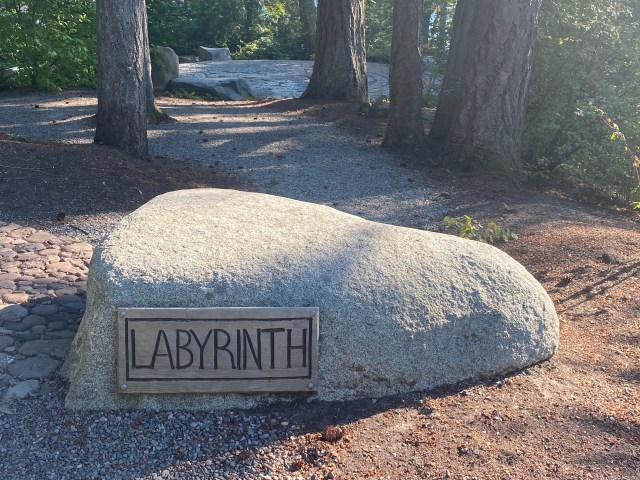
Wait what? A labyrinth? Near my trail?

Day 180 of Self Quarantine             Covid 19 Deaths in U.S.:  190,000

The habits of each day being another Ground Hog day make me wonder if I am sleep walking through life.  “Wake Up!” was my mantra for a while pre-pandemic when I wasn’t paying attention to the world around me.  Time to go back to waking up.

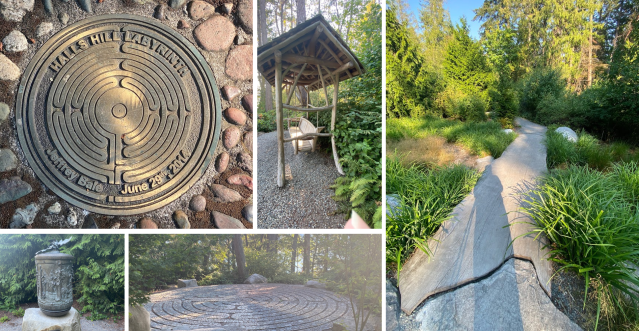
My lovely bride came back from her daily walk with pictures of a labyrinth on Hall’s Hill.  “Wait what?” I asked.

Sure enough there was a labyrinth to the left of where I ordinarily turn right on my walk.  With the surrounding gardens the labyrinth is a peaceful oasis.

I’ve been reading Robin Wall Kimmerer’s Braiding Sweetgrass.

“Purple and yellow are a reciprocal pair.

“Our eyes are so sensitive to these wavelengths that the cones can get oversaturated and the stimulus pours over onto the other cells. A printmaker I know showed me that if you stare for a long time at a block of yellow and then shift your gaze to a white sheet of paper, you will see it, for a moment, as violet. This phenomenon—the colored afterimage— occurs because there is energetic reciprocity between purple and yellow pigments, which goldenrod and asters knew well before we did.

“If my adviser was correct, the visual effect that so delights a human like me may be irrelevant to the flowers. The real beholder whose eye they hope to catch is a bee bent on pollination. Bees perceive many flowers differently than humans do due to their perception of additional spectra such as ultraviolet radiation. As it turns out, though, goldenrod and asters appear very similarly to bee eyes and human eyes. We both think they’re beautiful. Their striking contrast when they grow together makes them the most attractive target in the whole meadow, a beacon for bees. Growing together, both receive more pollinator visits than they would if they were growing alone. It’s a testable hypothesis; it’s a question of science, a question of art, and a question of beauty.

Kimmerer, Robin Wall. Braiding Sweetgrass . Milkweed Editions. Kindle Edition.

As I walk back home, I encounter the paired purple and yellow wild flowers:

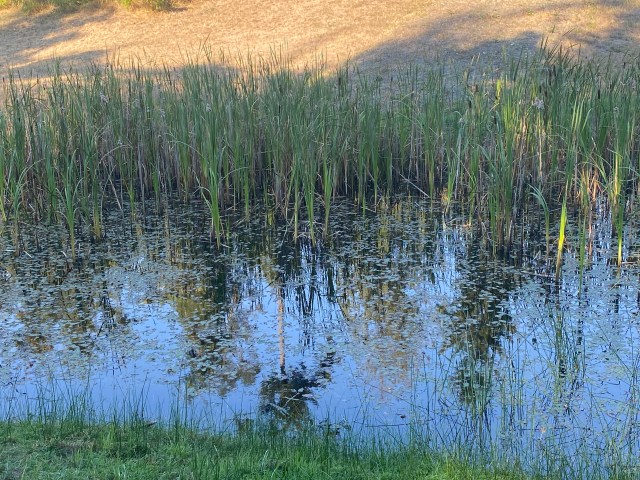
As I continue on, I walk by a pond.  Yesterday, it was just a pond.

Today I see the pond through the eyes of Kimmerer as I read her chapter on cleaning out their pond so they can go swimming:

“Being a good mother meant fixing the pond for my kids. A highly productive food chain might be good for frogs and herons, but not for swimming. The best swimming lakes are not eutrophic, but cold, clear, and oligotrophic, or poor in nutrients. I carried my small solo canoe up to the pond to serve as a floating platform for algae removal. I envisioned scooping up the algae with a long-handled rake, filling the canoe as if it was a garbage scow, emptying it on the shore, and then going for a nice swim. But only the swimming part worked out—and it wasn’t nice. As I tried to skim the algae, I discovered that they hung like sheer green curtains through the water. If you reach far out of a light canoe and try to lift a heavy mat of algae at the end of a rake, physics dictates that swimming will occur.”

Kimmerer, Robin Wall. Braiding Sweetgrass . Milkweed Editions. Kindle Edition.

I continue on my path excited to see nature with different eyes.

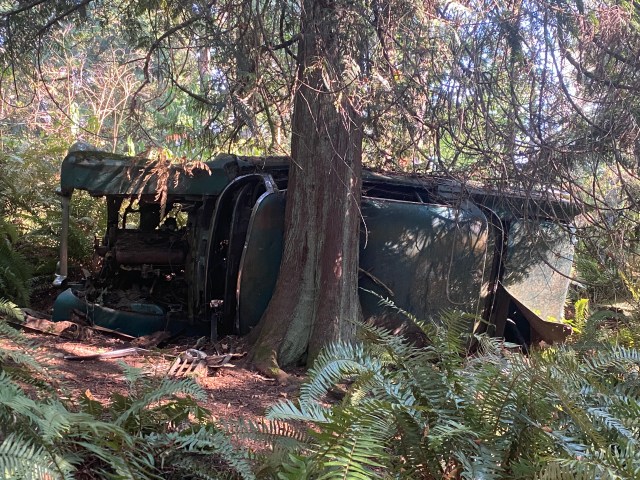
As I climb a short steep section I remember to look up and see the old car abandoned in the woods.

One of these days I will make up a story of how this car ended up here.

I stop by the Black Lives Matter shrine and see another gift of beauty.

The dreariness of this repetitive walk falls away as I am energized by the beauty and caring of my fellow path walkers.  As I turn a corner on my way home, I see an old man looking at me from another tree.  I’ve walked by this tree for 20 years and never seen the “art.”

As I walk through the labyrinth of life, I am indebted to all those who add beauty to my “ground hog days.”

Posted in Biodynamic, Design, Exercise, Lifelet, Wake Up! | Leave a comment

WUKID Extended

Day 177 of Self Quarantine             Covid 19 Deaths in U.S.:  188,000

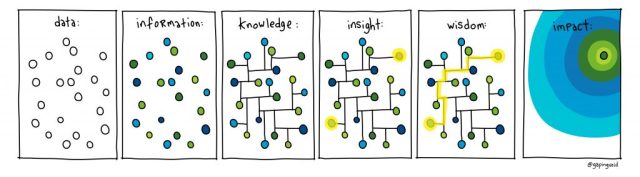
Since I met Russ Ackoff thirty years ago and learned about WUKID, I strive to advance from data to wisdom in my learning journeys.  Russ gave me the practical definitions of the stages of learning:

    • Data – the raw stuff of the world. It could be a temperature reading 67 degrees or the price of a book or any of the raw things that we encounter each day.
    • Information – provides structure for data. A weather report puts the temperature (data) in context. The outside air temperature in Seattle, WA on July 10, 2007 was 67 degrees at 2 PM and the sun is shining. Each of the components of the previous sentence is data put together to form a glob of information.
    • Knowledge – is actionable information. Given the above weather information string I would know that it is going to be a nice day but cool for that time of year so I would carry a light sweater or jacket if I were to go outside.
    • Understanding – is seeing patterns in knowledge and information. If the above weather string were combined with 20-30 days of similar strings of information and I had lived in Seattle for 10 or more years, I would be able to see a pattern of it being a cool summer. Understanding has a longer time component than information and knowledge. Understanding incorporates double loop learning as described in Schon’s The Reflective Practitioner.
    • Wisdom – is going beyond the levels of understanding to see larger scale systems and be able to predict behaviors and outcomes in the longer term future (5-15 years) based on seeing the patterns that arise through understanding. When lots of data over many years was refined into information, knowledge and understanding patterns, scientists were able to see long term weather patterns like el nino and la nina. Based on these patterns weather forecasters can predict longer term trends in Seattle and I can act accordingly.
I loved it when the Gapingvoid artists drew their image of WUKID and then added Impact:

What I love about these images is the text they provide to share the context behind the image:

“Semiotics is the study of the signs and symbols that imbue meaning and meaningful communication. It includes the study of signs and sign processes, indication, designation, likeness, analogy, allegory, metonymy, metaphor, symbolism, signification, and communication.
“Semiotics has been recognized as having important anthropological and sociological implications by many of the greatest innovators behind the respective disciplines. Umberto Eco proposed that every cultural phenomenon may be studied as communication; Clifford Geertz, arguably the 20th Century’s most respected anthropologist, once wrote that ‘culture is the culmination of symbols that transmit behavior’.

“It is with these thoughts in mind that Gapingvoid started to study how to impact organizational outcomes by informing culture, mindset, beliefs, and behaviors through semiotic tools.

“We have consistently witnessed and measured how people’s perceptions can be shifted through meaning attached to objects. Back in 2005, we popularized the term ‘social object’ with semiotics in mind: the idea that objects spread ideas faster and more effectively than nearly any other medium We see daily examples in internet memes and Red Baseball Caps, which have come to represent an entire political ideology.”

I’ve been fascinated with the study of conspiracy theories since Mark Ackerman of the University of Michigan introduced me to the Post Truth Economy and conspiracy theory.  As we talked, Mark introduced the notion of micro conspiracy theory.  Mark was studying the interaction of the Post Truth Economy and micro conspiracy theory.  I asked for an example.  He suggested I recall a time when I or others might have shared something we knew not to be true about another business colleague.  He explained that those examples are micro conspiracy theories.  I was depressed thinking about the number of times I propagated a micro conspiracy theory or accepted one.

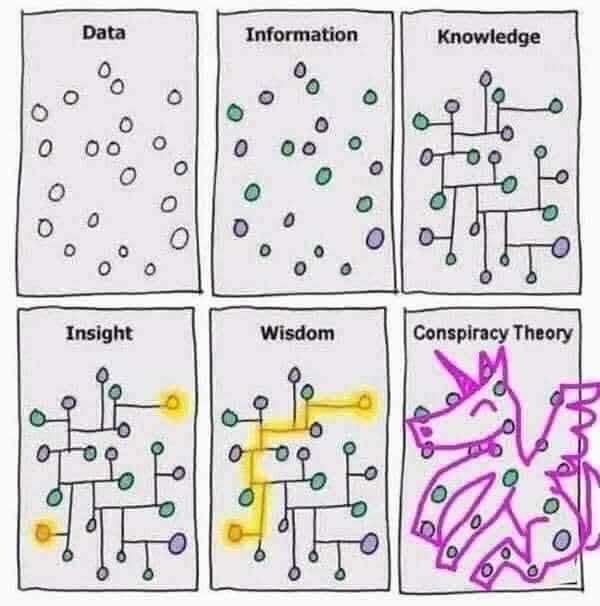
While on the way to somewhere else on an Internet search, I came across this doctored gapingvoid image posted on Imgur that adds conspiracy theory to my beloved framework of WUKID.

After I stopped laughing, I realized that in today’s Post Truth Economy I will have to update WUKID to WUcKID.  I placed conspiracy theory between knowledge and understanding because there is an evil genius in those who intentionally perpetrate conspiracy theories.  I can’t place conspiracy theory as a full fledged participant in the journey to wisdom and thus the lower case “c.”   Unfortunately in today’s world conspiracy theory has its place.

Posted in Content with Context, Flipped Perspective, Learning, WUKID | 1 Comment

The Map is Not the Territory. Or is it?

Day 165 of Self Quarantine             Covid 19 Deaths in U.S.:  177,000

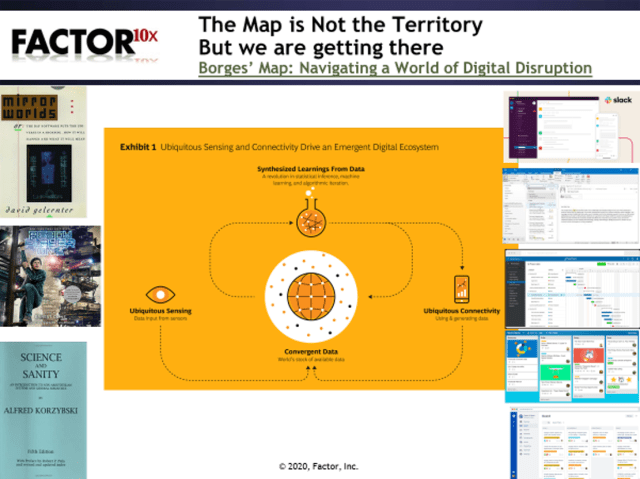
One of the profound early influences on my thinking was the statement in Alfred Korzybski‘s Science and Sanity “The Map is not the territory.”

A few years later, I came across David Gelernter‘s Mirror Worlds or The Day Software Puts the Universe into a Shoebox … How It Will Happen and What It Will Mean.  The title is the synopsis of the book.

Several years ago, I was reminded of “the map is not the territory” comment as I prepared for facilitating a working session of the GE Power Business Unit by reading several documents on “digital twins.”  The one I enjoyed the most was from Wired’s Kevin Kelly talking about augmented reality (AR) in “AR Will Spark the Next Big Tech Platform – Call it Mirror World.”

“General Electric, one of the world’s largest companies, manufactures hugely complex machines that can kill people if they fail: electric power generators, nuclear submarine reactors, refinery control systems, jet turbines. To design, build, and operate these vast contraptions, GE borrowed NASA’s trick: It started creating a digital twin of each machine. Jet turbine serial number E174, for example, could have a corresponding E174 doppelgänger. Each of its parts can be spatially represented in three dimensions and arranged in its corresponding virtual location. In the near future, such digital twins could essentially become dynamic digital simulations of the engine. But this full-size, 3D digital twin is more than a spreadsheet. Embodied with volume, size, and texture, it acts like an avatar.

In 2016, GE recast itself as a “digital industrial company,” which it defines as “the merging of the physical and digital worlds.” Which is another way of saying it is building the mirrorworld. Digital twins already have improved the reliability of industrial processes that use GE’s machines, like refining oil or manufacturing appliances.

Microsoft, for its part, has expanded the notion of digital twins from objects to whole systems. The company is using AI “to build an immersive virtual replica of what is happening across the entire factory floor.” What better way to troubleshoot a giant six-axis robotic mill than by overlaying the machine with its same-sized virtual twin, visible with AR gear? The repair technician sees the virtual ghost shimmer over the real. She studies the virtual overlay to see the likely faulty parts highlighted on the actual parts. An expert back at HQ can share the repair technician’s views in AR and guide her hands as she works on the real parts.

“Eventually, everything will have a digital twin. This is happening faster than you may think.”

Everything will have a Digital Twin – including you and me.  Sean Buchanan, CEO of Visom Technology, reminds me all the time that they are leaders in creating digital twins from MRI and CT scan data.  My medical digital twin will be a layered 4D model from my genomics to the ecosystem that I live in.  It will be 4D as we will have data over time.  How do my MRIs and CAT scans change over time?  How do my Xrays change over time?  How do my lab tests change over time? How do my chronological age and biological age change over time as I follow scientific wellness protocols?

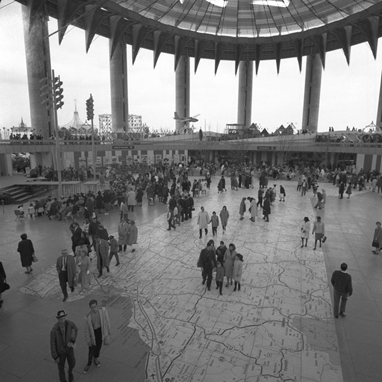
Mentioned in Kelly’s article is Jorge Luis Borges description of trying to create a map in the physical world that approaches 1:1.  I can remember the fun growing up visiting the 1964 NY Worlds Fair standing on a map of NY State.  I stood in the exact spot on the map that I was standing at the World’s Fair territory.  The experience exemplified the counter example to Korzybski’s “the map is not the territory.”

Lewis Carrol wrote:

“What a useful thing a pocket-map is!” I remarked.

“That’s another thing we’ve learned from your Nation,” said Mein Herr, “map-making. But we’ve carried it much further than you. What do you consider the largest map that would be really useful?“

“About six inches to the mile.“

“Only six inches!” exclaimed Mein Herr. “We very soon got to six yards to the mile. Then we tried a hundred yards to the mile. And then came the grandest idea of all! We actually made a map of the country, on the scale of a mile to the mile!“

“Have you used it much?” I enquired.

“It has never been spread out, yet,” said Mein Herr: “the farmers objected: they said it would cover the whole country, and shut out the sunlight ! So we now use the country itself, as its own map, and I assure you it does nearly as well.”

from Lewis CarrollSylvie and Bruno Concluded, Chapter XI, London, 1895

Philip Evans of Boston Consulting Group (BCG) fame compared what is happening now with digital transformation to what Borges described as a 1:1 mapping of the world.

. . . In that Empire, the Art of Cartography attained such Perfection that the map of a single Province occupied the entirety of a City, and the map of the Empire, the entirety of a Province. In time, those Unconscionable Maps no longer satisfied, and the Cartographers Guilds struck a Map of the Empire whose size was that of the Empire, and which coincided point for point with it.

“On Exactitude in Science” Jorge Luis Borges

Evans goes on to describe how health care is quickly showing that “the map is the territory” through the use of big data.

“HEALTH CARE is a prime example of the transformational power of these new business architectures. This huge and dysfunctional industry is at the beginning of a transformation. The cost of sequencing a human genome in 2001 was $100 million, and mapping just one (James Watson’s) took nearly ten years. Today it costs less than $1,000. In two or three years, it will cost $100, and sequencing will take just 20 minutes. The number of sequences has grown as the cost has fallen: the Million Human Genomes Project is up and running—in Beijing. Gene mapping is shifting from an abstract research activity to a clinical one, in which a doctor customizes treatment to the patient’s unique genomic makeup.

“The pattern is clear: big-data techniques will be used to spot fine-grained correlations in a patient’s genomic data, medical history, symptoms, protocols, and outcomes, as well as real-time data from body sensors. Medicine will advance by decoding immense, linked, cheap, noisy data sets instead of the small, siloed, expensive, clean, and proprietary data sets now generated independently by hospital records, clinical trials, and laboratory experiments. These databases will make it possible for practitioners and even groups of patients to become researchers and for breakthroughs to be quickly shared around the world.”

Gregory Bateson describes the problem in a different way in his cybernetic book Mind and Nature:  A Necessary Unity.  He relates the challenge of video capturing the reality of the world:

“Of course, the whole of the mind could not be reported in a part of the mind.  This follows logically from the relationship between part and whole.  The television screen does not give you total coverage or report of the events which occur in the whole televisions process; and this not merely because the viewers would not be interested in such a report, but because to report on any extra part of the total process would require extra circuitry.  But to report on the events in this extra circuitry would require a still further addition of more circuitry, and so on.  Each additional step toward increased consciousness will take the system farther from total consciousness.  To add a report on events in a given part of the machine will actually decrease the percentage of total events reported.”  P.432

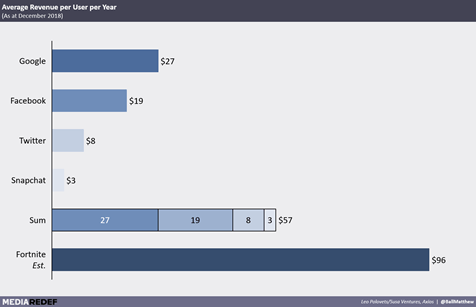
The other article (Fortnite is the Future, but Probably Not for the Reasons that you Think) that sparked my interest was on the metaverse which is being developed by the game company that makes Fortnite and the underlying game engine Unreal.  Fortnite could be the platform to host a world of health care Digital Twins.  The revenues from Fortnite are staggering even though it is a “free” game.  I was oblivious to their revenue model.  One of its powers is the built in collaboration.  I imagine the potential for very different coaching visits as a combination of digital twins and a “metaverse” user interface.

It is the “metaverse” stemming from Neal Stephenson‘s Snow Crash and added to by Ernest Cline’s Ready Player One that provide a model for how future health care interactions might evolve.

The term “Metaverse” stems from Neal Stephenson’s 1992 novel Snow Crash, and describes a collective virtual shared space that’s created by the convergence of virtually enhanced physical reality and persistent virtual space. In its fullest form, the Metaverse experience would span most, if not all virtual words, be foundational to real-world AR experiences and interactions, and would serve as an equivalent “digital” reality where all “physical” humans would simultaneously co-exist. It is an evolution of the Internet. More commonly, the Metaverse is understood to resemble the world describe by Ernest Cline’s Ready Player One (brought to film by Steven Spielberg in 2018).

Of course, early versions of the Metaverse will be far simpler – but the foundational elements will go well beyond “gaming”. Specifically, we’d see in-game economies (e.g. trading, bartering and buying items) become more of an industry where humans will literally “work”.

“If you look at why people are paid to do things, it’s because they’re creating a good or delivering a service that’s valuable to somebody,” Sweeney told Venturebeat in 2017. “There’s just as much potential for that in these virtual environments as there is in the real world. If, by playing a game or doing something in a virtual world, you’re making someone else’s life better, then you can be paid for that.”

To this end, a crucial difference between a vibrant game, including Fortnite, and the Metaverse is that the latter “should not simply be a means for the developer to suck money out of the users. It should be a bi-directional thing where users participate. Some pay, some sell, some buy, and there’s a real economy….in which everybody can be rewarded for participating in many different ways”, to further quote Sweeney (A semblance of this has existed for more than twenty years in so-called “Gold Farming”, where players, often employed by a larger company and typically in lower-income countries, would spend a work-day collecting digital resources for sale inside or outside of a game).

To Sweeney, the Metaverse represents the “next version” of the Internet – a matter of when, not if.

These articles remind me that I need to keep widening my lens for what is possible and how it applies to 21st Century Scientific Wellness or starting a new company.  The article “Magic Mirror: The Novel as a Software Development Platform” points out how science fiction often leads to software games which then lead to powerful applications.  Ender’s Game was an inspiration for Autodesk’s Ted Nelson who created hypertext and led Autodesk to create Autocad (which is one of the critical tools for XR).

While the above platforms (Unreal Engine, XR, Digital Twin) may not be available this year, I look to these efforts to inform the kind of architecture and platform we need to be designing to anticipate the future.  The Fortnite model also may give us some clues on how to have a very different revenue model.

This week I was reminded of “the map is not the territory” once again as I coached a non-technical CEO on the importance of “expect what you inspect” when it comes to managing software product development.  With all the different tools we have for “managing” like Zoom, email, Slack, Jira, project management GANTT charts, and project boards, it is easy to be distracted into thinking you know what is being built by software engineers.

The only way to really understand what is being built is to “Expect what you inspect.”  That is, you have to constantly see, demo and use the software your team is building.  Otherwise, all of your “productivity” tools will be the map that is not the territory.

I include at the start of each blog post the statistics about Covid.  These statistics are not the territory of this pandemic.  The politics and disinformation about Covid are not the territory.  The science to date is still only a partial map of the Covid pandemic.  We have so much more to learn in order for our understanding of Covid to be more about the territory.

Keep learning and keep contributing facts to the map of Covid.

Remember to vote those politicians out of office who keep spreading false maps.

Vote.

Posted in Big Data, Content with Context, Design, Flipped Perspective | Leave a comment

Thoughts on User Research through observation

Day 164 of Self Quarantine             Covid 19 Deaths in U.S.:  177,000

User research with an emphasis on observing users in their natural living and working environments is a key foundation for software product development.  In “Observing Users for Software Development” I shared my early introduction to the power of observing users along with several examples of professional design firms user observation leading to innovations.

Recently, in mentoring several CEOs in early stage software product development, I am spending a lot of time teaching, coaching, and encouraging them to do a lot of user observation.  Doing user observation is difficult in normal times, but especially difficult in the age of the pandemic.  There is only a certain amount of wide-field ethnography that you can do over Zoom with a camera controlled by the user.  I find that entrepreneurs are reverting to doing interviews with users rather than observing.

User research for product building is a bit different than interviewing for business and market research.  With human centered design user research or customer experience research a different process is needed.  One needs to switch from interviewing (talking) to observing the users, purchasers, and influencers in the wild.  The key things that you are looking to observe are the overall workflow that your potential product exists in, the skills and behaviors of the users, and which parts of the workflow matter.

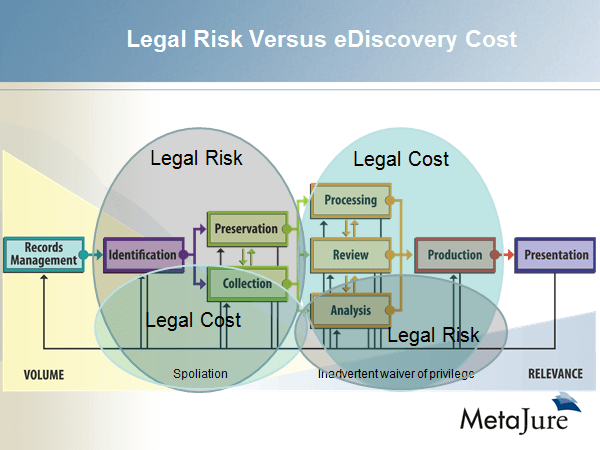
At Attenex, we had the privilege of being co-located with a sophisticated and high volume eDiscovery law firm.  We spent a lot of time observing and doing action oriented research where the software engineers spent a day a month actually doing eDiscovery.  We came out with a workflow that looked like the EDRM model:

We realized that all the costs were in the four boxes inside the Legal Cost on the right above.  Our competitors were spending their time building components for all of the boxes.  We focused on the four boxes where all the costs were going and reduced the costs by a factor of 10 times.  That bought us 8 years of competitive advantage AND 8 years of value based pricing while everyone else was stuck at commodity pricing.

Because we couldn’t use video ethnography due to confidentiality and legal privilege, we had to use pure observation and lots of note taking.  While not my preferred way, it worked.  The action oriented research on real matters (parallel to actual eDiscovery professionals) also helped the software engineers and UX researchers to figure out how to keep improving productivity.

Yet, the only way I’ve found to “teach” observation is through a lot of practice and mentoring/coaching.  The Institute of Design does a reasonable job of teaching and Blinkux does an excellent job with professional projects for observing users.

The problem with interviewing when it comes to user research is that folks Make Stuff Up (MSU).  People don’t want to appear stupid so they MSU.  Worse, most people have no idea what they really do tacitly.  Yet, with observing folks in their natural work habitat (not conference rooms) they are incredibly articulate.  All of the major insights I have made over 50 years came from observing folks in the wild.


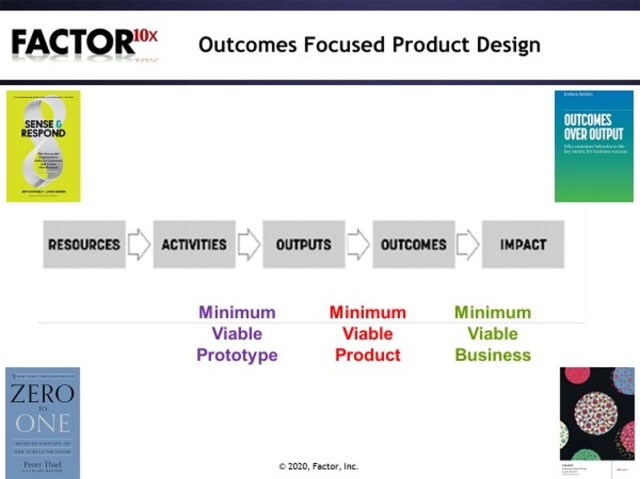
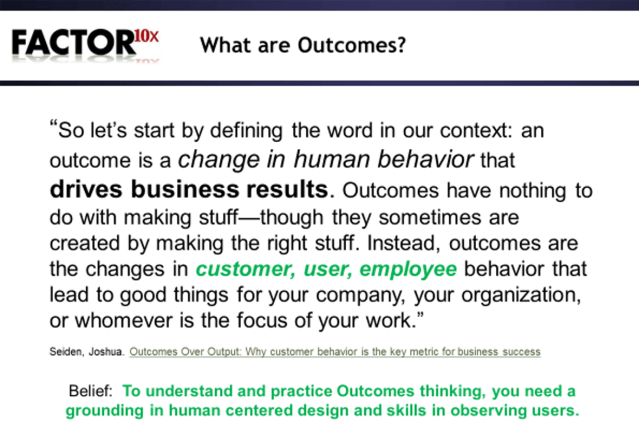
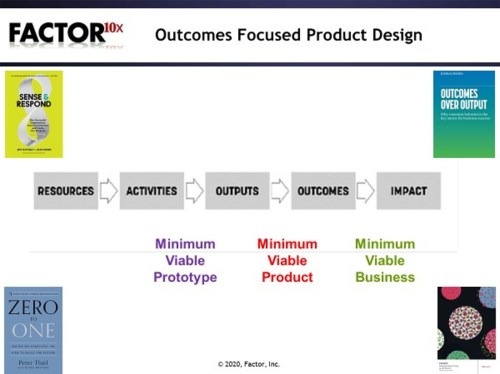
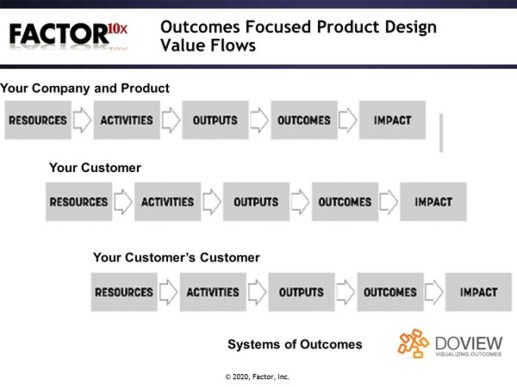
In his book on Outcomes and Lean UX, Josh Seiden provides the above model.  So what a good user researcher does is observe all of the above.  The user researcher wants to see what resources the user has (not just in the computer but what is on their desk, who they call on the phone or slack or email or who is around them in the office that they talk to and are collocated with).  What activities lead to what work outputs that lead to what outcomes that have what business impact.  And then ideally do the same for the customer’s customer.  How is your product idea going to work for your customer to produce impact and business results for their customers.

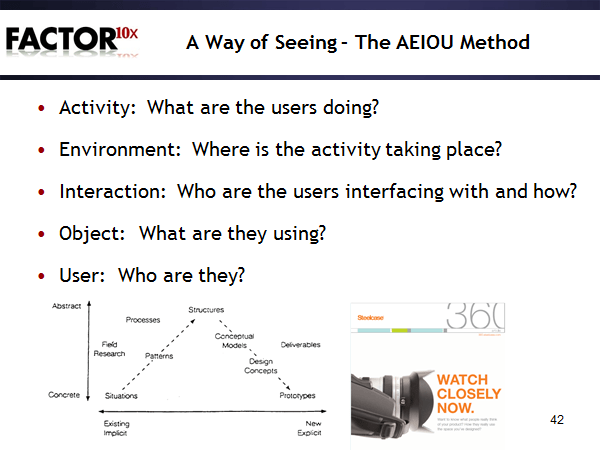
I particularly like simple to remember frameworks like AEIOU.

The bottom axis in the diagram is what observing users is all about – seeing the existing implicit.  Steelcase described this research in their article “Shaping Order from Chaos.”

Another way to look at this process is through the virtuous cycle of user observation (video ethnography where possible so you can look and relook at something 10s to 100s of times), insight generation, then rapid prototyping (including paper prototyping) while observing usage and then repeat.  To get to our V1 of Attenex Patterns we went through this loop at least 100 times including full blown prototypes that we put in users hands.  By Version 4 of Attenex Patterns we’d been through over 350 working software prototypes.  I periodically give a history talk that walks through many of the prototypes and how we got to >10x productivity.  Attenex First Year shows several of the prototypes.

While the professional human centered design firms have a lot of different PhD types doing the video ethnography and user research, I was pleasantly surprised how easy it is to learn in my own work.

The good news 25 years after I started working with the Institute of Design is that there is a growing literature from the ID professors on human centered design methods.

The ID literature I recommend is:

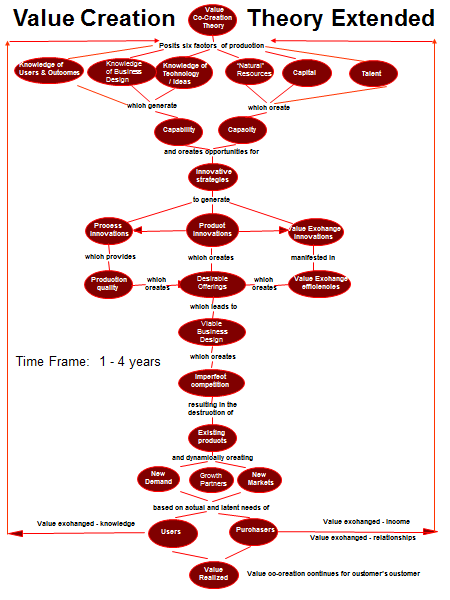
Now that Clive Dilnot and Suzan Boztepe (former ID student of mine) have published Heskett’s unpublished works, I will be publishing my extensions of his work.  John as an economist by training that came over to design through industrial design.  I loved sitting in on his classes when I was teaching at ID and having long lunch conversations with John about design and economics.

Explaining Value Co-Creation Theory is fodder for another blog post or two.

Posted in Attenex Patterns, Content with Context, Design, Entrepreneuring, Outcome, Reflecting, User Experience | 1 Comment

He saw me

Day 162 of Self Quarantine             Covid 19 Deaths in U.S.:  175,000

In the fall of 2014 I attended my first TEDxRainier Seattle in the Opera Hall at the Seattle Center.  Each of the speakers had a well honed message that supported the theme of the “known and the unknown”:

“Our theme is: The known and the unknown. We all face a shared future that is inherently riddled with unknowns. Our speakers and performers present windows into a rich variety of explorations, actions and reactions that may offer possible solutions to many long-present and new challenges. Stretch beyond the constraints of what we know and spark your curiosity for deeper exploration and engagement. Each of our speakers offers new knowledge informed by their work and their unique perspectives. Each raises intriguing questions that help us define and guide how we perceive and embrace our future.”

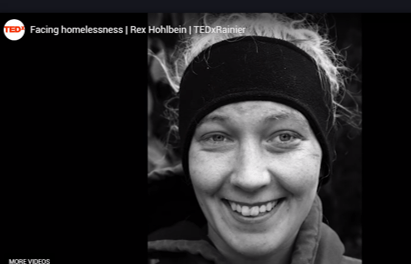
I enjoyed each of the talks, but it was the photo journalism of Rex Hohlbein that has stayed with me.

“A Seattle native, Rex ran a successful residential architectural firm for 30 years.

“Seven years ago, after befriending several men experiencing homelessness along the Fremont canal, Rex started a Facebook page to raise awareness for those living unsheltered through the sharing of photos and personal stories. Today, that Facebook page has over 46,000 followers, becoming a thriving and inspirational non-profit, Facing Homelessness. This year begins a new chapter, as Rex combines both architecture and community outreach in starting a social justice architecture firm, BLOCK Architects, with his daughter Jenn LaFreniere.”

As he showed his photographs and told the personal stories behind each photograph, what came through loud and clear in each story was “He Saw Me!”.

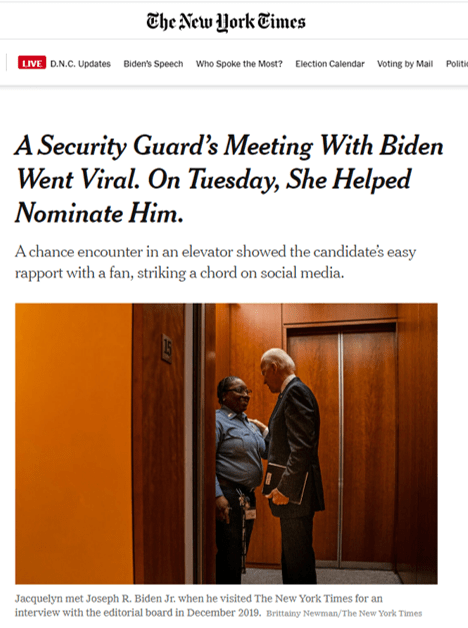
This week I sat enthralled, engaged, and a little teary eyed at times during the 2020 Democratic National Convention.  The nomination of Vice President Biden delivered by Jacquelyn, a security guard at the NY Times offices touched me deeply.

Jacqueline shared “But in the short time I spent with Joe Biden, I could tell he really saw me, that he actually cared, that my life meant something to him.”

On Thursday night we were treated to the same phenomena of “he saw me” shared by Brayden Harrington.

“They had met in February at a campaign event in New Hampshire. After they first spoke on the rope line, the former vice president invited Brayden backstage to continue their conversation about stuttering and told him about how he has worked to overcome his own stutter.

“He told me that we were members of the same club: We stutter. It was really amazing to hear that someone like me became vice president,” Brayden said Thursday night in the video recorded for the convention.

Biden, who has said he still occasionally catches himself stuttering, showed Brayden a copy of the campaign speech he had just delivered in New Hampshire with markings showing where he could take breaks between words.

“He showed me how he marks his addresses to make them easier to say out loud. So I did the same thing today,” Brayden said, flipping around the piece of paper he was reading to show the markings on his speech.

“I’m just a regular kid, and in a short amount of time, Joe Biden made me feel more confident about something that’s bothered me my whole life. Joe Biden cared. Imagine what he could do for all of us. Kids like me are counting on you to elect someone we can all look up to. Someone who cares. Someone who will make our country and the world feel better. We’re counting on you to elect Joe Biden,” Brayden said.

A variant on “he saw me” was all of us seeing the powerful resilience of Gabby Giffords relating her personal recovery from gun violence.  I saw her.  We saw her.  More importantly I heard her.

“Giffords, a key voice on gun violence prevention who had been shot in the head while speaking with constituents during the deadly attack in Tucson, urged Americans to take action to end gun violence in a taped speech calling on voters to elect Biden as president. Her remarks were the longest she has given since surviving the shooting nearly a decade ago, her spokesman Jason Phelps told CNN.

“Words once came easily, today I struggle to speak. But I have not lost my voice. America needs all of us to speak out, even when you have to fight to find the words,” Giffords said.

“Giffords worked for months with her speech therapist to perfect her remarks to capture her connection with Biden, who she endorsed in March, and the importance of this moment in history, according to Phelps.”

He saw me.  I heard her.

Karen Tumulty of the Washington Post pointed out in February 2020, that there are two Joe Bidens running for President.  This week we got to experience better versions of both Joe Bidens.

“In short, Biden sounds like a man whose time has passed. Many in the modest-sized crowds that he draws are dismayed. After he spoke on the same stage as the other Democratic candidates at a state Democratic Party dinner on Saturday night, one undecided voter told me: “Joe needs to retire.” This has become a common refrain, even among people who admire and respect Biden.

But then there is the Biden you see mostly on the rope line.

As soon as the sound on his mic is turned off, he dives toward the area where those who remain behind are standing to shake his hand or take a selfie.

At those moments, Biden is transformed. He lingers with anyone who wants to tell him a story, even as maintenance workers start dismantling his stage and folding up chairs. People light up in his presence. Perhaps because of the personal suffering he has endured, Biden seems to have a kind of radar that draws him to people who are starving for solace and reassurance, and they to him.

“On the stump, he is at his most compelling when he stops talking about himself and starts telling the stories of the people he has met.”

I heard her!  He saw ME!

Vote.

Posted in Citizen, Curation, Lifelogging | 2 Comments

Lifelet: Surprised by Joy!

Day 157 of Self Quarantine             Covid 19 Deaths in U.S.:  170,000

One of my favorite book titles is from C.S. Lewis, Surprised by Joy.  The book was a joy as well.

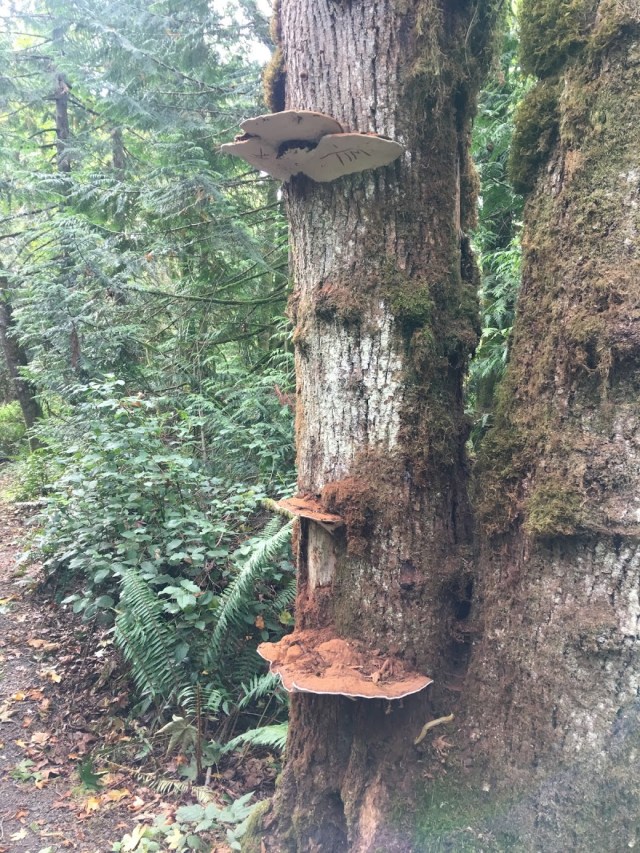
Yesterday, I was “surprised by joy” on my regular hiking trail on Bainbridge Island.  One of my favorite nature trails runs along our bluff on the east side of the island.  Three years ago, a tree sprouted a set of large fungus.

Somebody named Tim carved his initials into the top trio  of fungi.   I usually stop and acknowledge the presence of this delightful tree.

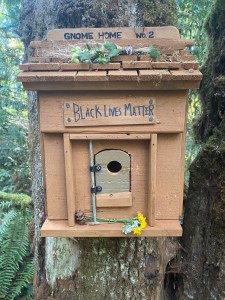
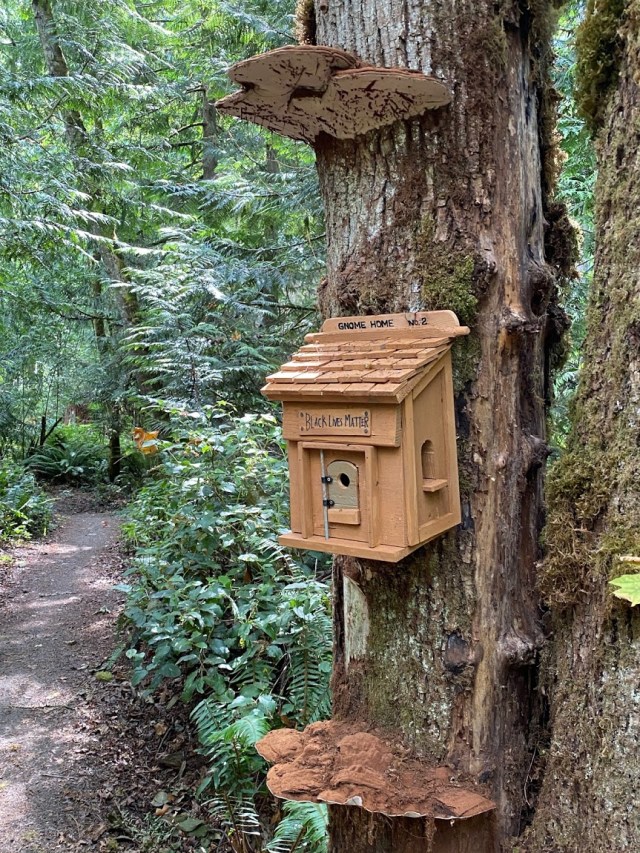
Yesterday, I did more than stop.  I was gobsmacked at the new addition to the tree – a gnome home.

As I drew closer, I  noticed the carving above the door “Black Lives Matter.”

I pause for a few minutes and thank the local craftsman for making this shrine and helping me remember that “Black Lives Matter.”

Thank you.

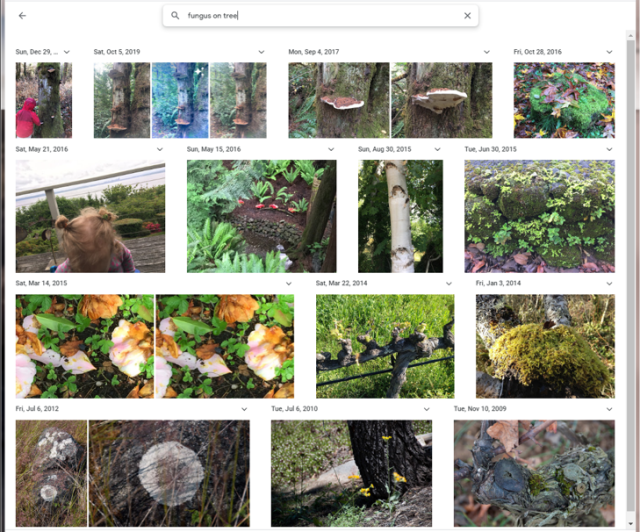
On a more trivial note, I was surprised by the joy that Google Photos brings to my life.  I wanted to find a before photo of my fungus tree.  I just typed “fungus on tree” in the search bar of Google Photos and immediately the photos appeared.

How cool is that.  I never know if a search term is going to work, but I always try given the tens of thousands of photos I have stored.  The date pops up as well.  I was going to write that I first came across my fungus tree a year ago.  It was three years ago.  My how time flies in a pandemic.

Thank you anonymous craftsman.

Thank you anonymous software product developers who evolve Google Photos.

Posted in Lifelet, Nature | 1 Comment

How do you create a product vision? Part 5

Day 151 of Self Quarantine             Covid 19 Deaths in U.S.:  163,000

Communicating the product vision – to employees, to customers, to investors

This post is the fifth part of describing how to create a product vision.

Getting to a product vision for an innovative product is a five step process:

  1. Understanding what a good one looks like
  2. Becoming an expert quickly in the knowledge domain of your product innovations
  3. Using an influencer centered design process to collaborate with domain experts and customers on your product vision
  4. Creating the product vision using service dominant logic and an outcomes orientation
  5. Communicating the Product vision – to employees, to customers, to investors

“They did what?” I exclaimed in my youthful arrogance.

“They took your reality of an ALL-IN-1 office automation product and your four Fortune 100 corporate installed customers and turned it into a vision that might be available sometime in the future,” shared one of my favorite sales people.  She described the product vision that the business products marketing department was distributing to sales and to customers.

As I reflect on those moments of my product leadership education, I realize that is the fundamental challenge – how do you take the reality of your generic V1 product and paint a vision of the potential product?

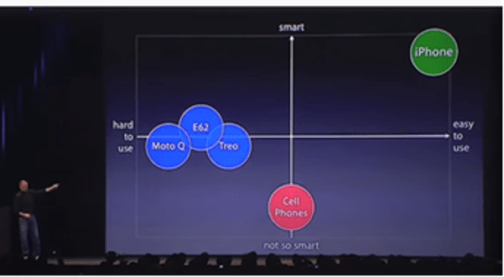
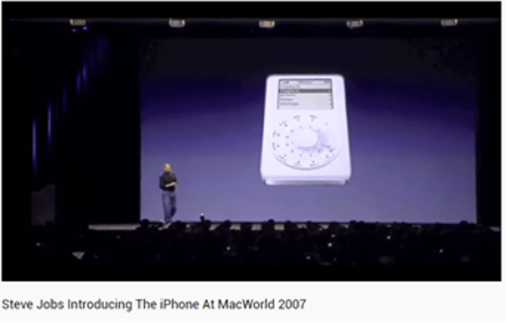
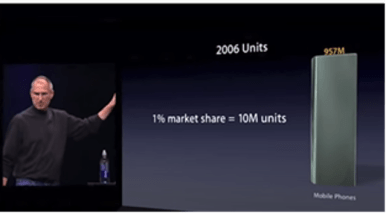
Steve Jobs did a masterful job of introducing the revolutionary iPhone as a continuing evolution of previous Apple products like the Mac and the iPod.  He had an hour and a half to show the path of arriving at the iPhone, describing its innovative features, and along the way shared how much better it was than the competition of the many attempts to marry “smart” with “easy to use.”  He illustrated in a simple 2×2 matrix how the iPhone was a leapfrog product:

I loved the way that he started with humor depicting their vision of a rotary dial attached to an iPod.

This image reminded me of the UX cartoon of the design of a new swing by committee:

Jobs uses a wonderful tag line to describe how smart phones with internet connectivity and cameras and music and a wealth of apps have evolved – “Your life in your pocket.”

Few of us have 90 minutes to introduce a new product and paint a vision of its future.  Few of us have a V1 product that took two years to develop and had over 2000 patents filed to protect the innovations.  Few of us have the history of Apple behind us when we are launching our first product.  Few of us have powerful partners like Google and Cingular (now AT&T) to join in our launch event.

So, what does an early stage entrepreneur do?

The recommended resources suggested in the first part of this series are a good place to start.

In addition to the Jobs launch of the iPhone, I particularly like the analysis of Elon Musk’s powerwall introduction outline:

  1. Name the enemy
  2. Answer “Why Now?”
  3. Show the promised land before explaining how you’ll get there
  4. Identify obstacles – then explain how you’ll overcome them
  5. Present evidence that you’re not just blowing hot air

Over the years, I’ve stumbled into a few additional ways of describing a product vision, particularly when you have little time and attention from your audience.

    • Tell a story
    • Develop an explanatory image
    • Start with an assertion that wakes the audience up
    • Like Tom Sawyer, invite people to help accomplish the vision

If you review Steve Jobs iPhone launch, he nicely hits all these attributes of communicating a product vision.

On my first day at work at Conga in early March of 2018, my chief product officer boss, Doug Rybacki, let me know that I had thirty days to come up with a vision and road map for the contract lifecycle management (CLM) products and then present that vision at the upcoming annual customer, senior management and all product development team event in Chicago.  I wanted to protest and argue that I didn’t know the products yet and I didn’t now the professional staff that worked for me and most importantly I had no knowledge of the Conga CLM customers.

Then I laughed and said “Sure, I’ll accept that challenge.”  I had no idea how I was going to accomplish that, but I had thirty days and a lot of travelling to the four US development sites to figure that out.

“Oh, by the way, you are making a presentation to IACCM members, the contract and commercial management association, in two weeks on the strategic value of CLM implementations with the director of IACCM,” added Doug.

“Great.  I can do that,” I eagerly replied.  My motor mouth was running while I was thinking “How am I going to do that?”

Fortunately, I had some background in the CLM market from building the Attenex Structure product for authoring contracts from a clause database library.

The month flew by (literally and figuratively) as I visited Orlando, NYC,  and Denver many times to learn, learn learn.  Unfortunately, I wasn’t able to visit any customers at their sites, but I talked to several by phone and teleconference.

I spent a lot of white boarding time with the product managers and engineering team leaders.  They were all eager to understand my vision of the future.  Images like these emerged from the discussions:

As I was in the middle of one two hour white board discussion, Doug wandered through and shared “By the way, you will only have 15 minutes to present your vision of CLM at the customer conference.”

Thanks, Doug.

After lots of sleepless nights and many discarded Powerpoint slides, I called my story telling mentor David Robinson and asked for help.  Pleaded for help might be a better way of saying it.  David listened for 30 minutes and then said, “tell a story and use the one word pitch from Dan Pink.”  Then he hung up.

Thanks, David.

Some time during the month, the words “Know Now” entered my head.  These words were the organizing principle that I needed and if I smashed them together I had my one word pitch.

Here is the 15-minute pitch I used to describe our vision of Conga CLM to our employees, our customers, and the influencers at IACCM.

What if we could “Know Now,” what is going to happen in the next 90 to 120 days with the Conga business?  Not predict, but know.  What if our customers could “Know Now” what is going to happen with their business for the next 90 to 120 days?  Not predict, but know.

“Know Now” is our vision for the future of the Conga CLM product line.

Twenty-Five years ago, I was the VP of Software Engineering for Primus Knowledge Solutions.  Our biggest customer was Compaq.  We spent nine months negotiating an enterprise contract with Compaq so that we could recognize the $2 million in revenue at the signing of the contract instead of spreading the revenue over the two-year life of the license.  We knew we were going public soon and we wanted to have a boost in revenues.

A month after the signing of the contract and Primus going public, I got a call from our customer support manager telling me that I had to send two of my software engineers to Valbonne, France the next day.  I laughed and hung up the phone.  He called me right back.  “No, I’m serious.  We are required by contract to put software engineers onsite if there is a problem.”

That was my first inkling that we were in deep financial trouble.

“Why do you think that?” I said.  “I was part of the contract negotiation and there was nothing in the contract that says we have to put engineers onsite.  All we agreed to is that any problems will be fixed in the next software release.”

“Well, the customer has an email from the salesperson that says that we will do this,” he replied.

I hung up and called the CFO.  After a set of emergency meetings (and a lot of yelling and screaming), we realized that we had to make a public announcement to restate our revenues.  Our stock lost, 80% of its value in the next two days.

The sad part was that none of the executives were aware of what the salesperson had committed us to supporting Compaq.  But our computer systems did.  If only we had a way to make sense of our email traffic in real time.

As I’ve gotten to know some of our Conga customer stories over the last month, I loved learning that when Conga Contracts was installed at Preferred Hotels, they immediately discovered that they had missed billing $600,000 to their customers.  The billing for services was in their negotiated contracts, but nobody went back and checked.  Preferred Hotels was able to pay for our product by the revenue that their current contract administrators didn’t know was past due.

The sad part was that the Preferred Hotel executives didn’t know, but the computer systems did.

While having lunch with the head of the FTI Consulting Forensics market segment, he wondered if our Ringtail product might help his business with his very large construction clients.  He shared that most large construction project clients like the multi billion-dollar airport in Abu Dhabi must allocate 10% of their costs to dealing with the inevitable litigation.  He lamented that in every forensic investigation they performed over his twenty-year career, all of the problems that resulted in litigation where usually found in email traffic in the first six months of the project.  He asked, “can’t we use Ringtail somehow to monitor the email and project plan changes and alert us?”

“Maybe,” I replied.  “If you’ve noticed any patterns in the emails, particularly common words that are used often, then we have a starting point and can turn our AI/ML and visual analytics loose on the digital information.”

“No problem,” Paul responded.  “When I get back to the office, I will send you the seven patterns we’ve noticed in all of our construction forensic investigations.”

As I reviewed Paul’s seven patterns, I started laughing because these patterns are present in every late software engineering project I have led.

The sad part was that the executives of these construction projects didn’t know, but their computer systems did.

Let me reiterate “no one person knows, but the computer system knows.”

When I built my first contract management product back in 2000, I realized that you could understand a corporation by the formal contracts with customers, suppliers and employees AND the informal contracts like business plans, product plans, sales compensation plans, and marketing plans.  When you combine these unstructured documents that move through email with the structured data that is in our financial systems, customer relationship management (CRM) systems, enterprise resource planning (ERP) systems, and project management systems you KNOW NOW what is going to happen in the future for your company.  Cliff Dutton in his research paper “Empowering Board Audit Committees: Electronic Discovery to Facilitate Corporate Fraud Detection” proved my assertion.

Knowing Now what is going to happen in the next 90 to 180 days means that you can start making organizational interventions NOW to change future business performance instead of having to wait until the end of the quarter to figure out what happened.

I shared with you the very personal pain of not Knowing Now while at Primus Knowledge Solutions.  I vowed to myself that if I could, I would never let that happen to another company.  The painful Primus experience is why I started Attenex to create a powerful visual analytic software system that can make meaning out of terabytes of unstructured and structured data to support litigation and to achieve compliance with corporate policies.  I came to Conga to continue extending the vision of Know Now.  Conga’s CLM products today, along with the products of the three companies we just acquired are the repositories of most of the formal and informal contract information.  Our new AI/ML capability which we are announcing this week will make meaning out of that information in real time.

I am exited to share with you today the KNOW NOW vision and the reality of what we are creating at Conga.

Thank you.

Later in the day at an all hands employee meeting, one of the senior product managers stood up and referred to the above presentation.  She shared “Skip’s reason for joining Conga to keep other companies from experiencing the problems that Primus had, and that Preferred Hotels had, and that every construction project has, made me realize that I had a very myopic view of my job as a product manager.  I’ve been trying to define features and then make sure that we stayed on time and on budget with my products so that we could hit our financial goals.  I never thought to have a higher order goal or drive to make our corporate customers’ businesses healthier.  Thank you Skip for sharing a powerful vision for CLM.  And thank you for inspiring me to take on a powerful meta goal.”

Thank you.

Over the next two days, many of the senior software engineers, product managers, and engineering team leaders took time to thank me for providing a vision that they could relate to.  They shared their frustration at not being able to see how their daily work on their products would make a difference in their customer’s lives.  They related that they were having trouble figuring out how the new Conga Corporate vision we were presenting to our customers that week had anything to do with what they were building.

These wonderful conversations led me to the “Tom Sawyer” approach to product vision.  I shared that Know Now was a vision, but that I didn’t know how to get there.  I asked for their help every day to figure out how to get this vision built.  They all signed up to “paint that fence.”

I was not able to come up with a summary diagram in my first thirty days like Christine Martell provided to summarize my Valuation Capture methodology.

However, a few months later I was able to incorporate the Know Now stories and presentation into an explanatory 2 x 2 matrix that follows the scenario planning guidelines.

The Know Now example is a path to sharing a product vision with employees and customers.  Steve Jobs at the end of the iPhone product launch provides an example of what investors need – some idea of the business potential of your product and vision.  He showed a bar chart of the volume of units sold of different digital devices in 2006.  The mobile phone makers sold 957 million units in 2006 dwarfing other digital devices.

Steve modestly shared that he would be happy with first year sales of 1% of that market – 10 million iPhones at $500+ each.  It doesn’t take a calculator for an investor to see the business impact of the product AND the product vision.

Now it is your turn.

What is your product vision?

How will you quickly become an expert in your market domain?

How will you use influencers to develop and promote your product vision?

How will you help your customers adopt your product through an outcomes orientation?

How will you communicate the product vision to employees, to customers, and to investors?


The five parts of this series on how to create a product vision are:

  1. Understanding what a good one looks like
  2. Becoming an expert quickly in the knowledge domain of your product innovations
  3. Using an influencer centered design process to collaborate on your product vision
  4. Creating the product vision using service dominant logic and an outcomes orientation
  5. Communicating the Product vision – to employees, to customers, to investors
Posted in Content with Context, Design, Entrepreneuring, Human Centered Design, Idealized Design, Innovation | Leave a comment

How do you create a product vision? Part 4

Day 150 of Self Quarantine             Covid 19 Deaths in U.S.:  162,000

Creating the product vision using service dominant logic and an outcomes orientation

This post is the fourth part of describing how to create a product vision.

Getting to a product vision for an innovative product is a five step process:

  1. Understanding what a good one looks like
  2. Becoming an expert quickly in the knowledge domain of your product innovations
  3. Using an influencer centered design process to collaborate with domain experts and customers on your product vision
  4. Creating the product vision using service dominant logic and an outcomes orientation
  5. Communicating the Product vision – to employees, to customers, to investors

Who is your customer’s customer?  How is your product or service helping your customer better serve their customers?

These questions are among the most powerful facilitation questions I use to get product teams to build better products and innovative product visions.

These questions arose after facilitating hundreds of Technology and Organizational Performance (TOP) Mapping sessions while at Digital Equipment Corporation.  While these sessions elicited useful representations of current and future state designs for organizations, I did not feel that we were getting the kinds of innovations that talented executives could create.  We would get good information about the inside of the organization under study, but not very good information elsewhere in the map.

Out of frustration one day, I asked participants to include in their TOP Maps not just the relationship with their customers, but also with their customer’s customers.

Immediately we got better and more innovative actionable results.  While we didn’t get much information about the customer’s customer, the extra level of abstraction helped participants do a better job of showing the relationships with their customers.

As part of the pre-merger meetings between Adobe and Aldus, we used TOP Mapping to depict the future possibilities for a merged entity.

The map helped the executive teams focus our discussions and actions on how we would create new customers that neither company was able to do alone.

Many years later I came across Mack Hanan’s description of growth partners:

“How can you grow your business?

“You cannot.

“You can only grow someone else’s business.  His business growth will be the source of your growth.  By growing, he will force growth back upon you because he will want you to grow him again.

“The businesses you can grow have a name.  They are called your major customers.  Their growth must be the objective of your business.  The capabilities you require to grow them must be your asset base.

Growth requires a partner. A growth partner is a special kind of customer.  He is a customer whose costs you can significantly reduce or whose profitable sales volume you can significantly increase.  In one or both of these ways, you can improve his profits.  This is the basis for his growth.  It is also the basis for his contribution to your own growth.  As the two of you grow each other, you will become mutually indispensable.

“If you cannot grow a customer, you cannot partner him.  You can continue to do business with him, buying and selling, but the maximized profits of growth will elude both of you.  If all your cusotmers are buyers instead of growers, you will be a slow-growth or no-growth business.  None of your customers will be growing you because you will not be growing them.”

It is a joy for me to see the “Ah Hah!” expression after a few moments of thought on the part of an entrepreneur.  Until this moment of comprehension, I think most entrepreneurs believe they are in control of their own business. Hanan’s simple question “How can you grow your business?” with the counter-intuitive response “You cannot” is an eye opener for an entrepreneur.

More recently, Jim Spohrer of IBM during our participation in a Computing Research Association  cybersocial learning systems visioning series of workshops introduced me to Service Science.

I had never heard of the discipline so I devoured everything that I could find.  I was delighted to find a wealth of research and insights that helped resolve a fifty-year management dilemma of mine – how do you manage both professional services and product development at the same time?  Over the years I’ve managed to do well with one or the other, but I’ve never been able to manage both simultaneously successfully. Jim’s research provided a wealth of answers and insights.

Value Co-Creation through Service Systems

Several key concepts from Service Science extended what I’d learned from  Rob Bernshteyn’s Value as a Service with Value Co-Creation being an important synthesis.

“For conciseness, we think pay for performance is a reasonable definition of a service—in that this phrase captures the idea that what the provider does for the client is essential, as opposed to exchange of an artifact or a good being essential. However, combining Fitzsimmons and Fitzsimmons’s definition with Hill’s definition, a time-perishable, intangible experience performed for a client who is acting as a coproducer to transform a state of the client, reveals some other essential characteristics of services: namely, that the client plays a key role in coproduction activities (the client has responsibilities) and in the co-creation of value (transformed state of the client) (see also Sampson and Froehle 2006). To understand the notion of responsibility in a coproduction activity, consider a teacher telling a student to read a book and work a problem set (exercises) or a doctor instructing a patient to eat certain foods and exercise more. In both cases, the providers perform certain activities, but the clients must also perform activities that transform their own states or else the benefit or value of the service will not be fully attained. In business services, if the client does not install the new IT systems and train the necessary people in the reengineered process, the client will not receive the benefit of the service. Thus, the provider in many cases must negotiate to monitor and assess that the client is performing adequately on the client’s responsibilities, and, of course, the client needs to determine that the provider is likewise applying satisfactory effort and quality controls in the performance of the provider’s tasks. These issues become of paramount importance in outsourcing services, when a client may outsource a component of its business to a provider that is in a different country with different government regulations and national culture of the employees.”

The next key concept from Service Science was how work evolves and cycles between professional services and products.  This diagram captures that sequence:

Work Evolution in Service Systems

The minute I saw this diagram was a head slapping moment.  Throughout my professional life of creating software products, I stopped at the Augment stage.  Then I went on to the next opportunity.  I never realized that there was a larger process and that the process was a cycle.  Creating a product vision is to take an important problem and go through the cycle, and then find the next important problem and repeat.

As part of trying to create Service Science, the authors articulate premises that would allow the development of a theory.  While principles have not emerged yet, a series of premises have evolved over the last decade.

The key concept here is the customer must invest to gain benefit from the product that you offer.  Your product vision must include all of the work that a customer has to do to make your generic product into a whole product that works for them.

The service science authors summarize their insights through a Value Cocreation narrative diagram:

At FTI Consulting with the eDiscovery Ringtail product, we invested a great deal in moving from a waterfall development model to an agile continuous delivery cloud based product.  We invested in continuous integration, continuous testing, and continuous delivery devops infrastructure so that we could move from launching a product version once a year to launching every two weeks.  Yet, we invested very little to ensure that the features we developed were so valuable that our customers would continuously ADOPT our expensive work as routinely as we delivered updates.

Fortunately, I came across the Outcomes orientation to driving product development.  Joshua Seiden in Outcomes Over Outputs: Why Customer Behavior is the key metric for Business Success provides the rationale and examples for why outcomes have to drive a product vision and not features.

“So let’s start by defining the word in our context: an outcome is a change in human behavior that drives business results. Outcomes have nothing to do with making stuff—though they sometimes are created by making the right stuff. Instead, outcomes are the changes in customer, user, employee behavior that lead to good things for your company, your organization, or whomever is the focus of your work.”

Seiden, Joshua. Outcomes Over Output: Why customer behavior is the key metric for business success

If you are going to drive a business result, you must change human behavior.  And not just for your customer.  You also must change the behavior of your customer’s customer.

After trying many ways to get product managers and product development teams to switch from endless feature creation, I realized that to understand outcomes and behavior changes you first must understand how to do human centered design.  You have to get good at observing users in the wild (where they actually do their work).

Fortunately, there are resources like Engaged: Designing for Behavior Change that ease the way into designing and building products that enable the behavior changes required to produce outcomes and business results.

As we learned with Hanan’s needing to create growth partners, it is not enough to look at creating outcomes for your customers, you must create systems of outcomes:

Recently, Brandon Fleming, CEO of Chimerocyte, suggested an image of the Tao to illustrate how a company’s vision needs to reside inside their customer and the customer’s requirements needs to be represented as in Service Dominant (SD) logic in the product development organization.

Now that we have looked at several aspects of creating a product vision, I recommend rewatching the Steve Jobs introduction of the iPhone in 2007.  As you reflect on the evolution of the iPhone in the context of the vision Jobs laid out, identify all of the outcomes and behavior changes both of customers and of the application developers since the introduction of the iPhone and the iTunes App Store.  Use the frameworks from these product vision posts to identify key aspects of the vision that were present in the 2007 presentation.


The five parts of this series on how to create a product vision are:

  1. Understanding what a good one looks like
  2. Becoming an expert quickly in the knowledge domain of your product innovations
  3. Using an influencer centered design process to collaborate on your product vision
  4. Creating the product vision using service dominant logic and an outcomes orientation
  5. Communicating the Product vision – to employees, to customers, to investors
Posted in Content with Context, Design, Entrepreneuring, Human Centered Design, Idealized Design, Innovation | Leave a comment