Emails to a Young Entrepreneur: Applying Finding Talent

Day 120 of Self Quarantine             Covid 19 Deaths in U.S.:  135,000

Applying Finding Talent

The art form for finding talent is as simple as telling a good, compelling story about your “Why.” Dana was able to attract her co-founder with a 15 second story. The work in finding talent is the combination of being in the right place with the right story.

The flipping perspective theme for this week of exercises is observing how people in the startup ecosystem introduce themselves in “meetup” like settings.

We live in a time of Meetups. Through signing up at Meetup.com and subscribing to Startup Digest you are made aware of the many events related to your startup that are occurring weekly in your geography. Many of those Meetups are broadcasting their meeting video over the Internet. Look for meetups that are relevant to your startup. In addition, look for events where startups are doing short investor presentations – like at Angel Investment Forums, MIT Enterprise Forums, university business plan competitions or startup accelerator demo days.

The observational work is to attend seven nights of relevant Meetups, preferably in person. At the beginning of most small to medium sized Meetups each person introduces themselves to facilitate interactions later in the networking sessions.

It is these introductions that you want to pay close attention to. For each meetup, pick one example of an introduction that resonated with you. Make sure to take a photo or two of the Meetup setting and the people that are present for your flipped perspective exercise.

At the end of the seven days, what patterns emerge on what works for these fifteen second introductions? Did these patterns impact how you described yourself over the course of the seven Meetups?

In summary, for seven days:

    • Attend a “meetup”
    • Take photos of the participants in different stages of the Meetup
    • Each day select one introduction that resonated with you
    • Free write about that introduction

Here are a couple of examples of seeking lead customers and lead investors.

February 1, 2014

After taking a two year break, Cathi Hatch of Zino Society twisted my arm to rejoin Zino as a coach. I agreed and then two days later she asked me if I would be a panelist for the Angels and Demons investment forum coming up. I agreed without knowing what I was getting into. I figured there would be 30-40 people in the audience and the usual mix of high tech companies. When I walked into the room I couldn’t believe the 150 people that were already there. Then I looked at the presenting companies and found that three of them were Cannabis new ventures under Washington State law. What an interesting night this is turning out to be. Nine companies presented with one not-for-profit and one update from a company that had presented previously. Each of these companies was pitching to find that lead investor that could kickstart their company. The panelists were a range of VCs, super angels, and me. Cathi and her team do a good job of trying to match companies with the investors in the audience through their “green sheets” where attendees can provide comments on the pitch and check a box for wanting more information, to make connections to customers, or to invest in the startup. The demon in me looked at the one page info sheets from the cannabis companies and started chuckling at the thought “what were they smoking when they came up with this plan?” I figured somebody on the panel would use that to get a chuckle. I was delighted when nobody did and I had the last opportunity to ask the companies a question and used the chuckle line to the delight of the crowd. One of the panelists leaned over to me and shared “clearly a lot of the teams were smoking something when they came up with their plans!” I am glad I am on this side of the presentations as it is really difficult to present in a five minute pitch the essence of this conceiving of a new venture that the entrepreneur has sweated blood and tears over. Yet, these forums provide an opportunity to get in front of 150 investors at one time instead of the labor intensive activity of first finding an accredited investor and then meeting them one on one. Thankfully there are many forums in strong startup ecosystems like Seattle for an entrepreneur to look for their lead investor.

February 2, 2014

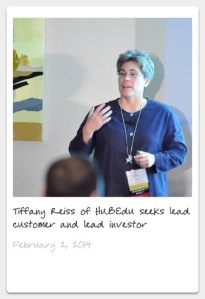
At the Angels and Demons Zino Society event, the only interesting company to me was HUBEdu who were pitching their tool for bridging the gap between Facebook and Learning Management Systems. Tiffany Reiss is the CEO and a professor at several local universities. She clearly has passion about her idea to engage students where they already hangout – in social media. The entrepreneur assassin in me found a lot to dislike. Because I was in expert panelist mode, when Tiffany’s lead developer, Chris Airola, came up to me after the event, I unloaded on him with everything that was wrong with their pitch. Well, my Vistage training didn’t last very long. He withstood my barrage of negatives and then asked if I would meet with the management team. He was interested both in my investor experiences as well as the potential for me to be a lead customer with my teaching at UW and the Institute of Design. I was impressed that he was paying attention and using the forum for double duty – find customers and find investors. Maybe there is hope for this group. I agree to a meeting and make a vow to myself to be more in Vistage “carefrontation” mode when I meet with them. When I got home I sent a collection of background articles on different learning systems and a pointer to Simon Sinek’s “WHY” video. I strongly suggested that they watch the video and spend time on what their personal and new venture “whys” are. When we got together, we started with their “whys.” As usual even with a heads up and the powerful Sinek video, they shared their “hows.” I pushed back and suggested other variants and they still couldn’t see the difference between their why and Sinek’s example of powerful whys. So I switched gears and went through a few other frameworks like the four developments (product, customer, talent and investor), Customer Lifetime Value (CLV) and RFM (Recency. Frequency. Monetization). I then came back to the WHY and Tiffany nailed it. After she shared her new why, Chris immediately saw the difference between their previous how and the new why.  The energy in the room exploded and for the next hour, Chris and Tiffany generated more good thoughts about their new venture than for the previous year. As we wound down, they asked me if I would be a customer and try their tool in my upcoming classes. Now that I knew they had a powerful why, I gladly agreed.

The Cosmos of the New Venture

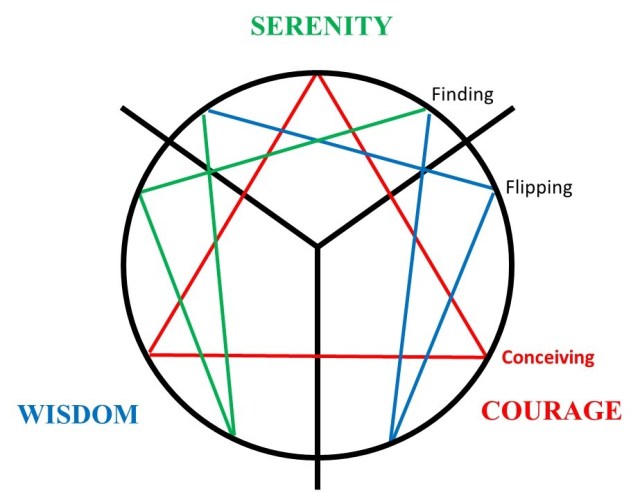
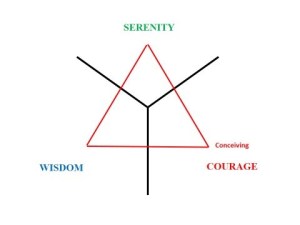
Finding talent is the first of the steps in understanding the context that surrounds the core triangle of work of the entrepreneur. The overwhelming urgency of the new venture leads the entrepreneur to focus only on the core triangle of work. This core work sits in a much larger context. The finding talent is an ongoing process for the new venture. The needs are always changing and expanding and finding the talent, customers and investors is a never ending quest.

Finding talent is the journey to finding the other key players in the cosmos of the new venture – the founding talent, the launch customer and growth partner, and the lead investor. The talent is the village that raises the new venture.

Finding talent is VALUING DIFFERENCES.


You can find the introduction to the Cosmos of the New Venture here.

Posted in Content with Context, Emails to a Young Entrepreneur, Entrepreneuring, Flipped Perspective, Learning | Leave a comment

Emails to a Young Entrepreneur: Finding Talent

Day 119 of Self Quarantine             Covid 19 Deaths in U.S.:  134,000

Finding Talent

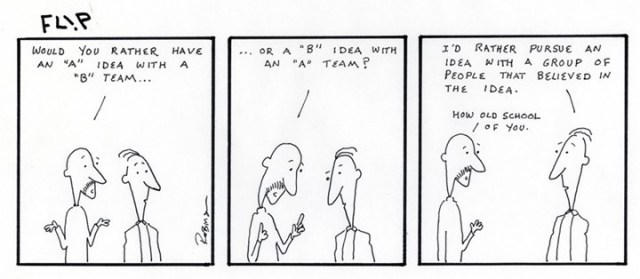
Flip Comic created by David Robinson

“The true path to wisdom can be identified by three things,” said Petrus. “First, it must involve agape, and I’ll tell you more about this later; second, it has to have practical application in your life. Otherwise, wisdom becomes a useless thing and deteriorates, like a sword that is never used.

“And finally, it has to be a path that can be followed by anyone. Like the road you are walking now, the Road to Santiago.”

Coelho, Paulo, The Pilgrimage (Plus) (pp. 27-28). HarperCollins.


Glen Ellen, CA USA, Benziger Family Winery, July 10, 2013

Dear Mikhail,

Thanks for your kind words about how much the flipping perspective exercises helped you to start observing your audience and customers. I am already seeing differences in your observing and discovering mindset as you describe your exercises and insights. I appreciate your sending along what you learned from brainstorming ways to create an audience for your project. As I shared earlier, I am not qualified to judge what is right for you and your path.

While a young mother understands that she is not alone in nurturing the infant and transitioning to being a parent, she realizes there is a lot to the old saying “it takes a village to raise a child.”

It takes a village of partners to raise a new venture.

In your emails, I’ve read a lot about your idea and your background. I haven’t heard anything about your partners in this endeavor and the talent that is surrounding you.

Today, I would like to share the importance of three people in your village that will nurture and help you develop your new venture. The key talent roles that you need to intentionally seek out are – your co-founder, your growth partner customer, and your lead investor. The search for each of these partners is much like the search for your life partner in a marriage. You will be interacting with each of these partners during the intensity of the infancy of your venture as much or more than with your life partner.

As I struggle to understand and share the lessons of my forty years of conceiving and growing new ventures, I am reminded of an hour long presentation on the culture of Japan.  We tried to absorb these lessons the first morning of our arrival in Japan as part of a Total Quality Control Study Mission with twenty manufacturing managers from Digital Equipment Corporation.

Jean Pearce, a columnist for the English language Japan Times, is a diminutive lady who has been in Japan for several decades.  Her comments stick with me 25 years later as I attempt to share the culture of entrepreneuring:

“When I first arrived in Japan, I was able to write a full book about the Japanese culture.  After a year, I was barely able to write five pages about the culture of Japan.  Today, after thirty years of living in Japan, I can’t even write a single definitive sentence about the culture of Japan.  The more I experience the Japanese culture, the less able I am to generalize.  However, I can share many examples of differences between America and Japan and hopefully that will help you experience your stay in Japan in a different manner.”

Jean pointed out a difference between East and West through something as simple as eating utensils. Silverware is noisy, clunky and cutting. Chopsticks are quiet and have not been used by others before. They are natural and have sensitivity.

She pulled out a little cage for keeping insects in the house so that one can hear the song of summer. The cage is arranged so that you feed the insect cucumbers or watermelon. I asked her later about these cages and she pointed me to the following short story:

Kusa-Hibari

Lofcadio Hearn

“His cage is exactly two Japanese inches high and one inch and a half wide: its tiny wooden door, turning upon a pivot, will scarcely admit the tip of my little finger.  But he has plenty of room in that cage — room to walk, and jump, and fly, for he is so small that you must look very carefully through the brown-gauze sides of it in order to catch a glimpse of him.  I have always to turn the cage round and round, several times, in a good light, before I can discover his whereabouts, and then I usually find him resting in one of the upper corners – clinging, upside down, to his ceiling of gauze.

Imagine a cricket about the size of an ordinary mosquito — with a pair of antennae much longer than his own body, and so fine that you can distinguish them only against the light.  Kusa-Hibari, or “Grass-Lark” is the Japanese name of him; and he is worth in the market exactly twelve cents: that is to say, very much more than his weight in gold.  Twelve cents for such a gnat-like thing! . . . By day he sleeps or meditates, except while occupied with the slice of fresh egg-plant or cucumber which must be poked into his cage every morning . . .to keep him clean and well fed is somewhat troublesome: could you see him, you would think it absurd to take any pains for the sake of a creature so ridiculously small.

But always at sunset the infinitesimal soul of him awakens: then the room begins to fill with a delicate and ghostly music of indescribable sweetness — a thin, silvery rippling and trilling as of tiniest electric bells.  As the darkness deepens, the sound becomes sweeter — sometimes swelling till the whole house seems to vibrate with the elfish resonance — sometimes thinning down into the faintest imaginable thread of a voice.  But loud or low, it keeps a penetrating quality that is weird . . . All night the atomy thus sings: he ceases only when the temple bell proclaims the hour of dawn.

Now this tiny song is a song of love — vague love of the unseen and unknown.  It is quite impossible that he should ever have seen or known, in this present existence of his.  Not even his ancestors, for many generations back, could have known anything of the night-life of the fields, or the amorous value of song.

They were born of eggs hatched in a jar of clay, in the shop of some insect-merchant: and they dwelt thereafter only in cages.  But he sings the song of his race as it was sung a myriad years ago, and as faultlessly as if he understood the exact significance of every note.  Of course he did not learn the song.  It is a song of organic memory — deep, dim memory of other quintillions of lives, when the ghost of him shrilled at night from the dewy grasses of the hills.  Then that song brought him love — and death.  He has forgotten all about death: but he remembers the love.  And therefore he sings now — for the bride that will never come.

So that his longing is unconsciously retrospective: he cries to the dust of the past — he calls to the silence and the gods for the return of time. . .Human lovers do very much the same thing without knowing it.  They call their illusion an Ideal: and their Ideal is, after all, a mere shadowing of race-experience, a phantom of organic memory.  The living present has very little to do with it. . .Perhaps this atom also has an ideal, or at least the rudiment of an ideal; but, in any event, the tiny desire must utter its plaint in vain.

The fault is not altogether mine.  I had been warned that if the creature were mated, he would cease to sing and would speedily die.  But, night after night, the plaintive, sweet, unanswered trilling touched me like a reproach — became at last an obsession, an affliction, a torment of conscience; and I tried to buy a female.  It was too late in the season; there were no more kusa-hibari for sale, — either males or females.  The insect-merchant laughed and said, “He ought to have died about the twentieth day of the ninth month.” (It was already the second day of the tenth month.)  But the insect-merchant did not know that I have a good stove in my study, and keep the temperature at above 75 degrees F.  Wherefore my grass-lark still sings at the close of the eleventh month, and I hope to keep him alive until the Period of the Greatest Cold.  However, the rest of his generation are probably dead: neither for love nor money could I now find him a mate.  And were I to set him free in order that he might make the search for himself, he could not possibly live through a single night, even if fortunate enough to escape by day the multitude of his natural enemies in the garden — ants, centipedes, and ghastly earth-spiders.

Last evening — the twenty-ninth of the eleventh month — an odd feeling came to me as I sat at my desk: a sense of emptiness in the room.  Then I became aware that my grass-lark was silent, contrary to his wont.  I went to the silent cage, and found him lying dead beside a dried-up lump of egg-plant as gray and hard as a stone.  Evidently he had not been fed for three or four days; but only the night before his death he had been singing wonderfully — so that I foolishly imagined him to be more than usually contented.  My student, Aki, who loves insects, used to feed him; but Aki had gone into the country for a week’s holiday, and the duty of caring for the grass-lark had developed upon Hana, the housemaid.  She is not sympathetic, Hana the housemaid.  She says that she did not forget the mite — but there was no more egg-plant.  And she had never thought of substituting a slice of onion or of cucumber!. . .I spoke words of reproof to Hana the housemaid, and she dutifully expressed contrition.  But the fairy-music had stopped: and the stillness reproaches; and the room is cold, in spite of the stove.

Absurd!. . .I have made a good girl unhappy because of an insect half the size of a barley-grain!  The quenching of that infinitesimal life troubled me more than I could have believed possible. . .Of course, the mere habit of thinking about a creature’s wants — even the wants of a cricket — may create, by insensible degrees, an imaginative interest, an attachment of which one becomes conscious only when the relation is broken.  Besides, I had felt so much, in the hush of the night, the charm of the delicate voice — telling of one minute existence dependent upon my will and selfish pleasure, as upon the favor of a god — telling me also that the atom of ghost in the tiny cage, and the atom of ghost within myself, were forever but one and the same in the deeps of the Vast of being. . . And then to think of the little creature hungering and thirsting, night after night and day after day, while the thoughts of his guardian deity were turned to the weaving of dreams!. . .How bravely, nevertheless, he sang on to the very end — an atrocious end, for he had eaten his own legs!. . .May the gods forgive us all — especially Hana the housemaid!

“Yet, after all, to devour one’s own legs for hunger is not the worst that can happen to a being cursed with the gift of song.  There are human crickets who must eat their own hearts in order to sing.”

The cricket owner in the story didn’t understand the partnership he was in with the cricket to receive value from the song of summer. Just as the cricket had to find partners to keep him alive through cold and care and feeding, you will need to find the partners to nurture your business through these early fragile years. You will need to go beyond just the care and feeding to find the partner that can help you to conceive your products and your song of summer.

During my journey of “paying it forward” I have the privilege of meeting so many young entrepreneurs who are wonderfully committed to creating a business and making the world a better place. Dana Dyskterhuis is one of those special forces I rarely encounter – someone who is doing it AND is able to be reflective about her journey AND is gifted in communicating her story.

Dana was kind enough to describe her journey with her company Fanzo to my MBA class in entrepreneuring.

“I come from Omaha, Nebraska and I moved to Seattle six years ago. I took a job with Qwest Communications which is now CenturyLink. I was in marketing communications and got to work with the Seattle Seahawks. As part of the job I had to deal with a lot of the technical issues surrounding events at CenturyLink Stadium and had to be available 24/7.

“I graduated from a Nebraska college in broadcast journalism and started my professional life as a television news reporter. Then I went to the other side and did PR for an arena in Omaha, a hockey team, and a non-profit – The American Cancer Society.

“I was recruited from my arena job to do PR for this hockey team that was the minor league team for the Calgary Flames. I was really excited.  They’d been in town for a year and a half, but there was no buzz about them. No one was going to the games. However, my mom and I were going to the games and were wondering why no one was showing up.

“Then they hired a local president to run the team and he recruited me away. I had one question for him ‘Is the team here to stay?’ He looked me in the eye and said ‘the team is here to stay. You can leave your job and come with us.’

“So I left my job and started doing PR for the team and two months later they left our city. So I said enough. It is time to get out of Omaha, so I started looking at other cities like New York and the Qwest job opened up in Seattle. I’ll go there and retire. My grandma worked all her life for Qwest and I can go to Qwest and the rest of my life will be set.

“I spent a year and a half in my job and then there were layoffs. It was tough.”

“Let me take you back to when I arrived in Seattle.  I knew one person. How can I find people? I’m so shy. I wanted to find where all the Nebraska folks hung out. So I looked around for Game Day. Where did all the Huskers go for football game day? I couldn’t find the game day bar. I didn’t know where to go.

“Finally a few months later someone told me that all the Huskers go to Lucky 7 in Kirkland. So I went and it was this sea of red. Kind of a back home feeling. Cool.

“I didn’t think much about it at the time. In subsequent years I continued my PR work and did some consulting for mom and pop shops. I did business development in a startup. I was getting advice from lots of people that if I wanted to stay in Seattle, go join a startup.

“So I did the bus dev job. I thought it was the coolest thing. But then they ran out of money.

“About two years ago, I was noticing a pattern on Twitter and Facebook amongst my friends who were tweeting out all the time things like ‘Hey, I’m going to San Francisco where do I go to watch the game? I’m going to New York where do I go to watch Manchester United?’

“For some reason, I began noticing that this was a problem. So I just started solving the problem.  I began building a database of watch sites, designated watch sites for fans. It was a Google Docs spread sheet. I’m not a technical person. The spread sheet was for the Top 20 cities in the United States.

“I just started talking to people about this idea. They’d all say ‘yeah, I have that problem.’ The more people I’d talk to, they would share their version of the problem. I went to Kansas City and I didn’t know where to go.

“I felt I was on to something. Then I was at an event where there were Silicon Valley speakers. It was a motivational startup day event in Bellevue. I got 15 minutes with Micah Baldwin who started Follow Friday on Twitter. He is a huge presence. He’s an angel investor who had several startups before with both successes and failures.

“I had a couple of other ideas at the time. He went No to the first and second ideas. Ok, so I have this database of watch sites. He went ‘Tell me more.’

“I told him more about the watch sites. He said ‘Pursue that. Go find a technical co-founder.

“Oh my God. How do I do that? What am I doing? I am not a startup person. I’m not a technical person. I was feeling really lost and horrified.

“But I did it. I just started going to events pitching my idea. This is what I’m doing. This is what I need. I did a Startup Weekend event where you build a prototype in a weekend. So we did that with a team.

“Then it was at an event at the Amazon campus on South Lake Union that you could get up and give a 15 second pitch on what you were doing and what you needed. It was in the basement of the TechStars building.

“People were drinking whiskey and eating pizza. It was really casual, but super intimidating to me. There was a line all the way around the room of people wanting to pitch. I wasn’t sure if I wanted to pitch. I was feeling really nervous.

“I had met a couple of people and they were like ‘you gotta do it.’ I was at the very end of the line and not going to pitch. But these folks kept encouraging me.

“Then the speaker said ‘OK, we’re done. Oh, but wait there is one more.’ I went ‘Oh God, OK.’ Then the speaker asked the crowd ‘Should we bring her up, should we bring her up?’

“The crowd yelled ‘Yeah, Pitch! Pitch!’ I went ‘Oh no. Extra pressure.’

“I got up and gave my pitch. I don’t remember what I said. Other than ‘If you want to start this business with me, come find me and we’ll go hook up.’ Then I realized what I said and went ‘No, No, I didn’t mean that.’ How embarrassing. I clarified that right away.

“After the pitch I stood around and talked to people and as luck would have it my co-founder Paul was there. I didn’t know who he was at first. Just this guy who came up to talk. He was interested and asking questions. What’s your business model? What’s your go to market? I had ideas.

“He’s like ‘OK.’ So then I asked ‘and who are you? Please tell me about you.’

“He said ‘I’m the CTO at Smilebox.’ My jaw dropped.  I couldn’t believe I was talking to him. I knew their space and I knew that they’d just sold for $40M. He helped co-found it and he was looking for his next project. And he loves sports.

“I went ‘Oh, this is my guy. I got to get him.’

“I spent the next several months winning him over. That meant meeting his parents, his wife, his children. Just like a family.

“We were hashing everything out. In that time also we created document after document – on competitors, go to market, business model, legal process, all of that.  All the grunt work that is really necessary. He left his job at Smilebox to join me full time about a year and a half ago.

“We just started testing the product out in the community. Paul said we can’t build a business off of watch sites. We have to think bigger.”

As I watched Dana, I saw her story come through to the class through her non-verbal skills as much or more than the words she shared. I told her about my experience of her presence.  She laughed and reminded me that she worked for a number of years as a TV reporter. One of the challenges of finding the talent for your new venture is practicing empathetic or deep listening. Researchers share that only 7% of communication is in the words that are spoken, with 38% coming from the way the words are said, and 55% from your facial expressions and posture.

Mikhail take some time to deeply observe the full messages through deep listening. I find it worthwhile to watch video of myself giving presentations and when interviewing others to understand how my full palette of communication channels are working (or not).

Each of us experiences the world in many ways based on our personality, learning style, communication style and on and on. We are a product of our life history. Yet, we have to continually communicate with others. Just as Dana was driven to pursue her idea and communicated in many different ways to find her co-founder, a key part of being an entrepreneur is adjusting your style to others. Being persistent AND flexible is part of the Finding Talent journey.

As Dana shared, finding the key talent AND recruiting them to your venture is a multi-step process where each person gains trust and rapport with the other talent over time.

During a weeklong intensive personal development seminar I encountered Mary Pipher’s “I am from …” poem. The exercise is taken from her book Writing to Change the World.

Mary’s “I am from …” poem is:

I Am From  

I am from Avis and Frank, Agnes and Fred, Glessie May and Mark.

From the Ozark Mountains and the high plains of eastern Colorado, from mountain snowmelt and southern creeks with water moccasins.

I am from oatmeal eaters, gizzard eaters, haggis and raccoon eaters.

I am from craziness, darkness, sensuality, and humor.

From intense do-gooders struggling through ranch winters in the 1920s.

I am from “If you can’t say anything nice about someone, don’t say anything,” and “Pretty is as pretty does” and “Shitmuckelty brown” and “Damn it all to hell.”

I am from no-dancing-or-drinking Methodists, but cards were okay except on Sunday, and from tent-meeting Holy Rollers, from farmers, soldiers, bootleggers, and teachers.

I am from Schwinn girl’s bike, 1950 Mercury two-door, and West Side Story.

From coyotes, baby field mice, chlorinous swimming pools, Milky Way and harvest moon over Nebraska cornfields.

I am from muddy Platte and Republican, from cottonwood and mulberry, tumbleweed and switchgrass, from Willa Cather, Walt Whitman, and Janis Joplin.

My own sweet dance unfolding against a cast of women in aprons and barefoot men in overalls.

The exercise is to do a free write in the form of “I am from …” writing as fast as you can for seven minutes.

Mary’s instructions are:

“Follow a formula with each line beginning with “I am from…” Writing this kind of poem is a way to experiment with identity issues. The poem must include references to food, places, and religion. Give it a try.”

My free writing variant of the “I am from …” poem is:

I am from Marge and Harry, Leigh and Pearl, Grace and Edward

I am from the empire state, the rust belt, the old south, live free or die, and the other Washington

I am from a dog’s breakfast of European ancestry

I am from loving parents who agreed to argue with each other in whispers

I am from a family where my much younger sister has never known me without my bride Jamie

I am from a farm community where planting cabbage skips and picking black cherries was a summer adventure

I am from an age when I could ride my bicycle all over western New York and my parents never had to worry about the crazies

I am from a travelling salesman father by day and an unschooled medical device inventor by night

I am from a stay at home mom who grew up very rich and whose father lost it all in the great depression

I am from the gift of fifty years of knowing and marrying my childhood sweetheart

I am a non-smoker from a Southern University funded by tobacco fortunes

I am from our deep family rivalry of Blue Devils and Tar Heels

I am from the too much travel of a corporate executive who missed so much of being a dad for three great children – Elizabeth, Maggie and John

I am from the gift of two infant granddaughters and their loving parents who allow me to re-experience what I missed as a travelling dad

I am from constant personal generated challenges like learning to fly, Outward Bound and becoming a university faculty member without an advanced degree

I am from the invisible university of Ackoff, Goldratt, Christensen, and Alexander

I am from the highest highs and lowest lows of serial entrepreneuring

I am from the gift of fantastic collaborating colleagues who have given me more than I can ever repay

I am from the solitary meditations of hiking Olympic mountain trails

I am from the poetry of mudlucious E.E. Cummings and the melodious voice of corporate poet David Whyte

I am from the formation of thousands of books

I am from the biodynamics of fine wine growing

I am from the spiritual traditions of a childhood full of Methodists, Baptists, and Presbyterians and a chosen Catholic adult faith

I am from an unhealthy gene pool of parents and grandparents and aunts and uncles who died at early ages

I am from the gifts of perpetual inquiry and an explorer of the world

I am Skip!

Near the beginning of your journey to rapport with your potential partners, the “I am from” poem is a great way for you to share your past in a unique way and set the tone for how you would like your relationship to evolve.

On my journey of learning how to become a better graduate school teacher, I attended Harvey Brightman’s Masters Teaching two day seminar in Atlanta. At the start of the seminar Harvey shared “your students are not like you.” Thanks Harvey, tell me something I don’t already know. As he looked at our skeptical faces, he said again “No, your students are really not like you.”

OK, you’ve got my attention. He then hit me with a curveball “70% of business students are ES (Extravert Sensing) in the Myers-Briggs profile. And 70% of business faculty are IN (Introvert iNtuitive).  The two styles communicate very differently. Most faculty members assume that the students are like them and teach in the same way they like to be taught. The problem is that if you communicate as an IN, then you lose all of the ESs right away. You have to be flexible enough to teach to the ESs, not the INs in the room.”

Sensing people process data with their five senses, so the Extraverted Sensing function allows a person to process life through their experiences. It is the ability to be keen to what is seen, smelled, touched, heard and tasted. It is energized by experience and it is able to live “in the moment.”

Intuitive people process data through impressions, possibilities and meanings, so the Introverted Intuition function allows a person to have a sense about the future. It is the ability to grasp and get a sense of a pattern or plan. Information that is usually hard to understand and dissect is easily processed through Introverted Intuition

The ESs are the doers and want to get moving. As a general rule, they don’t like abstractions. The INs are the visionaries and want to understand the implications of any new topics. The INs are the synthesists.

As Harvey described how to orient teaching materials to better suit the communication and learning styles of the ESs, I remembered Cathy Davidson’s discussions in Now You See It that class projects work best when there is maximal difference in the makeup of the student teams.

Armed with Harvey’s suggestions and my innovations for forming teams through maximal difference (combine Meyers Briggs, Social Styles Inventory, Tolerance for Ambiguity and demographic information), I launched into the new quarter with a revised set of slide decks and a new way for me to form teams. The class projects that quarter were significantly better than in my previous twenty years of teaching project based courses. I was feeling pretty good about my innovation and shared the process and results with my peer faculty members.

Professor Jennifer Turns realized that what I’d independently discovered was similar to what Doug Wilde had researched for fifteen years in the Stanford Engineering School. Doug had fifteen years of research on the success of maximal difference in teams. His metric was on the large difference in the number of national engineering competition prizes his student teams won before and after he used the teamology technique. Doug introduces the impact of melding personalities into teams:

“It has become a generally accepted premise that our world—or at least the technology we use in it— is increasing in complexity. Smart cellphones, touch-screen ATMs, personal robots, labs on a chip— all those things and many more are intended to make our world easier and more fun to negotiate. In general, the easier the devices are for us to use, the more sophisticated they have to be.

“The design of advanced medical devices, autonomous mechanisms, and tomorrow’s technological miracles requires a cumulative knowledge that exceeds a single person’s abilities. So as technology advances, products are increasingly being designed in the commercial world by teams of skilled collaborators. Each team member is chosen to bring a specific range of skills and experience to bear on the mission, and each contributor is essential to a successful outcome.

“But it is not only different types of expertise that people bring to the task. They also have distinct personalities, and different ways of approaching and solving problems. The proper application of those traits can be as important as combined technical knowledge to a team’s success.

“What we are talking about is whether a person is introverted or extraverted, and which mental process one is inclined to use in finding answers to questions: sensing, intuition, thinking, or feeling. Many people may have the initial reaction that some of these characteristics are irrelevant, or perhaps disruptive, to meeting challenges that are primarily technical and scientific.

“Informal studies at Stanford University strongly suggest, however, that all of these personality traits are indeed very relevant to a team’s success. Almost a quarter-century of records of student design teams, mainly in Stanford University’s mechanical engineering design program, indicate that performance improves when a team pays attention to its individual personalities. The basic principle learned, which may apply in corporations as well as universities, is that in the long run teams do better when they are composed of people with the widest possible range of personalities, even though it takes longer for such psychologically diverse teams to achieve smooth communications and good cooperation.

“Before diverse team members can be integrated into a cooperative unit they must not only cultivate an openness to opposing opinions but also recognize the value of exploring a problem from various angles. Sharing personality information about each other facilitates this essential awareness.”

From “Personalities into Teams” by Doug Wilde.

As you get to know your co-founder and other talent that you recruit, it is more than meshing different skills, it is looking for maximal difference in your thinking and behavioral styles.  It is about encouraging and valuing multiple points of view.

Scott Page in The Difference: How the Power of Diversity Creates Better Groups, Firms, Schools, and Societies asserts that “diversity trumps ability”:

“Reviewers recognized that The Difference explores the pragmatic, bottom-line contributions of diversity. It does so using models and logic, not metaphor. The book’s claims that ‘collective ability equals individual ability plus diversity’ and that ‘diversity trumps ability’ are mathematical truths, not feel-good mantras.

“Diversity, as characterized in the book, means differences in how people see, categorize, understand, and go about improving the world. I should hasten to add that the book’s emphasis on cognitive diversity and the pragmatic benefits of diversity does not deny other dimensions of diversity. Those exist, and they matter. In fact, identity diversity and cognitive diversity often go hand in hand. Two people belonging to different identity groups, or with different life experiences, also tend to acquire diverse cognitive tools.”

As you look for your co-founder and your other launch team members, Dave McClure at 500 Startups recommends a starting team have members who can fill the roles of hacker, hustler, designer and visionary. I add another key role which is the lead customer or growth partner.
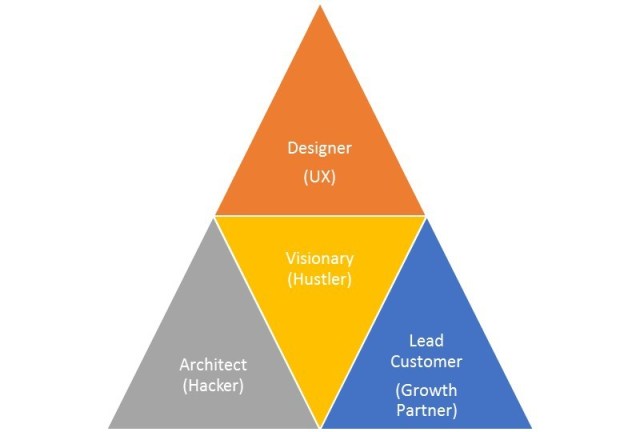
Figure 6 Key roles in the new venture

Mack Hanan describes the importance of this lead customer and growth partner:

“How can you grow your business?

“You cannot.

“You can only grow someone else’s business. His business growth will be the source of your growth. By growing, he will force growth back upon you because he will want you to grow him again.

The businesses you can grow have a name. They are called your major customers. Their growth must be the objective of your business.  The capabilities you require to grow them must be your asset base.

Growth requires a partner. A growth partner is a special kind of customer. He is a customer whose costs you can significantly reduce or whose profitable sales volume you can significantly increase. In one or both of these ways, you can improve his profits. This is the basis for his growth. It is also the basis for his contribution to your own growth. As the two of you grow each other, you will become mutually indispensable.

“If you cannot grow a customer, you cannot partner him. You can continue to do business with him, buying and selling, but the maximized profits of growth will elude both of you.  If all your customers are buyers instead of growers, you will be a slow-growth or no-growth business. None of your customers will be growing you because you will not be growing them.”

Read those first three lines again and again.

“How can you grow your business?

“You cannot.

“You can only grow someone else’s business.”

As an entrepreneur, I felt my fortunes were in my hands. Yet, as I reflected on my own experiences and started paying attention to successful businesses, it became obvious that in order to grow I have to grow my customer’s business. It’s not about selling, it’s about growing other businesses.

At Attenex for legal conflict of interest reasons, we were forced to go to market through service provider channel partners. Over the course of five years, we provided marketing and selling expertise to grow our channel partners businesses from a total of $5M in revenue to >$300M. One of our growth partners, FTI Consulting, liked our partnering capabilities and product so much that they bought us for $91M.

The sooner you can locate your lead customer and growth partner the faster your own business will grow.

Most people assume that the UX person (designer and researcher) can be the customer surrogate. However, I’ve found that it is crucially important to view the lead customer as a member of the team and invite them inside the product development bubble. The key to having the lead customer as a team member is to be able to regularly visit the customer’s work environment. Their work site is where the observation action is.

Let’s look at the four key roles of the ideal product development team:
    • Visionary (hustler) – the visionary sees the opportunity and imagines what technology is capable of solving the customer need. In an ideal world, the visionary sees not just a “nice to have” but a “got to have” solution and a business model that makes money quickly. A good visionary will have a big dose of hustler in them – the ability to “engineer exchanges to separate customers from their money (time/attention) willingly by creating, communicating and delivering unique value” (thank you Dan Turner for this definition). As Dan Pink shows in To Sell is Human, the hustling skills can be learned (and most of us are tacitly already “selling” most of our time).
    • Architect – builds the prototype and foundation for the product. While the term of the moment is “hacker,” I prefer someone that can go beyond prototyping and design at scale. They are able to translate the visionary opportunity and designer wireframes or physical prototypes into something that works. An ideal product architect will build at hacker speed and design for scale.
    • User Experience Designer – observes customers and translates the observations into human computer interaction designs and thinks more broadly about the full user experience design. The UX researcher needs to exhibit “beginner mind” and be optimally ignorant while observing customers “in the wild” and in their natural work habitat. A key role of the UX researcher is to See Organizations.
    • Lead Customer – the ideal customer is the manager who has the direct need and the budgetary authority to buy your product or services. They should have the time, expertise and commitment to see the project through. The “got to have” need has to have one or more (preferably all) of the characteristics of increases efficiency, increases effectiveness, increases revenue, and decreases expenses.

It is the responsibility of the Visionary/Hustler to find the lead customer. Visionaries need to go beyond seeing the opportunity and find the customers who can help them create the solution. Once they get the lead customer working with the architect and the UX Designer, the visionary/hustler needs to identify the business model that will not only grow their own business but help the customer grow their business (see Growth Partners).

To help identify good opportunities, the visionary uses a form of “backward chaining” by finding workflows that have a clear valued outcome and then working backwards to the starting point. A really good opportunity will have a decision point which leads to high value and/or a high risk outcome. Inserting a product into a high value or high risk workflow allows you the opportunity for value based pricing. The realization that the eDiscovery market was very high risk and high value allowed us to build a value priced solution with Attenex Patterns.

The Lead Investor is the third piece of your “finding talent” pursuit. Many investors have money that they can provide you. Very few investors have what you really need – the combination of experience, connections to influencers, purchasers and other investors, and an ability to provide tough love or what Vistage calls “carefrontation.”

Just as Dana described her pursuit for her co-founder, you will spend considerable time looking for the right lead investor match.

Marc Allen in Visionary Business describes his process of finding and working with his lead investor – Bernie.

“Can I help you?” I said.

“I don’t know,” he said with a smile. He held out his hand. “My name’s Bernie.”

I shook his hand; his fingers were long and delicate and cool. There was something warm and friendly about the old guy, something that immediately put me at ease.

“I’m Marc.”

“Nice little business you’ve got here.”

“Well, it’s just a beginning, I hope.”

“How long have you been in business?”

“Oh, we’ve had the office about six months, though we’ve been working on it for over a year now no, wait, it’s been almost two years now.” I flushed, a bit embarrassed – where had the time gone?

“I like the way you’ve furnished the office.”

He said it with a smile; I didn’t know if he was kidding or not. The office furniture was a hodgepodge of the cheapest stuff we could find at flea markets and garage sales, with a few leftovers from our apartments thrown in. Our front desk was a sheet of plywood with two-by-fours for legs.

“It’s low cost,” I said.

“That’s what I like about it,” he said. “I’ve seen startups that have put all their money into the furniture. I invested in a company a while ago, and the two owners went out and bought Mercedes and custom-built oak desks. I couldn’t believe it! They even had custom-built bookcases! I told them they needed to spend their money on their business, not on their furniture. They promised me they’d be fine – and they went bankrupt before the year was out. They didn’t invest in the future.”

He looked around the office, then spoke with a sudden vehemence.

“As a start-up, you’ve got to spend wisely. Every bit of capital you’ve got is precious, and you’ve got to use it on the things that’ll make your company grow. And don’t buy a Mercedes until you can easily afford it.”

His story piqued my interest. I didn’t know what to say; there was a pause that felt awkward to me. He simply looked at me, carefully, with that slight smile of his. I felt as if he were assessing something, but I had no idea what.

“Are you looking for an investor?” He said it casually, giving it no more importance than if he was asking me for the time of day.

“Well … we could use some capital…”

“Do you have a business plan?”

“Ah … no, not really. Lots of ideas, and plans of course, but nothing really concrete on paper yet.”

He didn’t waste time getting down to business. “You need a plan,” he said. “I might invest; I might not. You don’t know me from Adam I could be a weirdo off the street who’s conning you for a free cup of coffee.” He said it with his enigmatic smile. He could have been speaking the truth I had no idea.

“But it doesn’t matter. If all I do is encourage you to get started on a plan, my little visit here will have been worth your time. You need a solid, well-written business plan before any investor will take you seriously. Every company needs a plan, whether they need investors or not. A business without a plan is like a ship without a course. You just wander around aimlessly, without reaching any destination, because you haven’t charted out the course necessary to get anywhere. You haven’t even determined your destination.

“Your plan doesn’t have to be long and involved; it doesn’t have to be complex. But it has to be clear, to you and to anyone else who’s interested.”

Marc Allen. Visionary Business: An Entrepreneur’s Guide to Success (Kindle Locations 92-97).

While you continue to conceive your new venture and flip your perspective, make sure you spend equal efforts on finding the talent you need to nurture your newborn to the infant and toddler stage.

The tendency for young entrepreneurs is to work with people who are just like you. A great startup seeks to maximize the diversity of its team.

Finding talent is VALUING DIFFERENCES.

Yours in entrepreneuring,

Skip Walter

Posted in Content with Context, Emails to a Young Entrepreneur, Entrepreneuring, Flipped Perspective, Learning | Leave a comment

Emails to a Young Entrepreneur: Apply Flipping Perspective

Day 118 of Self Quarantine             Covid 19 Deaths in U.S.:  133,000

Applying Flipping Perspective

As “human doings” we quickly move our day to day actions to habits or tacit behaviors. Habits are those things we do without thinking about them. Getting good at flipping perspective is the primary way for developing your discovering and inquiring mindset.

With Applying Conceiving, we used the habits of everyday life to flip our perspective.

With Applying Flipping Perspective, we shift our focus to observing your potential audience and customers. Like Kim Erwin did for her class project, where are the similar environments in the physical world that you can observe potential customers. Each day for seven days find ways to observe (not interview – not interviewing is the fundamental flip for this chapter).

As you search for environments to observe customers, also look for places where you might volunteer and perform participatory observation. When I was doing research for a wine ecommerce site, I realized that I didn’t understand how normal consumers went about buying wine. So I volunteered to work in the tasting rooms of several wineries to interact with a wide range of novice to expert wine consumers.

As you look at your product or service, what are the steps a customer follows in your workflow? Experiment with reversing the steps in the process. What do you observe? What are your reflections on the results that occur with flipping the steps?

One of my flips in perspective in writing these Emails is to use Guy Kawasaki’s APE: Author, Publisher, Entrepreneur – How to Publish a Book as my North Star. The primary flip is to see creating a book not as an authoring exercise, but as a new venture. I am creating both the book as an asset and a company as an asset surrounding the book with speaking engagements, workshops, seminars and mobile applications.

As part of my flipping perspective while writing the book, I had these observations:

January 1, 2014

I finally kept my butt in the seat long enough to write a full draft of my first book. I can’t believe it. It is done. While talking to David, he shared that he’d been revising The Seer by having Kerri read him the chapters of the book. It hit me in an instant that what I need to do is voice record each chapter and then play it back in my own voice. This will be a completely different way to hear what I am writing. Possibly it will help me to understand what my writing voice actually is. This is the method that poets use to hear their poems. I’ve never done “the hearing” with my own poetry. As I experimented with this today, I realized there are two benefits to this process.  Just the exercise of trying to speak all that is written helps me to hear which sentences are most difficult and need rewriting. Then listening to the words in my own voice is really helpful in getting a sense of how it will come across.  Oh, if only I had a deep magical voice like David Whyte when he is telling his stories and reading his poetry and giving us a sense of what was behind the poem that he wrote. I know how much more meaningful the business books I read are when I had a chance to meet and interact with the author. Russ Ackoff was the first author I did this with. I read Creating the Corporate Future in a made up neutral voice. After meeting Russ, all of his other books were now coming through my head in Russ’s inimitable style. Should I go ahead and get serious about these recordings and do an audio version of the book as well as the written version? Certainly this is a flipped perspective for me – listening to what I write rather than seeing what I write. Maybe I can develop my auditory sense as well as my visual sense. Can this be something I write in a blog post? Can I capture what edits I make after I do the speaking of the chapter so that I can see what patterns are coming from the auditory edit rather than just the visual edit? Reading versus hearing – what are the essential differences in these two modalities. I wonder if Elizabeth has some pointers to our comprehension or response based on whether we hear the same information or read the same information. Could this be another revenue stream which is selling the audio books as well?  The juxtaposition of the audio player on the written text is interesting as well. What if we could develop an iPad app like T.S. Eliot’s Wasteland where somebody reads the poem and the color of each line changes as you read through – the experience of hearing and seeing at the same time.

January 22, 2014

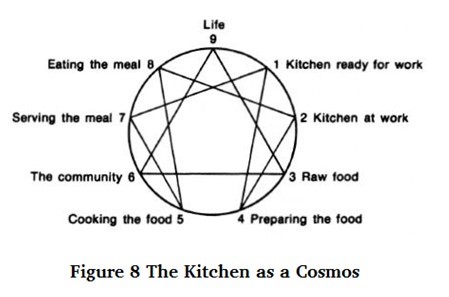
I am in the middle of going back to basics on the experience and meaning of the enneagram. I remember that I have one of the best sources which is Bennett’s Enneagram Studies. I sort of read it through quickly 20 years ago when I was sitting in Charley Krone’s monthly consultants’ study sessions and as part of the Bennett reading group seminars that Barney Barnett does with the Benziger Family Winery.  It was interesting but not enough to pursue really understanding the enneagram as a cosmos. Now that I am playing with the enneagram as the organizing principle for Emails to a Young Entrepreneur, I am finding the book a must read. The first chapter is looking at the workings of preparing a meal at a seminar center from the three layered cosmos view of the enneagram. What a great way to exhibit a cosmos in the formation of the meal (the dynamic) with the expertise of the chef in the context of the kitchen and the recipients of the meal. As I read through this chapter while waiting for my lunch to begin with a colleague at the Local360 restaurant in Seattle, I realize that I am in the midst of an interesting cosmos. The juxtaposition of the Bennett book on my iPad with the menu for the Local360 restaurant while the smells and perpetual motion of the cooks and kitchen boys are just a glance away. What a joy to wake up to the cosmos of my surroundings and see the dynamics of the whole local environment, rather than just the restricted view of the table awaiting my lunch meeting.  As I “see” the restaurant in this different light, I reflect on the goal of the Local 360 which is to source all of its food within a fifty mile radius of the restaurant. That goal necessarily restricts the food choices, but makes it easy to select the vegetable pot pie for my lunch. Lost deeply in thought as I await my meeting with Tim, I look up to see Tim and his lovely bride, Sarah. I jump out of my seat to give both big hugs at the unexpected pleasure of being able to interact with the both of them. As the Bennett book is just words on an electronic page until sitting in a kitchen, the meeting with Tim was just an entry in a calendar until Tim and Sarah show up. What if I could view each meeting in the context and cosmos of the enneagram? Would I prepare differently? Would the results be different? Sounds like a new idea for an applying exercise.

These two observations of the process of authoring are expanding my view of what my product is. While I used the recording of my book as a way to better edit the book, I reinforced the importance of having an audio recording of the book as a product for some “readers.” Thinking through the enneagram in context of the startup experience is leading me to ideas for mobile apps to provide a viewing portal into the book. Several reviewers of the book point to the importance of having key parts of the book always available as a mobile app. Should I start with the enneagram and reverse the “Emails” I am sequencing in the book?

The Cosmos of the New Venture

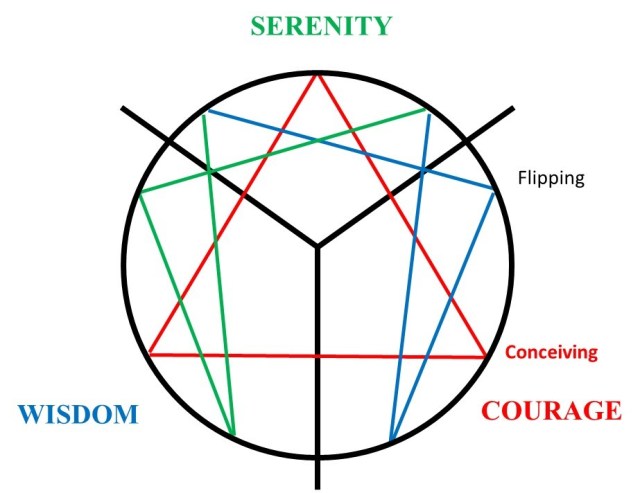
With the Flipping Perspective Email we introduce all of the geometry of the enneagram model of the cosmos of the new venture:

The Cosmos of the New Venture – Flipping Perspective

Flipping Perspective is at the heart of all that an observing and inquiring entrepreneur does. Flipping Perspective sits in the Courage cycle as it takes courage to see the world differently. You have to be intentional about stepping away from the habits and “expert mode” of behavior that is required when working for larger companies.

Along with flipping your point of view is reversing the steps in your product and business development and helping your customers reverse their steps to see more productive ways of working.

Flipping Perspective is OBSERVING with a spirit of inquiry.


You can find a PDF of the full Preface, Forward, Chapter 1 and Chapter 2 here.

You can find the introduction to the Cosmos of the New Venture here.

Posted in Content with Context, Emails to a Young Entrepreneur, Entrepreneuring, Flipped Perspective, Learning | Leave a comment

Emails to a Young Entrepreneur: Flipping Perspective

Day 117 of Self Quarantine             Covid 19 Deaths in U.S.:  133,000

Flipping Perspective

Flip Comic created by David Robinson

“When you travel, you experience, in a very practical way, the act of rebirth. You confront completely new situations, the day passes more slowly, and on most journeys you don’t even understand the language the people speak. So you are like a child just out of the womb.

“At the same time, since all things are new, you see only the beauty in them, and you feel happy to be alive. That’s why a religious pilgrimage has always been one of the most objective ways of achieving insight.”

Coelho, Paulo, The Pilgrimage (Plus) (p. 35). HarperCollins.


Orcas Island, Washington USA, July 4, 2013

Mikhail,

Thank you for your kind response to my previous email. I understand that it can be frustrating when someone doesn’t respond to specific questions. One of my colleagues, Professor Ed Lazowska, Computer Science Professor at the University of Washington, was kind enough to share his major insight when teaching – “I never answer the question that a student asks. Rather I seek to understand the misunderstanding or lack of relevant experience that is behind the asked question. I still don’t answer the question that was asked. Instead I give them an exercise (which usually includes a thinking framework) so that they can discover their own answers in their own context.”

What Ed was pointing out is a dysfunction in the gestalt of teacher and student that often inhibits learning. When the teacher is viewed as the source of all answers learning is stopped. Sir Ken Robinson through his many books and TED videos shares the roots of this dysfunction and how we transform dysfunction into vibrancy by shifting from the teacher/student framework to creating rich environments for lifelong learning.

My own mentor, Russ Ackoff, had the gift (or curse) of never answering a single one of my questions.  Rather, he would be thoughtful and then ask me a much better question back. Frustrating? Yes, very. Yet, it was just what I needed to more fully develop my skills of synthesis to complement my analytic skills.

I enjoyed the first seven of your flipped perspectives and the thoughtfulness you demonstrated in looking beyond the easy tacit patterns of daily life.

I am delighted that you connected the perspective shift that a new mother goes through with her newborn and the shift from causal thinking to an observing spirit of inquiry (effectual thinking). I want to talk some more about flipping your perspective in the context of developing an entrepreneurial and effectual mindset.

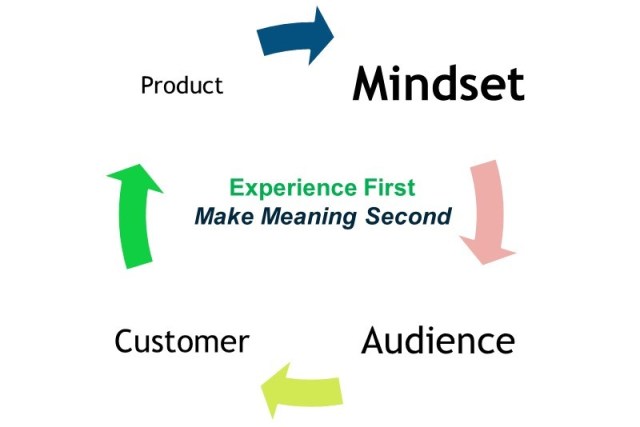
My daughter experienced what every new mother does when she arrived home and was confronted with her crying bundle of wonder. She quickly realized that Alice can’t tell her what is wrong or what is needed. She shifted from communicating with language to deep observation and listening to the distinction of the meanings of the different cries. She stepped into the first of the essential perspective flips – experience first, make meaning second.

In the beginning, Alice’s crying was just noise. There is only the raw experience and a mother’s jangled nerves experiencing her newborn in distress. Not having discovered the patterns yet, each cry leads to changing everything – changing the diapers, feeding her, holding her, talking to her – anything and everything to get Alice to stop crying. Slowly through many sleepless nights and days the patterns and distinctions of the cries become clearer. That cry means Alice is hungry. This cry means that Alice needs her diaper changed. And sometimes the cry is just about Alice exercising her lungs.

Through observation and many small experiments, mother and daughter begin to communicate. The needs are observed and discovered along with the solutions. Yet, the solutions keep changing as the baby rapidly develops. What worked yesterday to calm her isn’t working today. Pretty quickly a mom changes from the causal thinking of being able to predict, to effectual thinking of what resources do I have ready to hand? What experiment can I run this moment to figure out how to satisfy Alice’s changing needs?

As you learned during your years at the Institute of Design, people are very inarticulate when you ask them what they need or when you talk to them about your cool product idea. They have this disease called MSU (Make Stuff Up). As humans we never want to look or sound stupid, so we MSU. As a result, it is very difficult to find any patterns when we interview and talk to other humans.  When we observe humans in their natural environments, they can be very articulate.

The creativity is in finding those natural environments where you can observe humans who have a problem close enough to what you want to solve for. Once you’ve experienced (observed) the pattern, then you are ready to solve for it. Experiencing first is the foundation of flipping your perspective.

My introduction to this human centered design process occurred on my first visit to the Institute of Design. Instead of having me meet with faculty members, Patrick Whitney had students present their class projects. I was stunned at the breadth and depth of the insights that these first year students generated. It occurred to me that if the students could learn this quickly there were powerful frameworks and ways of thinking that the Institute of Design had learned how to transfer to students.

One of those students twenty years ago was one of your professors, Kim Erwin, author of Communicating the New. As I listened to Kim on her book lecture tour, I remembered her student project research. She wanted to design a completely new way of searching (remember this was twenty years ago before Google existed). She thought about where people had to search and navigate a complex space. She realized that she could observe patrons of the university library, a video store, and the Field Museum of Natural History. Brilliant.

Experience first; make meaning second.

An example of this core flipped perspective occurred at Attenex when we were researching our next product development opportunity:

After we’d gotten cash flow positive at Attenex, we were looking for additional markets. One of the many reasons I was interested in creating Attenex Patterns was so that I could have a personal version to make meaning out of my 8 TB (terabytes = 1000 gigabytes) of digital objects (text, photos, videos) on my desktop computer. While we knew that we couldn’t do a stripped down version of our enterprise level product, we didn’t know what the necessary and sufficient features were for a Personal Patterns.

I pulled in my lead architect, Eric Robinson, to spend a month researching and building a personal patterns prototype. Eric was the hacker (architect) and UX designer. I filled the roles of visionary, UX researcher and hustler. We made good progress in three weeks and a part of my hustler role was talking about and demoing the prototype to anyone I could grab (trying to find a lead customer). Everyone nodded and patted us on the proverbial heads and said “that’s nice,” but there was no energy in the engagements.

We went back to the drawing board and I did a little user research with Marty Smith (one of the lead customers for our Attenex Structure product), a contracts and Intellectual Property attorney at Preston Gates. Not really knowing what I was looking for, I asked Marty if I could just sit and observe him working on contracts for a couple of hours.

One of the lessons I learned at the Institute of Design is that observing people in the wild (their actual work or living environment) is far better than trying to interview them. People make stuff up (mostly because they don’t want to appear stupid) when you interview them and most of the time they don’t really understand what they actually do (tacit knowledge). However, they are incredibly “articulate” when you can just observe them in their natural work habitat.

Marty was working on his third draft of a licensing contract for a very large software company headquartered in our area. There was a lot of client discussion around a patent indemnity clause. He knew that he’d had to rework that clause for a couple of different clients in his previous ten years, but he couldn’t remember which clients nor the nature of the modifications.

Marty’s primary tools are Microsoft Word and Outlook/Exchange. He organizes his file foldering systems (both on the hard drive and in Outlook Exchange) by client and then by year and then by the company name of who a contract was with. He has one giant hierarchical mess. He could have used a primitive Boolean search engine (but his law firm IT group wouldn’t allow such a thing due to corporate security concerns). Even if he’d had a search capability, by searching for “patent indemnity” he would have gotten thousands of hits.

So I watched for thirty minutes as he navigated up and down the folder hierarchy, trying to use the client folder names and the contracting party names to jog his memory for one of the three or four contracts he’d modified in the past. He’d drill down through folder after folder; select a contract; scan through the contract in MS Word to see if there even was a patent indemnity clause; find nothing; and then go back to the folder hierarchy. No joy. So after thirty minutes, he gave up and went back to crafting a new clause from scratch.

I knew I was seeing something important here, but didn’t know quite what. I asked a few business model questions.

Skip: How many times a week does this happen to you where you can’t find a clause you are looking for?

Marty: 3-4 times a week.

Skip: How many times a week does it happen to the other 20 IP attorneys in the firm?

Marty: Probably the same amount for each of us. And we never find what we are looking for so we have to draft from scratch. We try for a while, but never find anything.

My back of the envelope business calculation was the extra cost to clients of $500 per hour * 20 attorneys * 2 hours (search plus redrafting time) * 3 times per week = $60,000 per year. In this one law firm we had $60,000 per year of savings for what I was thinking we might price at $20 per seat. Oops, missed the value equation on this one.

I bounced down the stairs to share my findings with Eric. I described what I’d seen (unfortunately because Marty was doing client legal work I couldn’t use video ethnography to record and analyze his interactions). We realized that the difference that would make a difference was if Marty could do clause level searching rather than try and guess at a couple of keywords that might be needed.

The insights generated from these few hours of relevant observation resulted in a software prototype which generated exciting enthusiasm for a “Personal Patterns” across a wide range of potential customers.

What I am describing is nicely captured in Warren Berger’s A More Beautiful Question: The Power of Inquiry to Spark Breakthrough Ideas. Berger defines a beautiful question as:

“A beautiful question is an ambitious yet actionable question that can begin to shift the way we perceive or think about something—and that might serve as a catalyst to bring about change…

“Through the years, companies from Polaroid ( Why do we have to wait for the picture? ) to Pixar ( Can animation be cuddly?) have started with questions. However, when it comes to questioning, companies are like people: They start out doing it, then gradually do it less and less. A hierarchy forms, a methodology is established, and rules are set; after that, what is there to question? …

“Sometimes questioners go out looking for their Why —searching for a question they can work on and answer. The term problem-finding is used to describe this pursuit, and while it may seem odd to go looking for problems, according to the business consultant Min Basadur – who teaches problem-finding skills to executives at top companies— it’s one of the most important things to do for an established business, large or small . As Basadur notes, if you are able to “find” a problem before others do, and then successfully answer the questions surrounding that problem, you can create a new venture, a new career, a new industry. Here again, as Basadur attests, it applies to life, as well— if you seek out problems in your life before they’re obvious, before they’ve reached a crisis stage, you can catch and address them while they still offer the best opportunities for improvement and reinvention.

“Just asking Why without taking any action may be a source of stimulating thought or conversation, but it is not likely to produce change. In observing how questioners tackle problems, I noticed a pattern in many of the stories:

        • Person encounters a situation that is less than ideal; asks Why.
        • Person begins to come up with ideas for possible improvements/ solutions—with such ideas usually surfacing in the form of What If possibilities.
        • Person takes one of those possibilities and tries to implement it or make it real; this mostly involves figuring out How.”

Along with asking actionable “Why” questions and observing humans in their natural environments, participatory research is a good way to experience first and make meaning second. In participatory research, you do the work that you would otherwise be observing. At Attenex, we would regularly have the software developers and product marketing team do the simulated work of an eDiscovery review attorney. They directly experienced the work and the use of our Attenex Patterns tool. Then in debriefing sessions we “made meaning.” We captured the insights from using the tool in order to understand how we could improve the product and the user experience.

The second major perspective flip for the entrepreneur is to reverse the steps of the normal product development process. Most entrepreneurs start with developing their product first and then look around to see if there might be some customers willing to buy their product. Steve Blank’s customer discovery process recommends that you do the customer research in parallel with the product development.

The traditional product development process looks something like:

    • Develop a product
    • Find some early adopter customers
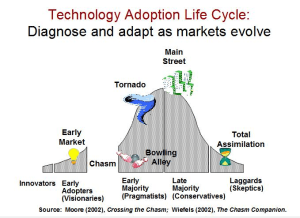
    • Find a larger audience (prospects, the early majority of Geoff Moore)
    • Discover that your causal mindset, thinking and product are not getting you across the Chasm from the early adopters to the early majority

The use of the traditional product development process creates the chasm that Geoff Moore describes. Since the entrepreneur is so focused on the product and not on understanding that the economic buying customer is the Early Majority, the first customers reinforce what the entrepreneur already knows. By not building the product for the early majority, the new venture collides into a wall of customer indifference. Most traditional ventures fail at this stage unless they have very understanding investors who can fund the rebuilding of the product to address Early Majority needs.

Figure 5 Geoffrey Moore’s Technology Adoption Life Cycle

David Robinson and I realized that the entrepreneur must stand the traditional product development process on its head and reverse the steps. In his book The Seer, David describes the progression through the Nine Recognitions to develop the Entrepreneur’s Mindset:

“The tasks (a study, an action, an exercise) will help you develop new patterns of thinking and seeing. To that end, you will also find within the narrative a few related practices. The practices are useful in preparing your mind for the flip to a new way of thinking. This process is like riding a bike: you can read about it and think that you know or you can get on, start pedaling and learn to ride. The practices and tasks will only help if you do them; they can’t help if you don’t engage with them. To reiterate: perspective shifts are not an intellectual exercise; they are dynamic processes. Shifts in perspective are intuitive, experiential engagements made conscious through action and reflection. Effectual entrepreneurs are like artists: engaged in dynamic, fluid creative practices. Get on the bike and ride. Challenge what you think you know. Open your eyes to possibilities. Allow yourself to make meaning of your experiences after you have them. It is, after all, how your brain works so you might as well begin by dropping the illusion that you know something before you encounter it – it’s an important skill for an entrepreneur.”

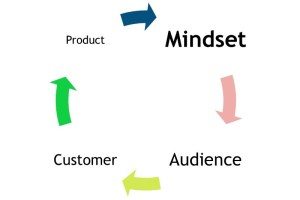
Reversing the steps – Mindset to Product

You need to reverse the traditional product development steps to:

    • Develop a questioning, observing and inquiring MINDSET (flip your thought process to effectual)
    • Find and create the AUDIENCE for your product or service
    • Identify which members of the audience will be your paying CUSTOMERS
    • Develop the PRODUCT

The next step in the entrepreneur’s flipped perspective is creating your audience.

An audience is the superset of the humans that might eventually become customers. I am part of a huge audience of fans who are excited about the 2014 Super Bowl winning Seattle Seahawks football team. I talk about them all the time with my family and friends. Yet, I am not a customer of the Seahawks – I don’t purchase tickets to their games nor do I purchase any of their jerseys or clothing. There are millions of us who are in the Seahawks audience and only 100,000 or so who are direct customers buying tickets for a game.

Linda Holliday, CEO of Citia, describes their challenges innovating in the traditional publishing industry by repurposing business books. They did some wonderful work with their reimagined books, but couldn’t find any customers.  And the publishers didn’t help them find customers because publishers have no idea who actually buys their books. They pivoted and realized they needed to find authors who already had a large audience. Their first foray with Snoop Dog led to a very successful relaunch of their technology. It was very easy for Citia and Snoop Dog to make Snoop Dog’s audience aware of the new interactive book.

Your first task as an entrepreneur is to discover or create your natural audience.

At a recent Meetup on Lean Content, Kelsye Nelson described her flipped perspective process of creating her company, Writer.ly. Kelsye and her co-founder met at the “Seattle Daylight Writer’s Group” Meetup that Kelsye had started to peer encourage other writers. The format of the Meetups is that the group would gather (20 to 100 writers) and write together silently for 45 minutes. At the end of the time, the writers could elect to share their work. Sometimes no one shared and at other times everyone wanted to share.

In the networking sessions that followed, the writers discovered that they had different strengths, weaknesses, likes and dislikes for different parts of the writing and self-publishing process. Pretty soon participants were discovering that somebody really liked to edit others work and another liked to do cover art. They realized that within the group were all of the skills and resources needed to create the online resource exchange for self-publishing authors.

The concept of Writer.ly was born. While they had a built in community to support them, Kelsye needed to build an audience with her limited resources before starting a company. Using her marketing expertise she started a social media Lean Content (content as a process) effort to build her audience. She started posting ten to twenty curated inspirational quotes a day about writing through Twitter and Facebook. About every ten posts she would send out a sign up for her writer.ly mailing list.

Within a few months she had 2000 active readers of her posts and she had her audience to pre-launch Writer.ly where authors can hire out the skills they don’t possess. Their product was a simple brokering of talent that required minimal development. As her customer base and revenue stream grew she was able to hire developers to build the real product.

What is important in your journey with your newborn venture is to regularly practice the first two flips:

Experience first. Make Meaning Second

Yours in entrepreneuring,

Skip Walter

Posted in Content with Context, Emails to a Young Entrepreneur, Entrepreneuring, Flipped Perspective, Learning | Leave a comment

Emails to a Young Entrepreneur: Conceiving – The Cosmos of a New Venture

Day 116 of Self Quarantine             Covid 19 Deaths in U.S.:  132,000

The Cosmos of the New Venture

One of the challenges of the entrepreneur is learning how to make progress even when feeling lost in the shifting from being in expert mode (causal thinking) and into an observing, discovering and exploring mode (effectual thinking). This “lost is the new normal” can feel like Orbiting the Giant Hairball:

Orbiting the Giant Hairball

I find when I am feeling lost that it is because I don’t see the bigger picture. J. G. Bennett in Enneagram Studies shares a powerful model of the “cosmos” to help us see the larger context that we are immersed in at any given moment.

“The enneagram is an instrument to help us to achieve triadic perception and mentation. Whereas our ordinary mental processes are linear and sequential, the world in which we live is threefold. According to Gurdjieff, three-foldness is one of the ‘fundamental sacred Cosmic Laws’ and must be studied by anyone who wishes to understand himself and the world in which he lives.

“We find it hard to look at the whole of what is happening in and around us because our thinking is linear, by which I mean thinking along one single line or by association. We miss significant episodes and cannot understand how it is that processes go the way they do. When things go wrong we seldom know where, nor how to put them right. This is not a serious handicap in thinking about processes that are themselves linear, such as most of those in the material world. However it breaks down when we try to think about man and his life, for these are not linear. Man is very complex and his life is always made up of different processes that cannot be separated without falsification. To think about man effectively we must get beyond linear thinking in order to see the inner cohesion. The spiritual world is totally non-linear and this is why we cannot ordinarily think about it at all. We must therefore find a new way of thinking. In order to change our way of thinking we have first of all to recognize that it is not only a matter of looking along several different lines at once but recognizing that there is structure in what we are looking at. The structure may be imperfect, but if it were not there at all, we could understand nothing.

“To illustrate this, let us take the example of a meal being cooked in our kitchen at Sherborne. The obvious thing is to look at the food and to say that the process of preparing a meal is a process of transforming food. This is quite true, but it is not the whole story for something is also happening in the kitchen itself. The kitchen has to be in a certain state of preparation and things in it are going to change. Its state has to be maintained. It is not enough to have cooks: some have to play the role of kitchen boys and cleaners, whose task it is to maintain the conditions that allow the meal to be cooked. Help is needed in preparing the vegetables or other raw foods. We usually take all this for granted and do not notice its importance because our thoughts are flowing in a single line. We notice only when things go wrong, and then the cook begins to concern himself with the function of the kitchen boy and the kitchen boy begins to concern himself with the cooking process.
“Linear thinking will assume that only the cooking process is important and disregard the need to maintain order in the kitchen, the cleanliness of the utensils and the provision of what is required. However the whole process of cooking a meal is not confined even to these quite distinct series of events; the one being the changes that are happening in the kitchen itself and the other the changes that are happening to the food. There is also something happening to the people and it is necessary that this too should be taken into account. When a meal is being cooked, especially when it is on a fairly large scale, which makes these distinctions significant, many people have to be taken into account: the people who are cooking, the kitchen boys, the people who are preparing the table and the entire community which is going to eat the meal. What is happening to them is also an essential part of the whole process; they have to be able to communicate with one another to understand one another’s needs and, if necessary, to change their roles. Those who cook will in turn become those who eat. Again, we can see that this is obviously necessary and we do not attach special importance to it all unless something goes wrong, at which point we may say that there is a “bad relationship” between the cooks and the kitchen boys and so everything is going to pieces, or perhaps people have not taken the trouble to find out what is going to happen with the meal, who can eat what, who will be there or will not be there, so that too much or too little is cooked. Something has gone wrong, but we do not associate this “something has gone wrong” with the cooking of the meal. Now if you look at the preparation of the meal for the house as one whole event, you can see that each of these three processes can be thought about linearly, yet each of them is quite distinct in nature from the others. They do not replace one another. Looking at it in this way, if you ask “Could you cook a meal without a kitchen, without utensils, without fire?” the answer is “No, cooking would cease to be there at all if there were not all these things in some form or other.” Even if you are camping in the open air you would still require certain conditions and implements with which to make it possible. It is obvious that you cannot cook without food, as you cannot or would not cook if there were no one to cook for. So food and guests are both independent of one another and also mutually necessary. There is no such event as cooking a meal unless the kitchen, food and guests are present. They are closely interdependent. How one goes will determine how the others go. But how they will affect one another is not at all obvious and in general it is by experience alone that little by little we learn what is required.

With experience, it is possible to see that there are different rhythms. The order of the kitchen and its utensils goes in a cycle which completes itself. When everything is properly organized, the kitchen starts clean with all the utensils clean and in their own places and when the meal is finished it is brought back again to its initial condition. It has completed a cycle. Something has happened in the kitchen, but the kitchen has returned to its prime state. With the food something different has happened for the food has changed its nature from being raw to being cooked. It has not returned to its primitive state but instead has been through a variety of irreversible processes.”

Bennett, John Godolphin (2012-04-02). Enneagram Studies (pp. 17-18). Bennett Books.

This first Email on Conceiving begins the first point on the core triangle of work for our Cosmos of the New Venture.

Figure 4 Cosmos of the New Venture Conceiving

Conceiving sits within the courage cycle described in the Entrepreneur’s Prayer of serenity, courage and wisdom. The navigation and interrelationships of the nine terms in the Cosmos of the New Venture meta-model aid the entrepreneur in discovering, developing and trusting your inner guidance system.

Conceiving is COMMITTING.

Posted in Content with Context, Emails to a Young Entrepreneur, Entrepreneuring, Flipped Perspective, Learning | Leave a comment

Emails to a Young Entrepreneur: Applying Conceiving

Day 115 of Self Quarantine                       Covid 19 Deaths in U.S.:  132,000

Applying Conceiving

Starting a new venture is an experiential process as Sarasvathy describes. The good news about the effectual process is that you start with the resources that you have available to you. The bad news is that you become so overwhelmed with the urgent you forget to take time for the important.

The most critical skill to develop as an effectual entrepreneur is to constantly observe the world around you and easily flip perspective. To survive as an adult, we develop habits that tacitly guide our actions. It is those tacit habits that blind us to what is happening in the world. The flipping perspective exercise for applying the concepts in the book is aimed at breaking our hidden patterns of behavior so that we can see the world we inhabit with new eyes. By seeing differently, we can think outside the box and see opportunities that others cannot.

The core process throughout the book is to commit to a daily flip of perspective.  The process has four components:

  1. Identify a pattern of behavior to break
  2. Break it by flipping your perspective
  3. Take a photo which represents some part of the flipped perspective
  4. Spend 7 to 10 minutes free writing about your flipped perspective

That is all there is to it.  Just a few minutes each day spent breaking your tacit patterns.

We’ll start with easy patterns to break and flip. With the “Applying” part of each Email, I suggest a theme for what kinds of perspectives to flip. These themes will echo the topic of the Email exchange with Mikhail.

This exercise is inspired by many years of mentoring entrepreneurs and working with graduate students at the intersection of design and business and with the core exercise in The Artist’s Way at Work. The Artist’s Way authors describe the importance of their core exercise of writing three morning pages:

“We all suffer ambivalence about our simultaneous desires to be a part of, and apart from, groups, and many of our new tools are designed to explore this ambivalence. We have found that morning pages show us both our connectedness and our individuality.

“As you will soon discover, the inner self has a variety of voices. In doing morning pages, you will experience some of them. You will also learn to discern which voices of this ‘self’ are best heeded and which best disputed. You will discover many positive forces that might have become silenced over the years, including one we call the Inner Mentor.

“This Inner Mentor, which some of us characterize as an older sage, is not unlike the eldest dragon of Chen Rong‘s painting or Star Wars’ Obi-Wan Kenobi in our popular mythology. Knowledge of this and similar voices will eventually evolve into a guidance system you can depend on. But first you will meet a host of other voices, the voices most of us think of as ‘myself.’

“Realize that in just thinking about doing morning pages, you have already heard one of your inner voices. If you listen carefully, below the resistance you will probably hear the whisper of ‘hope,’ barely audible above the din of your other ‘rational’ voices, that might say, ‘What if this works? Wouldn’t it be exciting?’

“Creativity expert Howard Gardner has noted three practices common to many ‘Big C’ creatives:

      • Some type of daily reflection
      • The ability to leverage their strengths
      • A way to reframe failures

“Morning pages and other techniques in this book help you do all of the above.”

Allen, Catherine; Bryan, Mark; Cameron, Julia (2012-12-01). Artists Way at Work: Riding the Dragon (Kindle Locations 381-384). William Morrow.

Start by making a short list of the patterns that you do on a daily basis that you don’t think about. Here are some questions to help you get started:

  • Do you drive the same way to work each day?
  • Do you eat the same foods for breakfast each day?
  • Do you do your emails first thing in the morning?
  • Are all your emails textual?
  • Do you eat lunch with the same people every day?
  • Do you read the same newspaper or news source each day?
  • Do you exercise the same way every day?
  • Who is a colleague or friend or family member you haven’t talked with in a long time?

You get the idea. What are your habits or patterns of behavior that you just do and don’t think about?

Start with one of the easiest patterns to break like the way you go to work each day. Take a different path to and from work today. Or take a different mode of transportation to work.  While you are breaking your pattern, take a photo or video of some aspect of the pattern that you are breaking. Notice what is different while you are breaking the pattern. Are you seeing, hearing or feeling objects or people from a new perspective?

When you get back home or to a quiet place after experiencing the breaking of your pattern, do a free writing exercise as part of making meaning from the pattern break. Free writing involves:

“… continuous writing, usually for a predetermined period of time (often five to fifteen minutes). The writer writes without regard to spelling, grammar, etc., and makes no corrections. If the writer reaches a point where they can’t think of anything to write, they write that they can’t think of anything, until they find another line of thought. The writer freely strays off topic, letting thoughts lead where they may. At times, a writer may also do a focused freewrite, letting a chosen topic structure their thoughts. Expanding from this topic, the thoughts may stray to make connections and create more abstract views on the topic. This technique helps a writer explore a particular subject before putting ideas into a more basic context.

“Freewriting is often done on a daily basis as a part of the writer’s daily routine.”

Using the picture or video that you took during your pattern break, start free writing about the experience.  Write for seven (minimum) to ten minutes (maximum). Look at the picture and your writing, and reflect for a moment on what the experience of breaking the pattern means.

I find mobile apps like Collect or Google Photos an easy way to capture your flipped perspectives (here is a month of flipped perspectives recorded in Collect):

A month of flipped perspectives

I keep a daily journal of my flips in perspective. Here are a couple of excerpts from my Flipping Perspective journal:

January 2, 2014

When I can, I like to walk a three-mile trail that is a loop from my house through a combination of roads and woods. I decided that for my flipped perspective today I would walk the route in reverse. I take this hike so for granted and have been doing it for so many years I rarely “see” what is in front of me. Just by reversing the path I see things that I haven’t noticed before. I can no longer walk on autopilot anymore as well. I have to pay attention to where I am stepping. And because I don’t know the path as well I have to look up and see what is around me. It is amazing what a tree that I pass from the other direction looks like from the reverse path. This tree is so gnarly and who knew it had so many trail markers on it. If I had just taken a picture a little differently, I would have seen two blue eyes instead of three.  This forest primeval (well not really as Bainbridge Island has been clear cut at least three times) is a brief respite from the houses that surround me on all sides. But for a few minutes I am alone in the Northwest woods in the rainy Puget Sound. Should I walk backwards when I am traversing the trail backwards as well? But then I would see what I see from the regular direction of the path. So maybe another flipped perspective is to walk the path forwards but walking backwards. Maybe in the summertime because the trail is so slippery right now and even walking forward it is difficult with all the tree roots covered up by the leaves of fall now all brown and slippery. I love the way so many of the fir trees in the forest have the dead limbs just sticking out like a witch with unruly hair. So many metaphors are conjured up as I walk this path in reverse. What if I could walk my life in reverse? Would I really be interested in doing that? There is so much that is fun right now as I am writing again and enjoying the two granddaughters that have blessed our life. How can we help them learn the joys of flipping their perspective? How do I pass down the art of seeing and the art of flipping perspective? How many other paths do I need to reverse every day? How many paths have become as ordinary and unconscious as my walking of my woods path? Doing this flipping has also made me realize that I need to expand my horizons and walk many more of the wonderful Parks and Recreation paths on Bainbridge Island. It is just so nice to walk out my front door and not have to get in the car and drive to one of the trailheads. Walking these paths is also difficult right now with the problems with my right knee. I’ve taken walking and even jogging for granted for so many years and now the thought of not being able to walk freely because of the pain in the knee makes me a bit fearful about the future.

January 5, 2014

Early morning ferry ride

I always sit at the aft of the Seattle-Bainbridge Island ferry.  This practice is about not wanting to be at the front of the boat with the Type A extroverts who want to rush to get off the boat. I enjoy sitting at the back reading my Kindle books on iPad and sipping my coffee from Commuter Comforts. Yet, the most spectacular view on the ferry is at the front. Clearly, I’ve gotten too much in the habit of commuting versus flipping my perspective to SEEING. So this morning on the 7:05 as I head to the airport for my trip to a seminar in San Diego I sit up front.  It is an interesting winter time of day as the sky is mostly dark black but you can start to see a faint streak of light on the horizon.  And today the sky is crystal clear (and a cold 28 degrees). I was treated to an immediate glorious sight as we turned south out of Eagle Harbor – Mt Rainier. I forget that sitting in the very front row, the window serves as a frame to see the world.  Here was Rainier framed so beautifully in the Window – a silhouette.  Then the ferry made the left hand turn to head to Seattle.  The skyline of Seattle is a faint Christmas tree kind of blinking small line on the horizon.  I look for a while and see the sky lightening and hoping that there would be a sunrise before I got to the Seattle side.  As I looked out my “window frame” I decided it was time to continue reading Rilke’s Letters to a Young Poet.  I pulled out my iPad and got immersed in Rilke.  After about five minutes, I folded the cover back and started chuckling. The whole point of the flipping perspective exercise was to get out of my habits. And here I was back in my habit of reading on the ferry boat, not noticing anything.  I put the iPad back in my backpack and enjoyed the sights of getting closer to Seattle and see the silhouettes turn into real buildings as the sun’s early morning light slowly emerged.  I took several photos a few minutes apart hoping that I would get the buildings to fill up the height of the frame. Then as I looked at the image that was showing up on my iPhone I saw that the internal lights on the ferry were creating a mirrored effect and I was doing a selfie. So I got two perspectives in one – you can look through the glass at Seattle or you can see the reflection of myself and others in the first couple rows at the front of the ferry. As the ferry turns to the dock, I see another view – the condensation from the window on the outside sloshing back and forth in a mercury silver trickle – back and forth as we turn.  Never seen that before.

I recommend doing the flipping perspective for your first week of daily habits that are not related to your new venture. For the first seven days, just do it.

As we progress through each future Email we will work on themes of different patterns to break.

Posted in Content with Context, Emails to a Young Entrepreneur, Entrepreneuring, Flipped Perspective, Learning | Leave a comment

Emails to a Young Entrepreneur: Conceiving

Day 114 of Self Quarantine                       Covid 19 Deaths in U.S.:  132,000

Six years ago, I wrote a draft of a book that was a takeoff on Rilke’s Letters to a Young Poet.  It was not well-received by my test audience.  The most common critique was TL;DR.  When I asked how to fix it, most test readers laughed and said “pay attention to your title.  Turn your book into a series of emails that we can read in small bites.”

As I write the components of Know Now, I wanted to start the book with an overview story.  Blackwell and Iny recommend that you give away a free eBook in order to attract people to high value online mastery courses.  I did not look forward to having to write two books.  I realized I already had a free book that provides a story and a context for Know Now.

Over the next couple of weeks, I will publish the free eBook as a series of blog posts.  Along the way I will provide in PDF format the accumulated chapters of the book.  After the last chapter I will provide in EPUB format the whole book.

My fondest hope is we can enter into a conversation about the topics in Emails to a Young Entrepreneur.  You can email me using skip.walter in the usual Google email place.

Preface

While mentoring, coaching and teaching thousands of entrepreneurs and aspiring entrepreneurs over the last fifteen years, one thing is clear: entrepreneurs don’t understand the game they are playing or the “game board” on which they are playing. I am not surprised. I took forty years to understand the entrepreneurial game.

New entrepreneurs are so focused on their product and working IN their business, they forget to work ON their business. As a founder your “product” is the business.

Emails to a Young Entrepreneur is a journey of discovery to understand the new venture game and to develop and trust your inner guidance system.

The Emails provide relevant topics for the entire life cycle of a new venture. Most of us take several years to go from an idea to an exit. I suggest that no matter what stage you are in or whether you’ve been part of a new venture, read through the entire book as quickly as you can. Then figure out which chapters apply to where you are in your current venture. Re-read that Email and start working through the relevant exercises.

You will notice that only two of Mikhail’s Emails are captured in the book. The absence of the other emails is intentional. At the start of each Email, I summarize in a couple of sentences what was in Mikhail’s Email. The intent is for you to provide your experiences with your own venture as the substance of what Mikhail is writing about. Imagine what your life is like at each of the stages Mikhail is asking questions about. What questions do you have that you would like to bring to your understanding of a particular Email?

Mikhail is a fictional entrepreneur. However, he is a synthesis of three entrepreneurs from the United States and Russia with whom I worked intensely for two years.

To get the most value out of the book read it with the intention of understanding the new venture game you are a participant in and of discovering, developing and trusting your internal guidance system.

Use the Emails and exercises to find your deeper purpose (Why) and discover, develop and trust your North Star.

While the exercises are aimed at developing your inner guidance system, the results of the exercises are valuable for sharing with your founding team, lead customer and investors. Most learning is social so encouraging your stakeholders to engage with you in the exercises and share your insights accelerates your startup and company culture.

I look forward to exchanging Emails (use skip.walter at the google place) with you as you pursue your new venture.

Skip Walter

Email from a Young Entrepreneur

From: Mikhail Rostov                                                                  Friday, June 14, 2013  12:54 PM

Professor Skip,

As I was sitting in front of my locker staring at the detritus of my three year combined MBA and Master of Design program at the Institute of Design, I was deep in thought when Patrick Whitney stopped and asked me “what’s next for you, Mikhail?”

How did Patrick know that is exactly what was on my mind? For three years, I’ve worked towards the goal of graduating. What’s next? I want to do a startup that builds on the multiple disciplines that I’ve learned – business and human centered design. I even have an idea that I’ve worked on during many of the class projects – a visual interface for organizing work on the new portable tablets that are coming to market.

But I don’t know how to get started.

“Thanks for asking, Patrick,” I shared. “This is the question that’s been plaguing me for months now. I want to do a startup. And I’m going back to Moscow where there isn’t much of an infrastructure or ecosystem for supporting high tech startups. Who can help me when I’m thousands of miles away from all the resources here in the United States?”

Patrick smiled his Cheshire Cat knowing smile and offered “you should contact one of our favorite serial entrepreneurs, Skip Walter. He taught here for ten years commuting from Seattle once a week. He calls himself a pracademic (practitioner academic) and enjoys ‘paying it forward’ with young entrepreneurs.”

Patrick was kind enough to give me your contact information. Skip, I’ve got this great idea for a new productivity tool to help knowledge workers visualize the project workspaces they are collaborating on.

I’ve just finished the three-year combined MBA and MDES program and I am ready to start my own business.  Patrick wanted to make sure that I let you know that I am Russian and am headed back to Moscow. He thought maybe this would be something that would catch your interest. He also thought that you would be intrigued by the challenge of working with me remotely. I would be delighted to help you learn about the Russian entrepreneur ecosystem.

Attached to this email are some of the key artifacts from my final project. These artifacts include the design of the tool and a business plan to start the company. I would really appreciate your taking a look at these documents and offering your thoughts and comments on whether there is a viable product here.

Unfortunately, I am leaving for Moscow tonight, so I won’t be able to come to Seattle and meet you in person.

Let me know what you think of my ideas and prototypes and whether you would be interested in helping me bring this prototype to market.

Yours sincerely,

Mikhail Genrich Rostov
Chicago, IL
June 14, 2013

Conceiving

Flip Comic created by David Robinson

“You are looking outwards, and of all things that is what you must now not do. Nobody can advise and help you, nobody. There is only one single means. Go inside yourself. Discover the motive that bids you write; examine whether it sends its roots down to the deepest places of your heart, confess to yourself whether you would have to die if writing were denied you. This before all: ask yourself in the quietest hour of your night: must I write? Dig down into yourself for a deep answer. And if this should be in the affirmative, if you may meet this solemn question with a strong and simple ‘I must’, then build your life according to this necessity; your life must, right to its most unimportant and insignificant hour, become a token and a witness of this impulse.”

Rilke, Rainer Maria. Letters to a Young Poet (Kindle Locations 167-172). Start Publishing LLC.

Seattle, WA USA, June 20, 2013

Mikhail,

Thank you for your kind Email seeking my thoughts on the quality of your ideas. With great fondness, I remember the joy of immersing myself in the Institute of Design and the wonders of late-night conversations with Patrick about the history and evolution of human centered design. Patrick is the pied piper of the design world wandering through Global 1000 corporations sharing his message of the power of design to make a real difference in the business world.

Before I share my entrepreneurial experiences, a reflection is appropriate. I’ve found the regular reading of the entrepreneur’s serenity prayer to be a good practice (the use of God, Lord and other spiritual terms in these emails are in the sense of the Alcoholics Anonymous higher power or power greater than ourselves):

God grant me the serenity to accept my team, my customers, my investors and my suppliers as bringers of opportunity;

The courage to change my understanding of what the customer truly needs; and

The wisdom to know the difference between what is right and what the investors, the board and the bankers want.

I am not sure I have anything of specific value to you in your journey. Most entrepreneurs ask me very detailed questions like you did in your letter. On my good days, I make sure not to answer those questions. Each startup is its own journey. What I’ve done or observed in the past may or may not have anything to do with the journey that you are on. Mikhail, only you can know what is right for your new venture.

After forty years of entrepreneuring and intrapreneuring, I realize that for most of my professional life I did not understand the game of business I was playing. I had the core processes backward. I learned that I needed to flip my perspective.

Shortly after we sold Attenex to FTI Consulting two concept shattering events occurred. The first event was sponsored by the Northwest Angel Capital Association and featured Basil Peters sharing his process for Early Exits. As he described all the best practices that you should do as part of planning the venture exit process (getting acquired), I put my head down on the table and damn near cried.

Where was Basil’s book, counsel and valuable resources when we were exiting? I quickly understood that Attenex was the poster child of what NOT to do when being acquired. His best practices illustrated why we lost $35M in value from the initial FTI Consulting offer to our closing valuation six months later.

The second event was a surprise announcement from FTI Consulting, that based on the $91M acquisition of Attenex, they were launching an IPO of the division that acquired us to raise >$1B by selling 40% of the division. The FTI founders designed a way to turn a $91M acquisition expense into raising $1B of new capital. I was stunned at the innovative creativeness. We did not see it coming. Yet, upon reflection, if I had truly understood my Valuation Capture framework (described in the Exiting Email), the prediction of such a strategic move was embedded in the framework.

I am getting ahead of myself. I wanted to share with you that becoming an entrepreneur is a lifelong learning process.  It never stops.  The world of commerce is constantly changing. As a young entrepreneur, you need to learn just as fast. What worked yesterday has no guarantee of working tomorrow.

The above is a way of saying I am not qualified to pass judgment on your ideas or business plan or prototypes. Only you can do that. It is your idea and hopefully your passion.

A year ago, my daughter and her husband conceived their first child whom we know as Alice. The biological process of conception, birth, infancy, and parenting is close to this conceiving of an idea for a startup and bringing it into existence. Either by intention or serendipity you conceive of the idea for your new venture. As the idea matures in the womb of your mind, your life changes day by day. Your energies are focused on that idea and you start nurturing it and protecting it. And just as a mother’s pregnancy process becomes visible to everyone she encounters, your enthusiasm for your idea will be increasingly visible to those you encounter through your excitement and passionate energy.

In the ideal state, you have a life partner (co-founder) to join you in the nurturing of your idea. With design or luck, you’ve gotten to know your co-conceiver through your working relationships. Now you prepare for the birthing of your idea. Many budding entrepreneurs take birthing classes (like Steve Blank’s Launchpad classes) or find a wise mid-wife for a mentor. This pregnancy time is one of finding the professionals that can help you with the birthing of your conception. You need to find your lawyer, banker, and accountant who will take care of the administrative parts of the birth process.

You start seeking out other entrepreneurs either through your classes or Meetups. Peer learning is so valuable at this point with entrepreneurs who are in the same trimesters of pre-birthing.

The birthing day arrives on its own schedule. This day you formally start your new venture life. And like human births, where because of the size of the head, a baby is born about three months before it is really ready, you will quickly realize that you have jumped into something you weren’t prepared for.  That’s OK. We all have to start somewhere.

Many first time parents ride an emotional roller coaster in those early months caring for their infant. Their lament is “nobody gave me a manual for what a parent is supposed to do!” Where is the manual for a startup mother? While there are thousands of books and an unlimited amount of expert advice, prior to your baby venture arriving in the world you can’t understand a word of it. Now the reality is right in front of you crying constantly – for food, for poopy diapers, for discomfort, for who knows why.

For the terminal analytics among us, the second lament is “this is not going according to my plan.” During the idea pregnancy, you made lots of plans. New venture babies are not like established companies. They require a different way of thinking.

Saras Sarasvathy calls this type of thinking effectual:

“The word ‘effectual’ is the inverse of ‘causal’. In general, in MBA programs across the world, students are taught causal or predictive reasoning – in every functional area of business. Causal rationality begins with a pre-determined goal and a given set of means, and seeks to identify the optimal – fastest, cheapest, most efficient, etc. – alternative to achieve the given goal. The make-vs.-buy decision in production, or choosing the target market with the highest potential return in marketing, or picking a portfolio with the lowest risk in finance, or even hiring the best person for the job in human resources management, are all examples of problems of causal reasoning. A more interesting variation of causal reasoning involves the creation of additional alternatives to achieve the given goal. This form of creative causal reasoning is often used in strategic thinking.

“Effectual reasoning, however, does not begin with a specific goal. Instead, it begins with a given set of means and allows goals to emerge contingently over time from the varied imagination and diverse aspirations of the founders and the people they interact with. While causal thinkers are like great generals seeking to conquer fertile lands (Genghis Khan conquering two thirds of the known world), effectual thinkers are like explorers setting out on voyages into uncharted waters (Columbus discovering the new world). It is important to point out though that the same person can use both causal and effectual reasoning at different times depending on what the circumstances call for. In fact, the best entrepreneurs are capable of both and do use both modes well. But they prefer effectual reasoning over causal reasoning in the early stages of a new venture, and arguably, most entrepreneurs do not transition well into latter stages requiring more causal reasoning. Figure 1 graphically depicts the different forms of reasoning discussed above.”

Figure 1 Difference between Causal and Effectual Thinking

From “What Makes Entrepreneurs Entrepreneurial?” by Saras Sarasvathy of the Darden Graduate School of Business Administration, University of Virginia.

For many entrepreneurs, the strange word “effectual” is a road block to understanding. David Robinson in his “artist way” translated this for himself:

    • Causal thinking – Ready. Aim. Fire.
    • Effectual thinking – Fire. Aim. Ready.

Over the years I’ve found that managers in large corporations and academics do not see the distinction between causal and effectual thinking. They see both as being goal directed and miss the fundamental process of the entrepreneur. Another way to see how an entrepreneur thinks is in Figure 2. Through observations in the world or the emergence of an idea for a product and company, the entrepreneur has their great idea. They start looking at the world as a range of Spaces of Possibility. As they identify potential customers in these spaces of possibility, they look around for what resources they have in their own skills and in their network of relationships. Through several iterations of convergence and divergence, the entrepreneur begins to focus on how their idea can come into being for their discovered target customers. There is no goal for the entrepreneur at the beginning. Rather there is this to and fro between possibilities and resources.

Figure 2 An Entrepreneur’s View of the World

Just as one’s predisposed plans for what being a mother with a new infant will be like are thrown out the window at the first bout of unstoppable crying, any plan for a new venture rarely survives the first contact with a prospective customer or investor.

You are still at the beginning of your journey. Now is a good time to step back for reflection and revisit your intentions. I recommend starting by watching the TED Video “How Great Leaders Inspire Action” from Simon Sinek:

Simon Sinek’s Why What How

Sinek points out that great leaders start with their personal “why” and their company’s “why.” Sinek flips the perspective of most executives and marketing professionals who proclaim the “how” and “what” of their products. He concludes his video by pointing out that Martin Luther King’s most famous speech didn’t start with “I have a plan,” rather it started with “I have a dream!” Sinek writes:

“There are leaders and there are those who lead. With only 6 percent market share in the United States and about 3 percent worldwide, Apple is not a leading manufacturer of home computers. Yet the company leads the computer industry and is now a leader in other industries as well. Martin Luther King’s experiences were not unique, yet he inspired a nation to change. The Wright brothers were not the strongest contenders in the race to take the first manned, powered flight, but they led us into a new era of aviation and, in doing so, completely changed the world we live in.

“Their goals were not different than anyone else’s, and their systems and processes were easily replicated. Yet the Wright brothers, Apple and Martin Luther King stand out among their peers. They stand apart from the norm and their impact is not easily copied. They are members of a very select group of leaders who do something very, very special. They inspire us.

“Just about every person or organization needs to motivate others to act for some reason or another. Some want to motivate a purchase decision. Others are looking for support or a vote. Still others are keen to motivate the people around them to work harder or smarter or just follow the rules. The ability to motivate people is not, in itself, difficult. It is usually tied to some external factor. Tempting incentives or the threat of punishment will often elicit the behavior we desire. General Motors, for example, so successfully motivated people to buy their products that they sold more cars than any other automaker in the world for over seventy-seven years. Though they were leaders in their industry, they did not lead.

“Great leaders, in contrast, are able to inspire people to act. Those who are able to inspire give people a sense of purpose or belonging that has little to do with any external incentive or benefit to be gained. Those who truly lead are able to create a following of people who act not because they were swayed, but because they were inspired. For those who are inspired, the motivation to act is deeply personal. They are less likely to be swayed by incentives. Those who are inspired are willing to pay a premium or endure inconvenience, even personal suffering. Those who are able to inspire will create a following of people— supporters, voters, customers, workers— who act for the good of the whole not because they have to, but because they want to…

“What if we could all learn to think, act and communicate like those who inspire? I imagine a world in which the ability to inspire is practiced not just by a chosen few, but by the majority. Studies show that over 80 percent of Americans do not have their dream job. If more knew how to build organizations that inspire, we could live in a world in which that statistic was the reverse— a world in which over 80 percent of people loved their jobs. People who love going to work are more productive and more creative. They go home happier and have happier families. They treat their colleagues and clients and customers better. Inspired employees make for stronger companies and stronger economies. That is why I wrote this book. I hope to inspire others to do the things that inspire them so that together we may build the companies, the economy and a world in which trust and loyalty are the norm and not the exception.”

Sinek, Simon (2009-09-23). Start with Why: How Great Leaders Inspire Everyone to Take Action (Kindle Locations 177-183). Penguin Group US. Kindle Edition.

Get in touch with your essential why and your dream. And in true effectual fashion, the essential why is likely to evolve as you proceed along your effectual learning path. Put on your calendar to revisit your why and your dream at least once a month during the infancy of your conception.

A key part of your intention is making explicit the values that are important to you and your fledgling venture. As individuals we want to stand for something. This exercise is to clarify what are the most important values for you and your new venture’s success. The exercise is taken from Managing by Values by Ken Blanchard and Michael O’Connor.

The most important thing in life is to decide what is most important.

“What should I stand for?  What should be the values by which I operate?  Look over the list of values below.  Circle any values that ‘jump out’ because of their importance to you.  Then write your top three values, in order of importance, below the list.  Feel free to add values if needed.”

Truth Persistence Resources
Efficiency Sincerity Dependability
Initiative Fun Trust
Environmentalism Relationships Excellence
Power Wisdom Teamwork
Control Flexibility Service
Courage Perspective Profitability
Competition Commitment Freedom
Excitement Recognition Friendship
Creativity Learning Influence
Happiness Honesty Justice
Honor Originality Quality
Innovation Candor Hard work
Obedience Prosperity Responsiveness
Financial growth Respect Fulfillment
Community support Fairness Purposefulness
Integrity Order Strength
Peace Spirituality Self-control
Loyalty Adventure Cleverness
Clarity Cooperation Success
Security Humor Stewardship
Love Collaboration Support


  1. ___________________
  2. ___________________
  3. ___________________

After selecting the three top values to focus on, we need to bring the values into daily life.  Brainstorm ways in which you already bring these values into action or ways in which you would desire to bring these values into action.  Sketch an image for each of your selected three values as well as an integrated image that illustrates how you would bring the values into action.

One of the most elegant statements for a partial answer to an essential why and values is taken from DuPont’s published corporate vision:

“Our principles are sacred.  We will respect nature and living things, work safely, be gracious to one another and our partners, and each day we will leave for home with consciences clear and spirits soaring.”

Just as conceiving a child and going through the journey to birthing and parenting is sacred and a soaring experience beyond all others, conceiving a new company is a sacred responsibility. As you invite others to share in your journey and bring your opportunity to customers and investors, they are expecting you to honor your commitments. As Simon Sinek further elaborates in “Leadership is not a rank, it’s a decision,” the role of the parent and leader is to create a safe environment for the “baby” to grow and develop in order that she may soar on her own.

Michael Gerber observes many myths surrounding entrepreneurs and the conceiving of their new ventures:

“There is a myth in this country—I call it the E-Myth—which says that small businesses are started by entrepreneurs risking capital to make a profit. This is simply not so. The real reasons people start businesses have little to do with entrepreneurship. In fact, this belief in the Entrepreneurial Myth is the most important factor in the devastating rate of small business failure today. Understanding the E-Myth, and applying that understanding to the creation and development of a small business, can be the secret to any business’s success…

“Then, one day, for no apparent reason, something happened. It might have been the weather, a birthday, or your child’s graduation from high school. It might have been the paycheck you received on a Friday afternoon, or a sideways glance from the boss that just didn’t sit right. It might have been a feeling that your boss didn’t really appreciate your contribution to the success of his business. It could have been anything; it doesn’t matter what. But one day, for apparently no reason, you were suddenly stricken with an Entrepreneurial Seizure. And from that day on your life was never to be the same.”

Gerber, Michael E. (2009-03-17). The E-Myth Revisited (pp. 11-12). Harper Collins, Inc.. Kindle Edition.

The way to raise the success of a new venture in Gerber’s experience is for the entrepreneur to spend as much or more time working ON the business versus working IN the business on the product. The conceiving of the new venture is more than just the product or service the entrepreneur creates. Conceiving is a commitment. The commitment is to yourself, to investors, to customers, and to the talent you recruit. As the urgent overwhelms the entrepreneur, it is critical to focus on the commitment to bringing a successful business into the world.

Scott Peck in A Different Drum relates a story he calls “The Rabbi’s Gift” that gets at the heart of the extraordinary respect that must be a part of all of our sacred commitments and valued relationships, including our relationship with self.

“There is a story, perhaps a myth.  Typical of mythic stories, it has many versions.  Also typical, the source of the version I am about to tell is obscure.  I cannot remember whether I heard or read it, or where or when.  Furthermore, I do not even know the distortions I myself have made in it.  All I know for certain is that this version came to me with a title.  It is called ‘The Rabbi’s Gift.’

“The story concerns a monastery that had fallen upon hard times.  Once a great order, as a result of waves of anti-monastic persecution in the seventeenth and eighteenth centuries and the rise of secularism in the nineteenth, all its branch houses were lost and it had become decimated to the extent that there were only five monks left in the decaying mother house:  the abbot and four others, all over seventy in age.  Clearly it was a dying order.

“In the deep woods surrounding the monastery there was a little hut that a rabbi from a nearby town occasionally used for a hermitage.  Through their many years of prayer and contemplation the old monks had become a bit psychic, so they could always sense when the rabbi was in his hermitage.  “The rabbi is in the woods, the rabbi is in the woods again,” they would whisper to each other.  As he agonized over the imminent death of his order, it occurred to the abbot at one such time to visit the hermitage and ask the rabbi if by some possible chance he could offer any advice that might save the monastery.

“The rabbi welcomed the abbot at his hut.  But when the abbot explained the purpose of his visit, the rabbi could only commiserate with him.  “I know how it is,” he exclaimed.  “The spirit has gone out of the people.  It is the same in my town.  Almost no one comes to the synagogue anymore.”  So the old abbot and the old rabbi wept together.  Then they read parts of the Torah and quietly spoke of deep things.  The time came when the abbot had to leave.  They embraced each other.  “It has been a wonderful thing that we should meet after all these years,” the abbot said, “but I have still failed in my purpose for coming here.  Is there nothing you can tell me, no piece of advice you can give me that would help me save my dying order?”

“No, I am sorry,” the rabbi responded.  “I have no advice to give.  The only thing I can tell you is that the Messiah is one of you.”

“When the abbot returned to the monastery his fellow monks gathered around him to ask, “Well, what did the rabbi say?”

“He couldn’t help,” the abbot answered.  “We just wept and read the Torah together.  The only thing he did say, just as I was leaving — it was something cryptic — was that the Messiah is one of us.  I don’t know what he meant.”

“In the days and weeks and months that followed, the old monks pondered this and wondered whether there was any possible significance to the rabbi’s words.  The Messiah is one of us?  Could he possibly have meant one of us monks here at the monastery?  If that’s the case, which one?  Do you suppose he meant the abbot?  Yes, if he meant anyone he probably meant Father Abbot.  He has been our leader for more than a generation.  On the other hand, he might have meant Brother Thomas.  Certainly Brother Thomas is a holy man.  Everyone knows that Thomas is a man of light.  Certainly he could not have meant Brother Elred!  Elred gets crotchety at times.  But come to think of it, even though he is a thorn in people’s sides, when you look back on it, Elred is virtually always right.  Often very right.  Maybe the rabbi did mean Brother Elred.  But surely not Brother Phillip.  Phillip is so passive, a real nobody.  But then, almost mysteriously, he has a gift for somehow always being there when you need him.  He just magically appears by your side.  Maybe Phillip is the Messiah.  Of course the rabbi didn’t mean me.  He couldn’t possibly have meant me.  I’m just an ordinary person.  Yet supposing he did?  Suppose I am the Messiah?  O God, not me.  I couldn’t be that much for You, could I?

“As they contemplated in this manner, the old monks began to treat each other with extraordinary respect on the off chance that one among them might be the Messiah.  And on the off, off chance that each monk himself might be the Messiah, they began to treat themselves with extraordinary respect.

“Because the forest in which it was situated was beautiful, it so happened that people still occasionally came to visit the monastery to picnic on its tiny lawn, to wander along some of its paths, even now and then to go into the dilapidated chapel to meditate.  As they did so, without even being conscious of it, they sensed this aura of extraordinary respect that now began to surround the five old monks and seemed to radiate out from them and permeate the atmosphere of the place.  There was something strangely attractive, even compelling, about it.  Hardly knowing why, they began to come back to the monastery more frequently to picnic, to play, to pray.  They began to bring their friends to show them this special place.  And their friends brought their friends.

“Then it happened that some of the younger men who came to visit the monastery started to talk more and more with the old monks.  After a while one asked if he could join them.  Then another.  And another.  So within a few years the monastery had once again become a thriving order and, thanks to the rabbi’s gift, a vibrant center of light and spirituality in the realm.”

I unconditionally accept where you are, but respect you enough to help you strive for your ideal.

Mikhail, I started this Email about “Conceiving” with a quote from Rainer Maria Rilke to a young poet about deciding whether he must write. To paraphrase Rilke:

“This before all: ask yourself in the quietest hour of your night: must I start a company? Dig down into yourself for a deep answer. And if this should be in the affirmative, if you may meet this solemn question with a strong and simple ‘I must’, then build your life according to this necessity…”

Mikhail, thank you again for reaching out to me and trusting me with your sacred commitment of conceiving your new venture. Asking for help is an ongoing commitment to your growth and development. Receiving, synthesizing and integrating received wisdom is core to discovering, developing and trusting your guiding North Star.

Yours in entrepreneuring,

Skip Walter

Posted in Content with Context, Emails to a Young Entrepreneur, Entrepreneuring, Flipped Perspective, Learning | Leave a comment

What is a book? Part 4: Monetizing

Day 112 of Self Quarantine                       Covid 19 Deaths in U.S.:  131,000

“The best way to become acquainted with a subject is to write a book about it.”Benjamin Disraeli

“Self-publishing is akin to launching a startup.  Entrepreneurs must create a product, test it, raise money, recruit talent, and find customers at the same time.” – Guy Kawasaki, APE: Author, Publisher, Entrepreneur – How to Publish a Book

I started writing Know Now two months ago.  I tentatively titled the book Minimum Viable Business.

I wasn’t making much progress.  I constantly tweaked my outline.  I wandered in circles trying to identify my target audience.

Randomly, an email appeared suggesting that writing a non-fiction book is like doing a startup.  My hand moved rapidly to slap my forehead.

I remembered Guy Kawasaki’s book APE.

I realized the first thing I needed to do was a draft Lean Canvas.

Draft Know Now Lean Canvas

My original thought was to write something for product managers.  A quick Google search estimates that there are between 100,000 and 200,000 product managers in the United States. I like to do quick back of the envelope revenue projections to see if there is enough potential revenue to support writing a book with a startup mindset.

Revenue Streams

      • $100,000 Digital books (10,000 x $10)
      • $100,000 Online Courses (1000 x $100)
      • $100,000 Personalized Zoom Consulting (100 x $1000 per hour)
      • $5,000 Medium Blog Posts royalties ($5,000)
      • $0 Stock option value realization ($500,000 in Year 4)
      • $50,000 POP Your Value Solution kits – package of Zoom, Otter, Attenuated … (5% of revenue from partners for $3000 per year per product manager – 1000 kits)

I check to see how many entrepreneurs there are – 27 million.  How many of those are in high tech? >150,000   I like these numbers a lot better.

Now it is time to do some user research.

I reach out to several product managers (early stage startups, Nuix, Microsoft, Facebook and Google) to do a 30 minute interview with these questions:

    • Why did you become a product manager? What attracted you to this career?
    • What were the most important topics or concepts that you had to learn at the start of your product management career?
    • What do you know now that you had wished you had known when you started as a product manager?
    • What would you like to learn more about?

I wanted to understand what were the important things to learn and whether product management was different in a startup versus a big company.  My favorite quote came from a product manager who has worked in both a startup and a large tech company:

“In a startup you spend 80% of your time doing product management work and 20% of your time persuading others to do the right thing.  In a large company you spend 20% of your time doing product management work and 80% of your time persuading others to do the right thing.”

In parallel with this research effort, I started mentoring five startup CEOs in digital marketing, Jupyter like notebooks extensions, biotech, and legal AI.  I quickly realized this work was action oriented user research.

In the middle of this research, Professor David Socha, asked if I would do a guest lecture for his University of Washington at Bothell Computing & Software Systems Evidence-Based Design course.

CSS 572: Evidence-Based Design
Provides a foundation in evidence-based user-centered design theory, methods, and practices for creating innovative software-enabled products.

We decided that the topic would be about the importance of Outcomes thinking for human centered design rather than features based design prevalent in the high tech industry.  As part of the preparation for the lecture, David required his students to submit five questions they would like to ask of me about outcomes – before the lecture.  What a precious gift this was.

I used the presentation to synthesize what I was finding from my experience and user research.  I compared my synthesis to the questions that the Masters degree students generated from their reading about Outcomes.  I also provided written answers to each of the 50 questions that were submitted.

In my view, the presentation “failed.”  My synthesis, while helpful for me, was too abstract for students in just learning about human centered design.  However, the presentation succeeded as I realized I needed to be specific as well as providing thinking frameworks.

I reinforced through the action oriented research that I am most interested in working with early stage startups where the product and company are one and the same.  Intrapreneurs have the same characteristics in a large company – their product idea and the business case are one and the same.

Passion and Purpose

I want to write about and share the benefits of human centered design, outcomes orientation, and value (monetary value, supporting human values, and valuation capture strategies).

As my wife and I have self-published a couple of books and there are lots of resources for how to publish and the business model for self-publishing, here are introductory resources:

For me, the more interesting option is combining the book with online learning.  I attended several boot camp free online teaser courses from Jeanine Blackwell and Danny Iny.  Both offer “master classes” for $2,000 to $6,000 to help you put your course together.  Jeanine was immediately credible as I had purchased courses on painting fundamentals from two of her students.

While I was interested in the “how” for creating a course, I was mostly interested in the business models and the how to market your courses.  I was surprised when both experts recommended writing and distributing a free book in order to promote your course.  Blackwell even has a course on how to write your promotional ebook in a day.

The potential of the combination of the eBook and a “master class” caught my attention during the free bootcamp from Danny Iny and Abe Crystal (Ruzuku) that answered the question “can you just build the whole course for me?”

Creating an online course system

Iny was adamant in his three day free bootcamp for his master class that only the student can create the course that is related to their core transformation.  However, he realized that building an online teaching business requires having lots of content.  He reached out to Abe Crystal to co-develop a collection of almost ready to go courses that a core course creator could surround their product.  The idea is that Ruzuku would host courses that were almost ready to go.  All the student had to do was record in their voice or in video the transcripts of the content that was already created in the Ruzuku system.  The student experts could then use these courses as teaser material or sell them for a nominal amount.  Each of these additional courses would always point back to the core course of the creator.

Pre-created Course Topics

Iny and Crystal shared that it would take $100,000 and three months to create 20 instant courses to augment the student’s core transformation course.

Instant Course Offer and Promise

The instant course idea was great and the methodology to self fund the course development was great.  Out of the 500 students who attended the free two hour bootcamp, Iny and Crystal only needed 30 to sign up to pay the costs of their projected course development.  I am guessing that at least 100 students signed up.  The benefits were pretty clear:

Instant Course Benefits

I did not sign up.  I just couldn’t figure out how Iny could get 20 quality courses created in just three months for only $100,000.  Then it hit me.  Iny already has moved >1,000 students through his master class on creating core transformation courses.  He has the content developed from his previous students.  All he had to do was select the best courses and switch out the “expert” who developed each of the 20 courses for a script that the instant course purchaser could replicate in their own voice.

Brilliant.

Like that, a new multi-million dollar revenue stream for Iny’s online course business is created and Crystal now has another 1000+ lifetime customers for his online course platform.  Neither Iny or Crystal needed any additional investment. Further, Iny has spawned many hundreds of expert core transformation entrepreneurs.  These entrepreneurs can then be added to his network of expert coaches for his master class students as well as adding to his instant course library.

My initial estimate for where the revenue is with my book is too low.  I can envision $ 1 million per year in this online learning category alone.

With a book and the online courses, the path to monetizing professional expertise is clear.  By doing both the book and the course, they provide leads for private coaching, consulting engagements and for paid speaking opportunities.  The courses and the consulting provide opportunities to recruit other professionals to be able to teach my core transformation material – for a royalty fee.

Strategies for Course Creation

The path to monetizing my content is clear:

    • Write an eBook in a day
    • Create a core transformation course in a day with Ruzuku
    • Surround my Know Now “book” with instant courses

In a week, I will be on my way to $1 million a year by creating the above content and enrolling in Ash Maurya’s Leanstack Academy:

Lean Canvas Framework

While the promises are over blown, the path forward is clear.

I just have to keep my “butt in my chair.”

The “What is a book?” series of posts:

Posted in Content with Context, Curation, Entrepreneuring, Innovation, Learning, Product, Value Capture | Leave a comment

What is a book? Part 3: The Content

Day 111 of Self Quarantine                       Covid 19 Deaths in U.S.:  130,000

In 1986 I experienced a management development course through Outward Bound (OB)  from the Hurricane Island, ME branch.  One of the participants was Jack, a former English professor, who was in training to become an OB instructor.  He was a classic reserved New Englander and hard to engage in conversation.

When I found out Jack taught writing, I peppered Jack with questions throughout the three days on the Amberjackwockamus River.  I asked many different ways “what is the secret to becoming a good writer?”

Jack answered succinctly:

    1. Read a lot
    2. Keep a journal
    3. Have an architecture, an outline, for what you are getting ready to write
    4. Keep your butt in your chair

It took me several years to realize that #4 was the hardest.  Over time I’ve gotten better at keeping my butt in my chair.  I read a lot.  I keep a journal.  I used to be able to organize and outline any topic very quickly.

As the 7th decade of my life starts, I realize that I have a harder time organizing the terabytes of information I want to bring to bear on a subject.  The ability to focus on a specific audience with a specific goal for my content gets harder.  The media for expression get more varied and complex.

I get frustrated when I realize that no matter how well I write, I can’t actually transfer knowledge to someone else.  My writing generates information, but the reader has to transform that information to knowledge.   Elizabeth Orna in Making Knowledge Visible: Communicating Knowledge Through Information Products diagrams this never ending cycle of the transformation process.

Transforming information to knowledge

Orna shares:

Knowledge and Information

“Knowledge is the organized results of experience, which we use to guide our actions and our interactions with the outside world.  We all store our knowledge in our minds in highly structured form, which is directly accessible only to us.  When we want to communicate what we know to others who need to use it for their own purposes, we have to transform it and make it visible or audible to the outside world.

“The result of the transformation is information: knowledge which has been put into the outside world and made visible and accessible through a series of transformations.

“From the point of view of the user, information is what we seek and pay attention to in the outside world when we need to add to or enrich our knowledge in order to act upon it.  One of the commonest ways of getting information is by using information products – which are so named because they contain information and have been produced as a result of decisions by human beings, for specific users and use.  (We also get information by knowledgeable observation – a geologist looking at landscape, a doctor examining a patient, a skilled technician observing processes – which leads to applications of existing knowledge, either without the use of information products or supported by them, as in looking up relevant research literature.)

“So we can usefully think of information as the food of knowledge because we need information and communication to nourish and maintain our knowledge and keep it in good shape for what we have to do in the world.  Without the food of information, knowledge becomes enfeebled and unfit for action.

“Knowledge and information are, therefore, distinct, but interdependent, and they are the subject of transformations by human minds.”

Transformation

“Information products are the end result of the series of transformations of knowledge into information; they also become the starting point of transformation in the other direction on the part of their users, who seek to transform what they require of the information contained in the product into knowledge, and to integrate it into their existing knowledge structure so as to make it fitter for whatever they need to do.

“These transformation, of information into knowledge and knowledge into information, form the basis for all human learning and communication; they allow ideas to spread across space and time, and link past and present in a network that embraces generations and cultures over millennia.  By virtue of those qualities, they are also fundamental to the working of organizations of all kinds.”

Orna, Making Knowledge Visible, p. 11 -12

Lakoff and Johnson (Philosophy in the Flesh: The Embodied Mind and its Challenge to Western Thought) assert that knowledge lies only in the embodied mind.  It is the combination of mind and body that must be present for knowledge to exist.  From a review of the book:

“The opening paragraph clarifies what is being attempted:

      1. The mind is inherently embodied.
      2. Thought is mostly unconscious.
      3. Abstract concepts are largely metaphorical.

“The first is widely assumed in everyday discourse today.  The second is gradually sinking into public consciousness. The third point is trickier; Lakoff and Johnson had already spent a book (Metaphors we live by, 1980) trying to establish it, and most of part 3 of this text is also devoted to this cause.

“The import of these three points are revealed over the rest of the first chapter, but here’s a pithy summary (from an interview by Lakoff):

When taken together and considered in detail, these three findings from the science of the mind are inconsistent with central parts of Western philosophy, and require a thorough rethinking of the most popular current approaches, namely, Anglo-American analytic philosophy and postmodernist philosophy.”

“But more particularly, the book highlights how refuting these assumptions invalidates the framework for Transformation grammar (Chomskyan linguistics).”

The content I generate has to provide information as well as exercises or experiments or practices for the reader to make it their own knowledge.

Over the years, I developed my own process for preparing to research and develop content:

    • Through experience or reading or conversations with colleagues, I become aware of concepts and practices I want to learn
    • I wait for at least three pointers to a concept before I dive deeply into learning more
    • I test the concepts against my years of experience to see if it reinforces what I think I know or refutes what I think I know
    • I try to apply the concept in an area of my work or coaching or mentoring
      • If I can apply it, I add it to my personal knowledge base
      • If I can’t apply it, I recycle to do more research
    • As time passes, I look for patterns of connections to the new concept
    • Once I see a larger pattern, I engage colleagues to experiment with teaching the material.
      • If I can teach the concept, I am ready to write about it
      • If I can’t teach the concept, I recycle to do more research

The learning profession summarizes my process as “See one Do one Teach one” – SODOTO:

“SODOTO (See One, Do One, Teach One) is a methodology of teaching and learning skills and best practices through direct observation of a task, hands-on practical experience performing the task and teaching the task to another person.”

Many moons ago, Greg asked one of those questions that lead to a teachable moment: “So Skip, it’s clear from our working sessions that you think that knowledge and information are two different things. I’ve always thought of them as interchangeable. What is the difference?”

What a great question. It took me a long time and a lot of work by one of my mentors, Russ Ackoff, to help me see that these two concepts are very different. My simple definition of information versus knowledge is that information is structured data and knowledge is information in action. However, to put the question in a larger context, I then introduced Ackoff’s hierarchy which I’ve come to call WUKID – Wisdom, Understanding, Knowledge, Information and Data.

The following are my practical definitions of WUKID:

    • Data – the raw stuff of the world. It could be a temperature reading like 67 degrees or the price of a book or any of the raw things that we encounter each day.
    • Information – provides structure for data. A weather report puts the temperature (data) in context. The outside air temperature in Seattle, WA on July 10, 2007 was 67 degrees at 2 PM and the sun is shining. Each of the components of the previous sentence is data put together to form a glob of information.
    • Knowledge – is actionable information. Given the above weather information string I would know that it is going to be a nice day but cool for that time of year so I would carry a light sweater or jacket if I were to go outside.
    • Understanding – is seeing patterns in knowledge and information. If the above weather string were combined with 20-30 days of similar strings of information and I had lived in Seattle for 10 or more years, I would be able to see a pattern of it being a cool summer. Understanding has a longer time component than information and knowledge. Understanding incorporates double loop learning as described in Schon’s The Reflective Practitioner.
  • Double Loop Learning

    • Wisdom – is going beyond the levels of understanding to see larger scale systems and be able to predict behaviors and outcomes in the longer term future (5-15 years) based on seeing the patterns that arise through understanding. When lots of data over many years was refined into information, knowledge and understanding patterns, scientists were able to see long term weather patterns like el nino and la nina. Based on these patterns weather forecasters can predict longer term trends in Seattle and act accordingly.

If I am going to spend time authoring content, I want to do everything I can to help the reader move from information to wisdom in the chosen domain.  To do that the content of what I author needs to fit the domain model of the reader.

Understanding the knowledge domain that content must fit

In Designing Connected Content: Plan and Model Digital Products for Today and Tomorrow, Atherton and Hane establish the importance of a domain knowledge model in order to design the content and the media for delivering the content to their audience.

“Domain research lays the groundwork for content structure. Your content implicitly or explicitly supports the concepts and relationships inherent in a topic. These are the foundations that drive your structural design.”

Hane, Carrie; Atherton, Mike. Designing Connected Content. Pearson Education. Kindle Edition.

The authors illustrate their concepts with a domain model of an industry conference:

Domain Model Example

As I look through my ~100 hours of user research interview transcripts for Know Now, the megabytes of web pages on the topics of products and early stage startups I’ve collected in Evernote, the 100s of pages of notes I’ve written in Microsoft Word about the Know Now topic, I realize I don’t have a domain model.  As a long time information technology practitioner, a domain model makes sense.  Time to make a model for Know Now.

As I start to do the model, I realize that “content” is another one of those words that doesn’t parse like “customer.”

The “form” of the book has multiple types of content:

    • The text that I author
    • The diagrams that I create
    • The Python code for the compute cells in the Jupyter notebooks
    • The open source data available for the compute cells
    • The user generated data entered into the compute cells
    • The URL links to content I want to dynamically reference in the eBook
    • The references from books and web pages that I want to include for the context of what I author

Yet, this content is just one side of the content that starts flowing once the Know Now eBook has a paying audience of readers.  The Kindle reader software provides examples of the range of user generated data that is available to the author:

    • What does a given reader highlight?
    • What are the popular highlights for a group of readers?
    • How much of the content does the reader consume?
    • How much time do they spend reading?
    • What “margin notes” do they create?
      • How do those topics relate to what the author wrote?
    • How many links does the reader click through to learn more?
    • How much does the reader use the dictionary option to understand the vocabulary or concepts?
    • What content does the reader highlight and share with their social network?
    • Does the reader recommend the book to others?  What do they say in their recommendations?

In “A Product is a Conversation,” I shared the importance of designing a software product so that it can be in a continuous conversation with the users.  Now eBooks and Know Now can act like a software product and establish a conversation with each user.  The paper form of a book does not contemplate this conversation.  A paper book author would write for a mass audience.

Authoring in this new world of Jupyter notebooks with narrative, computing and data implies that the content needs to adjust to the needs of the user in the instant that they are “reading” the book.  This feature of this new medium raises the question of whether the book’s content is the same for each reader.  I am reminded of the philosophical question:

“No man ever steps in the same river twice, for it’s not the same river and he’s not the same man.” – Heraclitus

Is Know Now even going to be the “same” for me each time I come back to “read” it?  My needs are likely to change.

Need Read Simulate Apply

As I review all these frameworks for thinking about the content of my book, my head hurts.

It is time to resume writing about Knowing Now.

I will organize and structure later.

The “What is a book?” series of posts:

Posted in Amazon Kindle, Content with Context, ebook, Learning, Uncategorized | Leave a comment

What is a book? Part 2: The Form

Day 110 of Self Quarantine                       Covid 19 Deaths in U.S.:  129,000

I was beyond ecstatic to be selected as Vice President of Software Engineering for Aldus Corporation in 1990.  I couldn’t wait to evolve the tools that produce our precious books.  I looked forward to innovating new tools as the print medium transitioned from paper formats to digital formats.

I loved the on-boarding education where we spent a couple of days learning about Gutenberg and Aldus Manutius (inventor of portable books) from a professional graphic designer.  I delighted in the physical act of manually type setting an old form block of hot metal text and getting my hands black with ink as we printed our “creation.”

Manual Type Setting

Over the years, I wrote about the different ways that the form of books are changing.

I mused about how our fascination with the pages of analog and digital books will morph into the “places” foundation of Virtual Reality – From Pages to Places: The Transformation of Presence.

I get excited for our future when I watch my 7 and 5 year old grand children spend hours creating their book of the day.  They delight in drawing out their stories and annotating them with a little text.  They love putting together the pages with staples and ribbons.  More importantly, they delight in reading their new story book creation to us.

I am still wrapping my head around the impact of Jupyter Notebooks as a leading indicator for how books might move forward by combining narrative and computing and data in an interactive digital form (Intertwingling of Narrative and Computing).

I am writing a non-fiction book for early stage entrepreneurs and intrapreneurs titled “Know Now.”

Along with never ending drafts of content outlines, I am exploring the form of the book I am writing.  I assumed I would be writing a traditional form of a book.

Before starting my writing, I engaged in a research process with my target audience.  I was quickly reminded of how much computing and data gathering happens throughout the product building and company building process.  I was blinded by the traditional form of the book (mostly text and illustrations) that I forgot all of the disjoint tools with their siloed content (100s of Excel spreadsheets, 1000s of emails and Slack posts, 1000s of Powerpoint slides, 1000s of Evernote Notes) that an entrepreneur spews across their mobile, laptop, and desktop devices and in the cloud.

In parallel, I started exploring different ways of monetizing my authoring labors and came across Jeanine Blackwell and Danny Iny who recommend that you write and give away your eBook in order to attract your audience to online courses.  Is the new form of a non-fiction book just a brochure for online learning?

During my research for the book, several insights are driving my vision for the form of the book I want to produce:

    • I love the form of Chris Alexander’s Timeless Way of Building where he organized it into a five minute read, a 20 minute read, and a full length four hour read.
    • I learned when alpha testing my previous attempt at a book Emails to a Young Entrepreneur that most business and product people don’t have a lot of time to read.  When asked how I should organize the book, one tester said pay attention to your title – Emails.  Send stuff to me in bite sized chunks.
    • One of my first user research interviews with Sean Buchanan pointed out the need for the right information at the right time in the right medium.
    • The discovery of Jupyter Notebooks which combines narrative and computing.  The minute I understood what a computable notebook was,  I realized how many computing tasks a product manager or entrepreneur has to deal with on a daily basis but there is no easy way to combine the two.  Jupyter Notebooks allow this intertwingling.

As I reflect on this confluence of insights, I remember the journey that Frank Gehry went through to get his innovative designs that escape the rectangular box form of traditional architecture.  At each step of his Design – Build – Operate journey he had to radically innovate to get his designs built at the same cost as traditional “box” building designs.

Frank Gehry had to transform himself from an architect to a builder and then operator of the buildings that he designed. From “Is Designing Software Different from Designing Other Things?“, we catch a glimpse of how Gehry had to change his theories of design:

Gehry Experience Music Project Seattle

In a more complex example, Frank Gehry in a video, at a Technology, Education and Design (TED) Conference put on by Richard Saul Wurman, described his challenges in creating the kind of public building designs such as the Guggenheim Museum in Bilbao, Spain, the Experience Music Project in Seattle, and the Disney Concert Hall in Los Angeles. When he first started exploring complex curved shapes for the exterior of buildings he was startled to discover that when he put his designs out to construction bid, the contractors quoted him five times the normal fees. He realized that no one knew how to build his creations. So he had to form a company to first adapt Computer Aided Design (CAD) tools to design the complex metal shapes, and then develop the software that would connect his CAD tools with CNC equipment to cut and mill the complex metal shapes. The end result was that he was able to build his distinctive creations for the same cost as traditional construction methods. During his presentation, he reflected on whether he was now a building architect or a software designer.

These changes are causing the field of architecture to look more like the field of software design. Bruce Lindsey details the extent to which computer systems and particularly the Dassault CATIA CAD system have entered Gehry’s practice of architecture. The computer is used for simulations of the digital and physical models, direct detailing, computer aided manufacturing, coordination of the electrical, mechanical and plumbing systems, and as a framework for the operation of the building after construction. Gehry describes how his evolving process is changing the craft of building design and construction:

“This technology provides a way for me to get closer to the craft. In the past, there were many layers between my rough sketch and the final building, and the feeling of the design could get lost before it reached the craftsman. It feels like I’ve been speaking a foreign language, and now, all of a sudden, the craftsman understands me. In this case, the computer is not dehumanizing; it’s an interpreter.”

The significance of the changes that Gehry has made in his fluent design process shows up in the organizational interventions that the software is bringing to the building industry as described in Digital Gehry:

“Ultimately, allowing for all communications to involve only digital information, the model could signal a significant reduction in drawing sets, shop drawings, and specifications. This is already reflected in the office’s current practices where the CATIA model generally takes precedence (legal as well as in practice) over the construction document set. This is a significant change in standard practice where specifications take precedence over drawings and specified dimensions are subject to site verification. . . . . Glymph states that `both time and money can be eliminated from the construction process by shifting the design responsibility forward’. Along with this responsibility comes increased liability. When the architect supplies a model that is shared, and becomes the single source of information, the distributed liability of current architectural practice is changed.”

Building on the experience of Gehry, we see that this combined hard and soft design can shift forward into the area of operating a building as well. One software system can act as a shared repository and information refinery for the design, build, distribute, intervene and, now, the operate phase knowledge base.

I have a similar vision for this interactive resource that starts out as a Jupyter like “book” – Need Read Simulate Apply.

Need Read Simulate Apply

A new entrepreneur hears about the Know Now book and downloads it from the Kindle eBook store.  She goes through the five-minute read at the beginning of the book like in Timeless Way of Building.  She is interested and continues.

She reads a story about an entrepreneur’s hero’s journey that gives an overview of the experience of building a product and a company.

She reads that one of the first things a new entrepreneur needs to do is a Lean Canvas.  The book asks if she would like to try a Lean Canvas.  With a “Yes,” the book now turns into an application and creates two online accounts – one for the entrepreneur as an individual and one for the company.

Lean Canvas for a Book as a Startup

The entrepreneur sees that the components of the Lean Canvas are a mixture of text and computations.  Sub-forms pop up for the computations for Cost Structure and Revenue Streams.  Depending on how far along the entrepreneur is, the pop up form may have just a few fields, or be a more complex spread sheet or be an accounting application.

After spending a half hour on the lean canvas, the entrepreneur returns to the Know Now story.

The challenge of figuring out how much stock to offer to her first employee intrigues the entrepreneur, so she dives into the simulations of stock option grants.

A formulaic way of figuring out how many stock options to give to one of the first 10 hires in a startup based on Paul Graham’s “Equity Equation” now appears on her screen:

Context (narrative) and Computing in Jupyter Notebook

As she simulates her stock option granting and contemplates the value generated probability of the first set of hires, the entrepreneur realizes that she needs to look at more than just the first hire.  So the Know Now book asks if she wants to create a spreadsheet or a database.  This spread sheet becomes the basis for her first Cap Table automatically.

The entrepreneur is just reading a story about what is involved in starting a company while behind the scenes the Know Now “book” is creating the computational system and data bases to operate the new company.  Behind each of the components of the Lean Canvas a similar set of databases and applications are created to capture the entrepreneur’s draft ideas.

The core of the interactive Know Now book is providing the context and design principles and a simulation tool for the entrepreneur.  Then the narrative, computing and data move into action steps which become database entries and then become fully functional applications like an HR Management system or a financial management system or a product management system.

Just as Frank Gehry’s CAD system evolved into a building operating system, the Know Now book evolves into the startup’s business and product operating system.  At each step of Need Read Simulate Apply, Know Now has the resources for what you need to know right now.

Is this Know Now narrative a new book form or a new medium (in the McLuhan sense) or just some more interactive content?

The “What is a book?” series of posts:

Posted in Content with Context, Curation, Design, ebook, Innovation, organizing | Leave a comment