What is a book?

Day 109 of Self Quarantine                       Covid 19 Deaths in U.S.:  128,000

I love books.

From the minute I learned how to read, I surrounded myself with books of all kinds.

From time to time, I encounter a colleague or a young graduate student who extols the virtues of the good old fashioned paper books.  They disparage how pitiful electronic versions of books are on a Kindle or an iPad.  They revere their beloved printed page.

Spending a lot of time in the design community with great designers of books, I appreciate their point of view that the designed form of the book is as important as the content.  Kim Erwin shared how important it was for her to both author and design the form of her book Communicating the New: Methods to Shape and Accelerate Innovation.  She was so chagrined to watch her form design be mangled in the automatic translation to a kindle device which she couldn’t control.

For me, the benefits of digital books far outweigh the nostalgia for a printed book.

Recently, I came across research and a presentation from a graduate student of design sharing her reverence for the paper book.  It must be the pandemic because the research irked me into writing an unsolicited counterpoint to her assertions.  From her website describing her thesis research:

“There are two threads I’m interested in exploring throughout the course of this thesis: book as meaningful object + book as a tool to focus (bear with me on the second one—I’m still looking for the words).

“To help explain the first, I’d like to tell you about an interview I did with Heidi, a fellow book lover. It was an experiment, purposely left open ended and unstructured to see where and how the conversation would wander. A self-proclaimed book hoarder, Heidi walked me through the books in her “book lair” (an office-like area in the basement). What resulted was a personal narrative, an autobiography told through books. There are the classics that she read in high school English class, placed prominently so that people can see them. Lower down on the shelf are the science fiction novels, the cherished books from her grandmother’s collection, and a smattering of other books from miscellaneous experiences, interests and people. A narrow shelf next to the desk holds design books—lots of them—and a stack of worn literature and poetry books from college. There is one book in particular littered with orange post-its, and it easily falls open to a page full of underlines and notes. It’s one of the books you save. If you like books, too, you know which books in your shelf look and feel like this.

“When we finished combing through all the shelves, Heidi mentioned that she’d never really looked at all of her books at the same time in that way before. It was illuminating. Talking to Heidi about her books and the books most important to her made me think about my own books. What story do my books tell about me? And what makes me save the books I save? In other words, what makes my books meaningful?

“I’d like to contrast this to a classmate who prefers digital books. In an age where any and all information is available at our fingertips, why do we even need physical books? Despite threats of their demise in the face of the internet and the e-readers, physical books feel more relevant today than ever. Although some formats mimic the physical book better than others (i.e. the Kindle Paperwhite), it’s more challenging for us to focus on a screen versus a printed page. I have most notifications turned off on my devices, but still find that I am more distracted when reading on a screen. Lately, my overall attention is harder to control, and my brain feels scattered. When I spend more time reading, though, I’m calmer, I can focus better, I spend less time checking my phone, and I am more grounded in the present. Time tends to slow down a little bit without the constant pull and ping of the phone.

I was bothered enough by the line “physical books feel more relevant today … it is more challenging for us to focus on a screen versus a printed page” that I sent the following email:

This is unsolicited and coming from optimal ignorance having not heard your current presentation.  I am only able to react to what is publicly available on your website.  At one point, I held your point of view about physical books.  I have >5,000 hard copy books in my house that range from paper backs to my professional tomes.  They tell many stories of the journey of my professional life.

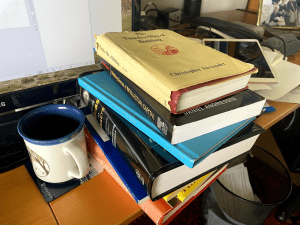
These are some of the books scattered throughout our house.  Please excuse the mess.  Paper books are everywhere.
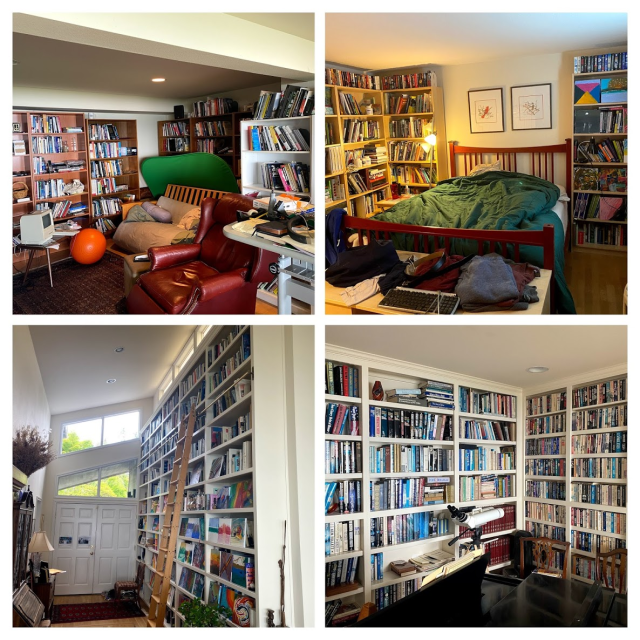
Skip’s Library of Books

However, I rarely pull any of these books out to look at or read.  The book cases are now spaces to display my experiments in acrylic painting.

I have >2,500 books in Kindle format on my iPad.  I keep my iPad with me at all times.  With my iPad I have several advantages:

      • All of my relevant professional books are ALWAYS with me.
        • When travelling, I no longer have to pack 10 books for a 5 day trip breaking my back by carrying that kind of load to satisfy my reading habits while on an airplane or in a hotel room.
      • All of my highlights and notes made in the “margins” are ALWAYS with me and searchable thanks to Amazon Highlights.
        • I no longer have to transfer my margin notes or underlines to an Evernote or Word document.
        • I no longer have to remember which book I made a margin note in.
      • All of my kindle books are now available as searchable PDFs
        • With a little help from DRM anti-encryption software
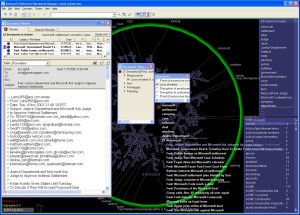
        • Through tools like X1 I have my terabytes of personal documents searchable as well as my books (that took 20 years from the vision I had for this capability – see Attenex Patterns History).

“At 5 PM yesterday, I saw my 30 year dream come alive.  I was able to display my research papers.  I navigated around the clusters and the concepts.  And then when I selected on a document, whether it was MS Word or a PDF, up it would pop in its own document viewer.  Unbelievable.  The only thing missing is the ability to index the books that I have in my home library.

“But synchronicity strikes again.  Just this week, Amazon.com started selling electronic versions of the popular management texts that are a core part of my library.  They come in either Microsoft reader or Adobe eBook format.  I quickly bought ebooks in each of the formats to see if we could index them.  Of course they are protected from that.  So close, so far.  But then it occurs to me, books are intellectual property.  I bet that someone in the Intellectual Property Practice at K&L Gates was involved in negotiating the licenses for some of the book properties.  Sure enough several folks in the group were.  So hopefully the last step in the journey of the dream is close at hand, the ability to not only pour my own writings and email, research reports, and published papers into the Attenex Patterns document database, but we can also get full length books indexed.

“Now I will be able to SEE the idea and concept relationships between all these wonderful publications that I can only fuzzily keep in my human memory today.  I can’t wait to glean new insights as I index more documents and as I use the re-cluster on anchor documents to see relationships I’ve never been able to see before.  I look forward to being able to publish meta-data about a corpus of documents and open up a whole new field of Document Mining.

“As a researcher, teacher, and business person, yesterday was the happiest day of my professional life.  My heartfelt thanks to all of you who’ve helped bring these concepts to life.”

The more I use my digital books on the Kindle, I realize additional benefits:

      • I now find it painful to find a comfortable position to sit in order to read a physical book.  I find it difficult to hold a large format book or to read the fine print of a paper back book.
        • With the iPad Kindle software I can change the font size as my eyes tire during the course of a long reading session.
        • The iPad is always the same weight and size – this sounds silly but it is easy to adjust to rather than having to adjust to the differing sizes and weights of each book
      • I hated making marks in a book to underline or highlight or make margin notes.  I felt I was ruining the book.  Then, I encountered a book signing event with Tom Peters who refused to sign any book that hadn’t been marked up.  He wanted to only sign books from folks he could easily tell appreciated what he had to say.  But I still hate to mark up my books.
        • I love highlighting a lot in a kindle book.
        • I use the different color highlights to “categorize” a highlight.
        • I can use the share option to immediately send to friends and colleagues important quotes from books I am reading.  I have to break state if I do that with a paper book.

        • While I have stacks of books now, they are books that don’t have Kindle variants yet (or likely ever).  They sit in a pile and sit some more and I don’t get to them.  Some of these are favorites from 30 years ago.  But they are not with me like my iPad.
        • I misplace and misfile my paper books all the time.  I never have to worry about that with my iPad Kindle.
        • Digital books are much better for the environment not requiring resources to produce the paper (a waste of precious water), the environmentally corrosive inks required for print, the electricity to run the presses, and the hydrocarbons required to deliver the book to you.  Nostalgia for the old is nice, but not environmentally friendly.

Many moons ago I had the pleasure of spending a weekend at the High Ground Conference put on by Mike and Katherine McCoy in Buena Vista, CO.  Present were a wide range of famous graphic designers, museum curators, book designers, font designers, and Bruce Sterling (science fiction author and design aficionado).  I listened as these folks pontificated on knowledge delivery in all of their areas of expertise.  I finally interjected that we had a very different understanding of knowledge.  I shared that museums are interesting and books are interesting, but it is not until they become digital that there is a chance for knowledge to develop.  Knowledge in this sense being the ability to link and cross reference both in authored and in automatic form.  An angry, yet spirited discussion ensued.  Bruce in his wonderful way figured out how to get us on a better discussion path by talking about the both/and of very different forms of knowledge.

Thanks for listening.  I wanted to provide a counterpoint to the bygone era of print and recommend the benefits I find in the digital version of books.

I only purchase books that are in digital format.  If the author is not bright enough to produce the book in digital form, they will not get my money.

In some cases, I do have to buy the paper book and the kindle book to make sure that I can experience the designed FORM.  However, I still need the always with me digital format AND the search-ability of the content for the author’s work to be useful to me in any context I might find myself.

I love digital books.

The “What is a book?” series of posts:

 

Posted in Content with Context, Curation, Design, ebook, Human Centered Design | Leave a comment

I Want to Move to New Zealand

Day 108 of Self Quarantine                       Covid 19 Deaths in U.S.:  128,000

New Zealand Rugby Match

I could not believe my eyes when I saw the news video of fans screaming and cheering side by side.  I thought it was from a year ago.

Nope.  It was from a country with amazing leadership and citizens who care about beating the pandemic, not about politicizing culture wars.

“Rugby has returned to New Zealand – but unlike in other countries where professional sport has begun to be played inside empty stadiums, last night almost 20,000 fans packed into the Forsyth Barr stadium in Dunedin to watch local favourites the Otago Highlanders take on the Waikato Chiefs.

“For rugby fans in New Zealand it marked the perfect end to a week celebrating the lifting of all coronavirus restrictions after Jacinda Ardern’s government declared the nation virus-free.”

Today, our stark news shows how much our sacrifices of the last three months were wasted by the stupidity of Donald Trump, his sycophants in his administration, the Republicans in Congress, and most Republican governors.

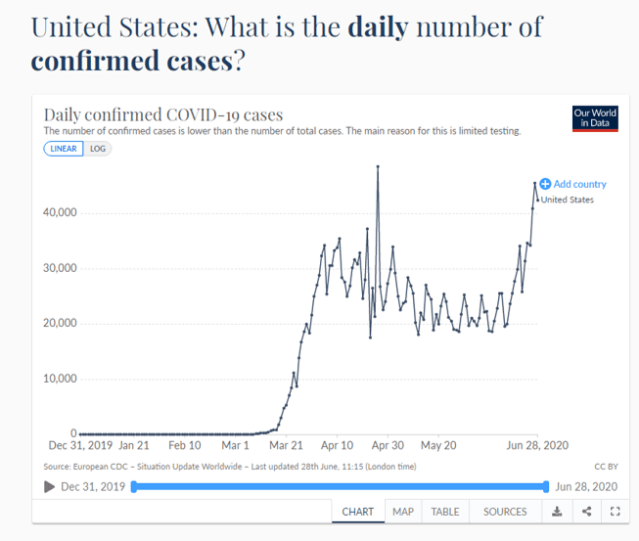
US Daily Corona Cases

To put this in perspective, as a vulnerable I self-quarantined on March 13 when there were ~1,000 cases per day.  Now we are in far worse shape as a country than we were in early March with >45,000 confirmed daily cases.   That is not the worst of it.  The CDC estimates that the U.S. total case count is 10 times higher than the 2.5 million confirmed cases so far.  To make matters worse, the data on cases and deaths lags reality by at least 7 days due to the different ways that each state reports public health data.

On Sunday, HHS Secretary Azar warned:

“Health and Human Services Secretary Alex Azar warned Sunday that time was running out for the U.S. to curb the spread of coronavirus as cases rise across the country, particularly in the American South and West.

“We’ve got the tools to do this,” Azar told NBC’s Meet The Press. “But the window is closing, we have to act, and people as individuals have to act responsibility. We need to social distance, we need to wear our face coverings where we can’t social distance, particularly in these hot zones.”

“As a doctor, a scientist, an epidemiologist, I can tell you with 100% certainty that in most states where you’re seeing an increase, it is a real increase,” Frieden said. “It is not more tests, it is more spread of the virus.” “

Today, the Washington Post shared this article “With Trump leading the way, America’s coronavirus failures exposed by record surge in new infections.”

“Five months after the novel coronavirus was first detected in the United States, a record surge in new cases is the clearest sign yet of the country’s historic failure to control the virus — exposing a crisis in governance extending from the Oval Office to state capitals to city councils.

“President Trump — who has repeatedly downplayed the virus, sidelined experts and misled Americans about its dangers and potential cures — now finds his presidency wracked by an inability to shepherd the country through its worst public health calamity in a century. The dysfunction that has long characterized Trump’s White House has been particularly ill-suited for a viral outbreak that requires precision, focus and steady leadership, according to public health experts, administration officials and lawmakers from both parties.”

Yes, I desperately want to hug my grand children again.

Yes, I want to go out to eat for a nice dinner.

Yes, I want to have the economy boom again.

No, I do not want to die because my fellow citizens are not taking this pandemic seriously.

I am glad New Zealand is a shining beacon in the world.  I wish America, the country I love, would notice AND pay attention to New Zealand’s beacon AND ACT accordingly.

I wish I had the resources to move myself and my extended family to New Zealand where we could all get back to a reasonable New Normal.

Posted in Citizen, Health Care | Leave a comment

Timeless Way of Building

Day 107 of Self Quarantine                       Covid 19 Deaths in U.S.:  127,000

I love Christopher Alexander’s Timeless Way of Building.

I love the form and the content.  Alexander wrote the book so that it can be read in 5 minutes, 20 minutes or the full book in five hours.

My favorite passage stops me every time when I try to do the 20 minute read:

Chris Alexander, Timeless Way of Building

In the midst of the pandemic, the economic crisis, and the Black Lives Matter protests, I am re-reading my timeless companion.

During my first reading, I noted a passage about the importance of work, play and home life being in the same place for a town to be alive.  I loved this design pattern as an ideal, but I saw no way that it could be realized in our modern life (pages 105-108 of Timeless Way of Building, 1979).

A man is alive when he is wholehearted, true to himself, true to his own inner forces, and able to act freely according to the nature of the situations he is in.

To be happy, and to be alive, in this sense, are almost the same.  Of course, a man who is alive, is not always happy in the sense of feeling pleasant; experiences of joy are balanced by experiences of sorrow.  But the experiences are all deeply felt; and above all, the man is whole; and conscious of being real.

To be alive, in this sense, is not a matter of suppressing some forces or tendencies, at the expense of others;  it is a state of being in which all forces which arise in a man can find expression; he lives in balance among the forces which arise in him; he is unique as the pattern of forces which arises is unique; he is at peace, since  there are no disturbances created by underground forces which have no outlet, at one with himself and his surroundings.

The fact is, a person is so far formed by his surroundings, that his state of harmony depends entirely on his harmony with his surroundings.

Some kinds of physical and social circumstances help a person come to life.  Others make it very difficult.

For instance, in some towns, the pattern  of relationships between workplaces and families help us to come to life.

Workshops mix with houses, children run around the places where the work is going on, the members of the family help in the work, the family may possibly eat lunch together, or eat lunch together with the people who are working there.

The fact that the family and play are part of one continuous stream, helps nourish everyone.  Children see how work happens, they learn what it is that makes the adult world function, they get an overall coherent view of things; men are able to connect the possibility of play and laughter, and attention to children, without having to separate them sharply in their minds from work.  Men and women are able to work, and to pay attention to their families more or less equally, as they wish to; love and work are connected, able to be one, understood, and felt as coherent by the people who are living there.

In other towns where work and family life are physically separate, people are harassed by inner conflicts which they can’t escape.

A man wants to live in his work and he wants to be close to his family; but in a town where work and family are physically separate, he is forced to make impossible choices among these desires.  He is exposed to the greatest emotional pressure from his family, at that moment when he is most tired — when he just comes home from work. He is confused by a subtle identification of his wife and children with “leisure,” “weekends.” and hence not the daily stuff of life.

A woman wants to be a loving woman, sustaining to her children; and also to take part in the outer business of the world; to have relationships with “what is going on.”  But in a town where work and family are completely separate, she is forced to make another impossible choice.  She either has to become a stereotyped “housewife,” or a stereotyped masculine “working woman.”  The possibility of both realizing her feminine nature, and also having a place in the world beyond her family, is all but lost to her.

A young boy wants to be close to his family, and to understand the workings of the world and to explore them.  But in a town where work and family are separated, he, too, is forced to make impossible choices.  He has to choose to be either loving to his family, or to be a truant who can experience the world.  There is no way he can reconcile his two opposing needs; and he is likely to end up either as a juvenile delinquent, who has torn himself entirely from his family’s love, or a a child who clings too tightly to his mother’s skirts.”

The Covid 19 Pandemic is illuminating the best and worst of the above two juxtaposed worlds for many families.  The problem is exacerbated with two parents working full time AND teaching their children.

The positive aspect of our new normal showed up for my daughter.  She was on one of her many Google Meet online meetings when she excused herself to help her six year old daughter who was in the middle of a science experiment.  “Wait a minute,” her peers on the meeting interrupted.  “Move your camera so we can see the science experiment.  That is a lot more interesting than what we are currently talking about.”

The negative aspects are washing over parents and children as their stress levels reach higher and higher as they try to maintain their old way of working, while trying to teach full time, and strive to have a family life.  And do all of this while in the lock down environment of self-quarantine.

While modern communication technology has enabled many of us to survive this pandemic, Alexander’s vision of a bygone era doesn’t fit our new normal.  We have to envision what a mixed work and learning and family life environment can be.  Alexander for all his wonderful visions of a healthy work life balance falls far short of what we need today AND tomorrow.

Posted in Content with Context, Design, Family, Flipped Perspective, Idealized Design, Values | Leave a comment

I want to be out on the streets of Seattle and DC protesting

Day 83 of Self Quarantine                       Covid 19 Deaths in U.S.:  109,000

It is so hard to watch the daily news showing peaceful protesters demonstrating against all that is wrong with my country.  I want to be with them.

But I can’t.

I want to visibly lend my voice with black Americans who are so wronged by our police and our economy and the ravages of a pandemic.  Black Lives Matter!

But I can’t.

I am now a Vulnerable.  Covid-19 is a clear and present death sentence at my age.

I want to let our dysfunctional politicians know in person that they need to live up to their respective oaths of office.

But I can’t.

I am now handicapped.  Getting caught in a stampede caused by police brutality and all manner of military armaments is a death sentence in my physical condition.  I can no longer physically run away.

I want politicians to hear my anger and heart ache, not just my inanimate TV that I scream at daily.

I am so disappointed in our country because I was stupid enough to think that by electing President Obama for eight years, a black American, that we had finally matured as a country.

I cry in my sleep that I was so wrong.

I was so wrong.

I give what I can to free the wrongly arrested peaceful protesters and to political campaigns in “red states” to elect politicians that are ethical and who will guard our democracy and who will de-militarize the police departments.

Is that enough?

I don’t think so.  I want to be out on the streets peacefully protesting.

But I can’t.

These protests and riots and police brutality are with me since I came of age in 1964 in the aftermath of the Rochester, NY, race riot.  We left Rochester shortly thereafter to move to Hendersonville, NC, for my father’s new job.

I arrived as a sophomore in high school the year after the city schools were integrated.  Racism was present at every turn depending on who you spent time with.  The times were peaceful and I was hopeful that we were in a better place.  My family and I watched in dismay the 1967 race riots in Detroit as the apartment that my grandmother and my uncle lived in just three years previously before was burned to the ground.

I thought I was safe now that I was away from the North.

I looked forward to attending Duke University in the fall of 1967.  Little did I know what awaited me during the next four years.

In the fall of 1967, while taking a shower in the men’s gym, I stared aghast at lines of ugly scars on the back of my biology professor.  I was too embarrassed to say anything to the professor.  I asked a grad student the next day what happened.

“Don’t you remember,” he said.  “The good professor participated in the sit ins at the Woolworth in Greensboro, NC in July 1960.  Those scars you saw were the result of being bull whipped by the white Sheriff’s department.”

“But the professor is white,” I said.

“Welcome to the south,” he replied.

On April 4, 1968, Martin Luther King was assassinated.  On April 8, Duke students started a peaceful vigil on the main quadrangle on West Campus.  I didn’t spend my nights on the quad, but I spent a lot of hours during the day listening to the speakers from many different walks of life.

1968 was an election year and I watched with horror as George Wallace ran for president and was popular in North Carolina.  On October, 24, Wallace held a rally and gave a speech in downtown Durham.  I was one of the demonstrators trying to shout the racist down.   I remember Wallace’s response to the crowd like it was yesterday:

Wallace received a mixed reception. While one local newspaper reported there were “oceans” of “Wallace for President” placards in the crowd, other demonstrators carried signs such as “Nobody Wins with Wallace” and “Hitler Was to Jews What Wallace Is to Blacks.” Responding to hecklers, Wallace said, “Let them get on television and it will all be over with,” and “I don’t know what they teach in college these days, but they ought to teach you how to behave in a crowd.”

The rally was one of my first encounters with tear gas, although not from the police.  Fortunately, Wallace was defeated but not before making clear how much of the country supported his candidacy.

In 1969 the riots and tear gas moved onto our campus at Duke.

“On February 13, 1969, between 50 and 75 Duke University students (many of whom were members of the Afro-American Society) occupied the Allen Building (Duke’s main administration building) to bring attention to the needs of African-American students. These needs included an African-American studies department, a black student union, protection from police harassment, and increased enrollment and financial support for black students.

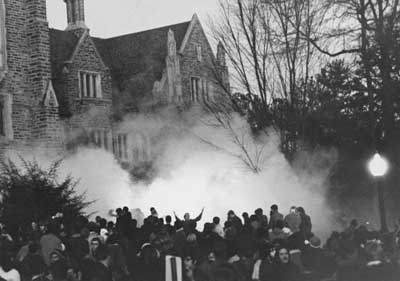
“The students remained barricaded in the Allen Building for most of the day, leaving sometime after 5:00 PM after an ultimatum from the Duke administration. Although their exit was peaceful, a large crowd of mostly white students had gathered outside the building during the day, and this crowd and the police became entangled. The police fired tear gas on the students, prompting further campus protests.”

Duke University Administration Building Takeover

What none of us knew was that after the George Wallace demonstrations, the City of Durham police department applied for Federal aid to obtain full riot gear, tear gas generating machines, and tear gas guns.  Prior to the peaceful student exit from Allen Building, the police had massed in Duke Gardens to assault the administration building and forcibly remove the student protesters.  Nobody told the police the students left the building.

In the above article about the riots, the term “entangled” is a polite description for the mess that followed.  As we watched, the police came storming out of the building immensely frustrated because they were not able to bash any black heads.  We started yelling for the police to “Come out with your hands up.”

The police went nuts and started using their new riot toys to spread tear gas all around in an attempt to disperse those of us protesting.  As quick as they would fire a tear gas canister, we would pick it up and throw it back at them.  Before we knew it, we had a riot on our hands.

Nobody let the police know that the black students had left.

Police cars were burned.  Students were chased.  Clouds of tear gas colored the quadrangle a surreal Martian orange.  The university Caroliner had climbed to the top of the Duke Chapel bell tower to play the MICKEY MOUSE Club song as the police sprayed tear gas chasing students.

The media entered into the mess with the ability to do live broadcasts about this time.  Broadcast crews showed up from around the Research Triangle.  Since my dorm was right across from the administration building, we would come inside every 10 minutes or so to see how the press was covering our riot at Duke.

Soon it was time for the Jesse Helms editorial commentary on Raleigh’s WRAL TV.  We all knew he was a racist, but he usually disguised his bigotry.  That night, he spewed hatred and the “N” word several times describing the actions of the Duke students.  We couldn’t believe it.  Now we were angered and went back to the quad to engage with the police in a louder shouting match.  Another police car was turned over and burned.

What a mess.  But at least I was able to protest.  I was able to raise my voice.

In July, 1969, NASA distracted us for a while.  On July 20, 1969, Neil Armstrong became the first human to step on the moon.  The racial divisions in our country were pushed aside for a week as we all watched TV to make sure that the astronauts got to the moon AND came back safely to earth.  This time of scientific and engineering achievement was the golden age of facts being important.

I find it painfully coincidental that in the midst of a pandemic and the pain of another black American killed by police, that we took time out to witness Americans going to space again on an American rocket.  In horror, I watched the gall of the politicians who deny science and facts, celebrate our return to space through the results of exacting science and engineering.

For the next thirty years after the 60s protests, I married, raised three wonderful children, pursued a career in software engineering and entrepreneuring, and moved to Seattle.  I forgot my roots of peaceful protesting.

I was briefly reminded of the importance of protesting in 1999 when the World Trade Organization came to Seattle.  Each morning as I would get off the ferry for work, I would see hundreds of protesters with their signs and costumes ready for a day of protest.  But this was a strange protest because there were at least 50 issues that were being protested either pro or con.  The mayor and team established protest intersections for each of the 50 issues with the “for” people on one side of the street and the “against” people on the other side of the street.  During work breaks, I would wander the streets mesmerized by the plethora of issues and protests.  It was so laid back Pacific Northwest.

Then the rioters and looters showed up after dark.

On my way back from the Westlake Center to the ferry, I got caught between a crowd of protesters and the police.  I got a full dose of tear gas.  I made it home safely.  But the smells of tear gas reminded me of a time long past.

This is a long winded way of saying that my life experiences and my memories are full of the pain of black Americans not receiving justice.  I am ashamed that I have not done more.

It is long past time to stop the inequalities.  It is long past time that all of us come together and figure out a way forward that removes injustice.  We need to stop figuring out how to restore our country to some nostalgic time in the past that never existed.  We need to create a country much better for all of us going forward.

I want to be on the streets protesting.

I can’t.

I can change myself.

I can be the change I want to manifest in the world.

I loved General Mattis’s statement yesterday:

“Instructions given by the military departments to our troops before the Normandy invasion reminded soldiers that “The Nazi slogan for destroying us…was ‘Divide and Conquer.’ Our American answer is ‘In Union there is Strength.’” We must summon that unity to surmount this crisis—confident that we are better than our politics.”

“Donald Trump is the first president in my lifetime who does not try to unite the American people—does not even pretend to try. Instead, he tries to divide us,” Mattis writes. “We are witnessing the consequences of three years of this deliberate effort. We are witnessing the consequences of three years without mature leadership. We can unite without him, drawing on the strengths inherent in our civil society. This will not be easy, as the past few days have shown, but we owe it to our fellow citizens; to past generations that bled to defend our promise; and to our children.”

We can unite without him.

We can change.  We must change.

Posted in Citizen, Lifelogging, Patterns, Reflecting | 3 Comments

We interrupt our Pandemic for …

Day 77 of Self Quarantine                       Covid 19 Deaths in U.S.:  103,000

We interrupt the Covid-19 pandemic for …

    • a black man, George Floyd, murdered by four policemen in Minneapolis
    • a dam breaking in Michigan and flooding hundreds out of their homes;
      • This natural disaster is advance notice for hurricane season on the East Coast and wild fires in the West this summer according to a warning from Columbia University Director of National Center for Disaster Preparedness, Dr. Irwin Redlener;
    • Twitter sort of blocking tweets from the President for using his bully pulpit to share “when they start looting we start shooting;”
    • the White House blocking public service health information from the CDC warning about spread of Covid-19 in newly opened churches when people sing;
    • a U.S. economy so bad that the White House is withholding its usual summer economic projections while another 2.4 million Americans filed jobless claims last week to bring the nine-week total to 38.6 million;
    • scientists sharing that Covid-19 lingers in the air for 30 minutes when you flush your toilet if you don’t put the lid down;
    • 17 year cicadas waking up on the East Coast;
    • Eugene Robinson of the Washington Post putting Minneapolis protests into perspective with the protests at the state house in Lansing, MI sharing that “Black Lives Remain Expendable.”

“Just a couple of weeks ago, hundreds of white protesters, some carrying all manner of deadly weapons, stormed into the Michigan state capitol and disrupted legislators trying to do their official business. Police saw them as exercising their constitutional rights and let them come and go without incident.

“A mostly black crowd protesting Floyd’s killing, on the other hand, was met Tuesday night with tear gas and rubber bullets. City officials perceived the Minneapolis unrest as an emergency. This nation needs to understand that life-threatening racism is an emergency, too.”

Just when you think 2020 couldn’t get any worse, I go to bed with the images of the protests turning violent in Minneapolis, MN.

Minneapolis Protests George Floyd Murder

I awake in the middle of the night to a text from my brother about the President’s inciting his base tweet.  I check in with our family Google Hangout and my son just shared that a CNN black reporter and his video crew were arrested in Minneapolis while a CNN white reporter was not.  So much for sleep tonight.

My daughter responds to my anger and frustration on our Hangout with:

You need to do so much more Dad.

The MOST important thing you can do for lasting change to help POC is to vote democratic up and down the ballot.  AND give TIME (and money) to help others do so.  If we do not ALL work our butts off between now and November we will only have ourselves to blame for continued violence. This violence is OUR fault.

Consider starting with either one of these: 

https://votesaveamerica.com/states/

https://www.environmentalvoter.org/

And/or call your congresspeople and let them know you were up at 4am thinking about how horrible this is and you want them to help. They don’t know if you don’t tell them.  An email takes literally 3 minutes.

Action action action action.

“Don’t boo. Vote” (And help get others registered to do so) etc etc

I mean, I get it. It’s awful. It’s so awful.  But turn to action!

As Sam Stein shared “I’m just so weary!”

As I sit with my morning coffee waiting for the sun to rise (yes, it did rise this morning), I am grateful that I have a roof over my head and food to eat and that I live in a very beautiful place.  I give thanks that a daughter of a colleague who lives a mile away from the protests in Minneapolis is safe and healthy this morning.  I give thanks for a family that knows we have to act in myriads of ways to save our democracy through our actions, our time and our money.

Sunrise Seattle

And I pray for the strength to keep me safe and healthy as I leave my comfort zone of self-quarantine.

Act now to get out the VOTE in November!

Posted in Citizen, Family, Lifelet | Leave a comment

Intertwingling of Narrative and Computing

Day 76 of Self Quarantine                       Covid 19 Deaths in U.S.:  102,000

[NOTE:  These numbers are staggering to me and life changing.  My thoughts and prayers are with all of the families of the deceased. Going forward, each of my blog posts will update these numbers on the day that the post is first published.]

I love synchronicity.

I depend on synchronicity to focus my discovery and learning activities.

When a new topic randomly crosses my path from three different sources or colleagues, I know it is time to pay attention.  Two weeks ago, the existence of Jupyter notebooks showed up from three different colleagues.  They were excited about the ability to combine narrative and computing.  Well, this is novel (double entendre intended).  These are two words (narrative and computing) that I never would put together.  These two words use different tools to create and think with.  These two words require different thinking modes.  They just don’t go together.  It’s like Digital Humanities.

Digital Humanities

The 2015 Jupyter Grant Proposal introduction describes the creators’ aspirations:

“Computers are good at consuming, producing and processing data. Humans, on the other hand, process the world through narratives. Thus, in order for data, and the computations that process and visualize that data, to be useful for humans, they must be embedded into a narrative – a computational narrative – that tells a story for a particular audience and context. There are three fundamental aspects of these computational narratives that frame the problem we seek to address.

Jupyter Notebook

“First, a single computational narrative needs to span a wide range of contexts and audiences. For example, a biomedical researcher might originally perform statistical analyses and visualizations for a highly technical paper to be published in an academic journal. Over time, however, that same individual will give talks to other researchers, or even non-technical audiences. Eventually, it may even be important to enable non-coding lab scientists to perform that same statistical analyses and visualizations on data from new samples using a simplified graphical user interface. Across all of these different audiences and contexts, core aspects of the computational narrative remain invariant.

“Second, these computational narratives need to be reproducible. That is, other people – including the same scientist six months later – need to be able to understand exactly what was done (code, data and narrative) and be able to reliably reproduce the work in order to build new ideas off it. Reproducibility has long been one of the foundations of the scientific method, but the rise of data science brings new challenges to scientific reproducibility, while simultaneously extending these questions to other domains like policy making, government or journalism.

“Third, computational narratives are created in collaboration. Multiple individuals need the ability to work together at the same time, on the code, data and narrative. Collaboration is present in nearly all contexts where computational narratives are created: between two postdocs and a professor in the same research group; between the writers, editors and visual designers of an online news site; between the data scientists and business strategists at a large internet company; or between a teacher and students in a university classroom.

“Given this background, the core problem we are trying to solve is the collaborative creation of reproducible computational narratives that can be used across a wide range of audiences and contexts. We propose to accomplish this through Project Jupyter (formerly IPython), a set of open-source software tools for interactive and exploratory computing. These software projects support scientific computing and data science across a wide range of programming languages (Python, Julia, R, etc.) and already provide basic reproducibility and collaboration features. This grant aims at making major progress atop this foundation. The main application offered by Project Jupyter is the Jupyter Notebook, a web-based interactive computing platform that allows users to author computational narratives that combine live code, equations, narrative text, interactive user interfaces and other rich media. These documents provide a complete record of a computation that can be converted to a number of formats (HTML, PDF, etc.) and shared with others through email, Dropbox, GitHub, etc. They can also be published online thanks to our Jupyter Notebook Viewer, a free service we operate that allows anyone on the web to view a notebook as a regular web page.”

As I am immersing myself in this new world, everyone keeps saying “well this works for programmers and scientist programmers and maybe you still remember how to program a little, but it will never work for anyone else.”  Then I remember my encounter with Kate Hayles at Duke University who shared how she teaches her Freshmen English classes.  She uses software for their comparative literature studies:

Then, Kate hit me with the real paradigm shift here.  Along with comparing “texts” across different media, she is using literary critique skills to critique code.  She described this emerging field of critical code studies.  I wasn’t sure I had really heard what she just said so I asked for a specific example.

Kate explained “We are now as interested in critiquing the software as we are in critiquing the text.  There are several efforts under way to have side by side displays of the ‘digital text’ and the software that implements the digital text.”  Now I knew that I had just fallen down Lewis Carroll’s Alice’s Adventures in Wonderland rabbit hole.

“Let me see if I understand this right,” I asked.  “You mean to tell me that Humanities students are both interested in software and have the ability to critique and write software in an humanities course?”

Kate looked at me a bit like I was a Freshman student, and patiently explained “of course, this current generation is interested in software.  This is the digital native generation and they are eager to do the software explorations.  They are frustrated with those of us from the old school who only want to focus on print.”

“Let me try one more time.  There are not any humanities majors I know (including one of my children) who have the least bit of interest in computing.  They chose the humanities so they could stay away from science, math, and computation,” I asserted.

Kate just smiled and suggested that I ought to sit in on one of her classes where they do exactly what she is describing – study comparative literature by creating and critiquing software.  Kate said that given this turn in the conversation she would send along a couple more chapters from her latest book.

The narrative and computing ideas crashing together means it is time to call my narrative colleague, David Robinson.  I provide a little context and ask him a few questions.   The intertwingling of narrative, computing and data leads me to two questions:

    • How do you make a narrative computable?
    • How do you make computing a narrative?

The Jupyter technology has answered these questions at least at a minimal level, but what I was really trying to get at is what is the meaning of those two questions.

What does it mean to make narrative computable?

In his wonderful way, prior to our Zooming, David points me to a TED talk by the comic artist Scott McCloud.

A Computer Screen is window into a digital comic

I take a quick look at the video and scratch my head.  I think David has been in Wisconsin too long.  I don’t get the connection to my questions.

On the morning of the Zooming, I re-watch the TED video.  Scott shares how comics have evolved through different media over the last 3000 years and are now entering the digital age.  Then it hits me.  I have to go re-read all of Marshall McLuhan and Lev Manovitch and Sergei Eisenstein‘s books.  If I am going to put narrative and computing together, I have to understand the combination as a new medium.  This new medium is heavily dependent on a database structure underneath.

From Scott McCloud’s TED talk:

“Dad understood the shape of the future. So did J.C.R. Licklider and his notions for computer-human interaction. Same thing: he understood the shape of the future, even though it was something that would only be implemented by people much later. Or Paul Baran, and his vision for packet switching. Hardly anybody listened to him in his day. Or even the people who actually pulled it off, the people at Bolt, Beranek and Newman in Boston, who just would sketch out these structures of what would eventually become a worldwide network, and sketching things on the back of napkins and on note papers

“So, three types of vision, right?

      • Vision based on what one cannot see, the vision of that unseen and
      • The vision of that which has already been proven or can be
      • And this third kind, a vision of something which can be, which may be, based on knowledge but is, as yet, unproven.

“Now, we’ve seen a lot of examples of people who are pursuing that sort of vision in science, but I think it’s also true in the arts, it’s true in politics, it’s even true in personal endeavors.

“What it comes down to, really, is four basic principles:

      • learn from everyone;
      • follow no one;
      • watch for patterns; and
      • work like hell.

“I think these are the four principles that go into this. And it’s that third one, especially, where visions of the future begin to manifest themselves. What’s interesting is that this particular way of looking at the world

“Why is this important? I think this is important because media — all media — provide us a window back into our world. Now, it could be that motion pictures and eventually, virtual reality, or something equivalent to it, some sort of immersive display, is going to provide us with our most efficient escape from the world that we’re in. That’s why most people turn to storytelling, to escape. But media provides us with a window back into the world we live in. And when media evolve so that the identity of the media becomes increasingly unique — because what you’re looking at is comics cubed, you’re looking at comics that are more comics-like than they’ve ever been before — when that happens, you provide people with multiple ways of reentering the world through different windows. And when you do that, it allows them to triangulate the world they live in and see its shape. That’s why I think this is important.”

I send a note to David before our conversation:

I thank you.

I curse you loudly.

Really. Very loudly.

I thank you and affirm you for your oblique coaching.

I curse you loudly.  Did I say that?

Watched McCloud again.

Now I lose my next month going back through McLuhan and Lev Manovich and probably a little Eisenstein.

Damn you David Robinson.

So is this what you are trying to coach me on?

Narrative and computing (aka literate programming) is a new medium.

The rules for this medium will be different than the old media of story or computing or big data.

What kind of medium will  this literate programming media be – hot or cold?

What is the intent of the new medium?  Is there more than one when you start combining the ideas in the document?

      • Narrative and Code
      • Narrative and Code and Big Data
      • Computing on the Narrative (like Attenex Patterns did with terabytes of documents)
      • Narrative and Code and Interactive Visualizations
      • Narrative and code as text books
      • Narrative and code as scientific notebook or patent notebook

What happens when you “break the page” and you have an infinite canvas?

What does it mean to shape the future with literate computing?

Thanks for starting the conversation with a bang.

As David and I explore narrative and computing and how I want to create in this new media, I am reminded of Frank Gehry and how he had to innovate with technology to get his architectural designs built:

Frank Gehry had to transform himself from an architect to a builder and then operator of the buildings that he designed as he was unable to get his designs built. From “Is Designing Software Different from Designing Other Things?“, we catch a glimpse of how Gehry had to change his theories of design:

“In a more complex example, Frank Gehry in a video, at a Technology, Education and Design (TED) Conference put on by Richard Saul Wurman, described his challenges in creating the kind of public building designs such as the Guggenheim Museum in Bilbao, Spain, the Experience Music Project in Seattle, and the Disney Concert Hall in Los Angeles. When he first started exploring complex curved shapes for the exterior of buildings he was startled to discover that when he put his designs out to construction bid, the contractors quoted him five times the normal fees. He realized that no one knew how to build his creations. So he had to form a company to first adapt Computer Aided Design (CAD) tools to design the complex metal shapes, and then develop the software that would connect his CAD tools with CNC equipment to cut and mill the complex metal shapes. The end result was that he was able to build his distinctive creations for the same cost as traditional construction methods. During his presentation he reflected on whether he was now a building architect or a software designer.

Gehry Experience Music Project Seattle

“These changes are causing the field of architecture to look more like the field of software design. Lindsey details the extent to which computer systems and particularly the Dassault CATIA CAD system have entered Gehry’s practice of architecture. The computer is used for simulations of the digital and physical models, direct detailing, computer aided manufacturing, coordination of the electrical, mechanical and plumbing systems, and as a framework for the operation of the building after construction. Gehry describes how his evolving process is changing the craft of building design and construction:

“This technology provides a way for me to get closer to the craft. In the past, there were many layers between my rough sketch and the final building, and the feeling of the design could get lost before it reached the craftsman. It feels like I’ve been speaking a foreign language, and now, all of a sudden, the craftsman understands me. In this case, the computer is not dehumanizing; it’s an interpreter.”

The significance of the changes that Gehry has made in his fluent design process shows up in the organizational interventions that the software is bringing to the building industry as described in Digital Gehry:

“Ultimately, allowing for all communications to involve only digital information, the model could signal a significant reduction in drawing sets, shop drawings, and specifications. This is already reflected in the office’s current practices where the CATIA model generally takes precedence (legal as well as in practice) over the construction document set. This is a significant change in standard practice where specifications take precedence over drawings and specified dimensions are subject to site verification. . . . . Glymph states that `both time and money can be eliminated from the construction process by shifting the design responsibility forward’. Along with this responsibility comes increased liability. When the architect supplies a model that is shared, and becomes the single source of information, the distributed liability of current architectural practice is changed.”

“Building on the experience of Gehry, we see that this combined hard and soft design can shift forward into the area of operating a building as well. One software system can act as a shared repository and information refinery for the design, build, distribute, intervene and, now, the operate phase knowledge base.”

David and I quickly realize this is the start of many conversations.  I am still confused on how narrative and computing relate to each other.  But now I am confused at a higher level.

Posted in Entrepreneuring, Explorations, Learning, Narrative | Leave a comment

Lord, Thank you for Cheryl

Cheryl is our local UPS driver.  We just found out her name (although I am not sure the spelling).  She arrives like a fairy in our neighborhood and drops off her packages of magic.  She’s done this package act for at least five years.

But now we notice her.  We pray for her.  We thank her every time we see her.  I worry about her when I don’t see her wearing a mask or gloves.  I trust she has a gallon of Purell in her  UPS truck.

UPS Truck and Cheryl

We thank all of our angels amongst us who deliver the mail, or drive the Fedex truck, or work at the grocery store, or all the unsung heroes who make our Vulnerable life tolerable.  We thank all of those in the global supply chain who get to us our food, our medicines, and our health care equipment.  I thank them for bringing me my Raspberry Pi.  OK, I’ve got to have a little fun.

We thank all the nurses, and doctors, and health care professionals who risk their lives for all of us daily.

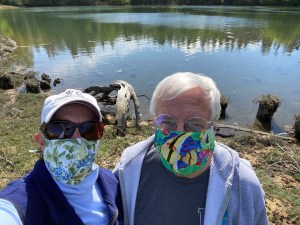
We thank all of those we encounter on the trails at Bainbridge Island for social distancing and wearing their colorful masks.

Social Distancing from the octopus stump

As a confirmed introvert, I like to live my life in the cocoon of my family.  Now I wake up and notice all those who are helping me stay alive and thrive during this pandemic.  Where we can, we reach out from a safe distance to ask our angels their names.  We want to know them and a little bit more about them in each random encounter.

Thank you, Cheryl.

I wish I could hug you and all the others who ease our isolation as we self-quarantine.  Hopefully, some day.

Know that each and every one of you has a virtual hug today.

Thank you all.

Posted in Citizen, Lifelet, Spiritual, Values | 1 Comment

A Product has a North Star

Recently, I came across a blog post on “North Star Metric” (NSM).  I was delighted that somebody else had written about a topic that is critical to the product teams I’ve managed.  I shared my thoughts in the post “The Power of Metrics to Guide Software Development.”

A North Star Metric is defined as:

“A North Star Metric is the key measure of success for the product. It is the single metric that best captures the core value that your product delivers to customers. They are key lagging indicators that measure success for the product.

“A NSM defines the relationship between the customer problems that the product team is trying to solve and the revenue that the business aims to generate by doing so.”

Yet, in every company I’ve joined the last ten years or consulted with, there would be a thirty something UX person who would be advocating and re-designing existing software with a universal interface or a more user-friendly interface or a modern interface like Microsoft or a pick a UI meme of the day.  I would scoff and pontificate or get really mad or just walk away in anger at their incompetence and stupidity.  I never stopped to understand what was the root cause of my frustration and anger.

I would have similar reactions whenever some UX person with too much power would completely redesign the UI of products I use for hours a day like Microsoft Office.  In the attempt to acquire a few more “young, hip” users, these companies would turn their backs on those of us who have spent decades learning and depending on their product to get real work done.  Every time I hear a product marketer proclaim we have a “modern user interface” I want to run for the hills.

In a user research interview for a forthcoming book with Kristen Litgen of Nuix (formerly FTI Consulting Ringtail) on how she learned to become a product owner, I suddenly realized that what I was frustrated by wasn’t incompetence.  I didn’t understand that I had a very different design center than the UX teams had.  It’s not like I had a single design center for every product.  The product design metric or NSM needs to change for any particular product and their target customer audience.

Attenex Patterns eDiscovery

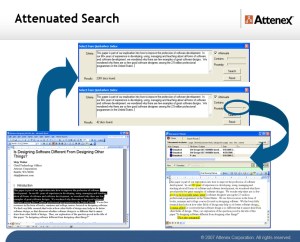
With Attenex Patterns, the NSM was “increasing document decisions per hour.”  With Personal Patterns the NSM was “minimize time between search start and useful results.”  [NOTE: See “Why are there so few visual analytics applications?“] With the full Patterns product, the users were going to be spending 8 to 10 hours per day with the product, so it was fine to require some training to understand the power of the product (1-4 hours).  For the consumer Personal Patterns, the product had to require no training and be fast to respond.  The NSM was different for each.

Personal Patterns Attenuated Search

Similarly, the design centers and users for contract lifecycle management (CLM) in a stand alone product were different than the users coming at CLM from our Salesforce product at Conga.  The skills were different and the amount of time spent in the products were very different in the two environments.  The two products needed different North Star metrics.  Yet, the UX folks insisted on a common “user friendly” UI.

Now that I realize the huge gap in the different design centers for a given product, I can have a more rational discussion that hopefully leads to a better outcome.  I can go back to the basics of discussion so nicely described by Amsterdam and Bruner in Minding the Law:

“So we take as the agenda of this book to make some very familiar routines in law-thinking strange again. We want to concentrate especially on three commonplace processes of legal thought and practice, to target them for consciousness retrieval. They are processes without which lawyers, judges, and students of the law could not possibly make do for as much as one hour: categorizing, storytelling, and persuasion.

“But our efforts to explore the processes of categorization, narrative, rhetorics, and culture will also lead us to use other techniques of estrangement. Perhaps the most powerful trick of the human sciences is to decontextualize the obvious and then recontextualize it in a new way.”

Anthony G. Amsterdam;Jerome Bruner. Minding the Law (p. 4). Kindle Edition.

I now realize that I didn’t spend the time to “de-contextualize the obvious” for the UX designers.  My bad.

Posted in Attenex Patterns, Content with Context, Design, Product, Reflecting, Software Development, User Experience | 1 Comment

Know Now

What if you could accurately predict, in fact even know, your quarterly results at the beginning of a quarter rather than at the end of a quarter?

That is the question that Eric Robinson and I explored many times over the twenty years we collaborated together.

If you could KNOW NOW and you could see any problems coming up, you could start interventions immediately and not have to wait 3-6 months to make changes.

During our time together, Eric and I founded a company called Attenex which was acquired by FTI Consulting in 2008 and then by Nuix in 2018.

As underlying technologies like Microsoft Office 365 and Oracle Financials migrated from client/server applications to the cloud, our ideas became easier to implement.  One of the biggest barriers to analyzing large amounts of unstructured information is having to collect that information from scattered computer systems.  With that information now in the cloud and robust APIs available, our ideas went from thoughts to prototypes.

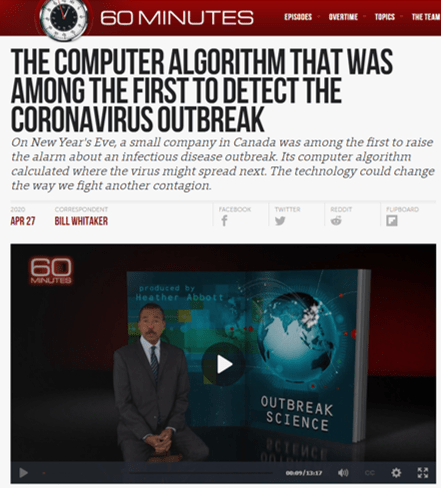
I was reminded of our musings while watching a 60 Minutes segment on Outbreak Science:

Outbreak Science featured on 60 Minutes

“When you’re fighting a pandemic, almost nothing matters more than speed. A little-known band of doctors and hi-tech wizards say they were able to find the vital speed needed to attack the coronavirus: the computing power of artificial intelligence. They call their new weapon “outbreak science.” It could change the way we fight another contagion. Already it has led to calls for an overhaul of how the federal government does things. But first, we’ll take you inside BlueDot, a small Canadian company with an algorithm that scours the world for outbreaks of infectious disease. It’s a digital early warning system, and it was among the first to raise alarms about this lethal outbreak.

“It was New Year’s Eve when BlueDot’s computer spat out an alert: a Chinese business paper had just reported 27 cases of a mysterious flu-like disease in Wuhan, a city of 11 million. The signs were ominous. Seven people were already in hospitals.”

Their prediction was used by a Toronto hospital to buy the necessary ventilators and personal protective equipment months before US hospitals, states, and the Federal Government started scrambling for these goods.

They are a current example of Knowing Now what is going to happen months into the future.

Eric and I realized that we could do a similar prediction from our experiences with large scale eDiscovery with all the “digital exhaust” flying around a corporation.  Yet, it still took a couple of chance encounters to realize how easy it would be.

The first encounter happened at an FTI Consulting senior manager’s retreat where Heidi Gardner presented her research on lessons from professional services firms.  She found that the more partners collaborate with each other the more revenue they generate.

“Today’s professional services firms face a conundrum. As clients have globalized and confronted more-sophisticated technological, regulatory, economic, and environmental demands, they’ve sought help on increasingly complex problems. To keep up, most top-tier firms have created or acquired narrowly defined practice areas and encouraged
partners to specialize. As a result, their collective expertise has been distributed across more and more people, places, and practice groups. The only way to address clients’ most complex issues, then, is for specialists to work together across the boundaries of their expertise.

“When they do, my research shows, their firms earn higher margins, inspire greater client loyalty, and gain a competitive edge. But for the professionals involved, the financial benefits of collaboration accrue slowly, and other advantages are hard to quantify. That makes it difficult to decide whether the investment in learning to collaborate will pay off. Even if they value the camaraderie of collaborative work, many partners are hard-pressed to spend time and energy on cross-specialty ventures when they could be building their own practices instead.

“And no wonder. This kind of collaboration is difficult. It’s different from mere assembly (in which experts make individual contributions and someone pulls them all together) and from sequential, interdependent projects (in which a professional adds to a piece of work and then hands it over to the next person to work on). It’s much harder than simply delegating to junior staffers. It’s also not the same as cross-selling, when partner A introduces partner B to her own client so that B can provide additional services. True multidisciplinary collaboration requires people to combine their perspectives and expertise and tailor them to the client’s needs so that the outcome is more than the sum of the participating individuals’ knowledge.”

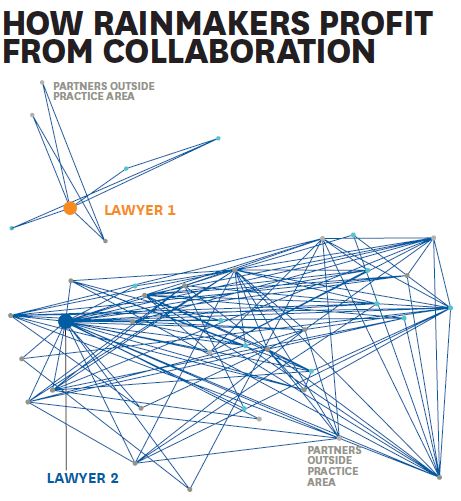
How Rainmakers Profit from Collaboration

“To illustrate how collaboration enhances a professional’s ability to generate business, let’s compare two nearly identical lawyers. Both graduated from law school the same year and are in the same practice area at the same firm. They billed nearly the same number of hours in a given year, but it’s clear from the diagram that they spent those hours in very different ways. Lawyer 1 brought six other partners into his own client work, half of whom were not from his own practice area (as shown by the gray dots). Lawyer 2 involved more than 30 other partners in work that he generated, two-thirds of them from outside his practice. Lawyer 2’s multidisciplinary approach paid off: Total revenue that year from his clients was more than four times higher than revenue from Lawyer 1’s.”

As Eric and I watched the presentation, we realized that the data was pulled from a standard time and billing system that we used.  We thought we could analyze that data to find our high, medium and low collaborators. We got permission to access a subset of the data to test Gardner’s theories on our professional services firm.  Our hypothesis was that we could educate the medium collaborators to become high collaborators to dramatically increase the firm revenues.  Heidi Gardner confirmed our hypothesis was the core of her analysis and training with her clients.

Our next chance encounter occurred when we were introduced to Cliff Dutton, who was Director of eDiscovery for AIG.  He shared with us research he did with Brown University colleagues.  The article (“Empowering Board Audit Committees: Electronic Discovery to Facilitate Corporate Fraud Detection“) demonstrated a principle that Eric and I believed, but had not been able to prove.  Their research showed that the elements of fraud were present in a corporate information system 60 days before it was identified by regulatory authorities.

“A number of recent accounting scandals in public companies have illuminated the need for enhanced oversight capabilities by board audit committees. The current reliance of boards on corporate financial statements reviewed by independent auditors is deficient; there is a delay in audit committees receiving these reports. Moreover, these reports transmit historic rather than real-time information to directors. In this paper we investigate if analytical techniques utilized by the U.S. Department of Homeland Security to provide advance warning of potential terrorist threats can be employed to strengthen corporate governance of public companies. The narrative reads that board audit committees can utilize electronic analysis of corporate email as an advanced corporate fraud detection system. Our application of these techniques to one actual case of corporate fraud indicates that an electronic monitoring system would have signaled an alarm of aberrant behavior to the board audit committee 60 days in advance of initial inquiries by regulatory authorities.”

The third chance encounter came during a conversation with Ade Miller at Conga.  He asked me what the future of artificial intelligence and machine learning (AI/ML) was in the contract lifecycle management (CLM) market.  I led off the discussion by asserting something I discovered twenty years before.  I believed that a corporation was the sum total of its formal AND informal contracts.  The formal contracts are the ones with customers and suppliers.  The informal contracts are all the “commitment” documents inside a corporation like business plans, compensation plans, product plans, product marketing plans, employment contracts and yearly performance reviews.  These formal and informal documents have the dates to deliver future commitments which have revenue and cost implications.  The informal commitments are also embedded in Customer Relationship Management (CRM) systems like Salesforce.  All of this information along with financial data is in the “cloud.”

I shared with Ade the experience at Primus Knowledge Solutions (PKSI) that illustrated “no one person knows, but the network does.”  We spent a year negotiating a large contract with Compaq to make sure that we could financially recognize all the revenue when the contract was signed.  Little did we know that the sales person had committed that we would provide onsite support to the client in an email.  This email was not shared with the PKSI executive team.  When the customer called to exercise the sales person’s commitment, we realized that we had to restate our revenues for the previous quarter.  Our stock price tanked.  Oops!

No one person knows, but the corporate network does.

Armed with our knowledge of how to collect and analyze large volumes of unstructured emails and documents and structured financial information, Eric and I prototyped a system that showed we could Know Now what our future financial situation would be.

As we exist here in the middle of the corona virus crisis, you might ask “so what happens when there is a black swan event that comes out of nowhere?”

The BlueDot outbreak risk analytic software can be easily combined with Know Now to prepare for a Black Swan event.  Not only are corporate data in the cloud, so is everything that BlueDot is analyzing.  So even unexpected events can be incorporated into Know Now.

No one person knows, but the globally interconnected World Wide Web does.

If only we knew where to look and how to analyze.

Posted in Attenex Patterns, Big Data, Content with Context, eDiscovery, Knowledge Management, Visual Analytics | Leave a comment

Programming a Computer makes me Happy

Translating an idea from my head into an inanimate extremely logical computer AND seeing the idea come to life makes me happy.

Even after 50 years of creating software and software products I am always “surprised by the joy” of programming.  I have to take the inspiration and ideas that accumulate randomly and meld them into something precise and logical.  While the tools for programming evolve to higher and higher levels of abstraction and capability, I still have to bridge my “gulf of intention.”

“The test of a first-rate intelligence is the ability to hold two opposed ideas in mind at the same time and still retain the ability to function.” – F. Scott Fitzgerald

Creating something new in software is my visceral experience of the Fitzgerald quote.  On the one hand, I have a grandiose idea of a “virtual world” inside the computer that I want to create.  On the other hand, I have the tedious detailed instructions that I have to type into some form of arcane computer language to realize the vision.

I experience great joy when I bridge this gulf of intention.

Hardest of all is no matter how long I work at bridging the gulf, the reality never comes close to my vision and intention.  Perversely, as I start to realize my intention, I realize how narrow the intention was in the first place.  My vision of what is possible grows wider.  The structural tension between vision and reality grows wider still.

Yet, I persist.  It makes me happy.

A program makes me happy when even a small portion of the gulf is crossed.

Yesterday, it was a simple starter Python program to see whether the computer clock time “minutes” were an even or odd number.

Three years ago, it was working with a team to design and produce what is now Nuix Discover’s Social Network Analytics.  While I didn’t do any of the programming, I collaborated to design what was needed for eDiscovery lawyers and forensic accountants.  Each day, I could see the gulf of intention narrow as Yong and Scott and Eric worked their magic.  And then the gulf widened as we realized we could add phone calls and SMS texts to the email communication between members of a social network.

Nuix Social Network Analytics

Over the course of a joyful month, we realized we could combine visualizations of semantic networks (how words and documents are related), social communication networks (how people and companies are related), event networks (how events are related in time), and financial transaction networks (how financial information is tied to communications, people and events).  Each day was a joyful celebration of progress and a joyful time of designing the next prototype iteration.

Fifteen years ago, David Socha and I asked ourselves “Is Designing Software Different from Designing Other Things?”  We summarized our findings by asserting that software design is different.  It is the very “softness” and changeability of software that is a “material without qualities” that provides the challenge.

While Heskett‘s `Design is to design a design to produce a design‘ seems nonsensical at first reading, it serves as a clarifying framework to look at the similarities and differences between hard and soft design. The view of the design activities field needs to expand beyond just generating a specification to include the full range of activities — design, build, distribute, intervene, and operate. The evolution of Frank Gehry‘s and John Socha‘s respective design experiences suggest that the future of hard and soft design is not an either/or choice but rather the appropriate combination of techniques, skills, and processes.

As we see in this paper, each of the meanings of `design’ is different between software design and most other design disciplines. In software, the first noun extends to include organizational intervention as a significant component. The verb is about reversing the steps (test-driven development). The second noun is about the source code is the design specification. The third noun is about the design not being an object to be manufactured, for most classes of software, but instead being a complex adaptive system that is an organizational intervention. The other design disciplines that are most like software design are those that share these qualities, including the disciplines dealing with bioengineering and social systems.

The result is what we believe to be a convincing story that software designing is different because it is a field of a `material without qualities’. The key
differences are:

      • Source code is the design (Noun 2)
      • Design (Noun 2) and organization intervention (Noun 1) are the dominant steps, unlike hard design where build and distribute are the dominant steps
      • The steps of the waterfall design (Verb) model are reversed
      • There is little material resistance with software — no physics, no first principles, no simulation from first principles
      • Software design (Noun 3) is a complex adaptive system design
      • Software is always deeply embedded — exists in some hardware form which provides one set of constraints, and in a soup of other complex adaptive systems which generates fuzzier constraints

As software becomes more prevalent in the design tools and products of other disciplines, we can expect those `hard’ disciplines to become progressively more `soft’, with the concurrent change in forces requiring softer design techniques. In the future, many domains of hard design will require multiple design methods and processes:

      • Hard design processes for those things that physics apply to.
      • Software design processes for the software or `alive’ components.
      • Recognition that most products have an organizational intervention component to them.

More recently, David Robinson and I had several discussions asking “is programming computers like making art?”  Maybe the question is closer to “does programming bring me the same joy that painting brings you?”

David is a very talented artist in the widest sense of the word.  His paintings stir my soul.  His theater work is masterful.  I had the pleasure of seeing the grand opening of his play “The Lost Boy”  David wrote the script, produced the play, was the lead actor and worked with the Chili Boys to compose the music.

Two years ago I started experimenting with painting using acrylics.  I love the experience and the joy of creating colorful marks on canvas.  It is the same challenge of translating the vision in my head on to the realities of the canvas.  And there is a huge gulf between my intention and what appears with my experiments.  Slowly I am bridging that gulf, but I fear I have come too late to develop the skills needed to reproduce my visions.

Flow series of painting experiments

Now that I am programming again, the joy is similar.  But different.

With programming I am resurrecting the skills I developed a lifetime ago with punch cards on an IBM 360 and a teletype interface to a DEC PDP-12.  I can draw on a wide range of programming languages, the advent of the World Wide web, many ways to store and manipulate big data, and 50 years of using and evaluating personal and enterprise software products.

With painting, I am an exploring novice.  At every turn, I know not what to do or even which tool to use.  Or even the questions to ask of others.

However, with both programming and painting, I am surprised by joy.

They make me happy.

Posted in Patterns, Reflecting, Software Development | 1 Comment