Lifelet: The Easter Bunny is Back

Many moons ago my wife took a cake decorating class before we had children.  Now that our waists have expanded and our children have their own families, the cake decorating creative outputs don’t show up very often.

With grand children, the cakes still arrive on happy occasions.

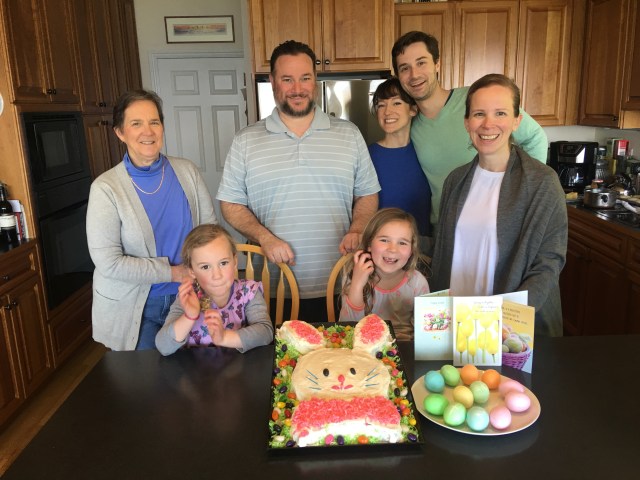
When I limped into the house last night after a very long day consulting, I turned the corner into the kitchen and there was the Easter Bunny cake.  A needed smile jumped onto my face.

Easter Bunny Cake 2019

I look forward to the smiles that it brings to the grand children this weekend.

Easter Bunny Cake 2016

Isn’t it amazing how the Easter Bunny doesn’t age as the grand children grow oh so fast.

Easter Bunny with Family 2019

Some traditions are a joy to eat, oops celebrate.

Posted in Lifelet | Leave a comment

Lifelet: Mourning Rain

How fitting that I start the day looking out at the rain and grays of the Puget Sound.  Seattle is barely visible to the East.

Puget Sound kaleidoscope of grays

The grays match my mourning mood.  The Mueller report is being released today.  Even CNN showed a little humor this morning in the redacted subject line of their daily email.

CNN gallows humor

As I sit with my morning coffee observing the ferries on their hourly to and fro, I am once again amazed at how much fascination I have with these shades of gray.  When I first wake up, there is this undifferentiated gray curtain hanging over the water.

Staring and eyes roaming, I see that there are clouds in the sky.  Their outlines a bit blurred but they are there.  The gray of the water is different from the gray of the clouds.  And there are multi-gray ripples as the light wind roams the water’s surface.  The gray curtain slowly decomposes into separate objects.

Looking down, not out, color springs to the fore.  Yay, the azaleas are starting to bloom.  The green of the hedges and trees start to shine through the dismal gray.  There is color here.  Slowly the Japanese maple tree maroon red distinguishes itself from the greens.  There are blossoms on our lonely Japanese cherry tree.  That is a miracle.  Evidently the deer can’t reach that high.

Color emerges

My mind wanders back to the days coming events.  Will the Mueller report shed light on the dangers of our incompetent government or will the LGBTQ rainbow colored redactions continue to hide the blindingly obvious?

Be. Here. Now.

Be. Here. Now.

One Day at a Time.

One Step at a Time.

Moving. Flowing. Flowering.

I refocus to bring myself back to the grays in front of me.  I slow my mind. I focus on the sounds of the grays.  Pitter pitter pitter as the water drops bounce off our plastic table on the deck.  A dull roar comes from the roof as the rain intensifies.  A crow caws.  The low throat-ed growl of the Victoria Clipper rumbles across Elliot Bay.

Here comes the ferry.  I hear it before I can see it.

The rich smell of my Nespresso coffee breaks my reverie.  Time for a sip of the bitter nectar of awakening.

Who knew there was so much “color” in the mourning rain?

Posted in Lifelet | 2 Comments

Lifelet: Value is Co-Created

Many moons ago, Katherine James Schuitemaker entered my life as I interviewed her for a senior marketing position at Aldus.  It was my first explicit encounter with Value Co-creation.

I asked Katherine “what is your philosophy and understanding of branding?” I expected some lametard answer about designing cool logos (my feeble understanding of branding at the time). Instead I got an education that started with “Branding is everything!” expressed with every energetic fiber in Katherine’s being.

Whoa! I had to challenge that. “Excuse me, but product is everything. Marketing is just the gloss and expensive budget that is spent without any controls. What do you mean branding is everything?”

Talk about waving a red flag in front of a charging bull. Katherine launched.

“Branding is everything. What you build as a product is just one component of the brand. The brand is the essence of everything Aldus needs to do as a company. Brand is the promise that is made to every customer. Brand is the experience that every customer has with every aspect of the product. From the first minute that the customer becomes aware of Aldus, to the out of box experience, to the trial of the product, to learning to use the product, to calling customer support when they have a problem, to receiving and installing product updates, to how you help the customer tell their friends about how wonderful your product is – branding is everything.”

I was having a hard time taking notes with the fire hose of passion that Katherine unleashed.

To slow Katherine down, I asked for an example.

Katherine explained to me her conception of branding by telling the story of her work in promoting the HP LaserJet.  While doing scores of buyer and user interviews, she kept hearing the customers say “I love my LaserJet.”  It took her a while to realize that the customers might actually mean they really had an emotional relationship with an object instead of a person.

When the customers were asked specifically about using a verb like “love”, they just laughed and said “of course, we don’t really mean that we love it in that sense.”  Yet, customer after customer kept saying those words.  So Katherine and her team decided to try out some print and TV advertisements using exactly that theme.

Long before I met Katherine and to this day, I remember those ads with enterprise customers talking about how they loved their HP Laserjet.  I remember a business manager sitting at his desk in white shirt and tie enthusiastically sharing “I love my LaserJet.”  I thought it was the dumbest ad.  Yet, what have I done since seeing those ads?  I have only bought HP LaserJets – for thirty plus years.  Those ads that Katherine generated increased LaserJet sales by over 1000% to billions of dollars per year.

Katherine used those insights as a core part of her Value Exchange Relationship process.  Some of the questions that she asks product teams (in oh so many ways) are:
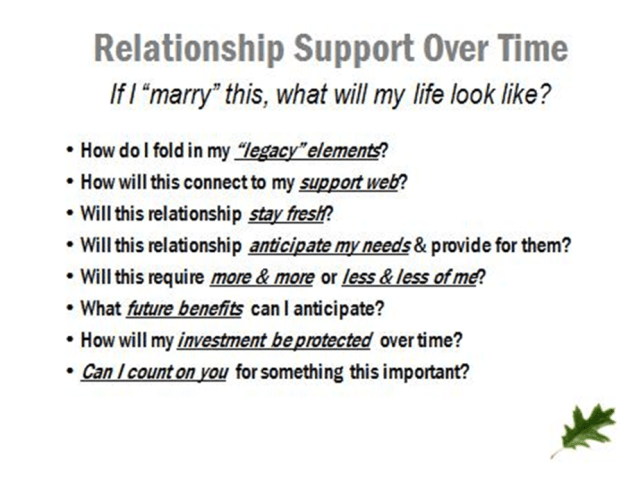
Value Exchange Relationships

Katherine took the customer research and turned it into the core of how she has helped countless companies since – people are in deep relationship with the objects of their life in a very similar manner to how they are in relationship with other people.

Little did I know that interview interaction would start a 25 year collaboration and friendship.

About the time I met Katherine, I met John Heskett at the Institute of Design at Illinois Tech. While on a sabbatical, John started synthesizing his life’s work into what he termed Value Creation Theory.  Recently, Clive Dilnot pulled together many of John’s writings into his book, Design and the Creation of Value.

“Heskett lays out the substantive principle of the organization of the seminar as follows:

In considering the economic role and value of design, two major aspects need to be discussed. Firstly, it is necessary to come to terms with the existing body of economic theory and practice and ask to what extent can it shed light on essential roles design can play in the context of business. Secondly, the way economic theory defines its field, and the tools and methods it uses, have come to constitute tightly defined forms of orthodoxy. Can design supplement or reinforce economic theory in clarifying and amplifying aspects of business in ways that at present are not commonly recognized? The question here is whether design theory and practice has the potential to add to, extend or provide linkages to economic theory. The organisation of this book is therefore broadly based on these two perspectives: one examining design from the standpoint of economic theory; the other examining economic theory and business practice through the prism of design.

The only caveat to Heskett’s explanation is that in fact, as the title of the seminar suggests, there are actually three, and not two, areas of concern here. There is design, for the book is, overall, essentially about how design can be understood and misunderstood (it is first of all a contribution to the understanding of design). There is economics – for the core of the book is a historical presentation and critique of economic thought vis-à-vis design. But there is also the third element, value. Value means here largely, but by no means only, economic value (for ultimately it is the extension of value creation beyond the economic narrowly thought that is Heskett’s concern). But value is the crucial third term in the equation because it is the essential mediator between economics and design. It is the introduction of ‘value’ as a concept lying between design and economics (but belonging fully to neither) that allows the dialogue to begin.

Design and the Creation of Value is, therefore, essentially the exploration of the relations between these three moments.”

Heskett, John. Design and the Creation of Value (pp. 5-6). Bloomsbury Publishing. Kindle Edition.

In previous publications, John diagrams the relationship of economics, design, and value:
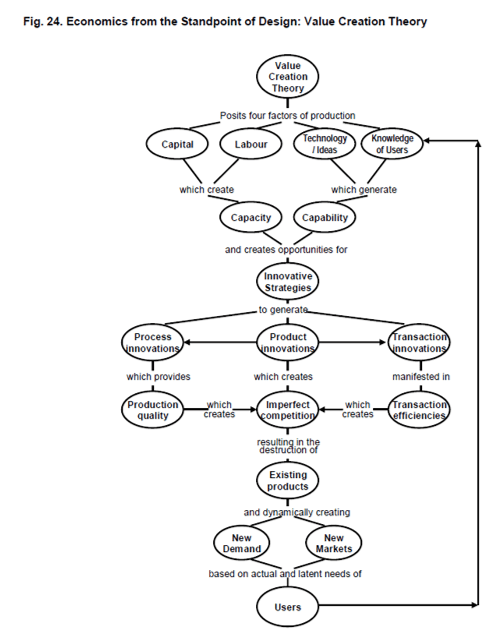
Value Creation Theory

After many discussions with John, I begged him to publish his early work.  It took another twenty years, but it finally got published.  In the mean time, I could not help myself.  I just had to add to John’s work with my experiences with creating new ventures and in mentoring other entrepreneurs.
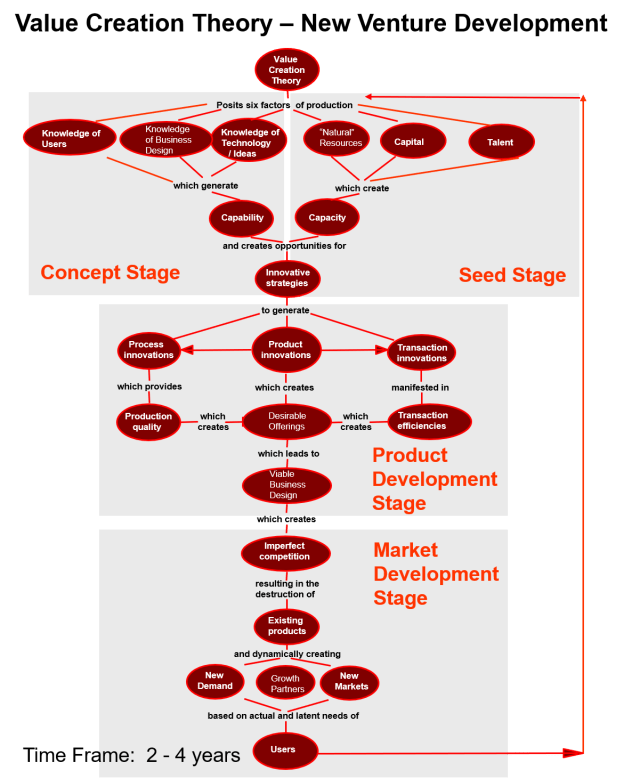
Value Creation Theory Extended

A couple of years ago, I extended my understanding of Value Co-Creation when I came across the book, Value as a Service: Embracing the Coming Disruption.

“We need to move to a concept that I call value as a service. It’s the simple idea that we promise that we will deliver to the customer something that will lead to quantifiable improvement: this much saved, this much improvement in lead generation, this much improvement in revenue, and this much improvement in employee retention.

In the future, every corporate purchaser will say, “You want me to buy what you are selling. Fine. Here’s the very specific, quantifiable set of outcomes I want. Prove to me that you are going to deliver them, and I’ll buy. If you can’t, I won’t.”

The relationship between buyer and seller should work like this. You’re going to pay a subscription fee, or pay for a product or service, and in return, we will give you something of value that can be clearly and distinctly articulated.

Bernshteyn, Rob. Value as a Service: Embracing the Coming Disruption . Greenleaf Book Group Press. Kindle Edition.

Shortly after encountering “Value as a Service”, I met Jim Spohrer of IBM research at a Computer Research Association visioning series of workshops.  He introduced me to the concept of Service Science that he had co-developed at IBM.  I had never heard of the discipline so I devoured everything that I could find in short order.  I was delighted to find a wealth of research and insights that helped resolve a fifty year management dilemma of mine – how do you manage both professional services and product development at the same time?  Over the years I’ve managed to do well with one or the other, but I’ve never been able to manage both simultaneously very successfully. Jim’s research provided a wealth of answers and insights.
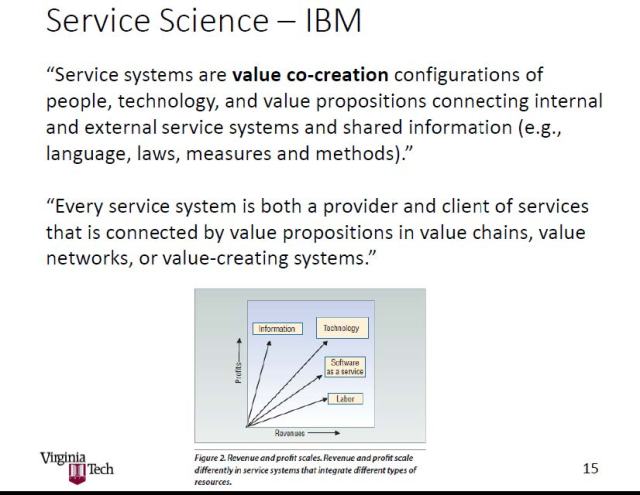
Value Co-Creation through Service Systems

Several key concepts from Service Science extended what I’d learned from Katherine and John and “Value as a Service” with Value Co-Creation being an important synthesis.

For conciseness, we think pay for performance is a reasonable definition of a service—in that this phrase captures the idea that what the provider does for the client is essential, as opposed to exchange of an artifact or a good being essential. However, combining Fitzsimmons and Fitzsimmons’s definition with Hill’s definition, a time-perishable, intangible experience performed for a client who is acting as a coproducer to transform a state of the client, reveals some other essential characteristics of services: namely, that the client plays a key role in coproduction activities (the client has responsibilities) and in the co-creation of value (transformed state of the client) (see also Sampson and Froehle 2006). To understand the notion of responsibility in a coproduction activity, consider a teacher telling a student to read a book and work a problem set (exercises) or a doctor instructing a patient to eat certain foods and exercise more. In both cases, the providers perform certain activities, but the clients must also perform activities that transform their own states or else the benefit or value of the service will not be fully attained. In business services, if the client does not install the new IT systems and train the necessary people in the reengineered process, the client will not receive the benefit of the service. Thus, the provider in many cases must negotiate to monitor and assess that the client is performing adequately on the client’s responsibilities, and, of course, the client needs to determine that the provider is likewise applying satisfactory effort and quality controls in the performance of the provider’s tasks. These issues become of paramount importance in outsourcing services, when a client may outsource a component of its business to a provider that is in a different country with different government regulations and national culture of the employees.

The next key concept from Service Science was how work evolves and cycles between professional services and products.  This diagram captures that sequence.
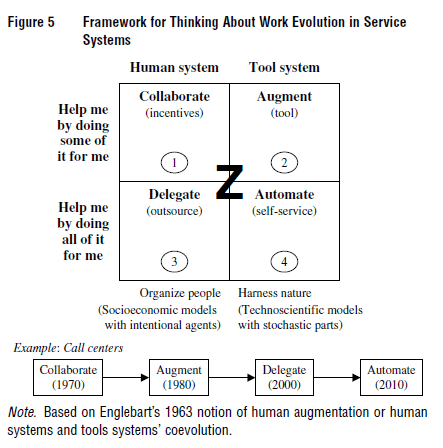
Work Evolution in Service Systems

The minute I saw this diagram was a head slapping moment.  Throughout my professional life of creating software products, I stopped at the Augment stage.  Then I went on to the next opportunity.  I never realized that there was a larger process and that the process was a cycle.  My future work is to take an important problem and go through the cycle, and then find the next important problem and repeat.

As part of trying to create Service Science, the authors tried to articulate principles that would allow the development of a theory.  While principles have not emerged yet, a series of premises have emerged.

Service Science Premises

Dan Pink in To Sell is Human points out the importance of “pitching” whether for a new venture or a new product or hiring a terrific talent.  Value co-creation is important in product development, and it is critical in product marketing and selling.  He points to research from Elsbach and Kramer on the importance of pitching AND catching:

“Kimberly Elsbach of the University of California, Davis, and Roderick Kramer of Stanford University spent five years in the thick of the Hollywood pitch process. They sat in on dozens of pitch meetings, analyzed transcripts of pitching sessions, and interviewed screenwriters, agents, and producers. The award-winning study2 they wrote for the Academy of Management Journal offers excellent guidance even for those of us on the living room side of the streaming video.

Their central finding was that the success of a pitch depends as much on the catcher as on the pitcher. In particular, Elsbach and Kramer discovered that beneath this elaborate ritual were two processes. In the first, the catcher (i.e., the executive) used a variety of physical and behavioral cues to quickly assess the pitcher’s (i.e., the writer’s) creativity. The catchers took passion, wit, and quirkiness as positive cues—and slickness, trying too hard, and offering lots of different ideas as negative ones. If the catcher categorized the pitcher as “uncreative” in the first few minutes, the meeting was essentially over even if it had not actually ended.

But for pitchers, landing in the creative category wasn’t enough, because a second process was at work. In the most successful pitches, the pitcher didn’t push her idea on the catcher until she extracted a yes. Instead, she invited in her counterpart as a collaborator. The more the executives—often derided by their supposedly more artistic counterparts as “suits”—were able to contribute, the better the idea often became, and the more likely it was to be green-lighted. The most valuable sessions were those in which the catcher “becomes so fully engaged by a pitcher that the process resembles a mutual collaboration,” the researchers found.3 “Once the catcher feels like a creative collaborator, the odds of rejection diminish,” Elsbach says.4 Some of the study’s subjects had their own way of describing these dynamics. One Oscar-winning producer told the professors, “At a certain point the writer needs to pull back as the creator of the story. And let [the executive] project what he needs onto your idea that makes the story whole for him.” However, “in an unsuccessful pitch,” another producer explained, “the person just doesn’t yield or doesn’t listen well.”

The lesson here is critical: The purpose of a pitch isn’t necessarily to move others immediately to adopt your idea. The purpose is to offer something so compelling that it begins a conversation, brings the other person in as a participant, and eventually arrives at an outcome that appeals to both of you. In a world where buyers have ample information and an array of choices, the pitch is often the first word, but it’s rarely the last.”

Pink, Daniel H.. To Sell Is Human: The Surprising Truth About Moving Others (pp. 157-158). Penguin Publishing Group. Kindle Edition.

Even at the start of an important endeavor, success in getting others to join you on the journey involves co-creating that value.

A very simple example of value co-creation showed up in my email as an invitation from the CEO of Arivale.  I just joined their health coaching offering and got the proverbial welcome email from the CEO.  Ordinarily, I ignore such marketing ploys.  However, I am impressed so far with the service, so I decided to respond.  I was delightfully amazed that the CEO (or surrogate?) promptly responded with an invitation to co-create.

Hi Skip,

I want to personally thank you for joining Arivale and placing your trust in us as you begin your journey.

When I think about our work at Arivale, I think about stories. I think of Kirby, who was motivated to turn his health around so he could be there for his young children. I think of Nita, who signed up hoping to lose the weight she gained after a knee replacement.

We started Arivale with the mission to empower individuals to transform their lives with a plan for taking action, one-on-one coaching, and personalized data. We’ve now seen thousands of people take control of their health, and we’re looking forward to helping you do it, too.

I invite you to reach out to me if you have questions or comments as you progress on your journey.

Congratulations on taking this big step. I’m rooting for you.

Clayton Lewis
CEO and Co-Founder

Clayton,
Thank you for reaching out.  I’ve heard about Arivale for years and was interested in some of the pioneer stories that led to Arivale founding (like from a UW professor colleague).  I have just started with a Coach and have enjoyed my multi-channel (telephone coaching, text messaging, and email exchanges) interactions with her.  I am looking forward to the results of the blood testing and gut testing to add further insights to my condition.  I realized that it was time to start dealing with my sleeping and weight issues.  I’ve already learned a lot and appreciate your coach’s help.  I look forward to learning more as we continue our interactions.
As I gain more experience with Arivale and achieving my health goals I look forward to continuing this conversation.
Thanks,
Skip Walter

Skip – I’m glad that you and our mutual colleague have talked. It has been a fantastic journey that started with leaders like our professor friend.

I look forward to hearing how your health continues to improve.

Please let me know if we can do anything to make the program more effective for you.

Best,

CL

It doesn’t take much other than a simple invitation to co-create value.  But how many of us feel duty bound to tell others everything we know, rather than looking for the opportunity to listen and co-create value.

Posted in Lifelet, Value Capture | Leave a comment

Lifelet: Coins Under My Pillow

Surprised by Joy.   I have always loved this title of a C.S. Lewis book.

This morning I was surprised by the joy of finding several coins under my pillow.

Coins under my pillow

My lovely bride surprised me once again.  As always, it brought a smile and started my day with great joy.

I also realized she is reading my blog posts.

A couple of days ago I did a post “Behold the Tooth Fairy.”  At the end I wrote:

Which got me to wondering again, if the tooth ferry is good enough for a child’s “first trauma” shouldn’t we have something this comforting for adult traumas.  While the trauma fairy doesn’t sound all that inviting, and the notion of God seems too big for a personal trauma, shouldn’t we invent an adult trauma fairy?

I feel the smile welling up within me as I think about reaching under my pillow and finding a gold coin (inflation sets in for adults, of course).  What a comfort that coin would be.

So this morning I found four coins under my pillow:

  • An Australian Dollar Coin
  • A Canadian Dollar Coin
  • An English Coin
  • A Token

The three foreign coins were reminders of several of the trips we’ve taken over our 40+ year marriage.

As an example of her impish humor, the token was for the Brown Bear Car Wash.   This token was a not so gentle reminder that our car needs washing.

Thank you, beloved, for starting my day off with a lot of joy and fond memories.

Posted in Humor, Lifelet | 1 Comment

Lifelet: Mourning Notre Dame Cathedral

I couldn’t watch.

My wife kept beckoning me to see the live coverage of the terrible fire at Notre Dame Cathedral.  I couldn’t bring myself to watch.  I wanted to keep my fond memories of several visits to the cathedral rather than images of the raging fire.

Instead I went to my Google Photos library to see if I’d uploaded any of my photos.  These photos are a small subset from our trip to France in November of 2009.

Notre Dame Paris

Notre Dame Paris

Notre Dame Paris

It was with great relief that we saw that most of the organ was saved.

As with many of our visits to the great cathedrals of the world, I love just sitting in the middle of the church and meditating on the beauty that surrounds me for hours.

I am deeply grateful for the many donors who are contributing to the fund to rebuild Notre Dame.  The world desperately needs the beauty that previous generations bequeathed us.

Posted in Lifelet, Travel | 1 Comment

Lifelet: Adult questions from a grand

Our oldest grand daughter wanted to go to church with us on Palm Sunday.  She loves sitting in the choir loft with her grandmother.  Sometimes she listens to the singing.  Sometimes she draws in her coloring book.  What I didn’t realize is that she listens to the gospel readings and the homilies.

The gospel for Palm Sunday was from Luke Chapter 22:14 – 23:56.  A subset of the reading is:

The Betrayal and Arrest of Jesus.d47While he was still speaking, a crowd approached and in front was one of the Twelve, a man named Judas. He went up to Jesus to kiss him.48Jesus said to him, “Judas, are you betraying the Son of Man with a kiss?”49His disciples realized what was about to happen, and they asked, “Lord, shall we strike with a sword?”e50And one of them struck the high priest’s servant and cut off his right ear.f51* But Jesus said in reply, “Stop, no more of this!” Then he touched the servant’s ear and healed him.52And Jesus said to the chief priests and temple guards and elders who had come for him, “Have you come out as against a robber, with swords and clubs?g53Day after day I was with you in the temple area, and you did not seize me; but this is your hour, the time for the power of darkness.”h

As we drove to our house for some after church collaborative painting, she asked “why was everybody so mean to Jesus?”  She couldn’t figure out why there was so much anger and violence.

“Can’t everybody just get along?  Why couldn’t they just talk it out? It was so rude what they did,” she continued.

I tried hard to stifle my laughter.  However, my wife in her wonderful way patiently explained some of the context.

As I listened to my wife’s explanation, I was reminded of what great questions these are for the many current divisions in our country.

As we shared her questions with her mom, she added “that sounds like her – we’ve been talking a lot about attitude and cooperation and how to work with others.”

I am so delighted that we have the gift of four lovely grand children.  I am excited that I now have the time to pay attention to the wonder of our world through their gifted eyes and ears.

Posted in Grand parenting, Lifelet | Leave a comment

Lifelet: Painting with the Grands

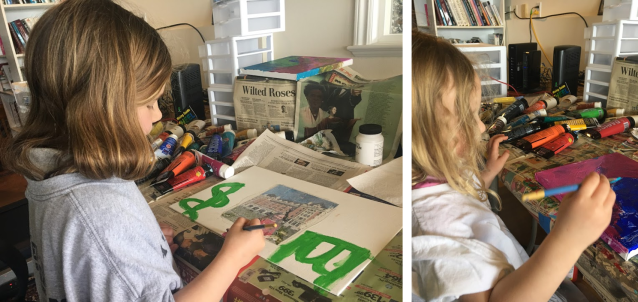
Along with painting myself into existence, I am joyfully introducing two of my grand children into the joys of acrylic abstract painting.

Painting with the grands

What amazed me as I started “guiding” them into acrylic painting was the many questions I asked of them as we moved along:

  • What color do you want to use now?
  • Where do you want me to place the color?
  • How much of the paint do you want me to put out?
  • Do you want it on the canvas or on the palette dish?
  • Which brush do you want to use?
  • How are you going to hold your brush?
  • What kinds of marks are you going to make with the brush?
  • Are we done yet?

And that was just one side of the decisions when we were doing collaborative art.  I had to answer all of those questions for myself.

Maybe the question I should ask more is – what does the painting need right now to move forward?

I am loving this optimal ignorance experimenting while at the same time trying to teach/guide the grands.

Posted in Lifelet | Leave a comment

Lifelet: A Blog a Day

I need to write myself into existence – again.

During times of stress I realize that I am not writing enough.  More importantly, I am not writing enough about topics other than business.

One of my favorite books is A Year with Swollen Appendices: Brian Eno’s Diary.  The author published a year of notes he made and I found the eclectic collection a joyful way to spend many hours.  Brian describes his journey into generative music in a diary entry:

“Of course, the real can of worms opens up with the new stuff I’m doing – the self-generating stuff.  What is the status of a piece of its output?  Recently I sold a couple of pieces as film-music compositions (a minor triumph, and an indication of how convincing the material is becoming).  I just set up some likely rules and let the thing run until it played a bit I thought sounded right!  But of course the film-makers could also have done this – they could have bought my little floppy (for thus it will be) containing the ‘seeds’ for those pieces, and grown the plants themselves.  Then, what would the relationship be between me and those pieces?  There is, as far as I know, no copyright in the ‘rules’ by which something is made – which is what I specify in making these seed programs.”

“For me, this is becoming a stronger body of work every day.  Having now had the chance to try out some of the work on lots of different people (even without telling them how it is being made), I am convinced of its musical worth.  Then the fact of its infinite self-genesis comes as an incredible bonus.   So I will be very happy if, at the end of it all, I get recognition as a pioneer in this area.  That in itself (given the way things have worked for me in the past) will also turn out to pay the bills.  It’s something to do with what Esther Dyson was saying about servicing an idea: if I let the idea free, then I get paid for servicing it – extending it, updating it, extrapolating from it.

“The end of the era of reproduction.”

In a previous variant of writing myself into existence, I came across Natalie Goldberg’s Writing Down the Bones: Freeing the Writer Within.  She encourages daily free writing:

“This book is about writing. It is also about using writing as your practice, as a way to help you penetrate your life and become sane. What is said here about writing can be applied to running, painting, anything you love and have chosen to work with in your life. When I read several chapters to my friend John Rollwagen, president of Cray Research, he said, “Why, Natalie, you’re talking about business. That’s the way it is in business. There is no difference.”

Learning to write is not a linear process. There is no logical A-to-B-to-C way to become a good writer. One neat truth about writing cannot answer it all. There are many truths. To do writing practice means to deal ultimately with your whole life. If you receive instructions on how to set a broken bone in your ankle, you can’t use those same instructions to fill a cavity in your teeth. You might read a section in this book that says to be very specific and precise. That’s to help the ailment of abstract, general meandering in your writing. But then you read another chapter that says lose control, write on waves of emotion. That’s to encourage you to really say deep down what you need to say. Or in one chapter it says to fix up a studio, that you need a private place to write; the next chapter says, “Get out of the house, away from the dirty dishes. Go write in a café.” Some techniques are appropriate at some times and some for other times. Every moment is different. Different things work. One isn’t wrong and the other right.

When I teach a class, I want the students to be “writing down the bones,” the essential, awake speech of their minds. But I also know I can’t just say, “Okay, write clearly and with great honesty.”

Goldberg, Natalie. Writing Down the Bones (pp. 4-5). Shambhala. Kindle Edition.

My latest reminder that I need to “write myself into existence” came from an announcement in my email from the On Being blog:

Sunday, May 12, 2019, 3:45 p.m.
Minneapolis, MN
Ross Gay
The Loft’s Wordplay Festival

Krista will interview poet Ross Gay. After his 42nd birthday, Ross promised to write a mini essay every day for one year to capture anything delightful. The Book of Delights is the culmination of this project — essays that all start with a simple moment and blossom into larger conversations, ranging from politics and racism to Ross’s mother and gardening. He is also the author of three books of poetry: Against WhichBringing the Shovel Down; and Catalog of Unabashed Gratitude, winner of the 2015 National Book Critics Circle Award and the 2016 Kingsley Tufts Poetry Award.

I immediately ordered the book and enjoyed the delights.  In the Preface, Ross reminded me yet again that it was time to Wake Up! and write:

“One day last July, feeling delighted and compelled to both wonder about and share that delight, I decided that it might feel nice, even useful, to write a daily essay about something delightful. I remember laughing to myself for how obvious it was. I could call it something like The Book of Delights.

I came up with a handful of rules: write a delight every day for a year; begin and end on my birthday, August 1; draft them quickly; and write them by hand. The rules made it a discipline for me. A practice. Spend time thinking and writing about delight every day.

It didn’t take me long to learn that the discipline or practice of writing these essays occasioned a kind of delight radar. Or maybe it was more like the development of a delight muscle. Something that implies that the more you study delight, the more delight there is to study. A month or two into this project delights were calling to me: Write about me! Write about me! Because it is rude not to acknowledge your delights, I’d tell them that though they might not become essayettes, they were still important, and I was grateful to them. Which is to say, I felt my life to be more full of delight. Not without sorrow or fear or pain or loss. But more full of delight. I also learned this year that my delight grows—much like love and joy—when I share it.”

Gay, Ross. The Book of Delights: Essays.  Algonquin Books. Kindle Edition.

My daily “Lifelets” are a way of noticing the world around me as I continue my resilience journey.

My commitment for the next year is to write a Lifelet a day.

Posted in Lifelet | Leave a comment

Lifelet: Photosynthesis

“What is the world according to Skip?” asked Gifford Booth early in our journey together in the TAI Tell course.

“Beats me” I replied trying to generate a little time to think.

“Instead of trying to tell me, why don’t you go to the flip chart and draw me the world according to Skip,” he suggested.

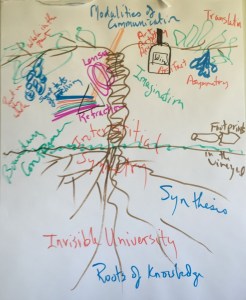
With a fist full of colored markers I drew the following:

World According to Skip

Thus began my Tell interactions.  TAI describes the Tell seminar as:

“In the words of Allen Schoer, creator of The Tell:

“A Tell is a mound, a hill, sometimes with layers of civilization actually built on top of it; and with layers of debris and dirt built on top of that. It’s a potential site of historical activity. There may be buried treasures underneath it.

The Tell is the site to be explored. It’s a place of great promise. It’s a place of infinite resources, great riches.

Each of us is a Tell site waiting to be explored. Each of us is a site of vast and infinite resources. You are a place of great promise with much buried treasure. This is too compelling an invitation to ignore – better to roll up your sleeves and dig in.”

After seeing my diagram, Gifford in his wonderfully supportive presence asked “can you describe your diagram in a single word?”

Without thinking, I blurted out “photosynthesis.”

Gifford asked “what was the thought process that got you from your diagram to photosynthesis?”

What followed was a stream of unconsciousness that flowed out.

I’ve always been a visual thinker which I realized when I started studying NLP.  They talk about the three primary information carrying senses as VAK (Visual Auditory Kinesthetic).  I realized I was primarily a visual thinker and in particular I use Visual Recall as my primary sub-modality.  I am not particularly good at the Visual Creating sub-modality.

In addition, I’ve worked quite hard to develop my synthesis skills after I was attracted to Russ Ackoff‘s description of synthesis.

“To understand “why” questions, you need to use a process of synthesis. Synthesis is the opposite process to analysis:

      1. Identify the system under study and then identify all the systems that the identified system is a part of.
      2. Understand the greater system of systems.
      3. Dis-aggregate the greater system back into the component systems.

Synthesis is about making sense of the whole.”

In drawing the diagram and responding to Gifford’s question I realized that tacitly I’ve been combining these two skills – visual recall and synthesis – into my way of thinking and being.  Photosynthesis nicely captures these two personal values.

In addition, the diagram tries to get at the more traditional meaning of photosynthesis in nature – what it takes to grow a plant.   I’ve focused on a subset of photosynthesis the last ten years – what it takes to grow fine wine.  I learned from Steiner‘s work on biodynamics that what goes on below the ground, particularly in what seems like the most dormant time (winter), is the most productive for the grape vine.  It is what is invisible in our minds that is the roots of our knowledge.  It is the outward manifestation of the green grape leaves and ultimately the fruit that captures our conscious attention.  Yet, the world just hears our words, not what is going on in the depths of our minds.  I like this notion of the Tell as it reminds me what we do all the time in the vineyard which is to look at the deep vine root structures.

Lastly, when I first started meditating, I created my mantra of “moving, flowing, flowering.”  To add a little meaning to the mantra, it is a reminder that before I can create I need to start moving.  Then as I move, I begin to effortlessly get into my Flow.  As the flow starts, I can start to feel myself flowering.  In my mind I go through the stages of the movement of the grape vine from dormant to greening to flowering to grape production.

As I think about this some more, I realize that “photosynthesis” is a natural outgrowth of the key idea I worked with in the Power and Presence seminar – “WAKE UP!” Wake up is a reminder to myself to pay attention and to look around me at the wonders of the world every day.  My natural tendency is to stay inside my head and not pay attention.  Wake Up!

“Thank you” offered Gifford, “that is a lot to absorb.  Now I want you to draw another diagram which we call the North Star.  Lay out a compass rose and label the four major points with your key discoveries from your Tell process.”

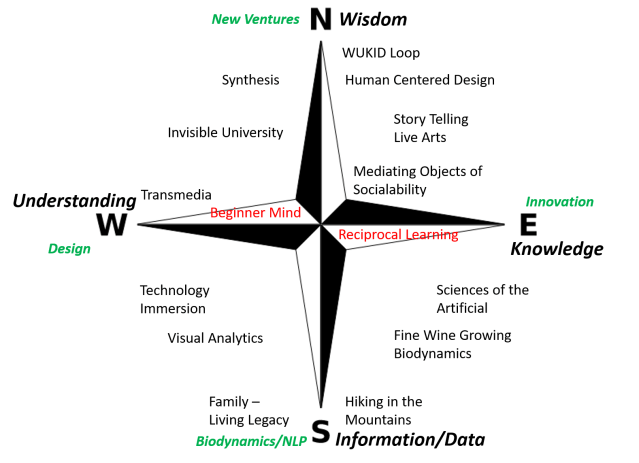
Drawing on the above, I used WUKID (Wisdom Understanding Knowledge Information Data) as my organizing principle.  WUKID is my shorthand for my lifelong learning process of moving from gathering data through the learning stages of information, knowledge, and understanding until I can arrive at Wisdom.

WUKID North Star

As I look at this diagram four years later, I am reminded of the digging into my personal TELL mound to unearth and organize these concepts.

Gifford then asked “now take these diagrams and represent them with a single photo and a little bit of text.”

Thanks Gifford.  This feels like yet another example of the “describe the universe and give three examples and you have ten minutes.”

What emerged was:

World according to Skip

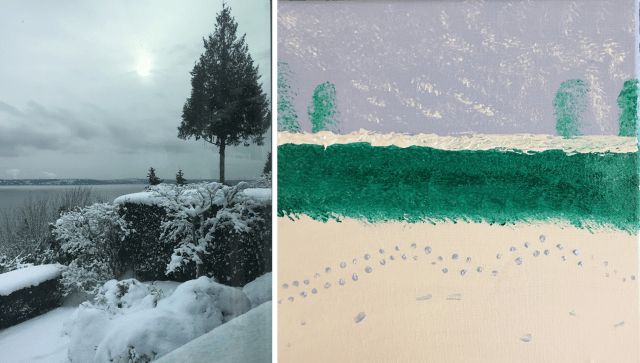
More recently, I am experimenting with acrylic abstract painting as a spiritual exercise on my resilience journey. Photosynthesis has taken on yet another new meaning – the synthesis of photography and painting.

Photosynthesis of my two creative joys

Each day I try to take photos with my always available iPhone and I attempt one experimental painting a day.  Both “creative acts” are a way to Wake Up!  As I start gifting my art work to friends, family and colleagues, I pair up my paintings with one of my photos to create a photosynthesis collage.

I love great questions and Gifford’s “what is the world according to Skip?” led to an unfolding journey into my personal Tell.

Posted in Flipped Perspective, Learning, Lifelet | Leave a comment

Lifelet: The Masters Lifts My Spirits Again

I am a terrible golfer.  I am a subscriber to the philosophy of “golf is a good walk spoiled.”

Yet, I love to watch golf in person at the great golf courses.  Augusta National and The Masters Tournament are my all time favorite venue.

Since we lost our family tickets to the Masters with the deaths of my wife’s parents, we are relegated to watching the Masters Tournament on TV.  We eat our homemade pimento cheese sandwiches and have a beer or two.  We pretend we are walking with 50,000 of our closest “patron’ friends.

I love naming the exact tee, or fairway or green before the announcers tell us where the players are.  The course is in my bones and I can feel and see every inch of this ode to nature.

We saw Tiger win there in 2002.  We saw Phil Mickelson win twice.  We saw Arnold Palmer play his last round at Augusta.

Phil Wins his First Major

NOTE:  In the photo above, I am between sitting and jumping as I celebrate Phil’s winning putt in 2004 on the first row of the 18th green.

We have a house full of Masters clothing and memorabilia.

And this year Tiger Woods won again for his fifth Masters victory and his 15th major tournament win.  Thank you Tiger for reminding us how amazing is your golf prowess and how beautiful the azaleas and majestic pines of Augusta National are.

As the rains came down during one of the rounds this weekend, I was reminded of the amazing technology to keep the greens and fairways dry.  On Saturday on one of our visits to Augusta the skies opened and the rain came down in buckets.  Yet, over the sound of the pouring rain I heard what sounded like jet engines cranking up.  It turns out that Augusta National installed a sub-air system to take any extra water out of the greens and fairways.  When the rains stopped, the golfers came back out and there was no water on the greens.  However, the spectator areas were awash in an inch of mud.

Amazing golfers, the beauty of manicured nature, technology, and inexpensive sandwiches and beer.  What a great way to spend four days.

I needed a dose of the Masters, Augusta National, and a triumphant Tiger Woods.  I recently finished a political book about golf.  It was as depressing as Tiger Woods was triumphant.

Rick Reilly, one of my favorite Sports Illustrated authors, just released a book, Commander in Cheat.  I didn’t expect a political tome, but maybe I should have, given that the topic was Trump.

Rick had me hooked with the line “the world of professional golf is slightly more Republican than a Cabela’s grand opening.”

Throughout the book Reilly exhibits his life long love of the game of golf.  Contrasted with his love of golf is the offense that he takes at Trump destroying the great game with his cheating and lying about his accomplishments.  Here a few quotes from the book:

“Somebody should write that the way Trump cheats at golf, lies about his courses, and stiffs his golf contractors isn’t that far from how he cheats on his wives, lies about his misdeeds, and stiffs the world on agreements America has already made on everything from Iran to climate change. “Golf is like bicycle shorts,” I once wrote. “It reveals a lot about a man.” You could write a book about what Trump’s golf reveals about him. Here it is.

Reilly, Rick. Commander in Cheat (p. 12). Hachette Books. Kindle Edition.

Golf + Trump is an odd couple, because in golf the most revered thing is not winning but honor. Jack Nicklaus may be the game’s greatest winner, but The King will always be Arnold Palmer, for the way he showed kindness to princes and plumbers alike. Bobby Jones was so taken with the idea of honor that he refused to turn pro, despite winning seven majors. Wasn’t gentlemanly.

Every day, in every tournament, in every state, players report violations on themselves that nobody else saw. Hale Irwin once missed the playoff at the 1983 British Open by one shot because he says he whiffed a one-inch putt on the final day. Nobody saw it but Irwin. In golf, that’s enough.

Reilly, Rick. Commander in Cheat (p. 28). Hachette Books. Kindle Edition.

Remember, Ricky, golf is a gentleman’s sport. —JACK REILLY

“WHEN JAPAN SURRENDERED AT the end of World War II, my Army lieutenant dad was assigned to duty in Tokyo. He’d heard that Emperor Hirohito played golf. So he went to the Imperial Palace and knocked on the guard house door. When they asked what he wanted, he said, “Well, I wondered if the emperor might like to play golf with me this afternoon.” That’s how it’s always been in my family. Golf solves everything. Our very bones are made of balata. The whole family golfs—nieces, nephews, uncles, aunts, nearly every single one of us. I can remember, when I was six years old, my mom, dad, and brother being on the pages of the sports section because they all were playing in the same tournament. I have an aunt who still wins her flight and she’s 91. We have a giant nine-hole family tournament every year—The Reilly Roundup—and everybody wears a yellow shirt, just like the one we buried my dad in.

So when a man like President Donald Trump pees all over the game I love, lies about it, cheats at it, and literally drives tire tracks all over it, it digs a divot in my soul and makes me want to march into the Oval Office, grab him by that long red tie, and yell, “Stop it!”

You can think Trump has made America great again. You can think Trump has made America hate again. But there’s one thing I know: He’s made golf terrible again.”

Reilly, Rick. Commander in Cheat (pp. 237-238). Hachette Books. Kindle Edition.

Sunday at Augusta came to a close with an epic Tiger Woods win and a temporary escape from the “Commander in Cheat.”  The New York Times took several articles to try and put into words Tiger’s Hero’s Journey:

“It was a monumental triumph for Woods, a come-from-behind victory for a player who had had so much go wrong on the course and off after his personal life began to come apart on Thanksgiving night in 2009.

As such, it was only fitting that after he walked off the 18th hole on Sunday, his one-stroke victory secure, his path to the official scoring office was gridlocked with well-wishers, including many of the golfers he vanquished over four grueling days at Augusta National Golf Club.

Woods triumphed in almost stoic fashion, playing with shrewdness and determination over the final stretch of holes while the other players who were grouped with him on the leaderboard took turns succumbing to the pressure of trying to win the Masters.”

Thank you Tiger!

Posted in Lifelet | Leave a comment