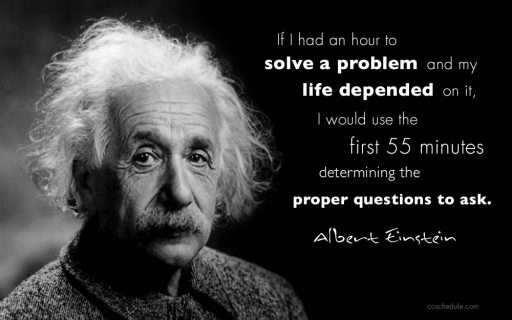
I live for good questions. A couple of weeks ago, the Brain Pickings Weekly digest had this quote from Krista Tippett’s Becoming Wise: An Inquiry into the Mystery and Art of Living:
“A question is a powerful thing, a mighty use of words. Questions elicit answers in their likeness. Answers mirror the questions they rise, or fall, to meet. So while a simple question can be precisely what’s needed to drive to the heart of the matter, it’s hard to meet a simplistic question with anything but a simplistic answer. It’s hard to transcend a combative question. But it’s hard to resist a generous question. We all have it in us to formulate questions that invite honesty, dignity, and revelation. There is something redemptive and life-giving about asking better questions.”
How does that work?
Gregory Bateson describes the role of questions and human computer interaction in Mind and Nature:
“There is a story which I have used before and shall use again: A man wanted to know about mind, not in nature, but in his private large computer. He asked it (no doubt in his best Fortran), “Do you compute that you will ever think like a human being?” The machine then set to work to analyze its own computational habits. Finally, the machine printed its answer on a piece of paper, as such machines do. The man ran to get the answer and found, neatly typed, the words:
“THAT REMINDS ME OF A STORY”
“A story is a little knot or complex of that species of connectedness which we call relevance. In the 1960s, students were fighting for “relevance,” and I would assume that any A is relevant to any B if both A and B are parts or components of the same “story”. Again we face connectedness at more than one level: First, connection between A and B by virtue of their being components in the same story. And then, connectedness between people in that all think in terms of stories. (For surely the computer was right. This is indeed how people think.)”
“Dad, how does a car work?” I asked as a lad of seven years old. Dad opened up the hood of our 1954 red Ford Convertible and showed me the maze of mechanical parts. He saw that I wasn’t understanding much. “Tell you what,” he said, “Tomorrow I will take you to tour the Ford Motor assembly plant and we’ll see how a car is made.”

As we toured the plant I was mesmerized by all these parts flowing together at just the right time to just the right person to then be manually installed. And every 30 seconds a new car would flow out the end of the assembly line. From that moment on, I’ve been fascinated with how things work AND how they are made AND how they are designed.
For a fun sidebar into the invention of the assembly line, see “Ford Historic Model T” video.
As I’ve grown older I’ve added to my “how” questions, the “what and why” partner questions to dig into understanding how things work and why they are made in the first place.
I keep six honest serving-men
(They taught me all I knew);
Their names are What and Why and When
And How and Where and Who.
I send them over land and sea,
I send them east and west;
But after they have worked for me,
I give them all a rest.
I let them rest from nine till five,
For I am busy then,
As well as breakfast, lunch, and tea,
For they are hungry men.
But different folk have different views;
I know a person small-
She keeps ten million serving-men,
Who get no rest at all!
She sends’em abroad on her own affairs,
From the second she opens her eyes-
One million Hows, two million Wheres,
And seven million Whys!
Rudyard Kipling
Over the years I’ve found that questions are the drivers of my learning and innovation and action.
The Importance of Questions and Inquiry
This document captures a recent discussion on the intersection of the TAI Group founding principles surrounding inquiry and discovery and my own pursuit of the power of questions.
Near the end of our TAI Narrative session as we explored the higher level categories of themes from our discussions, we dug into The WORK of the TAI Group. The discussion centered on the role of questioning and mirroring as key components of The WORK. The WORK is about searching, questioning and uncovering. The TELL illustrates The WORK at the personal level. The Narrative process illustrates The WORK at the whole corporation level.
Allen (AS) asked “is questioning the way we help people ACCESS?”
I said that the embodied ability to ask good questions is what has attracted me to TAI’s WORK and all of the partners and coaches. There is an innate and intentional curiosity that is present in each conversation. The ability to ask good questions is a part of my checklist for understanding how to build software with artistry.
The following is a transcript of the relevant part of the conversation (lightly edited) on Narrative from 5/27/15 (at 1:42:16 in the recording):
AS: Skip, does that speak to you? The questioning and mirroring?
SW: Yes! In a couple of different ways. One is looking at the Artificial Intelligence (AI) work and IBM’s Watson platform. They are all about the answers. It is assuming that a human is asking the questions and it is about giving you the answers. The other way is implicitly what Google and every search engine is about. They are all about the answers and not the questions.
SW: There is an interesting article in my daily reading of a stream of eDiscovery and Knowledge Management blogs applying Watson to the legal space (see note below – “Dear Watson – I have a question for you!”). Lawyers are saying “Watson, you are coming about it all wrong for our space – you need to generate the questions we need to be asking, not the answers.” What is not obvious from what we’ve been doing since day one of our interactions in thinking about replicating what the coaches do is that the software system has to generate the questions. So part of the design is seeing that there is a structuring to the questions and the structure is derived from the principles. Can we find the questions that are evocative and provocative in the moment? This is where the fundamental and real intelligence of the system will be.
We can go a long way with just stock questions, but the real art form is when we can see patterns and generate questions that you wouldn’t think to ask a priori. That is really how we want the system to work.
From the beginning of our journey together generating questions has been a primary concern in my mind. What can we do in software to reflect the nature of the TAI work on mirroring and questions? I am realizing in this moment that I haven’t made that explicit in our discussions. That is what I’ve been looking for. That is why I am not worried about any competition, because they are all focused on answers.
It is where everybody misses the boat. In Western education we are taught to provide answers. I think I’ve shared that when I am speaking and I have a collaborator in the audience, I always ask them not to capture notes on answers I give. I can recreate the answers. What I can’t remember or recreate are the questions that people ask of me. I have not found a single collaborator who will record the questions. They seem incapable of even hearing the questioning and remembering to take them down. What I get back is notes on my answers. Generating answers is wired into us, not asking good questions. This insight is the break through and part of what I was looking for at TAI. I saw this spirit of inquiry from the beginning. The WORK is a questioning and inquiry process.
Is the TAI work so idiosyncratic that it can’t be reproduced or is there a structure to it? I keep seeing more and more structure to THE WORK.
AS: I remember the questions, not the answers.
SW: You are wired differently than 99% of Western educated folks. That is the challenge. Our schooling is so wired to handle answers, not questions. [See section below on “Beating the System” by Russ Ackoff.]
AS: A simple practical example is facilitating. You ask a team a question, you reflect back, and the team goes down the road with twists and turns, and you are monitoring where it going, etc, etc. At some point you have to bring them back. More than sometimes, they will say where are we? What did we start with? The facilitation skill is be able to say “this is the question that set us on the journey. Let’s go back and look at addressing the question.” The retaining of the question by a facilitator is an occupational necessity.
SW: But as a participant, when we go into participant mode, we go back to being a student. We go back to second grade and want to generate right answers.
AS: So a primary question, of who is this guy Skip for me has been just what we are talking about now. How do you ever put the TELL out there because it will cause this mirroring and its questioning?
SW: Recently, I saw this in an interaction with a Big Pharma market research team that was going through P&P with Sam. The last time I was here I went up to the team leader and tried to put her at ease by sharing “you are going to be seeing me taking a lot of notes. I am not recording any of the answers or proprietary information of your group. I am capturing Sam’s questions.” She went “Oh, why would you do that?” I thought it was self-evident, particularly for a market researcher. However, I answered “It is just a thing I do. I want to be clear that I am not taking any notes on anything that is company confidential. I am interested in the questions that Sam is asking.”
AS: This is a major foundational piece in our journey coming center for us. I appreciate it a lot.
SW: Sorry I haven’t made it explicit. But it is a part of what I’ve been listening to in all of our sessions and from our first meeting in Seattle. It is a different way of sharing when Gifford reacted strangely to the technology demonstration at BlinkUX. It was a different way of asking a question. I thought to myself great. He’s not just sitting and listening. He is asking questions all the way through our interactions that he may not be able to articulate yet. OK, cool.
AS: When I briefly share with someone that we are exploring what we can do in the world of digital, the questions that come back to me are of the form: “You will be able to give us advice in a digital format, right?” And I can’t go further than that because that is anathema to what we are about. I didn’t know how to take the conversation any further to articulate what is underneath. Now, I understand and can share we are providing engines that keep the searching and inquiry and discovery going.
SW: In one of the documents that I sprayed out early on in our interaction, I included the Gregory Bateson story of how will we know the day that machines become intelligent. He tells the story in the old days of computing when a Fortran program was listening to and interacting with somebody. The day the machine became intelligent is when it responded “that reminds me of a story.”
That’s the other side of this questioning. To provide not an answer, but to pull a story into the conversation. This is the other piece of what y’all do. P&P is structured one way and the TELL is structured another. The stories and the questions are interleaved but in a different order. On my good days, I never answer a question. I let the story carry the learning. The learning is carried with the questions that are buried in a good story.
Gifford (GB): We’ve talked about this. I got it. I knew this somewhere along the way, probably after you did your P&P.
SW: I know that Graeme has asked me several times if I am worried about competitors. I give him answers in the moment, but I’ve forgotten to give him the “On Questions” context as it is the most important reason we are not going to have competitors soon. For everyone else, it’s all about the answers. To Google’s credit, they are a multi-billion dollar company providing answers. I’d like to have that revenue. I suspect TAI competitors are about answers. The customer asks “How do I present better?” And they go, here is the answer. Here is the formula.
Graeme (GT): It’s not just about the questions. It’s about continuing to learn from the range of questions that are asked. You referred to this very early on when you referred to Kasparov and DEEP BLUE. We need to be able to put a machine in place to learn dynamically from what we are doing so that we can ask the same questions that we ask during the coaching sessions.
SW: That’s part of the patterns.
GT: Knowing in real time what questions to ask depending on who is on the other side of that camera.
SW: The other thing that I’ve experienced with y’all is Russ Ackoff’s approach to questions. We used to joke about the Ackovian Existential crisis which is Russ’s gift and curse. Whatever question you asked him he would ask a better question back.
GT: I know a guy like that.
SW: For me that is powerful learning. However, it is very frustrating on a day when you need to get something done quickly.
AS: You raise an intriguing point – if the world is made up of companies who’ve made billions on providing answers. What is the market for questions?
SW: That is the innovation and the twist of moving out of working on efficiency (getting answers) to working on effectiveness (generating better questions) that we want to be the leader in. Innovation by any other name. If we time this right, this is the new game. If our timing and approach is right, we will create the innovation and narrative economy.
The Legal Industry and Questions, not Answers
From Dewey B. Strategic Blog:
Dear Watson – I have a question for you! Watson & Legal Research: We know it can answer, but can Watson ASK questions?
My colleague Ron Friedmann @ronfriedmann posted an interesting question on his blog Prism Legal today. He is collecting “crowd sourced” questions which he can ask at this week’s IBM’s World of Watson conference. I am fully booked, so I can’t attend, but I have a question for Ron to ask on my behalf: “Can Watson ask questions?”
Answers are Easy – Questions are The Sign of a Pro!
The test of Watson as a legal researcher will not be whether it can provide a generic legal answer but whether it can ask the necessary series of narrowing questions to help a lawyer define the answer that she/he really needs.
I am puzzled by the rather giddy certainty among the “legal techno pundits” suggesting that since Watson has made such great strides in responding to medical questions from doctors, that it will soon be the ultimate 24/7 associate—-Spewing answers at midnight and never uttering a word about work-life balance. Will it really be that easy to teach Watson to conduct legal research in in the next decade?

Medical Research vs Legal Research
Although I claim no expertise in medical research, I know enough about the evolution of online medical research systems to suspect that there is at least one significant difference between medical and legal research. Medical information has the benefit of having a comparatively standard and nearly universal taxonomy. Symptoms, diseases, diagnoses, adverse reactions are the same in each state and in each country. Measles are the same in New York and California.
But the law???? There is no standard naming convention across the federal government and the 50 plus jurisdictions of the United States. Terminology and even the definitions of ordinary words such as “person” or “homicide” could differ wildly when you cross state lines. Then there are such unruly concepts as elements, defenses, statutes of limitations, jurisdictional and procedural issues. And yet we are not done. The federal government and each of the fifty states have not only enacted laws but they each have courts which interpret the application of laws.
Then there are the administrative agencies which generate regulations for the federal government and each state – which explain how to comply with those laws. These agencies may have quasi- judicial enforcement arms which generate even more interpretive materials. I am not even going to mention, municipal laws, county zoning, equity, conflict of laws, international treaties, SRO’s (self-regulatory organizations), the ABA or state bar ethics rules…. and I trust my readers will come up with a dozen more sources of laws and compliance which lawyers need to take into consideration.
Comparing 50 state Laws
Let’s look at the existing state of legal taxonomy and the standardization of legal concepts across the US. West/Thomson Reuters developed the most sophisticated taxonomy and normalizing framework for US legal research in its topic and key number system which is compiled in the “Analysis of American Law.” Even its detractors have to admit that it is the closest thing we have to a taxonomy of US law – and it took over 100 years to develop!
Yet lawyers still struggle to find new tools which modulate and standardize the analysis of laws across the 50 states.
Compiling a “50 state survey” on a single issue used to be a surefire summer project which might take an associate a whole summer to complete! Thankfully the major legal publishers have spent the past decade trying to tame this particular beast. And today… if an associate gets such an assignment and has access to a savvy research professional – they may find that a comparison chart, survey or “smartchart” on their issue can be generated in a matter of seconds using one of the premium legal research services (LexisNexis, Blaw, Westlaw, Wolters Kluwer.) But the development of these charts involved a lot of “heavy lifting” by each publisher. There are still thousands of legal issues which have not yet been tackled by any of the majors.
It is in fact, a day for celebration when one of major legal publishers releases a new topical survey or a new tool for comparing 50 state laws which normalizes and highlights the differences and commonalities of laws on a single issue across the country.
Can Watson conduct a research interview?
Watson may get there, but I remain convinced that the biggest challenge for Watson may be learning to ask the series of contextualizing and narrowing questions that must follow a simple and common question such as “What is the statute of limitations for breach of contract?” Can a lawyer accept a google-ized /wikipeidi-ized generic answer which is not curated to address the specific facts of his client’s situation? We all know the frustration of hearing this standard Siri refrain “I don’t know ‘mens reä.’ ” Legal advice requires a higher level of precision than a Jeopardy-style fact based query. This is not a slam dunk.
A Humble Suggestion: I just suggest that Watson’s developers find some research librarians who have served serious “hard time” at a large law firm reference desk to run Watson through the paces. If Watson is to master legal research it needs to learn how to ask questions from the pros!
Russ Ackoff on Questions for Creativity
Types of Constraining Assumptions
“Our behavior is constrained not only by the assumptions we make about others and ourselves but also by the assumptions the systems and organizations with which we interact make about us. Four types of assumptions constrain behavior:
- Assumptions the system makes about us. (We will not break the rules.)
- Assumptions we make about the system. (The system is unyielding and won’t allow deviation.)
- Assumptions the system makes about itself. (The system functions correctly.)
- Assumptions we make about ourselves and others. (We are powerless to change the system or influence the boss.)
“Most assumptions made in and about organizations usually go unquestioned, and their validity is taken to be “self-evident” which means evident to oneself and no one else. “Obvious” does not mean “requiring no proof” but “no proof is desired.” Examples of typical assumptions that go unquestioned are “The boss won’t go for it,” “It costs too much,” and “We can’t do it because it’s never been done this way before.” Regardless, beating a system requires challenging the assumptions the system is using to beat us or we are using to beat ourselves. Denying an underlying assumption and exploring the consequences are at the heart of system beating and creativity.”
How Creativity is Suppressed
“Many people think of themselves as not being very creative. Often a supposed lack of creativity is used as an excuse to not even try to beat a system. Before concluding that beating a system is beyond one’s capabilities because it involves creativity, ask why most children display great creativity, but few adults do. Children are very creative because they focus on what they want, not on what they have to settle for because of the constraints, as adults do. Children up to about preschool age don’t even know what constraints are; they don’t make assumptions that dictate their behavior.
“The difference between children and adults suggests that the creativity that comes to children naturally is suppressed or lost in some way in the process of growing up. If this is the case, hope exists for resuscitating what was once there by becoming aware of what it was that was lost and why.
“The suppression of creativity in children takes place in school and at home. Teachers (and parents) present problems and questions to children from the beginning of their schooling until its end. For each question or problem they present, with few exceptions, they have an expected acceptable answer. To achieve, academic success, students at all levels must learn how to provide those in a position of authority with the answers they expect. An answer they do not expect, however right or creative it might be, is considered to be wrong.
“Jules Henry (1965), an eminent American anthropologist, asked what would happen “if all through school the young were provoked to question the Ten Commandments, the sanctity of revealed religion, the foundations of patriotism, the profit motive, the two party system, monogamy and so on.”
“Ronald Laing (1967), the distinguished British psychiatrist, replied that there would be more creativity than society could handle. Therefore, “What schools must do is to induce children to want to think the way schools want them to think. ‘What we see,’ in the American kindergarten and early schooling process, says Jules Henry, ‘is the pathetic surrender of babies.” Postman and Weingartner (1969) put it another way when they wrote, “Children enter school as question marks and leave as periods.”
Examples of Suppression
“On a geometry exam, a high school student offered proof of a theorem that was different than the one the teacher gave in class. The proof was marked wrong despite its actually being correct. (The student’s uncle was a mathematician and corroborated the proof.) The teacher acknowledged the correctness of the proof but defended the grade by saying that the proof was not the one she wanted. The student learned a lot from this, although not about geometry. He learned that he would be punished for thinking creatively.
“During World War II, one of us attended Officers Training School for the U.S. Army Corps of Engineers. A young lieutenant drafted as an ROTC member from an engineering program taught one of the classes. He made a statement about structures that one of the students who had a degree in structural engineering said was incorrect. The student offered a correct statement. The instructor obviously resented the interruption and ignored it, going on to another subject. The student who had broken into the lecture subsequently was called up by a captain and told he was not to correct an instructor in class. The student objected, saying the instructor had been wrong and this could lead to significant and costly errors. The captain told the student that an instructor is to be taken as right even when he is wrong, and an interrupting student is wrong even when he is right.
“In these examples it was made abundantly clear to students that they were expected to feed back what had been fed to them – nothing more or less. Good bye creativity! Whatever else creativity does, it produces surprising results; it defies expectations. If no surprise is produced, it is not creative. And generally, teachers and those in control don’t like surprises, that is, challenges to their authority.”
Resuscitating Creativity
“The domains in which creativity is applicable have no limit. These domains include the artistic creativity of a Shakespeare or a Picasso, the scientific creativity of a Galileo or an Einstein, and the political creativity of a Gandhi or Martin Luther King Jr. One does not need the creative abilities of any of these famous people to be creative in beating a system. What is needed is to share the conviction all of them had, namely, that doing things the way they’ve always been done and thinking about things in the way they have always been thought about is not particularly virtuous.
“To be creative is, simply, not to be bound by the limits and constraints imposed by conventional or traditional ways of thinking and doing things. The question, then, is how to remove these constraints and do something that would not ordinarily be done.”
The above paragraphs are from Beating the System by Russell L. Ackoff and Sheldon Rovin, pp. 28-32.
I had the pleasure of working with and being mentored by Russ Ackoff in the early 1980s. One of the results of this work was the “Idealized Design of a University” where we incorporated many of Ackoff’s ideas and principles to change the educational model to focus on questions. Aspects of this design can be found at:
He Makes Me Think
From my blog post “Lifelet: He Made me think!”
In 1981, I worked for an executive vice president at Digital Equipment Corporation, Don Busiek. Whenever Don would introduce me to someone, he would say “I would like you to meet Skip Walter. He makes me think.”
I took that as the highest compliment anyone had ever given me.
Whenever I would be in a seminar where they would do the Tombstone Exercise (what would you like to have on your gravestone?), I would always answer “He Made Me Think!”
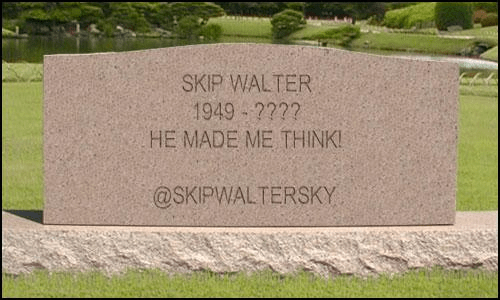
Several years after I left Digital Equipment, I ran into Don and thanked him for his wonderful compliment of “he makes me think.” Don laughed and said “You know I never meant that as a compliment. Whenever I asked anyone else who worked for me a question, they gave me the answer. You’d start asking me questions and make me have to think for myself to get at the answer. I hated that, particularly when I was in a hurry.”
We both laughed and went on our separate ways.
I like my version better.
It’s probably why I enjoy teaching so much. Or as my graduate students would now channel Don Busiek in a different way “Skip, enjoys torturing us so much by making us think.”
Interviewing Potential Employees
Over my thirty years of managing and interviewing hundreds of candidates for positions in my organizations, I realized that I changed my interviewing technique. When I started as a young manager, I used the question and answer, challenge and response format for the interview. I was analytical and interested in digging into the experience and knowledge that a candidate had.
By the time I became the Founder and CEO of Attenex, I asked only one question “do you have any questions for me?”
Amazingly, no matter what discipline the candidates came from – software developer, sales person, marketing person, or administrative – at least 80% of the prospects either had no questions or just one or two trivial closed ended questions. These were very short interviews. Even if the candidate was otherwise qualified, I realized that it was critical for our startup culture that the kind of innovative employees we needed had to have a spirit of inquiry.
Data-Driven Decision Making at Google – On Experiments
From a blog post at Smart Data Collective by Bernard Marr:
“Google is a company in which fact-based decision-making is part of the DNA and where Googlers (that is what Google calls its employees) speak the language of data as part of their culture. In Google the aim is that all decisions are based on data, analytics and scientific experimentation.
“In Google today, the aim is to start with questions and be very clear about the information needs at the outset. Their executive chairman Eric Schmidt says: “We run the company by questions, not by answers. So in the strategy process we’ve so far formulated 30 questions that we have to answer […] You ask it as a question, rather than a pithy answer, and that stimulates conversation. Out of the conversation comes innovation. Innovation is not something that I just wake up one day and say ‘I want to innovate.’ I think you get a better innovative culture if you ask it as a question.”
Fact-based Decision-Making at Google
“Within their global HR function, Google has created a People Analytics Department that supports the organisation with making HR decisions with data. One question Google wanted to have an answer to was: Do managers actually matter? This is a question Google has been wrestling with from the outset, where its founders were questioning the contribution managers make. At some point they actually got rid of all managers and made everyone an individual contributor, which didn’t really work and managers were brought back in.
Project Oxygen
“Within the people analytics department Google has created a group called the Information Lab, which comprises of social scientists who are part of the people analytics department but focus on longer term questions with the aim of conducting innovative research that transforms organisational practice within Google and beyond. This team took on the project of answering the question: Do Managers Matter – code named ‘Project Oxygen’. So the objectives and information needs were clearly defined.
What Data to Use?
The team first looked at the data sources that already existed, which were performance reviews (top down review of managers) & employee survey (bottom up review of managers). The team took this data and plotted them on a graph which revealed the managers were generally perceived as good. The problem was that the data didn’t really show a lot of variation so the team decided to split the data into the top and bottom quartile.
Analytics
“Using a regression analysis the team was able to show a big difference between these two groups in terms of team productivity, employee happiness, and employee turnover. In summary, the teams with the better managers were performing better and employees were happier and more likely to stay. While this has confirmed that good managers do actually make a difference, it wouldn’t allow Google to act on the data. The next question they needed an answer to was: What makes a good manager at Google? Answering this question would provide much more usable insights.
New Data Collection
“So the team introduced two new data collections. The first was a ‘Great Managers Award’ through which employees could nominate managers they feel were particularly good. As part of the nomination employees had to provide examples of behaviours that they felt showed that the managers were good managers. The second data set came from interviews with the managers in each of the two quartiles (bottom and top) to understand what they were doing (the managers didn’t know which quartile they were in).
The data from the interviews and from the Great Manager Award nominations was then coded using text analysis. Based on this the analytics team was able to extract the top 8 behaviours of a high scoring manager as well as the top 3 causes why managers are struggling in their role. If you would like to know the eight factors that make a great manager in Google and the three that don’t then read my separate post on it: 8 Behavious that make a Great Manager at Google – and 3 that don’t
Using the Insights
Google used different ways of sharing these insights with the relevant people including a new manager communication that outlined the findings and expectations. But only sharing the insights wasn’t enough, Google saw a need to act on the insights. There were many concrete actions that followed this analysis, here are some key ones:
- Google started to measure people against these behaviors. For that purpose it introduced a new twice-yearly feedback survey
- Google decided to continue with the Great Manager Award
- Google revised the management training
An Intelligent Company
Google is a great example of how good decision-making should be supported by good data and facts. Google clearly followed the five steps I outline in my book ‘The Intelligent Company: Five steps to success with Evidence-based Management’:
- Defining the objectives and information needs: ‘Do managers matter?’ and ‘What makes a good manager within Google?’
- Collecting the right data: using existing data from performance reviews and employee surveys and creating new data sets from the award nominations and manager’s interviews.
- Analysing the data and turning it into insights: simply plotting of the results, regression analysis and text analysis.
- Presenting the Information: new communications to the managers
- Making evidence-based decisions: revising the training, measuring performance in line with the findings, introducing new feedback mechanisms.
QBQ – The Question Behind the Question
“The one thing I’ve learned in my thirty years of teaching undergraduates and graduate students is to never answer a question that is asked of me,” said Professor Ed Lazowska of the University of Washington Computer Science and Engineering Department. We were sitting around a conference table at Preston Gates and Ellis and Ed was sharing his thoughts on what we could do to get increased funding for STEM education in Washington State.
“What I find is that behind every question is a misunderstanding that caused the question,” Ed continued. “If I just answer the question as asked, I won’t help the student. So I dig behind the question and ask the student several questions to get at what is their misunderstanding. Each question I get is an invitation to a dialog for learning. The student is not looking for an answer. They are looking for understanding. My job is to find that misunderstanding that caused the question to be asked.”
Like so many good insights, you can even find a book about QBQ – QBQ! The Question Behind the Question: Practicing Personal Accountability at Work and in Life.”
On my good days I remember to dig for the misunderstanding whenever I am asked a question.
The Sociometer – Honest Signals: How They Shape Our World
The following is from promotional materials for the book Honest Signals. The capabilities of the sociometer will be built into the TAI Interactive Virtual Coach.
“The group of rising-star business executives gathered at MIT for an important task: each executive would present a business plan to the group, and then the group would choose the best ideas to recommend to a team of venture finance experts. It was a great opportunity. The skills they each required-the ability to clearly formulate ideas, effectively communicate to a group of peers, and then persuade others to pursue those ideas-are indispensable in business as well as everyday life. These executives had each spent more than a decade building their strengths.
“Not only the other group members were watching and evaluating the business plan pitches, however. A sensitive, specially designed digital device was also monitoring each presentation. This device – we’ll call it a sociometer – wasn’t recording what each person said in their presentation but rather how they said it.’ How much variability was in the speech of the presenter? How active were they physically? How many back-and-forth gestures such as smiles and head nods occurred between the presenter and the listeners? This device was measuring another channel of communication that works without spoken language: our social sense.
“At the end of the meeting, the group selected the ideas that they agreed would sell the best. At least that is what they thought. When the venture finance experts were given the plans to evaluate-this time on paper, rather than via a live presentation-there was little similarity between the two groups’ judgments. Each group had a different opinion of which business plans were most likely to succeed. Why?
“Our up-and-coming executives didn’t pick different business plans simply because they weren’t as seasoned as the venture finance experts. Remember our other observer in the room-the sociometer? As it turns out, the sociometer was able to predict which business plans the executives would choose with nearly perfect accuracy. Both the sociometer and our executives (even though they didn’t know it at the time) were busy measuring the social content of the presentations, quite apart from the spoken, informational part.’ And which channel of communication-social or spoken-informed more of their final decision? Yes, the social channel.
“The executives thought they were evaluating the plans based on rational measures, such as: How original is this idea? How does it fit the current market? How well developed is this plan? While listening to the pitches, though, another part of their brain was registering other crucial information, such as: How much does this person believe in this idea? How confident are they when speaking? How determined are they to make this work? And the second set of information-information that the business executives didn’t even know they were assessing-is what influenced their choice of business plans to the greatest degree.
“When the venture finance experts saw the business plans, however, this social channel of communication was purposely removed. They saw the plans written on paper only-with no live presentation. With the social sense disconnected from the decision, the venture finance experts had to evaluate the plans based on rational measures alone. Unfortunately for them, research has shown that investments made without that “personal connection” are far more likely to fail.
“This is why venture capital firms normally only invest in companies they can visit regularly in person, and why many investors pay more attention to the face-to-face interaction among the company’s founders than they do to the business plan itself. This study, along with many others, leads us to a surprising yet illuminating conclusion: people have a second channel of communication that revolves not around words but around social relations. This social channel profoundly influences major decisions in our lives even though we are largely unaware of it. This idea lies at the heart of this book. My goal is to show you how powerful and pervasive this form of communication is in our daily lives, how it changes the way we think of ourselves and our organizations, and how you can make use of this information to better manage your life.”
[NOTE: In the book, the author shares that a key part of the interaction with the audience is how the presenter listens to and answers questions.]
WHAT THIS BOOK IS ABOUT
“Honest Signals comes from a new and emerging science, called network science that tries to understand people in the context of their social networks rather than viewing them as isolated individuals. Historically, our understanding of human society has been limited to relatively sparse observations of individuals or small groups because we have had only simple measurement tools. Recent advances in wireless communications and digital sensors have made it now possible to observe natural, everyday human behavior at a level of detail that was previously unattainable. The result has been revolutionary measurement tools, such as the sociometer mentioned above, that provide us with a “God’s eye” view of ourselves.
“For the first time, we can precisely map the behavior of large numbers of people as they go about their normal lives. By using cell phones and electronic badges with integrated sensors, my students and I have observed hundreds of participants for periods of up to a year. In the process we amassed hundreds of thousands of hours of detailed, quantitative data about natural, day-to-day human behavior-far more data of these kind than have ever been available before.’
“A new measurement tool such as this often brings with it a new understanding of what you are measuring. What we have found is that many types of human behavior can be reliably predicted from biologically based honest signaling behaviors. These ancient primate signaling mechanisms, such as the amount of synchrony, mimicry, activity, and emphasis, form an unconscious channel of communication between people-a channel almost unexplored except in other apes.
“These social signals are not just a back channel or complement to our conscious language; they form a separate communication network that powerfully influences our behavior. In fact, these honest signals provide a quite effective window into our intentions, goals, and values. By examining this ancient channel of communication, for instance-paying no attention to words or even who the people are-we can accurately predict outcomes of dating situations, job interviews, and even salary negotiations.
“We have shown that people’s behavior is much more a function of their social network than anyone has previously imagined. Humans are truly social animals, where individuals are best likened to musicians in a jazz quartet, forming a web of unconscious reactions tuned to exactly complement the others in the group. What the sociometer data demonstrate is that this immersion of self in the surrounding social network is the typical human condition, rather than being isolated examples found in exceptional circumstances.
“Why does this ancient communication channel exist? What does it do? Data from biology show that honest signals evolved to co-ordinate behavior between competing groups of individuals. For instance, honest signals form a communication channel that helps to create family groups and hunting teams. The social circuits formed by the back-and-forth pattern of signaling between people shapes much of our behavior, as our ancient reflexes for unconscious, social coordination work to fuse us together into a coordinated (but often contentious) whole.
“In a family, a work group, or even an entire organization, the pattern of signaling within the social network strongly influences the behavior of both the individuals and the group as a whole.” Healthy signaling patterns result in good decision making, while bad patterns result in disaster. The social circuitry of a work group, for instance, can insulate the group from problems like groupthink and polarization. Even for large networks of humans, such as companies or entire societies, the pattern of social circuitry influences the “intelligence” of the network.
“By paying careful attention to the pattern of signaling within a social network, we can harvest tacit knowledge that is spread across all of the individual members of the network. This network intelligence approach to capturing the “wisdom of the crowd” produces surprisingly good results and is often many times better than traditional decision-making methods. I will examine this idea of network intelligence carefully, and see how to harness it to improve group decision making.”
RBQ – The Really Big Questions
I first came across the notion of Really Big Questions while reading about John Wheeler, a Princeton atomic physicist.
Wheeler is known for addressing many of the most fundamental and challenging issues in physics. He has worked at the frontiers of knowledge where physics and philosophy meet. Often, Wheeler has addressed questions of the deep nature of physical reality, and his example has promoted that aspect of physics that represents the quest for a comprehensive, integrated understanding of the nature of the universe. Among his famous “Really Big Questions” (RBQs) are:
- Why the quantum?
- How come existence?
- It from bit?
- A “participatory universe”?
- What makes “meaning”?
Wheeler is known, too, for his inspiring teaching. His legacy, shaped in part by his influential mentor Niels Bohr, flourishes today amid the multitude of ongoing research activities pursued by several generations of those he has powerfully influenced and inspired over the course of much of the 20th century. (Remarkably, this group now includes the students of the students of his students’ students!).=
What is your theory of …?
As I was helping my wife edit her father’s autobiography, I was intrigued by Dr. Michael Keleher’s quote from Dear Progeny in his chapter about his surgical missionary work at Bulape in central Congo:
“Considering our less than perfect technique; our less than perfect sterilization procedure for instruments, solutions, gloves, drapes; the lack of hand washing facilities in the whole hospital; the lack of any plumbing facilities; the mixture of ‘dirty’ surgical cases with ‘clean’ cases – it is amazing to me that our surgical infection rate was as good as any hospital in the United States.”
As we chatted about the experience, Mike reflected:
“Here I am at the end of my surgical career and most of my theory of medicine was changed by my time in Bulape. I can remember in my first year as a fully certified surgeon here in Asheville, NC, where we operated without any air conditioning in the early 1950s. As I was doing intestinal surgery one afternoon, a long drip of sweat went from my brow into the man’s opened up belly. I was horrified. So I finished the surgery as quick as I could, cleaning up the sweat droplets and knowing we would have to keep the patient in the hospital for several extra days to make sure there was no post op infection. Fortunately, the patient recovered as expected with no infections.
“In Bulape, this kind of a sweat dropping problem was an every minute occurrence because it was so hot and humid. It was the least of our sterilization problems. Yet, we never had any major problems with not being sterile enough.
“My previous theory of medicine would say that everything had to be completely sterile to keep infections from happening. Now it’s not so clear.
“Also, if you remember from the chapter that very sick people would walk 20 miles to the hospital one day, we’d operate the next, and the next day they would walk 20 miles back home. My theory of medicine said that you had to put patients on bed rest for several days after major surgery. Today, I realize that exercise is good as soon as possible and is an important part of recovery.
“What I wouldn’t give to have had this wisdom at the beginning of my career rather than at the end of it.”
I then asked Mike “but what about your experiences during World War II in your time fighting the Japanese in the Pacific at islands like Iwo Jima. Weren’t you operating in the same kinds of heat and humidity?”
He laughed and shared “during those war years there was no time for thinking. We were so short of sleep and so under stress from the terror of the battles all around us that every day was one of survival, not one for developing something as esoteric as a theory of medicine.”
Dear Progeny along with a video of an interview with Dr. Keleher are enshrined at the Marine Corps Museum at Quantico.
“The MCHC maintains an abundance of personal accounts related to Iwo Jima. Among the most valuable of these are the Iwo Jima comments in the Princeton Papers Collection in the Personal Papers Section. The Marine Corps Oral History Collection contains 36 well-indexed memoirs of Iwo Jima participants. The research library contains a limited edition of Dear Progeny, the autobiography of Dr. Michael F. Keleher, the battalion surgeon credited with saving the life of “Jumping Joe” Chambers on D+3. The Personal Papers Section also holds the papers of TSgt Frederick K. Dashiell, Lt John K. McLean, and Lt Eugene T. Petersen. For an increased insight, the author also conducted personal interviews with 41 Iwo veterans.”
After this discussion with Mike, I regularly started asking my colleagues what their theory of their discipline is. “What is your theory of xxxx?” became one of my favorite RBQs. This simple question always leads in directions that are such a delightful surprise.
- What is your theory of communication?
- What is your theory of coaching?
- What is your theory of creativity?
- What is your theory of leadership?
- What is your theory of artistry?
- What is your theory of software design?
- What is your theory of business?
Google – The Ultimate Database of Intentions
The Search: How Google and Its Rivals Rewrote the Rules of Business and Transformed Our Culture by John Battelle
John Battelle wrote an insightful book about what is happening in the world of Search as a result of Google and Yahoo’s efforts over the last several years. It has been quite a while since I underlined and starred so much of a book. In several chapters, I had to keep myself from underlining each sentence.
The author was the founder of the Industry Standard and the writing style is quite familiar for those of us who read that Dot Com era magazine. He looks at the goods, bads and uglies of what Google has accomplished. He points out many of the interesting paradoxes that Google has found themselves in with respect to their “Don’t be evil!” public relations blitz.
What most enthralled me about the book is as a source of ideas about what we could be doing with Attenex Patterns. His analysis of the components of search and how each of the major search engines has combined those capabilities in different ways and with different strategies provides a framework to think about the market and product potential for the greater Search within our legal market and future markets we pursue.
While an obvious insight after it is pointed out, the author shines a light on Google as a media company and not as a technology company. Given that their business model is completely driven from advertising this is an “oh of course.” Yet with an interesting twist, as most media companies have both their business side (the advertising) and the editorial content side (their proprietary and copyrighted content). Google is changing the notion of where to best spend advertising dollars without having to generate any of their own content. This contrasts with Yahoo which still employs considerable resources in generating their own content to surround what they index on the web.
The key point that the author keeps returning to is that Google represents the world’s largest Database of Intentions:
“But once I’d seen Google’s Zeitgeist, I knew my beloved Macintosh had been trumped. Every day, millions upon millions of people lean forward into their computer screens and pour their wants, fears, and intentions into the simple colors and brilliant white background of Google.com. “Peugeot dealer Lyon,” one might ask (in French, of course). “Record criminal Michael Evans,” an anxious woman might query as she awaits her blind date. “Toxic EPA Westchester County,” a potential homeowner might ask, speaking in the increasingly ubiquitous, sophisticated, and evolving grammar of the Google search keyword.
“Of course, the same is true for the search boxes at Yahoo, MSN, AOL, Ask, and hundreds of other Internet search, information, and commerce sites. Billions of queries stream across the servers of these Internet services – the aggregate thought stream of humankind, online. What are we creating, intention by single intention, when we tell the world what we want?
“Link by link, click by click, search is building possibly the most lasting, ponderous, and significant cultural artifact in the history of humankind: the Database of Intentions.”
“The search all starts with you: your query, your intent – the desire to get an answer, find a site, or learn something new. Intent drives search – a maxim I’ll be repeating time and again throughout this book …. The holy grail of all search engines is to decipher your true intent – what you are looking for, and in what context.”
These quotes are all from the first chapter. They set the stage for looking in detail behind the covers of what search is about, the different technologies that are in use, and the different uses for search.
The author writes in a wonderfully congruent and recursive process of his journey of searching for what search is all about.
Amazon’s review has this to say about the book:
“If you pick your books by their popularity–how many and which other people are reading them–then know this about The Search: it’s probably on Bill Gates’ reading list, and that of almost every venture capitalist and startup-hungry entrepreneur in Silicon Valley. In its sweeping survey of the history of Internet search technologies, its gossip about and analysis of Google, and its speculation on the larger cultural implications of a Web-connected world, it will likely receive attention from a variety of businesspeople, technology futurists, journalists, and interested observers of mid-2000s zeitgeist.
“This ambitious book comes with a strong pedigree. Author John Battelle was a founder of The Industry Standard and then one of the original editors of Wired, two magazines which helped shape our early perceptions of the wild world of the Internet. Battelle clearly drew from his experience and contacts in writing The Search. In addition to the sure-handed historical perspective and easy familiarity with such dot-com stalwarts as AltaVista, Lycos, and Excite, he speckles his narrative with conversational asides from a cast of fascinating characters, such Google’s founders, Larry Page and Sergey Brin; Yahoo’s, Jerry Yang and David Filo; key executives at Microsoft and different VC firms on the famed Sandhill road; and numerous other insiders, particularly at the company which currently sits atop the search world, Google.
“The Search is not exactly the corporate history of Google. At the book’s outset, Battelle specifically indicates his desire to understand what he calls the cultural anthropology of search, and to analyze search engines’ current role as the “database of our intentions”–the repository of humanity’s curiosity, exploration, and expressed desires. Interesting though that beginning is, though, Battelle’s story really picks up speed when he starts dishing inside scoop on the darling business story of the decade, Google. To Battelle’s credit, though, he doesn’t stop just with historical retrospective: the final part of his book focuses on the potential future directions of “Google and its products’ development. In what Battelle himself acknowledges might just be a “digital fantasy train”, he describes the possibility that Google will become the centralizing platform for our entire lives and quotes one early employee on the weightiness of Google’s potential impact: “Sometimes I feel like I am on a bridge, twenty thousand feet up in the air. If I look down I’m afraid I’ll fall. I don’t feel like I can think about all the implications.”
“Some will shrug at such words; after all, similar hype has accompanied other technologies and other companies before. Many others, though, will search Battelle’s story for meaning–and fast.” –Peter Han
NOTE: What may not be obvious from the static images of the Attenex Patterns product is how it relates to search engines like Google.

With Google you type in a keyword or a phrase and get back up to millions of responses. With Attenex Patterns, we took a collection of information (often Terabytes of unstructured data) and clustered the information (the circles of dots you see above). It took us a while to realize that each cluster was essentially a different search request to a Google-like search engine. So any given display of information was the results of hundreds to thousands of search requests displayed at the same time. [The above image is a portion of a larger screen image that has over 30,000 document “dots”.]
Eliza – The Rogerian Therapist
One of my first programming challenges in 1968 on my first “personal” computer, the PDP-12, was to emulate Joseph Weizenbaum’s Eliza program which mimicked a Rogerian psychotherapist. The programming challenge was appropriate as I was working in a psychophysiology lab that was created by two Rogerian psychotherapists.
I was fascinated with how such simple programming and asking of the simple questions could lead to relatively profound interactions. Weizenbaum started the whole category of programming of what we now call Chatterbots or Chatbots. During the TAI technology seminar (Scaling P&P) in December 2014 we created our own avatar with LivingActor Assitant and generated Q&A scripts for our personal Chatbots.
ELIZA is a computer program and an early example of primitive natural language processing. ELIZA operated by processing users’ responses to scripts, the most famous of which was DOCTOR, a simulation of a Rogerian psychotherapist. Using almost no information about human thought or emotion, DOCTOR sometimes provided a startlingly human-like interaction. ELIZA was written at MIT by Joseph Weizenbaum between 1964 and 1966.
When the “patient” exceeded the very small knowledge base, DOCTOR might provide a generic response, for example, responding to “My head hurts” with “Why do you say your head hurts?” A possible response to “My mother hates me” would be “Who else in your family hates you?” ELIZA was implemented using simple pattern matching techniques, but was taken seriously by several of its users, even after Weizenbaum explained to them how it worked. It was one of the first chatterbots.
It’s the questions, stupid!
“What is the moisture content of the tobacco you put in your cigarettes?” Fred Zayas asked the IT manager from Philip Morris in 1977 as we sat in the computer room installing a PDP-11 computer for the automated control of their cigarette production line. This question came innocently enough after about thirty minutes of our getting to know each other while the computers whirled away on the installation.
“Nice try,” said the IT manager becoming very guarded suddenly.
After we left the site, I asked Fred where that question came from. He smiled and said “every time I get involved in a new industry or new company I try to find what people in that industry consider to be highly proprietary and what they are willing to share. In the tobacco industry, the most highly kept secret is how much moisture is put into the tobacco. The moisture content determines how “fresh” the cigarette will taste for how long as it goes through the distribution system to the consumer.”
A few years later on our Japan Study Mission trip to understand Japanese manufacturing, we found that there was a huge difference between what American companies considered proprietary and what Japanese companies would talk about. In the US, we talk freely about the processes by which we invent and create and manufacture and service our products. Yet, we hold closely anything that has to do with our next product or our product road map. In Japan, they will share anything about what their next or future products are, but they will share nothing about the processes they use to invent or manufacture such products.
Over the years, I’ve found that I developed a process to appear to be a Malcolm Gladwell 10,000 hour expert in any domain. I’ve had to do that every 2-3 years as I enter into new knowledge domain areas (like I am doing with TAI’s principles and methods).
My assertion is that if I work full time using the process for a month, a twenty year veteran in a given knowledge domain will have a hard time figuring out that I haven’t actually spent twenty years in their industry.
The process is pretty simple – I alternate between immersing myself in the literature of the field and then interviewing experts in the domain. What I am in search of in this process is the key questions that are driving the industry or the domain of knowledge?
It is the questions that are asked that create the perception that you know what you are talking about. The perception from the real industry experts is tacitly “if you know to ask that question then you really have worked in this industry for twenty years.”
Part of asking knowledgeable questions is to know when to balance the simple questions with the more detailed and complicated questions.
To this day, I remember my first encounter with the simple question phenomena.
“Who is our customer?” David Creed, Vice President for the US Area Software Services organization of Digital Equipment Corporation asked in May of 1982. I’d just been promoted to the corporate level as a part of our developing ALL-IN-1 in Charlotte, NC. This meeting was my first exposure to the two day monthly meeting of the US and regional VPs.
Sitting at the back of the room I rolled my eyes as nobody in the room answered Creed’s question. “Are you kidding me?” I thought. “Even I know the answer to that question. These bozos don’t have a clue.” And what kind of idiot is my new boss, Mr. Creed, if he doesn’t even know who our customers are.
Fortunately, I kept my mouth shut and didn’t blurt out what I was thinking.

It took a while to get going, but quickly the discussion became quite lively and enlightening. David was really asking where we were getting our revenue from and had the nature or characteristics of our customers been changing over the last year.
“Who is our customer?” is a simple question. Trying to answer it with the wisdom of the crowd sheds more light on the qualitative aspects of our customers than simply looking at a list in our Salesforce CRM systems.
In May 2015 I had the opportunity to have dinner with an accomplished academic philosopher who also shared that she was a painter and a poet. Having discovered that one of her areas of academic expertise was on knowledge, I was hoping that she’d applied some of her philosophic expertise to defining her visual language for painting.
As part of my interest in visual analytics, I am on the constant lookout for anyone who has developed a visual language for their domain. One of my favorites is for visualizing the taste of wine by Patrick Reuter. Patrick found that if he only took text notes on the taste of a wine, when it came time to compose the blend the next year the words didn’t tell him anything. So he developed his “shape tasting” language to help him remember the taste of a wine. Patrick is now using his visual language for his wine labels.

My new philosopher friend asserted that indeed she did have a visual language. She then said “I’ve been painting for 20 years and you are the first person that has ever asked me if I had a visual language.”
I asked “when we next get together, I would love to understand your visual language.”
She immediately pulled back and closed down the conversation. Later, with another colleague she stated that she wouldn’t be able to share the visual language with me because it was proprietary and was worth a lot.
I was fascinated with the response. Like most entrepreneurs who worry that it is their idea that has value and that somebody will steal it from them, she felt that her visual language had inherent value. What entrepreneurs don’t understand is that ideas are worthless. It is what you do with executing the idea that generates the value.
What my philosopher friend missed was the value of the prompting question – do you have a visual language? Nobody had asked her for 20 years about her visual language. I thought that would be more than enough of a clue for a philosopher as to where knowledge and value really resides. Most people focus on the painting artifacts, not the patterns behind the generation of the artifacts. It’s the questions that lead to the deeper discoveries. The artifacts are the experiments. She did not recognize how much experience, study, knowledge and wisdom went into asking the seemingly simple question at the right time.
Overcoming Life’s Fears
One of my favorite quotes that sheds light on the process of learning comes from Carlos Casteneda:
Overcoming Life’s Fears
“When a man starts to learn, he is never clear about his objectives. His purpose is faulty; his intent is vague. He hopes for rewards that will never materialize for he knows nothing of the hardships of learning.
“He slowly begins to learn – bit by bit at first, then in big chunks. And his thoughts soon clash. What he learns is never what he pictured, or imagined, and so he begins to be afraid. Learning is never what one expects. Every step of learning is a new task, and the fear the man is experiencing begins to mount mercilessly, unyieldingly. His purpose becomes a battlefield.
“And thus he has stumbled upon the first of his natural enemies: Fear!
“And thus he has encountered his second enemy: Clarity! That clarity of mind, which is so hard to obtain dispels fear, but also blinds.
“But he has also come across his third enemy: Power! Power is the strongest of all enemies. And naturally the easiest thing to do is to give in; after all, the man is truly invincible. He commands; he begins by taking calculated risks, and ends in making rules, because he is a master.
“The man will be, by then, at the end of his journey of learning, and almost without warning he will come upon the last of his enemies: Old Age! This enemy is the cruelest of all, the one he won’t be able to defeat completely, but only fight away.”
– Carlos Casteneda, The Teachings of Don Juan: A Yaqui Way of Knowledge, p. 83-87.
Relearning the Art of Asking Questions
An architecture for the art of asking questions comes from a March 2015 blog post at Harvard Business Review. The authors share:
“Proper questioning has become a lost art. The curious four-year-old asks a lot of questions — incessant streams of “Why?” and “Why not?” might sound familiar — but as we grow older, our questioning decreases. In a recent poll of more than 200 of our clients, we found that those with children estimated that 70-80% of their kids’ dialogues with others were comprised of questions. But those same clients said that only 15-25% of their own interactions consisted of questions. Why the drop off?
“Think back to your time growing up and in school. Chances are you received the most recognition or reward when you got the correct answers. Later in life, that incentive continues. At work, we often reward those who answer questions, not those who ask them. Questioning conventional wisdom can even lead to being sidelined, isolated, or considered a threat.
“Because expectations for decision-making have gone from “get it done soon” to “get it done now” to “it should have been done yesterday,” we tend to jump to conclusions instead of asking more questions. And the unfortunate side effect of not asking enough questions is poor decision-making. That’s why it’s imperative that we slow down and take the time to ask more — and better — questions. At best, we’ll arrive at better conclusions. At worst, we’ll avoid a lot of rework later on.
“Aside from not speaking up enough, many professionals don’t think about how different types of questions can lead to different outcomes. You should steer a conversation by asking the right kinds of questions, based on the problem you’re trying to solve. In some cases, you’ll want to expand your view of the problem, rather than keeping it narrowly focused. In others, you may want to challenge basic assumptions or affirm your understanding in order to feel more confident in your conclusions.
“Consider these four types of questions — Clarifying, Adjoining, Funneling, and Elevating — each aimed at achieving a different goal:
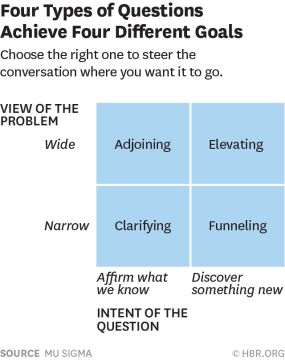
Clarifying questions help us better understand what has been said. In many conversations, people speak past one another. Asking clarifying questions can help uncover the real intent behind what is said. These help us understand each other better and lead us toward relevant follow-up questions. “Can you tell me more?” and “Why do you say so?” both fall into this category. People often don’t ask these questions, because they tend to make assumptions and complete any missing parts themselves.
Adjoining questions are used to explore related aspects of the problem that are ignored in the conversation. Questions such as, “How would this concept apply in a different context?” or “What are the related uses of this technology?” fall into this category. For example, asking “How would these insights apply in Canada?” during a discussion on customer life-time value in the U.S. can open a useful discussion on behavioral differences between customers in the U.S. and Canada. Our laser-like focus on immediate tasks often inhibits our asking more of these exploratory questions, but taking time to ask them can help us gain a broader understanding of something.
Funneling questions are used to dive deeper. We ask these to understand how an answer was derived, to challenge assumptions, and to understand the root causes of problems. Examples include: “How did you do the analysis?” and “Why did you not include this step?” Funneling can naturally follow the design of an organization and its offerings, such as, “Can we take this analysis of outdoor products and drive it down to a certain brand of lawn furniture?” Most analytical teams – especially those embedded in business operations – do an excellent job of using these questions.
Elevating questions raise broader issues and highlight the bigger picture. They help you zoom out. Being too immersed in an immediate problem makes it harder to see the overall context behind it. So you can ask, “Taking a step back, what are the larger issues?” or “Are we even addressing the right question?” For example, a discussion on issues like margin decline and decreasing customer satisfaction could turn into a broader discussion of corporate strategy with an elevating question: “Instead of talking about these issues separately, what are the larger trends we should be concerned about? How do they all tie together?” These questions take us to a higher playing field where we can better see connections between individual problems.
In today’s “always on” world, there’s a rush to answer. Ubiquitous access to data and volatile business demands are accelerating this sense of urgency. But we must slow down and understand each other better in order to avoid poor decisions and succeed in this environment. Because asking questions requires a certain amount of vulnerability, corporate cultures must shift to promote this behavior. Leaders should encourage people to ask more questions, based on the goals they’re trying to achieve, instead of having them rush to deliver answers. In order to make the right decisions, people need to start asking the questions that really matter.”
On Questions