Lifelet: The Seahawk Twelves

What an unbelievable journey for Seahawk nation here in Southeast Alaska (thank you Jimmy Johnson).

For the last month, “Flipping My Perspective” is a way of life as I do my daily flips. For the last two weeks my Seahawk fandom and exercises are intersecting. Too many of my daily flips and free writing are about the Seattle Seahawks 12th man flag icon representing our over the top civic support.

My first 12th flag capture came while driving on the Bainbridge Island ferry to Seattle. Here is the photo, pithy flipped tag line, and my “free writing” for the flipping perspective exercise:
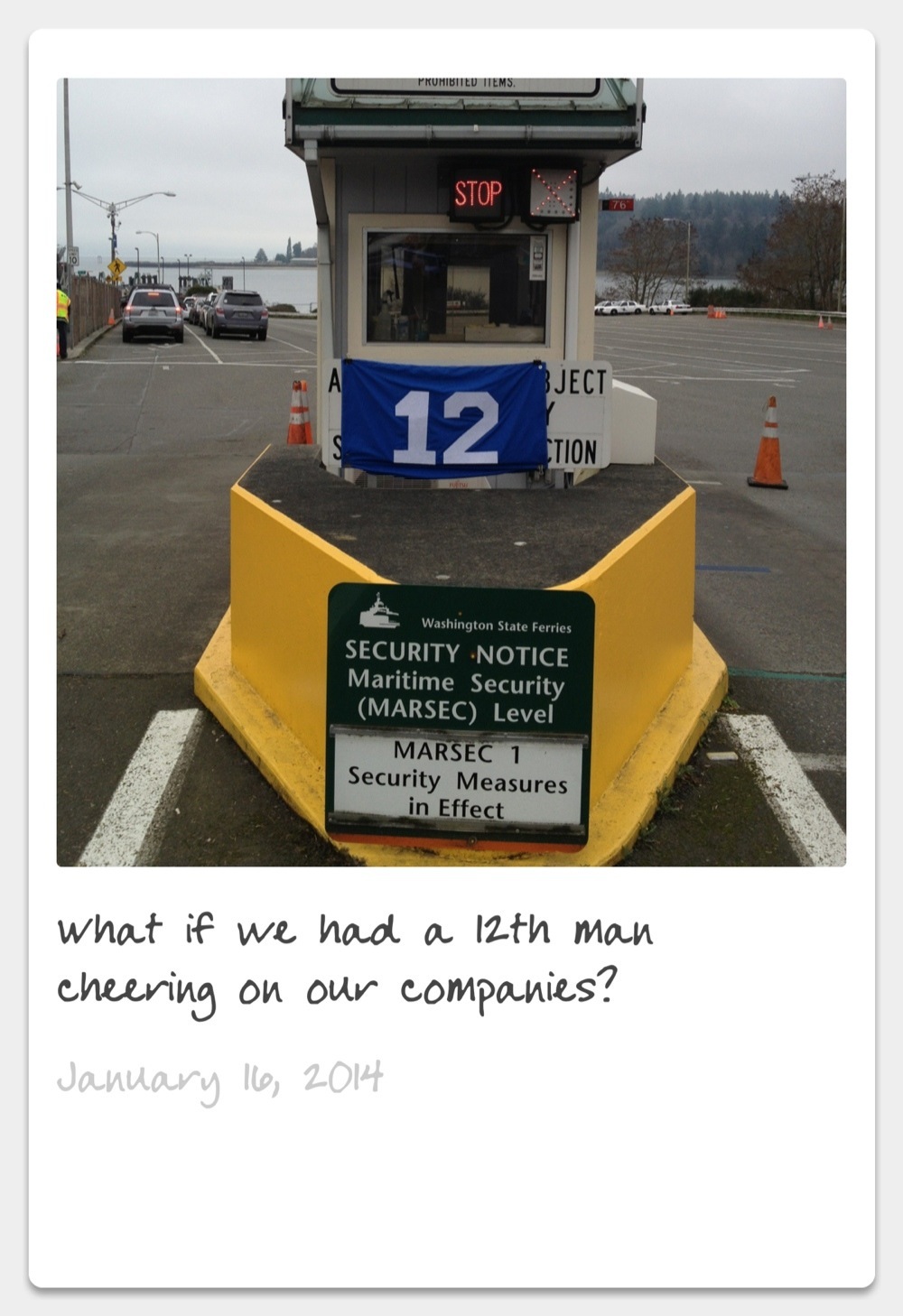
ferry terminal 12

“We in Southeast Alaska are living through one of those way too rare optimistically hopeful and severely anxiety making run of the Seahawks to the Super Bowl. Each week is pins and needles time to see if the Seahawks are going to keep the magic going for another week. There is something about being ignored by all the national media here in the far northwest corner of the USA. Which brings us to the 12th man phenomena. The joy of seeing 12th man flags in so many surprising places just warms my heart. Today’s surprise was seeing a 12th man flag on the ticket taker’s booth at the Bainbridge Island ferry entrance. A smile automatically comes to my face and a wonderful conversation with the ticket taker. Just a brightening of an otherwise dull gray day here in Seattle. As I continued to see 12th person flags throughout Seattle and environs I started wondering what it would be like if each of us had the energy and enthusiasm and bonding of a 12th man in our work or personal lives. Somebody that was always faithful and not judgmental and constantly cheering me on. Maybe that is a business we can start or a new URL ending like .COM – .12man.  At any rate, back to basics, GO SEAHAWKS! Beat the snot out of those Broncos in New York (oops New Jersey).”

Every day the local media capture Close Encounters of the 12th Kind. My two favorites are what Russell Investments Center companies committed to and the “take that Denver” corporate support of Boeing.

seattle skyline Russell 12

The Puget Sound Business Journal shared the story of the work it took Carl Shumaker of Daniels Real Estate to figure out how to create an 18 story high 12 on the west facade of the Russell Investments Center 42 story building.

Carl Shumaker, Daniels’ vice president of construction, worked with a Seattle company called Blue Danube Productions to sketch out the design of where to tape light-defusing paper to the windows, each of which is lit with two 500-watt spotlights that are left on in the building scheduled to open in April.

It’s a more complicated undertaking at the Russell Investments Center, a big, busy building where 3,500 people work. Many of them are in on the building’s 12, helping position the shades on 418 windows just so. If even one is off, the whole scheme unravels.

“The first night we had a backward five instead of a two,” said Coleen Spratt, a general manager with CommonWealth Partners, the owner of Russell Investments Center.

CommonWealth is riffing off something that happened in 2006, the first and last time the Seahawks made the Super Bowl. Back then the building was Washington Mutual’sheadquarters, and the bank configured the window shades to light up the skyline with a 12.

“We tried to take the original idea and make it look exactly like the 12 the Seahawks use. The font, everything,” said CommonWealth’s Matthew Hale, the property manager.

Hale plotted the grid on an Excel spreadsheet and worked with CommonWealth Operations Manager Rob Keator on the design and many other colleagues on the execution, which took time and patience.

The first night, Jan. 8, CommonWealth had the tenants shut every blind on the west side of the tower, where employees were stationed to open shades.

“Everyone stayed late,” Hale said, adding no one questioned the non-essential nature of the mission.

Keator, meanwhile, was monitoring the results from West Seattle. This entailed finding just the right spot: the home of longtime West Seattle resident Bob Horton.

“I actually went up and knocked on the door of a complete stranger,” said Keator, who took pictures of the building and sent them back to the building.

The team tweaked the design over the course of three nights with help from passersby in West Seattle. Keator relocated to different spots, including Salty’s on Alki Beach. The restaurant set up a special spot for Keator, who said “all of the guests were all involved in getting [the 12] shaped. I had lots of helpers.”

On the first couple of tries adjusting the shades took around three hours. The team tweaked the project over three nights, and the display was finalized on Jan. 10 the day before the Seahawks’ first playoff game against New Orleans.”

At 2:48pm on January 30th, I got an email from my son that Boeing was flying a “12” pattern over Washington state and I followed the pointer to the Flightaware flight tracking website:

Boeing 747 12 flight pattern

I caught the flight just as the plane was completing the lower right part of the bottom of the “2.” I assumed that it was either a hoax or a small corporate jet. I couldn’t believe it when Geekwire the next day showed photos of the 747 freighter that made its inaugural flight flying the “12.”

boeingseahawks221-600x399

For more photos of the Seahawks 747 see the Geekwire article.

“Starbucks’ 12-cent coffee campaign was cool and Microsoft’s on-campus decorations were neat, but it’s safe to say Boeing just might have the most Seahawks passion of any company yet.

We’ve been hearing a few people complain that Boeing is “wasting fuel,” by flying the 747-8 Freighter today in the “12″ pattern. We reached out to Boeing to see if the company had a response, and here’s what they sent:

“This is a Boeing owned airplane that is already being used in test flight. We are sponsors of the Seahawks and have partnered with them for many years for community projects. We’re proud to show our support of the team and their fans across the Northwest.”

Microsoft spelled out their support with their 12th man photo:
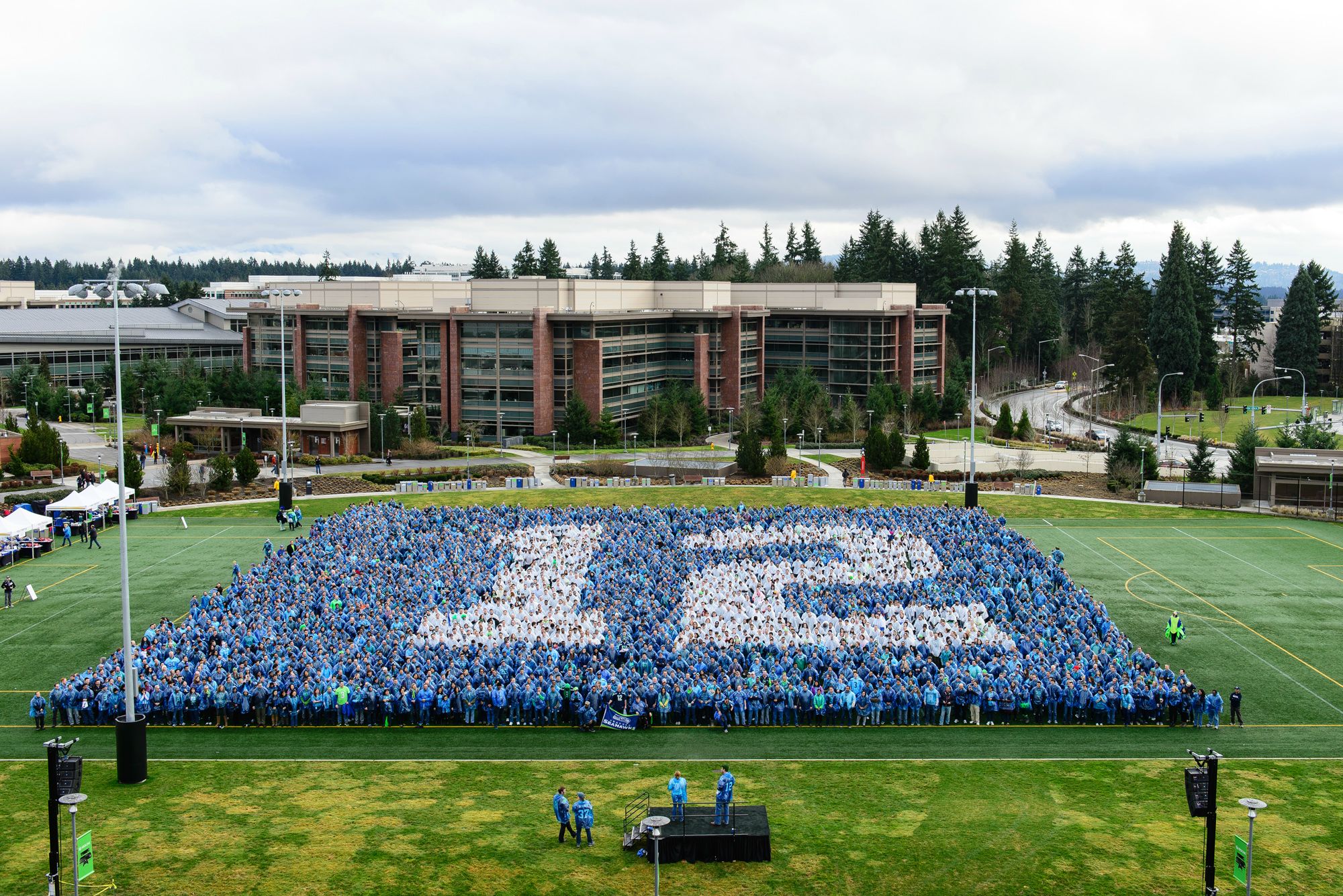
Microsoft 12

While Google’s new building is just starting construction, they didn’t want to be left out of the 12th man craziness. So the construction team painted a Seahawks logo at the bottom of the construction pit:

Google construction 12th

In my continuing series of daily flips, the Space Needle jumps into the fray on January 20:

space needle 12 flip“The Seahawks 12th men are everywhere. It is a delight to be experiencing the 12th man flags in all kinds of strange places – from the ferry terminal, to 18 story light patterns on Seattle’s skyscrapers and on that old standby the Space Needle. The many ways of flipping perspective in this photo of the top of the city looking down on Century Link Field, to the green color of the roof as a 50 year celebration of the building of the space needle to all of the people actually standing on the top of the space needle representing the 12th man. What I really like about the change in perspective of the 12th man is the bringing together of the fans and team as one. Instead of just flying a Seahawks logo flag, it is a tribute to the oneness of team and fans. And we are everywhere – whether here in Seattle or the native New Yorkers who are coming out in droves for Super Bowl run. And on Super Bowl Media day the real attraction for me wasn’t the crazed international media but the Seahawk 12th man flag waving and number 12 jerseys of the fans sitting in the stands cheering their “teammates” on. We are ONE of the 12. How cool is that? There are so many ways that the elite athletes are separate from those of us who are mere uncoordinated mortals. Yet the notion of the 12th man brings us all together. It is another way of reaffirming why it is so important to have a live audience cheering the team on. Having sat (well stood, you can’t sit at a Seahawks game) in Century Link field the raw power of the 12th men and women at full roar is something that has to be viscerally experienced. The sound goes right through you. You are unable to hear yourself or even your neighbor. You can only feel the sound vibrating through every part of your body. We won’t be in New York for the Super Bowl but we 12th men will be there in spirit helping the local 12th men shout their support for our collective team.  Go Hawks!!!”

For our finale of 12th man support, what could be better than the Seattle Opera saluting the 12th man at the end of their Rigoletto performance:

A close up view of those Rigoletto performers in their 12th man shirts.

Go Seahawks! Trounce those Broncos.

Seattle 12 skyline

Posted in Content with Context, Curation, Flipped Perspective, Humor, Lifelet, Patterns, Relationship Capital, Sports, User Experience | Leave a comment

Lifelet: It’s Not About the Nail

How do you teach empathetic listening? It is not something that you can lecture about. You have to experience it. At a recent developmental seminar, we went through several paired exercises to improve our deep listening skills.

However, sometimes a well crafted video just says it all:

Annie Dillard, in The Writing Life captures the deeper essence of listening without the motor running:

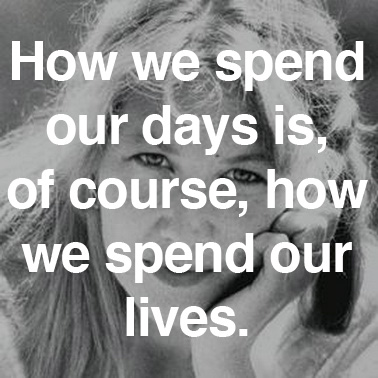
“How we spend our days is, of course, how we spend our lives. What we do with this hour, and that one, is what we are doing. A schedule defends from chaos and whim. It is a net for catching days. It is a scaffolding on which a worker can stand and labor with both hands at sections of time. A schedule is a mock-up of reason and order—willed, faked, and so brought into being; it is a peace and a haven set into the wreck of time; it is a lifeboat on which you find yourself, decades later, still living. Each day is the same, so you remember the series afterward as a blurred and powerful pattern.”

anniedillard how we spend our days

How will you spend your life today?

Posted in Humor, Relationship Capital, Values | Leave a comment

Flipping My Perspective

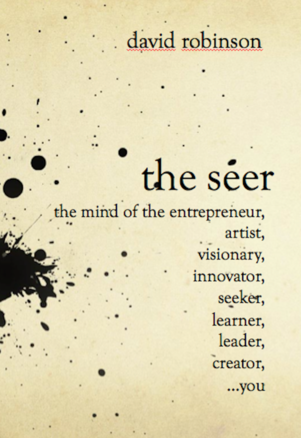
The Seer book coverMy colleague, David Robinson, just completed his book The Seer: The Mind of the Entrepreneur, Artist,Visionary, Seeker, Learner, Leader, Creator…YouDavid’s book follows a young entrepreneur and his Socratic interactions with a mysterious guru Virgil. The book is about seeing the world in a different way.

I just finished a very early draft of my first book, Emails to a Young Entrepreneur. The core exercise in the book is about flipping your perspective each day.

The exercise is simple – at least once a day break a habit and then do something different.

Applying Flipping Perspective

As “human doings” we quickly move our day to day actions to habits or tacit behaviors. Habits are those things we do without thinking about them. For the next seven days, apply the Breaking Patterns exercise each day.

Start by making a list of all the patterns that you do on a daily basis that you don’t think about. Some questions to help you get started:

  • Do you drive the same way to work each day?
  • Do you eat the same foods for breakfast each day?
  • Do you do your emails first thing in the morning?
  • Are all your emails textual?
  • Do you eat lunch with the same people every day?
  • Do you read the same newspaper or news source each day?
  • Who is a colleague or friend or family member you haven’t talked with in a long time?

You get the idea. What are your habits or patterns of behavior that you just do and don’t think about?

Start with one of the easiest patterns to break like the way you go to work each day. Take a different path to and from work today. While you are breaking your pattern, take a photo or video of some aspect of the pattern that you are breaking. Notice what is different while you are breaking the pattern. Are there different things that you are seeing, hearing or feeling?

When you get back home or to a quiet place after experiencing the breaking of your pattern, do a free writing exercise as part of making meaning from the pattern break. Using the picture or video that you took during your pattern break, start free writing about the experience.  Write for five (minimum) to ten minutes (maximum). Look at the picture and your writing, and reflect on what the experience of breaking the pattern means.

The process in a nutshell:

  • Select a pattern to break today
  • Break the pattern (take a photo or video of one of more parts of the pattern break)
  • Do 5 to 10 minutes of free writing on your experience
  • Reflect on what breaking the pattern meant for you today.

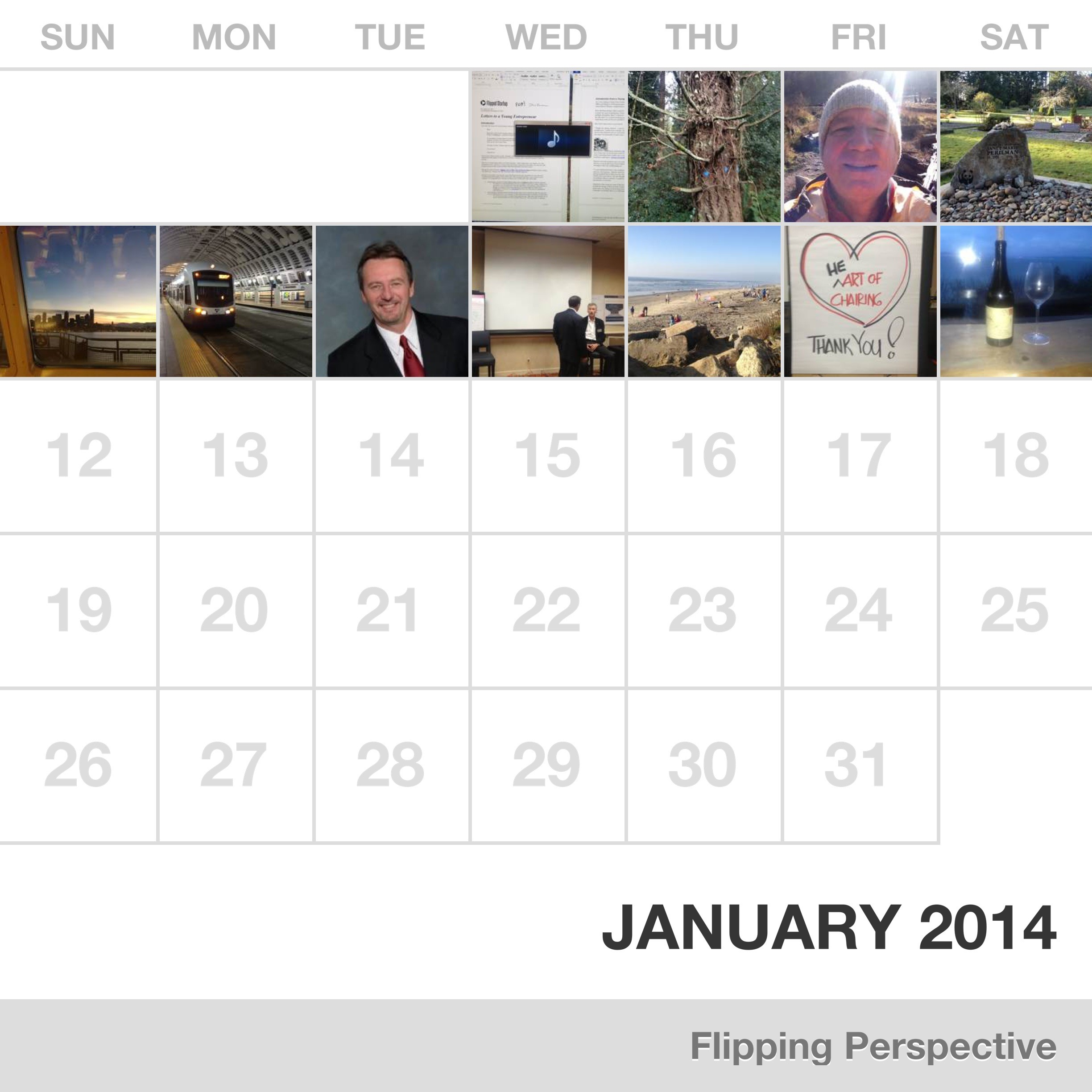
Use a tool like Collect or Heyday to capture your flipped perspectives (a collage of my first couple of weeks of flipped perspectives recorded in Collect):

flipping perspective january calendar

Here are a few of the flipping perspective free writing journal entries:

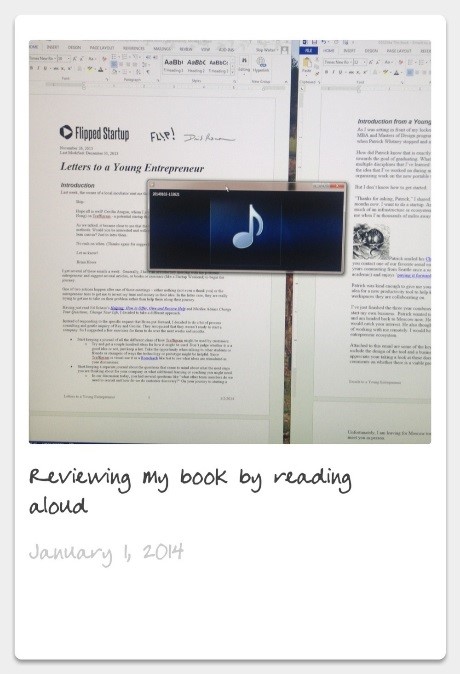
January 1, 2014

january 1 flippedI finally kept my butt in the seat long enough to write a full draft of my first book. I can’t believe it. It is done. While talking to David, he shared that he’d been revising The Seer by having Kerri read him the chapters of the book. It hit me in an instant that what I need to do is voice record each chapter and then play it back in my own voice. This will be a completely different way to hear what I am writing. It will help me to understand what my writing voice actually is. This is the method that poets use to hear their poems and which I’ve never done with my own poetry. As I experimented with this today, I realized there are two benefits to this process.  Just the exercise of trying to speak all that is written helps me to see which sentences are most difficult and need rewriting. Then listening to the words in my own voice is really helpful in getting a sense of how it will come across.  Oh, if only I had a deep magical voice like David Whyte when he is telling his stories and reading his poetry and giving us a sense of what was behind the poem that he wrote. I know how much more meaningful the business books I read were when I had a chance to meet and interact with the author. Russ Ackoff was the first author I did this with. I read Creating the Corporate Future in a made up neutral voice. After meeting Russ, all of his other books were now coming through my head in Russ’s inimitable style. Should I go ahead and get serious about these recordings and do an audio version of the book as well as the written version? Certainly this is a flipped perspective for me – listening to what I write rather than seeing what I write. Maybe I can develop my auditory sense as well as my visual sense? Can this be something I write in a blog post? Can I capture what edits I make after I do the speaking of the chapter so that I can see what patterns are coming from the auditory edit rather than just the visual edit? Reading versus hearing – what are the essential differences in these two modalities. I wonder if Elizabeth has some pointers to our comprehension or response based on whether we hear the same information or read the same information? Could this be another exercise to go along with the watching the video exercise with Dana Dyksterhuis? Could this be another revenue stream by selling the audio books as well?  The juxtaposition of the audio player on the written text is interesting as well. What if we could do the iPad app of T. S. Eliot’s Wasteland where somebody reads the poem and the color of each line changes as you read through? The power is in the experience of hearing and seeing at the same time.

January 5, 2014

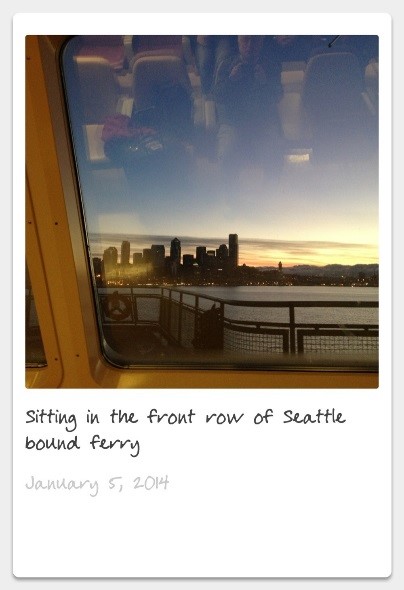
janyary 5 flippedI always sit at the aft end of the Seattle-Bainbridge Island ferry.  Something about not wanting to be at the front of the boat with the Type A extroverts who want to rush to get off the boat. I enjoy sitting at the back reading my Kindle on iPad and sipping my coffee from Commuter Comforts. Yet, the most spectacular view on the ferry is at the front. Clearly, I’ve gotten too much in the habit of commuting versus flipping my perspective to SEEING. So this morning on the 7:05 as I head to the airport for my trip to the Vistage FOVC seminar in San Diego I sit up front.  It is an interesting winter time of day as the sky is mostly dark black but you can start to see a faint streak of light on the horizon.  Today the sky is crystal clear (and a cold 28 degrees). I was treated to an immediate glorious sight as we turned south out of Eagle Harbor – Mt Rainier. I forget that sitting in the very front row, the window serves as a frame to see the world.  Here was Rainier framed so beautifully in the window – a silhouette.  Then the ferry made the left hand turn to head to Seattle.  The skyline of Seattle looks like a faint Christmas tree kind of blinking small line on the horizon.  I look for a while and see the sky lightening and hoping that there would be a sunrise before I got to the Seattle side.  As I looked out my “window frame” I decided it was time to continue reading Rilke’s Letters to a Young Poet.  I pulled out my iPad and got immersed in Rilke.  After five minutes, I folded the cover back and started chuckling. The whole point of the flipping perspective exercise, was to change perspective to get out of my habits. Here I was back in my habit of reading on the ferry, not noticing anything.  I put the iPad in my backpack and enjoyed the sights of getting closer to Seattle and saw the silhouettes turn into real buildings as the sun’s early morning light slowly emerged.  I took several photos a few minutes apart hoping that I would get the buildings to fill up the height of the frame. As I looked at the image that was showing up on my iPhone, I saw that the internal lights on the ferry were creating a mirrored effect. I was doing a selfie. I got two perspectives in one – you can look through the glass at Seattle or you can see the reflection of Skip and others in the first couple rows of the ferry. As the ferry slows to dock, I see another view – the condensation from the window on the outside sloshing back and forth in a mercury silver trickle – back and forth as we turn.  Never seen that before.

January 12, 2014

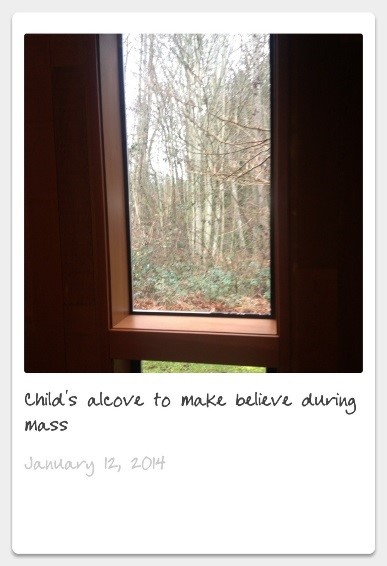
january 12 flippedYet another gray day as I make it to Sunday Mass at St Cecilia’s on Bainbridge Island. I am late and most of the pews on “my side” of the church are full. For a moment I thought about flipping my perspective by going to the very front row of the church. However, I had enough of that at the learning conference this week. There was space in the very back pew and I thought that more appropriate after an emotionally intense week. Just as I sat down a family of five with two boys and a four year old girl entered the pew in front of me. Now that I have grandchildren I have a smile when I see young kids and imagine what Alice and Hazel are going to be like in a couple of years. As the mass moseyed ahead I was immersing myself in the traditions of the Mass. Then I looked to the right and the young lady was sitting on the window sill sketching in her blank paper book. Sitting and sketching as close to the natural light on this gray rainy day. I immediately wanted to get up and take a photo. I’ve been looking through those windows at the woods outside for 20 years and it had never occurred to me that the window sill might serve as an alcove seat for a young child. Who knew? The young child was happy as a clam. I was warmed and delighted at both the child finding this new way to use semi-sacred space and the patience of the parents not to disrupt their daughter’s creativeness. As the mass ended and everyone headed back to their cars, I shared with the man next to me what a delight it was to see the young lady in the window. We both had one of those shared grandfatherly moments of enjoying the gifts of the young to inspire. He asked me why I didn’t take a picture of her when she was sitting and drawing. I shrugged my shoulders and said that I didn’t want to do anything to disturb the moment. So I took a picture of the empty window, but in my mind’s eye the girl was still there in the window sketching in her notebook. The mind’s eye is always more generative for me than the photo itself.

Flipping Perspective

Spend a few days flipping perspective and reflect on any changes for how you are seeing the world. Feel free to send them along for inclusion in my book.

Posted in Flipped Perspective, Learning, Patterns, Teaching | 3 Comments

Lifelet: Your Verse Anthem

It takes a lot for a TV ad in the middle of an NFL game to cause me to pay attention. This afternoon Apple managed to wake me out of my inattention with one of the most moving vignettes I’ve encountered. The ad was for the iPad air and had stunning imagery of many of the ways the iPad is used in nature, business, science, education, and music.

The ad started with jump cuts of a range of video and some low key music and then this intense voice joined in with the moving images:

“We don’t read and write poetry because it’s cute. We read and write poetry because we are members of the human race. And the human race is filled with passion. And medicine, law, business, engineering — these are noble pursuits and necessary to sustain life. But poetry, beauty, romance, love — these are what we stay alive for.

To quote from Whitman,

“O me, O life of the questions of these recurring.
Of the endless trains of the faithless. Of cities filled with the foolish. What good amid these, O me, O life?
Answer: that you are here. That life exists and identity. That the powerful play goes on, and you may contribute a verse.”

“That the powerful play goes on, and you may contribute a verse.”

“What will your verse be?”

Take a moment to enjoy a well crafted inspiring ad:

What will your verse be?

As I searched Google in hopes that somebody had uploaded the ad and had a transcript, I came across several context articles.  The article shared that the transcript came from Robin Williams Dead Poets Society movie. Fortunately, some kind soul has uploaded the scene from the movie where Mr. Keating shares Walt Whitman’s speech:

“That the powerful play goes on, and you may contribute a verse.”

What will your verse be?”

Now that is an inspiring wake up call.

The synchronicity of this call to action arrived after a week long intensive developmental seminar where we experienced an exercise based on Mary Pipher’s “I am from …” poem. The exercise is taken from her book Writing to Change the World.

Mary’s “I am from …” poem is:

I Am From  

I am from Avis and Frank, Agnes and Fred, Glessie May and Mark.

From the Ozark Mountains and the high plains of eastern Colorado, from mountain snowmelt and southern creeks with water moccasins.

I am from oatmeal eaters, gizzard eaters, haggis and raccoon eaters.

I am from craziness, darkness, sensuality, and humor.

From intense do-gooders struggling through ranch winters in the 1920s.

I am from “If you can’t say anything nice about someone, don’t say anything,” and “Pretty is as pretty does” and “Shitmuckelty brown” and “Damn it all to hell.”

I am from no-dancing-or-drinking Methodists, but cards were okay except on Sunday, and from tent-meeting Holy Rollers, from farmers, soldiers, bootleggers, and teachers.

I am from Schwinn girl’s bike, 1950 Mercury two-door, and West Side Story.

From coyotes, baby field mice, chlorinous swimming pools, Milky Way and harvest moon over Nebraska cornfields.

I am from muddy Platte and Republican, from cottonwood and mulberry, tumbleweed and switchgrass, from Willa Cather, Walt Whitman, and Janis Joplin.

My own sweet dance unfolding against a cast of women in aprons and barefoot men in overalls.

Our exercise was to do a free write in the form of “I am from …” writing as fast as we could for seven minutes.

Mary’s instructions are:

“Follow a formula with each line beginning with “I am from.” Writing this kind of poem is a way to experiment with identity issues. The poem must include references to food, places, and religion. You might want to give it a try.”

My free writing variant of the “I am from …” poem is:

I am from ….

I am from Marge and Harry, Leigh and Pearl, Grace and Edward

I am from the empire state, the rust belt, the old south, live free or die, and the other Washington,

I am from a dog’s breakfast of European ancestry

I am from loving parents who agreed to argue with each other in whispers

I am from a family where my much younger sister has never known me without my bride Jamie

I am from a farm community where planting cabbage skips and picking black cherries was a summer adventure

I am from an age when I could ride my bicycle all over western New York and my parents never had to worry about the crazies

I am from a travelling salesman father by day and an unschooled medical device inventor by night

I am from a stay at home mom who grew up very rich and whose father lost it all in the great depression

I am from the gift of fifty years of knowing and marrying my childhood sweetheart

I am a non-smoker from a Southern University funded by tobacco fortunes

I am from our deep family rivalry of Blue Devils and Tar Heels

I am from the too much travel of a corporate executive who missed so much of being a dad for three great children – Elizabeth, Maggie and John

I am from the gift of two infant granddaughters and their loving parents who allow me to re-experience what I missed as a travelling dad

I am from constant personal generated challenges like learning to fly, Outward Bound and becoming a university faculty member without an advanced degree

I am from the invisible university of Ackoff, Goldratt, Christensen, and Alexander

I am from the highest highs and lowest lows of serial entrepreneuring

I am from the gift of fantastic collaborating colleagues who have given me more than I can ever repay

I am from the solitary meditations of hiking Olympic mountain trails

I am from the poetry of mudlucious ee Cummings and the melodious voice of corporate poet David Whyte

I am from the formation of thousands of books

I am from the biodynamics of fine wine growing

I am from the spiritual traditions of a childhood full of Methodists, Baptists, and Presbyterians and a chosen Catholic adult faith

I am from an unhealthy gene pool of parents and grandparents and aunts and uncles who died at early ages

I am from the gifts of perpetual inquiry and an explorer of the world

I am Skip!

Indeed, what is my verse to add to the unfolding poem of life.

What will you do this day to add your verse to mine?

Posted in iPad, Lifelet, Patterns | Leave a comment

Lifelet: Things you don’t think about on Halloween

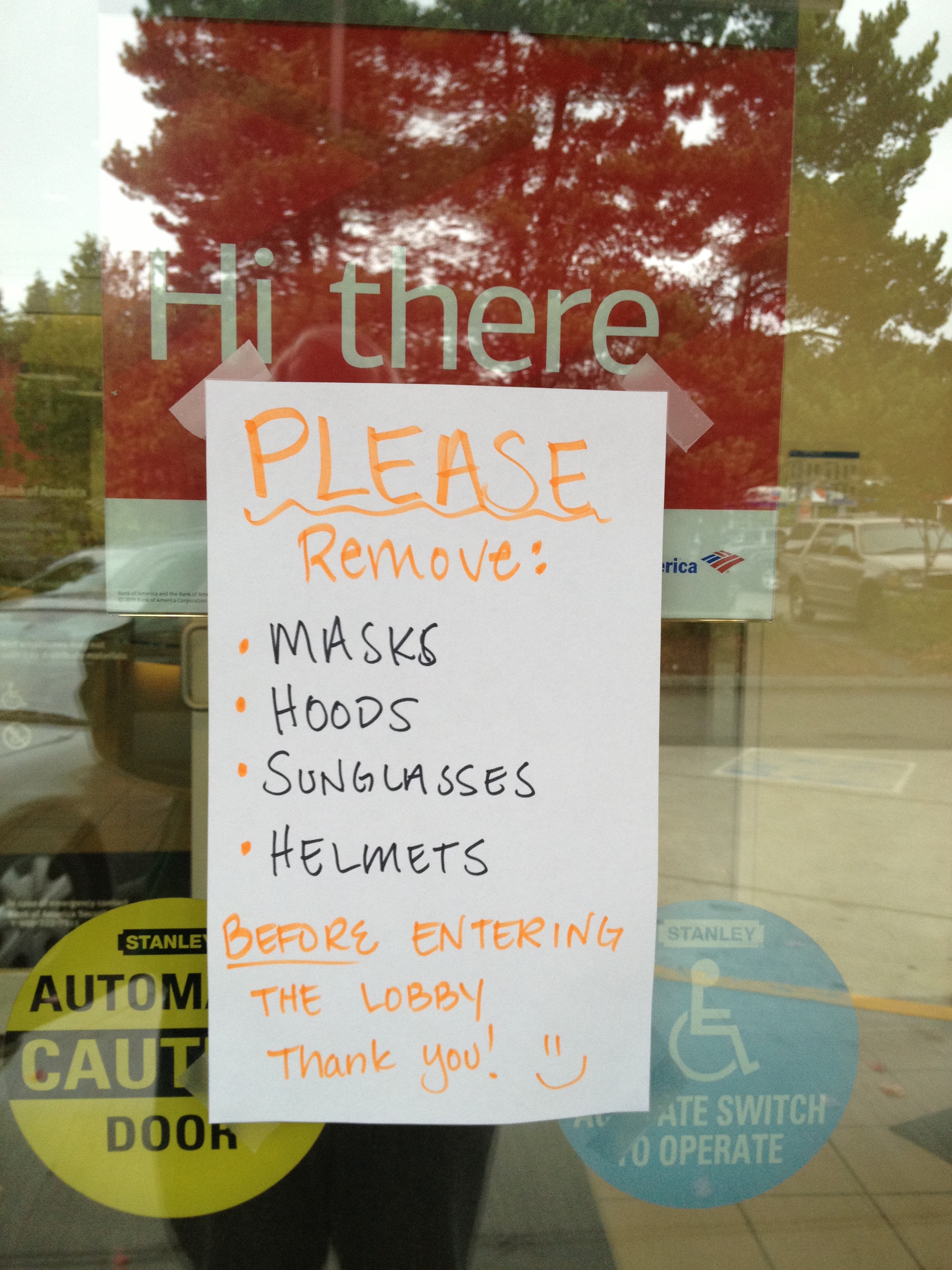
I went to get some cash out of our Bank of America ATM and found this handwritten sign. Sometimes you just have to let the pictures speak for themselves:

bank sign

Lifelets are brief glimpses of daily life that are small creative acts of bringing new life to my inert digital media captured over a lifetime.

For a humorous look at the wonderful world of innovation and new ventures, checkout Fl!p and the gang at Fl!p Comics.

Posted in Humor, Lifelet, Lifelogging | 3 Comments

Questions?

Twas the night before Halloween and I couldn’t resist. My lovely bride stocked our house with our annual sugar overdose and I dove in.

halloween candy

The Heath Bars and Reese’s Peanut Butter Cups somehow leaped into my hand. As the sugar high cut in and my emotional high watching the Boston Red Sox win the World Series amped me up, I laughed realizing that I wasn’t going to get much sleep.

At 3 am I was wide awake cursing my inability to avoid a chocolate overdose late in the evening. I reached for my iPad and waded into my overnight email. I was so awake and so bored, I even read through the newsletters I normally skip like Berrett-Koehler Publishers. There to my wandering eyes appeared a quote from Helen Keller – “A well-educated mind will always have more questions than answers.”

Even at 3am they had my attention. I found a review of Ed Schein‘s Humble Inquiry which I’d bought a while ago but never read. I knew if they had this book then somebody was on the ball. As I scrolled further down I came across an offer I couldn’t refuse – for the next 48 hours I could download Schein’s book Helping and Marilee Adams book Change Your Questions, Change Your Life.

I’ve been fascinated with the nature of questions since spending a year being mentored by Russ Ackoff in the mid 1980s. Russ’s PhD students shared that no matter how hard they tried to ask Russ good questions, he always managed to ask them a better question back. Up to that point, I’d always acted as the expert and focused on coming up with great answers. The year with Russ flipped my perspective into learning how to ask good questions.

About the same time I came across John Grinder’s distinction between Outcome Frame and Blame Frame (see “What process should we use?“). The Outcome Frame increases personal and group energy by asking the questions:

    • What are we trying to create?
    • How will we know we created it?
    • What resources do we have to get started now?
    • What other opportunities does this lead to?

The problem or blame frame decreases energy by asking questions like:

    • What is the problem?
    • How did it get this way?
    • Who caused it?
    • What are you going to do to fix it?

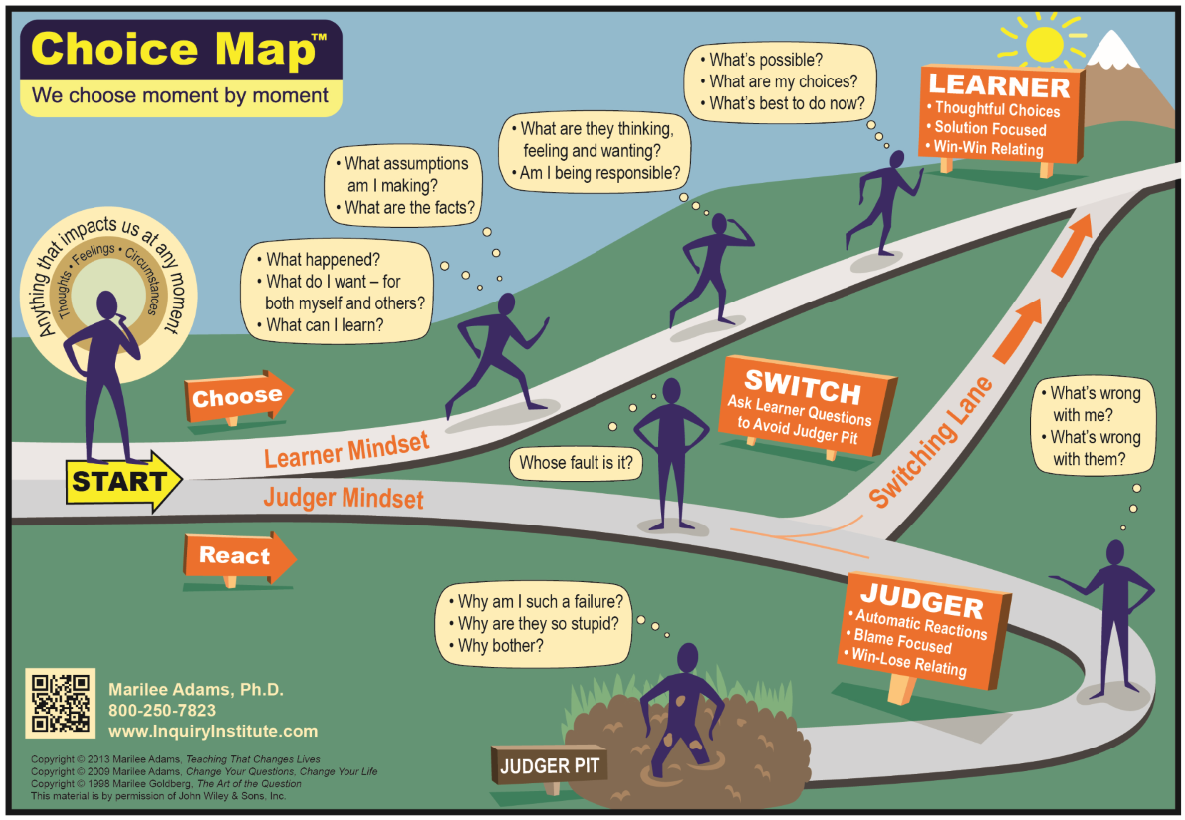
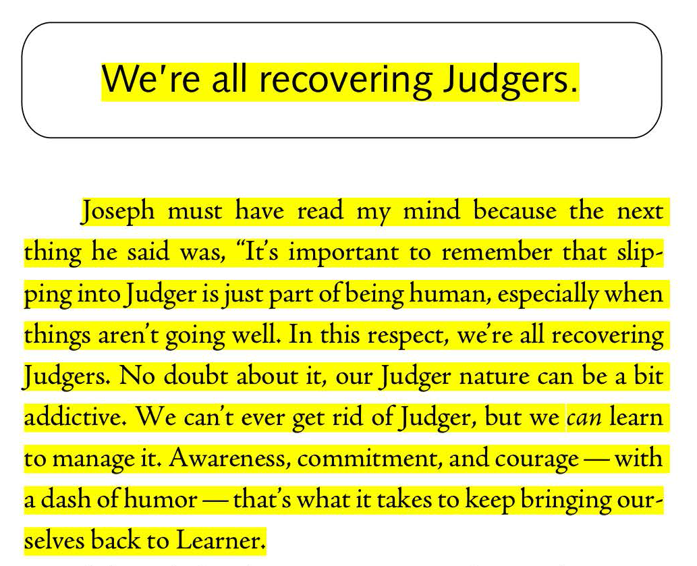
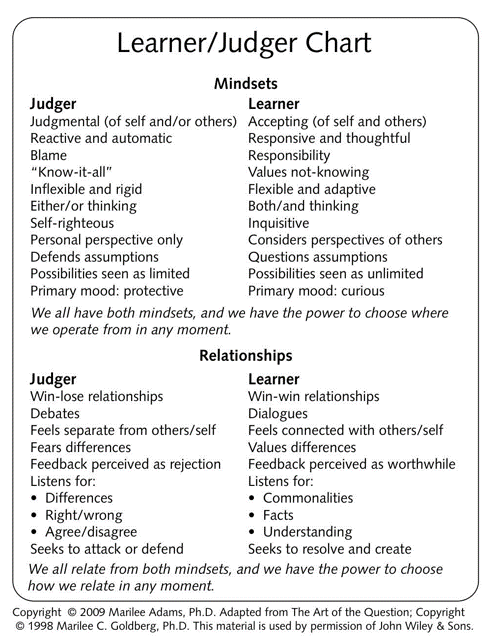
I took a quick look at the two free books and realized the Adams book was in Socratic story form. It won. For the next three hours, I was into the land of Ben (the desperate executive) and Joseph, Ben’s new transformational guru. Joseph described the two constant choices of daily life as being in “learner mindset” or “judger mindset.”

As Joseph elaborated on the model, he shared that all of us are recovering “judgers.” As I took a few moments to reflect on what I was reading, I realized that I wasn’t in the recovering judger mode. I was hip deep in the muck of the “judger pit.” Not just of my own making, but of those I was associating with over the last couple of weeks.

recovering judgers

If I could have highlighted this section several times, I would have worn out the screen of my iPad.

So I took a deep breath as I walked myself through the different types of questions on the Learner/Judger Chart.

Learner Judger Chart

And there it was about midway through the Learner Mindset – “values not knowing.” For the last six months, I’ve ranted about all the “experts” who have no idea what they are talking about or doing in the entrepreneurial space, but they still bluster and spew their expertise in every direction. I shouted to my colleagues at times “my kingdom for someone who values not knowing (and means it).”

Then I started laughing. I was as deep in the judging mode as they were. I was unable to choose to switch my mindset to the learner mode or the Outcome Frame. I was stuck in the Blame Frame.

I took to heart Adams ABCD action framework (Awareness, Breathe, Curiosity, and Decide). Now that I was aware of my Judger mindset, I breathed deeply and continued reading the book. Today is Day 1 of my Learner mindset action program. I eagerly await my first encounter with a “judger” event to see if I can take the Switching Lane to “learner” mind.

I picked up my calendar for the day and saw that I have a phone call with a product manager from Launchpad Central to provide product feedback. My first thought was a takeoff on one of the last scenes in Erin Brokovich “where did you learn how to design a software product? Because you suck at it!” (actual quote from the boss character Ed Masry: “Do they teach beauty queens to apologize? Because you suck at it!”).

Judger mode much?

Maybe I need a little more practice at switching into learner mode. Fortunately, I have a few hours to try several more learner mindset exercises.

It’s the questions Skip, not the answers. It’s the questions.

????

Maybe I can get a “?” tattoo for the back of my hand as a reminder?

question mark tattoo

For a humorous look at the wonderful world of innovation and new ventures, checkout Fl!p and the gang at Fl!p Comics.

Posted in Ask and Tell, Content with Context, Entrepreneuring, Flipped Perspective, Learning, Russ Ackoff, Working in teams | 1 Comment

Lifelet: He made me think!

While writing my blog post today on “Epistemology of Software,” I credited Drew Paine with “making me think.”

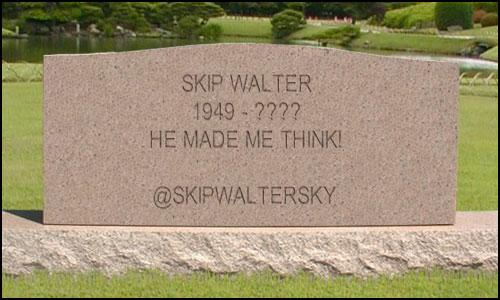
In 1981, I worked for an executive vice president at Digital Equipment Corporation, Don Busiek. Whenever Don would introduce me to someone, he would say “I would like you to meet Skip Walter. He makes me think.”

I took that as the highest compliment anyone had ever given me.

mel-blanc-tombstone

Interesting tombstone quotes

Whenever I would be in a seminar where they would do the Tombstone Exercise (what would you like to have on your gravestone?), I would always answer “He Made Me Think!”

Several years after I left Digital Equipment, I ran into Don and thanked him for his wonderful compliment of “he makes me think.” Don laughed and said “You know I never meant that as a compliment. Whenever I asked anyone else who worked for me a question, they gave me the answer. You’d start asking me questions and make me have to think for myself to get at the answer. I hated that, particularly when I was in a hurry.”

We both laughed and went on our separate ways.

I like my version better.

It’s probably why I enjoy teaching so much. Or as my graduate students would now channel Don Busiek in a different way “Skip, enjoys torturing us so much.”

Lifelets are brief glimpses of daily life that are small creative acts of bringing new life to my inert digital media captured over a lifetime.

For a humorous look at the wonderful world of innovation and new ventures, checkout Fl!p and the gang at Fl!p Comics.

Posted in Learning, Lifelet, Lifelogging, social networking | Leave a comment

Epistemology of Software?

While in the middle of a UW HCDE committee review of Drew Paine‘s dissertation research proposal, I was fascinated by the first sentence of his project goal:

“The driving philosophical goal of my dissertation is to critically examine the
epistemology of software and its interaction with data in the unfolding of scientific research work.”

Clawing through my memory fog of what epistemology means, I dove for Google. From Wikipedia, I found:

“Epistemology is the branch of philosophy concerned with the nature and scope of knowledge and is also referred to as the ‘theory of knowledge.'”

OK, that put me back on more familiar ground as I’ve spent most of my professional life searching for the elusive path to automated knowledge management systems.

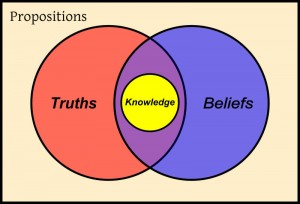
It was late in the day and I needed an image to go with all this text. Up came a link to philosophy for a child (Philosophy with Selvi) that had this image:

epistemology-300x204

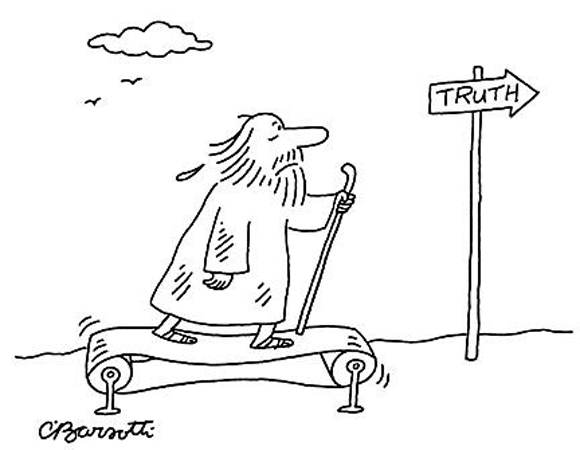
Even better, the link had a cartoon to explain it. I thought there might be a chance of understanding until I read:

“Each and every observation that is claimed as evidence requires justification and belief. This brings us to another aspect of justification, called the structure of justification. How do all the beliefs that we hold relate to each other? And how do those relationships between beliefs create knowledge? These are just some of the questions that are asked and answered within the discipline of philosophy called ‘Epistemology’”

Oh, right, this is philosophy so of course we have this unending stream of more questions. Back to what started this information foraging.

What is the epistemology of software? Software is certainly my foundation for thinking about knowledge management, but what is the knowledge embedded in this software development practice? What is this thing or artifact or concept of software?

Careful Skip, you are about to enter the danger zone of recursion and circular reasoning and Theory of Logical Types (which I’d just crashed into with trying to reconcile Actor Network Theory and Activity Theory – it has been a very strange week). I could hear the opening theme from the Twilight Zone getting louder in my head.

Then, Drew reminded me that Lev Manovich’s recent book Software Takes Command ended with a discourse on software epistemology. So I reached for my iPad to bring up my Kindle reader to open Manovich’s book and make some sense of software epistemology.

“One of the key ideas developed in this book is that the computer metamedium is characterized by “permanent extendibility.” New algorithms and techniques that work with common media data types and file formats can be invented at any time by anyone with the right skills. These inventions can be distributed instantly over the web, without a need for the large resources that were required in the twentieth century to introduce a new commercial media device with new functions or a new media format. Use of open source and free software licenses and web-based hosting services repositories such as GitHub encourages people to collectively expand existing software tools, which often leads to their rapid evolution.

“Turning everything into data, and using algorithms to analyze it changes what it means to know something. It creates new strategies that together make up software epistemology. Epistemology is a branch of philosophy that asks questions such as what is knowledge, how it can be acquired, and to what extent a subject can be known. Digital code, data visualization, GIS, information retrieval, machine learning techniques, constantly increasing speed of processors and decreasing cost of storage, big data analytics technologies, social media, and other parts of the modern techno-social universe introduce new ways of acquiring knowledge, and in the process redefine what knowledge is.

“Another important type of software epistemology is data fusion— using data from different sources to create new knowledge that is not explicitly contained in any of them. For example, using the web sources, it is possible to create a comprehensive description of an individual by combining pieces of information from his/ her various social media profiles and making deductions from them. Combining separate media sources can also give additional meanings to each of the sources. Consider the technique of the automatic stitching of a number of separate photos into a single panorama, available in most digital cameras. Strictly speaking, the underlying algorithms do not add any new information to each of the images (i.e., their pixels are not modified). But since each image now is a part of the larger panorama, its meaning for a human observer changes. The abilities to generate new information from the old data, fuse separate information sources together, and create new knowledge from old analog sources are just some techniques of software epistemology.”

Manovich, Lev (2013-07-04). Software Takes Command (Kindle Locations 5925-5935). Bloomsbury Publishing.

What I thought was going to be an intellectual diversion landed right in the middle of my current customer discovery research I’m doing with GroupTie on what data fusion could be most helpful for a new venture. Can reflecting on this opportunity from Manovich’s point of view help me better understand what I’m gathering?

Thanks again, Drew, for making me think and guaranteeing that I will be lost in the world of the epistemology of software for the next week.

As Russ Ackoff would laugh and share “I am still confused. However, I am now confused at a higher level.” Who could ask for more on a gray foggy fall day on Bainbridge Island.

For a humorous look at the wonderful world of innovation and new ventures, checkout Fl!p and the gang at Fl!p Comics.

Posted in Content with Context, Human Centered Design, Software Development | 2 Comments

Lifelet: Growing Alice

On a beautiful fall, sunny day in Seattle, Alice’s parents asked us if we could give them a break and babysit for the little girl. Oh, twist our arms.

The day before, my loving bride uploaded eight months of photos to a shared album. So for today’s Lifelet, we take a look back at the making of Alice’s quilt prior to her birth along with some early Alice photos. We finish “On the Road to Find Out” with an afternoon with Alice watching the Seahawks, letting Alice entertain us, and strolling along the Puget Sound.

For a low resolution version of the video click here.

Oregon girls

Oh those Oregon girls cheering for the Ducks

Lifelets are brief glimpses of daily life that are small creative acts of bringing new life to my inert digital media captured over a lifetime.

For a humorous look at the wonderful world of innovation and new ventures, checkout Fl!p and the gang at Fl!p Comics.

Posted in Grand parenting, Lifelet, Lifelogging | Leave a comment

Lifelet: UW ESPN Game Day

No way I could get up at 4am to be a part of ESPN’s College Game Day at the University of Washington. But the next best thing was scheduling a meeting with my HCDE colleagues the day before the game to walk through a buzzing (and wet) Red Square. When what to my wandering eyes doth appear, but a recently fired Lane Kiffin and a random set of ESPN announcers.

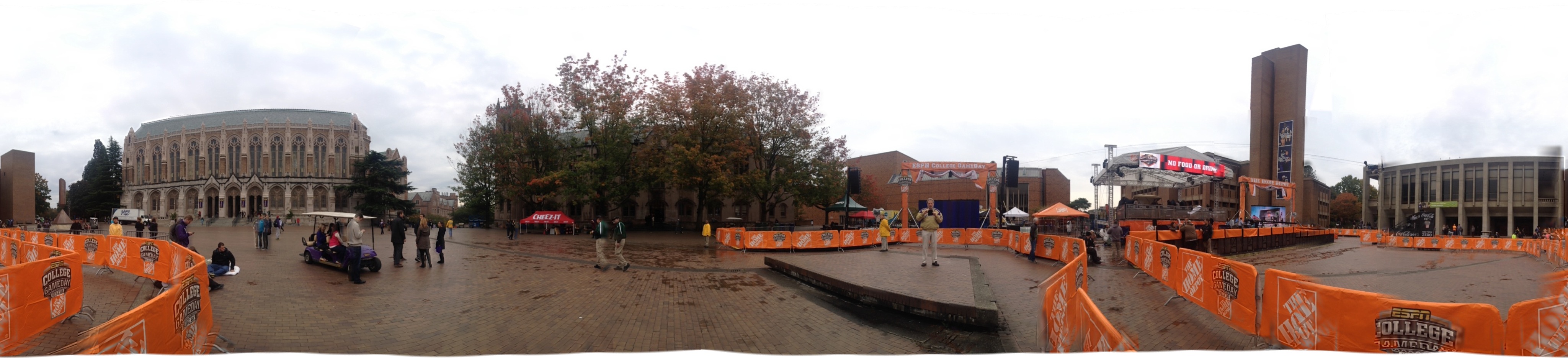
Take a quick look at the preparation for ESPN game day at UW in a 360 degree view at Red Square in waiting for Game Day. For those of you on the East Coast, Red Square is not a communist gathering point, rather it is the color of the bricks paving the square.

While we couldn’t be at the broadcast, we made sure we recorded ESPN Game Day live. Too bad it was so cloudy you couldn’t see Mt. Rainier – oh, right it is October in Seattle.

For the low res version of the video click here.

Lifelets are brief glimpses of daily life that are small creative acts of bringing new life to my inert digital media captured over a lifetime.

For a humorous look at the wonderful world of innovation and new ventures, checkout Fl!p and the gang at Fl!p Comics.

Posted in Lifelet, Lifelogging, Sports | 1 Comment