Lifelet: Alaska Airline Surprise

My definition of a good trip is that nothing surprising happens.  When it comes to airline trips, I want boring.

On a recent return trip to New York City, I chose Alaska Airlines for the trip from Newark Airport to Seattle, WA. I had a great week with a new collaboration partner, The TAI Group.  And I was exhausted from an intense week of business interactions and continuing my education of live theater (on Broadway and off off off Broadway).

I got back to my hotel late on Thursday night and had to get up at o dark thirty to make my 7:00 am departure. I had a dreaded middle seat for the long westward headwind trip.

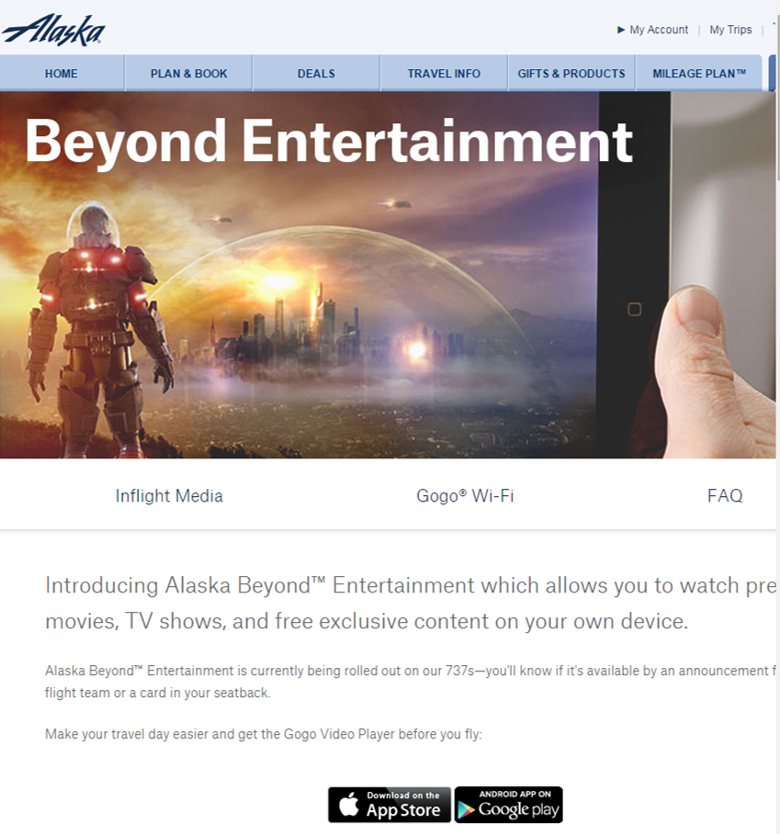
My first surprise occurred when I got so tired I couldn’t read on my Kindle for iPad app. In shear boredom, I reached up and started reading the inflight entertainment card. Somehow I’d missed that if you have an iPad you can watch inflight movies. I assumed you had to pay for the GoGo inflight internet option.

Alaska Airlines Inflight Entertainment

Alaska Airlines Inflight Entertainment

I logged onto GoGo and navigated to the Apple AppStore and downloaded the designated App. I opened the app and here were over 50 movies to watch. The good folks at TAI suggested that a wonderful movie to add to my education would be Muscle Shoals: The Incredible True Story of a Small Town with a Big Sound.

What a great movie.  Who knew that the Muscle Shoals backup band was all white? The landscapes of small town Alabama were breath taking in their beauty to accompany all of the pop sounds that came from the recording studios.

OK, Alaska Airlines, you’ve scored big points for a pleasant surprise.

As I landed I texted my wife to let her know that I’d returned safely. I also let her know how tired I was. Then I remembered it was holiday time and there might be some holiday singers and dancers in the terminal hall ways.

I straggled off the plane and an Alaska Airline Santa’s helper handed me a gift bag. This is a new experience.  I looked into the bag and there were some immediately useful gifts like some Beecher’s crackers and a candy bar.  I was starved so those were eaten quickly.

Then I noticed that on the back of the card was a code for a 20% discount on my next Alaska Airline flight.

Alaska Airlines, you have outdone yourself this holiday season.

Thank you from a weary AND grateful traveler!

Alaska Gift Bag

Alaska Air Gift Bag

Alaska Air Gift Bag Items

Alaska Air Gift Bag Items

For a taste of the holiday spirit at SeaTac airport, enjoy this short video.

https://vimeo.com/115294273


Posted in Lifelet, Travel | Leave a comment

Lifelet: Alice Helps Grandma with Christmas

One of the joys of Christmas is having quality time with family. This year our granddaughter Alice was able to spend the day with us helping prepare for upcoming family time. Enjoy grandmother and granddaughter making cookies and decorating our 2014 Christmas tree.

https://vimeo.com/115291901

Posted in Family, Lifelet | Leave a comment

Lifelet: The Fruit Song

Every once and a while a beautiful soul wanders into my life.  For the last several months I’ve been overjoyed getting to know John Andrew Morrison who has a day job at the TAI Group.  In his spare time, he is an accomplished actor, singer and director.

At the recent TAI Holiday Party, I was touched by his magical singing. As I commented to others, they all laughed and shared that I needed to watch John Andrew sing “The Fruit Song.”  Ooops.  Now I can’t get the song out of my head.

Enjoy.


Posted in Content with Context, Humor, Lifelet | Leave a comment

Lifelet: Beast Quake I and II

The creativity of sports fans always amazes me.

As Seahawk fans we came out of our chairs yelling wildly as Marshawn Lynch ran 79 yards against the Arizona Cardinals for a touchdown.

This fan spliced both Beast Quake runs together:


Posted in Lifelet | Leave a comment

Feeling Thankfully Reflective

As the year closes in on another turning of the calendar pages, 2014 is a fantastic year. We are blessed with a healthy family, great friends, wonderful colleagues and lots of great wine.

Our two granddaughters continue to grow, develop and amaze.

Alice Hazel and friends

Alice and Hazel with their friends

I encountered amazing learning opportunities this year as I discovered new colleagues and re-engaged with long time collaborators.  The highlight of the year was discovering the wonderful team at the TAI Group who somehow managed to teach this old dog new tricks. Through the joys of reciprocal learning, the executive coaching team at TAI continually teach me how to lead and communicate with Power and Presence. I enjoy helping them with a few things I’ve learned about business.

An exciting addition to my professional life is Scott Parris who collaborates with me in helping SaLTBOX “bend the curve” of their entrepreneurial journey. As Russ Ackoff shared many years ago, the best information retrieval and knowledge management system in the world is one’s colleagues and students. Scott pointed me to the TEDxRainier event on November 22, 2014.

The TEDx Rainier organizers curated a fabulous array of speakers as they explored the topic of the KNOWN/UNKNOWN.

“What do we know about our world? How do we know what we don’t know? The theme of TEDxRainier 2014 is The Known and the Unknown. Our talks will explore knowledge and the lack thereof, going to the edges of what we know and think we know, and beyond.”

Each of the speakers had an important message to share from the reaches of outer space to the day to day travails of our everyday world.  Rex Hohlbein deeply captured the spirit of the event with his very low key sharing of the faces of homelessness.

Rex Hohlbein - Putting a face on homelessness

Rex Hohlbein – Putting a face on homelessness

By the end of his talk, there was not a dry eye in the Seattle Opera House and we all jumped up to thank Rex with a standing ovation. His talk was a timely reminder of how lucky so many of us are AND how many are in need of our conscious awareness. This talk (at about the 7 hour and 18 minute point in the Live Stream) along with all the other talks can be found at the TEDx home page with the video live stream.

A few days after the event, one of the regular TED email blasts showed up with a pointer to Louie Schwartzberg’s “Nature. Beauty. Gratitude.” TEDx San Francisco talk illustrating with examples from his many years of time-lapse photography the beauty of nature.

Louie Schwartzberg - Nature. Beauty. Gratitude.

Louie Schwartzberg – Nature. Beauty. Gratitude.

The images from the talk are awe inspiring. I particularly loved the voice over from an elderly man with the poetic wisdom of an ancient voice:

Elderly Man:

You think this is just another day in your life? It’s not just another day. It’s the one day that is given to you today. It’s given to you. It’s a gift. It’s the only gift that you have right now, and the only appropriate response is gratefulness. If you do nothing else but to cultivate that response to the great gift that this unique day is, if you learn to respond as if it were the first day in your life and the very last day, then you will have spent this day very well.

Begin by opening your eyes and be surprised that you have eyes you can open, that incredible array of colors that is constantly offered to us for pure enjoyment. Look at the sky. We so rarely look at the sky. We so rarely note how different it is from moment to moment, with clouds coming and going. We just think of the weather, and even with the weather, we don’t think of all the many nuances of weather. We just think of good weather and bad weather. This day, right now, has unique weather, maybe a kind that will never exactly in that form come again. That formation of clouds in the sky will never be the same as it is right now. Open your eyes. Look at that.

Look at the faces of people whom you meet. Each one has an incredible story behind their face, a story that you could never fully fathom, not only their own story, but the story of their ancestors. We all go back so far, and in this present moment, on this day, all the people you meet, all that life from generations and from so many places all over the world flows together and meets you here like a life-giving water, if you only open your heart and drink.

Open your heart to the incredible gifts that civilization gives to us. You flip a switch and there is electric light. You turn a faucet and there is warm water and cold water, and drinkable water. It’s a gift that millions and millions in the world will never experience.

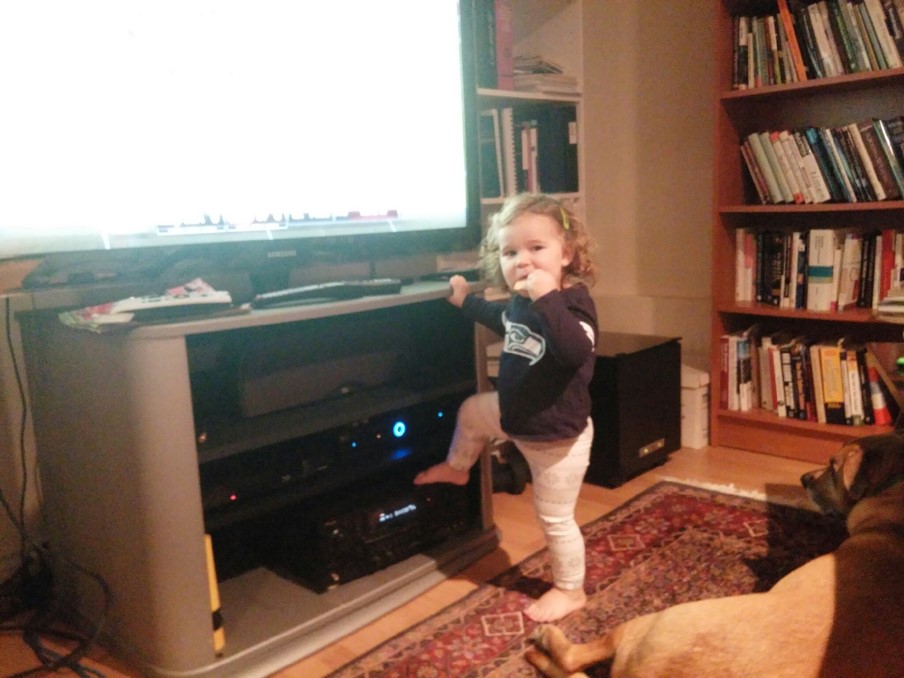
As I watch young Alice run around the house this Thanksgiving and help us cheer on the Seattle Seahawks, I am deeply grateful this day as I celebrate the joys and beauty of everyday life.

Little Alice Seahawk

Little Alice Seahawk

Peace to all as we navigate this tumultuous world of ours.


Posted in Family, Grand parenting | Leave a comment

My Storyteller Knows Me

coorg coffee plantationSeveral years ago my wife and I went to India to visit Brinda, an exchange student who lived with my wife for a year in high school. While we were in India, Brinda wanted us to visit her home region of Coorg to get a real sense of where her family’s roots were. We stayed with Ayu and Dechu, cousins of Brinda and her husband Anand. I could have stayed on their coffee plantation forever. It is a corner of the world that still moves with the rhythms of nature, not the fast pace of man’s progress.

Each evening after dinner we gathered in the garden overlooking the valley of their plantation and their cook would join us. He would then coorg cookdelight us with a story that would fit the mood of the day. When we got back home, we tried to think of a gift that was appropriate for Ayu and Dechu. We decided that since they liked stories so much, we would send them a VCR and several of our favorite movies and TV programs.

We received a wonderful thank you note from Ayu going on and on about how wonderful their new VCR was. About a year later I had a chance to drop in on them on my way to visit a supplier in Bangalore, India. I noticed that there was a thick coating of dust on the VCR and all the tapes.

I asked if there was something wrong with the VCR. They assured me that there wasn’t; that the VCR work just fine.

“But you don’t seem to be using it,” I asked.

“No, we really don’t use it anymore,” they replied.

I had to ask why.

Ayu replied “While the tapes are very nice, they are very impersonal stories from a very different culture. We find that we are much more comfortable with the evening stories from our cook. Because MY STORYTELLER KNOWS ME. He recognizes my mood and knows just how to weave the right story together to make sense of the day or heal the hurts of our family.”

In that instant, I was able to name what was so bothering me about my life’s work. I was one of many who are creating technology that keeps getting more and more impersonal. We are constantly having to adjust to the foibles of our machines (and their software), rather than the other way around. For twenty years, I’ve been working with personal computers who don’t even recognize me, let alone know me.

Larry Keeley, founder of the Doblin Group, observed that every urinal in American airports is more “intelligent” than the most expensive personal computer. Each urinal recognizes when there is a human present and when the human has left, flushing after a man walks away. With the advent of the modern laptop and smart phone, all of the technology exists to change this impersonal state of computers. But to do that, we’ve got to understand what it means to know someone else. It is also important to understand that knowing somebody is a loop, that is, I have to know about myself to be good at helping someone else understand me.

Recently, a new colleague, Chris Shaw, is bringing life to the human computer interface with what he is calling spontaneous animation. Using the camera and microphone of a laptop or smart phone, the user is able to “interact” physically and emotionally with an onscreen character. You can catch some glimpses of Shaw’s previous work in his videos of emotional animation. Stay tuned for a soon to be started Kickstarter campaign to fund the open source part of Shaw’s latest work.

Who is your storyteller? Do they know you?


Posted in Content with Context, Design, Relationship Capital, User Experience | 4 Comments

The Lost Art of Selling B2B – the $1B meeting

My father was a salesman. I grew up vowing I would (or could) never do what my father did. He was a “hail fellow well met” kind of guy and always had a bevy of jokes to get and keep a party rolling. I was a deep introvert and would prefer reading by myself to interacting with anybody else.

Yet, life has a way of throwing curve balls at you and here I am fifty years later realizing through the lens of Dan Pink‘s To Sell is Human, that I’ve spent my entire professional life selling. Not the used car salesman kind of selling but the manager and entrepreneur type of selling ideas, product, visions of what could be, and stock in the companies we created. As Pink shares the “non-sell sell” is any time we have to acquire resources to accomplish some goal:

“We’re persuading, convincing, and influencing others to give up something they’ve got in exchange for what we’ve got. As you’ll see in the findings of a first-of-its-kind analysis of people’s activities at work, we’re devoting upward of 40 percent of our time on the job to moving others. And we consider it critical to our professional success.”

Pink, Daniel H. (2012-12-31). To Sell Is Human: The Surprising Truth About Moving Others (p. 3).

When I look at my activities, the “selling” activities account for over 80% of my time.

As I mentor entrepreneurs, teach graduate students about entrepreneuring and generating Demand, and observe start-ups in my research at accelerators, it is clear that most professionals don’t understand the first thing about selling. Most folks start (and unfortunately stay there) in one of two camps:

  • Build it and they will come
  • Let me tell you about the 3000 features of my product

Dan Pink does a wonderful job of walking through how selling occurs today with numerous great examples. His chapter on pitches is fabulous shedding light on how today’s selling happens.

However, for those of us in the B2B world, selling is much more of a process because you are trying to establish a long term relationship not just a one time transaction.

I first experienced large scale enterprise B2B selling when we brought our office automation opportunity to DuPont. The DuPont sales rep and I went to lunch with Ray Cairns, CIO for the Textile Division, and we talked about the history of our efforts and the capabilities of our ideas.  He was an active questioner and probed far and wide about where we’d been and where we expected to go.  He knew that we were developing this capability in conjunction with our customers and then would move it into DEC’s central engineering.

Our unique offer to Ray was they would have an unlimited use license for the first version of the software within DuPont.  Then, if they liked the tools, they would have to buy licenses for the next version of the product.  This offer allowed them to amortize the cost of the project over quite a few hardware systems which made the costs appealing to their financial analysts.  We appeared to be giving up quite a bit of future software revenue, but we were betting that we would have a new version of the product well before they were ready to deploy the software across a lot of systems.  This offer was win-win for both corporations.

I relaxed and felt quite good that the decision maker would decide in our favor.  Little did I know what I was in for in the formal meeting with Ray and his twelve direct reports.  We had professional 35mm slides to present our story and product ideas.  At the end of the 30 minute overview presentation, Ray asked several warm up questions and then hit me with the question that rocked my world: “how has this product helped impact Digital’s bottom line, either positively or negatively?”  He knew from our lunch conversation that the product didn’t even exist, so that it couldn’t have much of an impact.  I knew he wasn’t a stupid man. What was going on here?

In a flash of desperate panic brilliance, it came to me that he wasn’t really asking about DEC; he was using me as a convenient foil to get critical education across to his management team.  I mumbled a few things about our unique approach to developing application software in conjunction with a customer.  Then, I turned the question around (the springboard bringer of opportunity question) to the DuPont management team and asked them how they thought this product might affect DEC’s bottom line?  It is much easier to speculate about the cause and effect in someone else’s organization when you are at a level of optimal ignorance than to do speculation about your own organization.

What ensued was a great one hour conversation about the implications of such a product and technology on a large, complex organizational system like a Fortune 50 company.

After the meeting, we were awarded the order and we now had the funding to take the ideas of our specification and our demonstration into a full blown product (which became Allin1-titleALL-IN-1 – a $1 billion per year product for DEC).  The learning for me in this meeting was quite revealing.  Our way of approaching the selling of our ideas to individual contributors and middle managers was the more traditional features and benefits – what Simon Sinek refers to as the What and How.  Ray made clear that at a certain level of management, the rules change and the offer must move from features and benefits to higher order implications.  In this case, what effect would it have on both the revenue side of DuPont and the expense side of DuPont.  In order to answer that kind of question you have to move from the product under study to the system under study.  In particular you have to look at the interactions of an entity with its environment.

We were really rolling now. I’d evolved from presenting lots of facts and features to understanding how to bring opportunity through the springboard story and the springboard bringer of opportunity question.

Fast forwarding several years to the early years at Attenex, I was once again at the forefront of selling our product to large enterprises and their law firms. Our east coast sales manager, Kathryn Hardie, brought me to NYC to meet with two up and comers at FTI Consulting – David Remnitz and Joe Looby.

We arranged to meet at a small NYC bistro for lunch and I shared what we were up to at Attenex. David and Joe brought a whole lot of energy to the discussion as it turned out they were proposing a big push into the eDiscovery arena and needed another technology tool to complement Ringtail. Over the course of the next several years, Kathryn worked well with David and Joe and FTI Consulting to catapult FTI to our largest customer.

After I left Attenex, David called and asked if I would help consult with FTI about their future road map for eDiscovery software products. I said I’d love to under the constraint that I wouldn’t share anything that wasn’t public about Attenex and our products. They were clear that they did want to know anything proprietary, but rather were impressed with how I’d fashioned a vision for Attenex and had translated that vision into products.

About midway through our first day long planning meeting, I realized that FTI was about to spend a large amount of money on what Attenex already had and Attenex was about to spend a lot of money building what FTI already had. I wondered aloud with a springboard bringer of opportunity question “as Attenex’s largest customer, have you ever spent any time with the development team to understand what they have and where they are headed?” I strongly suggested that the FTI team go visit the Attenex crew and look at some form of joint venture or acquisition.

Six months later, FTI acquired Attenex for $91M.

Following the completion of the acquisition, there was a surprise announcement from FTI Consulting, that based on the $91M acquisition of Attenex, they were launching an IPO of the division that acquired us to raise >$1B by selling 40% of the division. The FTI founders designed a way to turn a $91M acquisition expense into raising $1B of new capital. I was stunned at the innovative creativeness. We did not see it coming. Yet, upon reflection, if I had truly understood my Valuation Capture framework, the prediction of such a strategic move was embedded in the framework.

In a few years, that first meeting with David, Joe and Kathyrn turned the relationship with FTI from a prospect to a customer to a growth partner to an acquirer to a potential IPO.

With both DuPont and FTI Consulting, a $60 lunch started what became a $1B relationship. No wonder Keith Ferrazzi asserts that you should Never Eat Alone.

Who are you eating lunch with today?

For a humorous look at the wonderful world of innovation and new ventures, checkout Fl!p and the gang at Fl!p Comics.

Posted in Attenex, Content with Context, Entrepreneuring, Flipped Perspective, Relationship Capital | Leave a comment

TouchCast – Evolution or Revolution?

Way too many moons ago, I came across Paul Ryan and his unique approach to videography. I spent an intense cerebral day with Paul in his apartment near Columbia University in New York City. We were exploring ways to generate new products in the video capture and story telling arena at Digital Equipment Corporation (DEC). My research group was enamored with the video editing tools that were showing up on the Macintosh and wondered if we could find something unique that we could do on the DEC VAXstations.

Paul walked me through his journey of discovery on the capabilities of this new medium of video in the McLuhan sense. He showed me several clips from his Nature in New York City series of explorations of ecology surrounding a large city. What captured my imagination was his “automatic composition” technique for creating educational videos. I particularly liked that he was able to teach it to junior high school students and was mesmerized by some of the student compositions. On his website, Paul shares his process through shooting the video in the categories of firstness, secondness and thirdness and then doing the automatic composition by traversing his relational circuit:

The Categories of Firstness, Secondness, and Thirdness

Because I wanted a notational system for video that was responsive to the totality of the environment, I was attracted by the comprehensiveness of the categories of firstness, secondness, and thirdness as developed by the American philosopher Charles Peirce (1839-1914). Following Kant, Peirce subscribed to the architectonic theory of philosophy (Apel: 1981). By architectonic, he meant the art of constructing systems, i.e., uniting manifold ways of knowing under one idea. The idea or concept of a formal whole determines a priori both the scope of the manifold content and the positions that the parts occupy relative to each other. This unity makes it possible to determine, from our knowledge of some parts, what other parts are missing, and to prevent arbitrary additions. Knowledge can grow organically, like the body of an animal.

For Peirce, knowledge corresponds to three modes of being: firstness or positive quality, secondness or actual fact, and thirdness or laws that will govern facts in the future. Peirce held that these categories of being are phenomenologically evident to anyone who pays attention to what happens in the mind. Direct observation will produce these categories of knowledge.

Firstness is positive quality. The taste of banana, warmth, redness, feeling gloomy: these are examples of firstness. Firstness is the realm of spontaneity, freshness, possibility, and freedom. Firstness is being “as is” without regard for any other.

Secondness is a two-sided consciousness of effort and resistance engendered by being up against brute facts. The “facticity” or “thisness” of something, as it exists, here and now, without rhyme or reason constitutes secondness. To convey the pure actuality of secondness, Peirce often used the example of pushing against an unlocked door and meeting silent, unseen resistance.

Thirdness mediates between secondness and firstness, between fact and possibility. Thirdness is the realm of habit, of laws that will govern facts in the future. With a knowledge of thirdness we can predict how certain future events will turn out. It is an ‘if…then’ sort of knowledge. Thirdness consists in the reality that future facts of secondness will conform to general laws.

When we attempt to interpret a natural site with a video camera, we are confronted with “everything.” We need to make selections. If those selections are arbitrary, the final tape can leave out significant aspects of the ecosystem. Significant omissions can make the interpretation of the site faulty. Peirce’s categories of firstness, secondness, and thirdness are, in effect, a theory of everything. Using these comprehensive categories, it is possible to make selections that are responsible to “everything” at the site. The way in which Peirce’s categories can be used to organize video perception of ecological sites is evident in my videotape titled Nature in New York City (Ryan: 1989a). Consider the following list of the four sites in the tape and how my interpretation of the sites was guided by using Peirce’s categories.

1. Horseshoe crabs laying eggs, Jamaica Bay, Gateway National Recreation Area, Brooklyn and Queens. Firstness: eggs, signifying the possibility of new crabs; secondness: predator birds and meddlesome boys; thirdness: pattern of crabs mating and context of urban habitat.
2. Clay Pit Pond, Clay Pit Pond State Preserve, Staten Island. (Five phenomena selected: deciduous trees, evergreen trees, abandoned cars, grass, reeds.) Firstness: quality of five phenomena plus pond surface; secondness: facticity of five selected phenomena; thirdness: patterns of phenomena in the context of the pond.
3. Stand of trees, forest in Inwood Hill Park, Manhattan. Firstness: melting snow, bark surfaces and sprigs of green; secondness: burnt wood and litter; thirdness: children swinging on rope, pattern of tree crowns.
4. Waterfall, Bronx River, New York Botanical Garden, The Bronx. Firstness: quality of surface water and texture of turbulence; secondness; water turbulence; thirdness: explicit water patterns, geological context of the falls.

This twenty-seven-minute tape was edited in six-second passages set up in 4/4 time for musical interpretation. Each passage corresponds to firstness (F), secondness (S), or thirdness (T) and the passages fade into each other. A given sequence might run FSFT, SFST, TSFS, TFSF.

The Relational Circuit

 The Nature in New York City tape was composed using what I call “the relational circuit.” The relational circuit organizes the categories of firstness, secondness, and thirdness in unambiguous, relative positions. The circuit is to the Earthscore System what the staff and bars are to classical music notation. I originated the relational circuit based on my own video experimentation and a study of Peirce’s failed attempt to develop a logic of relationships.

Peirce thought that the organization of knowledge according to his three fundamental categories required a new kind of formal logic. During his lifetime he made four major attempts to construct a philosophic system, each attempt guided by new discoveries he had made in logic, but none succeeded.

The major difficulty Peirce had was with continuity. Peirce believed all things were continuous and that the concept of the continuum was the master key to philosophy. However, he was never able to organize his categories in a logical continuum (Murphey: 1961).

Working with video, I was able to construct a topological continuum that, I believe, supplies the formal logic necessary to realize Peirce’s architectural dream. My purpose here is to present the circuit for the reader’s inspection and show how it organizes Peirce’s three categories.

The relational circuit is a self-penetrating, tubular continuum with six unambiguous positions. The circuit below is depicted in three dimensions. There is a part contained by two parts, the position of firstness. There is a part contained by another part and containing a part, the position of secondness. There is a part that contains two parts, the position of thirdness. The circuit organizes differences in terms of these three positions and the three “in-between” positions that connect them in the continuum. Peirce’s three categories map onto this continuum. The positions are named to correspond to the categories.

relational_circuit_3d

The relational circuit provides the core of a notational system which can regulate composing with firstness, secondness, and thirdness in a way that is analogous to the way the painter Cezanne composed with what he fondly called his little blues, little browns, and little whites (Lacan 1978: 110). Nature in New York City is an example of such a composition. However, since this tape was produced by me as a solo artist, it falls short of the ideal in which cooperating videographers interpret the ecology. 

Paul shared that he was present during the time frame when this new medium of video was at a crossroads of evolution – would the medium be primarily used for education or for entertainment? Through the hindsight of history the path was clear – go for entertainment and for decades no one looked back. With the advent of the flipped classroom, MOOCs and mobile video capturing smart phones, we are slowly coming back to video as a key component of education and lifelong learning.

We weren’t able to make the business case for DEC going into the video products business at the time. My next encounter with the power of video was the acquisition of AfterEffects while I was at Aldus. The brilliant software engineers of CoSA developed a product that is still popular twenty years after the initial development. They brought the concepts of Adobe Photoshop to moving images. I left Aldus when we merged with Adobe and was not able to bring Paul Ryan’s composition techniques to video software editing tools.

Then on January 27th, 2010, Steve Jobs and Apple rocked my world with the introduction of the iPad (I’m now on my fourth upgrade of the iPad to the iPad Air). During the launch demo, Jobs alluded to a new vision for what traditional media (books, movies, photos) could be if you combined them in a powerful tablet computer. I envisioned that we could finally escape the tyranny of the black box of video. I was reminded of Marvin Minsky‘s Society of Mind interactive CD where each page of the CD had a page from his book and Marvin “walked” around the “page” explaining the key concepts. Peter Meyers further explored these ideas in his Breaking the Page. What if we could really integrate and synthesize video and text and then generate automatic compositions like Paul Ryan had in mind.

While the vision was compelling, I wasn’t motivated to go build it. I keep hoping that someone will come along to fulfill the vision. I keep buying and trying apps that purport to make it easier to shoot and compose “interactive video” both for consumer use or for my professional video ethnography work in studying entrepreneurs.

So with some hope and a lot of cynicism I was pointed to Touchcast which exclaimed “TouchCast is a platform for a new class of video apps or vApps that combine the look and feel of TV graphics with the interactivity of the web.” Sitting on my deck overlooking Puget Sound with my trusty iPad, I looked at the demos and got interested. So I generated a quick version of a test app. Oh my, it actually works.  In just a few minutes, I had an interactive video with pointers to my blog and a PDF that illustrated the concept I just did a riff on.

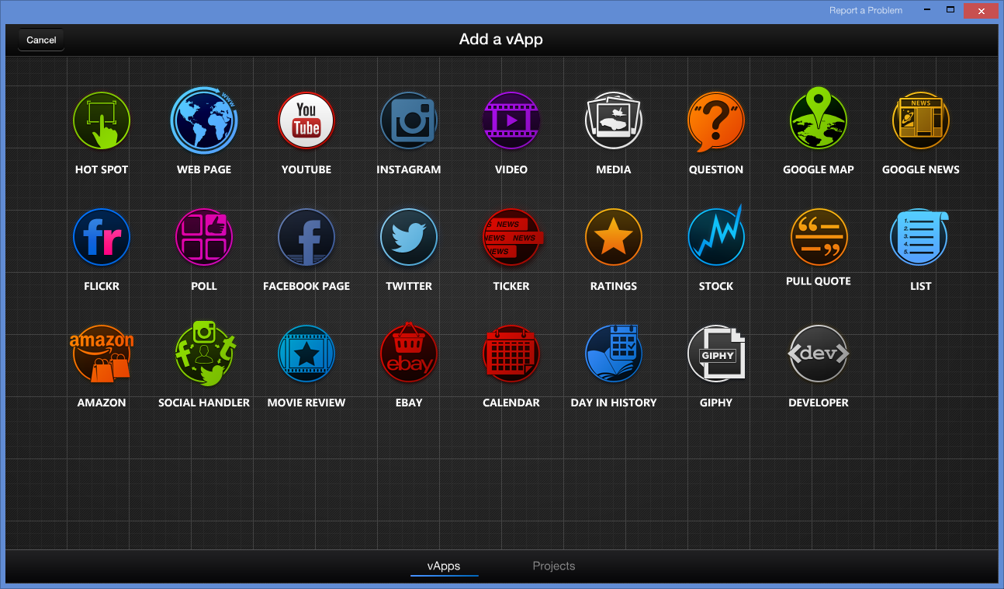
Then I noticed that they had a developer capability. TouchCast ships with several vApps.
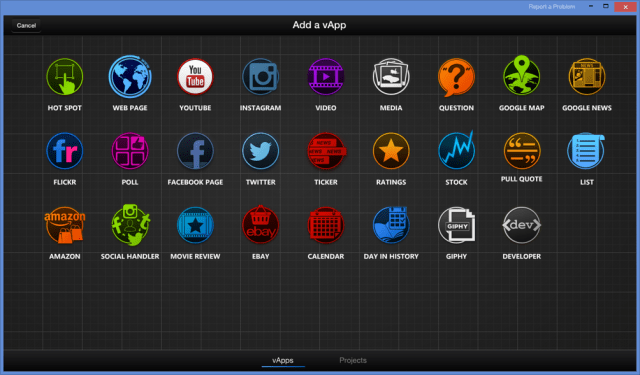
touchcast vapps

And amazingly you can add your own vApps.

I think I’ve found the platform for developing my book content (Emails to a Young Entrepreneur) into a mobile app that can combine presentation videos with the book content and with the exercises.

Of course, I always want to push the envelope so I am recruiting a couple of developers to see how far they can push the vApps. I am hoping I can take the Vidbolt and CommentBubble annotating capability and get them added to TouchCast. Maybe I can even talk my colleague, Kelly Franznick of BlinkUX to add TouchCast to his Feedback Panel for live streaming and commenting on user research video ethnography client projects.

Stay tuned for some early TouchCast prototypes.

Posted in Content with Context, Curation, Design, Flipped Perspective, Human Centered Design, iPad, organizing, Patterns, Teaching, Video | 1 Comment

Lifelet: NASA unveils earth selfie

Sometimes cool stuff just shows up. Today it was the unveiling of NASA’s “global selfie“. NASA asked people around the world to take a selfie and submit it on earth day. They organized the selfie’s into a global view of earth in a photo mosaic.

NASA global earth selfie

Link to the interactive explore mode and drill down to find the individual selfie photos. Make sure you play with snapshot mode as well.  One of my favorite select and zooms:

world selfie photoNow maybe NASA and Google can combine to do an autoawesome of a global view of my thousands of photos on my hard drive.


Posted in Lifelet, Lifelogging | Leave a comment

Discovering Your Inner Entrepreneur

hell freezes overA few months ago, Patrick Whitney and Matt Mayfield invited me to teach an intercession course on Entrepreneuring at the Institute of Design (ID) at the Illinois Institute of Technology. I figured that by March 3, Chicago would be out from under the brutally cold winter weather. Wrong.

I got my own week long full fruity flavor of the deep cold and snow of a Chicago winter. However, the warmth of the welcome from former students, current professors, current students and new friends from my public lecture on “Discovering, Developing and Trusting Your Inner Entrepreneur” made the trip beyond worthwhile.

One of the many gifts of teaching graduate students who are working professionals is that our paths continue to cross over the years. It was a delight to see so many former students from the ten years that I taught at ID during the 1990s.

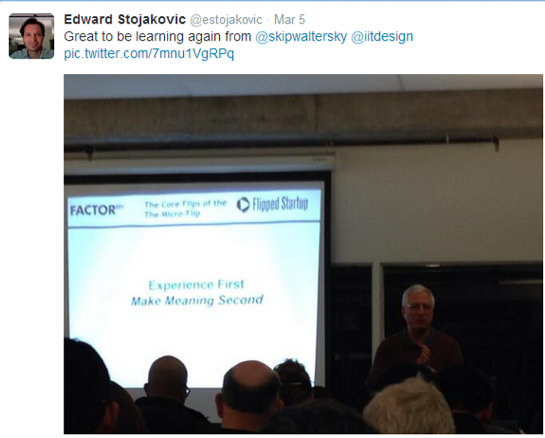
Ed Stojakovic was kind enough to tweet a photo from the talk that captures the core flip of the FlippedStartup:

stojakovic tweet

I was excited to find that he tweeted out one of the sidebar comments “Find. Copy. Paste. Tweak.” is the new black when it comes to computer programming and the “maker” world.

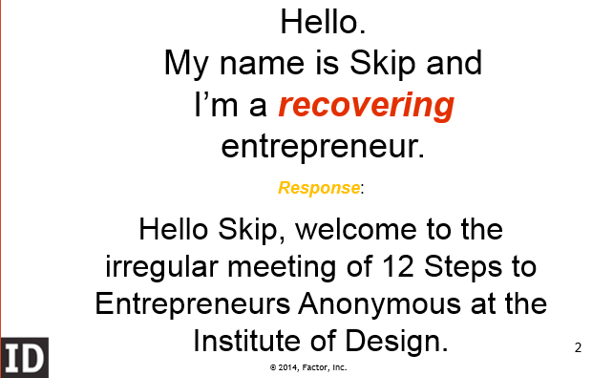
I started the talk with a not too subtle summary of what it is like to be a serial entrepreneur:

recovering entrepreneur opening

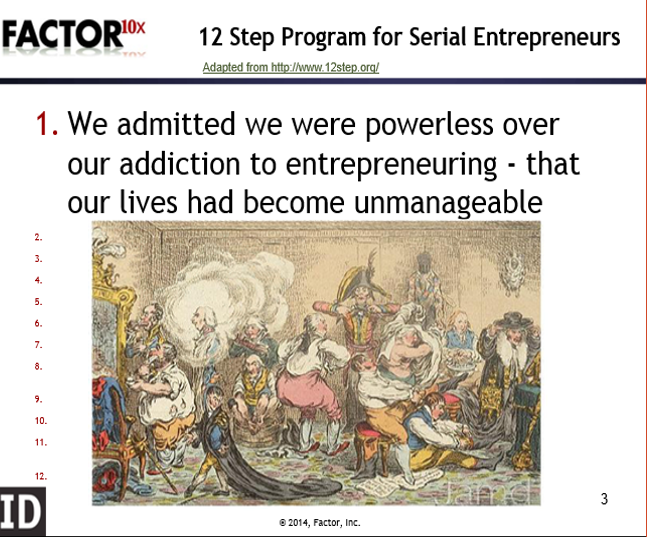
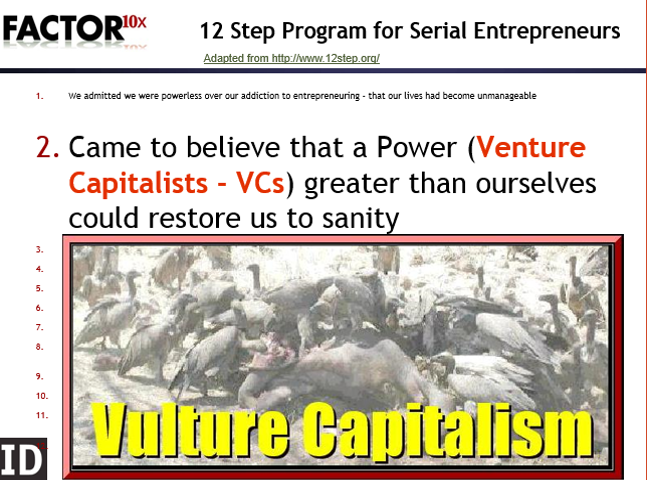
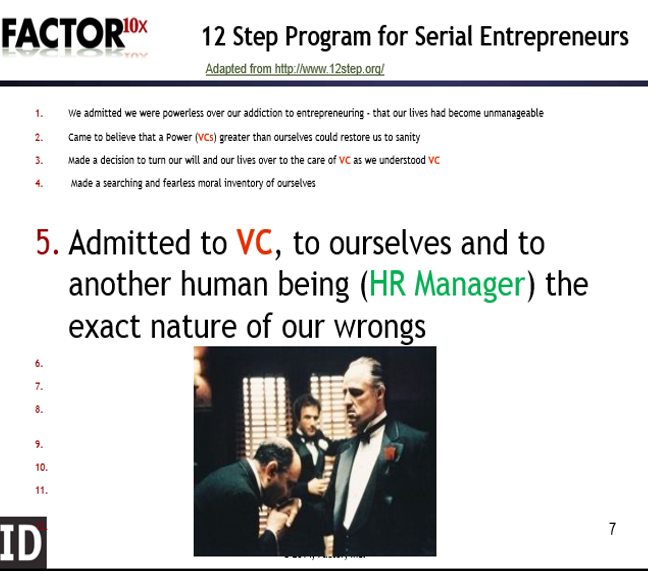
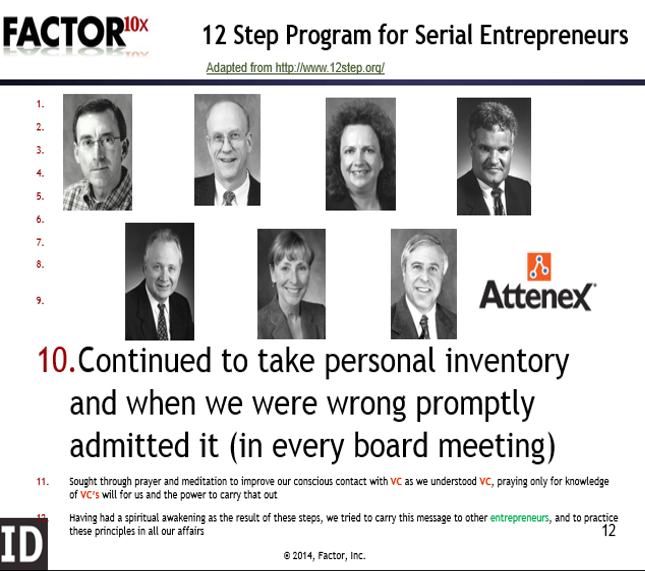
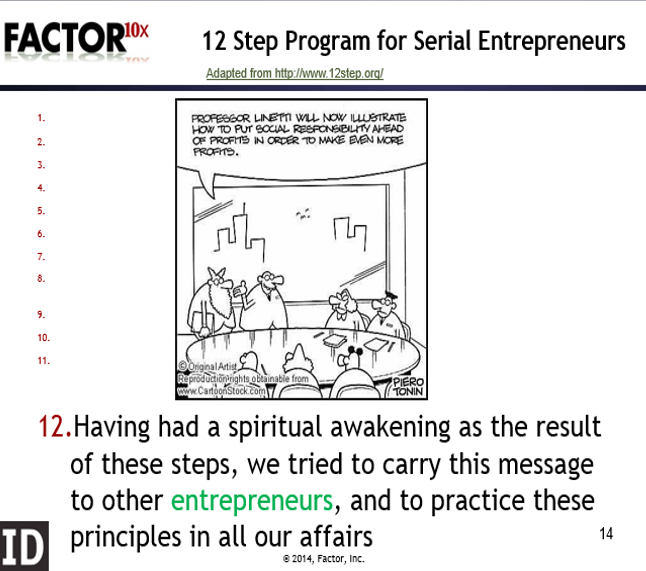
Here are a few of the 12 steps to recovery for the serial entrepreneur:

step 1 EA

step 2 EA

step 5 EA

step 10 EA

step 12 EA

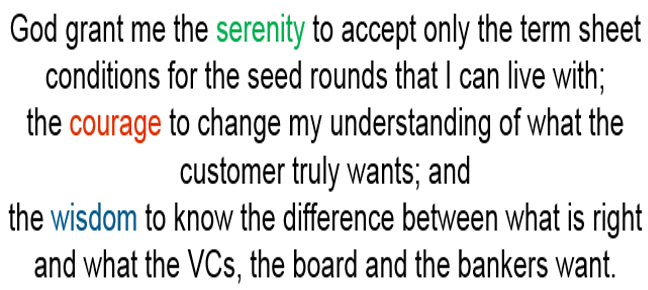
As with all Entrepreneur’s Anonymous meetings we closed with the Entrepreneur’s Serenity Prayer.

Serenity EA

Raina Russ and Ashley Lukasik did a great job organizing the event. They shared that there was a lot of interest from students and ID community members in entrepreneuring who couldn’t spare the time for the intercession course. They hoped that I could share what the world of entrepreneuring looks like on the west coast (Silicon Valley and Seattle) and how designers can link up with the entrepreneuring ecosystem.

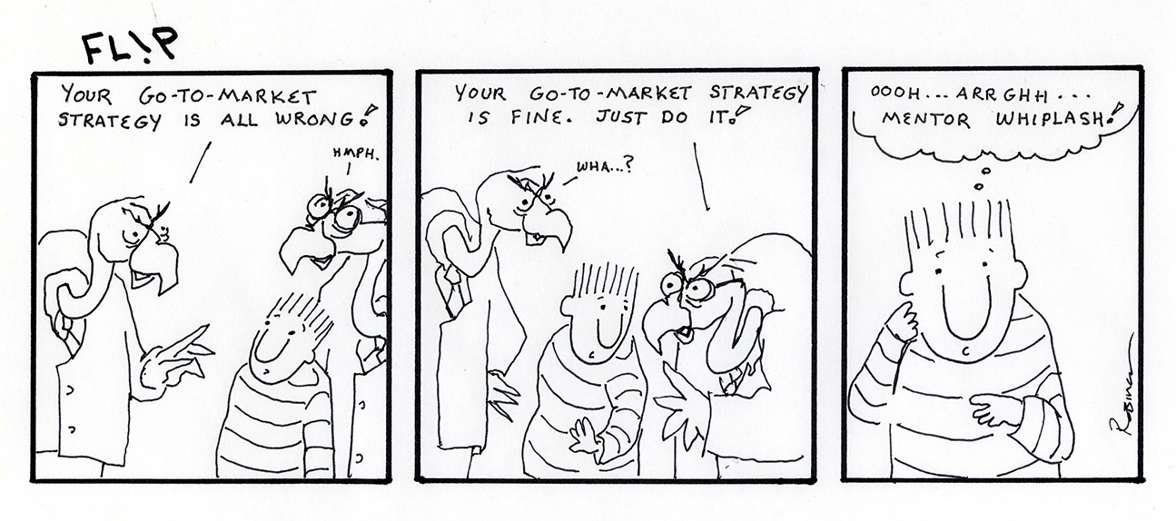
The slide deck from the talk “Discovering, Developing and Trusting Your Inner Entrepreneur” can be found here. The core theme of the talk is that there is an incredible richness of resources for the entrepreneur. However, the entrepreneur quickly finds that many of the resources and “helpers” advice is in conflict. What David Robinson and I call “mentor whiplash“.

mentor whiplash

One of the surprises of the evening was finding out that a reporter from the Chicago Tribune, Cheryl Jackson, was covering the event. Once again I am reminded to always understand who is in the audience. She wrote the following in an article titled “Why the business should get more attention than the product“.

The average entrepreneur often pays too much attention to the product, and that’s a mindset that needs to be corrected, executive coach Skip Walter said Wednesday during a talk at IIT Institute of Design.

Rather than product, entrepreneurs need to focus on the valuation and the exit, Walter said.

“Everyone is focused on a product instead of on the business,” he said. “The founding entrepreneur has to be focused on the business more than the product and separate the two things. The valuation is when you sell the business as an asset.”

Entrepreneurs also tend to overlook better sources of money, he said. They often have friends, family, angel investors and venture capitalists on their radar but don’t consider corporate investors, who could do double duty – provide funding outright to a budding enterprise and buy services or products from that business, Walter said.

“Corporate or strategic investors often become a customer,” he said. “If they’re going to invest in you, often they have a problem internally that they want you to help them solve. So you get your first customer.”

“And you’ve got your exit partner,” he said, adding that such relationships often have larger companies buying ones in which they have invested.

Until they are flush, startups need to do a lot of experimentation, he said. Instead of the ready-aim-fire method of corporations, smaller operators need to think ready-fire-aim, Walter said.

“A large company will do ready, aim, aim, aim, aim and aim for years, and then launch something into the market,” he said. “They have all kinds of resources. An entrepreneur, because they have fewer resources, has to say ‘Let me experiment. Let me try a couple of experiments that will help me sort out where I want to aim my product.’”

Walter was founding CEO of Attenex, which was sold to FTI Consulting for $91 million in 2008. He has raised more than $25 million in new venture funding for companies, and he said it’s easier to launch a technology business than when he started.

“It used to be if we wanted to program anything, we had to write in this arcane computer language,” he said. “Today, there are libraries of programming code, which we call recipes. You copy it and edit. It takes like minutes, when it used to take us months.”

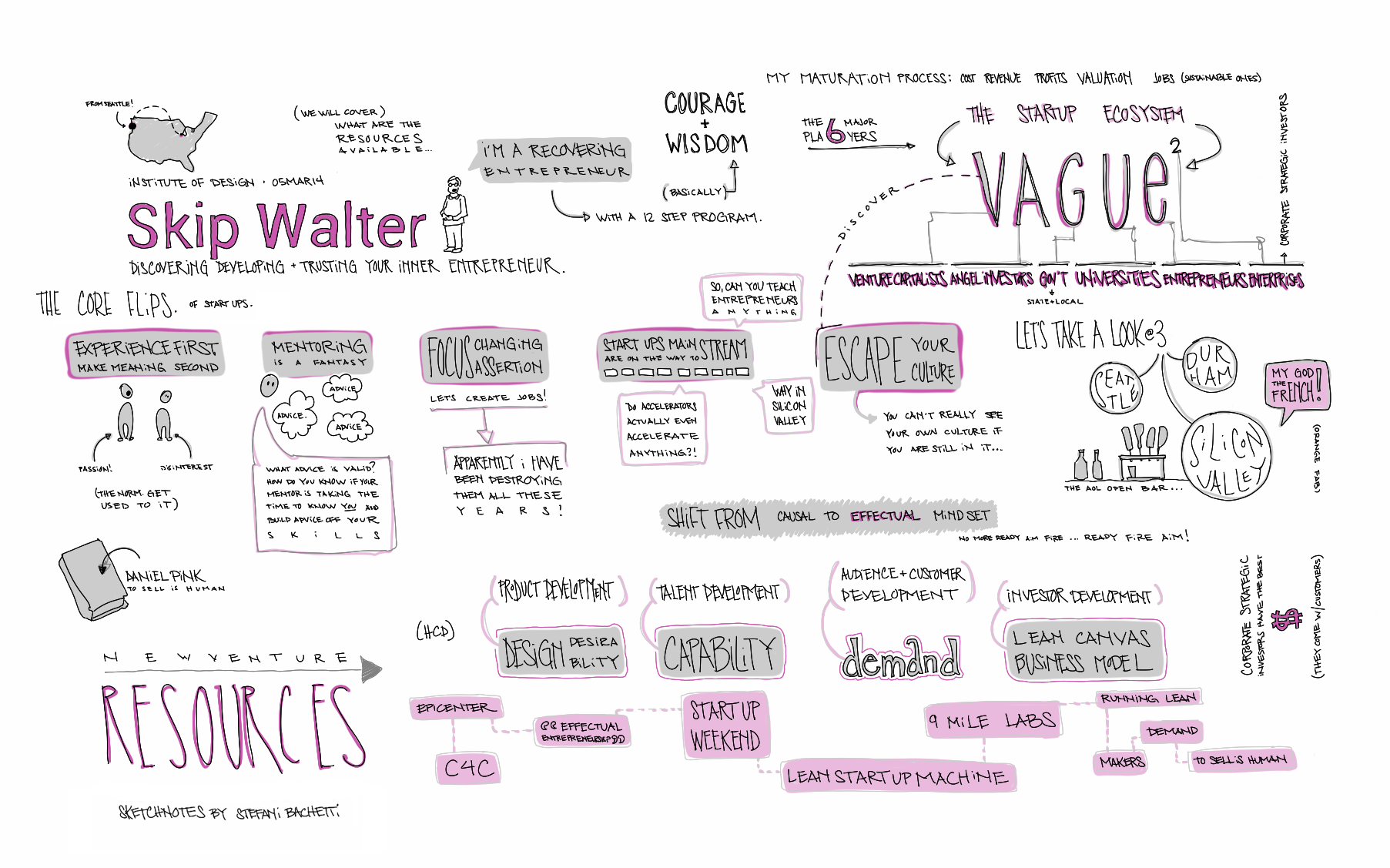
However, the real treat was to wake up to a sketchnote from Stefani Bachetti. Stefani nicely captured the visual gist of my talk in the following sketch:

05mar14 stefani bachetti notes skipwalterThank you Stefani for summarizing the talk better than I ever could.

Posted in Design, Emails for Young Entrepreneur, Entrepreneuring, Flipped Perspective, Human Centered Design, Learning, User Experience | 2 Comments