What if Business were Art Making?

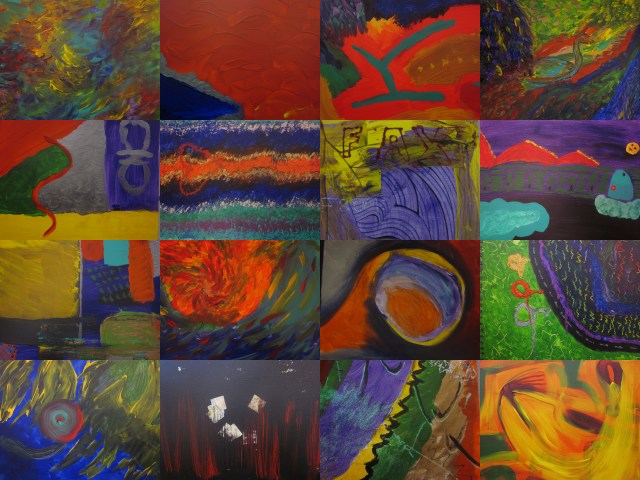
At the UW Bothell Bootcamp Part 1 facilitated by Michele and Jim McCarthy, a powerful part of the process was the making of team art.  The supplies were all there and we were encouraged to “make art” throughout the weekend.  A wonderful stream of paintings flowed from our interactions.

Professor David Socha captured this collage of the paintings in his blog after the weekend.

UW Bothell Bootcamp Part 1 Team Art

What I missed during the weekend was that creating great teams who create great products included bringing the making of art into the workplace.

The process of art making fulfills the vision that Stan Davis created in his book The Art of Business.

What would business look like if art making were an integral part of work?

Posted in Content with Context, Human Centered Design, Idealized Design, Learning, social networking, User Experience, Working in teams | 5 Comments

Life Goes On

As I was watching an episode of Body of Proof, the main character, Megan Hunt, in comforting the wife of a policeman who was killed in the episode shared this quote from the poet Thomas Campbell:

“To live in hearts we leave behind is not to die.”

As our extended family mourns the passing of my wife’s mother, Barbara Cassat Keleher, this one line is somehow comforting.  Barbara’s obituary describes her long and happy life.

The full Thomas Campbell poem is:

“What’s hallowed ground? Has earth a clod
Its Maker meant not should be trod
By man, the image of his God,
Erect and free,
Unscourged by Superstition’s rod
To bow the knee?

That’s hallowed ground where, mourned and missed,
The lips repose our love has kissed;—
But where’s their memory’s mansion? Is’t
Yon churchyard’s bowers?
No! in ourselves their souls exist,
A part of ours.

A kiss can consecrate the ground
Where mated hearts are mutual bound:
The spot where love’s first links were wound,
That ne’er are riven,
Is hallowed down to earth’s profound,
And up to heaven!

For time makes all but true love old;
The burning thoughts that then were told
Run molten still in memory’s mould;
And will not cool
Until the heart itself be cold
In Lethe’s pool.

What hallows ground where heroes sleep?
‘Tis not the sculptured piles you heap!
In dews that heavens far distant weep
Their turf may bloom;
Or Genii twine beneath the deep
Their coral tomb.

But strew his ashes to the wind
Whose sword or voice has served mankind,—
And is he dead, whose glorious mind
Lifts thine on high?—
To live in hearts we leave behind
Is not to die.”

Rest in peace, Mom Keleher.

Posted in Family, Quotes | 4 Comments

Looking Out my Window

On a grey winter day, it is the little things in life that make a difference in the dreary Northwest.  As I was heads down focusing on my virtual screen to the world, I looked up and there was an aircraft carrier cruising by my window.  I immediately raced for my camera to record its passage and brighten up my day.

Trying to focus the camera, I was busy trying to capture the carrier with the Bremerton Ferry in the background. Fortunately I also caught a container ship in the far left background anchored near the docks.  It wasn’t until I loaded the photo to my computer that I realized that those weren’t planes on the deck, but rather cars.

Thanks to the wonders of the internet I looked up US Navy Aircraft Carrier number 76 and found out it was the USS Ronald Reagan (CVN-76).  The Wikipedia entry is so good that it let me know that the USS Ronald Reagan was transferred to the Puget Sound Naval Shipyard.

As I filed the photo away in my very disorganized library, I happened upon a similar photo taken last summer of the Washington State Ferry passing my window.

What a difference the summer sunshine makes on a photo, and on my mood.  I can’t wait for the warm sun to come back to the Puget Sound.

As the silly season of presidential politics heats up, the passing of the USS Ronald Reagan reminds me of the gift we get every day for the sacrifices that our military folks make so that I have the freedom to do what I choose to do.

Having a great day in the Pacific Northwest looking out my window.  Being. Here. Now.

Posted in Nature, Photos, User Experience | 1 Comment

Hassle Maps and Theory of Constraints

In the midst of teaching my human centered design course last fall, I came across Adrian Slywotzkys latest book Demand: Creating What People Love Before They Know They Want it.  I was delighted to find his discussion of the use of Hassle Maps to drive demand. For years, I’ve used Eli Goldratts Theory of Constraints as a way to make sense of complex enterprise workflows.  However, this approach is overkill for making sense of consumer needs.  Hassle Maps fits the consumer user research task.

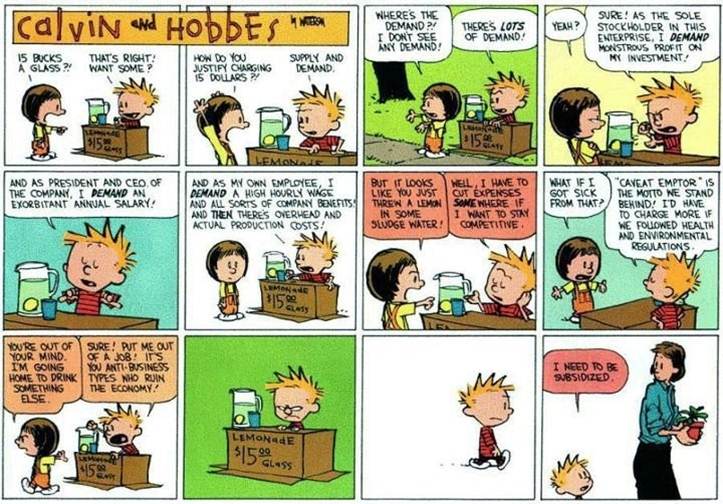
In getting ready to give a seminar lecture this week on Hassle Maps and the Theory of Constraints and how they affect demand, I came across the wisdom of Calvin and Hobbes:

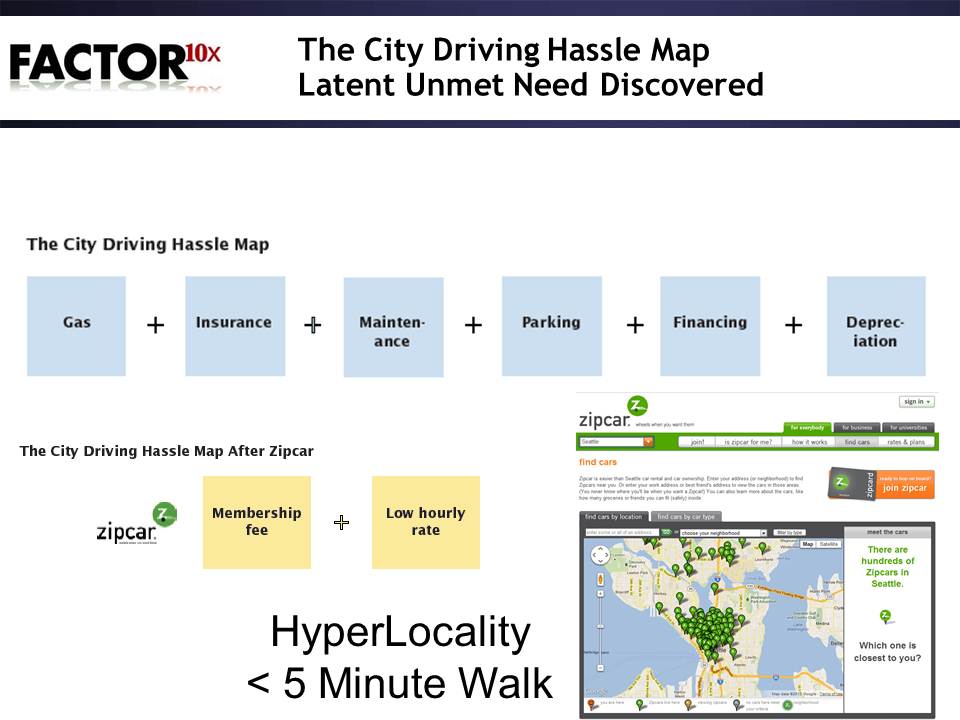
In the book Demand, I liked the example of the user observation and human centered design explanations of what it takes to drive demand.  I decided to use the Zipcar example for the lecture:

The founders of Zipcar were committed to a new, green economic model for personal transportation that could eliminate the need for owning a car.  However, the company struggled for a number of years, until a new CEO came in and required a fresh look at what users really wanted.  As it turns out, while most users were philosophically aligned with Zipcar, their key desire was to walk less than five minutes to get to a car.  Zipcar experimented with this solution which worked and demand for their product took off far beyond their competition.

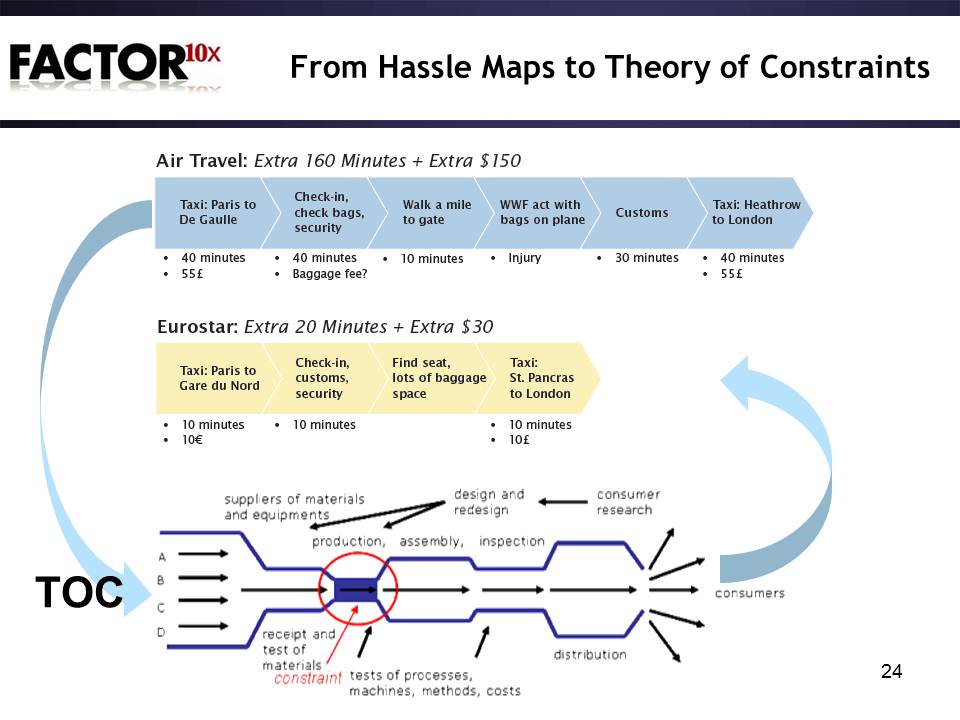
As I switched to describing Theory of Constraints, I realized I needed a bridge slide between the two topics.  So I borrowed another example from Slywotzky and a diagram of Theory of Constraints and put them together.  The “Ah Hah” moment came when I stared at the two maps side by side.  I suddenly realized that it isn’t a matter of “either/or” when it comes to Hassle Maps and Theory of Constraints, they complement each other.  In order to solve the hassle map for the consumer, the enterprise has to examine all of their value adding workflows and find the bottlenecks keeping them from fixing the hassle map of the consumer.  Hassle Maps and Theory of Constraints are mirror images of each other.

When I took a break from preparing this lecture, I read a transcript that my colleague Alan Wood sent along as part of our innovation and the university working group.  The transcript was titled “Don’t Lecture Me: Rethinking the Way College Students Learn” from American RadioWorks.  The thesis of the research professors is that lecturing is a very poor way to transfer learning to students.  Wonderful.  So now all my thoughts will be on how to change from a traditional lecture to using “peer instruction.”  Not.  The thoughts will be there, but I don’t have the time to do it right.  Oops.  That is the other main point of the article.

Once again I find myself on the horns of a dilemma.

Posted in Content with Context, Humor, Learning, Teaching | 2 Comments

The Cricket

After an intense weekend of group process at a McCarthy bootcamp, I wanted to spend some time reflecting on the process and the insights.  As part of searching while “On the way to Somewhere Else” to aid those reflections, I came upon the following story that was in my account of the Japan Study Mission I participated in while at Digital Equipment Corporation in the late 1980s.

Once we arrived in Japan, we continued our education in the Japanese culture.  Our first formal meeting was with Jean Pearce, a columnist for the English language version of the Japan Times.  As part of her show and tell for examples of the differences between Japan and America, she pulled out a little cage for keeping bugs in the house so that one can hear the song of summer. The cage is arranged so that you feed the bug cucumbers or watermelon. I asked her later about these cages and she pointed me to the following short story in Use Both Sides of Your Brain by Tony Buzan.

Kusa-Hibari

“His cage is exactly two Japanese inches high and one inch and a half wide: its tiny wooden door, turning upon a pivot, will scarcely admit the tip of my little finger. But he has plenty of room in that cage – room to walk, and jump, and fly, for he is so small that you must look very carefully through the brown-gauze sides of it in order to catch a glimpse of him. I have always to turn the cage round and round, several times, in a good light, before I can discover his whereabouts, and then I usually find him resting in one of the upper corners – clinging, upside down, to his ceiling of gauze.

“Imagine a cricket about the size of an ordinary mosquito – with a pair of antennae much longer than his own body, and so fine that you can distinguish them only against the light. Kusa-Hibari, or ‘Grass-Lark’ is the Japanese name of him; and he is worth in the market exactly twelve cents: that is to say, very much more than his weight in gold. Twelve cents for such a gnat-like thing! . . . By day he sleeps or meditates, except while occupied with the slice of fresh egg-plant or cucumber which must be poked into his cage every morning. . .to keep him clean and well fed is somewhat troublesome: could you see him, you would think it absurd to take any pains for the sake of a creature so ridiculouly small.

“But always at sunset the infinitesimal soul of him awakens: then the room begins to fill with a delicate and ghostly music of indescribable sweetness – a thin, silvery rippling and trilling as of tiniest electric bells. As the darkness deepens, the sound becomes sweeter – sometimes swelling till the whole house seems to vibrate with the elfish resonance – sometimes thinning down into the faintest imaginable thread of a voice. But loud or low, it keeps a penetrating quality that is weird . . .All night the atomy thus sings: he ceases only when the temple bell proclaims the hour of dawn.

“Now this tiny song is a song of love – vague love of the unseen and unknown. It is quite impossible that he should ever have seen or known, in this present existence of his. Not even his ancestors, for many generations back, could have known anything of the night-life of the fields, or the amorous value of song.

“They were born of eggs hatched in a jar of clay, in the shop of some insect-merchant: and they dwelt thereafter only in cages. But he sings the song of his race as it was sung a myriad years ago, and as faultlessly as if he understood the exact significance of every note. Of course he did not learn the song. It is a song of organic memory – deep, dim memory of other quintillions of lives, when the ghost of him shrilled at night from the dewy grasses of the hills. Then that song brought him love – and death. He has forgotten all about death: but he remembers the love. And therefore he sings now – for the bride that will never come.

“So that his longing is unconsciously retrospective: he cries to the dust of the past – he calls to the silence and the gods for the return of time. . .Human lovers do very much the same thing without knowing it. They call their illusion an Ideal: and their Ideal is, after all, a mere shadowing of race-experience, a phantom of organic memory. The living present has very little to do with it. . .Perhaps this atom also has an ideal, or at least the rudiment of an ideal; but, in any event, the tiny desire must utter its plaint in vain.

“The fault is not altogether mine. I had been warned that if the creature were mated, he would cease to sing and would speedily die. But, night after night, the plaintive, sweet, unanswered trilling touched me like a reproach – became at last an obsession, an affliction, a torment of conscience; and I tried to buy a female. It was too late in the season; there were no more kusa-hibari for sale – either males or females. The insect-merchant laughed and said, ‘He ought to have died about the twentieth day of the ninth month.’ (It was aleady the second day of the tenth month.) But the insect merchant did not know that I have a good stove in my study, and keep the temperature at above 75 degrees F. Wherefore my grass-lark still sings at the close of the eleventh month, and I hope to keep him alive until the Period of the Greatest Cold. However, the rest of his generation are probably dead; neither for love nor money could I now find him a mate. And were I to set him free in order that he might make the search for himself, he could not possibly live through a single night, even if fortunate enough to escape by day the multitude of his natural enemies in the garden – ants, centipedes, and ghastly earth-spiders.

“Last evening – the twenty-ninth of the eleventh month – an odd feeling came to me as I sat at my desk: a sense of emptiness in the room. Then I became aware that my grass-lark was silent, contrary to his wont. I went to the silent cage, and found him lying dead beside a dried-up lump of egg-plant as gray and hard as a stone. Evidently he had not been fed for three or four days; but only the night before his death he had been singing wonderfully – so that I foolishly imagined him to be more than usually contented. My student, Aki, who loves insects, used to feed him; but Aki had gone into the country for a week’s holiday, and the duty of caring for the grass-lark had developed upon Hana, the housemaid. She is not sympathetic, Hana the housemaid. She says that she did not foget the mite – but there was no more egg-plant. And she had never thought of substituting a slice of onion or of cucumber! . . . I spoke words of reproof to Hana the housemaid, and she dutifully expressed contrition. But the fairy music had stopped: and the stillness reproaches; and the room is cold, in spite of the stove.

“Absurd!. . . I have made a good girl unhappy because of an insect half the size of a barley-grain! The quenching of that infinitesimal life troubled me more than I could have believed possible. . .Of course, the mere habit of thinking about a creature’s wants – even the wants of a cricket – may create, by insensible degrees, an imaginative interest, an attachment of which one becomes conscious only when the relation is broken. Besides, I had felt so much, in the hush of the night, the charm of the delicate voice – telling of one minute existence dependent upon my will and selfish pleasure, as upon the favour of a god – telling me also that the atom of ghost in the tiny cage, and the atom of ghost within myself, were forever but one and the same in the deeps of the Vast of being. . .And then to think of the little creature hungering and thirsting, night after night and day after day, while the thoughts of his guardian deity were turned to the weaving of dreams!. . .How bravely, nevertheless, he sang on to the very end – an atrocious end, for he had eaten his own legs!. . .May the gods forgive us all – especially Hana the housemaid!

“Yet, after all, to devour one’s own legs for hunger is not the worst that can happen to a being cursed with the gift of song. There are human crickets who must eat their own hearts in order to sing.”

As I strive for the virtue of “being present” that I committed to with my bootcamp colleagues, I seek to be aware of the songs around me and to seek out the songs that I don’t hear.

Posted in Content with Context, Human Centered Design, Learning, Nature, Travel, Working in teams | Leave a comment

Bootcamping with the McCarthys

I am spending the weekend getting booted at a McCarthys bootcamp sponsored by my colleague, Professor David Socha at UW Bothell.  It is an exciting way to learn new things about myself and to meet a wonderful collection of students, faculty and community members.  However, the greatest joy is running into professionals who are using the session to kickstart their idea stage startup.  What fun it is to listen to the insights and ideas for unmet needs and their solutions.  I look forward to engaging with the two different groups to see their ideas turn into reality.

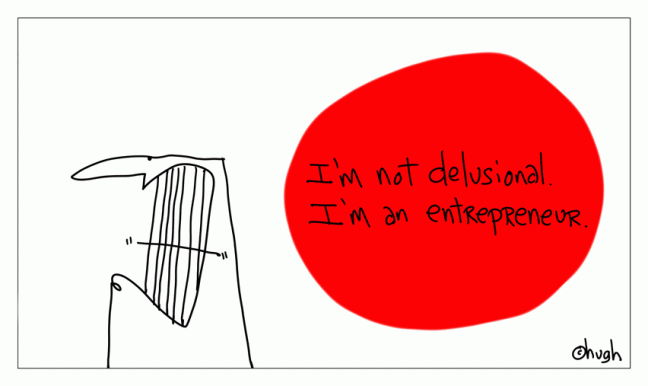
And just in time, Hugh MacLeod offers up his unique insight into doing a startup.

Posted in Humor, organizing, social networking, Uncategorized, Working in teams | 1 Comment

Orbiting the Giant Hairball

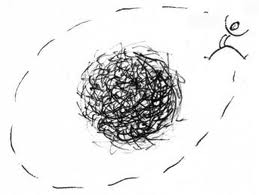
It’s been one of those weeks.  Today, feels like the wonderful image from a book by Gordon MacKenzie called Orbiting the Giant Hairball:  A Corporate Fool’s Guide to Surviving with Grace.  Too many projects and too many new and wonderful people have showed up in my life.  Instead of a network structure which is somewhat organized, it just feels like a hairball at the moment.

I look forward to navigating the loops and whorls to untangle the hairball into a network.

Posted in Humor, Relationship Capital, social networking, User Experience | Leave a comment

The Future of Higher Education – MLA Seattle

Action driving tweets – who knew that such few characters of text could drive action that leads to engaging learning.

A few days ago, Cathy Davidson tweeted that she was headed to Seattle, WA to the Modern Language Association Conference where she was participating in a panel discussion on “The Future of Higher Education.”  What a delight that I would be able to hear and experience Cathy in person, not just through her books and video snippets.  Even better, Ed Lazowska from the UW Computer Science Department would be on the panel as well. And still better, the panel session was open to the public.

This duo of synchronicity and hyper locality started by a simple tweet moved me to rearrange my schedule to attend the session.

I had high expectations for the session given the quality of the participants, and those expectations were far exceeded.  I was treated to four superb intellects sharing their passions from very different points of view across the sciences and the humanities, and yet a powerful vision of what could be emerged from the talks.

The styles of presentation were also interesting and formed a spectrum of ways to shed light on a critical topic.

Kathleen Woodward did a wonderful job presiding over the session and making all of us feel at home.

Sidonie Ann Smith started the panel talks with “Emergent Projects, Processes, and Stories.”  Clearly, this professor is a wonderful writer and her medium is text.  The few slides were all text to share her outline and to provide a few quotes.  In a more traditional lecture style, she read from her prepared paper.  She spoke at a hundred miles per hour, so fast that my traditional note taking couldn’t keep up.  She provided several wonderful turns of phrases like “the new dissertation – thinking outside the proto-book.”

Smith presented four Macro-Narratives to describe the state of higher education:

  • Macro-Narrative 1: Declining state support for public higher education.
  • Macro-Narrative 2: Redefinition of the “institution” of higher education.
  • Macro-Narrative 3: Re-conceptualization of knowledge and knowledge production.
  • Macro-Narrative 4: The emergent scholar.

Smith then followed her macro-narratives with her suggested action plan:

  1. Transform doctoral education
  2. Forge a new ethics and praxis of scholarly communication
  3. Rethink our relationship to scholarship
  4. Re-conceptualize our scholarly collaboration – faculty, students, community, world
  5. Update our narrative of the humanities – from the singular word to the expanse of Big Data

As much as I believe that I read broadly and keep up with a wide range of topics, I never thought I would hear an English professor talking about Big Data.  Did I miss that there was a harmonic convergence in Seattle this week?

Next to speak was Curtis Wong from Microsoft on the topic of “Learning Collaboratories, Now and in the Future.”  From the world of macro-narratives Curtis transported us millions of years into the universe with his WorldWide Telescope project (WWT).   The context for Wong’s talk was the notion of a collaboratory.  His vision for WWT is a prototypical collaboratory where not only is there a visualization capability but the ability to develop curated journeys through the vast data.  Curtis shared another nice turn of a phrase – “education could be a collection of curated journeys.”

As Curtis toured us around several curated journeys, he made clear that story telling is the passport to education.  I am a little slow on the uptake, but here was the union of science and the humanities – storytelling and narrative providing a context for “big data.”  Professor Smith presented a suggestive narrative presentation primarily in words.  Wong presented a visually animated narrative of what the union of the humanities and science could be.  The power of the visual map of the sky illustrates so clearly where there is scientific work going on AND where there isn’t work going on – inviting the community at large (professional and amateur) to contribute to our knowledge of the universe – and to tell stories about their discoveries.

What I especially liked about the ability of the WWT to host meta-data, text, video and audio as a curated journey, is that there was always a smooth transition between content and context.  With a blog entry or a Vook (video book), when you follow a link you are jarred from your current context as you leap from one disparate piece of content to another.  WWT seamlessly integrates the multiple media into a single visual space.

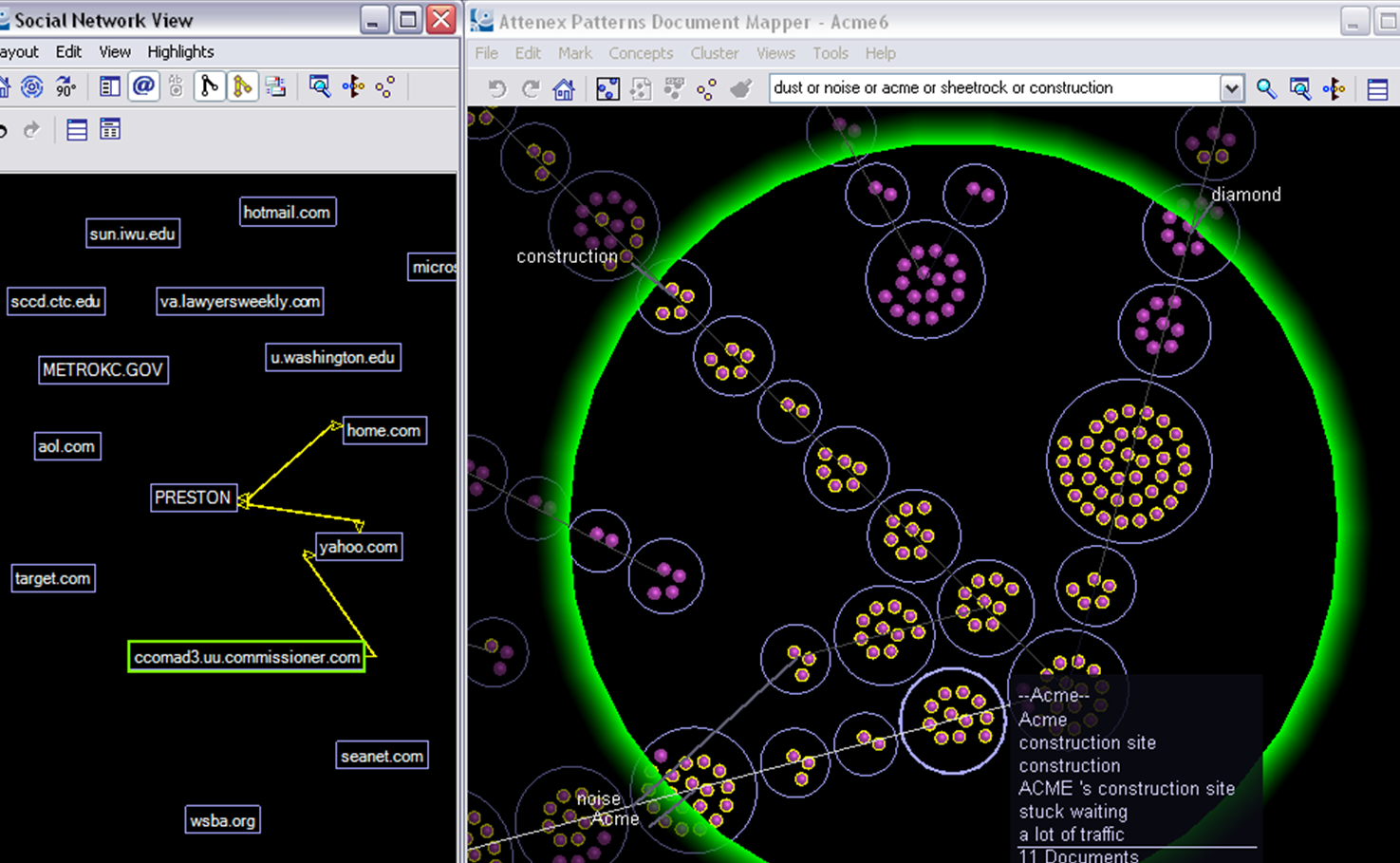
As an innovator in the development of visual analytics capability through our work in creating Attenex Patterns to exponentially increase the productivity for legal electronic discovery, I wanted to run to the podium and meet Curtis to explore how far his WWT engine could be pushed into the realm of document visualizations.

However, I calmed down and looked forward to Ed Lazowska’s presentation on big data – “It’s the Data Stupid!” Ed is one of those wonderful gifts to the computer science community and to the state of Washington.  He is a tireless advocate for the importance of research and high technology.  Whether in a public presentation or in small group meetings with Ed, I always come away smarter.  My favorite learning from Ed has affected my pedagogy ever since he advised “never answer a students question directly. Always seek first to understand the misunderstanding that caused the question to be asked in the first place.”  Forgetting this advice leads to poor mentoring on my part when interacting with students or colleagues.

Ed started his talk off with a wonderful hook “Let’s look at four things that happened in 1969 – man walked on the moon, Woodstock happened, the Mets won the World Series, and the first data packet was sent over Arpanet (precursor to the Internet).  Forty years later, which of these four events had the most impact.”  Clearly, all of us answered the Internet.

Ed then went through the evolution of approaches to science:

  • Theory
  • Experiment
  • Observation
  • Computational Science – the world of simulation
  • Today:  eScience – the dawn of data driven science

Connecting with Wong’s talk, Ed pointed out that the Sloan Digital Sky Scanner that created the data source for the WWT collected 80 Terabytes (TB) over seven years.  This amount of data precipitated the shift to the public sharing of data which is a big leap from previous methods of hoarding data based on how expensive it was to collect and curate data.  We are seeing the democratization of science through this sharing of big data.

Current desktop gene sequencers generate 17 TB of data per day.  Imagine the amount of data that a roomful of these desktop gene sequencers create – every hour, every day, 24/7.

In his wonderfully fact based presentation style, Ed shared several observations on how these advances in big data are destroying the economics of the university.  Lazowska connected nicely with the talks from Smith and Wong by arguing convincingly for the connection of humanities to big data to aid in telling the stories buried in the data.

With three talks completed and one to go, I knew I was in the presence of a special event. Each speaker had a unique style and a unique point of view, yet they prepared and shared bridges and connections to the views of the other speakers.  As a regular attendee and presenter at academic and business conferences, it is a rare occurrence to have a group of panelists coordinate their messages so seamlessly.

Now it was Cathy’s turn to share her thoughts on “How to Crowdsource Thinking”.  Over the last month, Cathy’s books, videos and prolific tweets entered my invisible university of thought leaders.  Of course, Cathy being a professor at Duke University, my alma mater, and sharing anecdotes about Shane Battier, one of my favorite Duke basketball players, helped a lot.

Cathy’s recent book Now You See It is an inspiration at so many different levels.  At the top level, her insights give me a completely different way to see both the student/teacher relationship as well as the manager/employee relationship.  As a practitioner and teacher of human centered design, I spent the last four years trying to improve the learner centeredness of my courses in the UW HCDE Department and in the UW Foster Business School.  While I made some improvements, I was operating without a framework or theory or evidence based method for teaching AND assessment.

Through Davidson’s research and innovation in the classroom, I now have several frameworks to use to change the learning dynamics in the classroom and “in the wild.”  I loved Cathy’s description of her charter while she was Vice Provost at Duke “break things and make things.”

Cathy issued several interesting questions and observations as she began her talk:

  • If <1% of college students go on to become tenure track professors, why is an English department structured for the 1% rather than the 99%?
  • Quoting Clay Shirky “institutions tend to preserve the problem they were designed to solve,” Professor Davidson asked “why do we have to keep preserving the institution of higher learning?”
  • Why are we letting the industrial-educational complex, drive scientific labor management into scientific learning management?
  • Why do we continue to use the “A, B, C, D” grading system that even the American Meat Packing Association rejected within months of starting its use?

Why indeed?

As she described in her book, Cathy’s talk was from the union of head and heart as she did not use a prepared paper and had relatively few slides.  As an audience member, it was easy to feel that I was in a conversation, not a lecture.

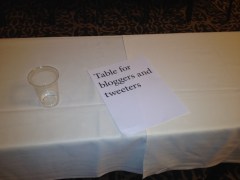
The Q&A session was lively and gave the panelists an opportunity to share an even wider range of thoughts.  As I left the room, I had to chuckle at the sign on the back table.
As I walked from the Ballroom at the Seattle Sheraton back to the ferry terminal for the ride home to Bainbridge Island, I was flooded with imagery of a software application that I would really love from today’s panel discussion.  I imagined that prior to the panel discussion, all of the books, publications, videos, and reference pointers from the speakers were loaded into a visually rich environment like the Wong’s WWT engine.  And the panelist presentations and Q&A session were recorded (video and audio) and loaded into the WWT engine.  Then, after the session, each of the panelists would curate a journey through this n-dimensional media space and capture their reflections on what they took away from the event and the ideas shared by the other panelists.  After the event, all of us as participants, could start adding our reflections and relevant references to the compendium and curate our own journeys through this rich topic space.  What a conversation that would be.

This kind of tool would truly be “content with context.”

The lasting benefit of the panel discussion today is that along with Cathy and Ed, I am adding three more professors to my invisible university.

Posted in Big Data, Content with Context, Human Centered Design, Idealized Design, Intellectual Capital, Knowledge Management, Learning, University, User Experience, WUKID | 6 Comments

Don Norman would be proud

Don Norman is a delightful professorial curmudgeon who collects and publishes examples of good and bad design in books like The Design of Everyday Things and Living with Complexity.

On my walk through the Seattle Ferry terminal yesterday I finally took the time to capture the theater of the absurd when it comes to public safety and add to the collection of bad designs.  With all the lawyers that travel between Seattle and Bainbridge Island, I don’t know why somebody hasn’t filed a lawsuit at this crazy lack of common sense on the part of public officials.

Here is the offending bench:

Here is the warning sign placed at eye level for normal height adults – at least 30 feet away from the closest offending bench:

What parent would ever see the sign or think of the danger, until after a child has caught their finger in a hole?  For the life of me, I can’t figure out why they don’t just remove the offending benches.  I guess common sense isn’t so common anymore.

Posted in Health Care, Human Centered Design, Travel | 1 Comment

Say What – human cloud?

You know you are getting old when you mis-hear something that leads to more interesting that what was actually said.

I sat in on Professor David Socha‘s class on “Evidence Based Design” for MSCSS students at UW Bothell last evening.  David gave me the gift of sitting in on my “User Centered Design” course last quarter and I am returning the favor for him this quarter.

As David was providing the course overview and describing the different types of prototypes, he emphasized the importance of low fidelity versus high fidelity prototypes.  He shared that with low fidelity prototypes you get great insightful feedback on your ideas, while with high fidelity prototypes you get feedback on font sizes and colors and button locations.

One of the students volunteered that this reminded him of a great website to look at.  I thought I heard him say “the human cloud.”  What an interesting term.  I had not heard the term before so immediately did a Google search to see what he was referring to.  There were several great websites and the essential theme for “human cloud” was another term for “wisdom of crowds.”

However, just to make sure that I had heard the student right I asked him what the specific URL was for his comment.  He replied “Hugh MacLeod’s gapingvoid.com.”

This mis-hearing is a perfect example of “On the Way to Somewhere Else“.  It could have taken months to come across the meme of the “human cloud.”  However, through the wonders of getting old and having gradual hearing loss, I found a new meme (“human cloud“) and was re-introduced to a favorite author and cartoonistHugh MacLeod.

Posted in Humor, Learning, Quotes, Teaching | Leave a comment