Review of Empirical Research Through Design

Design Research is one of those quirky phrases that I have a difficult time parsing.  Does design research mean that I am doing research on design (itself a tricky word as demonstrated in an article I co-wrote on “Is designing software different than designing other things?“) or does it mean that I am doing research for a design that I am working on? This conundrum came to mind as I was reading “Empirical Research by Design” by David Keyson and Miguel Alonso.

The abstract describes the paper thusly:

“This paper describes the empirical research through design method (ERDM), which differs from current approaches to research through design by enforcing the need for the designer, after a series of pilot prototype based studies, to a-priori develop a number of testable interaction design hypothesis which are then embedded in a working prototype and tested in context with target users. The approach builds on contextual enquiry methods such as context mapping leading to a verifiable working prototype while contributing to fundamental design knowledge. A case study is described to illustrate the application of the ERDM method.”

Context Mapping Tools

As I am always interested in new ways to do prototyping as well as ways to teach graduate students the importance of prototyping, this article had my attention. However, the introduction really caused me to want to read and understand the authors research:

“Research through design focuses on the role of the product prototype as an instrument of design knowledge enquiry. The prototype can evolve in degrees of granularity, from interactive mockups to fully functional prototypes, as a means to formulate, develop and validate design knowledge. The designer-researcher can begin to explore complex product interaction issues in a realistic user context and reflect back on the design process and decisions made based on actual user-interaction with the test prototype. Observations of how the prototype was experienced may be used to guide research through design as an iterative process, helping to evolve the product prototype.”

This introduction captured what I have such a difficult time conveying to students and colleagues that design and research are iterative activities.  Further, this process is all about generating actionable insights.

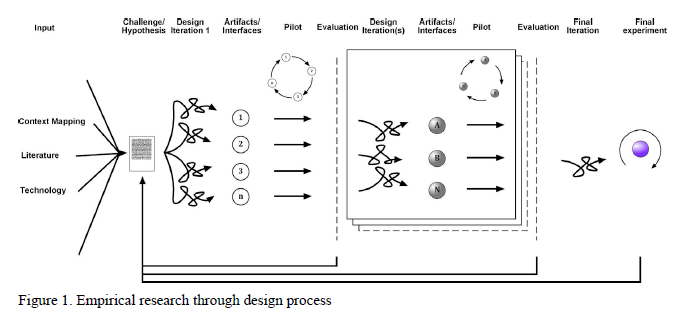
The authors describe their process in this diagram:

The authors highlight several challenges for the prototyping process.  One of the challenges occurs when getting to the prototype evaluation stage where it is important not to confound the research variables.  For example, if you are trying to study voice versus pen mobile interfaces it is important that the visual interface be the same in both variants.  It is easy to do cumulative designs that vary across multiple dimensions for each test and then your statistical analyses have a hard time sorting out the dependent and independent variables and any significant differences.

Another challenge is whether you need to understand how the prototype will work over time (the longitudinal study). If important, then you need to figure out how to observe a subject’s interactions over several weeks.  A longitudinal study is important as how we interact with something may be different once we become more of an “expert” user.  New designers tend to think of their designs as being timeless when in reality the users needs change over time. One way to do a longitudinal study is with the aid of the user.  Tools like dScout provide the user with an easy way to record their observations and a dashboard for researchers to make sense of the data.

What I especially like about articles that propose a design method or model, is when they include an example of the method in practice and the experimental results.  The authors described the design and evaluation of a fun office professional device – Pause Buddy.  What I found very helpful is that their methodology was clearer to me in the example than in the general description.  The described design method steps in the example were:

  • Hypothesis (this step is so critical and yet so many designers jump into a design process without any working hypothesis)
  • Iteration1 to n
    • Design
    • Participant Study
    • Findings
    • Conclusions – feed forward into next Design Iteration
  • Final Design
  • Final Evaluation

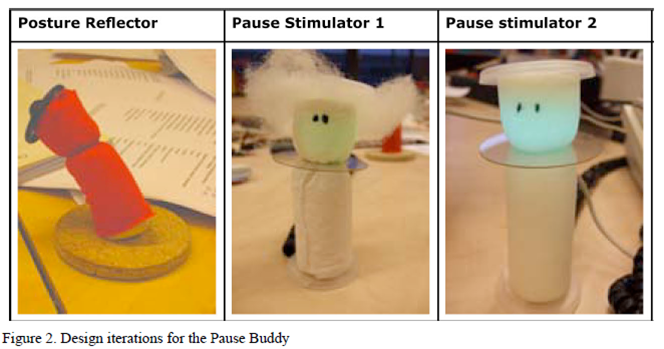
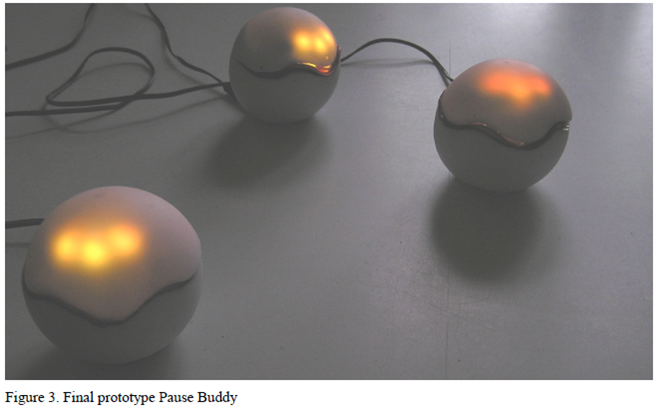
I really liked the two sets of designs that emerged from this Empirical Research Through Design Method (EDRM):

The authors did a great job of illustrating both definitions of “design research” posed in the opening paragraph.  This article contributed both a new method of design research (the research on design research) and provided an example (Pause Buddy) of how to do design research in the context of a particular design brief.

The only thing missing from the methodology I teach in my human centered design (HCD) classes is some notion of the monetization of the design – how will the designers make money with their newly designed product (the value creation).  While they did provide some insights into the human values (the other notion of value in the core HCD process), these values were not connected to the value creation process.

While I was not aware of this research before we started the design of Attenex Patterns, the process we used to design our product was congruent with ERDM.

If you are a practicing human centered designer, or a UX researcher, the ERDM should definitely be a part of your toolkit.  This process nicely encapsulates the power of empirical design research to generate more robust products in a timely fashion and at a reduced cost (get it right at V1 before starting costly manufacturing and distribution).  As a teacher, I look forward to using this article as part of my courses to show how ERDM can lead to more powerful insight generation.

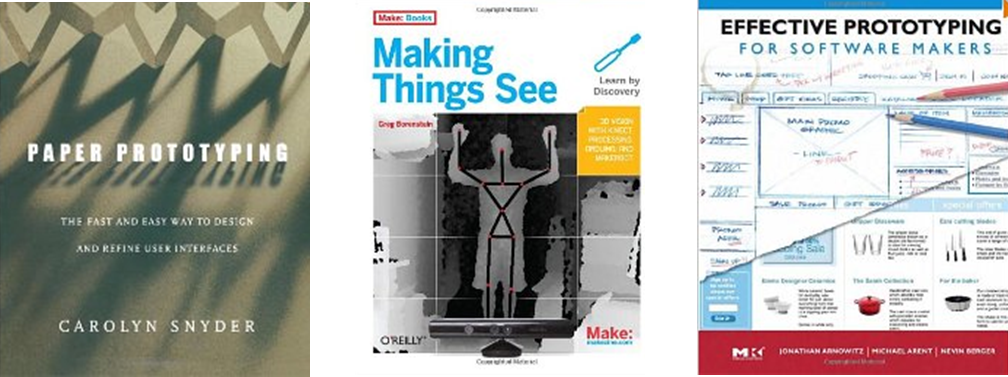
The beauty of an evidence based research article is that it captures key concepts in a few pages.  Usually these articles are enough to convince you of the need for their design research method, but in the few pages there isn’t enough information to begin to practice the new knowledge.  Here are a few of the books I’ve found useful for different types of prototyping:

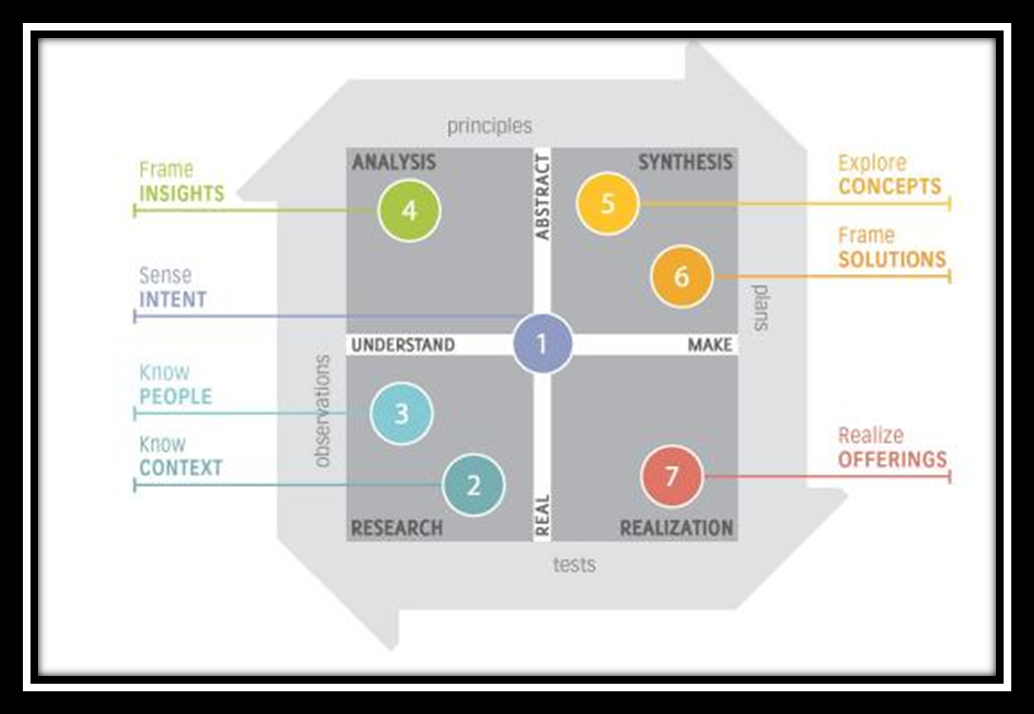
If you are interested in the richness of design methods, a wonderful book by a former colleague, Vijay Kumar was just published – 101 Design Methods: A Structured Approach for Driving Innovation in Your Organization.  Vijay’s organization of the types of design methods is a must have for any design researcher.

Can you place the ERDM in this framework?  Maybe it can become the 102nd model.

Posted in Attenex Patterns, Content with Context, Design, Human Centered Design, University | 1 Comment

Hiding in Plain Sight

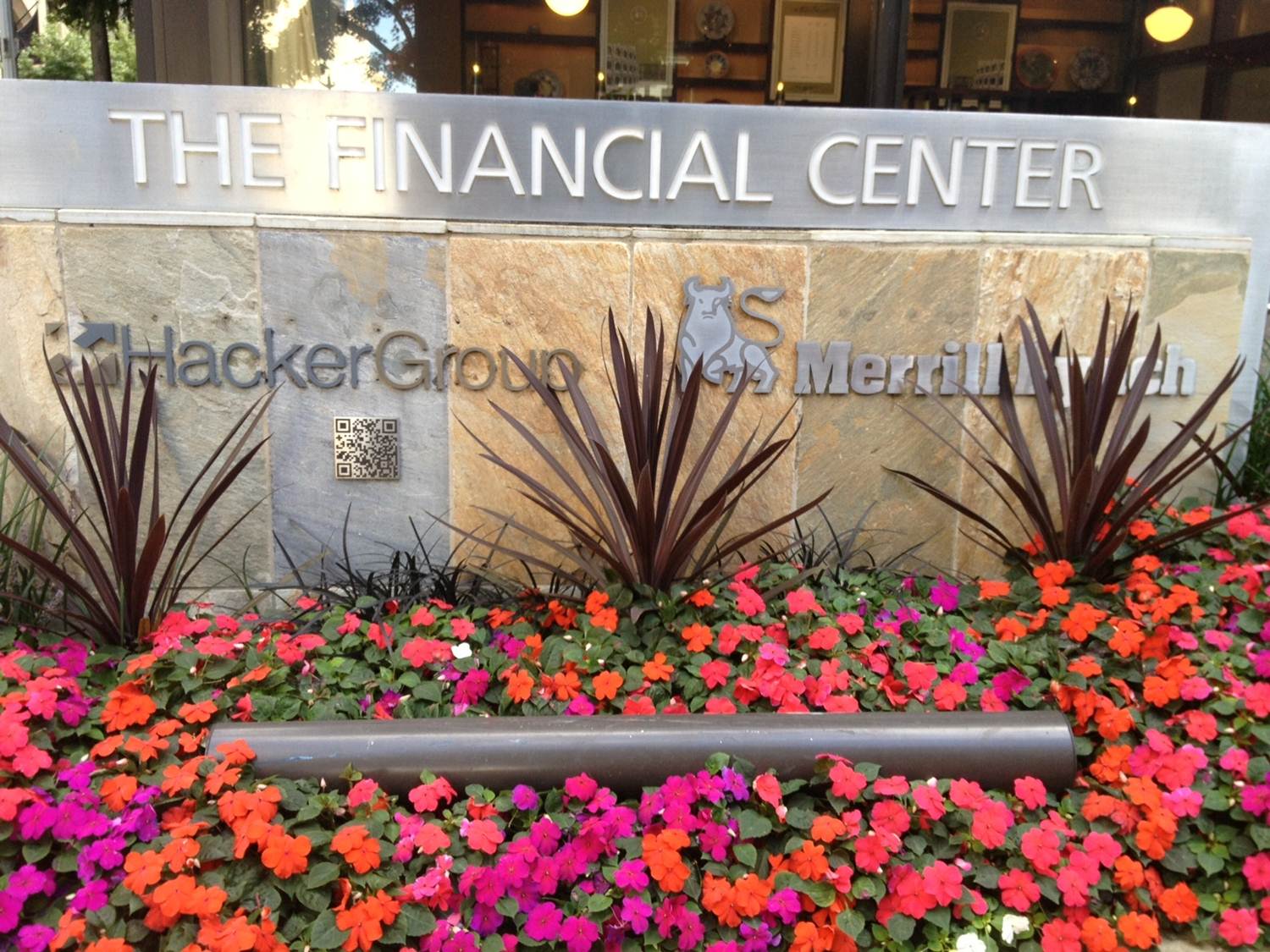
While walking on Fourth Avenue in Seattle on a bright autumn day (a route I walk quiet often), an array of multi-colored flowers caught my eye.  I admired their beauty on this sunny day and kept on walking.  About 20 feet later, the sign registered in my slowly reacting mind.  So I retraced my steps and just burst out laughing at the juxtaposition of the company names on the Financial Center’s branding display.

Posted in Humor | 1 Comment

A little eDiscovery Humor

As I step back into the world of legal eDiscovery, it is a delight to see that this market segment has finally achieved market notoriety – cartoons are showing up making fun of the work of our dedicated professionals.  CaseCentral is doing a wonderful job with their weekly cartoon on legal humor.  An example of their insightful and wry look at the world surrounds the joys of email:

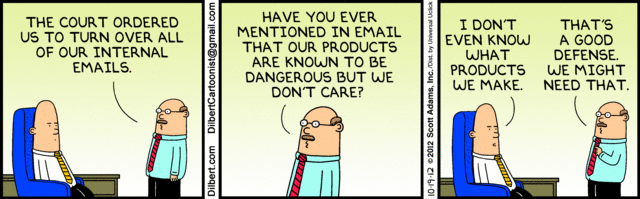
Yet, an industry’s effect on the world isn’t really felt until it is mocked in Dilbert.  This week Scott Adams captured the foibles of eDiscovery as only his wonderful world view can:


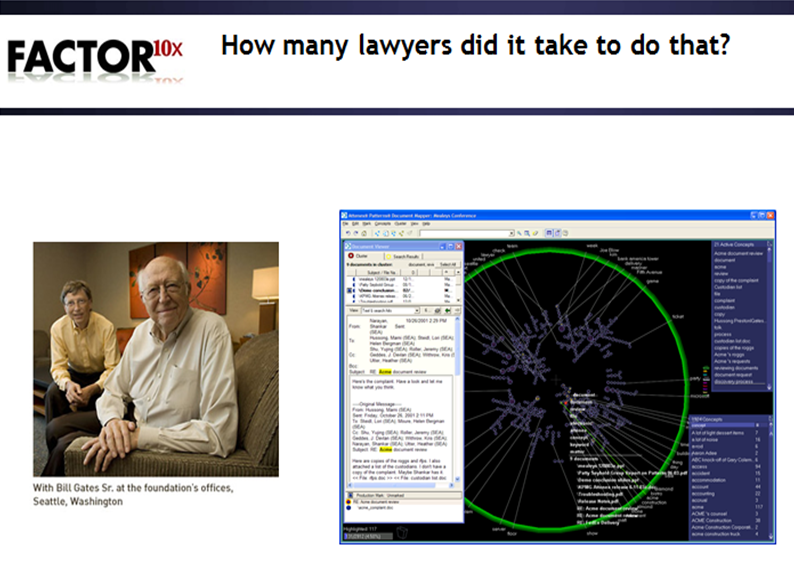
 The Dilbert cartoons reminded me of an interaction with Bill Gates, Sr. (author of Showing Up for Life: Thoughts on the Gifts of a Lifetime), during the first year of the development of Attenex Patterns.

An important value that Preston Gates & Ellis (now K&L Gates) brought to the development process was to bring technology industry luminaries by to get demonstrations of what we were up to.  One of the most fun demos that we did was for William H. Gates, Sr (yes, that is Bill Gates dad and one of the named partners for Preston Gates & Ellis).  Gates, Sr. would usually come by Preston Gates in the summer to address the summer associates about his views of what it means to be a lawyer. For this summer visit, Gerry Johnson persuaded Gates, Sr to come by and see that a law firm could fund innovative software development.  Gerry also wanted to give Gates, Sr. visibility into how large the eDiscovery problem was growing for Microsoft since Preston Gates did most of Microsoft’s eDiscovery work.

We prepared more extensively than usual for this demo.  By the time Gates, Sr., arrived to see the demo he was clearly quite tired.  I was concerned that since we were running late we would put him to sleep in a darkened room.  So I shortened my introductory slides and got right to the demo (seen above).

Just at the point that I thought I had put Gates to sleep, he straightened up and looked at me and said “So how many lawyers does it take to annotate a given document and the collection of documents with all those concepts?”

I replied “No lawyers at all.  Our content analytics software is able to figure out all the meaningful concepts within each collection of documents.  Everything you are seeing was done automatically.”

He looked at me again like I hadn’t understood the question, “No.  Really.  How many lawyers did it take to mark up these concepts?”

I repeated “None.”

Bill Gates, Sr., then turned to Gerry Johnson and said “Gerry.  Really.  How many lawyers does it take to identify these concepts?”

Gerry answered “None.”

As the implications of what we’d just demonstrated dawned on him, he asked “Has anybody demoed this to my son Bill, yet?”

Nervously, we all answered that we had not demoed it to anyone at Microsoft yet.

Gates then almost shouted “Well, will you quickly go over and demonstrate this to him so he’ll quit writing those stupid emails that get him in all that trouble with the Justice Department?”

After we stopped convulsing in laughter, we went on with the demo.  Clearly, he understood the implications.

Posted in Attenex Patterns, Dilbert, eDiscovery, Humor, Relationship Capital | Leave a comment

Re-energizing “working” a grape harvest

My favorite fine wine growing time of the year is the fall grape harvest, crush, and fermentation.  I shook off my fall lethargy to go spend a couple of days with my favorite wineries in Oregon’s Willamette ValleyArchery Summit and Dominio IV.

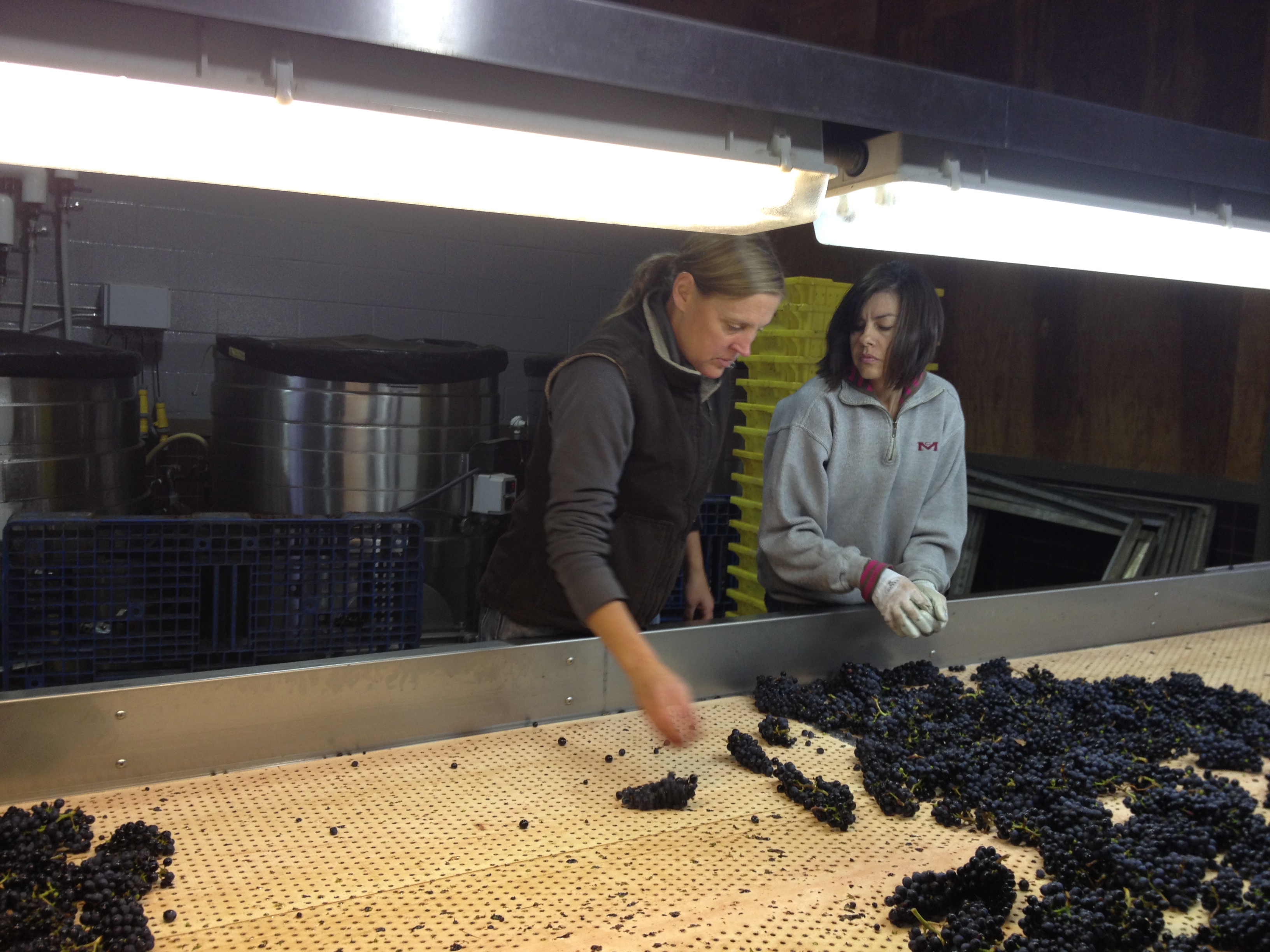
Anna Matzinger (on the left) who is a most gifted wine maker was showing us how to sort the pinot noir grapes before they went to the de-stemmer.  There is something wonderfully fulfilling about spending a day on the sorting table contributing just a little bit to the 2012 grape harvest.

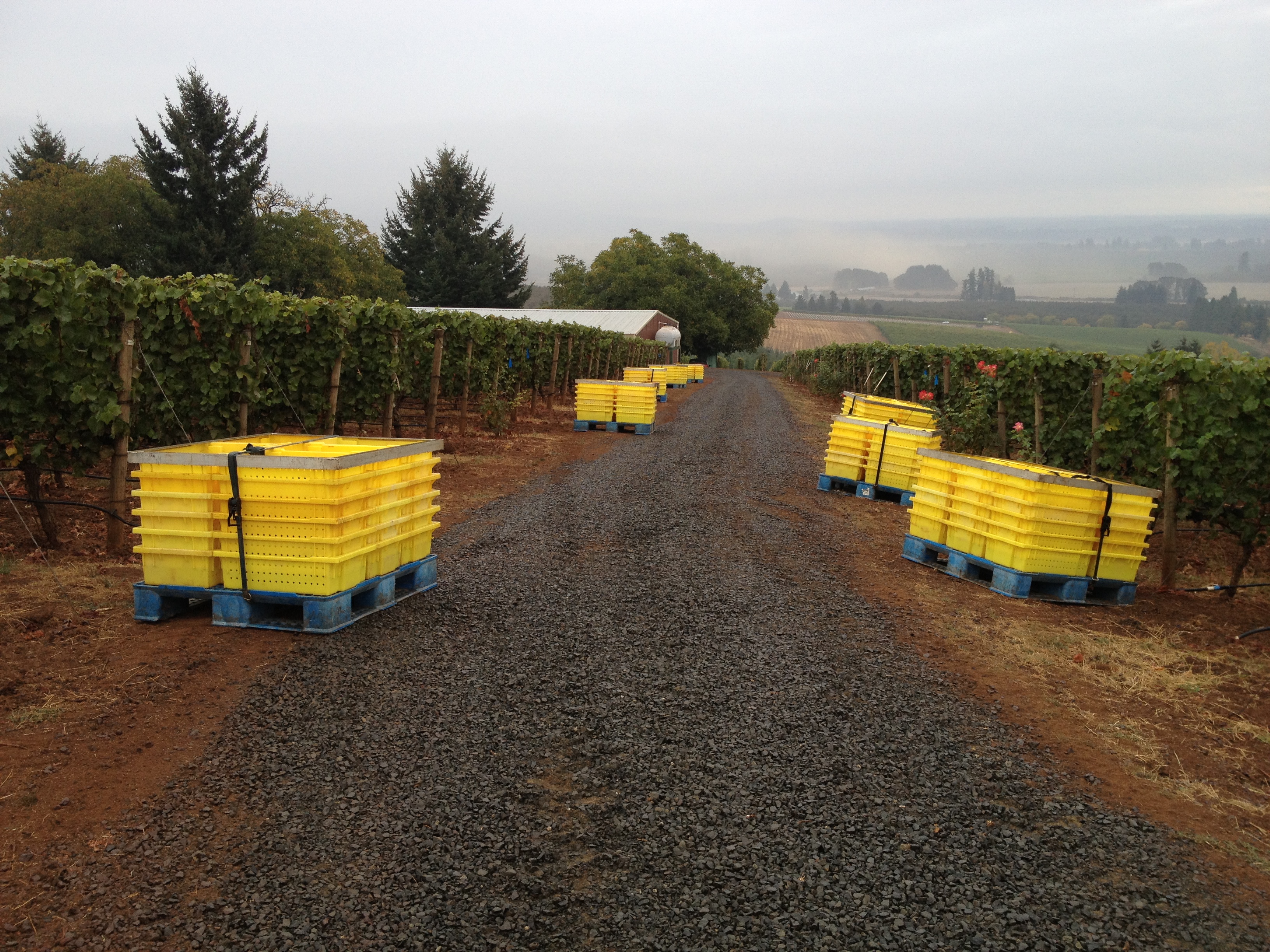
As I walked around the winery during a lull in the grape sorting I enjoy the early Halloween gifts of the cold soaks that invite me to shoot way too many photos or the “fog” flowing lightly down hill.

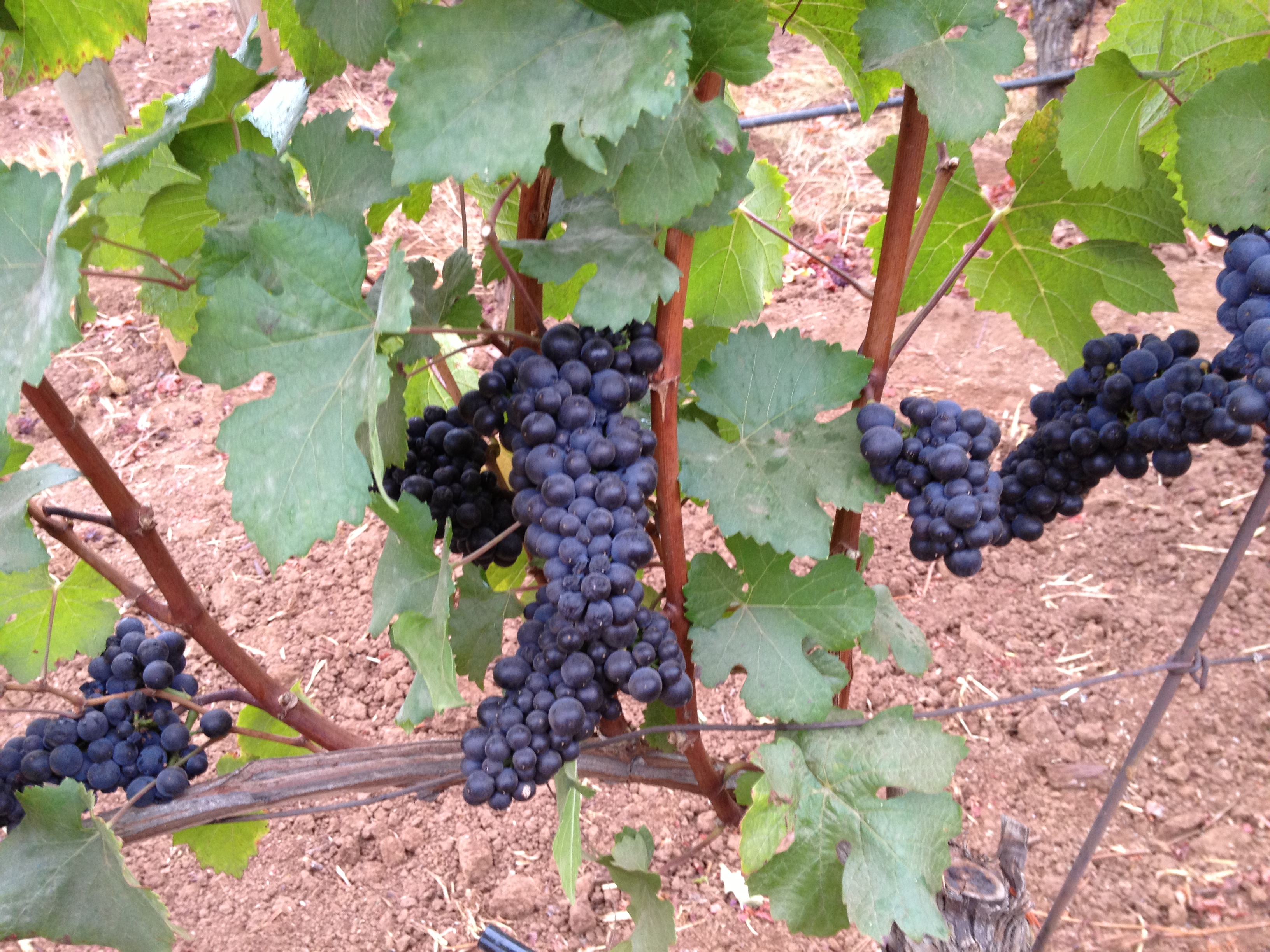
 Today’s grapes were coming from Renegade Ridge, Archery Summit’s biodynamic vineyard that is a few hundred yards away from the winery.  I wandered over the hillside to see what the grapes looked like before they were picked:


The Pinot Noir grapes showed the results of an almost perfect growing season.  They were deep purple, tasted so sweetly tart, and showed no signs at all of any molds which can happen in a wet growing season.  As I looked up, I could see the calm before the frenzied activity of the vineyard workings picking off the grape clusters.

As I wandered down the hillside, the rains came in great gulps, the first real rain of the growing season.  With great reluctance, I went back inside the winery and continued the sorting of what I’d just seen picked.

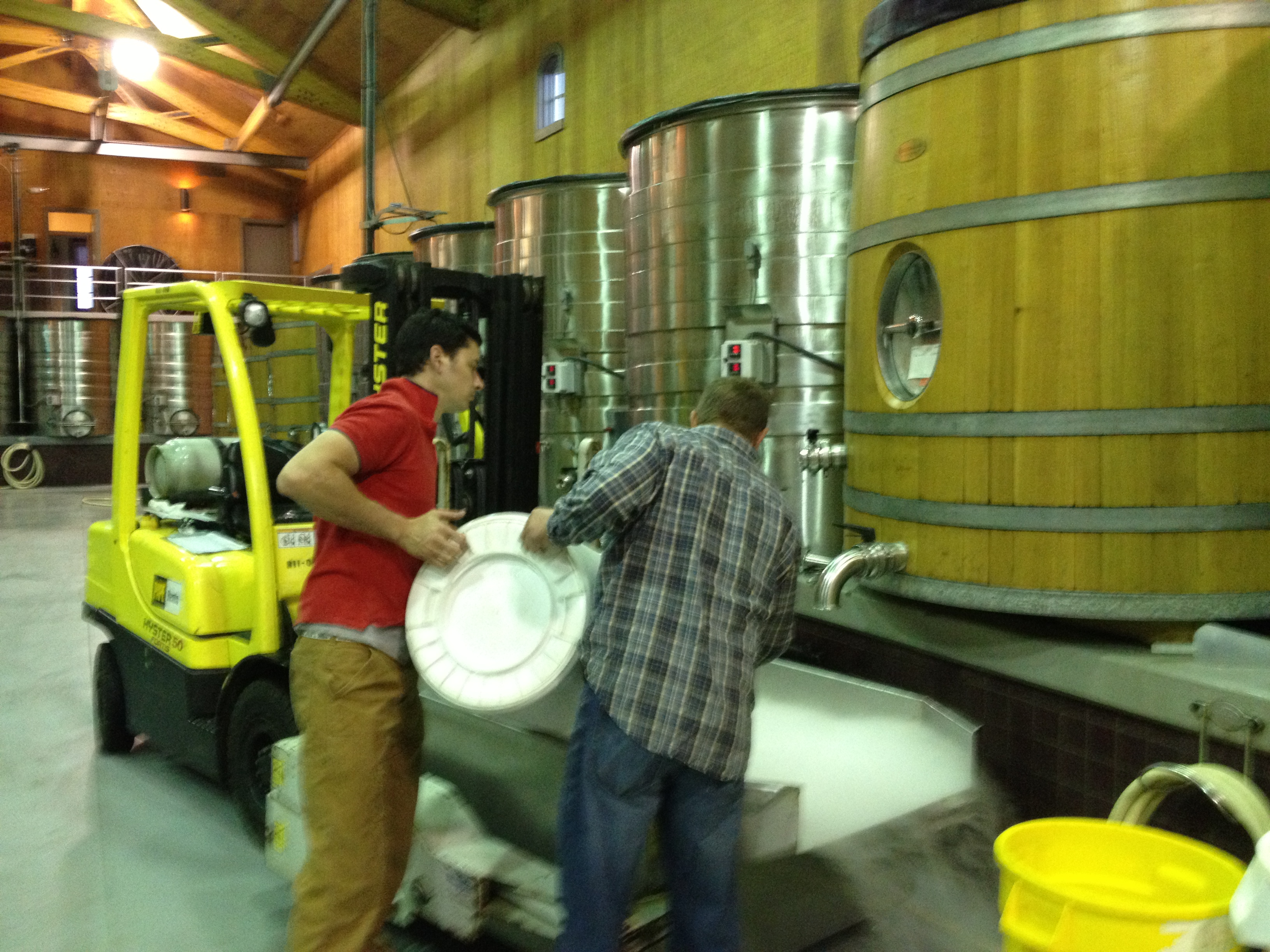
Later that evening, I wandered over to see how Dominio IV was doing with the grape crush.  I arrived just in time to see the master mechanic, Mordechai, at work on the de-stemmer as Leigh Bartholomew (co-owner and vineyard manager extraordinaire) inspected the grapes.  I then enjoyed myself helping sort through the Rhone style grapes (Syrah and Grenache) from the Scorched Earth vineyard.

It just doesn’t get any better than spending a fall day seeing, feeling, and talking about the beginnings of a fine wine.

Posted in Wine, Working in teams | Leave a comment

Find. Copy. Paste. Tweak.

“Technology is anything that wasn’t around when you were born.  If it was around, it’s an appliance.” – Alan Kay

I keep thinking that nothing can amaze me any more when it comes to technology. Then I come face to face with what normal people can do with the magic of technology.

While waiting for another meeting to start, I was chatting with a long time colleague, Kelly Franznick of BlinkUX.  He shared with me how excited he was with his HCI class (Theory of Interactivity) at Lake Washington Institute of Technology. [For Kelly’s version of this conversation see his post on “Find. Copy. Paste. Tweak.“] It is a class on interaction and he had them focus on an Arduino microprocessor hardware project.  This hardware is a darling of the Maker community.

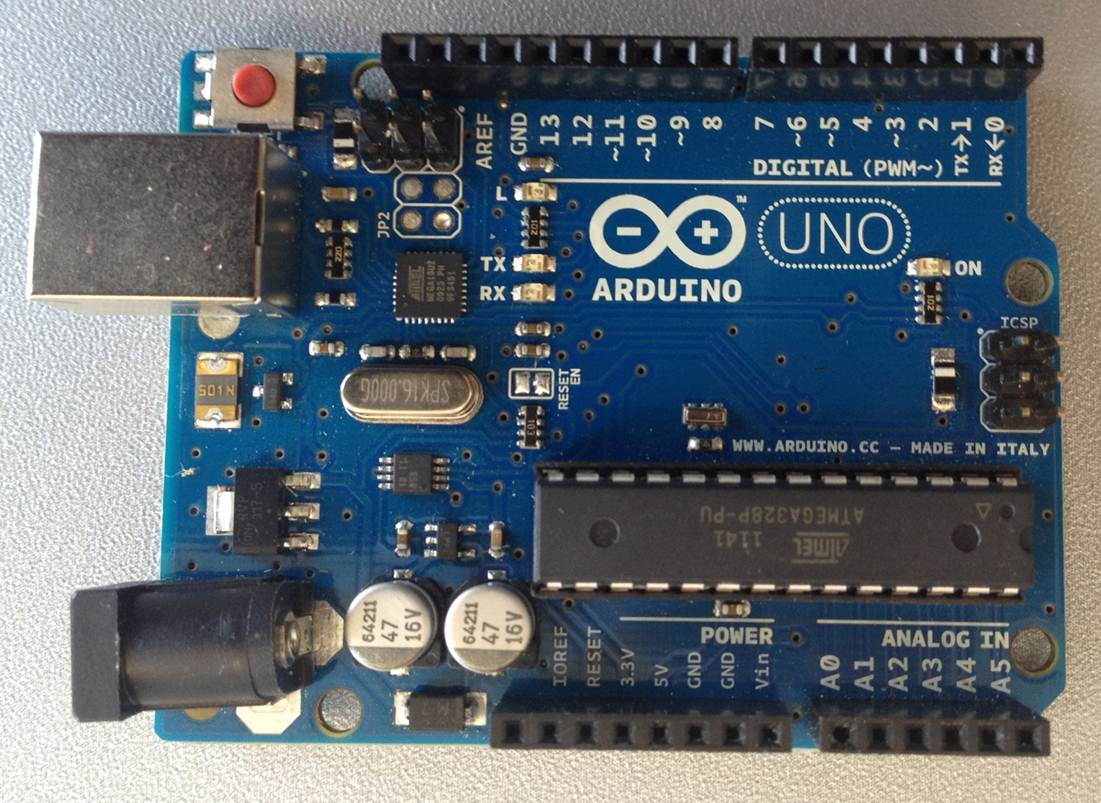
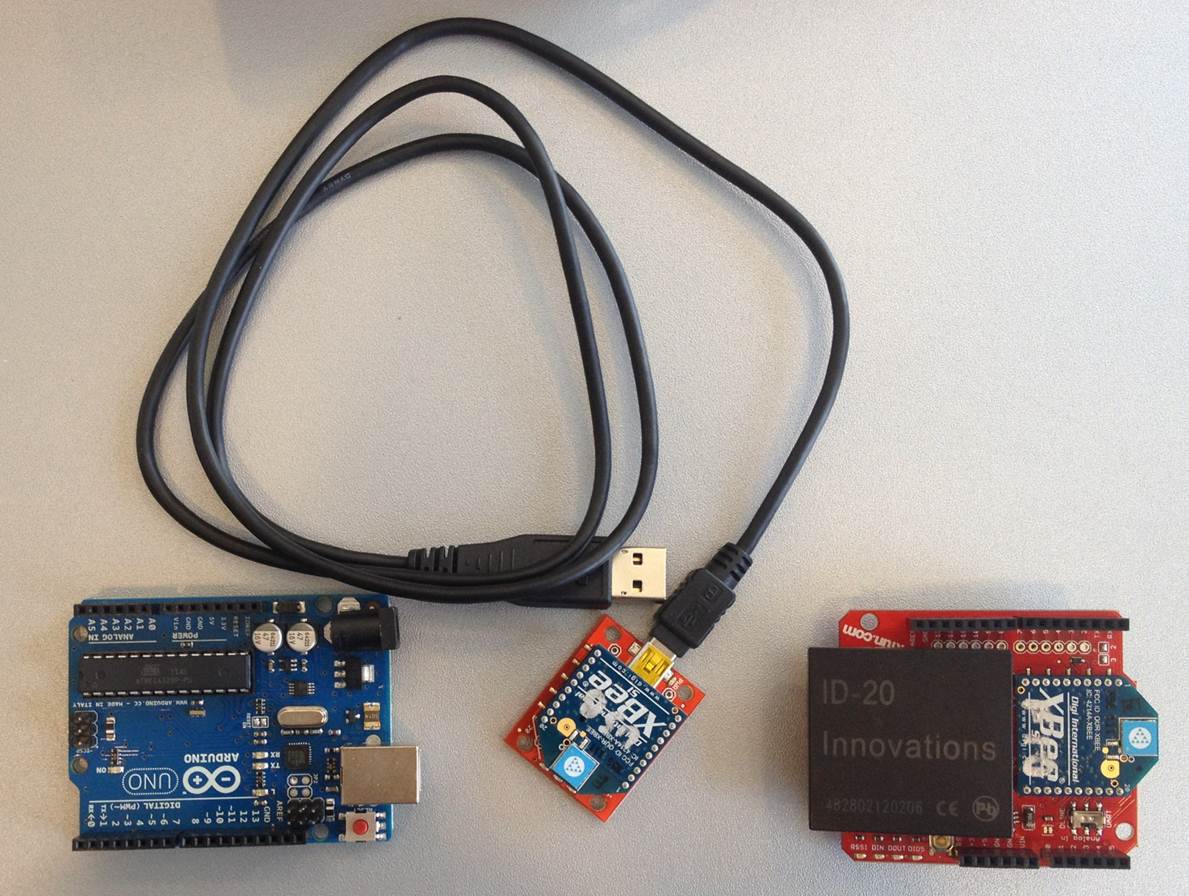
None of the students had any kind of hardware or software programming background. Yet, here he was showing me their product – a dog activity tracking system.  The three components of the system are pictured below:

The processor (on the left) powered by a 9 volt battery is small enough to attach to a dog collar.  It consists of the Arduino processor with an additional board (on the right) for an RFID tag reader and a wireless communication device.  The wireless receiver is shown in the middle with the USB connecting cable to a computer to log the events from the dog tracker. 

The dog owner then puts RFID tags on things like the dog’s water bowl, food bowl, door to the outside and particular areas where the dog might go in the yard.  Every time a dog goes near one of the RFID tags a message is sent (could be to Twitter) to a database or the owner letting them know that the dog has drunk, eaten, gone outside or is currently in some specific room in the house.  For less than $50 of hardware and open source software, a complete solution was generated by novices in a couple of weeks.

All of the hardware was certainly believable, but I had to ask how humanities majors and architectual technicians and interior designers could program the Arduino.  Had I missed the development of an easy programming tool for the Arduino?

Kelly laughed and said “Nope.  There are no tools other than the C compiler (a very low level programming lanugage).  However, there are thousands of programs (see RFID code) to do different things on the Arduino.  I had the class search for software that was close to what they wanted to do, copy the software from the website, and paste it into the compiler.  Then they start “tweaking” the code (a technical term for blindly making changes to the code to see what happens).  Within minutes the “discovery” was done and the processor was doing something useful and then the students could modify until they got what they wanted.  Certainly none of them really know how to program, yet look at the fully functional hardware/software system they just built.”

Find, copy, paste, tweak.

Very simply that may be the wisdom of crowds authoring tool of the future.

This student project and the pedagogy reminds me of the student projects that Neil Gershenfeld described in FAB: The Coming Revolution on Your Desktop – from Personal Computers to Personal FabricationThe ScreamBody is one of my favorite projects from Gershenfeld’s first Fab class. Clocky is another product to evolve from the class.

As I shared Kelly’s experience with my colleagues, David Robinson marvelled:

“This amazes me. First, I have the impression that there is a magic language (and mindset) for programmers – and this challenges that paradigm. Second, the process you describe is one step shy of a game: what can you do if…. Simple coding seems insurmountable to me and most of my clan – in things as simple as website construction (a step shy of what you are describing but think of the implications if this programming-boundary was breachable!).

“Also, you’ve cracked opened for me yet another facet of the word ‘authoring.’

Thanks for the thought fodder!”

Another colleague, Ross Bohner, suggested that the concept of – find, copy, paste, tweak – was similar to “Code Scavenging” described by Scott Klemmer at Stanford. One of Klemmer’s articles gives the example of Web Bricolage:

“The Web provides a corpus of design examples unparalleled in human history. However, leveraging existing designs to produce new pages is often difficult. This paper introduces the Bricolage algorithm for transferring design and content between Web pages. Bricolage employs a novel, structured prediction technique that learns to create coherent mappings between pages by training on human-generated exemplars. The produced mappings are then used to automatically transfer the content from one page into the style and layout of another. We show that Bricolage can learn to accurately reproduce human page mappings, and that it provides a general, efficient, and automatic technique for retargeting content between a variety of real Web pages.”

In his book Demand: Creating What People Love Before They Know They Want It, Adrian Slywotzky describes this phenomena in creating a whole product as knowing when to imitate and when to innovate:

“Rather than wasting precious economic fuel and creative energy in designing a great retail website from scratch, Hastings (Netflix) studied Amazon’s and did a 90-percent-plus emulation. Netflix’s site mirrored Amazon’s navigation system, product and button placement, search tools, inclusion of reviews by customers and professional critics, and even the use of small, low-resolution cover images to allow fast Web page loading.

“You might call this strategy ‘Imitate to be unique.’ Of course, it must be used appropriately. The core of a new business design can’t be based on imitation. (In Netflix’s case, the core was “Reliable, convenient, affordable movie rental by Internet and mail.” A unique website design wasn’t part of that definition.) Like great artists and writers, great demand creators shamelessly imitate minor things so they can focus their originality on major things.”

So join the world of Hackademia and start creating technical and innovative marvels:

Find. Copy. Paste. Tweak.

The New Language of Innovation.

Posted in Content with Context, Design, Human Centered Design, Innovation, Learning, Software Development, User Experience, Working in teams | 4 Comments

Wildlife in the San Juan Islands

We’ve lived in the Pacific Northwest for over 20 years and have never been to the San Juan Islands.  We remedied that over the Fourth of July weekend, when our newest inlaws, the Shellys, invited us to spend a couple of days with them at their cabin on Orcas Island.

As my wife and oldest daughter, Elizabeth Shelly, got ready to leave our home on Bainbridge Island, we were treated to the youngest baby deer we’d ever seen in our backyard sauntering through.

On the early morning drive up to Anacortes, WA, gateway to the San Juans, I was not looking forward to the long wait at the ferry line to get to Orcas Island.  My sister used to live on Guemes Island and one of the memories of visiting her in the summer is the huge long lines of cars waiting to catch the ferry.  I wanted no part of that as we have our own challenges with the Bainbridge Island ferry in the summer with all the tourists clogging things up.

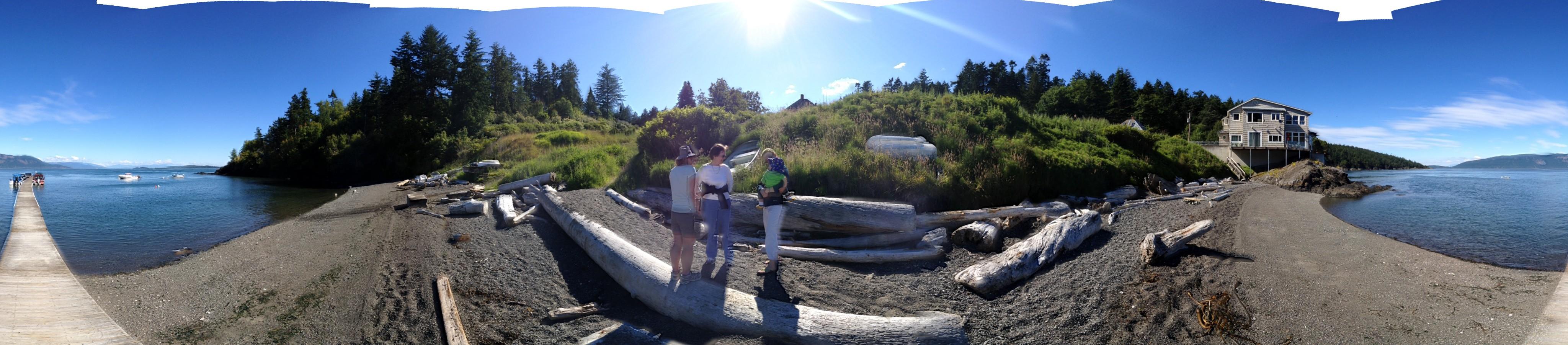
Imagine my surprise when we arrived an hour early at the ferry terminal and it was clear that we were going to make the next boat.  That was easy.  We arrived at the cabin and immediately went for a walk on the beach (see interactive 360 view):

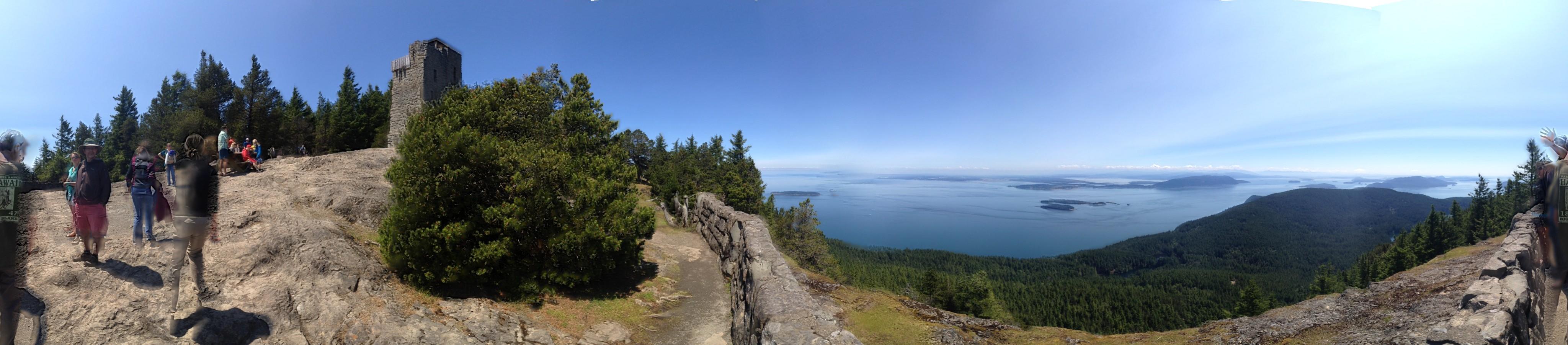
We couldn’t wait to take an extended family outing to Mt Constitution in Moran State Park.  Somehow our weather karma finally gave us some spectacular weather and we were treated to the clearest view of the Puget Sound from Seattle and Mt Rainier in the South to Vancouver in the North (360 view).

The birds were out showering us with their chatter:

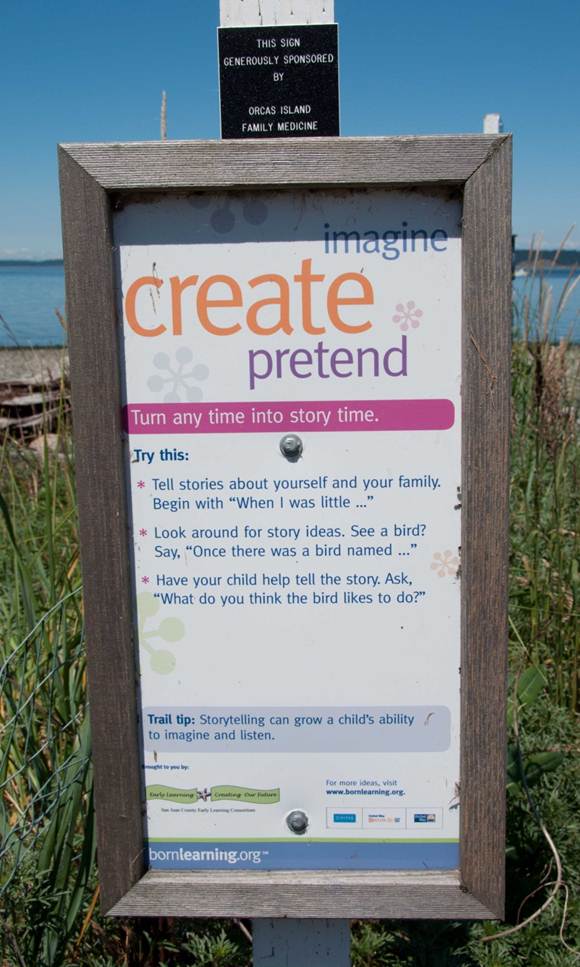
While we were exploring the island, we came across this sign at North Beach near the town of East Sound:

During our two days with the extended Shelly family, we’d had the gift of listening to the never ending stories that Suzanne and Robert shared with their two children.  “Imagine. Create. Pretend.  Turn any time into story time.” What special advice for adults to do with children along with remembering to do it for ourselves.

As we continued our island tour, we went by the Rosario Resort.  While Jamie and Elizabeth listened to a mini-organ recital, I walked behind the old mansion to view the inlet.  I couldn’t believe the number of starfish that were making their way over the rocks as the tide came in:

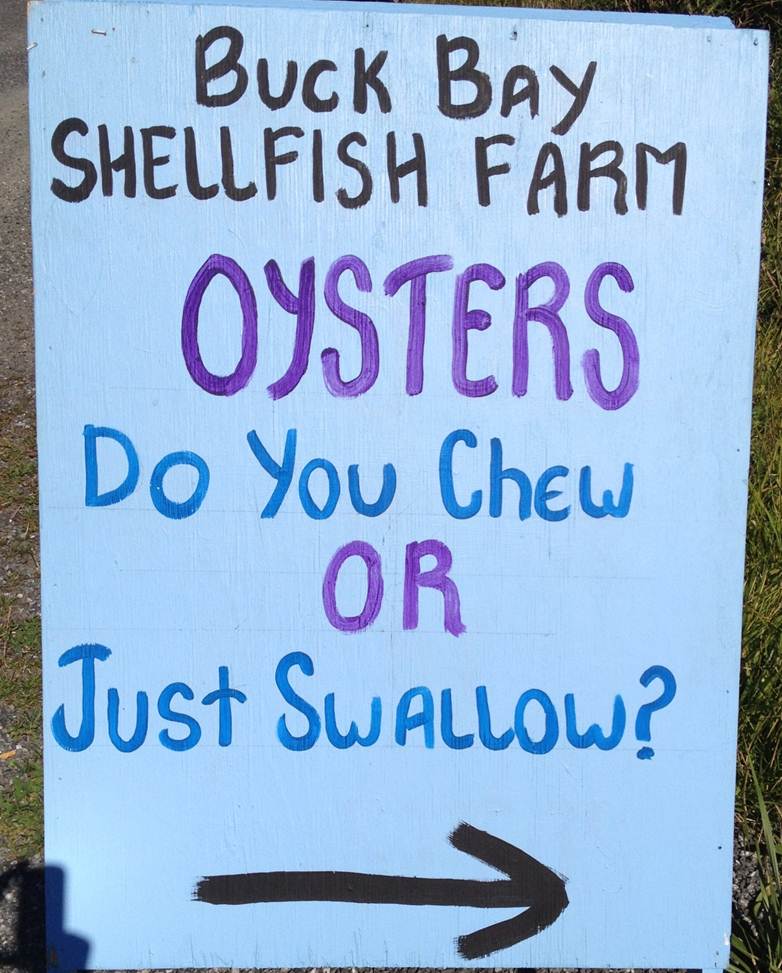
We also couldn’t escape one of those priceless philosophical questions as we passed by a local shellfish farm:

All too soon our time on Orcas Island was over and it was time to head over to Friday Harbor and San Juan Island. Just after we arrived on the island we headed out to Lime Kiln Point State Park to see if we could view some Orca Whales within sight of the shore. Little did we know that we were in for the treat of our short visit to the San Juans.  Just as we arrived at the viewing point, a pod of three whales came within 50 feet of the rocks that we were standing on.  Here are just a few of the hundreds of photos of the whales that we shot at three separate times during the day:

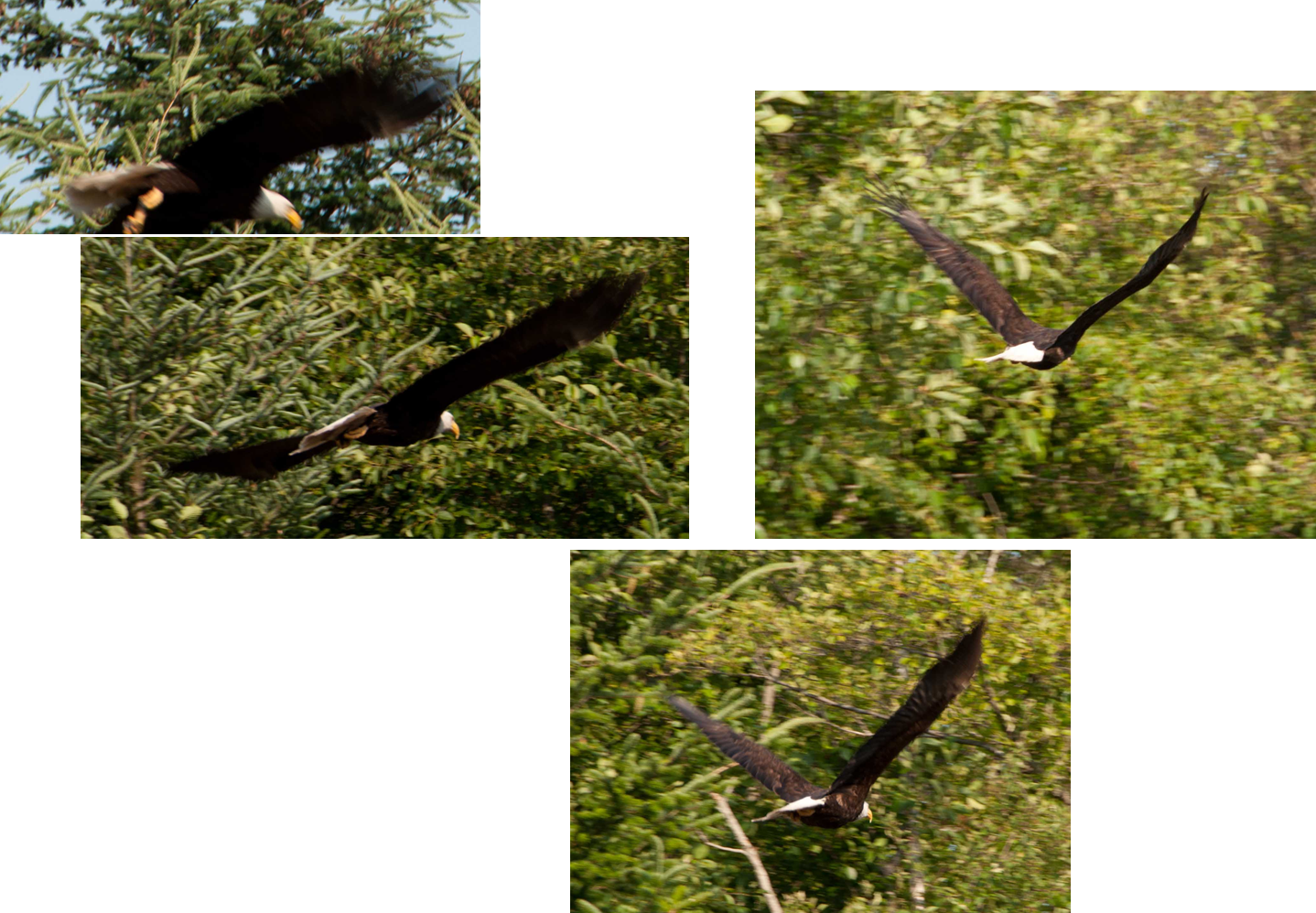
We headed up to Roche Harbor Resort for lunch (a little to East Coast Newport Beach snobby for us) and then came back across the island to visit American Camp National Historic Park. We took the time to hike several miles within the park and visit one of the oldest redoubts left on display.  As we left the park, a huge eagle flew right over our car and landed in a nearby tree.  I quickly moved the car to the side of the road to grab some pictures of an eagle up close:

As I got too close for comfort, the eagle took wing:

What a day.  So we slowly pulled our car back onto the park road, and out popped a fox. I felt like I was at Disney World with an unseen director shouting “cue the fox.”

On such a lucky day for the fauna of San Juan Island, we decided to drive back over to Lime Kiln Point State Park to see if the whales were still around.  We got to watch two more pods come back south close to shore:

As we turned to walk away, one of the other tourist observers pointed to a seal close to the rocks:

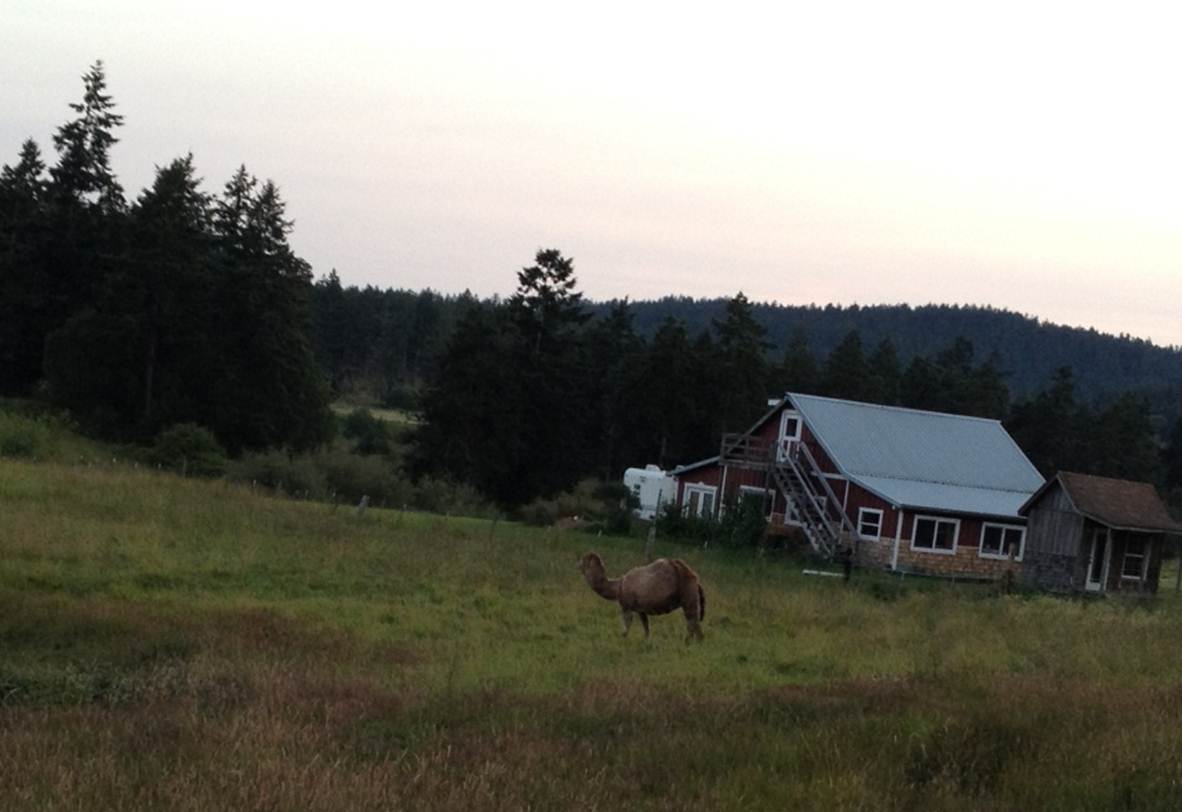
What a full day of wild life viewing.  Who knew that the San Juan Island was such a repository of wild life.  After dinner, we meandered our way back to our room at Lakedale Resort Lodge (360 degree view) and darn near drove the car off the road as we looked up and saw a camel in the field.  Come on, a camel in the Pacific Northwest.  We had to stop and get a photo:

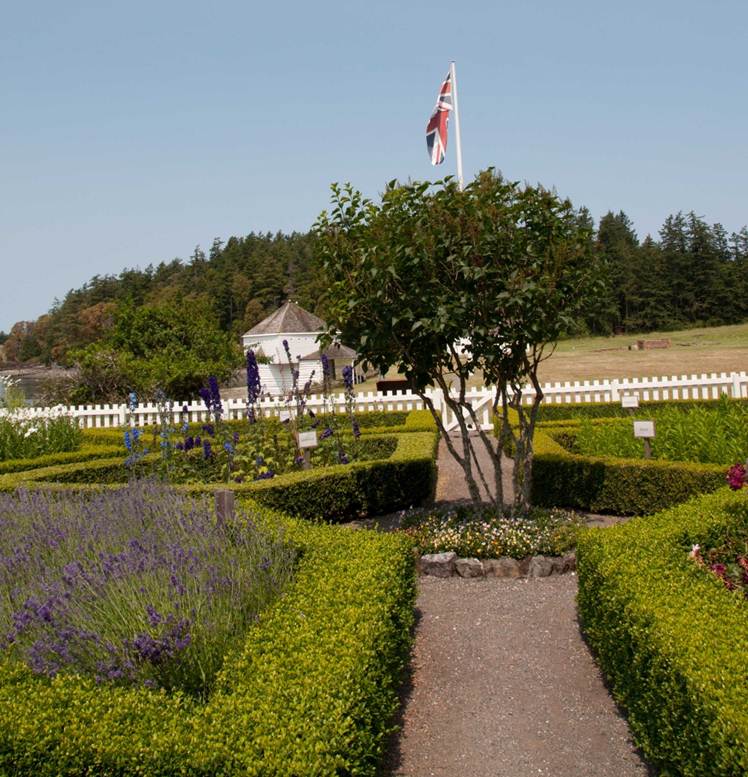
We were really excited to get up the next morning for another day of whale watching.  We headed out early to Lime Kiln Point State Park but saw none of the whale watching boats that flooded the area the day before.  We waited around for over an hour but saw no whales.  So we decided to head up to English Camp National Historic Park.  What a beautiful little park nestled away on the west side of the island with massive old cedars and a quaint English garden.

With delight in our hearts from the beautiful weather and the gifts of nature, we headed back to Friday Harbor to catch the ferry to Anacortes.

One of those wonderful surprises happened the following Monday evening after I finished teaching my “Designing for Demand” course at the UW Foster School MBA program.  Karthik, one of my students, came up to me at break with his iPad showing a photo of an Orcas Whale.

I had included one of my Orcas Whale photos at the beginning of my lecture slides. Karthik asked me where I’d taken the photo and we both laughed when I shared that it was off San Juan Island.  Karthik had also ventured up to Friday Harbor and had taken one of the whale watching boat trips.  On Saturday while we were looking for the whales on the west side of San Juan Island, the whales had migrated to the south side of Orcas Island where Karthik captured his photos.  That’s when I realized how lucky we were with our full day of viewing the whales from shore at Lime Kiln Point State Park.

Posted in Photos, Travel | 2 Comments

Listening for Life

In the late 1980s, Donna Stoering showed up in our lives in Southern New Hampshire when my wife sang with Donna in the St. Elizabeth Seton church choir. Donna gave us one of those gifts that keeps on giving when she asked if she could sponsor us to a Cursillo Weekend.  Jamie and I had seen the incredible difference that Cursillo made in the lives of several of our friends so we readily agreed.

The Cursillo process has separate Men’s and Women’s weekends with the men usually attending the three day weekend first and then the women attending a weekend often scheduled within a month of the men’s weekend.  The NH Cursillos are usually held at the Sarto Center several rural miles outside of Manchester, NH.

Donna picked me up and dropped me off at the Sarto Center and then with a cheery goodbye left me in the midst of 30 men I didn’t know.  She made sure that I didn’t have a car so that I couldn’t leave the weekend if things got “tough.”  In retrospect, the weekend was one of those transformative events that change one’s world view and approach to life. During the weekend, I treated the experience more as an academic exercise and went into my cocoon of silent observer.

At the end of the weekend with great energy and emotion the larger Cursillo community came flooding into our meeting room singing the rooster song – De Colores.  Donna was one of the first Cursillistas in the room singing so vibrantly and she immediately came up and gave me one of her wonderful hugs. My bottled up emotions from the weekend came flowing out.

As we all calmed down, our wonderful “three amigos” guitar players started playing and singing “Here I am Lord” by Dan Schutte (hear the song played and sung by Dan Schutte).

I, the Lord of sea and sky,
I have heard my peo-ple cry.
All who dwell in dark-ness now
My hand will save.

I who make the stars of night,
I will make their dark-ness bright.
Who will bear my light to them?
Whom shall I send?

Here I am, Lord. It is I Lord.
I have heard you call-ing in the night.
I will go, Lord, where you lead me.
I will hold your peo-ple in my heart.

I, the Lord of snow and rain,
I have borne my peo-ple’s pain.
I have wept for love of them.
They turn a-way.

I will break their hearts of stone,
Give them hearts for love a-lone.
I will speak my words to them.
Whom shall I send?

Here I am, Lord. It is I Lord.
I have heard you call-ing in the night.
I will go, Lord, where you lead me.
I will hold your peo-ple in my heart.

I, the Lord of wind and flame,
I will tend the poor and lame.
I will set a feast for them.
My hand will save.

Fin-est bread I will pro-vide,
Till their hearts be sat-is-fied.
I will give my life to them.
Whom shall I send?

Here I am, Lord. It is I Lord.
I have heard you call-ing in the night.
I will go, Lord, where you lead me.
I will hold your peo-ple in my heart.

When we hit the phrase “I will break their hearts of stone,” I looked up at Donna and thanked her for the gift of a new spiritual life.

It wasn’t that long after the Cursillo Weekend that we moved to Seattle.  No matter how much you want to stay in touch with special friends distance gets in the way.  We followed Donna’s career as a world class pianist and swapped periodic letters, but our physical world paths crossed precious few times until last Thursday night.  Donna and her current husband, Andy Anderson, stopped by on their way to a wedding in Mt Vernon, WA.  We had not met Andy, so we were delighted to get to know him.

Most of the evening was spent catching up on where our respective journeys had taken us and most especially learning about the journeys of our respective children. At the very end of the evening one of those “oh, by the way” synergistic moments popped out of the universe when Donna shared that she was in the process of fund raising for her Listen for Life for profit entity.  She was particularly excited about the Travels with Music project which is currently in DVD ROM form and will be released as a series of Apps in the fall.

I was excited about the depth and breadth of what Donna had done since founding her organization in 1998:

“At Listen for Life we envision a world where all music cultures are valued and appreciated as the channel for communication. We are dedicated to the service of music through a variety of international and local outreach projects, and by creating a global family of music performers, teachers, creators and listeners.

“Listen for Life is a global organization created for the preservation and advancement of musical culture by serving the needs of music, musicians and music listeners in every region of the world. Through our variety of outreach, education and media projects, we aim to create an international family of music listeners, in community with those who compose, teach, and perform all of the wonderfully diverse musical styles that can be heard on the planet.

“Listen for Life was founded in London, England, in 1998. It then grew eastwards around the globe to encompass volunteers or affiliate studios in many countries, and it recently established new development and administrative offices in Oakland, California, USA.

“One of our goals is to encourage musicians themselves and enable their growth, through workshops, master classes and international retreats. We also encourage them by offering new performance, recording and broadcasting opportunities to relatively unknown but deserving musicians throughout the world.

“To serve both the musicians and the music listeners, and therefore to help advance the cause of music itself around the globe, Listen for Life has developed into an international umbrella organization for a series of outreach projects, with each project happening in many different locations around the world.”

The Listen for Life website is full of sample videos from the project and interviews with musicians from around the world.

I couldn’t believe the timing.  My colleagues and I recently founded a company to produce an integrated media content authoring and sharing tool.  One of the forms of media that we were missing along with the associated expertise was music.  Here was over 400 hours of professionally produced music, and even better it came with associated videos, games and text.  Just the kind of content we are looking for to test the bounds of our tool and to help us do the user research on what “integrated media” really means.

I do love the synchronicity of the universe – “when the student is ready the professor will show up.”  I can’t wait to learn from Professor Stoering.

Posted in Content with Context, Family, Spiritual, Values | Leave a comment

Graduate Students – Best Knowledge Transfer System

Way too many sleeps ago, Russ Ackoff shared that the best information retrieval system and best knowledge transfer system was the collection of graduate students that worked with him at Penn’s Wharton School. “Every morning when I come into the office there will be 2-3 articles taped to my door that somebody thinks is important for my research. They are always spot on” Russ shared.

Last Saturday evening a Tweet arrived from two UW HCDE grad students (Drew Paine and Behzod Sirjani) asking if they could come over on Sunday afternoon and enjoy the view of Puget Sound from our deck on Bainbridge Island. “Of course, we’ll bring the food. All you have to do is supply the wine.”

“Done,” I replied.

Drew is in the process of starting his PhD research on the topic of human centered software development. In all of my focus on using human centered design (HCD) and teaching HCD, I don’t remember ever putting human centered with software development before. I asked Drew what he meant by the phrase.

Drew shared that he was interested in how non-software engineers, like scientists, develop software to support their research. They are self-taught and often use scripting language as a way of making sense of their data. They are able to get important things done, but are doing it without formal knowledge. So he wants to understand how to make computational thinking and computational doing more approachable to all of those professionals who aren’t going to go through a computer science or software engineering curriculum.

Human centered software development conjures up something very different for me. I believed the phrase should mean getting software developers to move from being technology centric to being human centric. I have the hardest time getting software engineers to pay attention to what a user really needs rather than focusing on the minutia of getting a program to actually work. Or worse, the software developer focuses on what would be neat to build.

So I looked to Behzod to share what he thought human centered software development might mean. As he sipped some of the Dominio IV wine, I’d pulled up from our spiral wine cellar, Behzod expressed his belief that it meant we need better tools for crafting software programs. He goes crazy with the arcane languages that we have to express a program to the computer and thinks that something like Scratch should be the way we all develop programs. “It is not just the language itself that needs to be more human centered, but also the system and the way that software developers can collaborate.  That’s what I like with Scratch. And the real problem is that no program contains the knowledge necessary for someone else to pick up and modify the program. That is the area that we need software to be more human centered.”

As you can imagine, with good wine and a great view an enlightening conversation ensued.

The next evening, Bill Knight, dropped by to listen to some of my “rubber meets the sky” ideas about the next tool I want to build and to share some fine wine. Bill has been kind enough to listen to my flights of fancy since we worked together at Aldus back in 1990. Since Bill is an incredibly accomplished software engineer and CTO, I asked him what he thinks human centered software development means.

Bill shared that he thinks the term means embedding software developers onsite with the humans who have the problem that is trying to be solved for. “Most of the time, software developers are many hours or time zones removed from the people that they are developing solutions for. The term means to me that you should embed the developers directly with the key users in the problem space. Human centered software development is problem space focused. It’s what we did at Attenex by embedding ourselves with the Preston Gates eDiscovery lawyers.”

As we continued the discussion, Bill added that by embedding software developers one should shift to focusing on the process and make the process more understandable. “We have to make the software relevant and the only way to do that is by embedding the developers deeply into the problem space.”

With four interesting view points on what human centered software engineering might mean, I can’t wait for Drew to get started with his PhD research and see where he ends up.

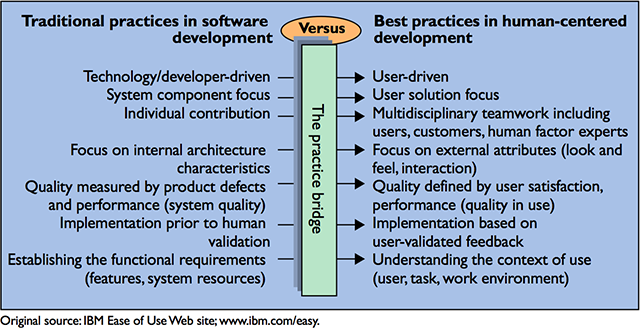
And just to have some fun, I decided to see if Google had any images on the subject. Up came an old IBM diagram:

So what do you think human centered software development means?

Posted in Attenex Patterns, Content with Context, Human Centered Design, Knowledge Management, Learning, Software Development, University, Wine | 4 Comments

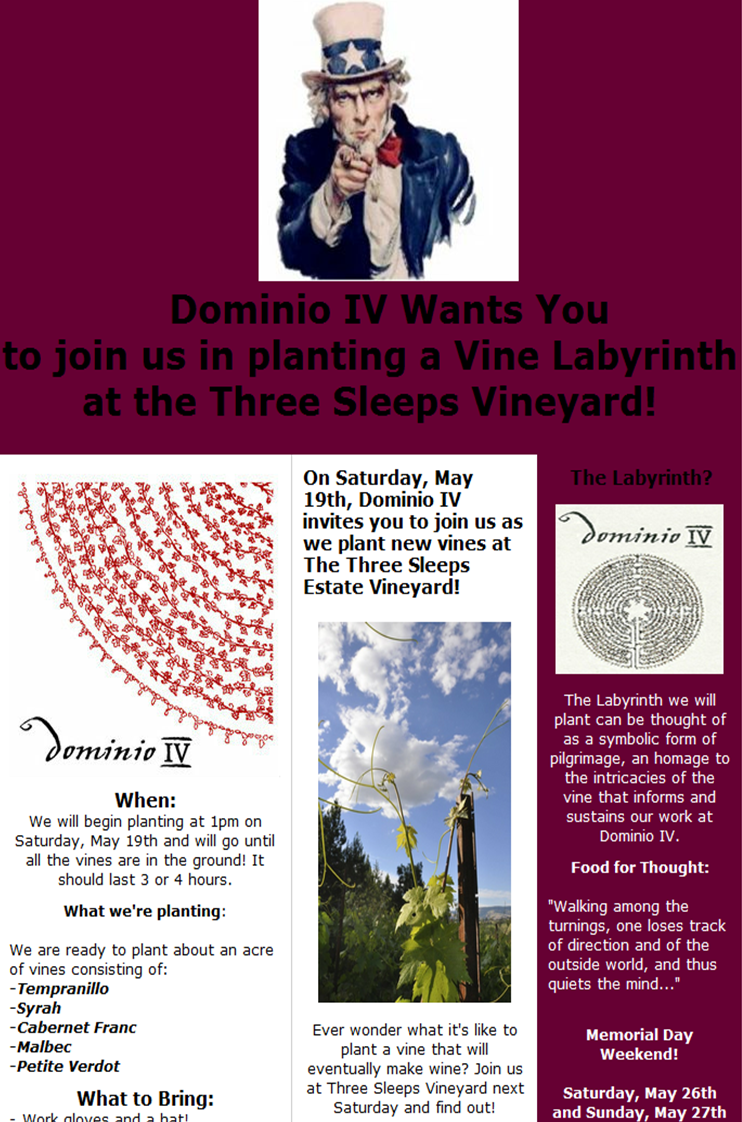
Shape Planting – The Dominio IV Labyrinth

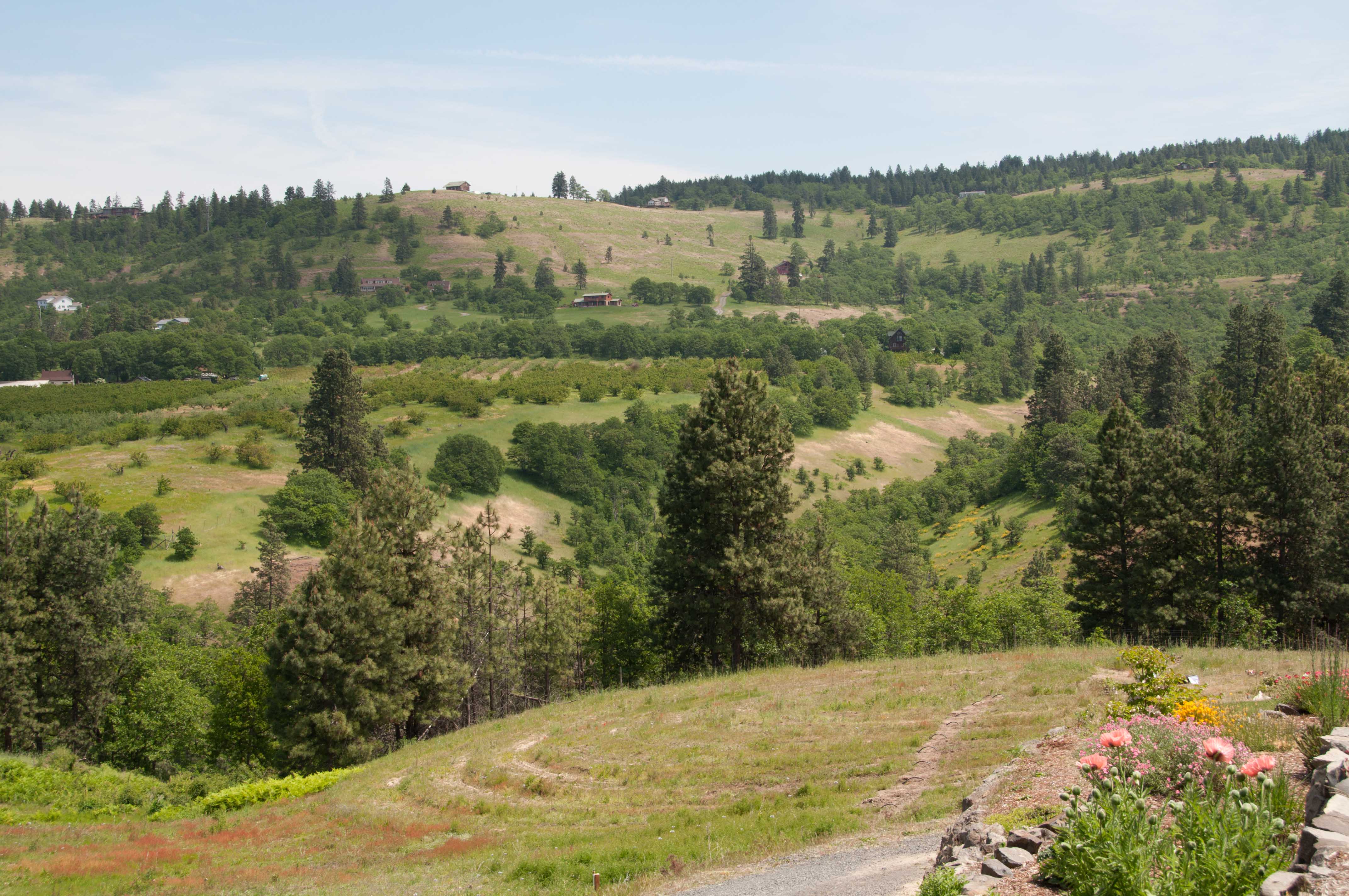
On a dreary Seattle day, an intriguing invitation from Dominio IV showed up in my inbox to come plant a grape vine labyrinth near Mosier, OR at their Three Sleeps Vineyard. I checked my calendar and I had nothing planned for that day.  It has been way too long since I’d been to Oregon Wine Country so this was a great excuse to have another authentic experience for my wine geek education. I usually try to get down to their McMinnville winery a couple of times a year to see what Patrick Reuter is innovating around the making of fine wine. I also try to arrange to help out in the tasting room or with the fall crush.  However, it has been over a year since I’ve made time to visit my favorite wine making family.  While I’ve been hearing for years about their biodynamic vineyard in the Columbia Gorge, I hadn’t managed to make my way to the property. Clearly, now was the time to go learn some more about fine wine growing.

Wiltshire Labyrinth

Many moons ago when we toured England as a family, our children insisted that we go visit the labyrinth in Wiltshire, England near Stonehenge.  We were fascinated with the distinction between a labyrinth and a maze.  A maze is a complex puzzle while a labyrinth has only a single non-branching path which leads to the center.  We enjoyed walking through the labyrinth and the kids wished that there was one of these closer to home in Seattle, WA.

Patrick Reuter was so fascinated with the experience of labyrinths that he encountered while working at different wineries in Europe, that he chose the labyrinth as the symbol for Dominio IV wines. For ten years, Patrick has tried to convince his co-owner and wife, Leigh Bartholomew, to let him plant a labyrinth on their vineyard property.  Leigh being an amazing vineyard manager at Archery Summit, has resisted because she dislikes driving a tractor in circles through rows of vines.  Maybe one day we’ll all find the real story as to why she relented and decided to support Patrick’s dream of having a labyrinth of grape vines that friends of the winery can come experience the journey to the center.

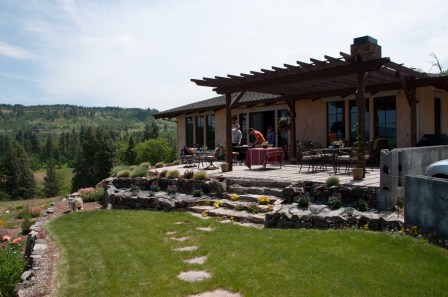
Three Sleeps Bed and Breakfast

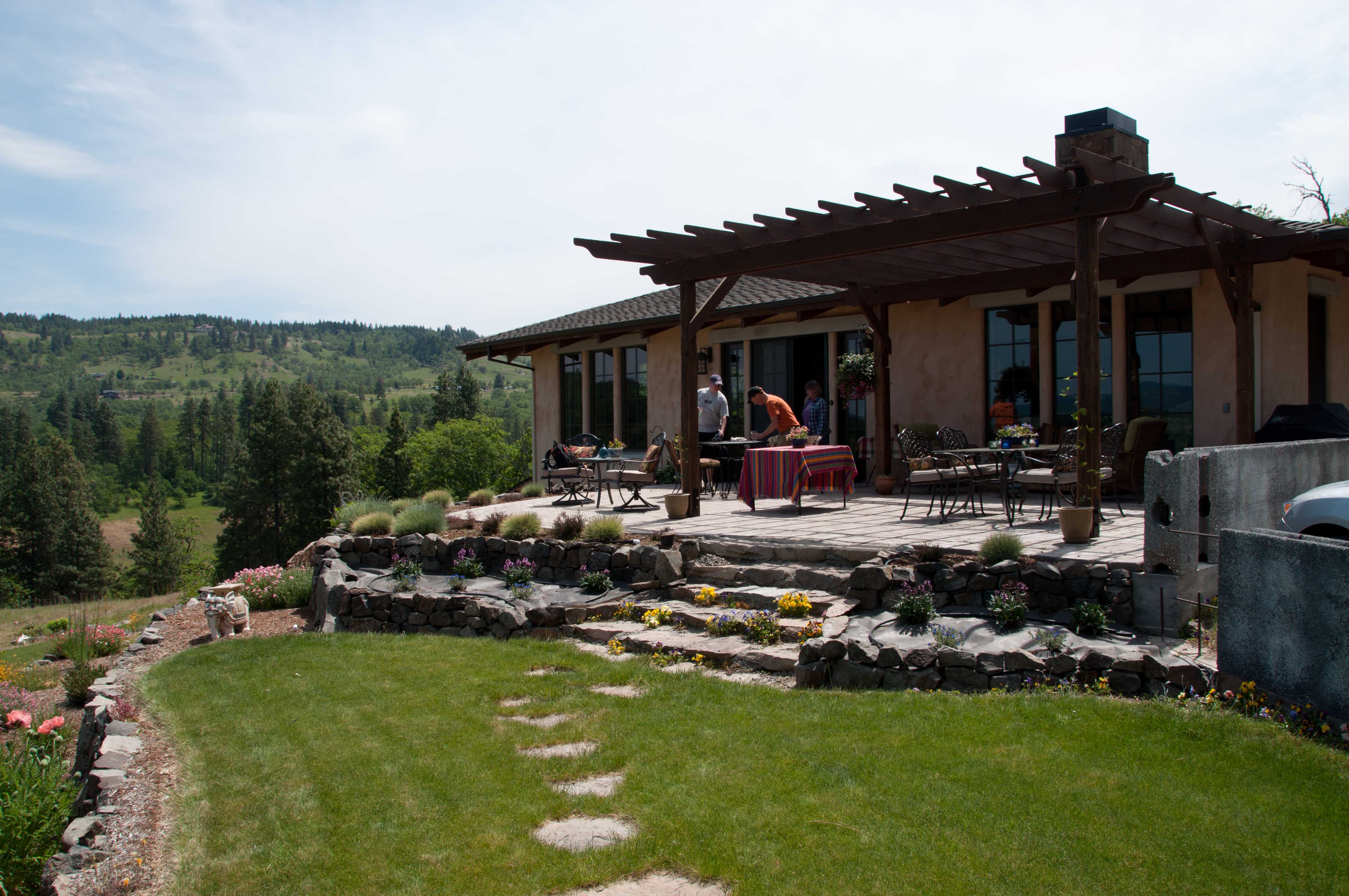
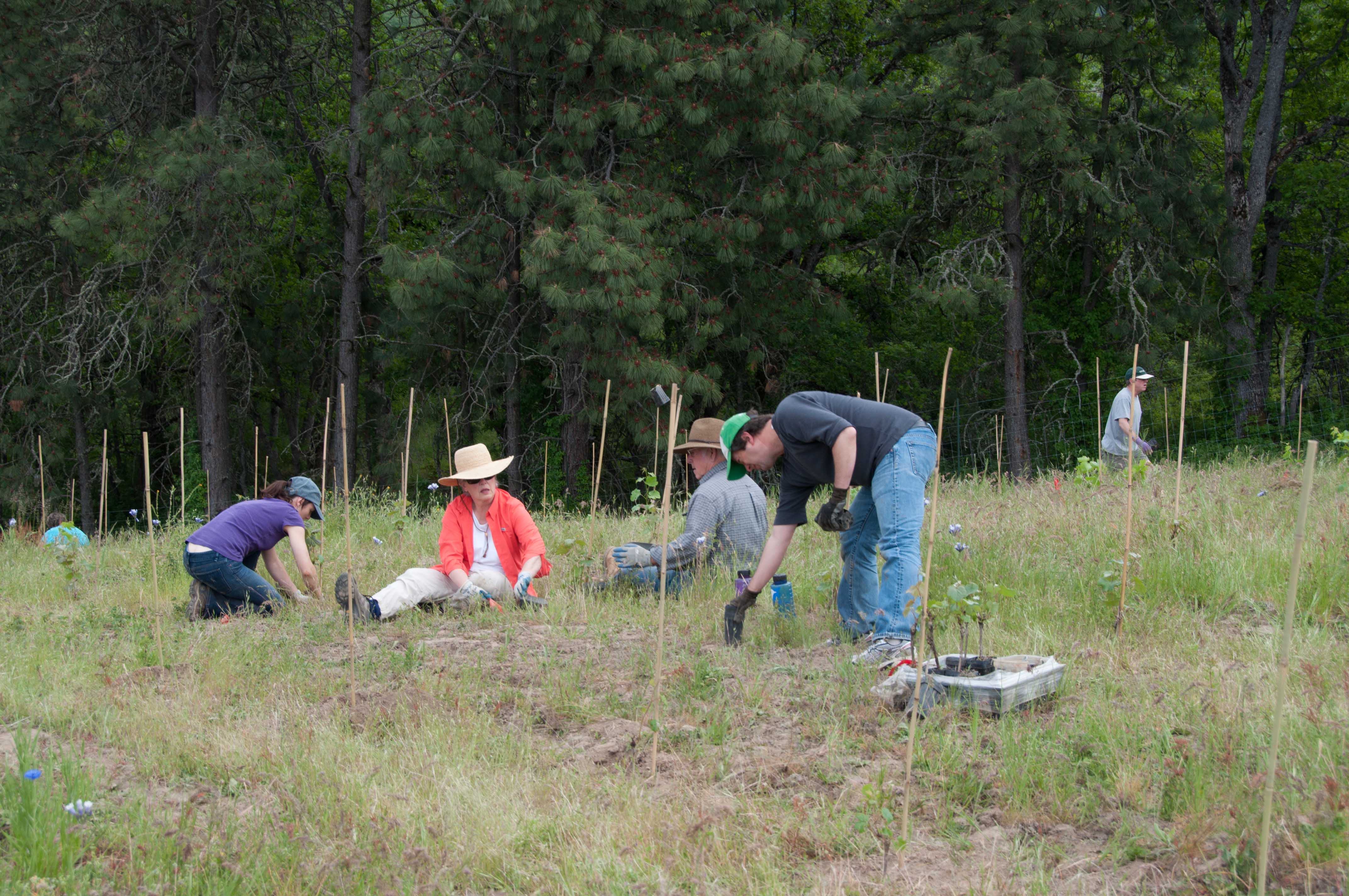
Glenn and Liz Bartholomew who live on the property and run the Three Sleeps Bed and Breakfast along with other family members laid out and prepared the ground for twenty of us to come do the “shape planting.” [Note:  As a way to remember the taste of his wines, Patrick invented something he calls “shape tasting.”] Glenn had prepared all of the irrigation lines and then augered all the holes for the vines. The rest of the family pounded in the bamboo stakes into the planting holes to help guide the upward spreading of the grape vine.
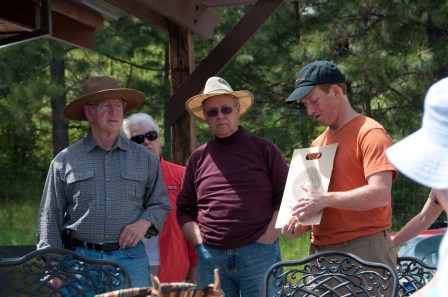
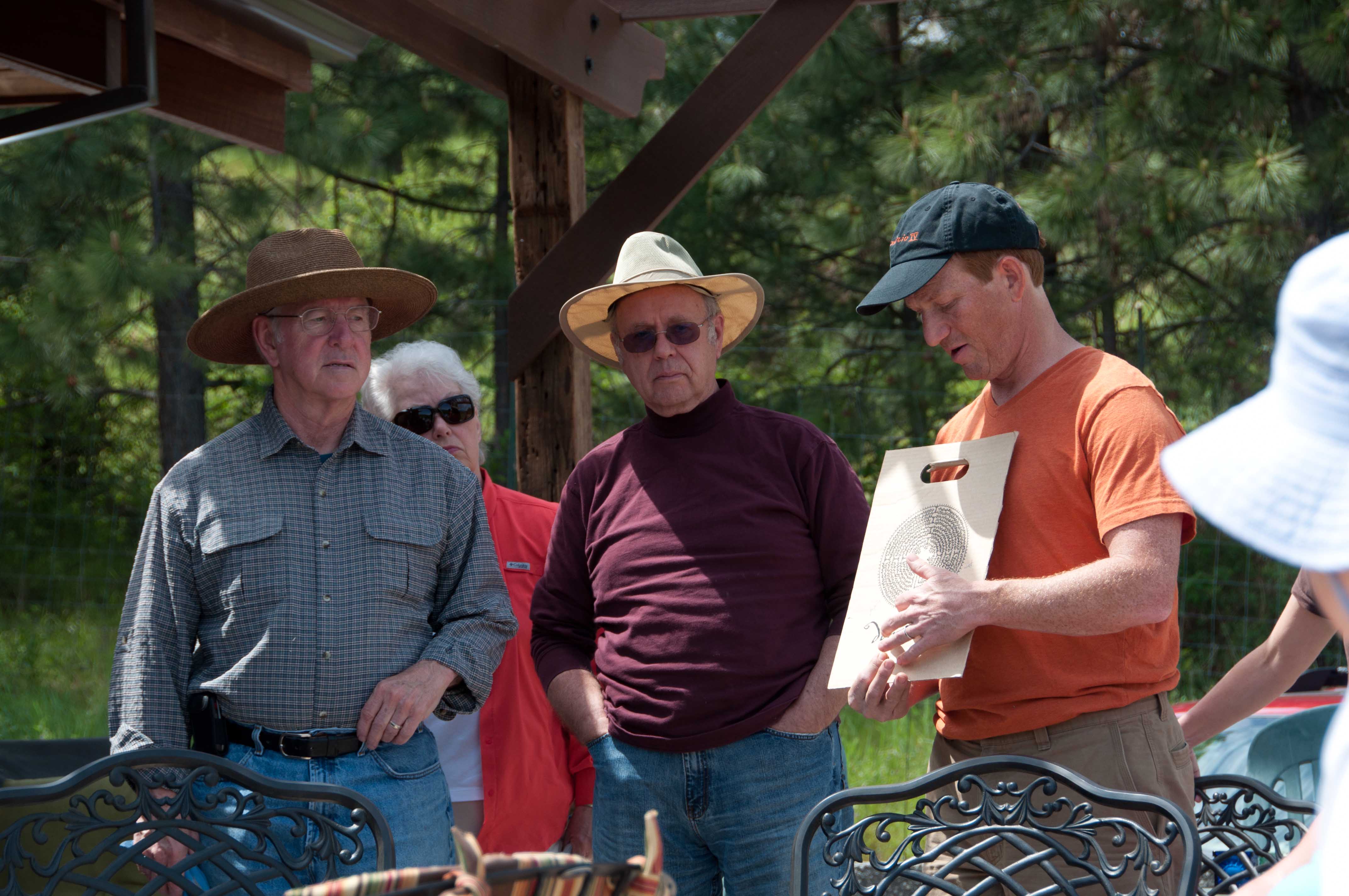
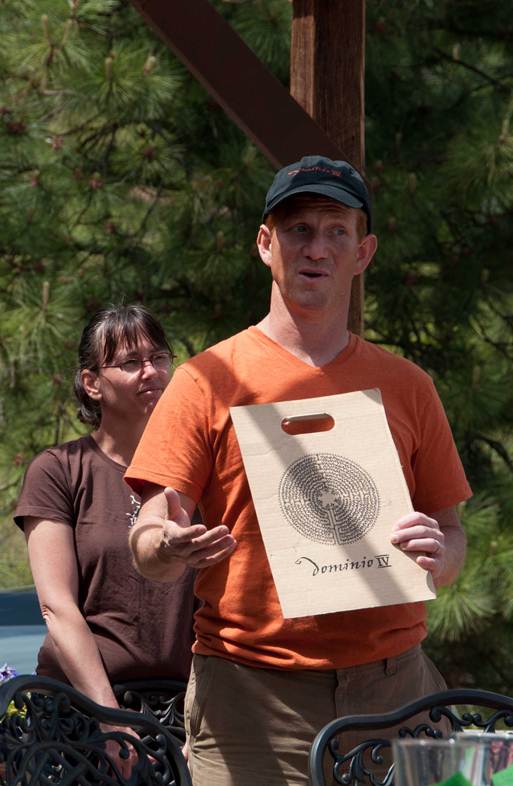
Patrick Reuter describing the labyrinth layout

We all gathered on the front porch of the Bartholomew’s home where Patrick shared his vision and philosophy for the labyrinth. His design challenge was how to lay out the labyrinth so that it would be both an interesting walk and allow the farming and irrigation of the vines to occur. Patrick’s explanation of the labyrinth:

“You’re looking down this row, here, in the center. It’s laid out straight in front of us. There is a pin in the center. There are 12 rows. It is a variation of our Dominio IV logo.  The outer rings are called lunettes which are half circles. The half circles have meaning. There are 28 and a half lunettes in each quadrant. It is a calendar.  These are lunar cycles. So you can mark the year going around the labyrinth. Each one of these is a season.

“So the way we’ve set it up is you are looking straight east, well not exactly straight east. A little bit off so on solstice on June 21st when the sun comes up, it comes up directly over the entrance. So it gives you the seasons in each quadrant. It is an 11 ring labyrinth but we are choosing to plant the outside ring so that when you are walking the outside of the ring you have vines on both sides of you.  This way there aren’t stones on the outside. We’re actually planting the outside ring.

“The inside ring is going to be roses. It will be close to a mile to actually walk it, to go into the center. Then you turn around and you do a loop through the center. Then you exit again the way you came in and go back out.

“It’s not a maze but a labyrinth, so you don’t get lost in it.  As long as you are moving forward, you are where you are supposed to be. The idea of connecting this in a whole circle is that each of these rings will be a different varietal.  The first three rings are Tempranillo. The next two are Syrah. Then it goes to Malbec, Cab Franc, and Petite Verdot.

“So that blend, what we call a field blend, is kind of an ancient way of planting different varietals together that they think will grow well in a region.  Then you make a wine out of it. The idea is to have people come and sign up like you just did.  You guys will be the first in the book. This book will go on for all the people who walk the labyrinth. These walks could go on for a 100 plus years.
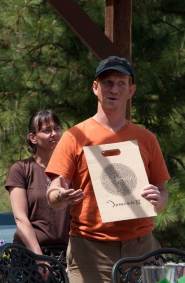
“We are putting these vines in the ground.  And if you do your job correctly (not putting the plants upside down), the vines will last. [Lots of laughter.] Everybody is familiar with what the top of a vine looks like, right?

“These actual vines could be in the ground for over a 100 years. What we are creating here is a place for people to come and walk and go through a journey in and out. It is often a meditation for people to do that. In a sense we are planting a sacred place for people to come, which is really unique and special.

“It is awesome that you guys came. You are the special ones in that way. Thank you for being the first and being the special planters. As you walk the vines in a given year, you leave something behind. Something intangible, that we can’t really talk about. Scientifically, it is a process that you go through of going in and going out of this sacred place.

“Every year we’ll make the wine just from this block.  We’ll ferment it in its own fermenter and put it in its own barrels. Then we’ll bottle it on its own. Then we’ll offer the wine back up to the people that walked the labyrinth that year. So whatever your intention, your meditation, will be captured in some way by the vines and taken into the wine and then brought back to your dinner table.

“It’s an interesting circle.

“So that is what we are up to today.

Shape Planting group: “Are we going to live long enough to try this wine?”

Patrick: “Three years.  You have to hold on for three years. We’ll be picking in three years so it will be three or four years before we have a bottle of wine from the labyrinth.

“We haven’t figured out how to mark the vines.  We are hoping to have great examples of the people who’ve worked on the vines or meditated on the vines. We want to have some representation of the great lives who’ve passed through here.  We’ll eventually work that into dedicating the life essence and vitality here. If you want to work that into your planting today, just keep track of which plants you were intentional about and we’ll come back and mark them in a way that stays there.

“So it could be like a Tibetan flag. You know how the Tibetan prayer flag (green, red, blue) is supposed to be flapping in the wind.  As they flap in the wind, the Tibetan Buddhists think that is the prayer going into the wind. Every time they flap back and forth there is another prayer being said. That’s my vision of what we want. The marking would be people’s names but also kind of dangle and flap from the vine and that would be ongoing, significant and intentional.

“The first vines that have gone in are dedicated to my uncle who passed away last year about this time. That’s the special vine so don’t crush it. Let’s get on with the planting.”
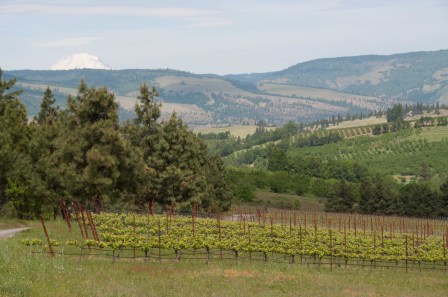
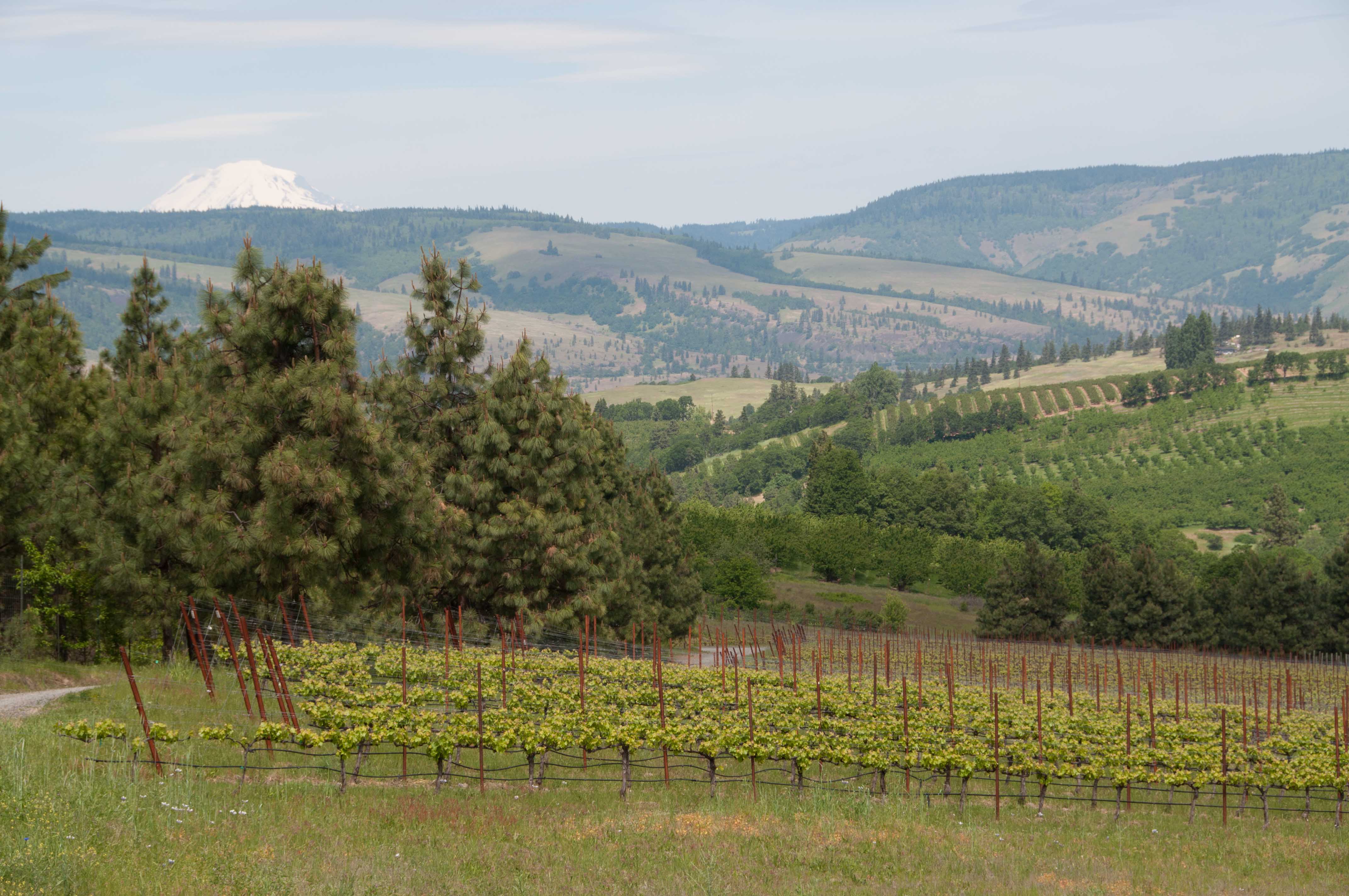
Mt Adams rising about Three Sleeps Vineyard

From his winemaker’s view, he is planting an interesting mix of Tempranillo (the majority of the grapes planted on the rest of the property), Syrah, Cabernet Franc, Malbec and Petite Verdot. His goal is to produce a “field blend” in a couple of barrels that will be available to wine club members and those who journey through the labyrinth. What we are planting today will be harvested in three years and then take two to three years to age before being released. Once again I am reminded of the long range thinking that one has to do in the wine industry – what we do today won’t be available for the market for at least five years.
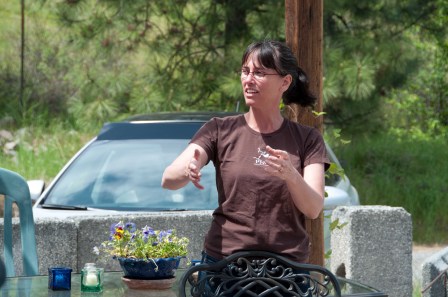
Leigh Bartholomew on Shape Planting

Leigh then took over to move us from the visionary spiritual to the pragmatics of how we would plant the vines. We moved down to the labyrinth and Leigh went through a detailed explanation and show and tell of how to plant. First, we put some all natural rock phosphate fertilizer on the mound of dirt piled on the side of the hole. She explained that we needed to mix this in with the dirt and put this in the hole first followed by a couple of inches of dirt so that the fertilizer didn’t “burn” the root structure. Ideally, you wanted to have about a fist of root stem above ground right next to the bamboo shoot pole. With the one example we were now educated to go plant our way around the circular rows. I love the process of see one, do one, teach one approach to experiential learning.
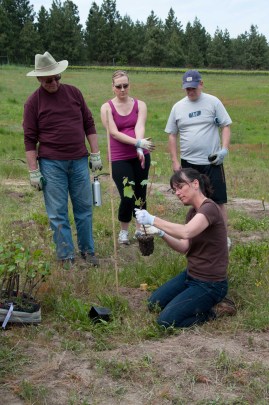
Of course I had to encourage Patrick to plant lots more Cabernet Franc which has become my favorite speciality varietal.  I lovingly planted about ten Cab Franc vines with focused intentionality so that they would thrive and Patrick would see the light to plant even more in the future. In addition to the Cab Franc I was able to plant some Petite Verdot and Tempranillo varietals before all of the vines were in their respective holes.  It is amazing how quickly what seems like a forever task is finished with 25 motivated wine lovers.
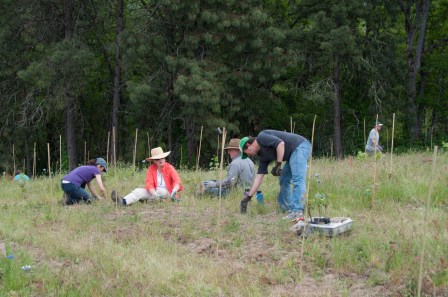
Many hands makes fast shape planting

As the planting was winding down, I asked Patrick how the journey would flow through the labyrinth vineyard. In his wonderful way, Patrick started with “I’m not sure.  Now that all the vines are in, I have to figure out how to set up a symbol system to guide the flow through these open spaces we have to leave for the tractors. I thought about putting stone markers where people need to turn, but they are so heavyweight for the vineyard.  The tractors will run over them and drive them into the ground compacting the root systems.”
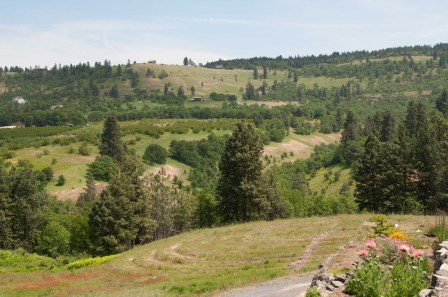
Before we start the labyrinth grape vine planting

I immediately lept to a technical solution to the problem laughing at myself the whole time that I shared it with Patrick.  “Look we could do a quick labyrinth navigation app.  All you would have to do is get one of those augmented GPS transmitters like wheat farmers use to precisely plant a field.  Then the user could look at the app and navigate their way through the vineyard.”

Neither of us could stop laughing at the thought of wine lovers looking to get back to nature and do something spiritual in the vineyard looking at their iPhone the whole time.  Some things are just so wrong.
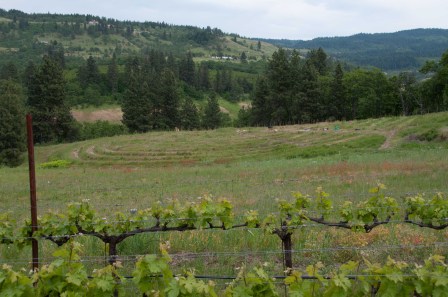
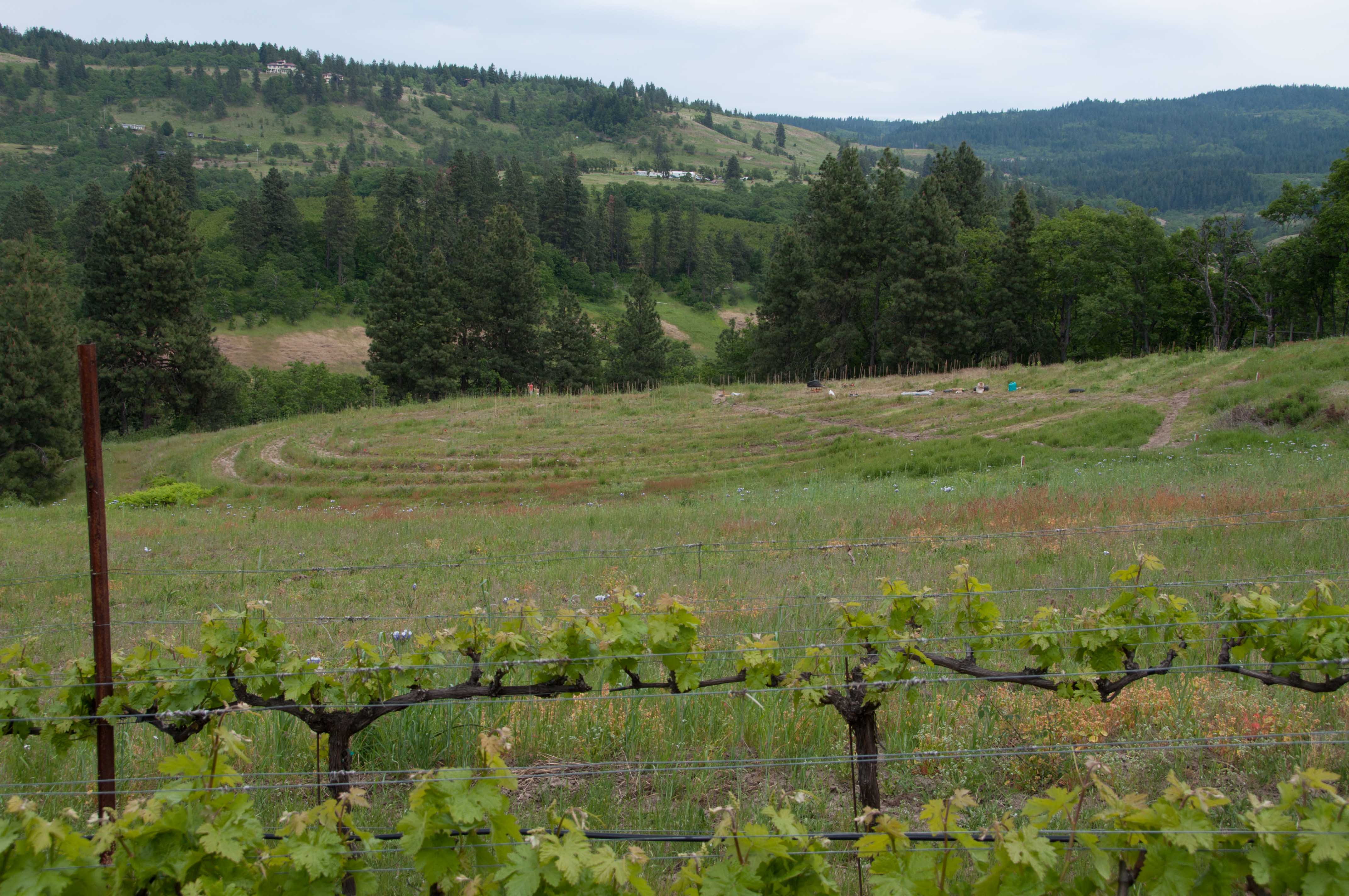
The planted labyrinth from the existing vineyard

Throughout the afternoon, Patrick and Leigh’s two young boys and a friend were navigating the tall grasses within the maze as they acted out their fantasies of hunters looking to prey on these farmers planting their vines. The lyrics of lions and tigers and bears from Wizard of Oz kept running through my head.

The hunters ready to soak the planters.

After cleaning up a little, we retired to the front porch to have some tacos, fresh vegetables and of course, Dominio IV wines. The Bartholomews know how to put on a fresh food spread. We started with the 2011 Viognier to accompany the chips and salsa and then moved through a progression of reds – Pinot Noir, Syrah, Syrah-Tempranillo blends, and finally a Tempranillo.

As the evening wound down and the labyrinth planters began to drift off, Patrick suggested that Jeff Weissler of Conscious Wine and I chat a bit. Jeff and I had exchanged emails a couple of months back after I’d written the blog post on Shape Tasting and Patrick pointed me to Jeff’s videos on Shape Tasting with Patrick. We did the “do you know” routine to establish our wine geek credentials. We have many mutual friends on our respective journeys including Bill and Barb Steele of Cowhorn Winery, Alan York, Paul Dolan, and the Benzigers.

Jeff is doing some interesting work promoting his four principles and twelve practices of fine wine making.  His focus is on figuring out how to rate wineries over the long term rather than myopically only pay attention to a particular bottle of wine from a particular vintage. I look forward to many great interactions in the future with Jeff as he helps all of us be intentional in what we look for in fine wines and fine wine growers. Jeff posted his video of the labyrinth planting earlier today.

Very early stage grape cluster growth

With lots of hugs for old friends and new wine fellow travellers it was time to head back up the road to Bainbridge Island.

As I headed out from the peace and aliveness of Three Sleeps Vineyard, I once again reflected on Brian Doyle’s insightful quotes from  The Grail:  A Year Ambling and Shambling through an Oregon Vineyard in pursuit of the best pinot noir wine in the Whole Wide World about fine wine growing:

“Grapevines are amazing life forms when you think about it, they plunge their fingers a hundred feet down into the rocky soil, they can live for hundreds of years, they fend off all sorts of insect attacks, and they have been working with human beings for so long, thousands and thousands of years, that you wonder sometimes who cultivates who, you know what I mean?  Are people manipulating and taking advantage of grape vines, or are grape vines deftly using human beings to take over the world?

“On my way back uphill to my car I remember what Jesse told me once, that each vine produces enough grapes to make about three-fourths of a bottle of wine, and I chew on the idea that three-fourths of a bottle of excellent wine is probably just the right amount necessary for two or three people to start telling stories fast and furious,so that each of the vines I pass is pregnant with stories, some of which were never born into the world before, and this idea makes me happy also, so by the time I get to the town where I am supposed to give a talk I am cheerful as a chipmunk.

Posted in Spiritual, User Experience, Visual pattern Language, Wine, Working in teams | 6 Comments

Conveying Complex Thoughts

While preparing for my recent presentation for the Design Strategy Conference 2012, I went through a labor of love trying to make some complex ideas and experiences understandable. To help me with this process, I engaged my colleague, Christine Martell from VisualsSpeak, both to use her consulting process to help me shorten and simplify the message and to add some design sense to the slides.

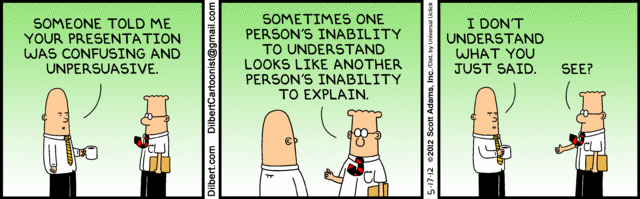
While in the middle of preparing the presentation, it felt like all I had left was the trivial.  I felt like the relevant details were being left out in the process of getting at the essence of the core concepts. I was caught up in the process and losing sight of the purpose of the presentation. Dilbert, as usual, showed up with how hopeless this process sometimes seems to me.
With the shortening of what was previously a two hour graduate school lecture to a short thirty minutes, I wondered what if any impact I would have with the presentation. The immediate feedback after the presentation wasn’t very positive much like the “big boss” in Dilbert:

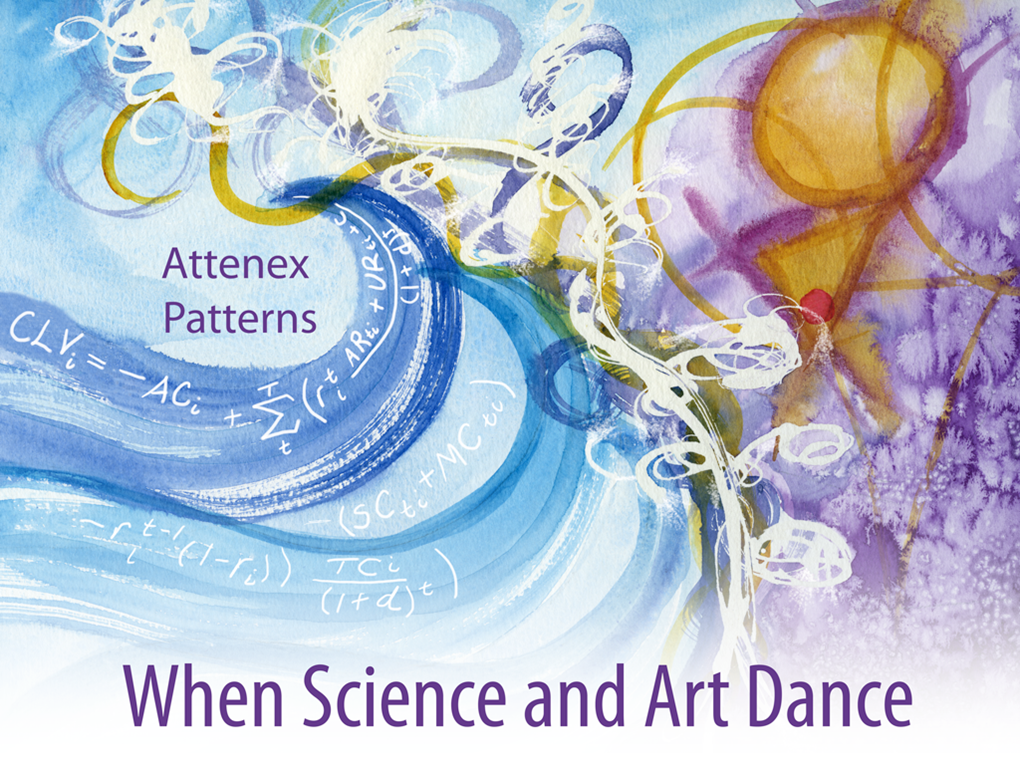
However, as the conference progressed and deeper conversations ensued, there was a wonderful range of engaging feedback. For myself, I am overjoyed at uncovering the essence of what I was trying to say which Christine captured so eloquently with her imagery for the title slide “When Science and Art Dance – Business Results.”

Posted in Attenex Patterns, Content with Context, Design, Human Centered Design, Science and Art, Value Capture, Visual Analytics, VisualsSpeak | Leave a comment