Day 1 – Creating My Future

As Alan Wood, David Socha, and I were sharing another wonderful breakfast at Sunflour Bakery and Cafe, continuing our discussion on how to improve higher learning in higher education, Alan shared his desire to have a tool like Devonthink to help him with his research. I shared an overview of what I’d done in the past with Attenex Patterns as a much better alternative and then shared what I had in mind for a new tool code named “content in context.” Alan immediately got in my face and said “You’ve got to build that.”

Well, thanks Alan, I’ve been wanting to build it for three years but I just can’t pull together the energy. We chatted about the amount of personal energy required to start a company, raise funding, build a product, and then sell the product (hopefully to millions). After having started so many companies, I can’t fool myself any more about how much energy it takes.

As luck would have it, I traveled to Portland,OR, the next day to meet with Christine Martell to work with her on updating a business plan for her company VisualsSpeak. In addition, we hoped to work on a high level design for the software system she would really like to have.

Christine Martell

As we finished up over a late lunch at an organic grocery store deli, Christine asked me what I was up to and what I wanted to do next. I should know better than to try and share what I want to do when I’d just had my world turned upside down by the depth of what Christine has researched and created with VisualsSpeak. I needed some sleep time to do the synthesis for how to integrate the vision I’d just glimpsed of what it would mean to combine the power of Christine’s visual thinking with my designs for “content with context.”

Yet, it was the right question to ask so I rambled for an hour sharing the different pieces I was immersed in and pulling together and the option space for ways to move forward. On my four hour drive back from Portland, OR, to Bainbridge Island, WA, I reflected on what the implications of Christine’s work were for my design. Then it hit me that the constant theme of the several meetings with Christine was that what VisualsSpeak is really good at is helping people get unstuck by changing their story.

The next morning I called Christine and asked if there was a way we could simulate the software design we’d come up with. She suggested that we do the four day process with the Exploring New Options pack of images. I would do the work each day and send her my results and then she would simulate how the computer would give me feedback as both a test of our ideas, a deeper way for me to understand her process, and with any luck help me get unstuck.

The core of the process is to first formulate the question that is at the heart of what I am stuck in. Then, you spread out the images from the Exploring New Options pack, select the 5-7 images that speak to me in the context of my question, then arrange the images in a way that makes sense. After arranging the images, then tell a story that connects the images in the context of the core question.

Once I had the image collage and the story, the next step is to submit the two to Christine the human computation pattern recognizer. Christine the computer will then respond with the questions that emerge from the deep patterns represented both by the images chosen and their arrangement.

The core question I started with was “what is the future I want to create for myself for this new venture and product?”

With the question in mind I spread out the deck of images. Way too many of the images were speaking to me. I selected the following eight images:
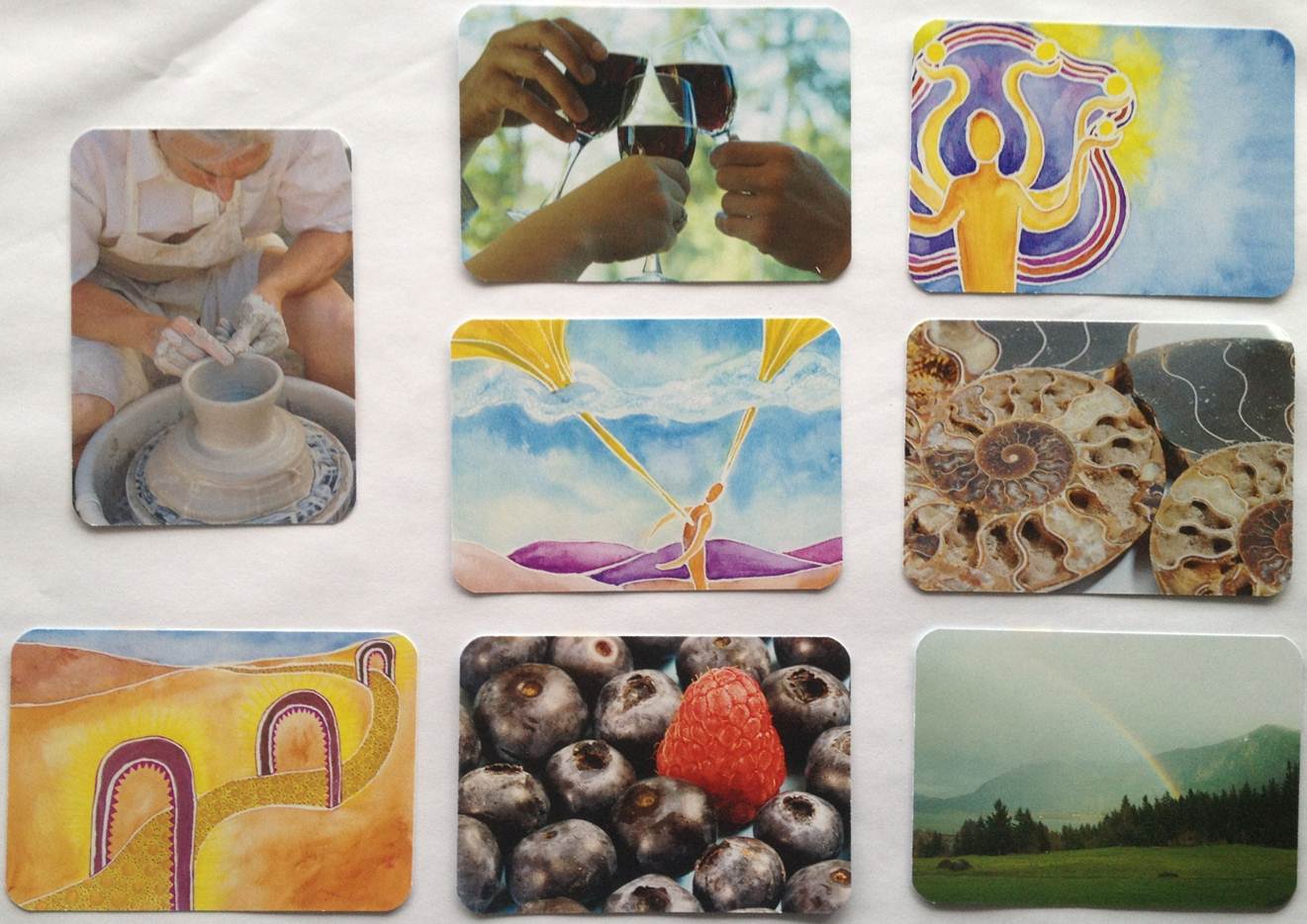
As I stared at the images, I began to move them around. I then realized that I needed to select one of the images to be in the center.  I selected the potter with the clay pot. I then arranged the rest of the images to surround the potter.

The story I captured with the collage of images in the context of the question was:

“I am envisioning a new venture that requires many hands to create.  From the individual work of making the clay pot to the inspirational work of partners (left most picture) providing inspiration (double entendre) for me to create a legacy that is the result of a long and twisting path.  I want the thing that is made to be biodynamic in nature as a fine wine that is grown and results in the magic elixir.  I want the legacy to be as natural and organic as a nautilus shell (the first logo for the ALL-IN-1 product that I created back in 1981). I would like that legacy product to be as long lasting as a fossilized shell – still as beautiful today after thousands of years. The balance though is to achieve the wonderfully dynamic properties of a fine wine – a product that continues to live as it ages, yet with something firm enough (clay pot and nautilus shell) to be long lasting. The product of this work has to be capable of evolving through all of the partners (influencers, purchasers, suppliers, customers, customer’s customers) in the process. In other words, the product delivered has to be a process.”

As I sent this off to Christine, I laughed at my inability to arrange the images in a spiral or more randomly. My natural style is to have everything nicely vertically and horizontally arranged.
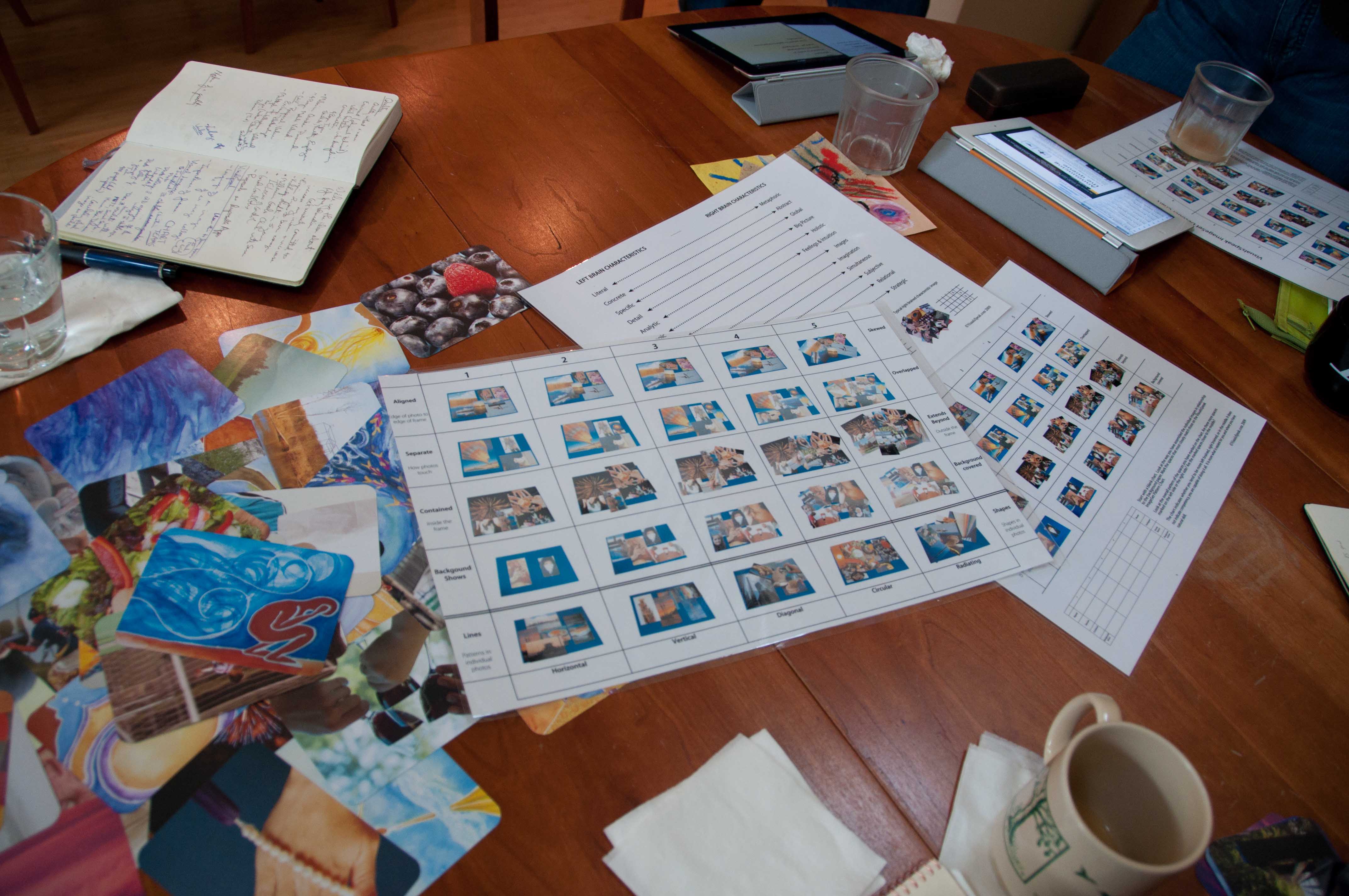
In our first meeting, Christine shared her matrix of the different patterns that people arrange the images (see matrix in the center above). She has noticed that each of us has a style and it is very difficult to get people to shift their arrangement to another style. The closest personality indicator that she correlates with this finding is the Hermann Brain Dominance Indicator.

Christine responding as the computer noticed the following things in the image:
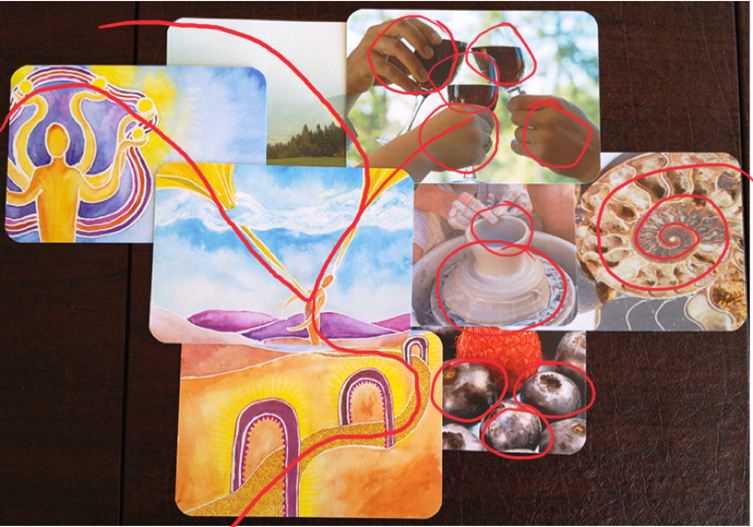
“Does it mean anything to you that the images on the left side are all paintings and flowing, and the images on the right are photographs with circular patterns and a spiral off the side? This division is in the center of the image, which if often the most important.

“Is there anything more to say about the images that are tucked partially underneath at the top right and bottom left?”

I am fascinated by the lines/paths she draws through the images. My software design brain cuts in first and starts to think about how we would do the image recognition to follow the lines and shapes through a collection of images.  I feel some wavelet decomposition mathematics coming to bear.

Slowly I quiet the software brain down, and get back to the image questions. I am fascinated how “unconscious” I was at lining up the many different lines and circles. My biodynamic fine wine growing imagery is hitting me left and right as I think about the cycles of sunshine to plant to berries to containment vessels (clay pots) to sharing fine wine in celebration of the journey.

Right now these questions are too deep for me.  I’ll let sleep time deal with them.

Posted in Content with Context, Design, Human Centered Design, User Experience, Visual pattern Language, VisualsSpeak | 1 Comment

The Paradigm of Awesome and Silage

Michael Josefowicz (@toughLoveforx) had a great pointer to a series of videos on The Paradigm of AWESOME! from Trustus Pharmaceuticals. Cathy Davidson came across Michael as part of researching her book Now You See It.

Cathy described Michael in her book:

“I met him on the Internet. He called himself ToughLoveforX. He had a way with winning phrases. Soon, I was one of his followers.

“This story isn’t going where you think it is.

“ToughLoveforX is Michael Josefowicz, a retired printer who has an active life on Twitter. I began to follow him, which means, for those who don’t use Twitter, that I selected to receive Josefowicz’s tweets. They roll past me every time I check out my Twitter page, several times a day. Twitter is called an asymmetrical technology in that you can follow anyone you want and read what they tweet. You follow people because you are interested in what they have to say. Because he seemed always to be on top of the most exciting news and research on education, social media, publishing, civil society, the brain, and other areas that interest me, I began following ToughLoveforX—or TLX, as I now call him for short—and found that every other day or so, he would be sending out a link to something invaluable for my own thinking and research.

“I’m not the only one who thinks TLX has a bead on something worth seeing. He currently has 3,202 followers. That’s a pretty substantial audience, given that, of the 75 million people with accounts on Twitter at the end of 2009, only the top 1 percent had more than 500 followers. The average Twitter user has exactly 27 followers.14 TLX describes himself as: ‘Retired printer. Lots of time for blabla. If I can help fix high school. So much the better.’ That candid, offhanded, unpretentious style is why a lot of us follow him. Another reason is that, in addition to having so many followers, he himself is avid at following others, 3,410 of them to be exact. He has made himself one of the most informed people out there, anywhere, on all of the research in neuroscience and learning.”

Soon I was following Michael and what a torrent of insight I jumped into.  Thanks to Cathy and Michael, I realized what a terrific knowledge awareness tool Twitter is. Some days I dive into the business stuff, some days the university and learning stuff, and some days I grab the humor.  This morning I need a little humor.

MEDCITY News wrote this about the Big Pharma Parody that “The Paradigm of Awesome” is a part of:

“My favorite video is the one describing “The Future of Pharma.” It shows new hire Mike talking with site manager Heidi, who is immersed in the corporate speak of Kaizen training and another corporate initiative called “5s.”

“In the exchange, Mike notes how at Trustus, science appears to have taken a backseat to corporate goals. “Don’t you do chemistry here?” he asks.

Heidi: Chemistry is the past, Mike. We are the future. Once you learn to be a team player, we will have a project assignment for you to sink your teeth into. But it won’t involve doing any chemistry. Once you join a project team, you’ll be assigned a specific portion of the chemistry. Mostly, your job will consist of selecting companies in China where that chemistry may be outsourced.

Mike: Ah, I see. So then we just come up with the ideas here. Is that it?

Heidi: Ah, no. We mostly get our ideas from other companies. Either by acquiring the companies or by licensing in their projects.

M: So then, what we do at our site is develop the projects. We take the raw laboratory processes and then develop them so they are suitable for manufacturing. Is that it?

H: That’s how it was in the past, Mike. Now, most of the development work is done at our corporate headquarters before the projects are transferred to our site.

M: So, the company gets projects from other companies. The projects are developed at our corporate headquarters and then transferred to us. And then we portion out the work to Chinese firms.

H: Check the big brain on Mike. Now you’re getting it.

For me, I loved Heidi’s comment in “Awesome” about silos and silage.  Sure enough there was an episode on “We Have Silage.”

A good friend and marketing colleague forwarded me another example of corporate silage from a sales executive at Cisco. You just can’t make this stuff up.

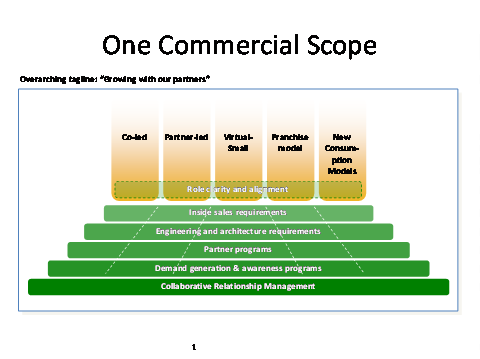
“Today is a historic day at Cisco! We are coming together as a Segment on a Global basis to share our theater and functional best practices in order to maximize revenue and optimize investments.

“Our overall segment is now the Small Business and the Mid Market. We have enjoyed great success throughout the world in each segment to date, and with the unification of our go-to-market segment, our growth will accelerate. In Mid Market and Small, rhythm is important in everything we do. Starting with this Day One Message, we will be driving consistent communication within our team, and externally to our Partners and Customers.

“Before we focus on the future, let’s reflect on our roots. First, I would like to recognize all of our theaters for the amazing journey over the past years in Commercial Mid Market. All of our theater leaders are to be commended for their leadership–you should all take great satisfaction in knowing you were a part of the Commercial success we will now unify around. Your commitment to innovation in each theater to grow Commercial has resulted in many pilots we can now build throughout the world jointly.

“Secondly, I would like to thank Andrew Sage and the entire Small Business team for a tremendous launch during FY09 and for the focus on execution and scaling during FY10. The entire Small Business team can take great pride in knowing that the innovative approach to the routes to market will now be scaled across both Small and Mid Market for the overall success of Cisco. Thank you all!

“Commercial is now a very exciting place to be within Cisco, and this is why:

1.     We are Investing in the Segment by Aligning to Five Go-to-Market Models

    1. Co-Led: Known as Select in the US, or Large Opportunity in EU, this go-to-market model will bring home our largest opportunities and drive architectures.
    2. Partner Led: Throughout the world, we will scale our Partner AM’s to success and growth for the Partners and Cisco.
    3. Virtual Small: The Small Business Team continues their journey and further develops the routes to market for growth acceleration.
    4. “Franchise Like”: We will pilot several flavors of these new models to gain great coverage throughout the world.
    5. New Consumption Models: We will develop Cloud and Xaas models with our SP brothers to scale all four of the Go-to Market Models.

2.     We are Investing in the Segment by Aligning to Five Supporting Functional Tracks

    1. Inside Sales is now aligned to the above Go-to Market Models for maximum return.
    2. Engineering and Architectures will be creating a scalable solution for technical salessupport throughout the world.
    3. Channels is aligning to create greater momentum in Commercially-focused Partner Programs – DAP, DAPc/s and Avant Garde.
    4. Marketing continues to be our best ally in terms of investing in Demand Generation in each theater.
    5. Collaborative Relationship Management, beginning with a deep understanding of our Partners and then our Customers.

3.     We are Aligning as an Innovation

“For many years, our theaters and functions were forced to innovate within theater budget limitations, which made scaling across theaters very difficult.  We are now sharing our innovations, and will be scaling our best pilots. The worldwide organization will facilitate the awareness and project management of key pilots.  Alignment is our next Innovation!

4.     Commercial Organizational Support

“The investments made in a worldwide organization to assist in alignment are only valuable if the new organization creates value for the theaters and the functions. Therefore, we are here to serve.

“Below is the single slide that will be our focus.  We have ownership of each go-to-market model and functional track, and we would like you to offer your perspective, so we can develop a dialog as we launch our efforts. (If you would like to share your thoughts, please visit the WWPO Partner Watch blog  and post your ideas in the comments.)

The Culture of Commercial

“I personally have great pride to be associated with this group. Our efforts will develop the Small and Mid Market into the ultimate growth engine within the company, and our Partner base.  We will behave differently in our new aligned world by driving success to, through and with our Partners.  Our new organization is responsible for SALES, but we are organized within the Worldwide Partner Organization to drive the needed investment and alignment for the Commercial Segment.  We will need to have great cross-functional support and rhythm to all we do. You will lead Cisco by living our company culture.

“The Commercial Leaders will meet in mid-September to take our next steps on alignment and investment. You can expect to see the worldwide team organizational announcements in the coming weeks to serve your needs.  Please let us know your thoughts as we align around the world as One Commercial within One Cisco!

“Congratulations on FY10 and welcome to One Commercial in FY11.”

I will never be able to sit through another corporate speak presentation without thinking “here comes the silage.”

Posted in Humor, organizing, User Experience, Working in teams | Leave a comment

In Honor of the Recent 2012 CSCW in Seattle

The 2012 ACM Conference on Computer Supported Cooperative Work (CSCW) just concluded in Seattle. The conference draws a wide range of academic and industry luminaries. CSCW describes themselves as:

“CSCW is a premier venue for presenting research in the design and use of technologies that affect groups, organizations, and communities. CSCW encompasses both the technical and social challenges encountered when supporting collaboration. The development and application of new technologies continues to enable new ways of working together and coordinating activities. Although work is an area of focus, CSCW embraces research and technologies supporting a wide range of recreational and social activities using a diverse range of devices. The conference brings together top researchers and practitioners from academia and industry who are interested in both technical and social aspects of collaboration.”

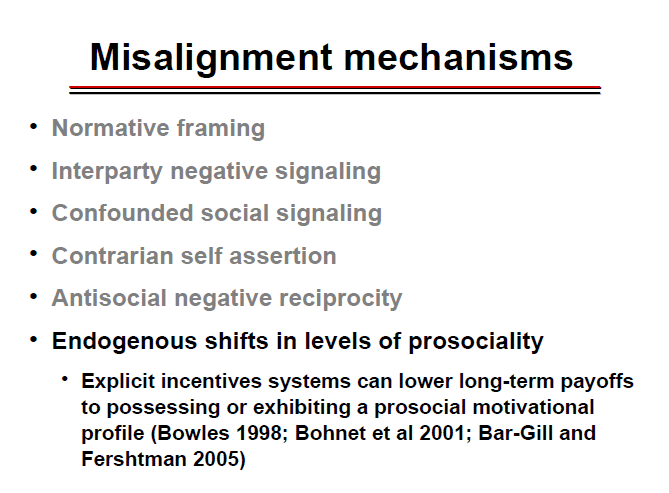
Yochai Benkler from Harvard Law School presented a keynote on “The Penguin and the Leviathan – Towards Cooperative Human Systems Design.” After several days of slides like the following, I had to search for some humor:

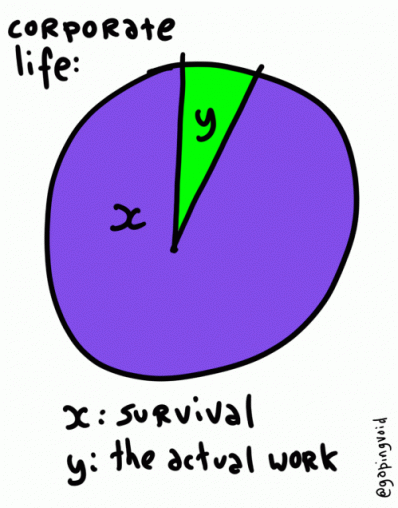
In the category of you can’t make this stuff up, both Dilbert and Hugh MacLeod offered up their insights on CSCW a few days after the conference.  First from the Gaping Void website:

In addition to his cartoons, Hugh also adds a nice description of what he was thinking about with his art work:

“Oh, politics rears its ugly head again. What is is about large organizations that makes everything other than doing the work the focus of people’s lives? We all know that being liked, saying the right things, and making the right friends is essential to success in a big corporation. Isn’t that true about life too?

“I guess the work and the social aspects of getting the work done are equally important. Let’s face it, if you have the best  idea in the world, but are hated in your organization, you’ll never get it implemented, will you?

“Work, politics, lobbying… it’s all just part of life.”

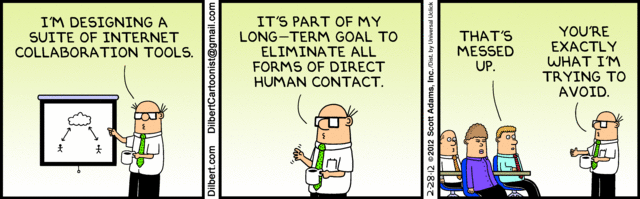
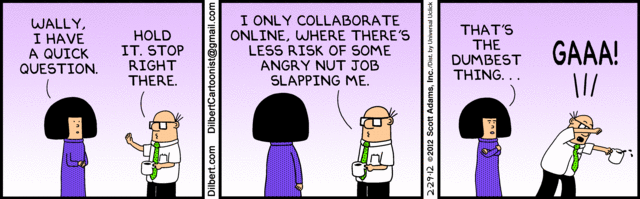
Scott Adams was delightfully eloquent with his thoughts about corporate collaboration in the last week:

Thanks to the availability of wireless internet access, I can always rely on Dilbert and Hugh Macleod to provide perspective to get me through a conference.

Posted in Humor, Learning | Leave a comment

Advice to a Non-Technical CEO of a Software Startup

One of the challenges of an early stage software start-up is whether to have a non-technical CEO who has a good set of relationships with prospective customers, or to have a CEO who really understands the technology and the art of software development. Like all tough questions the answer is “it depends.” Mostly it depends on how management savvy the CEO is regardless of their professional experience.

The following advice was created for a non-technical CEO who had very little management or executive experience on how to manage software development.

At the heart of management of any software start-up and software development and customer development is a quote from the Quality Guru W. Edwards Deming:

Expect what you inspect

“You can expect what you inspect. Dr. Deming emphasized the importance of measuring and testing to predict typical results. If a phase consists of inputs + process + outputs, all three are inspected to some extent. Problems with inputs are a major source of trouble, but the process using those inputs can also have problems. By inspecting the inputs and the process more, the outputs can be better predicted, and inspected less. Rather than use mass inspection of every output product, the output can be statistically sampled in a cause-effect relationship through the process.”

When you are doing a software start-up, there are multiple parallel processes that are going on simultaneously which is why what is called the “Waterfall Development Process” can never work for a V1 product.  Here is a list of some of the challenges along with proposed solutions or interventions:

  • Unlike a physical object which has many physical constraints along with the constraints imposed by the science of physics, software has almost no constraints.  This aspect is one of the most wondrous aspects of software development and one of the most disastrous when trying to produce a product and meet deadlines.  There is always something else that you can add “easily” to the software and almost always a way for a software engineer to make the software better.
    • The successful executive must work tirelessly to impose appropriate constraints.  This is an art form in itself.
      • The kinds of constraints that can be imposed are:
        • Limit the amount of time to the next deliverable.
        • Limit the scope of what is to be built.
        • Limit the amount of resources applied to the development.
        • Focus on a single customer type for a single market in a single geography.
          • Focus on a single “bottleneck” or pain point (from Goldratt’s Theory of Constraints) that the customer currently has.
      • The best constraint I’ve found over the years is to limit the time by going to a daily demo.
        • That is, every day I want to see a 5-10 minute demonstration of the progress that was made the previous day.
        • In the process when I don’t see visible progress, I will at least get the reasons (generally in the form of excuses) as to why progress wasn’t made.  That is where I can help break through these roadblocks either by asking good follow up questions or by removing the roadblocks in some other way.
  • When you set out to build a V1 product, most of the time you are setting out to envision and design something that hasn’t been done before.  Bringing this new thing into being means every day is an exercise in learning the implications of what the design means.  It’s like peeling an onion.   You very quickly run into the four boxes of knowing:
    • What you know
    • What you don’t know
    • What you don’t know you don’t know
    • What you know that is wrong

    • The dynamics of the interaction of these four boxes are truly problematical:
      • As you learn more about what you are trying to do, you also expand exponentially that which you don’t know.
      • As the size of what you don’t know increases, so does the size of the box of what you don’t know you don’t know.
      • And as you keep learning more, you are also learning more things that are wrong.
    • This expansion of knowledge is what I call the diverging (DIVERGE) of the problem space.
    • So part of what you have to continually do because of the knowledge expansion (and thus scope expansion, not necessarily in terms of extra features or modules or lenses, but in terms of the amount of work and depth of a particular feature) is to CONVERGE and focus on what the customer (user, purchaser, influencer) really needs to solve their point of pain.  Which of course means that you need to be doing as much “customer development” work as software development (see “Agile is only half of what you need” for a very good discussion of this problem with pointers to several slide shows that are worth going through along with an article by Ash Maurya on “Customer Development“).
  • But wait there is more.  Along with trying to understand WHAT to build, you are putting a team together to build it.  The challenges of hiring the key players while figuring out their strengths and weaknesses, and figuring out who else to hire, and figuring out the new hire’s strengths and weaknesses are a never ending talent challenge.  Not only do these early hires have to figure out how to work with each other to produce something but they (and you) are key to establishing what kind of culture the company is going to have (and that needs to be intentionally developed as well).
    • The biggest challenges are:
      • Making sure that the appropriate people are constantly collaborating with each other
      • Making sure that decisions are arrived at in a fast yet appropriate manner (more on this to come)
      • Making sure that decisions wherever possible are based on EVIDENCE (that is why I really like the mission statement that BlinkUX came up with – Evidence Based Design) rather than on interminable discussions and arguing over people’s opinions rather than demonstrated customer needs.
        • The more that you can focus the team on grounding their decisions on what really matters to the customer the better and quicker you will get through the V1 phase.  This is why I am so committed to Human Centered Design.
          • For example, there is no way that the Attenex Patterns User Interface and functionality and 10X+ productivity would have resulted from a designer or an information architect or an engineer devising the interface and declaring it good.  It came through the user research, user observation, prototype development and user testing of hundreds of design iterations.  Ultimately before we committed to any change, the performance increase had to be validated in usage.  Which meant we had to be very clear about who our users were and be able to test the “design improvements” on a regular basis.
          • It was quite painful when some of our best inspirations and designs not only didn’t increase productivity but dramatically decreased productivity.  These setbacks were a constant reminder to go back to paying deep attention to our customers (users, purchasers, and influencers).
  • And more.  Customer Development – from the point of view of product development (not from the point of view of sales and marketing)
    • Finding the relevant customers for your chosen product domain and picking the right customers to listen to is another one of those start-up challenges.  It is particularly problematical because there are two competing priorities – get a sale (generate revenue as quickly as we can) and get a set of launch customers who have the problem that we are trying to solve for and will give us their most important asset – their time and attention.  It is very hard for a single person (CEO) to do both things at the same time.  The customer will always hear from your actions that one of the two goals is paramount (and for the CEO getting the sale is always paramount).
    • So for customer development you have to use resources that very clearly have an agenda of learning and helping and are just as clear that they don’t have an agenda of selling.  You have to separate out sales from customer development in the context of product development.  This is where companies like BlinkUX and IDEO come in because they are a neutral third party.  It is also where in house user researchers come in when you grow a little more as a company.  As much as I wanted to do both roles in the early days of Attenex, as long as I had the CEO title I was perceived as always being in a selling role.  It wasn’t till I switched roles to the CTO that I was really able to dig deeply into our customers’ needs by going in and observing companies like Pfizer, KPMG and FTI (when they were our biggest customer).

Yes, software start-ups are messy and many days it seems like you are taking two steps backward for every step forward.

My recommendation for dealing with the above in a way that keeps people out of opinion mode or whining mode or “it can’t be done because mode” is moving to a daily demo.  At a minimum, this lets you as the CEO always know where things are in a visceral way, not by trying to interpret status reports or email traffic.

Some attributes of the daily demo are:

    • Phase I:
      • The total time for the daily demo and the discussion shouldn’t exceed 15 minutes.
        • You want to have the meeting at a standard time every day (usually first thing in the morning).
        • At the size of an early stage start-up, I would try and involve everybody in the company in the demo.
          • This is also a good way to get everyone to work at the same time (but I never said that).
          • However, if people are working staggered schedules don’t try and wait until the latest person comes in.  Get the meeting going early in the day, first thing if possible.  Do not ever do the daily demo at the end of the day.
        • Rotate who gives the demo to show case somebody’s work and to give everyone a chance to demo the whole product (another byproduct of the development of your talent).  It also gets people more comfortable with public speaking.  Often I would have engineers that were working in one part of the product demonstrate some other part of the product so they were constantly seeing the whole product in use.  Clearly they had to have advance notice to do that until they realized that I expected each of them to be able to always demonstrate the whole product.
        • The emphasis is on ACTUALLY DEMOING something.
          • This is not a time for anyone to lecture.
          • It is show and tell with the emphasis being on showing.
        • Questions during the demo should be “questions for understanding”.  That is while the “show” is going on be asking those questions that come from not understanding what you are seeing.  But don’t let the answer go on forever.  If the explanation is not clear in a minute or so, make a note to come back to that in a longer meeting, but press on to the next thing so that the 15 minutes doesn’t bog down.
        • Don’t let the daily demo become a surrogate design meeting.  That’s a separate meeting.
      • After the show part, then ask follow on questions like:
        • What did you expect to show today?  Basically you are checking for progress against plan.
        • What were the reasons for the differences between plan and what got accomplished?
            • What things didn’t get done and why?
    • If there were extra things, what were they and how did they manage to get in?  You are looking for inadvertent scope creep.
      • As you start the daily demo, you want to get people into the habit of doing the above.
          • You should be positive at all times with liberal sprinkling of compliments for the cool stuff that appears.
          • This is not a meeting to place blame.  It is a meeting to celebrate the little accomplishments along the way.
          • This is your chance to observe how the development team is doing and how the software folks are relating to the product and marketing folks.  You want to observe any non-verbals like eye rolling or people not being able to look you in the eye and all those cues that lets you know that there is an elephant in the room somewhere.  These meetings are your early warning system.  However, these are not the meetings to do the problem solving in.  You want to problem solve in separate meetings.
        • If you get into a phase of the project where there doesn’t seem to be anything new to demo, don’t let the developers cancel the daily demo.  Continue to have the meetings and have them go through things you may not have fully understood in the past.  Pretty soon they will get the message that you are serious about seeing daily progress and you won’t take lame excuses.
        • Where possible you should hold to the daily demo even if  you are travelling or if someone is on vacation.  Make sure you have a license to Webex or a similar tool so that you can do remote demos.
      • Phase II:
        • Once people are in the habit of doing the daily software demo, then it is time to bring your marketing resources more to the fore by splitting the meeting into a daily demo of the software and a “daily demo” of the knowledge that is being gained about your customers.  This is where you move into evidence based design.
            • You want marketing to show a video or at the very least play audio tapes of some aspect of customers trying to do their job using your product.  This is where the user videos from a BlinkUX become so important.
            • You want to ground the development team in ACTUAL users, not made up personas or someone’s opinion.
            • This is not a place for the product marketing folks to pontificate or a place to get the developers to add a piece of functionality that a sales person thinks they need.  You want to focus on developing software that meets someone’s actual needs (evidence based design).
      • Phase III:
        • Once the group has gotten comfortable with showing the daily progress in the software development and the customer understanding, then it is time to move the daily demo into the final phase of sophistication – getting the development team to demo how they are doing automated testing and the many ways that they are trying to make the system fail proof.  Similarly, the software should be far enough along that you are able to do usability testing and so product marketing should now be adding in videos that show users trying to actually use the software and provide further evidence of what is required to build both a desirable and a usable product.

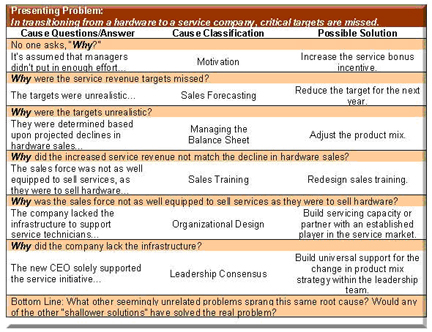
As with any software development effort, there are times when it becomes clear that you really need to understand something more deeply.  The thought tool that I’ve found most helpful grew out of Toyota, but I first came across it when studying W. Edwards Deming and the quality movement and six sigma.  Your role as CEO is to make sure that you are getting to the causes of any issues and not dealing with the symptoms. The Deming tool is the “Five Whys“:

“Systematically asking why an event occurs or a condition exists. The question ‘why?’ is applied to each response until the root cause of the event or condition is found. Sometimes the root cause is identified by the 2nd or 3rd “why.” In other situations it may take 6-7 ‘why’s’ to get to the root cause. Try to get to the 5th level without getting to an absurd level of detail.

“At the heart of this simple tool is the belief that real problem solving occurs when the cause, rather than the symptom, of the problem is addressed. This is often referred to as ‘drilling down’ to the heart of the problem. Dr. Kano refers to this ‘drilling down’ as ‘going an inch wide and a mile deep into a problem’ (real understanding leading to targeted solutions) rather than ‘going a mile wide and an inch deep into a problem’ (superficial understanding leading to shotgun solutions). At a more philosophical level, the 5 Why’s also demonstrate Dr. Deming’s principle that the real problem usually lies in the deeper system rather than in the performance of an individual who is working within that system.”

An example of the Five Whys:

Another thought tool that I find very helpful comes from Ed Lazowska, the Bill and Melinda Gates Professor of Computer Science at UW.  He found that if he tried to answer directly the question that a student or colleague asked him there was almost never a good result.  He realized that to provide a good answer he first had to ask “what is the misunderstanding that caused the question to be asked in the first place?”  Once he knew what the misunderstanding was he could provide an answer that led to understanding.

A wonderful book QBQ!  The Question Behind the Question: Practicing Personal Accountability at Work and In Life provides a comprehensive exploration of Ed’s insight.

The document on Decision Styles that is drawn from Bob Crosby’s Walking the Empowerment Tightrope: Balancing Management Authority & Employee Influence makes clear for those decisions which are important to be explicit about how the decision will be made and who will make it.  With most decisions it is clear.  But there are some decisions, like we are going to only focus on one persona or a single market or which concept search tool to use where it is important that as part of the evolving startup culture that you be explicit about how the decision will be made.  As a general rule you don’t want to have a culture where consensus is the primary decision tool.

For those decisions where you realize that you need to be explicit about the decision style, you should also start the formality of creating a decision record so that you can be working on continuous improvement of the quality of your decisions and which decision styles are working for your organization.  Russ Ackoff provides a quick and direct method for tracking decisions.

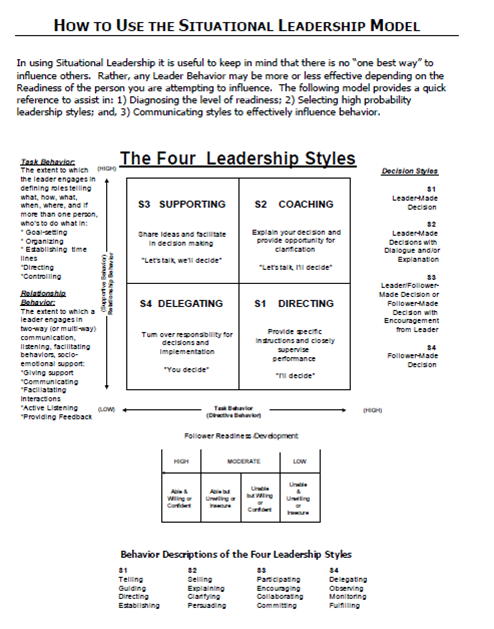
The article on Coaching for Performance provides some simple yet effective methods for working with your development talent. The article describes the Situational Leadership Model.

While this “advice” is a lot to absorb for the start-up CEO, by immersing the CEO in the ways to manage a software start-up there is a higher likelihood for success.

For a humorous look at the wonderful world of innovation and new ventures, checkout Fl!p and the gang at Fl!p Comics.

Posted in Ask and Tell, Attenex, Content with Context, Design, Human Centered Design, Learning, organizing, Russ Ackoff, Software Development, User Experience, Working in teams | 13 Comments

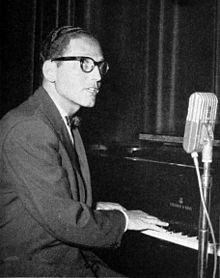
Tom Lehrer

My parents had a quirky sense of humor. One of the comics they came across was the brilliant Tom Lehrer. In the late 1950s when there were so few choices for home entertainment (only 3 TV channels and no internet), many a night we listened to the plinking piano tunes of Tom Lehrer from our stereo.

To this day I chuckle every time I think about songs like “Poisoning Pigeons in the Park,” “The Vatican Rag,” “The Elements,” and “Oedipus Rex.” And my favorite line from all the songs “soon we’ll be sliding down the razor blade of life” which was the refrain in “Bright College Days.”

Listening to these songs over and over in my early teens is probably why I have such a warped sense of humor today. Listening to these songs while putting together this blog post is a wonderful way to remember so fondly the evenings with my parents, Harry and Marge Walter.

Posted in Family, Humor | Leave a comment

Visual Search – Please, I’m begging you!

At breakfast the other morning, my colleague Alan Wood was excited to try out a software tool, Devonthink, that he’d just read about in Steven Johnson’s Where Good Ideas Come From

“Private serendipity can be cultivated by technology as well. For more than a decade now, I have been curating a private digital archive of quotes that I’ve found intriguing, my twenty-first-century version of the commonplace book. Some of these passages involve very focused research on a specific project; others are more random discoveries, hunches waiting to make a connection. Some of them are passages that I’ve transcribed from books or articles; others were clipped directly from Web pages. (In the past few years, thanks to Google Books and the Kindle, copying and storing interesting quotes from a book has grown far simpler.) I keep all these quotes in a database using a program called DEVONthink, where I also store my own writing: chapters, essays, blog posts, notes. By combining my own words with passages from other sources, the collection becomes something more than just a file storage system. It becomes a digital extension of my imperfect memory, an archive of all my old ideas, and the ideas that have influenced me. There are now more than five thousand distinct entries in that database, and more than 3 million words—sixty books’ worth of quotes, fragments, and hunches, all individually captured by me, stored in a single database.

“Having all that information available at my fingertips is not just a quantitative matter of finding my notes faster. Yes, when I’m trying to track down an article I wrote many years ago, it’s now much easier to retrieve. But the qualitative change lies elsewhere: in finding documents that I’ve forgotten about altogether, finding documents that I didn’t know I was looking for. What makes the system truly powerful is the way that it fosters private serendipity.

“DEVONthink features a clever algorithm that detects subtle semantic connections between distinct passages of text. These tools are smart enough to get around the classic search-engine failing of excessive specificity: searching for “dog” and missing all the articles that only have the word “canine” in them. Modern indexing software like DEVONthink’s learns associations between individual words by tracking the frequency with which words appear near each other. This can create almost lyrical connections between ideas. Several years ago, I was working on a book about cholera in London and queried DEVONthink for information about Victorian sewage systems. Because the software had detected that the word “waste” is often used alongside “sewage,” it directed me to a quote that explained the way bones evolved in vertebrate bodies: namely, by repurposing the calcium waste products created by the metabolism of cells. At first glance that might seem like an errant result, but it sent me off on a long and fruitful tangent into the way complex systems—whether cities or bodies—find productive uses for the waste they create. That idea became a central organizing theme for one of the chapters in the cholera book. (It will, in fact, reappear in this book in a different guise.)

“Now, strictly speaking, who was responsible for that initial idea? Was it me, or the software? It sounds like a facetious question, but I mean it seriously. Obviously, the computer wasn’t conscious of the idea taking shape, and I supplied the conceptual glue that linked the London sewers to cell metabolism. But I’m not at all confident that I would have made the initial connection without the help of the software. The idea was a true collaboration, two very different kinds of intelligence playing off one another, one carbon-based, the other silicon. When I’d first captured that quote about calcium and bone structure, I’d had no idea that it would ultimately connect to the history of London’s sewage system (or to a book about innovation). But there was something about that concept that intrigued me enough to store it in the database. It lingered there for years in the software’s primordial soup, a slow hunch waiting for its connection.

“I use DEVONthink as an improvisational tool as well. I write a paragraph about something—let’s say it’s about the human brain’s remarkable facility for interpreting facial expressions. I then plug that paragraph into the software, and askDEVONthink to find other passages in my archive that are similar. Instantly, a list of quotes appears on my screen: some delving into the neural architecture that triggers facial expressions, others exploring the evolutionary history of the smile, others dealing with the expressiveness of our near-relatives, the chimpanzees. Invariably, one or two of these triggers a new association in my head—perhaps I’ve forgotten about the chimpanzee connection—and so I select that quote, and ask the software to find a new batch of passages similar to it. Before long, a larger idea takes shape in my head, built upon the trail of associations the machine has assembled for me.

“Compare that to the traditional way of exploring your files, where the computer is like a dutiful, but dumb, butler: “Find me that document about the chimpanzees!” That’s searching. The other feels radically different, so different that we don’t quite have a verb for it: it’s riffing, or exploring. There are false starts and red herrings, but there are just as many happy accidents and unexpected discoveries. Indeed, the fuzziness of the results is part of what makes the software so powerful. The serendipity of the system emerges out of two distinct forces. First, there is the connective power of the semantic algorithm, which is smart but also slightly unpredictable, thus creating a small amount of randomizing noise that makes the results more surprising. But that randomizing force is held in check by the fact that I have curated all these passages myself, which makes each individual connection far more likely to be useful to me in some way. When you start a new query in DEVONthink and look down at the initial results, at first glance they can sometimes seem jumbled and disconnected, but then you read through them in more detail, and inevitably something tantalizing catches your eye. “Jumbled” and “disconnected” is of course also how we describe the strange explorations of our dreams, and the comparison is an apt one. DEVONthink takes the strange but generative combinations of the dream state and turns them into software.”

Johnson, Steven (2010-10-05). Where Good Ideas Come From: The Natural History of Innovation (pp. 115-117). Riverhead. Kindle Edition.

Alan shared as much as he could remember of the above passage.

Finally, I couldn’t help myself and blurted out “You don’t want to do that.  You’ll find it hard to use and it won’t do what you think it will do.  What you really want is a personal version of Attenex Patterns.”

What ensued was a long discussion about visual analytics, semantic networks, social networks, and event networks. Finally, Alan looked at me and said “Well, why don’t you just go build it? What are you waiting for?”

After David Socha and I stopped laughing and crying simultaneously as we’ve been having this same discussion for ten years, we all looked at each other and said “Maybe it is time.”

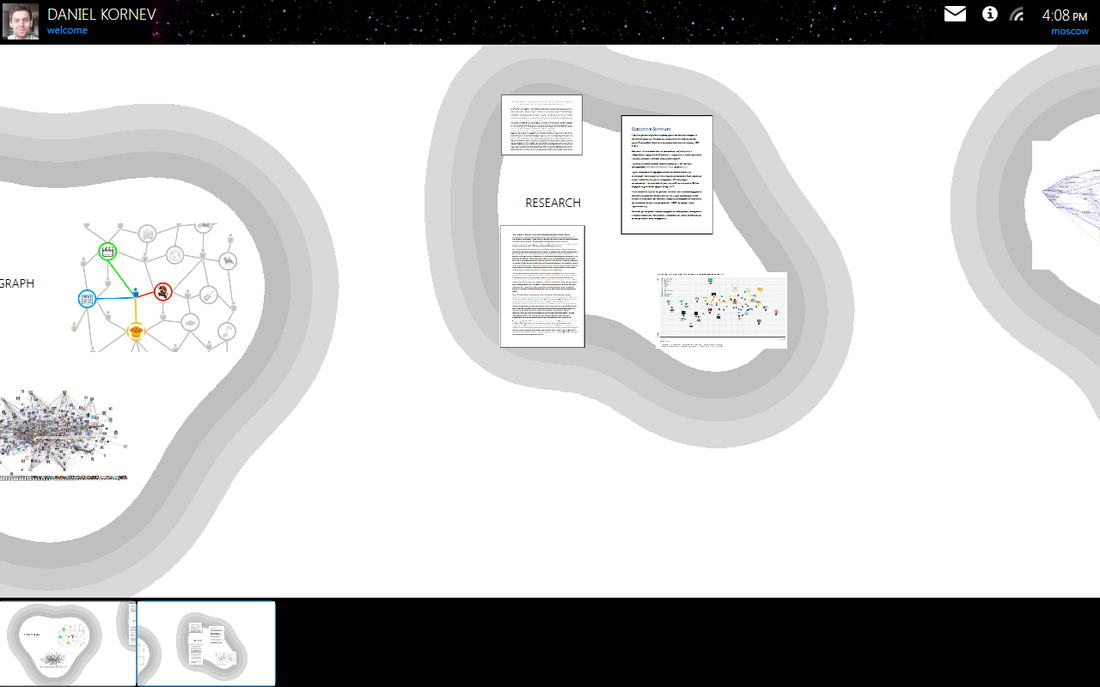
As I shared this story with one of David’s students, Yulana Shestak, she asked me if I’d ever heard of a tool called Zet Universe that a friend of hers is working on. I hadn’t heard of it so she sent me a pointer. The tool looks interesting and I can’t wait to try it out. A description of the tool can be found at Neocytelabs.

Project Overview

What

Zet Universe is the ubiquitous digital work environment with a game-changing natural user interface that learns and expands on users interest graph over the time. Zet Universe is a new, living metaphor of working with information in the Post-PC world.

Problems

Zet Universe addresses the needs of generation Z mindsets to have a simple yet powerful digital work environment with natural user experience across multiple devices.

Tools to tackle information are currently split between various products and platforms, leading to overload, context loss, permanent thought and action flow disruption, productivity decrease and extremely poor experience.

Goals

Like original Context-aware Computing Shell UX, Zet Universe is a system that is designed to enable user to:

  • Concentrate on important projects
  • Switch between projects without loosing context
  • Return to previous projects after long time
  • See whole picture of the project and easily jump to its details

in order to:

  • Reintroduce people’s information processes around their interests

Zet Universe is the Interest Graph

  • Zet Universe will reintroduce people’s information processes around their interests – from inception to learning, updates and sharing.
  • Zet Universe is interest graph that uses sophisticated machine learning algorithms to extract interests from personal information.
  • Zet Universe stores and makes user information of any kind (files, notes, people, places, documents, etc.) available across one’s devices via cloud service.
  • Zet Universe gives relevant recommendations within current user activity over the time.

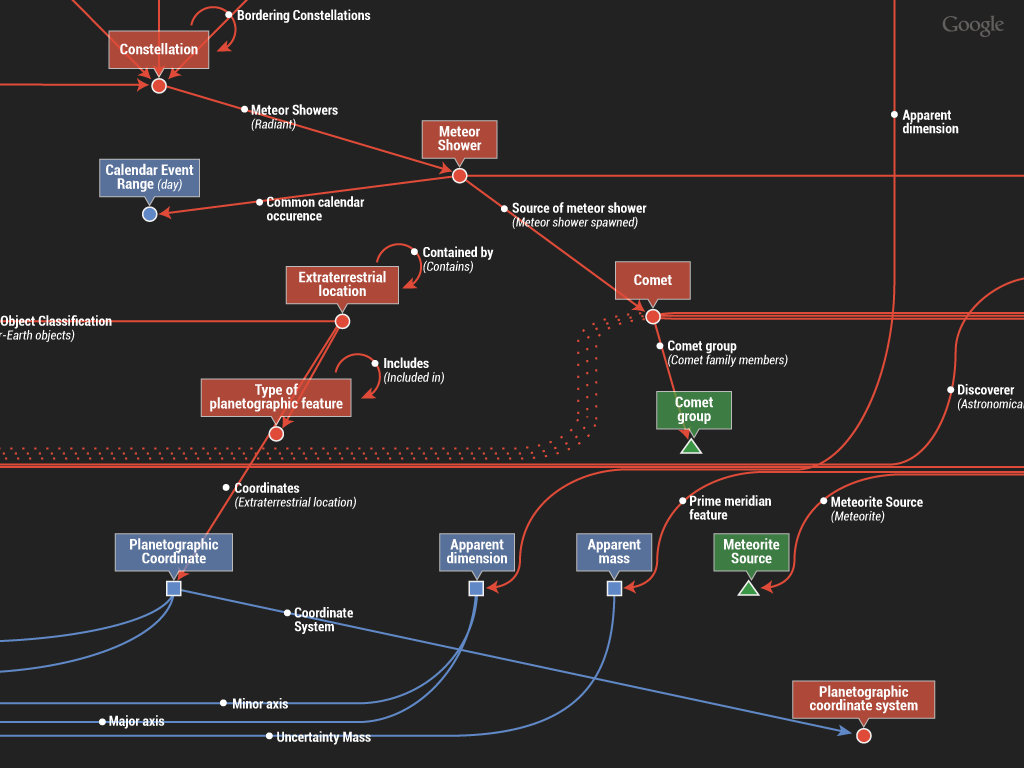
As I poked around Daniel Kornev’s websites, I found a pointer to the Google Knowledge Graph. I’ve wondered whether Google was ever going to get into this space, so it was nice to see some acknowledgement on their part of the importance of visualization. Lance Ulanoff had this to say about the knowledge graph:

“Google has a confession to make: It does not understand you. If you ask it “the 10 deepest lakes in the U.S,” it will give you a very good result based on the keywords in the phrase and sites with significant authority on those words and even word groupings, but Google Fellow and SVP Amit Singhal says Google doesn’t understand the question. “We cross our fingers and hope someone on the web has written about these things or topics.”

“The future of Google Search, though, could be a very different story. In an extensive conversation, Singhal, who has been in the search field for 20 years, outlined a developing vision for search that takes it beyond mere words and into the world of entities, attributes and the relationship between those entities. In other words, Google’s future search engine will not only understand your lake question but know a lake is a body of water and tell you the depth, surface areas, temperatures and even salinities for each lake.

“To understand where Google is going, however, you need to know where it’s been.

“Search, Singhal explained, started as a content-based, keyword index task that changed little in the latter half of the 20th century, until the arrival of the World Wide Web, that is. Suddenly search had a new friend: links. Google, Amit said, was the first to use links as “recommendation surrogates.” In those early days, Google based its results on content links and the authority of those links. Over time, Google added a host of signals about content, keywords and you to build an even better query result.

“Eventually Google transitioned from examining keywords to meaning. “We realized that the words ‘New’ and ‘York’ appearing next to each other suddenly changed the meaning of both those words.” Google developed statistical heuristics that recognized that those two words appearing together is a new kind of word. However, Google really did not yet understand that New York is a city, with a population and particular location.”

Google Knowledge Graph

To build it (and they will come) or to wait for someone to build the personal visual analytics engine that I really want and need. That is always the question when it comes to my crazy ideas.

Maybe just maybe, Curtis Wong from Microsoft with the engine underneath the WorldWide Telescope project will provide what I need.

Posted in Attenex Patterns, Content with Context, Knowledge Management, Software Development, Visual Analytics, Visual pattern Language | 1 Comment

“We don’t need no stinkin’ badges!”

The buzz around badges is heating up in the educational environment. Whenever I hear badges, I immediately think of the old western movie where the hombre exclaims “We don’t need no stinkin’ badges.”

Cathy Davidson has a thoughtful post on “Can badging be the Zipcar of Testing and Assessment?” She relates her discovery of badges as a form of assessment:

“I first came across badging about four years ago.  I was researching the “How We Measure” chapter of Now You See It.  That chapter is a pointed, systematic (one reader called it “relentless”) critique of current forms of end-of-year compulsory grading and multiple choice bubble testing, especially the end-of-grade testing required by the 2002 No Child Left Behind national educational policy.  (Don’t get me started!)  It seemed unfair, though, to produce all of the historical, statistical, psychological, and cognitive evidence that shows how poor One Best Answer item-response testing is for motivating or even measuring learning without providing some alternatives.

“Badging is one of the alternative peer-evaluation systems I came across.  The more I talked with badging pioneers and practitioners, the more I began to leave my own misgivings aside.  This wasn’t just some expensive technology designed to line someone’s pockets.  Like Zipcars, badges proved to be an easy, flexible, customizable system that fit the needs of some organizations.  I’m especially interested in badging systems developed by the world-wide community of Web developers who engage in collaborations with people they may never meet face to face.  Companies such as TopCoder or networks like Stack Exchange have badges that allow one developer to recognize another’s skills at C++, for example, but also to give credit for a collaborator’s ability to come up with a brilliant idea getting everyone to agree on a workable solution to ship a product out the door on schedule.”

In the Atlantic article “Envisioning a Post-Campus America,” Megan McArdle provides 12 contemplations on what the future might hold for higher learning. Several of her speculations point to the shift to online learning.  One of the predictions looks at how students can signal their competence:

6.  “Young job-seekers will need new ways to signal diligence.  I’d expect to see a lot of free labor in the early years, something like what aspiring writers and visual artists already do with their blogs.  There will be more freelancing, more try-out employment, and more unpaid internships.”

Badges are one way to signal diligence. In the electronic text Learning, Freedom & The Webthe authors provide a comprehensive look at education in the future.  One of the sections in the book is on Badges. I was particularly intrigued with the Open Badge System Framework (which reminds me of Life-Wide Learning):

“Imagine… a world where your skills and competencies were captured more granularly across many different contexts, were collected and associated with your online identity and could be displayed to key stakeholders to demonstrate your capacities. In this ideal world, learning would not be limited to a formal classroom, but could come from open education courses, previous experience, discussion with peers, participation in a forum or that book you read…evidence of skills could be acquired automatically from your interactions with online content or peers, could be explicitly sought out through various assessments or could be based on nominations or endorsements from peers or colleagues. This would allow you to present a more complete picture of your skills and competencies to various audiences, from potential employers to yourself.

“This world is not purely fictional, but instead is the direction that we are moving. The next step is to support and acknowledge this learning so that these skills and competencies are available and become part of the conversation in hiring decisions, school acceptances, mentoring opportunities, and even self-evaluations. This is where badges come in.”

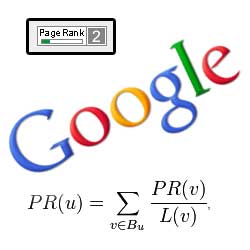
As I read through the rest of the chapter, it occurred to me that badges or more appropriately reputation could be the next big search organizer. In the beginning of the era of Google (and their fifty-seven signals), we have PageRank (link analysis) as a way to determine the priority of what should be displayed first given a search request:

“A PageRank results from a mathematical algorithm based on the graph, the webgraph, created by all World Wide Web pages as nodes and hyperlinks as edges, taking into consideration authority hubs such as cnn.com or usa.gov. The rank value indicates an importance of a particular page. A hyperlink to a page counts as a vote of support. The PageRank of a page is defined recursively and depends on the number and PageRank metric of all pages that link to it (“incoming links“). A page that is linked to by many pages with high PageRank receives a high rank itself. If there are no links to a web page there is no support for that page.”

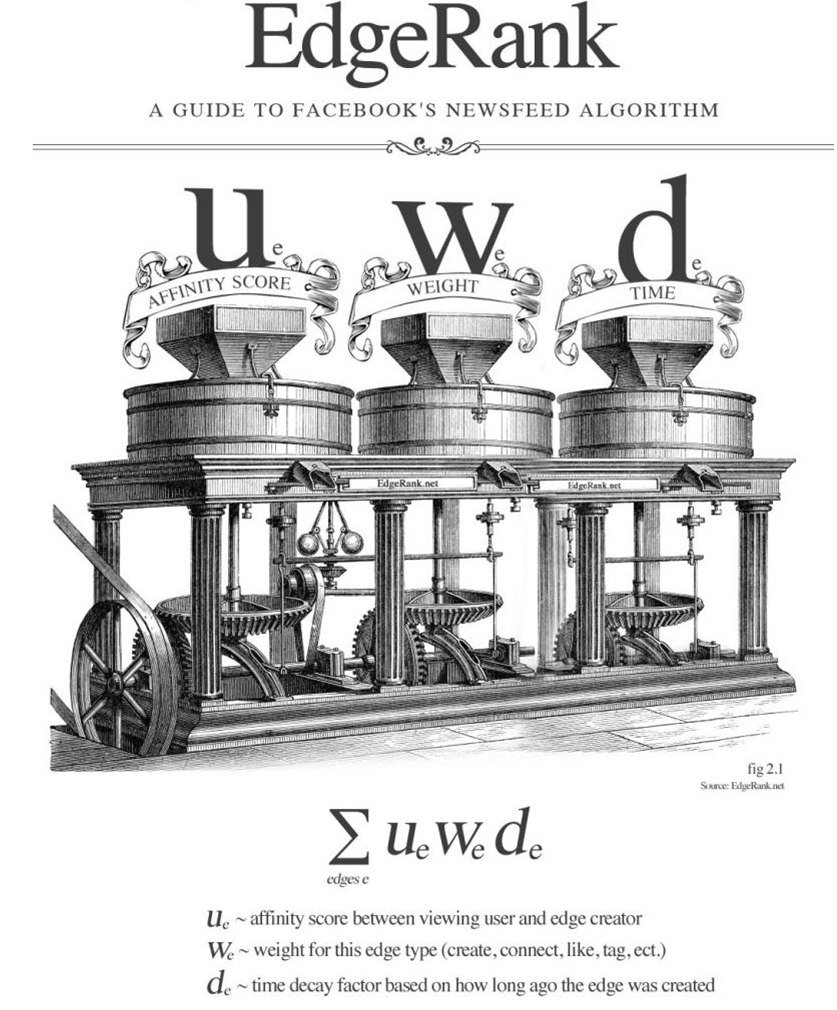
Following the success of the graph analysis of Google’s PageRank, Facebook followed suit with their EdgeRank for prioritizing search requests and news items by your social graph of friends.

“EdgeRank is the Facebook algorithm that decides which stories appear in each user’s newsfeed. The algorithm hides boring stories, so if your story doesn’t score well, no one will see it.

“The first thing someone sees when they log into Facebook is the newsfeed. This is a summary of what’s been happening recently among their friends on Facebook.

“Every action their friends take is a potential newsfeed story. Facebook calls these actions ‘Edges.’ That means whenever a friend posts a status update, comments on another status update, tags a photo, joins a fan page, or RSVP’s to an event it generates an ‘Edge’, and a story about that Edge might show up in the user’s personal newsfeed.

“It’d be completely overwhelming if the newsfeed showed all of the possible stories from your friends. So Facebook created an algorithm to predict how interesting each story will be to each user. Facebook calls this algorithm ‘EdgeRank’ because it ranks the edges. Then they filter each user’s newsfeed to only show the top-ranked stories for that particular user.”

I wondered if you could rank searches based on the reputation of different web authors by the number of badges they had as indicators of their level of expertise. To explore this idea further I discussed this with a colleague, Ash Bhoopathy who is the founder of BetterAt. Since BetterAt, P2PU and the Open Badge System had both received funding from the MacArthur Foundation (along with Cathy Davidson), I figured Ash would be in position to help me understand this space. Ash shared that they were thinking along the lines of badges with a four stage level of certification:

  • I say I did something
  • Someone else confirms that I did that something
  • An expert confirms that I did that something
  • A relevant certifying organization confirms that I did that something

The above signals of increasing competence along with the texts associated with a given badge could provide “reputation scores” to prioritize which articles should be elevated in the returned search list depending on the reputation of the author(s).

To continue my research on the topic, I chatted with Professor Mark Zachry, UW HCDE Department, about his research work on reputation. Mark pointed me to several recent articles from his research group on reputation using Wikipedia as the tangible surrogate for their research. These articles include:

I was delighted to get these pointers and start wading my way through these articles as I have always wondered why more researchers didn’t mine the data in the Wikipedia editing logs. I really liked the introduction to social translucence in the first article:

“Understanding and interpreting the behaviors of others in an online environment is hard. The cues and signals that we readily interpret in a face-to-face situation are not present or are at best attenuated. Lacking sufficient cues, users often misinterpret or misunderstand the actions and intentions of others. As the number of participants and the amount of interaction grows it becomes harder and harder for users to make sense of others’ actions, much less their own place in the community and the health of the community at large.

“Social translucence is a socio-technical term to describe how systems can facilitate understanding with regard to the actions of people in online environments. Social translucence includes three key design attributes: (a) mutual awareness of activities, (b) contextual propagation of socially salient cues (visibility), and (c) accountability for one’s actions. Through support for these three characteristics members in a community can better understand the types of activities that transpire, understand the norms of the community and the consequences for the actions that they may take.”

Now we have that small little matter of programming to extend these ideas of reputation for an environment like Wikipedia to the web as a whole. Can the Open Badge Project be a catalyst to get another part of the infrastructure needed for ReputationRank to go beyond PageRank and EdgeRank as the means for prioritizing what we search for on the web?

Posted in Content with Context, Curation, Design, ebook, Human Centered Design, Innovation, Learning, Teaching, Transactive Content, University, User Experience | 3 Comments

Search and you shall receive

Sometimes we are so close to technological advances that we forget what an amazing world we’ve created for ourselves.

I was reminded of this world of magic when I set out to search for my deceased uncle’s EdD dissertation. I didn’t know if he actually had written one or where he had received his doctorate. The first thing I did was email my brother and sister. Since it was late at night, neither of them responded right away.

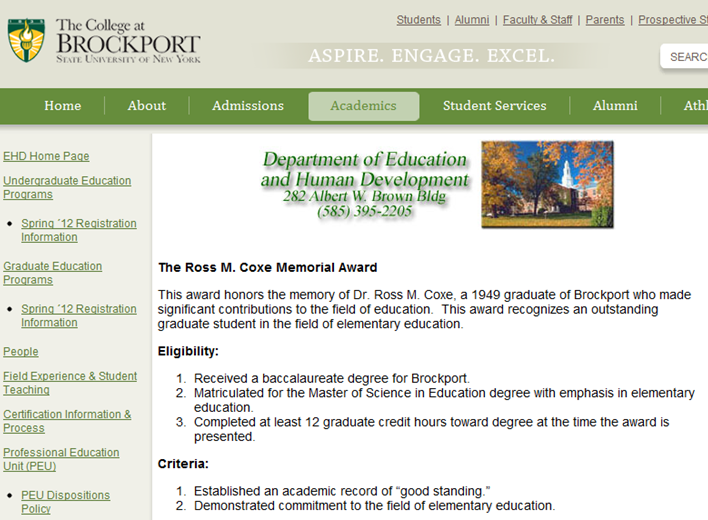
So I did a search for his name to see if any of his articles or other history were available on the net.  Up came an entry at The College at Brockport State University of New York for the Ross M. Coxe Memorial Award. I had completely forgotten about this memorial that my cousin, Kathy D’Ambra, had helped set up. I then emailed the library at Brockport State to see if they had his dissertation on record. They kindly called this morning at 6am Seattle time to share that they couldn’t find anything. Now that was responsive customer service.

As I groggily stumbled to my email to respond, I noticed a note from my sister that she was not able to find hard copy of my uncle’s dissertation but she vaguely remembered that he did his EdD work at Wayne State University in Detroit. Now I am feeling like an idiot as I was just talking to a friend about my uncle and grandmother living in downtown Detroit.

Without much hope, I entered my uncle’s name into the library search box and up came a pointer to his dissertation on A Suburban School System Faculty Looks at and Improves its Program in Social Studies for Children and Youth. The notes on the page indicate that the thesis is only available at the library.  Darn.  I am not likely to be in Detroit anytime soon. As I wonder whether I can send a note to see if they would copy it for me, I see a pointer that it was microfilmed.

Off I go to the UMI Proquest dissertation express service to see if I can some how get a copy of the dissertation. Within a few seconds up pops a screen that says that they have the dissertation and I can order a copy. So I order the dissertation and now I can’t wait for the paper copy to arrive to see a part of my Uncle Ross’s view of education in 1957.

Thank you dear, committed librarians all over the world for the dedicated work you do in preserving the many ways that knowledge is created, produced and distributed. I am deeply grateful for how much of this work you keep putting online.

Posted in Content with Context, Curation, Knowledge Management, University, User Experience | 2 Comments

The Non-Linear or Layered eBook

As a life long and life wide software entrepreneur, I love building software systems. Well, to be truthful, I love doing the user research and design of the system. Once the system is designed, then it is just that small matter of programming with all the glorious messiness.

For the past several months, I’ve been thinking about, researching, observing and designing what I’ve been calling the “content in context” software application. At the same time, I’ve been working with colleagues to envision what an idealized design of a university might look like to provide 21st Century Learning. A key part of higher learning is the production of knowledge which can then be learned in an expeditious fashion by the student.

Through pointers from Cathy Davidson and others in the HASTAC research group, I investigated Learning, Freedom and the Web along with the Be You book draft. I wrote about Learning, Freedom and the Web in a previous blog post about Badges. The Learning authors begin their “book” (in PDF, web, and hard copy form) with the following comments:

Learning:

The natural, unstoppable process of acquiring knowledge and mastery.

The vast majority of the learning in your life doesn’t happen when you’re a kid in school. We do it everywhere, all day long, by reading, writing, conversing, tinkering with the world around us, playing around, solving problems, asking questions, and messing up. A teacher can’t make you learn, any more than a coach can run a race for you. It’s something the learner drives and seeks. We’re all teachers and learners.

The Web:

A set of building blocks that anyone can use to invent, build, connect, and bend things in the digital world.

Rules, protocols, and languages like TCP/IP, HTML, JavaScript, and more. Like any language, or like the rules of mathematics, they are owned by no one, and available to anyone who wants to create online. Like a set of Legos, they are fixed pieces that can be reassembled into anything you imagine. This system has helped us create wealth, beauty, and human connection of a nature and scale that was barely imaginable 25 years ago. And we’ve all done it. Everyone. Together.

Freedom:

The right to access, remix, copy, and share, generating new ideas from the old.

These are the founding freedoms of the digital world—”free” as in “free software.” The web doesn’t function without the ability to look under the hood, get your hands dirty, and fix what doesn’t work. But these kinds of freedoms weren’t born in the 20th century. They are central elements for the flourishing of all intellectual life. And learners, especially, could use a little more freedom.

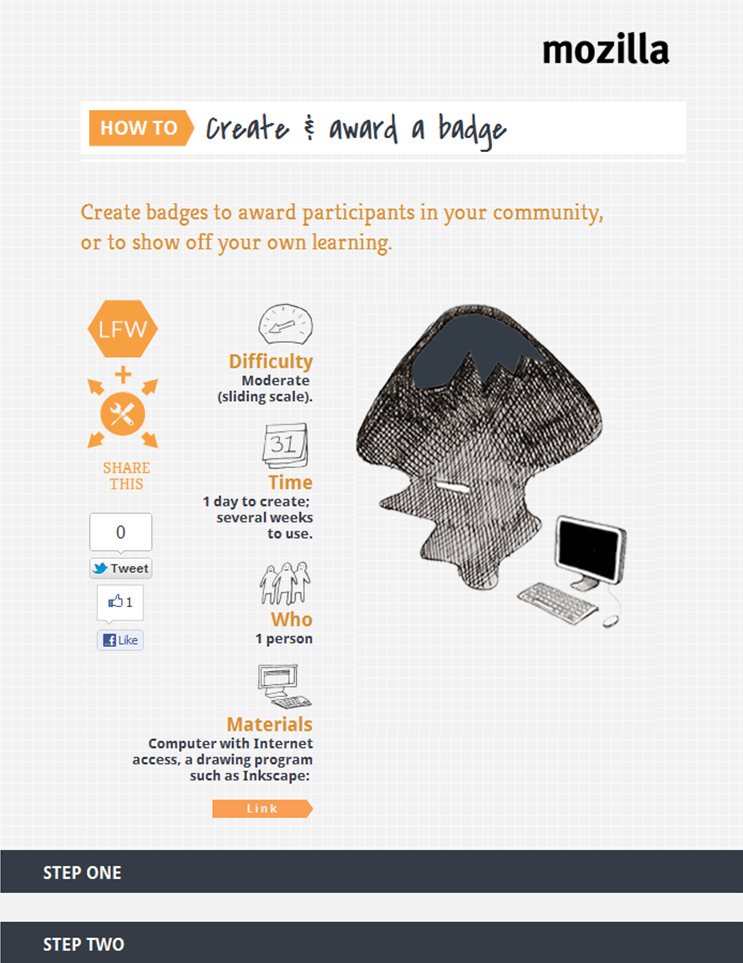
The authors do a nice job of highlighting each topic with a profile of someone who is doing the work, a description of a phenomena (like open content, webcraft, open video, badges …), and then How To exercises. An example of a How To Exercise is:

 The exercise leads you step by step through the process of creating and awarding a badge.

While this is an interesting way of teaching and to some extent learning, it is still one directional. It is not like a Wikipedia where the content becomes a starting point for the community to add to and even transform the content.

In addition, it is not clear what the tool is that produced the Learning document.  So it is hard for others to follow in the footsteps of using the form of this book to discuss other topics.

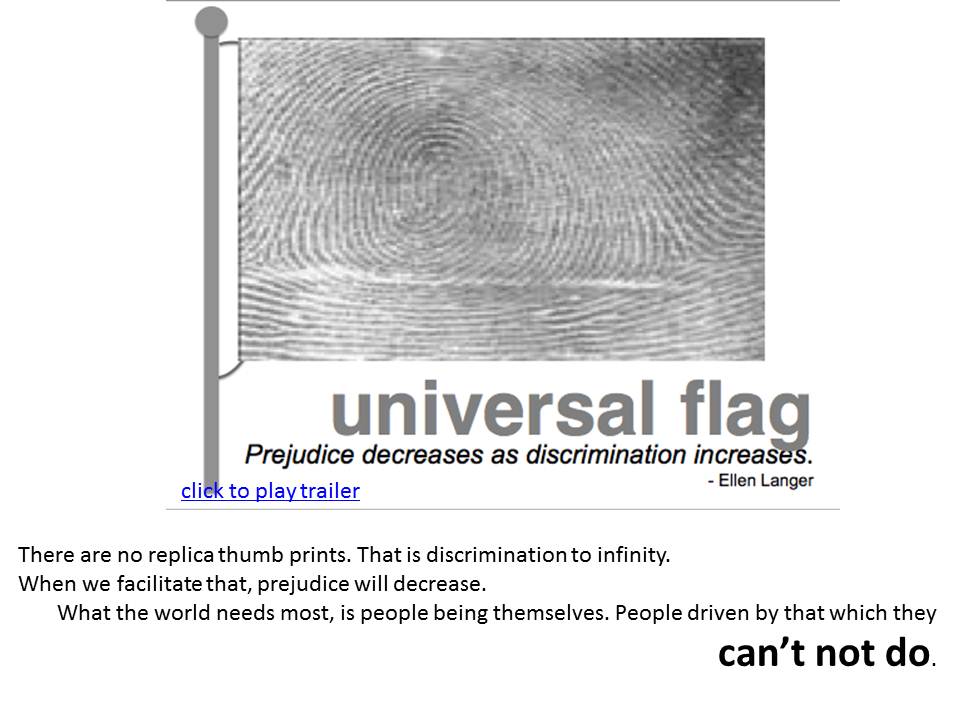
At the other end of the spectrum is an ebook which is a Powerpoint Presentation on A Quiet Revolution: Be YouI recommend starting the journey into this book by viewing the Be You Trailer on YouTube. While it took me quite a while to get to it, even while quickly trying to scan through the slides, I loved the Universal Flag of Be You.

The Be You authors using tools that exist all around us (Powerpoint, Google Docs, YouTube) provide a very compelling story of the journey to Being You. Much like trying to skim through Chris Alexander’s Timeless Way of Building, I kept getting stopped by wonderful FORM and CONTENT. Each time I scan through Timeless, I have to stop and read the section about the simple Japanese fish pond:

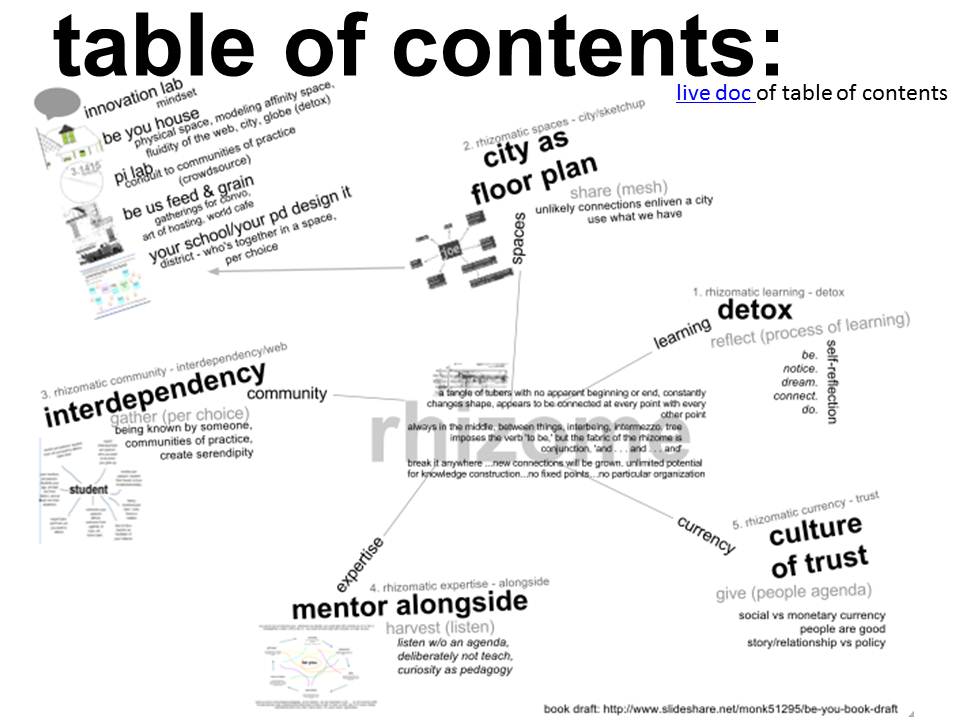
An example of getting sidetracked with Be You, is the Table of Contents which doesn’t show up until Slide 18 and then invites you in by providing a link to the Live Doc table of contents:

As I bounce around the non-linear forms of Learning, Freedom, and the Web and Be You and Wikipedia, I start to see dimly what a non-linear or layered book might look like. The cool thing is that the Be You folks demonstrated that I don’t have to wait for a be all, end all tool.  I can get started now generating the kinds of content I want to share with my students. What blinders I’ve had on thinking that Powerpoint was just a presentation tool.

Go ye forth and create the layered book!

Posted in Content with Context, Curation, Design, ebook, Human Centered Design, Knowledge Management, Learning, Transactive Content, User Experience, WUKID | 1 Comment

Software Practice – A PaineFull Discussion

One of the joys of teaching graduate school is getting to interact with bright young HCDE PhD students. Recently, I’ve been able to spend quality time with Drew Paine, a software engineering graduate of Rose-Hulman Institute of Technology.

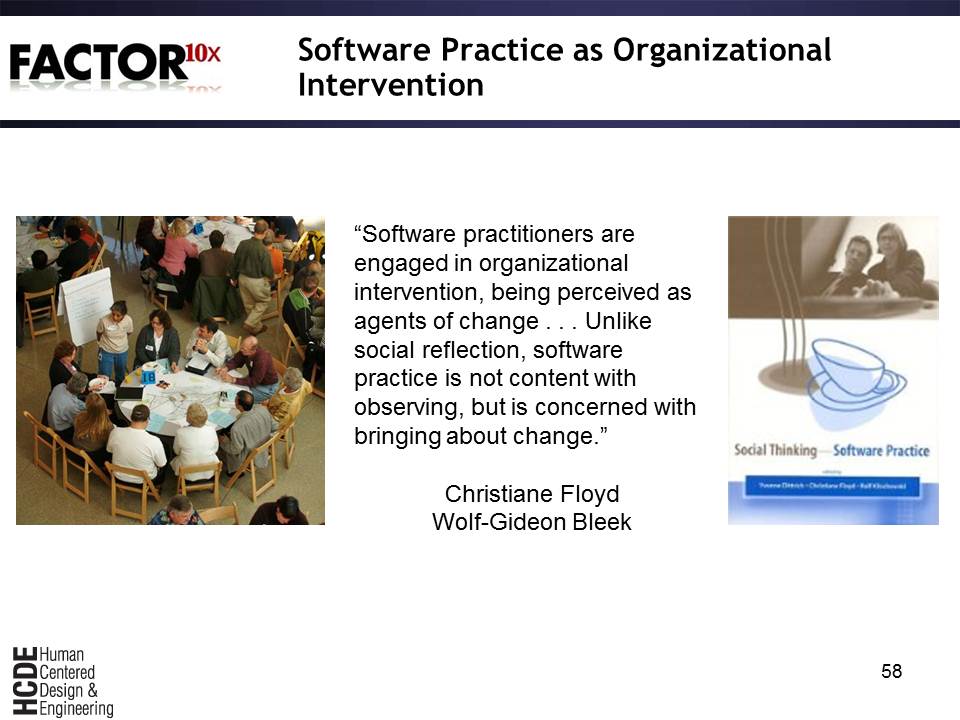
Drew reminded me of the book Social Thinking – Software Practice by Christiane Floyd that was first introduced to me by Wolf-Gideon Bleek when he was on his sabbatical at UW. When reading this book I had my own Chris Alexander existential crisis as I encountered the following paragraph:

David Socha and I wrote about this moment in our paper “Is designing software different from designing other things?” when I realized the missing ingredient in getting my students to do high quality designs:

“Over the course of my career, I (Skip) alternated between line management jobs in software engineering and working as an organizational consultant helping large and small organizations develop visions, missions, strategies and innovative product designs.  In the process of consulting and graduate school teaching, I tried to pass on what I’ve learned about designing successful software products and systems.  While my customers and students generated better designs, they did not generate innovative designs like I’ve accomplished over my career.  I knew there was something missing from my framework of design, but I couldn’t pinpoint it.

“Then I had a Chris Alexander [23] moment while reading Floyd’s article.  Alexander realized that the reason his students weren’t producing great designs is that he left two important aspects out of his Pattern Language – color and asymmetry.  Similarly, I left out of my teaching the foundations of organizational development, change and design.  Yet at least half of the work of every successful product design that I’ve done has included innovative organizational design and interventions.”

Design Patterns: Elements of Reusable Object-Oriented Software was an important breakthrough for the software development community by drawing from the work of Chris Alexander.  However, the gang of five was very myopic as is typical of software developers and they only brought over the most micro level of what Chris had done.  Chris designed from the micro level – how to design a window through many levels to the meta level with how to design a geographic region.  The Software Design Patterns folks stopped at the level of designing a window.

Chris has gone through three stages of evolution in his writing – analysis, synthesis, and the deeper nature of order (the equivalent in the design field of what Watson and Crick did with discovering the structure of DNA).

The key works from Chris Alexander are:

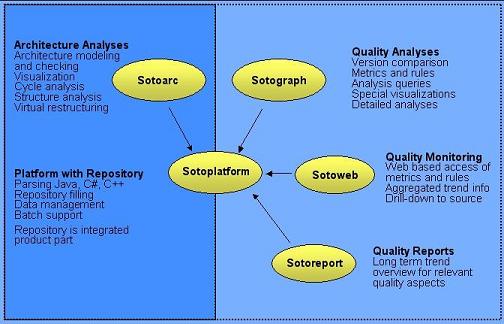
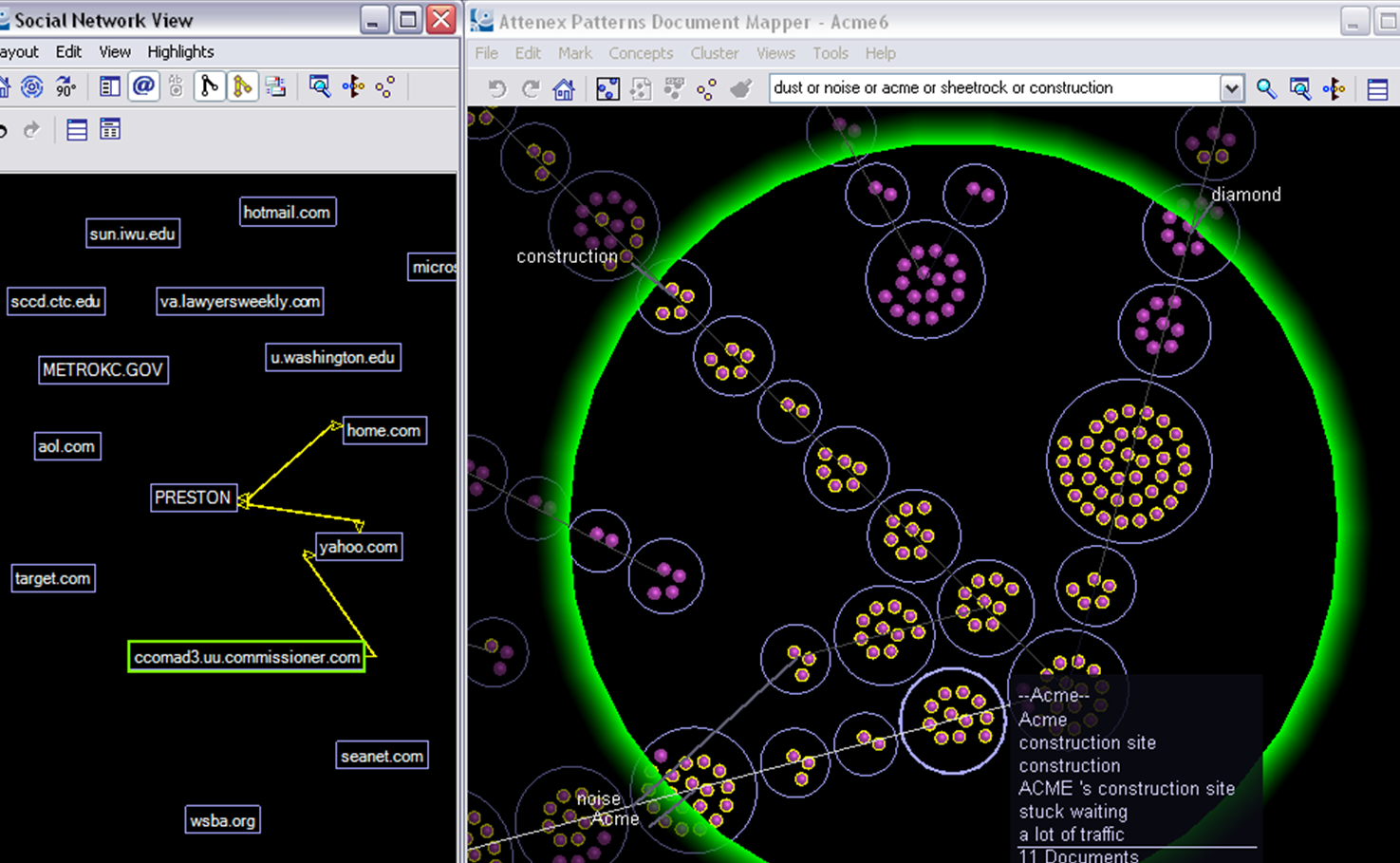
While we were studying Alexander’s work and entertaining Wolf-Gideon Bleek, the topic of the automatic discovery of patterns in software arose.  Bleek pointed us to some work on Software Tomography that his colleagues were working on. I loved the name and the images it conjured up. So we took a look at the software and realized that if we fed software code into Attenex Patterns we could do a much better job than the Sotograph software at finding links.

So I had my wonderful architects, Eric Robinson and John Conwell, spend a couple of days seeing what Attenex Patterns could do. We were amazed at what came out. In a matter of hours we discovered hundreds of bugs that had been in the software for quite a while which were the result of code reuse throughout the hundreds of thousands of lines of code. Yet another innovation we did that never saw the light of day because software development tools were not our target market (tongue very firmly planted in cheek).

As I shared these two different sets of visual analytics tools, I imagined the study of organizational tomography (Attenex Patterns with the visual analytics associated with semantic networks, social networks, event networks, geographic networks and financial transaction networks) and software tomography with the same tool.  Then you can truly see software as an organizational intervention AND all the implications.

This combination of the ability to analyze texts and the ability to analyze the software that is making the digital media come alive is what Kate Hayles in her new book How We Think: Digital Media and Contemporary Technogenesis is trying to envision. Now it is just that small little matter of programming to make it happen.

Thanks Drew Paine, for reminding me of these other threads that need to be a part of the “content with context” tool.


Posted in Content with Context, Design, Human Centered Design, Intellectual Capital, Knowledge Management, Learning, Software Development, Teaching, University, User Experience | 2 Comments