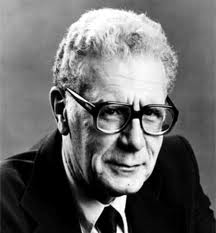
Chris Alexander – Patterns Which are Alive

One of the many challenges of life is how work and living get separated along with the spiritual and play.  I often reflect on how much I am away from home with my business and how little my children got to see of what it meant for me to work.  Chris Alexander expresses this aspect of human nature as he describes patterns which are alive in his book The Timeless Way of Building. 

“The fact is, a person is so far formed by his surrounding, that his state of harmony depends entirely on his harmony with his surroundings.

“Some kinds of physical and social circumstances help a person come to life.  Others make it very difficult.

“For instance, in some towns, the pattern of relationships between workplaces and families helps us to come to life.

“Workshops mix with houses, children run around the places where the work is going on, the members of the family help in the work, the family may possibly eat lunch together, or eat lunch together with the people who are working there.

“The fact that family and play are part of one continuous stream, helps nourish everyone.  Children see how work happens, they learn what it is that makes the adult world function, they get an overall coherent view of things; men are able to connect the possibility of play and laughter, and attention to children, without having to separate them sharply in their minds, from work.  Men and women are able to work, and to pay attention to their families more or less equally, as they wish to; love and work are connected, able to be one, understood and felt as coherent by the people who are living there.

“In other towns where work and family life are physically separate, people are harassed by inner conflicts which they can’t escape.

“A man wants to live in his work and he wants to be close to his family; but in a town where work and family are physically separate, he is forced to make impossible choices among these desires.  He is exposed to the greatest emotional pressure from his family, at that moment when he is most tired—when he just comes home from work.  He is confused by a subtle identification of his wife and children with “leisure,” “weekends,” and hence not the daily stuff of life.

“A woman wants to be a loving woman, sustaining to her children;  and also to take part in the outer business of the world; to have relationships with “what is going on.”  But, in a town where work and family are completely separate, she is forced to make another impossible choice.  She either has to become a stereotyped “housewife,” or a stereotyped masculine “working woman.”  The possibility of both realizing her feminine nature, and also having a place in the world beyond her family, is all but lost to her.  A young boy wants to be close to his family, and to understand the workings of the world and to explore them.  But, in a town where work and family are separated, he, too, is forced to make impossible choices.  He has to choose to be either loving to his family, or to be a truant who can experience the world.  There is no way he can reconcile his two opposing needs; and he is likely to end up either as a juvenile delinquent, who has torn himself entirely from his family’s love, or as a child who clings too tightly to his mother’s skirts.”

Posted in Content with Context, Human Centered Design, Nature, Quotes | Leave a comment

Russ Ackoff – The Aesthetics of Work

While working with Russ Ackoff, he noticed that the company that we were working with at the time – Digital Equipment Corporation (DEC) – seemed to be stuck in OK performance, but not exciting performance.  He pointed me to one of his unpublished essays on the aesthetics of work that later became published in his book Management in Small Doses.  While we were not able to change all of DEC, we took these ideals to heart to improve the performance of our own group.

From Management in Small Doses:

“Ancient Greek philosophers identified three ideals—truth, the good, and beauty—the pursuit of which they belived was necessary for progress and development.  Modern man has added a fourth—plenty or abundance.

“Science is dedicated to the pursuit of truth, and technology to its application; ethics and morality, to the pursuit of the good; aesthetics, to beauty; and economics to plenty.

“These pursuits are relevant to management.  Management science, business ethics and morality, and managerial economics are subjects that are familiar to managers.  But what about the aesthetics of work or management?  What in the world does that mean?  It is not surprising that the answer to this question is not apparent because the aesthetician has been the “odd man out” for a very long time.

“Although most people believe that we have made a great deal of scientific and economic progress and some believe that at least some ethical and moral progress has been made, few believe that there has been any aesthetic progress.  We seem neither to produce more beauty nor to appreciate beauty more than preceding generations.

“Aesthetics is the least understood aspect of progress and development.  Little wonder, then, that most managers have no idea of its relevance to their work and that of others.

“Aesthetics is related to two things: recreation and creation.  Recreation is activity that refreshes one’s mind and body, activity from which immediate satisfaction is derived, regardless of its outcome or consequences.  It is intrinsically valuable; this means that its value lies in the fun and enjoyment we get out of it.  To the extent that managing is fun and enjoyable, it has aesthetic value.

“The creative aspect of aesthetics is reflected in the sense one can have of getting somewhere, of developing.  It is this sense of progress that endows human activity with extrinisic value and makes it meaningful.  Beauty inspires, produces visions of possible progress, and encourages the pusuit of these visions, whatever short-run sacrifices are required.  Therefore, it motivates us to pursue development, to pursue progress.  Recreation provides refreshing pauses in the pursuit of progress and makes the pursuit itself a satisfaction.

“The currently growing concern with quality of life, in general and work life in particular is a matter of aesthetics.  To improve the quality of life or work life is to increase the (recreational) satisfaction derived from what we do, whatever we do it for, and the (creative) satisfaction derived from making progress toward our ideals.

“A few years ago the CEO of a very successful corporation asked me to look around his organization for any serious problems that were being overlooked.  I spent several months traveling on reconnaissance.  When I reported back to the CEO I told him there was one overriding problem that required attention:  many of the company’s employees, especially its managers, were not enjoying their work, thought it was unimportant, and had little sense of personal progress.  As a result, their efficiency and effectiveness were deteriorating.  The company was aesthetically deficient.

“After some discussion of what might be done about it the CEO authorized an effort to improve the aesthetics of work.  A participatively designed quality-of-work-life program for all employees was initiated and eventually succeeded.

“Work that is neither fun nor meaningful is not worth doing well, no matter how much one is paid to do it.”

Posted in Content with Context, Russ Ackoff, User Experience, WUKID | 6 Comments

Japan Study Mission – A Learning Intensive Model

In the late 1980s I had the good fortune to participate in a Japan Study Mission while at Digital Equipment Corporation (now Compaq which became HP).  This activity was a great example in several areas of process innovation and adult learning:

  • A new way to provide experiential learning in a collaborative community
  • Direct observation and benchmarking of the world’s best at Just In Time (JIT) Manufacturing and Total Quality Control (TQC)
  • Implementation of learning and the virtuous learning cycle

The VAX systems manufacturing group had just finished a long five years of implementing MRP II and DRP II throughout fifteen manufacturing plants located throughout the world.  The leaders of that effort were asked to take on the challenge of implementing JIT and TQC.  They knew they couldn’t do the same process because it took too long and didn’t achieve the results that they had hoped for.  So in desperation they turned to a consultant for help who recommended going to benchmark the best of the best.

A group of 20 professionals from the manufacturing, sales, information services, and software services organizations were selected for the first trip.  In the two months prior to the three week visit to Japan, the individuals were loaded up with 10 books and about 50 articles to read and absorb.  In parallel, the leaders and consultants developed an outline of topics to benchmark and observe on the trip.  All of the participants met in Seattle for a day and a half to review the study materials, get to know each other, and develop study teams to augment the study guide and further develop the questions to ask to get to the information that was sought.

The group then traveled to Japan for an intense three weeks of plant visits and cultural experiences.  A typical day would involve two plant visits of manufacturers that ranged from a sewing machine manufacturer to Sony, Canon, Ricoh, Toshiba, Matsushita, Honda, and Nissan.  Each day would start with an overview of the plants we were to visit and specific learning objectives for those plants.  On the bus to the plants we would break into study groups that focused on topics ranging from plant finances to information systems to quality processes and inventory control processes.  We would review and capture what we learned the previous day and would develop questions that we would want answered on the visits for that day.

At each plant site we would have a set of formal presentations where we would present what we were there to learn and the plant personnel would give an overview of their operation and the products that they produced.  We then would take a walking tour of the facility where we could gain informal access to our hosts.  At the conclusion of the walking tour we would then gather back in the conference room for additional Q&A and our formal goodbyes.  We all quickly learned that the best sources of information came from the guides on our walk throughs of the plants.  The guides were typically educated in the US, spoke excellent English and were very forthcoming about what we were seeing.  When we were in the conference room however, these same people were so low on the totem pole that they were the ones serving coffee and refreshments.

On the bus at the end of each plant visit, we would pass a microphone around and each of us would give a short summary of what we saw that day that we expected to see and what we didn’t see that we expected to see.  Most of us learned the most from what we didn’t see that we expected to see.

Gregory Bateson – The difference that makes a difference

In his many contributions to the field of cybernetics, Bateson introduced the notion of “the difference that makes a meaningful difference.”  So much of the previous work in cybernetics focused on just noticeable differences and Bateson always wanted to get at the essence of what makes each “system” unique and operate as a system.  When used in a facilitated way, the “difference that makes a difference” is a powerful way to prioritize what is the one thing to do that if we get it right will move us the farthest in the direction of our intentions.

A powerful example of the Bateson question occurred on a Japan Study Mission I participated in while at Digital equipment.

From my own personal experience, the most powerful example of the difference that makes a difference can be summed up in the following story that summarized the end of a three week study mission by 20 manufacturing professionals touring the best Japanese corporations that had implemented Just-In-Time Manufacturing and Total Quality Control:

At the end of the three weeks, we gathered for a day long seminar to summarize the learning of the previous three weeks and all the reading we did before the trip.   We must have come up with over 500 ways that we could improve our plants back in the US.  Then the consultant really earned his keep.   He asked us to reflect on all that we’d seen and then to pick the single difference that would make the biggest difference back in our own plant.  He went on to explain that the typical US manager will come up with 100 ideas and try and implement them all at once, accomplishing very little.   The Japanese manager will select one idea, implement it, achieve significant results and then move to the second item on the list.

The Burlington Vermont management team whose plant produced the largest VAX computers took this advice to heart and realized that the single biggest difference between their plant and all the plants that we’d viewed on this visit was cleanliness.   Their plant was a relative pig pen compared to the Japanese facilities.  So they came back to the US and gave a presentation to all three shifts at the plant about the Japan Study Mission and set a goal to get the plant cleaned up.    It took a week on all three shifts to get the plant cleaned up.  Then they ran into their first big surprise.   It took them an additional three weeks to figure out how to keep the plant clean.  They had to back into every process and work with some of their suppliers to keep the plant clean.

No one was prepared for the second surprise.  As a result of getting AND keeping the plant clean, the operation generated a one time $150 million benefit to DEC’s bottom line by increasing their inventory turns from 5 to over 12.   Many internal consultants tried for years to increase throughput as evidenced by inventory turns and had not had any positive effect. These efforts included large amounts of Artificial Intelligence technology.   Then they hit their third surprise – their quality improved by over 300%.  They were no longer damaging parts by moving things to find work in process inventory and every part stayed in the plant for only a short period of time.

A three week study mission which cost the company less than $300,000 had returned more than $150 million.  Now that’s process innovation.

All of this improvement was a result of asking the simple question “What is the single difference that will make the biggest difference?”

Communicating the Value of the Japan Study Mission

At the end of the mission, we gathered in a Tokyo hotel for two days of analyzing and synthesizing what we had learned.  One of the challenges was to figure out how to communicate to other professionals in our organizations what we had learned.  After a wonderful celebratory dinner, we got up the next morning to summarize and put together a communication summary of our learnings.  The following is from my journal of the three week study mission.

The Last Day

It was real tough to get up this morning. The dinner last night was a gracious finale. The drinks afterwards in Mike’s room were a letting down of our hair after the formality of the dinner. But I gotta get up early to get the damn bags packed and to do my presentation.

I had run my mouth yesterday afternoon in a conversation with Steve and Susan. Somebody needed to give a summary presentation on what we had learned about Human Relations in the two weeks. Since Susan wasn’t going to be there in the morning, she asked if Steve or I would give it. I volunteered by saying “I’ll be happy to. Somebody has got to do a right brain presentation sooner or later. I’m tired of these bulletted lists of facts.”

Those were fighting words for Steve, “What do you mean right brain presentation?”

“Pictures. Man. Pictures,” I rattled back. “I am so tired of these two weeks with this crew of twenty terminal analytics doing nothing but provide lists and lists and lists of facts. A picture is worth 50,000 of those kinds of words.”

Steve wasn’t buying it.  “Look I’ll make you a bet,” I proposed. “You go back and put together a summary presentation for the two weeks however you would normally do it. And I’ll do the same.  I’ll bet you whatever you want to bet, that my presentation will be remembered and yours won’t. ”

Looking at Steve I had clearly stepped over the lines of decency. I was in one of my seldom right, but never in doubt modes.   So I changed the proposition, “Look I’ve watched you the last several weeks and you are superb at sifting through a lot of data and getting at what is relevant and then listing it out. I’m terrible at that. But what I am really good at is taking a sifted list and putting it into a picture that will be remembered. If you are willing, let’s work together on the presentation. You do the sifting, and I’ll do the picture.”

“Now, you’ve got a deal,” replied Steve quite eagerly. “I’ll get the list to you tonite.”

I wasn’t quite sure what form the picture would take but I knew that it had something to do with the triangle, circle and square theme. So I suggested to Steve, “I still don’t have a good picture in mind, but I’m pretty sure it is going to be organized in threes. See if there is a natural breakdown of the material into threes.”

Off he went. I then turned to Susan and did a little brainstorming with her on what the picture might look like. She suggested that somehow the picture should reflect the uncertainty of the new generation of Japanese who didn’t seem to be conforming as well to the old.  Click.  I know just the thing. I’ll relate it back to our Japan cultural consultant showing us the crack in the piece of China. I had gotten as far as my creative juices were going to take me. I had also backed myself into a creative corner.

At dinner Steve gave me a one sheet summary of the last two weeks of human resources observations.  His work was impeccable.  Now all I needed was the picture. After sleeping on it, the last puzzle piece fell into place. Mt. Fuji would be the triangle. Talk about symbolism all over the place. Now my only concern was had I outsmarted myself by being clever too far.

After scrambling to get all my packing done and get a call in to the States, it was time to go to the annex for our last official study group meeting. It was a little sad this morning because all three of the Burlington contingent, John, Zach, and Susan had already left. We started the session off by going around the room with each of us relating what the trip had meant to us personally. Emotions were pretty strong this morning; none of us really wanted this learning experience to end. But most importantly, we didn’t want to lose the close associations that had formed over the three weeks. Tears were the order of the day for several of us, and tight chests made it real difficult for each of us to speak when it was our turn.

I wanted so badly to let each study mission participant know how much I had grown and learned on the trip. For me most of that learning was the result of the interactions with the group surrounding me. The exposure to the Japanese companies provided the screen on which the movie we created could play, but it was this group and their willingness to share that was the heart of the experiential learning.

Steve was up first with his summary of what we could bring back to the states and apply directly, that is, what were the advantages that we had that we need to ensure that we keep.

Finally it was my turn. I was the last one. Somehow I think Steve managed to make sure that I was last, hoping that I could summarize all of the trip not just the Human Relations.

No matter how much I tried to take deep breaths to calm myself down, I was shaking like a leaf. You would think that after all these years of public speaking that I could control my nerves a lot better. No such luck. Today was especially difficult because I wanted to touch to the core of what the visit to Japan had meant to me and to be able to share with these new friends something other than words.

I looked out: paused for a few seconds; took a deep breath and started tentatively. “Whenever I take a trip, I always take several books with me. I never conciously stop to think whether the books have something to do with the trip. I just need something to occupy the plane flights and those hours in the hotel room when I can’t sleep.  I’d like to share with you a short excerpt from one of those books. I couldn’t believe how apropos it is to this group, at this time and in this place.”

I then read this excerpt from Edward T. Hall’s The Silent Language:

“Culture hides much more than it reveals, and#.strangely enough what It hides, it hides most effectively from its own participants. Years of study have convinced me that the real job is not to understand foreign culture but to understand our own. I am also convinced that all that one ever gets from studying foreign culture is a token understanding.”

“The ultimate reason for such study is to learn more about how one’s own system works. The best reason for exposing oneself to foreign ways is to generate a sense of
vitality and awareness – an interest in life which can come only when one lives through
the shock of contrast and difference.”

I tried to look up several times during the reading, but I couldn’t. I was shaking and so hoping that it would be accepted. After finishing, I looked out and the expressions were so heartwarming I wanted to just sit there and bask in the reflections. Several people started at once, “Read that again so we can copy it down!” “That summarizes so well what we have just been through, where did you get it?”

I waited and then said “I’ll finish up with this at the end and I’ll make sure I include it in the journal.”

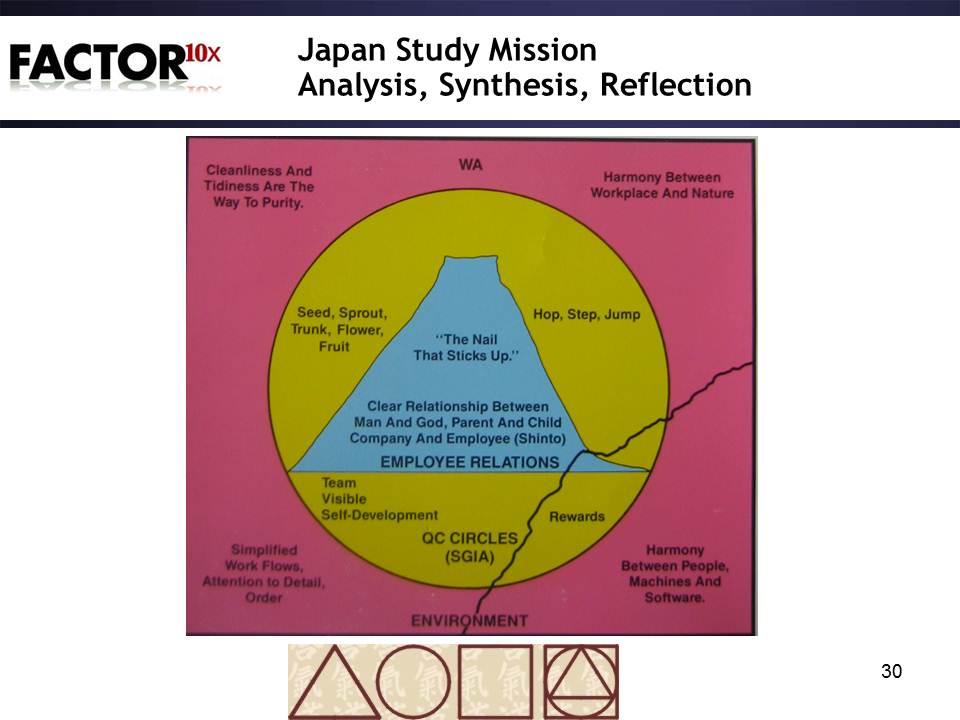
I then put up the first overhead. Starting from the center and working outward, “Just as Mt. Fuji is the center and focal point for the Japanese geography, employee relations are at the center of Japanese corporations. Surrounding this focus is the workgroup itself sometimes called Quality Circles and sometimes called SGIA. Yet, just as people are important, so is the environment that exists within the plant, and within the Japanese homeland.”
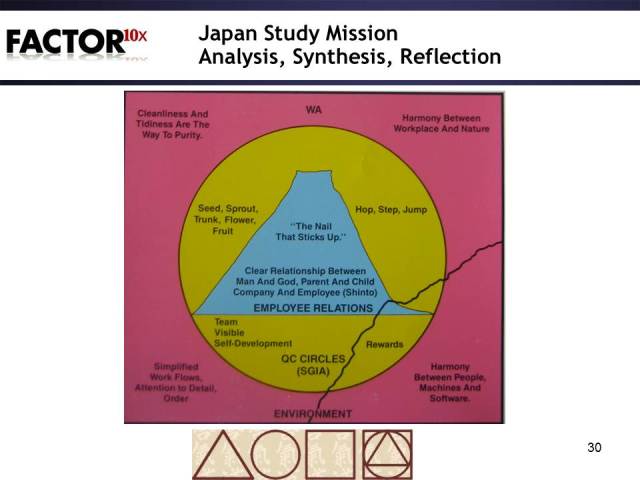
“But I think the key word for me as I reflected on the last several weeks was one that Ken mentioned when we first met – ‘sometimes’.”  I added: “As I think about the plants that we have visited, the geographies that we have toured, I see a lot of contradictions and differences. There is certainly nothing black and white like I expected before I came over.”

I then positioned an overlay on top of the previous transparency. “If we look at the next level of observations,” I went on, “we see some very appropriate summary statements. At the heart of Employee Relations is ‘the nail that sticks up gets pounded down.’ We saw that everywhere we went, that the individual is subservient to the group. But what wasn’t so obvious until after the weekend at the Shinto Shrine and then seeing Brother Industries is that for each individual worker there is a clear relationship between God and man, between employer and employee, and between parent and child. What really struck me with full force is the congruence between these three relationships, that they are all viewed as the same and that the relationship is buried deep in the cultural belief system.”

“As we move outward to the role of the group within the corporation we see the symbols for long term investment for long term growth – the seed, sprout, trunk, flower, and fruit. The Japanese have brought the mentality of the citrus farmer to the corporate world – what I plant today will be harvested in ten years. The Hop, Step and Jump of the Quality Circles at Brother were correlated with the physical life, lifetrend, and life mission of the Shinto value system. Finally, we see the reward system and how it intertwines with the focus on the team, on visible recognition, and the need for self-development to help one’s team members, a self-development that will lead to greater group glory.”

“Where does this path and journey to self-development lead?” I asked rhetorically. “To Wa, to group harmony. Harmony between the workplace and nature. Harmony between people, machines and software. This harmony starts with a value system that embraces cleanliness and tidiness as a symbol of purity. This value leads to the simplification of work flows. to the attention to detail, to an orderliness.”

“Yet, within this vision and embracement of cultural values also lies a firm grip on current reality,” I continued. “‘Brother Industries expressed it quite well. A period of steady equilibrium has replaced the era of high growth. Quality over quantity. The New Realism.”

As I got ready to turn off the overhead projector, someone asked what the jagged line was running through the right side of the picture. Now I knew I was losing it. How could I possibly forget that? “Thanks for the prompt,” I acknowledged. “The jagged line is symbolic of a rent in the fabric of the Japanese culture. We have heard from several sources these last several weeks of the discontent amongst the current generation of merely accepting previous ways. Work may not be the dominant drive of the future, like the past. Concern with family is becoming very important to young Japanese. And this culture really hasn’t embraced a meaningful role for women. Also as the pressures mount from the outside world to open up what is perceived as a closed culture and market, we don’t know what effects that will have.”

One of our study books had an observation about this situation: “It was entirely obvious that Father Pittau deplored this cast of mind and that he attributed it at least in part to the changed atmosphere of the Japanese home. ‘So far,’ he said a bit grimly, “companies and government agencies have been able to take these youngsters and reshape them, giving them the traditional social formation in which loyalty to one’s company or ministry is paramount. But already it’s not so easy as it used to be to instill a spirit of service in young people in this country. And it could get harder and harder.” The Japanese Mind p. 137.

“So the jagged line represents the crack that I see in the superb Japanese economic machine,” I observed. “The question is will the machine break apart or will it be like the piece of china that Jean Pearce showed us two weeks ago and the crack will be covered in gold as the Japanese adapt to this New Reality.”

“It is easy to create a cultural change when there is a crisis, but how do you keep it going when affluence or the overriding vision is achieved? Since the Meiji restoration in 1868, Japan has used the industrial countries in the West as a model for its vision. It has now reached that vision. What does Japan do now to create a new vision to carry forward? Will Japan focus on quality of life with a unique combination of eastern and western philosophies or will Japan slide backwards?” I finished.

If communications are the results that you get, all I had to do was look at the faces in the room to know that I had shared a piece of me with a group of the greatest professionals in the world. Thanks for letting me share this journey with all of you.

As a final gift, I offer a summary of the trip in the form of a brief poem:

Impressions of Japan

Sameness. It’s OK. I can survive.
Difference. I’m not alike. I will thrive.
Spread out. Flat. Hazy.
Grace to graciousness.
Chopsticks – a silent, gentle, natural dinner companion.
Clean. Slow. Fast.
Wa – the synergistic harmony.
The nail that sticks uP
GETS POUNDED DOWn
God and Man
Parent and Child
Company and Employee
Here and Now
Nature. The garden – holistic view, narrow focus.
Elegance through simplicity:
By movement
By set menu
By flowing production
Discipline.
Triangle. Circle. Square.
Just in Timeliness
“Herro, cutie pie.”
“Been in Japan long?”
Rhythm. Incense. Water to smoke to purify.
Form and function integrated.
Both – And: not Either – Or. Together.
We need each other!

Posted in Knowledge Management, Learning, organizing, social networking, Value Capture, Working in teams, WUKID | 2 Comments

Making Intangible Assets Tangible

In 2008, Paul D’Antilio, CEO of Future Point Systems called to see if I would be interested in  consulting with his company about visual analytics.  He had recently become the CEO and knew that we’d been successful commercializing a visual analytics product in Attenex Patterns (acquired by FTI Consulting).  As it turned out when he called I was in Palo Alto, helping my daughter Elizabeth move to Stanford University to start her post doctoral research in cognitive psychology.

We agreed to meet on a hot Bay Area Saturday morning at the Future Point offices in San Mateo, CA.  As our discussion ensued it turns out he’d had a very successful career in software product development and was part of the development team at State Street Bank that had developed the mortgage backed securities and received one of the first software patents.

As I presented the Attenex Patterns story and did a brief demo and shared how we’d used the tool in electronic discovery and patent analytics, Paul suddenly stood up and said “this is really interesting.  When we did the mortgage backed securities at State Street Bank we were essentially taking a tangible asset and making it intangible and then trading it.  What you are talking about is taking intangible assets like patents and making them tangible enough so that they can be traded.  It’s the mirror image of what I’ve spent my career working on.”

I stared at Paul for a moment as the thought of making intangible things tangible rolled around in my brain.  I jumped up and exclaimed “You have the other half of the knowledge I didn’t know I’d been looking for the last ten years.  You understand the valuing transforms back and forth between tangible and intangible assets.”

We both knew in that moment that we’d discovered something important, but we didn’t know what to do with it.  Paul realized that while it was a potentially big idea he had more urgent topics to deal with.  So I agreed to consult with him at Future Point and see what we could do with the PNNL Starlight technology.

After a few months we realized that there was not enough capital at Future Point to generate new product lines so we parted ways.  However, the notion of making the intangible tangible enough to be identified, valued, monetized and traded is ever present in my thoughts.

Over the last two hundred years, great wealth resulted from the systematic identification and monetization of new asset classes.  The financial services industry has profited from taking tangible assets like mortgages and turning them into intangible assets that can be traded.  In the music industry, David Bowie was the first artist to bundle together his future “hits” into a monetizable asset.

In the wine industry, Joe Ciatti put together a REIT to invest in winemaking properties that raised a large fund, but ultimately failed at the execution level.  In a different arena, Intellectual Ventures had raised billions of dollars to monetize patents rather than go through the long process of litigation.  At the micro level, fine wineries are having difficulty monetizing their customer assets due to the difficulty of marketing their authentic differences and their lack of better business models and processes.  Inventors face the same difficulties of matching their inventions to customers (enterprises or consumers) who could monetize their ideas.

In the electronic discovery market, no lawyers, developers or suppliers view the problem as identifying the few “assets” in the millions of documents that will prove or disprove their case.  Yet, each large scale complex matter is an exercise in systematically identifying the key document assets and then “monetizing” them by winning the case.

The central observations about large scale customer problems are:

  • The difficulty of recognizing a new asset class soon enough to create a market for it
  • The focus of asset developers are to create an asset rather than on how that asset can be marketed and sold
  • Few industries create “brokers” to trade bundles of assets until the industry matures.

The experiences of using clustering and classifying mathematics in problems as diverse as mortgage backed securities, legal electronic discovery, patent brokering and licensing, and creating customers for life with biodynamic wineries suggests that there is a common solution to a diverse range of market problems that asset class monetization technology proposes to solve.

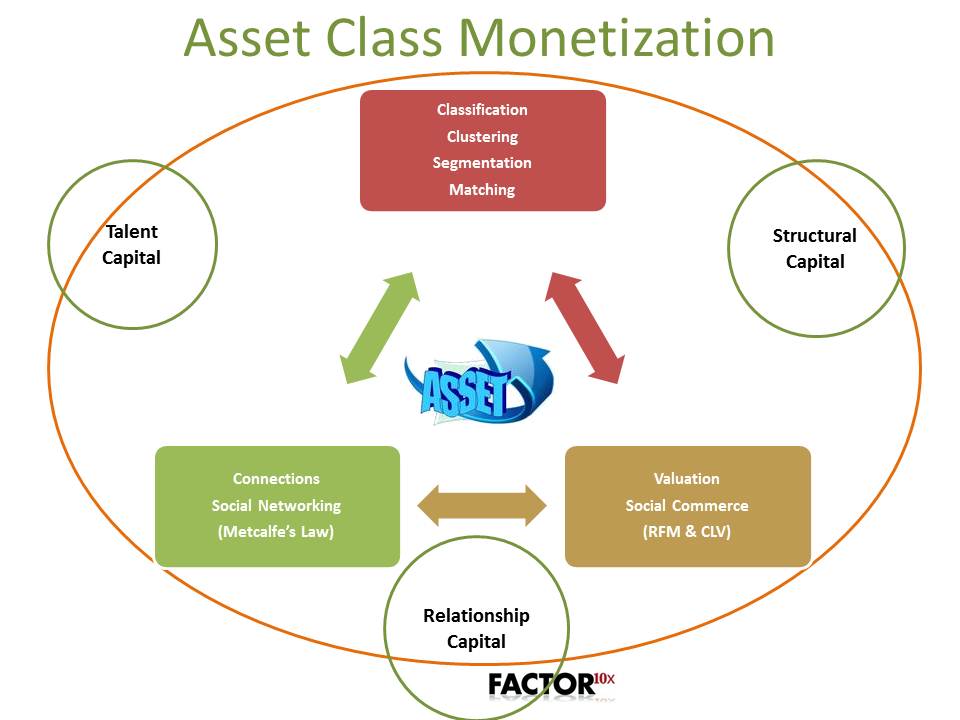
The following diagram captures my current thinking on Asset Class Monetization.

Asset Class Identification

At the core of the model is identifying new asset classes that are not yet recognized as being tradable and for which no “market” exists and no transparent information about the market exists.  Clues to these asset classes are the difficulty in selling the asset or placing a value on the asset.  Broad examples of difficult asset classes to value and sell are:  patents, enterprise software from new startups, and the selling of a startup for an exit opportunity.

An example is the valuation and selling process for a biodynamic winery.  Recently, a Southern Oregon Winery went through an assessment process to value their holdings after four years as a precursor to taking investment for expansion or sale.  They required four different types of assessors (property, equipment valuation, agricultural value assessment, and quality and volume of the wine inventory) and financial experts.  This assessment was time consuming (six months from start to finish), expensive, and not very accurate.

The above assessment is further complicated by trying to assess the value add (or lack thereof) of the certified biodynamic component of the property.  Is this a short term cachet or with the advent of a growing appreciation for authentic fine wine growing that represents the specificity of the place (terroir) and the accompanying slow food movement is this a long term trend?

While a little more advanced in its evolution, the patent market appears to be moving from a very difficult arena to monetize using litigation or the very expensive sale process of licensing to the attempt to create a market.  Intellectual Ventures and Ocean Tomo are at the forefront of trying to create a market, but their efforts have been primarily aimed at acquiring patent assets or creating an auction for those assets.  Little effort is spent at understanding how to value the assets and create a transparent information structure around those assets (like a Morningstar for patents).  As a result, Intellectual Ventures is having a far harder time in licensing their patents than in acquiring them.

Classification, Clustering, Segmentation and Matching

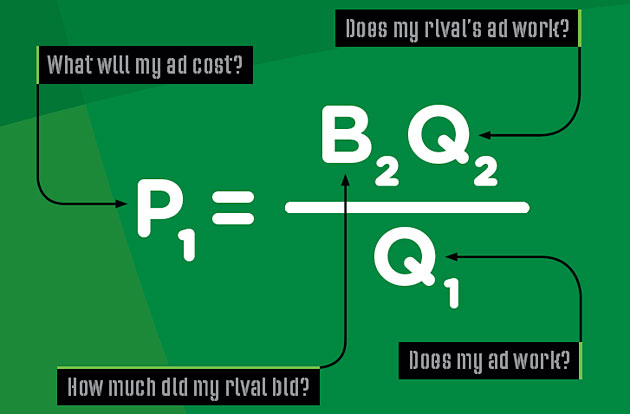
Once an asset class is identified, sense must be made of the collection of assets.  In most cases with complex assets, this process is expensive and highly dependent on experts.  With the large scale adoption of the Internet, this process is now becoming routine, mathematical, automatic and highly scalable.  Google Adwords and Adsense are great examples of both the power of the mathematics and on the ability to monetize the mathematics.  Wired Magazine had an excellent article on “Googlenomics” showing how Google monetizes content through massive mathematics.

Recent book length treatments of the processes, techniques and tools for classification, clustering, segmentation and matching are:

Redman describes the power of being data driven:

“I find looking at an organization through the data and information lens to be extremely powerful.  To do so, one examines the movement and management of data and information as they wind their way across the organization.  The lens reveals who touches them, how people and processes use them to add value, how they change, the politics surrounding seemingly mundane issues such as data sharing, how the data come to be fouled up, what happens when they are wrong and so forth.”

Data and information are most valuable when they are flying from place to place.”

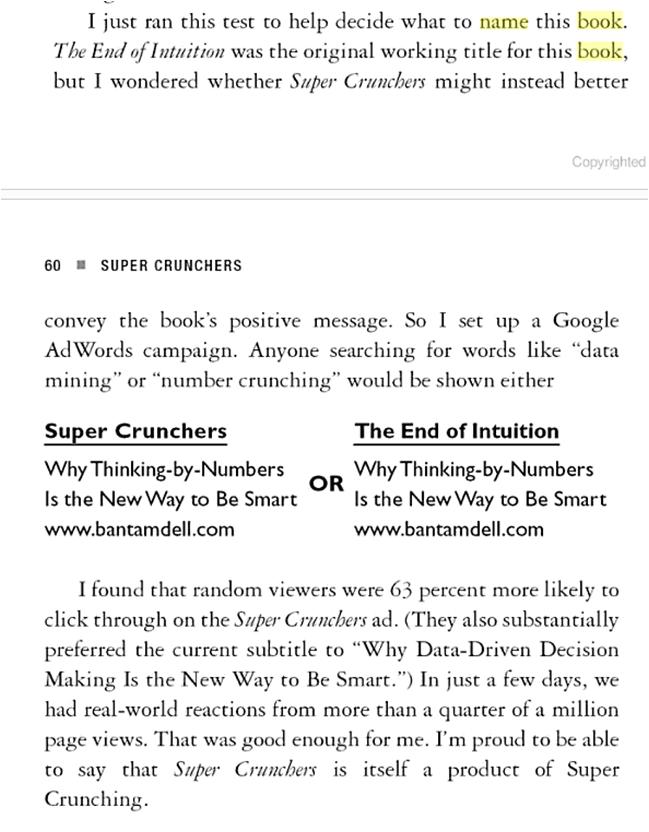
Ayres described how he used Google’s Adwords to come up with the book title Super Crunchers.  For a fee of $100 in Adwords he saved himself the $50,000 of consulting fees to name the book:

Connections

The value of an asset grows as there are more connections to that asset.  Whether we are talking about a product with a high sales volume, or a webpage on the Internet (Google Page Rank algorithm), the number of connections to an asset grows the value of that asset exponentially (see Metcalfe’s Law as described in Unleashing the Killer App:  Digital Strategies for Market Dominance by Larry Downes and Chunka Mui).

Daniel Andriessen in Making Sense of Intellectual Capital:  Designing a Method for the Valuation of Intangibles points out that the value of the three types of intellectual capital – human capital, structural capital and relationship capital (customers, suppliers, infuencers) – is dependent on the number of cross connections between the types of capital.  However, today this process of connecting is primarily a manual and high expertise process.

A key enterprise problem when it comes to connections and social commerce is Return on Research.  A.G. Lafley at Proctor and Gamble made a dramatic turnaround from <5% Return on Research to >50% Return on Research by creatively outsourcing innovation through a process of Open Innovation.  The process is described in The Game-Changer:  How you can Drive Revenue and Profit Growth with Innovation.  The result of this process led to several startups which include innocentive.com, yet2.com, and mynextcareer.com.

Valuation and Social Commerce

Once an asset is categorized and connections expanded, the challenge is to value and price the asset.  Once the asset is priced, then buyers and sellers must be matched.  The mechanism for providing the matching is through the “wisdom of crowds”, crowd sourcing and social commerce.

Social commerce is a subset of Electronic commerce in which the active participation of customers and their personal relationships are at the forefront. The main element is the involvement of a customer in the marketing of products being sold. e.g. recommendations and comments from customers. This happens for example when customers publish weblogs with their shopping lists.

Making the Identified Assets Tangible

I’ve been enamored with Intellectual Capital (IC) since reading several books on the topic by Leif Edvinson, Karl Sveiby, and Tom Stewart (while he was at Fortune Magazine and before he became editor of the Harvard Business Review).  The basic question these authors asked and that Leif Edvinson implemented at Skandia Insurance Companies was how to find a financial set of metrics that worked for knowledge based companies.  Traditional finances don’t take into account the difference between a company’s book value (traditional finance) and its stock price (the realm of intellectual capital).

However, the major problem as identified in the book Making Sense of Intellectual Capital:  Designing a Method for the Valuation of Intangibles by Daniel Andriessen is that valuing the IC of a company the size of Skandia takes 50 KPMG accountants approximately 3-6 months of subjective interviews and wild guesses.  Thus, the real value is completely out of date long before the accounting engagement is over.

Ijiri in his academic articles on Triple Entry Bookeeping (momentum accounting) tries to get at the same kinds of metrics but his ideas have never taken off.

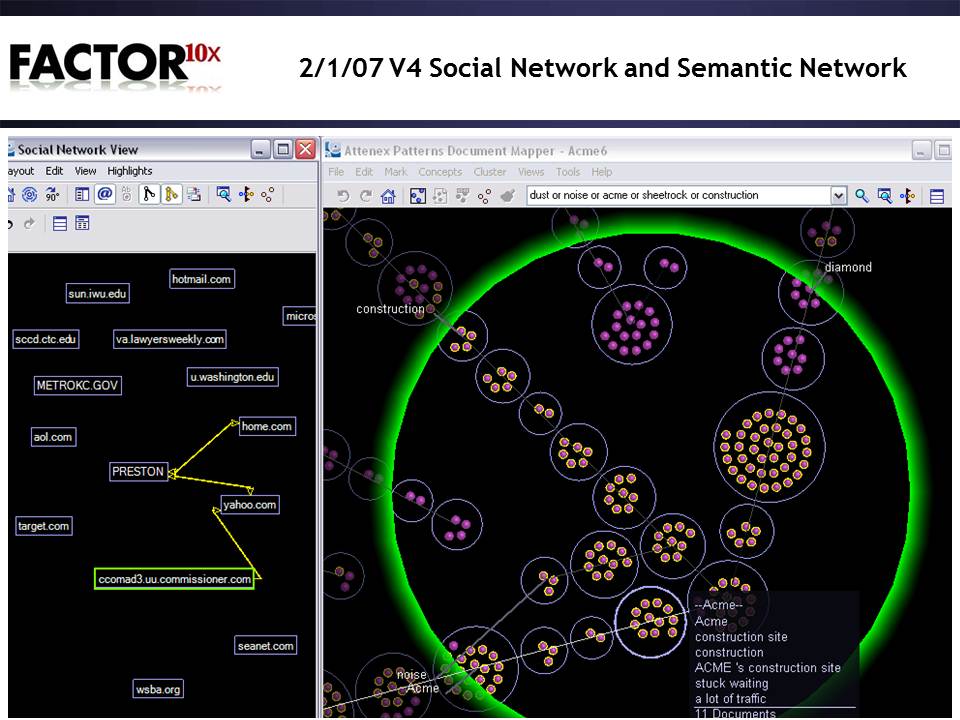
All of these thoughts and the study of IC were swirling through my head while we were developing Attenex Patterns and were automatically able to do the content analytics and visual analytics to look at the digital detritus of a company in the form of their email and documents on PCs and servers.   The following slide shows a recent version of Attenex Patterns illustrating the social network view (in this case the company view by taking the information to the right of an “@” in an email address) and the semantic network view:

Once we had the semantic network, social network and timeline network views, we put together a financial transaction network view for KPMG.  In the process of doing the fraud prototype for KPMG the intangible to tangible asset thoughts really came together:

What I saw with this prototype was that we could put financial information together with other networked unstructured information – semantic networks, social networks, event networks (timelines), geolocation networks, and financial transaction networks.  Once I realized all this information could live in the same visual analytics environment and I reflected on the nature of traditional finances, I could see the way forward.

Traditional finances all rest on a simple transaction format – the debit or credit which consists of a date, time, from, to, dollar amount, and a message as to what the transaction was about.  The rest of the scaffolding of single entry, double entry, and triple entry bookkeeping evolves from millions of these transactions within a company or between companies (wire transfers).  So I asked myself, is there a functional equivalent of the debit/credit for Intellectual Capital.  As it turns out there is – the ubiquitous message we call email (or a calendar entry, or a contact entry et al in CRM systems and on and on).  These messages consist of a date, time, from, to, subject, and message.  Unlike traditional finances though, the unstructured text within the message isn’t very interpretable.  However, with a full set of interesting content analytics like we’d developed at Attenex and the appropriate multi-variable visualizations to go with them it is easy to pick out the patterns and then “automatically” calculate the Intellectual Capital value of the firm.

My assertion is that if you give me access to your email (outlook email, calendar, contacts and exchange server), your CRM system, and your traditional financial system, with the types of visual analytics described above, we can calculate in real time your Intellectual Capital values (talent capital, structural capital, relationship capital).  Because email is the distribution mechanism for most unstructured Structural Capital (business plans, performance reviews, product plans, marketing plans …) everything needed to discover, understand, and value intellectual capital is in digital form.

In the human capital area, the founder of PayPlusBenefits is trying to pitch his service to angel investors and entrepreneurs so that they can “see” the state of their startup investment at any time.  His assertion is that since the major outflow of money in an IT startup is for people, that he is already sitting on the data to understand when the startup is going to run out of money (burn rate).

So in the context of a making the intangible tangible, you now have an accounting and measurement system to actually manage Intellectual Capital which is huge step forward from traditional finances which tell you where you’ve been not where you are going.  With this IC accounting, valuing and managing capability, you now have the ability to make the intangible tangible so that it can be monetized and traded (brokered).

Posted in Content with Context, Knowledge Management, organizing, Transactive Content, Value Capture, Wine | 3 Comments

Facebook Timeline – is the current me happy with the older me?

“I can’t believe how much work it is to clean up my Facebook posts before my Timeline gets turned on and I only have 7 days to do it” a colleague explained the other day in a meeting.

Not a regular FaceBook user, I asked my colleague what she was talking about.

“The 2004 Sally on Facebook didn’t know what she entered into Facebook would make the 2011 Sally really mad” she shared.  “The really miserable part is that not only do I have to delete the photos and comments that I put in when I was in college in 2004, but I also have to delete from my timeline all the crazy things my friends put in.”

I couldn’t help laughing as she’d just eloquently put into words what I have tried to get across to my son and the twenty something entrepreneurs I work with.  Maybe I need to start doing guided meditation with these heavy Facebook users to first think about what they are likely to be doing in ten years.  Then have them reflect on what their future self might think of their current spur of the moment entry.

As I was sharing this with my daughter, Elizabeth, she remembered a Calvin and Hobbes comic strip that captured a similar idea.

The complete sequence of the immortal philosophy of Calvin and Hobbes for their time machine process of dealing with the challenge of generating content was nicely pulled together by Stephen Coley.

One of the challenges of the many “digital droppings” we leave everyday is how much good or ill are they doing for my future self.  This challenge is similar to what we face in terms of our relationship with nature and how our actions today will affect the environment some time in the future.

As we think about “content in context”, one of the key forms of context is how this content will evolve in future years.  Stated another way, what is the time dimension of a piece of content.  Does it only have immediacy or is it likely to last?  Will it age well like a fine wine? When will it turn to vinegar?

In the business world, this time dimension of context is what is behind records management and records management policies.  It is also the problem that is at the bottom of electronic discovery in litigation – will this content that I keep help me or hurt me if we ever get involved in litigation?

Wouldn’t it be nice if we had instant content aging simulation software like we now have instant face aging photo software?

Posted in Ask and Tell, Content with Context, social networking | 2 Comments

PhD General Exam – A Model for Mentoring?

Earlier this year, I was asked to serve on the PhD committee for Alex Thayer at UW HCDE along with the co-chairs – Charlotte Lee and Jan Spyridakis, and Cecilia Aragon.  I eagerly accepted as a way to understand what the process for acquiring a PhD was all about.  My surprise in working through the process with my colleagues and with Alex is what an interesting model it is for the coaching and mentoring of design and business professionals along with entrepreneurs.

The formal process for the HCDE General Exam shows the timeline and steps.  I viewed the steps I participated in as:

  • The PhD candidate provides a short description of what they are interested in doing their dissertation on
  • A committee of appropriate faculty is formed with each faculty member given a subject area to focus on – theory, methods, society & systems, and media design & application
  • Each faculty member works with the student to refine a list of readings (approximately 20 article or chapter length articles) in the context of the research the student is interested in performing
  • Each faculty member provides a question in their assigned area to the department advisor who will provide the questions to the candidate to write a timed essay on
  • The candidate writes the questions
  • The committee members review the answer to their question (along with the answers to the other questions)
  • The committee member meets 1:1 with the candidate to discuss the answer before the oral exam where all committee members are present
  • An oral exam with all committee members where followup questions are asked completes the process.

Based on my experience and expertise, I was assigned the topic of Media Design and Application to work with Alex.

After receiving the description of what Alex was interested in researching – college student collaboration using eReaders, I discussed his research and past publications with him.  Based on this discussion, I thought he was too focused on one medium – text – and was heavily biased to the Amazon Kindle versus much richer multiple media platforms like the Apple iPad.  I also wanted to make sure that Alex had a richer understanding of collaboration.  Based on this assessment, I suggested the following readings:

  • Alexander, C. (1979). The Timeless Way of Building. Oxford University Press.
  • Bardzell, J. (2007). Creativity in Amateur Multimedia: Popular Culture, Critical Theory, and HCI. Human Technology, 3(1), 12-33.
  • Bardzell, J., Bardzell, S., Briggs, C., Makice, K., Ryan, W., and Weldon, M. (2006). Machinima prototyping: an approach to evaluation. In Proceedings of the 4th Nordic conference on Human-computer interaction: changing roles (NordiCHI ’06), ACM, New York, NY, USA, 433-436.
  • Cetina, K.K. (2001). Objectual Practice. In T.R. Schatzki, K.K. Cetina, and E. Von Savigny (Eds.), The Practice Turn in Contemporary Theory (pp. 175-188). Routledge.
  • Chan, M. and Liu, K.  (2004). Applying Semiotic Analysis to the Design and Modeling of Distributed Multimedia Systems.  In Proceedings of CSCWD (Selected papers). 437-447.
  • Fogg, B.J. (2002). Persuasive Technology: Using Computers to Change What We Think and Do. Morgan Kaufmann. Chapter 5.
  • Keen, P.G.W. (1979). Decision Support Systems and the Marginal Economics Of Effort. MIT Paper.
  • Manovich, L. (2002). The Language of New Media. MIT Press. Chapter 5.
  • McLuhan, M. (1994). Understanding Media: The Extensions of Man. MIT Press. Part 1.
  • McLuhan, M. and McLuhan, E. (1992). Laws of Media: The New Science. University of Toronto Press: Toronto, ON. Chapter 3.
  • Mitchell, C. T. (1993). Redefining Design:  From Form to Experience. Chapters 5-6.
  • Nass, C. and Moon, Y. (2000). Machines and Mindlessness: Social Responses to Computers. Journal of Social Issues, 56(1), 81–103.
  • O’Connor, J. and Seymour, J. (1994). Introducing NLP: Psychological Skills for Understanding and Influencing People. The American Press. Chapter 2.
  • Rose, C. (1998). Accelerated Learning for the 21st Century: The Six-Step Plan to Unlock Your Master-Mind. Dell. Chapters 4, 12.
  • Ryan, P. (2001). Earthscore for Artists: A Systemic approach to collaboration. Retrieved 2011/08/01.
  • Schell, J. (2005). Understanding entertainment: story and gameplay are one. Comput. Ent. 3(1), 1-14.
  • Vines, B.W., Krumhansl, C.K., Wanderley, M.M., Dalca, I.M., and Levitin, D.J. (2010). Music to my eyes: Cross-modal interactions in the perception of emotions in musical performance. Cognition 118, 157-170.
  • Wright, P., Wallace, J., and McCarthy, J. (2008). Aesthetics and experience-centered design. ACM Transactions on Computer-Human Interaction15(4), 1-21.

I went further and grouped the readings by themes:

  • Nature of Media
    • Understanding Media, Marshall McLuhan, part 1
    • Laws of Media, Marshall and Eric McLuhan, Chapter 3 “Laws of Media”
    • Chan and Liu, 2005, Applying Semiotic Analysis to the Design and Modeling of Distributed Multimedia Systems, pp 437-447.
    • “Music to My Eyes,” Daniel Levitin
    • “Story and Game Play are one,” Jesse Schell
    • “Objects of Socialability,” Karin Knorr Cetina, Chapter 12 in The Practice Turn in Contemporary Theory.
  • Perception and Learning
    • “Machines and Mindlessness,” Clifford Nass and Youngme Moon, Journal of Social Issues, 2000.
    • Chapter 2 Doors of Perception in Introducing NLP by Joseph O’Connor and John Seymour
    • Chapters 4 (The Six Step MASTER PLAN) and 12 (The Magic of Music) in Accelerated Learning by Colin Rose (print)
    • “Marginal Economics of Effort” Peter Keen, 1979.
  • Design
    • Timeless Way of Building by Chris Alexander (print)
    • “The Language of New Media,” Lev Manovich, pp. 212 – 281
    • “Creativity in Amateur Multimedia”, Jeffrey Bardzell
    • “Machinima Prototyping”, Jeffrey Bardzell, 2006.
    • Chapters 5 and 6 from Redefining Design:  From Form to Experience, C. Thomas Mitchell, 1993.
    • “Aesthetics and Experience Centered Design,” Wright, Wallace, McCarthy, ACM Transactions on Computer-Human Interaction 15(4): 1-21, 2008.
  • Application
    • “Earthscore for Artists: A Systemic approach to collaboration,” Paul Ryan, 2001.
    • “Computers as Persuasive Social Actors,” by BJ Fogg, Ubiquity, 2002.

As you can see by the list, I emphasized the work of authors who worked in media other than text like McLuhan, Ryan, Bardzell, Levitin, Schell and Manovich.  I was particularly hoping that through the Bardzell and Manovich readings that Alex would see a powerful way to organize the semantics of multiple media to aid in collaboration.

From the combination of my assessment and from the readings I generated the following question:

Using principles and frameworks from Marshall McLuhan, Lev Manovich, M. Chan, Jeffrey Bardzell and Paul Ryan, provide an overview that compares and contrasts the syntax, semantics, and semiotics for designing collaborative applications in different media like text, video, and interactive media and go into depth for the syntax, semantics and semiotics for one of the media other than text.

Alex did an excellent job answering the question and demonstrating his understanding of the readings.  I learned a lot from his perspective as he recombined the readings in the context of what he is interested in researching.

The oral exam was an opportunity for the committee as a whole to interact with Alex.  What a great learning experience for me to understand the readings and questions from the full time faculty in their assigned areas.

While I wasn’t fully conscious of it at the time, during the next couple of weeks after Alex’s oral exam I was mentoring my graduate students and entrepreneurs differently than before.  Prior to going through the general exam process, I would set up a meeting and come relatively unprepared and do “leadership jazz” in the moment.

Now I started asking for a couple of items ahead of time like their resume and their aspirations and any publications they might have.  Along with these items, I asked for what kinds of questions they were interested in asking of me.

Now before the meeting I could think through what might be missing that I could help with.  However, I would not make recommendations until we could have some time to understand their backgrounds and aspirations.  The first part of the meeting would be aimed at having them “tell me your story.”  In listening I could get a sense of their strengths and weaknesses and understand better what questions were the right ones to answer.  Then after the meeting I would suggest a set of readings that could help them with their missing knowledge.  However, the key thing is I would end this memo with a core question that would require them to read the material in their particular context.  I then suggested a follow on meeting where we could further explore their “answer” to the question.

An example of this process is the interaction with one of my fellow angel investors who asked if I would have the proverbial cup of coffee to help him think through his next startup in the medical technical arena.  I found out that he was the key engineer in a successful sonography product several years earlier and had done very well when the company was sold.  For the last year, he and his partner had self-funded the development and IP generation for a more portable and less costly product in the same arena.  While he is a very experienced engineer and inventor (he is good at value creation), he has not spent that much time understanding how to go to market and capture the value he has created.

His presenting question was asking me a fairly common question from entrepreneurs – how should I fund my new company?  Should I fund it myself, go to angel investors, take a development contract with a larger med tech firm, or go to VCs?  It is an easy question to ask but the answer is always very path dependent on where they are with the new venture and their previous experience.  So I asked a lot of questions and then shared with him a model that I’ve used for understanding the levers that affect capturing value.  I also pointed him to a couple of references:

At the end of our “cup of coffee,” I asked the entrepreneur “given what we’ve talked about this morning what is the answer you would come up with for how you should fund your next venture?”  I told him that I didn’t want to know the answer now, but rather would like he and his partner to give me a call in a week or two to go through what they recommended and why.

A couple of weeks later they both gave me a call and shared with me their recommendation for which path for funding they thought was best to move forward.  Their thinking was well grounded and indicated that they had clearly absorbed the material that I’d shared with them.  Now that they had thought things through, they were ready to hear a better proposal which combined in an interesting value engineering way a combination of approaches.  They were blown away.

I was excited that the in depth process of the PhD General Exam could also be used at a micro level to mentor my clients.  I was sharing this insight with a colleague and she started laughing “Skip, it’s called the Socratic Method.”  Ah yes, everything old is new again.

Then I went on to share what I was envisioning for augmenting this method with the “content in context” tool described in a previous post on Transactive Content.

She got very serious “Now that is something really new.  How much funding do you need to  get it built?  When can I write the check?”

Maybe it is time for me to start building this “content in context” tool.

Posted in Content with Context, Human Centered Design, Knowledge Management, Learning, Teaching, Transactive Content, University, WUKID | Leave a comment

Eliminating the Professional Priesthoods

One of the trends I’ve seen over the years is the systematic elimination of priesthoods in industry after industry.

I first noticed this with the publication of the book From Wall Street to Main Street by Gene Perry.  He described the transition from needing a broker to buy and sell stocks to being able to do it yourself.  We can see this now in computer programming where programs that used to require deep expertise can now be done by novices with no programming experience.

Many years of my life in several different startups were aimed at changing the nature of the health care priesthood.  I was reminded of this discussion by the article this week on Patients want to read Doctor’s notes, but many doctors balk.

It is the same old debate about whether the “idiot patient” can possibly be able to understand the knowledge laden notes of a professional MD.

David Cochran, MD

Those views were put to rest by Dr. David Cochran who was our Medical Director at Lexant, one of my many startups.  One of the reasons David joined us from his position as CIO of Harvard Pilgrim Health Care is that he had noticed the complete change in his relationship with patients over the previous 10 years.  It used to be that he was viewed as a God by the patients dispensing his hard won knowledge.  Then he noticed that all of his patients were highly educated and that with the advent of the internet they knew far more about their specific disease than he would ever know.  So he changed his practice to be a consultant to the patient.  While the patient knew the facts of their disease along with their signs and symptoms, they didn’t know what to do with those facts.  David had to know and be able to manage several tens of thousands of sign-symptom-disease complexes which meant that he knew relatively little about any one disease but he was well versed in the process of health to illness back to health.  His role became augmenting the patient’s knowledge not pontificating from on high.

I would assert that the classroom is still full of priests and is quite hierarchical.  Somehow we have to recognize the student as the center of the universe (and university) not the professor or the administrators.  That is a huge change from the hierarchical system that we’ve all experienced as students and as professors.  Or stated another way at the core of the redesign of the university has to be the shift to learner centered design which includes having the students take far more responsibility for their learning than most do today.

Cathy Davidson has a lot to say about this process and particularly one of the last bastions of the hierarchical approach which is assessment.  I wrote a little bit about this today on my blog entry on learning and the internet.

Posted in Content with Context, Health Care, organizing, Teaching, Working in teams | Leave a comment

Too Funny for Words – Redneck Wine Glass

Redneck Wine Glasses

Just in time for the Holidays, we now have Redneck Wine Glasses.

How could I possibly have missed such a creative way to drink wine?

I loved one of the advertising blurbs:

“Break out the hooch and sip in bumpkin style! Not just for the good ole boys, this here redneck wine glass says “yahoo!” for the mason jar and heck yeah for the hillbilly honor! Crafted from a genuine Ball mason jar and fancied with a dang good looking stem, these mason jar wine glasses are terrific for white lightening, your favorite brew, or a nice glass of that there red wine! With the screw-on lid in place, simply tighten the lid on our mason jar wine glass for a break.”

Now who would have ever thought that you could make a wine glass with a built-in lid so that your wine doesn’t get too much oxygen during your evening of imbibing.

I can’t wait for the next Riedel Glass Tasting that we have at the house to populate the table with these Redneck Wine Glasses for the starter course.

Posted in Humor, Wine | Leave a comment

Learning and the Internet – Cathy Davidson

“When the student is ready, the master will appear.”

I hate it when I come across a book, buy it, and then have it get lost in my other Amazon Kindle book purchases.  Such was the case with Cathy Davidson’s Now You See It:  How the Brain Science of Attention Will Transform the Way We Live, Work, and Learn.  I bought the book in August, but did not find it again until starting a collaboration on innovating on the future of the university with colleagues from the University of Washington Bothell.

I really wish I had read it before starting my Human Centered Design course at UW Seattle.  I made a lot of changes in the course this year (as an example see the use of MBTI to form teams) that dramatically improved the student’s class projects compared to previous years.  However, as the course went along, I realized I changed a lot in the syllabus but I didn’t fundamentally change the assessment process.  I was excited and relieved to see a whole chapter in Davidson’s book about the way assessment needs to change when we reinvent and reinvigorate learning and teaching in the Internet Age.

The following are several highlights from the text that are helping me to rethink the role of assessment in a graduate school project based course:

“By the end of This Is Your Brain on the Internet, I felt confident I’d taught a pretty impressive course. I settled in with my students’ course evaluations, waiting for the accolades to flow over me, a pedagogical shower of student appreciation. And mostly that’s what I read, thankfully. But there was one group of students who had some candid feedback to offer me for the next time I taught This Is Your Brain on the Internet, and it took me by surprise. They said everything about the course had been bold, new, and exciting.”

“Everything, that is, except grading.”

“They pointed out that I had used entirely conventional methods for testing and evaluating their work. We had talked as a class about the new modes of assessment on the Internet—everything from public commenting on products and services to leader boards—where the consumer of content could also evaluate that content. These students said they loved the class but were perplexed that my assessment method had been so twentieth-century. Midterm. Final. Research paper. Graded A, B, C, D. The students were right. You couldn’t get more twentieth-century than that. It’s hard for students to critique a teacher, especially one they like, but they not only did so, they signed their names to the course evaluations. It turned out these were A+ students, not B students. That stopped me in my tracks. If you’re a teacher worth your salt, you really pay attention when the A+ students say something is wrong.”

“Assessment is a bit like the famous Heisenberg principle in quantum mechanics: the more precisely you measure for one property, the less precisely you can measure for another.”

“Grading measures some things and fails to measure other things, but in the end, all assessment is circular: It measures what you want it to measure by a standard of excellence that you determine in advance.”

“Grading, in a curious way, exemplifies our deepest convictions about excellence and authority, and specifically about the right of those with authority to define what constitutes excellence.”

“Once we figure out how to teach collaboration, how do we measure it? Kids shouldn’t have to end up at their first job with a perfect report card and stellar test scores but no experience in working with others. When you fail at that in your first job, you don’t get a C. You get a pink slip and a fast walk to the exit door.”

The above are just a few of 261 highlighted passages and 19 notes I made while reading the book.  Along with the work I did with Russ Ackoff in the 1980s on the Idealized Design of the University, Cathy Davidson’s research work will be instrumental in inspiring us to innovate for the university of the future.

In addition to her book, Now You See It, several other Cathy Davidson resources are available on the web:

When you read her book, it becomes clear that not only is Cathy a prolific social media writer (see her pointers for following on the top of her blog page).

Posted in Knowledge Management, Learning, University, User Experience | 5 Comments

Transactive Content

In one of our many discussions on Content Management that continue since the early 1980s, Geoff Bock introduced me to the notion of “Transactive Content.”  He had come across the term in a Gilbane report which referenced work done at Forrester.

“Forrester was one of the first of the major market research firms to target the
Internet and web applications, particularly for e-commerce. Their concept of
“transactive content” has been influential in helping drive home the critical role
of content in commerce. There is now quite a collection of terms used by other
analysts that are similar (processable content, dynamic content, active content,
actionable content, transactional content, etc.).”

Forrester (2000) defined Transactive Content as “software that blends transactions with interactivity and content over the net.”  Further, they go on to say:

“Internet commerce struggles to fulfill its promise.  The reason? Web technology cannot deliver a seamless self-service experience.  This report concludes that a new type of application – Transactive Content – will redefine Internet self-service.  The key: support for a fluid commerce experience, from gathering information to executing transactions.

“Two mismatches undercut today’s efforts to fulfill the self-serve imperative:

  • Current Web technology is too thin. The Web delivers information to and from anywhere, but it cannot handle give-and-take conversations such as on-line commerce
  • Web-enabled business apps are only a partial solution. Slapping browser front-ends on internal transaction systems — like order entry or inventory — only gives customers access to “commitments.” This is not enough. Questions, answers, and decisions are not supported.

“Forrester believes that a more powerful model — Internet Computing — will subsume the Web by 2000 and lay the groundwork for high-grade self-service. Internet Computing sets up rich discussions between firms and Web visitors with:

  • Two-way conversations. With live software easily delivered to the client using technology like Java and Dynamic HTML, sophisticated interactions can happen without prior setup. This approach produces intelligent clients that do real work — for example, crunching data or rendering multimedia — which powers compelling commerce.
  • True sessions. Internet Computing lets the give-and-take between Net clients and servers flow coherently across time and multiple systems. This continuity underlies the self-service imperative.

“Your competitors are 18 to 24 months away from delivering advanced Transactive Content. To get there ahead of them:

  • Ask Mom to buy something at your site. The first step on the path to Transactive Content is to shed the evolutionary mindset that dominates most on-line commerce thinking.
  • Make friends with the right people. Get started building affiliations across the Net that will address the whole experience your customers need. Set a new breed of business development managers loose on-line, building relationships with complementary sites — connections that are much deeper than Web links. Move into what Forrester calls Syndicated Selling — embedding your content and transaction links in partner sites.
  • Be gutsy about technical innovation. Transactive Content front-runners will blast away at two technical initiatives: 1) today’s production Web offering, and 2) a Transactive Content lab. Co-locate these groups to breed interaction that will incrementally enrich the current offering with new technologies – Java, Dynamic HTML, and emerging component platforms – and connect the “TC” dreamers to the rigors of quality and deployment. “

To the above list we would now add social media and the world of smartphone and iPad applications.

In 2005, my colleague Eric Robinson showed me a slide show of digital camera pictures of a trip he took on his motorcycle between Seattle, WA and Reno, NV.  As he clicked to a beautiful snow covered rock formation, I asked “where was that?  I’d love to go visit that area?”

Sheepishly, he answered “I don’t know.  I know it was somewhere in the Cascades but there aren’t any clues in the photo that helps me remember where I was.”  As a typical software architect, he bemoaned “I sure wish they made digital cameras with a GPS device in them so that you would always know when and where you took a photo.”

“What a great idea,” I responded.  Then it occurred to me that somebody must have already had that idea.  So we immediately called up Google and searched for “camera and GPS”.  To our amazement a range of responses came up that included GPS camera phones and software that could combine data from a GPS device and from a digital camera .   We looked at the sample website  and found an amazing set of automatically generated context.  Given that I had a digital camera and a GPS device, I immediately jumped in my car and took photos on the way to the ferry and then over to Seattle.   An overview satellite photo comes up with labels for where the photos were taken.  You can click on the positional label or on one of the thumbnails on the left side of the web page.  When the specific photo comes up you see the photo, the satellite photo of the surrounding land mass, and then pointers to MapQuest (for driving directions), TopoZone (for the topographic information), and then the structured information (latitude and longitude, elevation, camera make and model, photographic settings).

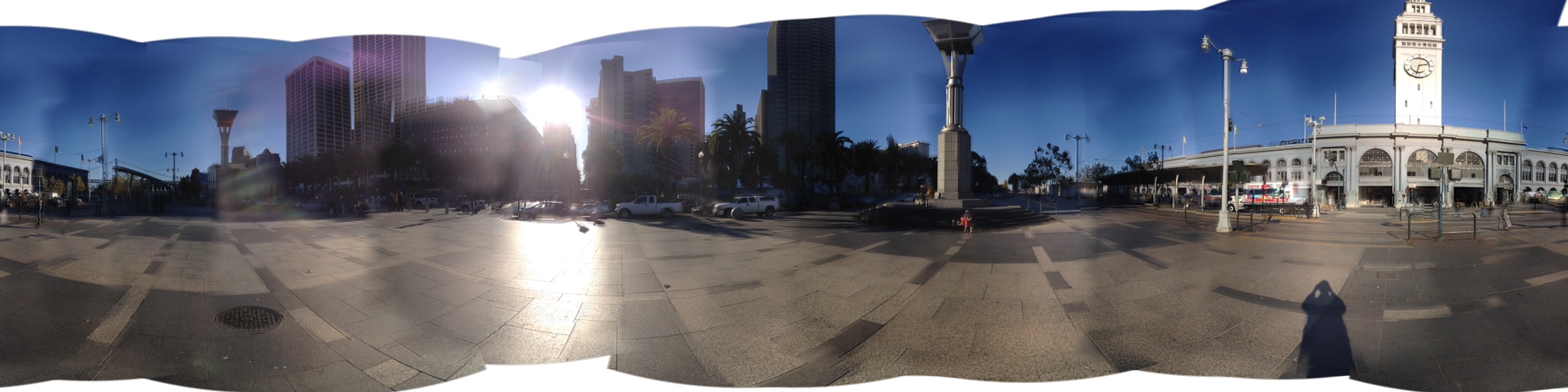
With the recent advances in camera phones, you can now have voice combined with the camera and GPS information.  The iPhone 4s combines all of the above features plus it can let you know who you might have been talking to while you were taking your photos.  Without having to wait until you get back to your PC your photos are automatically uploaded to the iCloud and have friends and families seeing the content in context immediately.  I still am amazed (I amaze easily) when I take photos with my iPhone and then see them magically appear on my iPad.  With apps like 360 Panorama and Photosynth you can go beyond just simple photos and videos that are geotagged but all the way to 360 degree panoramic views.  With the latest Dot panoramic lens you can go even further.

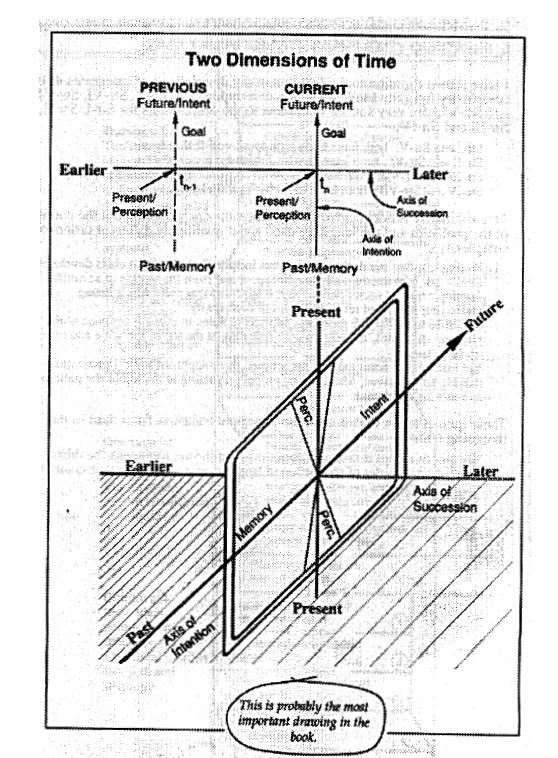
In business, we have the same needs placing the content that comes our way on the flood tide each day in a larger, more organized context.  An email arrives from Eric, what is the context of this email?  Which project does it belong to?  What is the social network of people and organizations that are associated with this project?  What is the event time line for this email – is it leading up to a particular deliverable on a particular date (the two dimensions of time)?  What is the semantic network of other documents that are closely related to this message?  What financial transactions in the form of budgets and actuals should be linked to this item?  Is this message a part of a sales activity or intellectual capital that could be patented?  Each of these questions leads to a collection of potential contexts for a message much in the same way that the act of simply taking a digital photo could automatically generate additional context that is a part of the process of creating a travelogue that is immediately shareable.

With Attenex Patterns (acquired by FTI Consulting and a part of Ringtail) we had many of the pieces of Transactive Content, but we did not have the transaction component of eCommerce.  As a result we set up a prototyping effort for a project code named Quicksilver to explore all aspects of Transactive Content.  In parallel with starting the prototype, I reflected how we had gotten to our current understanding.

In the beginning was Office Automation (OA, circa 1980).  With much hand wringing about how people couldn’t type, the worry of OA was that we would turn every office worker into a secretary.  Here we are 26 years later and for the most part there are no more secretaries and we all know how to type.  We are much more efficient and probably more effective with the current tools than we ever were with paper and secretaries.  In the process we also became our own travel agents and graphic designers (well OK, Powerpoint slide generators).

Now we are pretty much in an age where every knowledge worker is a content generator every single day.  We turn out an incredible amount of stuff, as Attenex sees everyday when it comes to electronic discovery.  In the business world the content that we generate is still primarily text and numbers.  But as Stan Davis in the Art of Business pointed out – we are text and numbers in business, but with the advent of the iPod, iPhone, iPad and the digital camera we are sound and pictures at home.  His prophecy is that business will soon be flooded with all four forms of content – text, numbers, sounds, pictures.

Then along came an incredible sea change as the result of the big fraud cases and homeland security and litigation issues like the Zubalake case ($1 million judgement, $30 million sanction for electronic discovery fraud) and the Morgan Stanley/Coleman $1.5Billion sanction for not keeping and being able to produce relevant emails.  In attending the seven conferences on these topics in 2005, it was clear that business was in the process of making every employee a professional records manager.  And along the way they are adding the burden of becoming compliance managers and regulatory compliance managers and Sarbanes Oxley policy wonks.

An interesting example of how bad it has gotten comes from Kevin Esposito formerly at Pfizer.  From his role in the law department it became clear that Pfizer needed to dramatically update their records management policies and start adhering to them.  This was going to cost 10s of millions of dollars and take several years.  Yet he got the program sold and approved with 1 slide.  He found a slide that had been used at a manufacturing plant manager’s meeting the week before that described the water quality results from the plant for the previous week.  He put the slide up with it’s five bullets.  He then went bullet by bullet and pointed out which regulatory agency required the information to be produced AND retained.  The shortest time that the information needed to be retained was for 2 years.  The longest time was seven years for one of the bullets.

“Let me be very clear.  Not just this information needs to be retained, but this slide needs to be retained for the longest time period of the regulations,” Kevin pointed out.  For each document like this that we don’t retain appropriately we are liable for sanctions ranging from $10,000 to millions of dollars.”  Further he elaborated:  “And notice that this document has nothing to do with our core business which is producing pharmaceuticals.  Imagine how much worse those records retentions policies are.”  Needless to say after everyone stopped swearing and fainting, they had everyone’s attention and the records management initiative was approved.  This was in 2003.  Regulations, compliance and the high stakes of litigation have made the problem much worse since then.

The above is all about the negative side of information and records retention (although unfortunately it is what gets everyone’s attention).  What business really needs is for each knowledge worker to realize that they are incredible Intellectual Capital generators – human capital, structural capital, and relationship capital (customer capital).  Yet, there are no tools for personal knowledge creation and management, let alone trying to do Intellectual Capital Management and Accounting at the Enterprise level (even though as Tom Stewart et al have pointed out this is the biggest unaccounted for part of every company’s financial accounting gap).

So the challenge is how do we take the “stick” approach and turn it into a carrot opportunity.  Today, the simplistic response to this challenge is to do “search” better.  Ideally, this means to have the tools to “unite” the unstructured document pools that I want to explore – the complete deep internet, the whole enterprise, my personal document universe (email and my hard drive).  But nowhere is the context of the search kept, which at its fundamental level is the business process that triggered the search in the first place.  As Autonomy talks about in their recent literature, if you have to do a search it is a sign that your application has failed.  It is the formal and informal work processes that contain the context of why a search was needed.  I believe that this is the next big area with companies like Genentech which is to take the documents that already exist that have an incredible amount of latent structure.

The placeholder notion that I’m using for this arena is Transactive Content.  The term comes from a Forrester Research initiative in the late 90s to describe the advent of XML processes but seems to have been lost.

In 2005, Enrique Godreau one of our board members at Attenex challenged me to describe our prototype Quicksilver in terms that simple people could understand.  The following is a result of that homework:

With a little bit of time to reflect and think about how I would talk about Quicksilver the almost one sentence description would come out something like this:

Quicksilver is a way to quickly See What Matters at the personal, departmental and enterprise levels.  It allows me to visually recover things I know are in my document/data pool but I can’t quite remember how to get at them exactly.  It enables me to discover patterns that I didn’t know were there that matter to me in the moment.  It automatically provides ways in which I can make my key intellectual assets more findable.   Depending on the workflow, the user can also recombine the ideas that are found into a virtual document that more closely matches their intent.

The following are representative stories or use cases to illustrate the above.

What is the cost of recovery?

Marty Smith is a senior partner and transactional attorney, formerly at K&L Gates.  He took on the most important and complex contracting tasks for companies like Microsoft.  As he negotiates clause by clause in these complex contracts he often has to go find similar clauses in contracts that he has constructed and then modified over the past 25 years.  During a user research session on a “live” contract negotiation, we watched him spend over 30 minutes trying to find examples of ways in which he had modified a particular clause.  He knew that he had done it about 30 times in the past but couldn’t remember for which clients and which contracts.  He finally gave up and had to craft his changes from scratch without the benefit of his previous work.  With the Quicksilver Attenuated Search capability he would have found the documents which contain the clause within 30 seconds.  The cost to the client from lost productivity >$500.  The cost from not doing the best work – unknown.  This happens several times a week for each transactional attorney.

In the past, most corporations have simply recycled the computers of employees who have left the firm.  Now firms are realizing the lost intellectual capital and risks associated with simply deleting the work of a former employee.  Many companies and law firms could use Quicksilver to quickly search and organize a former employees digital assets and place those assets into a “corporate memory”.  The intellectual assets are both the documents that somebody had crafted as well as the people relationships developed.

What is the benefit of discovery?

A globally known textile manufacturer suspected that two of its sales people were committing fraud.  Law firms and accounting firms estimated that it would cost $50,000 to $100,000 and take 1-3 months to examine the 2 GB of email from the two sales people.  By using an early single user prototype of Quicksilver, the Sales Manager was able to examine the emails and in one hour (which included training) found over $1 million of fraudulent transactions.  Investigations of suspected employees can become routine by the appropriate manager.

The pharmaceutical industry has coined the term “freedom to operate” to describe a process need to identify early on whether the drug they are thinking of developing is already being worked on or has patent problems associated with it.  Today, they often spend $100 million or more to discover and develop a new drug only to find out after releasing it that others hold patents on that drug.  With Quicksilver at any stage in the development process, the drug researcher can combine searches of their own research, the patent database, product announcement databases and the medical research literature to identify problems in the development of new drugs.

Anti-money laundering software is difficult to develop and generates thousands of alarms to a compliance manager.  Today’s systems just look at the transaction flows going through a financial institution.  What the financial company wants is a way to tie the transaction flow into the CRM system and into the emails of the high net worth customer managers.  Quicksilver is the only tool that can provide analytics into each of these different pools of data and then visualize the results so that the number of alarms can be dramatically reduced.

In each of the cases mentioned, the combination of Quicksilver’s automatic indexing and easy access to many sources of unstructured, semi-structured and structured information combined with visualization capabilities allows a researcher or investigator to quickly see what matters without having to wade through, correlate and laboriously analyze lists of results from traditional search engines.

The above are just a few of the stories and the use cases that we’ve identified with the key aspects of Quicksilver.  The overarching goal is to move into an area I am calling transactive content.  That is, content that is retrieved, analyzed, and used as part of an overall goal directed business process.  Search engines today are disconnected from the goals and processes of anyone doing research or investigations, whether as a knowledge worker inside an enterprise or a consumer.  The ability for an individual to do this research on their own materials independent of a company having to make a global enterprise purchase is key to personal productivity.  Attenex Patterns requires an enterprise purchase and IT staffing.  Quicksilver would be as easy to use and install as Google desktop but far more powerful.

An important part of Transactive Content is making sense of citations.  Citations come in many forms – URL links from one web page to another, case law citations in formal legal briefs, references in journal articles, forward and backward prior art references in a patent, and pointers to people to talk to in informal email sessions.  The importance of citations even emerges from the “Workflow as a Pi Process” discussion that the goal of email is to create a contact.

I’ve been enamored with citations from my first introduction by Russ Ackoff to the notion of invisible universities to what Chaomei Chen has been doing with the visualizations of citation references in formal journals.  Clearly Google has made a fortune out of a very simple citation link – page rank and then connecting that to the powerful set of citations called WordSense and Adsense.  Facebook is doing a similar thing with its EdgeRank.  Each citation link has an enormous amount of information buried behind it, but I have to lose context to go chase that link.  This is particularly painful when I’m reading a paper book or business article where there is no easy link to the electronic information.   The hardest part is that I don’t get to see the author’s whole product – their content plus all the content they’ve drawn from to create their content.  In addition, I also want to see who has been referencing this content.  In the legal field, this is a core part of the value that Lexis and Westlaw provide – what cases does this case reference and who is referencing this case.

The Amazon Kindle with the annotation highlighting option provides an interesting public sharing of highlights.  As you read a book, sections where 5 or more people have highlighted the text show up as a public highlight.  However, what I would really like is some way to connect with the knowledge workers who are highlighting the same things I am.

I’ve felt that there has been something missing to jump to the next step which is to have some associated content to place the citation in some form of abstract concept space.  I didn’t know how to get there without having the content for every citation as well as the content of the document which contained the citation.  Assuming that I now have some content/context for the citation I now have fodder to do some interesting joining.

Let’s say you wanted to do a formal document like a contract or a brief or even a white paper.  The author instead of having to author everything as is the case today could instead write basically an outline of statements about what they want to put together.  The tool then looks at the statements and compares them to its database of statements to find the best match.  A good match would be a document that included all the statements, but most likely you would match against bits and pieces of existing documents.  The tool would then bring back the piece parts and the user would select the document sub pieces that best match their intent.  The really good news about this approach versus what we were trying to do with our Attenex Structure product is that there is no knowledge to maintain or create beyond the original documents with their citations.  95% of the cost of knowledge management systems goes away and yet you get over 90% of the benefit without having to go through the pain of generalizing the knowledge that sits in a specific memo like this piece of paper.

If this core citation stuff works, then I think we have the whole next level of PageRank and EdgeRank and can generate Transactive Content processes rather than having to always author them through very specific, very brittle and very narrow in scope workflows.

Where I’m trying to go with this is to define transactive content in order to get into the Intellectual Capital management business by discovering what is already there (see what matters).   All of these thoughts are about putting content in context.

Posted in Content with Context, social networking, Transactive Content, Value Capture | 3 Comments