Ferry Capacity – Obesity Strikes

You have to love some of the things that the government spends time and money on.  This week we learned that the Washington State Ferries passenger carrying capacity has to be lowered considerably due to the average weight gain of American adults.  Somehow this was important enough or we had a slow news week to make National Headlines.  From the Washington Post:

SEATTLE — The Washington state ferry service isn’t going to start turning away hefty passengers, but it has had to reduce the capacity of the nation’s largest ferry system because people have been packing on the pounds.

“Coast Guard vessel stability rules that took effect nationwide Dec. 1 raised the estimated weight of the average adult passenger to 185 pounds from the previous 160 pounds, based on population information from the Centers for Disease Control and Prevention

“During the past 20 years, there has been a dramatic increase in obesity in the United States and about one-third of American adults are now considered obese, the CDC says on its website.

“The state ferry system has complied with the new stability rules by simply reducing the listed capacity of its vessels, Coast Guard Lt. Eric Young said Wednesday.

“That has effectively reduced the amount of passengers by about 250 passengers or so depending on the particular ferry,” said Young, who is based in Seattle. “They generally carry about 2,000, so it’s down to 1,750 now.”

“With that many passengers, the ferry wouldn’t tip over even if everyone ran to the side at the same time to look at a pod of killer whales, he said.

“The state operates 23 white and green vessels on 10 routes across Puget Sound and through the San Juan Islands to British Columbia. Carrying more than 22 million passengers a year, it’s the biggest ferry system in the United States and one of the four largest in the world, said system spokeswoman Marta Coursey.

“The ferries themselves could be contributing to passenger girth. The galleys cater to customers looking for fast food they can eat while looking out the windows at the scenery and seagulls. Calorie counters typically aren’t buying the hamburgers, hot dogs and chicken strips.

“We do serve light beer,” said Peggy Wilkes who has worked 20 years for the food concessionaire, Olympic Cascade Services, which serves food and drinks on 12 of the state ferries.

“News reports of overloaded ferries sinking in other parts of the world are sometimes a topic of discussion, she said.

“I think it’s cool the Coast Guard is keeping up on that,” she said. “Not that we overload them. A couple of times, like for a Seahawks game, we’ve had to cut off passengers and had to leave them at the dock.”

“Carol Johnston, who has been riding the state ferries since 1972, said she found the rule change perplexing.

“The ferries are not listing, they are not sinking,” said Johnston, who was onboard a Seattle-bound ferry from Bainbridge Island Wednesday afternoon. “How are you going to establish how much weight there is on the ferry?”

“Johnston worried about the potential loss in revenue, which could cause ferry fares to increase further. And she joked she may alter her eating habits.

“That means I will not have popcorn with my wine,” Johnston said.

“The reduced passenger capacity is unlikely to have much practical effect on the spacious ferries, said Coursey, the system spokeswoman. The ferries often fill up with vehicles, but the number of passengers, especially walk-ons, is seldom a problem, she said.

“The new stability rules may have a bigger impact on the smaller charter fishing boats, such as those that take anglers fishing out of the Pacific Ocean ports of Westport and Ilwaco, Young said. Any vessel that carries more than six paying customers has to be inspected and certified by the Coast Guard as a passenger vessel.”

Today’s editorial in The Seattle Times captures the issue with wonderful tongue in cheek humor:

“The rest of the planet is having weigh too much — oops — way too much fun with news Washington State Ferries revised some vessel passenger numbers.

“A widely circulated Associated Press story described how U.S. Coast Guard vessel stability rules were rewritten to account for the estimated weight gain of adult passengers, from an average of 160 pounds to 185 pounds.

“Blame the Centers for Disease Control for noticing the extra pounds, and the resulting Assumed Average Weight Per Person. Oh, and the regulatory arithmetic applies nationwide, across passenger-vessel categories.

“Certainly the torrid interest in a local transportation update by readers in New York, Washington, D.C., San Francisco, television news and the Internet is obvious. Rank jealousy.

“Combine the scenic beauty of Puget Sound with the presence of iconic employers including Microsoft, Boeing, Amazon and Starbucks, world class higher learning, and a well-educated, globally connected and humble populace, and it drives others mad.

“They look for any reason to snicker and giggle. So sad.

“Outlanders do not appreciate the glory and tradition behind the nation’s largest ferry system. For example, they are sized like lattes — super, jumbo and ginormous.

“People cannot understand the high caloric pride in these vessels, from the historic Kremekalakala to the Black Forest Chetzemoka, The Walla Walla Super Sweet, the Chocolate Cathlamet and the Cherries Kittitas. Each is a treat to ride. Especially the seasonal Egg Nog Tillikum.

“Let the rest of the country chortle into their oh-so slimming cheese steaks, three-way spaghetti, Reubens, deep-dish pizzas, Key lime pies and biscuits and gravy.

“We see the crowd shots at televised sporting events. Come and visit and enjoy healthy grilled salmon. But please don’t try to board the ferries, at least not all at once.”

Posted in Content with Context, Human Centered Design, Humor, Nature, Travel | 2 Comments

Keeping up with the Infosphere

Along with the periodic reflection on nodes in my social networks, I like to reflect on what catches my interest in the infosphere and why.  In the past about once a month I would document a “day in the life” of Skip by looking at the meetings, types of email, types of projects, and types of information interactions I encountered in the course of a day.

Feeding my inner infovore

With the current focus on writing daily blog entries and discovering a rich vein of Twitter knowledge connectors thanks to Cathy Davidson, my early morning infovore activities are changing dramatically.  For the past 40 years, every day would start with a cup of coffee and the daily newspaper.  I’d take a quick glance at the front page and then dive into the Sports and Business sections.  My email inbox would have to wait until I got through a look into the wider world.

However, with the acquisition of the iPad (and this year the iPad 2), my morning routine has shifted.  Without getting out of bed and without bothering my wife by turning on a bedside lamp, I reach over to the bedside table and grab my iPad.  First I check my email and then I go to the USA Today app to see what is happening in the wider world.  Then I go to Twitter to see what interesting knowledge was pointed to last night and then I head to FlipBoard to do a quick cycle through Facebook, and the other curated feeds (The New Yorker, Harvard Business Review, inarratives, Fast Company, Future Lab, Mindshift, Datavis, and Gamification).

This firehose of information shows up in professionally formatted color glossy mode on my iPad.  It’s just there – 24/7.  I’ve gone from couch potato to bed head.  There is so much here that I have to limit my semi-random information foraging to an hour (or stated another way until my craving for a cup of Nespresso coffee cuts in).

While I am sure there is a better way to capture those things that interest me or that I want to mark for future reference, I just email the link to myself.  Then after my coffee I semi-curate the references into my days To Do List.

The references to follow from this morning’s information foraging are:

With so much luck finding great articles for my many areas of interest, I decide to try once again to see if I can get my blog to connect with Flipboard so that I can view the blog in the wonderful formatting of Flipboard.  Somehow today I achieve success.

My start of day routine information seeking took 1 hour of real time.  This reflections blog post and the associated actions took four hours to accomplish.  Once again Gregory Bateson‘s observations in Steps to an Ecology of Mind triumph:

“Of course, the whole of the mind could not be reported in a part of the mind.  This follows logically from the relationship between part and whole.  The television screen does not give you total coverage or report of the events which occur in the whole televisions process; and this not merely because the viewers would not be interested in such a report, but because to report on any extra part of the total process would require extra circuitry.  But to report on the events in this extra circuitry would require a still further addition of more circuitry, and so on.  Each additional step toward increased consciousness will take the system farther from total consciousness.  To add a report on events in a given part of the machine will actually decrease the percentage of total events reported.”  P.432

Yet, what I went through in an hour this morning while in bed with my iPad 2 and the associated apps would have taken well over eight hours even four years ago.  Even then, I would have to be sitting at my desktop to try and locate all of this information.  However, it still isn’t easy enough to capture the context of each of the things I found interesting and then make those “connections” actionable – both in the immediate sense and in the longer term pattern making sense.  There is an app here somewhere.

Posted in Content with Context, ebook, iPad, Knowledge Management, organizing, Quotes, Transactive Content | Leave a comment

Being a Citizen

In the mid-90s, I took a five day scenario planning certification workshop put on by the Global Business Network.  One of the most intensive moments of the workshop was the half-day interaction our eight person working team had with a woman who was a sports reporter for the San Francisco Chronicle.  She was introduced as one of the first woman sports reporters to win the right to enter professional locker rooms after a game.  I had heard about her for years and was delighted to have a chance to meet and interact with her.

As part of her introduction to our group, she talked about her passions in life.  I was all ready to hear about sports. Instead she said her passion was to improve education as she was so proud to be a beneficiary of Title IX legislation which provided for equality in women’s sports.  She then went on to describe that it was a great advancement for diversity but more importantly a sign of how we needed to be different citizens.

I asked her to relate her passion for education with her notion of citizenship.  She went through an eloquent history of how K-12 education in the US was all about creating both better citizens and students who could populate the factories of the industrial age.  She related that we no longer live in either of those conditions.  She described her years of covering the Olympic Games and International Sports.  She talked about how confusing it was at Olympic Games where ostensibly nations were competing. Yet, everywhere she looked global brands were vying for attention, even more so than the different national flags and emblems.  And most everybody spoke English.

She looked at us all and said so what are we a citizen of now? – the United States, the world (in the McLuhan sense of the global village), or of Global 1000 Corporations (like Nike, Samsung, IBM) or the Tom Friedman notion of the Lexus and the Olive Tree.  With the internet, global social networks and the opportunity to interact on a regular basis with peers from all over the world, what are we a citizen of?  I am a collector of good questions that I want to regularly revisit.  This is one of those great questions you could form a syllabus around – what am I a citizen of?

As I travel the world both on business and for personal education, this question of what am I a citizen of is never far away.  Growing up there was no question, I was a citizen of the United States.  Then I started working for and with global corporations and realized that my identity was more closely aligned with the global reach of our business then with the physical citizenship of my country of birth.  In the process of this travel, reading international newspapers was always a journey into how “filtered” my US citizenship news sources are.

Then as our technology infrastructure proliferated global communication capabilities and my work brought me into daily Skype meetings with a development team in Shanghai, China, an executive team in San Francisco, and their software architect in London, England, I really began to wonder where our collective citizenship was.  With a click of a button, I can be in voice, video, and shared desktop communication with anyone with an internet connection wherever they may be in the world.

In parallel with the ease of travel and the telepresence of technology, I also enjoyed the visionary musings of those authors positing a global brain such as Willis Harman and Teilhard de Chardin.  McLuhan further shared his insightful look into the impact of cool and hot media on the shrinking of global space.   I will never forget the paradigm changing image of the “earthrise” taken from Apollo 8 in 1968 which changed forever our earth centric view of the universe.  Frank White in The Overview Effect: Space Exploration and Human Evolution described so eloquently the mind shifts that the astronauts to the moon experienced.  So should I be thinking about being a citizen of the universe?

While the question of what am I a citizen of is always top of mind, it also calls into question what is the larger purpose of education in creating future citizens?  We view public education as a right of our country, and we still use it to create citizens of the United States.  Isn’t it time we revisited the larger purpose of education and expand the view of citizenship to include the world in the McLuhan sense?  How do global businesses and their ever present brands shape our view of citizenship?  Am I part of the Nike Country every time I wear the Nike logo?

At some level, the answer is all of the above.  But what are my rights as citizens of these other domains?   Do I get to vote?  Do I have to pay taxes?  What does the collection of entities that I am part of provide me?  Maybe it is time to go back and re-read the wonderful sequence of books from Orson Scott Card starting with Enders Game that sheds so much light on the many different aspects of a citizen of earth and the universe.

Or maybe it is just time to go back to John F. Kennedy’s quote:

“My fellow Americans, ask not what your country can do for you, ask what you can do for your country.”

And then ask ourselves in the context of how we define citizenship, how we would update this quote?

Posted in Learning, Quotes, social networking, User Experience | Leave a comment

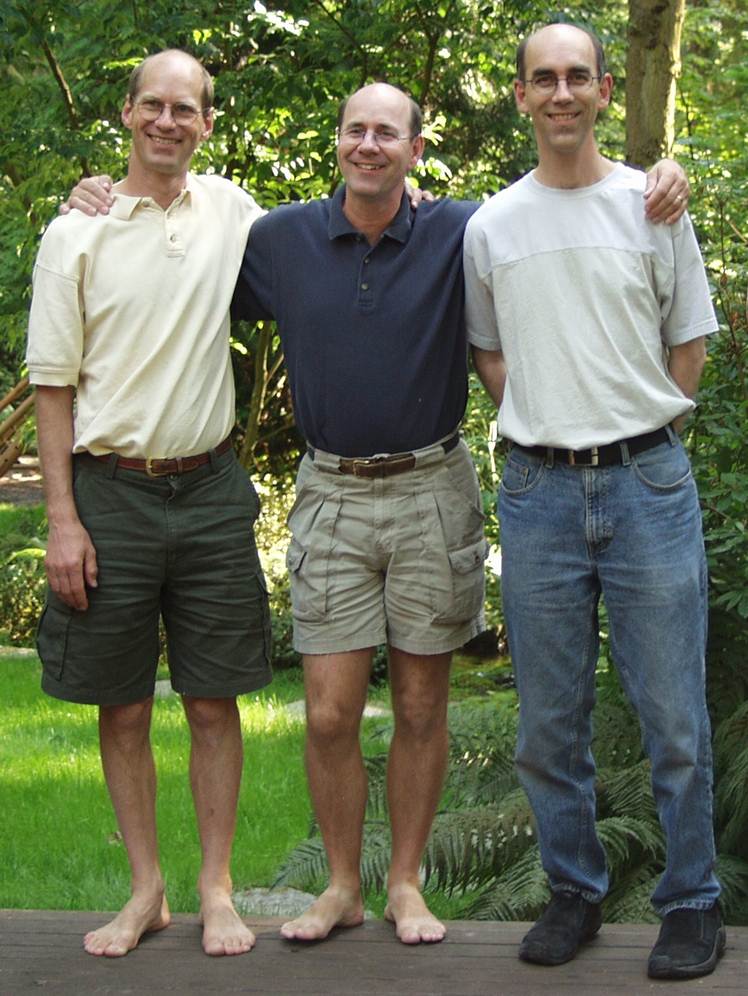
Three Socha Brothers

David, George, and John

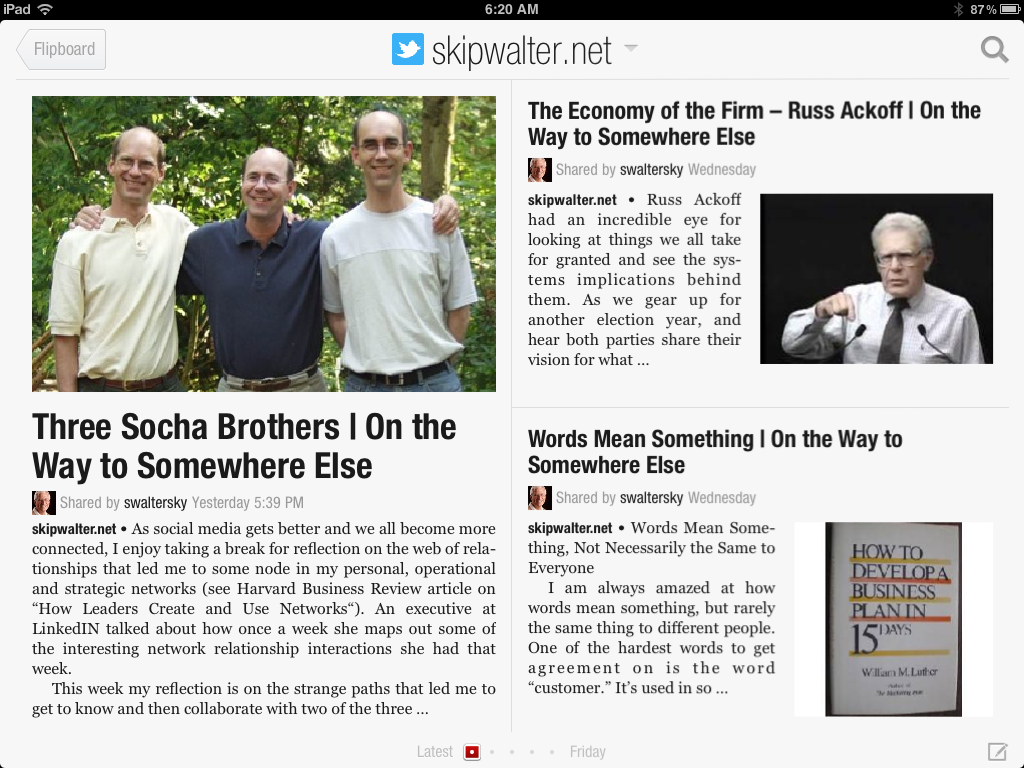
As social media gets better and we all become more connected, I enjoy taking a break for reflection on the web of relationships that led me to some node in my personal, operational and strategic networks (see Harvard Business Review article on “How Leaders Create and Use Networks“).  An executive at LinkedIN talked about how once a week she maps out some of the interesting network relationship interactions she had that week.

This week my reflection is on the strange paths that led me to get to know and then collaborate with two of the three Socha Brothers (David, George and John).  My first introduction to the Socha brothers was to George Socha who is one of the leading legal electronic discovery consultants.  We met in 2001 as part of my business development and strategic networking I did for Attenex, the company I founded to develop software visual analytics for document review in eDiscovery.  Along with Tom Gelbmann, George started the Socha-Gelbmann ED Survey reviewing the hundreds of eDiscovery vendors.  While we were not ready to publicly announce our product, we were interested in meeting the key influencers in this market segment.

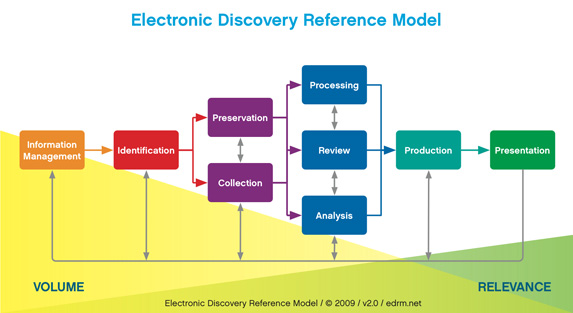
Once we announced our product, we supported the ED Survey and were very interested in the Electronic Discovery Reference Model project.  George is one of those really well connected networkers that every fledgling market really needs.  While working at a law firm, George saw the need for a service that would help guide law firms in the selection of technology and vendors for eDiscovery.  He formed Socha Consulting and has continued to evolve his offerings with Apersee.  While we interacted at general legal conferences and brought George in to consult with us at Attenex several times, I really got to know George at the Legalworks series of conferences that he organized where I participated as a panelist.

As a social introvert, I usually avoided the speaker dinners but George constantly let me know that I was missing the best part of the conference.  When I finally attended one of the dinners, I couldn’t believe what I had missed.  During our panel sessions at the conferences, most of our time was spent educating new lawyers to what eDiscovery was about.  However at the dinners, judges, leading thinkers on eDiscovery, and the innovators among the vendors could spend quality time both getting to know each other as well as talk about the future of eDiscovery.  I had always viewed my work for Attenex at these conferences as giving a good presentation.  I didn’t realize that the most important work was creating relationship capital with the thought leaders.  I am forever grateful to George for opening my eyes to the real work of these conferences.

The high point of these conferences was when George and I were able to take our spouses to London for one of the conferences and get to know each others respective families.  While the conference was great, the high point of the trip was being invited by Craig Ball and his wife to attend the London West End production of “A Few Good Men” with Rob Lowe.  Rob was a hit star on the TV Show “West Wing” at the time and my wife was ecstatic when Craig helped her get a photo with Rob after the play ended.

In June of 2002, I got a phone call from David Socha after a virtual email introduction from a mutual colleague, Emer Dooley, asking if I would teach a class in his undergraduate computer science class that summer.  I asked him how he’d gotten my name and he shared that he was looking for somebody who could talk about software development in the context of business.  He asked the professor who’d taught the class the previous year if he knew anybody with that combination of skills.  The professor did not know of anyone, but pointed David to Emer Dooley who suggested David get in touch with me.   Once again the web of contacts in a small world network worked.

I was delighted that David asked me to teach and we settled on a topic and a time for later that summer.

After I hung up the phone, I looked at my notes and David’s email address and started connecting the dots.  Did I just land in yet another small world phenomena?  So I sent an email off to George Socha and asked if he had a brother in Seattle, named David.  George replied immediately and said “Yes.”  I always loved George’s ability to be succinct.  So I called David back and asked “Do you happen to have a brother named George who is a lawyer?”

David said “Yes.  How could you know that?”

I laughed at the synchronicity and shared “You probably have no idea what my company does?”

“No, I don’t.  Why do you ask?”

I explained “I know your brother George quite well as we make a product for electronic discovery and George has been incredibly helpful to us in guiding us through the process of developing our business and critiquing our product.”

David sheepishly shared “You know, George and I never talk about our work.  He is a lawyer and I’m a computer scientist.  We don’t have a lot in common.”

So I asked David if he would mind coming into the office for a demo of our product and a tour of the office and then an extended lunch.  He agreed to meet the next week.  When I greeted him in the office, I started laughing again.  I couldn’t help myself, “you look just like your brother.  How am I ever going to tell the two of you apart?”

David laughed as well and said “Yes, we both wear glasses and have similar hair lines (what George called follicly challenged).  Even our respective kids often can’t tell us apart when we are together.”

So we went back to my office where we had the first of many demos and whiteboard discussions that have regularly punctuated our collaborations over the last 10 years.  However, I noticed this strange parade of Attenex employees coming by my office window to stare at David.  When the VP of Marketing knocked and came in, he went straight to David and said “George, I didn’t know you were going to be in the office today.  Stop by my office on the way out.”  David and I got the giggles at that point.

“Mike, I’d like to introduce you to David Socha, George’s brother.”  We all had a good laugh as Mike apologized.  After Mike left, I suggested that David go by our CFO’s office and ask for George’s consulting check and see if he could fool our CFO.

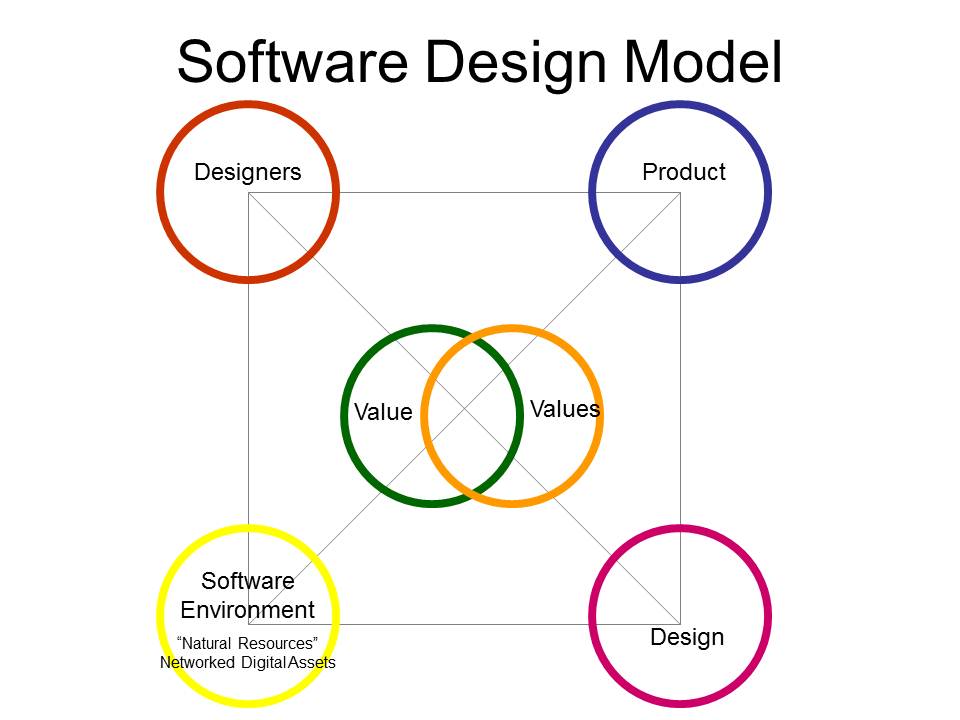
Socha-Walter Software Design Model (Early Draft)

From these early interactions, David and I realized that we had a mutual interest in software design and how to teach software design.  This interest led to the collaboration on a talk at a Harvey Mudd conference on Engineering Education and then to a journal article in the International Journal of Engineering Education on “Is Designing Software Different from Designing Other Things?”  As part of writing the article, David mentioned his third brother John Socha-Leialoha, who created the very successful software application Norton Commander.

2004 NMRA National Convention Most Photogenic Model

After sharing with David the insights I’d gained from reading Neil Gershenfeld‘s Fab: The Coming Revolution on Your Desktop – From Personal Computers to Personal Fabrication, David mentioned that was another area of John’s expertise – designing and manufacturing buildings, train cars and scenery objects for N guage trains.  So I moved meeting John from something to do in the future, to wanting to make it happen sooner.  In December of 2005, David, John, and I had lunch.

John is clearly the introvert of the three Socha brothers.  I rarely have much trouble carrying on a conversation with someone I am interested in learning from, but John was a challenge.  David had forewarned me, but as usual I didn’t listen.  While it took awhile, eventually we got moving on topics of mutual interest.  John was fascinated that any business executive could be the least bit interested in the design and manufacture of model train objects.  I learned a lot about how to do low volume just in time manufacturing and could see that Gershenfeld was right about how soon we would be having desktop 3D printers.

After I left Attenex, I haven’t had much of a chance to interact with George as I’m not doing much in the eDiscovery arena.  David and I continue to collaborate on the principles for designing software and for teaching human centered design.  However, our collaboration has taken another wonderful twist as David gets more involved with institution building at UW Bothell.  We are extending our collaboration into the realm of innovation and the university.

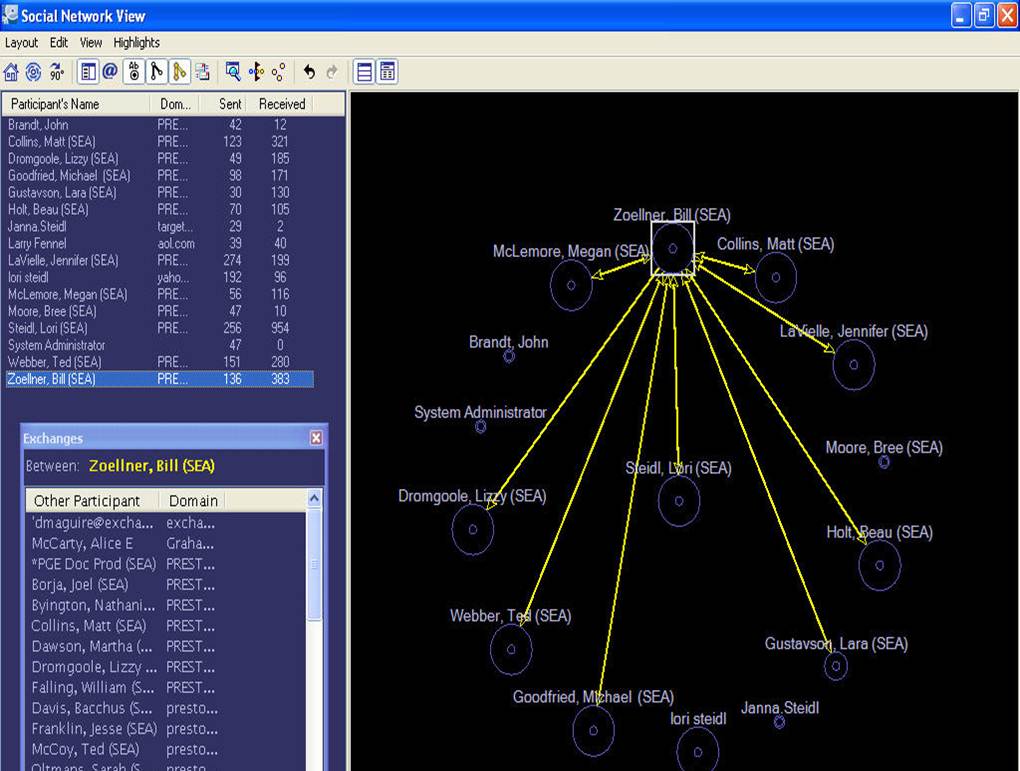
While I don’t have the personal email network visualization tool I wish I had, if I did have one, the relationship network visualization of the three Socha brothers and how they’ve shared their relationships with me would be interesting.  Two of the three Socha brothers would have hundreds of links emanating from their nodes that we now have in common (as derived from the number of email addresses in the combined set of shared emails), while John’s visualization would only have links to his two brothers.  Further, if there were an email traffic analysis and timeline analysis, we would see that I have almost no communication with George over the last three years and a dense set of communication with David since we first met.  With both George and David, those links have led to strategic networking relationships with members of their respective networks.

My life is deeply enriched by meeting all three Socha brothers and the connections in their networks.  I am thankful this holiday season that my collaboration with David continues to evolve in wonderful ways.

Posted in Content with Context, eDiscovery, Intellectual Capital, Relationship Capital, social networking | 1 Comment

Words Mean Something

Words Mean Something, Not Necessarily the Same to Everyone

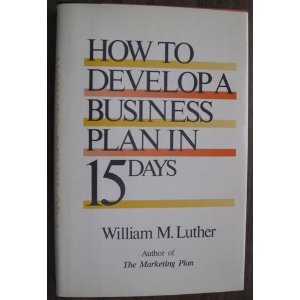
I am always amazed at how words mean something, but rarely the same thing to different people.  One of the hardest words to get agreement on is the word “customer.”  It’s used in so many different ways by each function within a corporation that rarely is there the same image conjured up in each mind in any conversation where the word “customer” is used.  The clearest insight into this problem came when I was reading a book by William Luther called How to Develop a Business Plan in 15 Days.  At the very start of his book, Luther begins:

“In December 1984, I was hired by Clemson University to conduct a two-day marketing seminar for five state colleges in Florida.  The first half-day was most difficult, because the people from the colleges kept stating that there was no way someone with no experience in education could help them develop a marketing plan.  I tried to convey to them that the planning process was the same regardless of the type of product or service, but they just wouldn’t buy it.  The use of a bad analogy made matters worse – the analogy being that the planning process was the same whether you were selling a college or a can of beer.  The meeting did not go very well until just after lunch, when they were presented with a five-step procedure that helps you determine who your customer is and what the message should be.  As I went through the sequence, I proved to them that they had been spending all of their marketing dollars for the last five years on the wrong target audience.

“Like so many other institutions of higher learning, these colleges realized that they must get a better understanding of marketing, now that federal and state funding assistance has diminished.  The group was openly hostile until the purchase-process priority was discussed.  When asked who should be number one in the purchase-process priority, the college officials, after several minutes of discussion, stated that it was the parent.  Number two was the high-school guidance counselor.  The student was listed as number three.  At this point, I asked them how they had been allocating all their marketing dollars during the past five years.  Almost in unison they said words to the effect of ‘son of a gun.’  They had been committing their complete marketing budget to the students.”

Here we are 27 years later and colleges are committing the same mistake.  Our three kids attended college and postgraduate education with our household receiving untold pieces of marketing literature from colleges starting in the sophomore year of high school for each child.  In the six years we endured this onslaught (2-5 pieces of mail every day), not a single direct mail piece was addressed to the parents.  Everything was aimed at the student.  Amazing.

Luther’s process starts by identifying those categories of people involved in purchasing decisions, and then classifies them as influencers, purchasers and users.  In the above example, the parent is typically the purchaser, the guidance counselor is an example of an influencer, and the student is the user.  So when we start talking about customer, it is important to think just a little harder to understand which role the person we are talking about is playing – influencer, purchaser, or user.

One of the fundamental mistakes made in product development is focusing all of the design and functionality on the user.  The most successful products design in capabilities for the purchaser and influencer.

Another definition of customer was popularized by W. Edwards Deming as part of Total Quality Management – customer as next person in line.  As business becomes more market and customer centric, we tend to think of customer in an external sense.  Deming pointed out that it is hard for most of us when we are inside of a company to have much exposure to an external customer.  Therefore, it becomes easy to think that quality is someone else’s problem and nobody will realize I’m not paying attention because I’m so far away from the customer.  Deming then defined customer as the next person in line to receive the work that an individual produces.  By providing this definition of customer, more direct measures of quality can be taken.

Posted in Content with Context, Knowledge Management, Learning, Quotes, Teaching | 3 Comments

The Economy of the Firm – Russ Ackoff

Russ Ackoff had an incredible eye for looking at things we all take for granted and see the systems implications behind them.  As we gear up for another election year, and hear both parties share their vision for what democracy means this year, Russ reminds us to compare the dictatorships we live in 8-12 hours a day at work with the espoused form of capitalism that our country stands for.  This quote from Management in Small Doses captures his insights.

“A curious contradiction is present in the ways we run our national macroeconomy and the microeconomies of the business enterprises within it.  At the national level we favor a market economy that is regulated as little as is compatible with national interests.  The economies of most of our business enterprises, however, are run much like the national economy of the Soviet Union.  They are centrally planned and controlled, transfer pricing is imposed on the parts, and when internal sources of products or services are available the are usually run as bureaucratic monopolies.

“What would a corporation look like if it were run like the American economy?

“Each component would be a profit center free to buy and sell products and services wherever it wanted to—free, but subject to as little regulation by corporate management as required for the good of the whole.  Corporate management would have the function of government within the firm.  Moreover, each unit would have to pay corporately imposed taxes on its profits, interest, or dividends on the capital obtained from the corporation, and, unless the corporation believed in free trade, duties on some imports to, and exports from, the corporation.

“Only a few corporations approximate this way of operating.  Why?

“Two reasons are usually given.  First, centralized planning and control are said to maximize synergy between the parts of the corporation.  But there is no lack of synergy between suppliers, producers, and consumers in the national economy.  Many corporate producers experience less conflict and more cooperation with external suppliers and customers than with those that are internal.

“Second, it is argued that some economies of scale enjoyed by corporations would be lost in a “free corporate economy”; but such losses are not necessary.  Parts of a corporation can form buying, producing, and selling cooperatives just as independent enterprises do in the national economy.  This cooperation can be encouraged by corporate management, just as it is by governments of most free national economies.

“Moreover, a market economy within the firm can avoid some diseconomies of scale.  Large internal monopolies are often no more efficient than those that are external and tend to be less sensitive and responsive to their customers than smaller internal units that must compete with external suppliers for internal business.

“It is possible for corporate management to intervene in the transactions of the units reporting to it as our government can but seldom does.  Suppose headquarters wants one internal unit to buy from another internal unit but the buying unit does not want to because the internal supplier demands a higher price than an external source.  Corporate management can pay the buying unit the difference.  Unless it did, the buying unit would be free to use an external source.  This requirement would discourage corporate management from arbitrarily restraining external trade.  It would have to pay for these restraints and therefore would not be likely to impose them unless it believed the corporation as a whole would benefit.

“In a corporate market economy corporate headquarters would receive income from taxes on unit profits, import and export duties, and interest or dividends from units for funds it provided.  It would pay for any profit-reducing constraints it imposed on internal units and for any services it obtained from them.  This would make it possible for the headquarters itself to be a profit center.  Its profits or losses would not be the same as the corporation’s.  Therefore, effectiveness of corporate management could be evaluated in the same way as that of business units.

“Isn’t it time for corporations to practice the same type of economy they preach to the nation?”

Posted in Content with Context, Quotes, Russ Ackoff, User Experience, WUKID | 3 Comments

Mediating Objects of Socialability

The Map is not the territory.”Alfred Korzybski

These qualities of vision are characteristic of people who love maps, for maps show an overview and details all at once.”David Weinberger

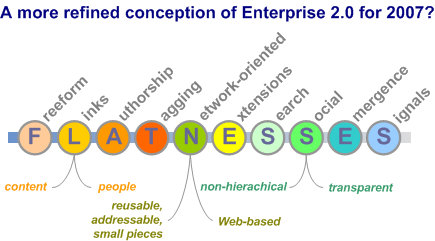
Andrew McAfee wrote a great article on Enterprise 2.0 about innovative and foundational Information Technology (IT) that is social network and Web 2.0 based.  Dion Hinchcliffe extended some of these artifacts.  Together these articles provide a map to a vision of the future of work.

The other major change to the core objects and schemas in an Enterprise 2.0 world is that most every content object that is presented to the member must be capable of handling Web 2.0 like user generated content as described by Andrew McAfee in his Enterprise 2.0 article and book and by Dion Hinchcliffe in his extensions to McAfee’s SLATES.  The day of hierarchically generated content where information flows in an orderly fashion up and down the hierarchy for approval and controlled distribution is over with Enterprise 2.0 technology and culture.

The current list of Enterprise 2.0 capabilities that need to be added to each object are depicted below:

Yet, as these capabilities get deployed, the “social me” I present has to also change depending on the context of who is viewing the content.  As part of her Masters Thesis on photography collections at The MIT Media Lab, Fernanda Viegas (previously at IBM’s Many Eyes research project) quoted Joshua Meyrowitz:

“When I was a college student in the late 1960s, I spent one three-month summer vacation in Europe. I had a wide range of new and exciting experiences, and when I returned home I began to share these with my family, friends, and other people I knew. But I did not give everyone I spoke to exactly the same account of my trip. My parents, for example, heard about the safe and clean hotels in which I stayed and about how the trip had made me less of a picky eater. In contrast, my friends heard an account filled with danger, adventure, and a little romance. My professors heard about the “educational” aspects of my trip: visits to museums, cathedrals, historical sites, and observations of cross-cultural differences in behavior. Each of my many “audiences” heard a different story.

“The stories of my trip varied not only in content, but also in style. There were varying numbers of slang words, different grammatical constructions, and different pronunciations. The pace of my delivery, body posture, facial expressions, and hand gestures were different in each situation. Each description had its own unique mixture of earnestness and flippancy. My friends, for example, heard a speech filled with “sloppy speech” and sarcasm. 

“Did I “lie” to any of these people? Not really. But I told them different truths. I did what most of us do in everyday interactions: I highlighted certain aspects of my personality and experience and concealed others.”  Joshua Meyrowitz

Joshua goes on to describe how these stories all were mediated by the artful selection of which photos he shared with each audience.

Jyri Engestrom in his blog describes the importance of adding objects as mediators of social networking:

“A while ago I wondered how our relationship to social networking services will change when instead of adding new contacts, we begin to feel like we’d be better off cutting the links to the people who we actually don’t know, stopped liking, or no longer want to be associated with for whatever other reason. I was reminded of this on reading that Russel Beattie has now decided to link out of LinkedIn. He explains:

“Yes, I thought about just deleting the people I didn’t know, but each deletion of a contact requires an individual request to customer service (it’s not just a check box and submit operation) so I finally just decided to cancel the whole thing. I think in general, people who would want to use this service are pretty contactable without using this system, no? … And if you’re a hard to reach person, you’re most likely not using this sort of thing anyways. Anyone can contact anyone in five hops, so what real use is it?”

“I want to use Russell’s question about the ‘real use’ of LinkedIn as a window into what I think is a profound confusion about the nature of sociality, which was partly brought about by recent use of the term ‘social network’ by Albert Laszlo-Barabasi and Mark Buchanan in the popular science world, and Clay Shirky and others in the social software world. These authors build on the definition of the social network as ‘a map of the relationships between individuals.’ Basically I’m defending an alternative approach to social networks here, which I call ‘object centered sociality’ following the sociologist Karin Knorr Cetina. I’ll try to articulate the conceptual difference between the two approaches and briefly demonstrate that object-centered sociality helps us to understand better why some social networking services succeed while others don’t.

“Russell’s disappointment in LinkedIn implies that the term ‘social networking’ makes little sense if we leave out the objects that mediate the ties between people. Think about the object as the reason why people affiliate with each specific other and not just anyone. For instance, if the object is a job, it will connect me to one set of people whereas a date will link me to a radically different group. This is common sense but unfortunately it’s not included in the image of the network diagram that most people imagine when they hear the term ‘social network.’ The fallacy is to think that social networks are just made up of people. They’re not; social networks consist of people who are connected by a shared object. That’s why many sociologists, especially activity theorists, actor-network theorists and post-ANT people prefer to talk about ‘socio-material networks’, or just ‘activities’ or ‘practices’ (as I do) instead of social networks.

“Sometimes the ‘social just means people’ fallacy gets built into technology, like in the case of FOAF, which is unworkable because it provides a format for representing people and links, but no way to represent the objects that connect people together. The social networking services that really work are the ones that are built around objects. And, in my experience, their developers intuitively ‘get’ the object-centered sociality way of thinking about social life. Flickr, for example, has turned photos into objects of sociality. On del.icio.us the objects are the URLs. EVDB, Upcoming.org, and evnt focus on events as objects. LinkedIn, however, is becoming the victim of its own cunning: it started off thinking it could benefit by playing up the ‘social just means people’ misunderstanding. As Russell put it,

That was the “game” right? He who has the most contacts wins. At first you were even listed by the number of contacts you had, remember?

“Reid Hoffman’s choice (however unintentional it might have been, I don’t know) to encourage the use of LinkedIn as a game is what activity theorist Frank Blackler would call the introduction of a ‘surrogate object.’ The surrogate object is actually not sustained by the economic, technical, and cultural arrangement that the activity relies on to sustain itself. Playing ‘Who has the most connections wins’ might have been fun to some people for a while, but it was not very valuable to the users and developers as a collective in the long run. Now LinkedIn is trying to change the object of sociality that it offers, and persuade people to re-orient their networks around their actual jobs. (Don’t get me wrong—I’m the first to support Reid and his team on their endeavour to make LinkedIn more useful as a medium for job-centered sociality!)

“Last but not least, we can use the object-centered sociality theory to identify new objects that are potentially suitable for social networking services. Take the notion of place, for example. Annotating places is a new practice for which there is clearly a need, but for which there is no successful service at the moment because the technology for capturing one’s location is not quite yet cheap enough, reliable enough, and easy enough to use. In other words, to get a ‘Flickr for maps‘ we first need a ‘digital camera for location.’ Approaching sociality as object-centered is to suggest that when it becomes easy to create digital instances of the object, the online services for networking on, through, and around that object will emerge too. Social network theory fails to recognise such real-world dynamics because its notion of sociality is limited to just people.

“For a much more elaborate academic argument about object-centered sociality, see the chapter on ‘Objectual Practice’ by Karin Knorr Cetina in The practice turn in contemporary theory, edited by Theodor R. Schatzki, Karin Knorr Cetina, and Eike von Savigny (London 2001: Routledge.)”

Karin Knorr Cetina in “Objectual Practice” in The Practice Turn in Contemporary Theory goes even farther as her research shows that object relational thinking is key to the knowledge worker.  These two vignettes look at the difference between the routine and the difficult for the knowledge worker (protein research scientists):

“Vignette 1:  “Cloning is perhaps one level below what one calls exciting in the lab.  You sit down, you think about a particular construct, and then you clone it.  That’s not very different from deciding to dig a hole in the ground and then to dig it – it’s about that exciting.”

“Vignette 2:  “Well, the protein, because it has previously been a problem, the protein is a bit more moody.  I think about it, I get more visual, I treat it differently, in one word, I pay more attention to it, it’s more precious.  I don’t handle it routinely yet.

“How do you visualize it?”

“I see the protein in a certain size in front of me.  I visualize why it is precipitating, then I visualize the solution and I visualize the falling out and the refolding process.  I also visualize the protein denaturing, stretched out and then coming together, and I visualize how it is being shot into the solution and what it is going through when it starts to fold.  With the expression, I visualize the bacteria when they grow in a more anthropomorphic way, why are they happy?  I try to visualize them shaking around, I visualize aerobic effects, the shaking, how much they tumble around and what could have an effect.”

Cetina describes the process that the researcher uses to deploy relational resources to help her solve the difficult research questions.

Ibarra and Hunter in a Harvard Business Review article “How Leaders Create and Use Networks” add another dimension to social networks that mirrors Joshua Meyrowitz’s description of the many forms of his European trip.  The HBR authors extend the notion of social networks to include personal (friends), operational (who I work with), and strategic (who I learn from and am mentored by).  So social network systems need to not only have mediating objects of socialability but also understand what process is being mediated.

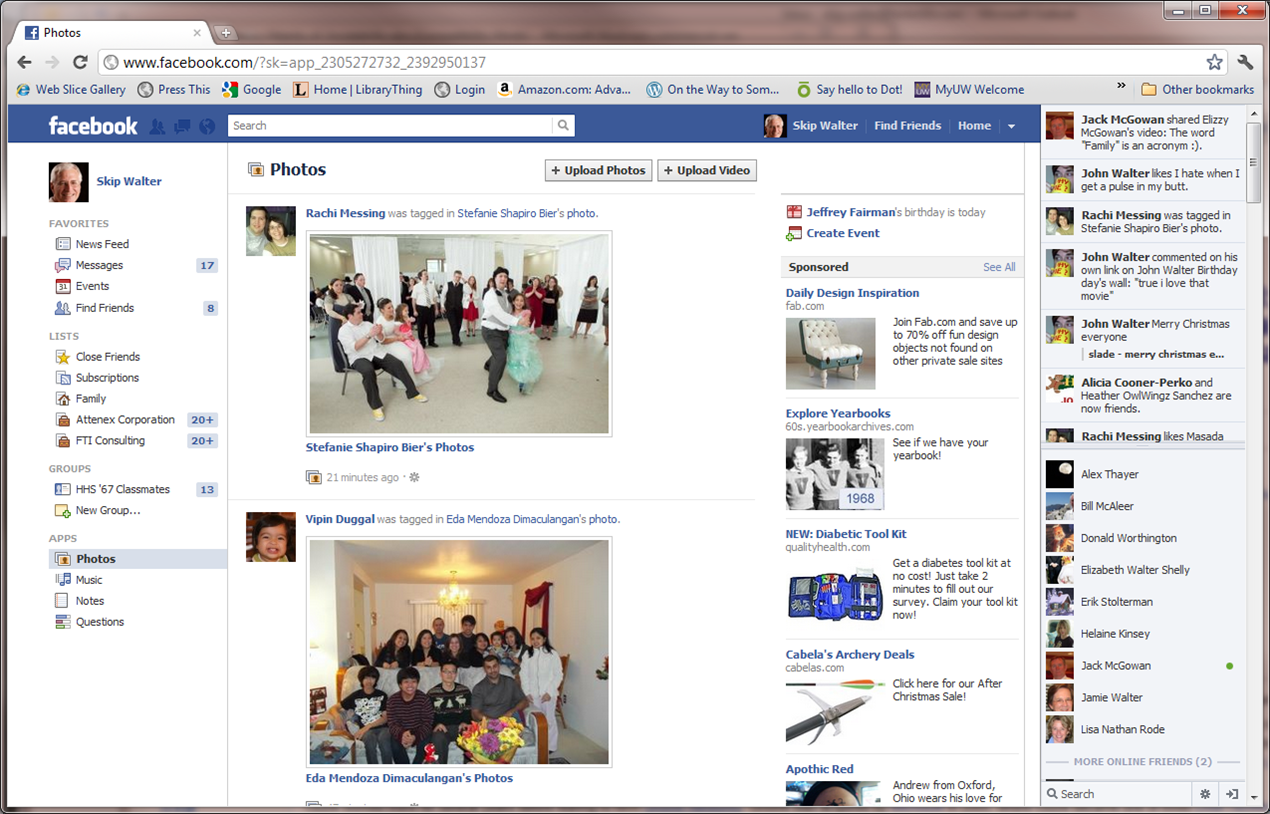
Facebook has done an excellent job with the many ways that it uses photos (and other objects) as mediating objects of sociality.  We first glimpse the power of pictures to mediate socialability from the ever growing recent photo albums page that happens as my “friends” add to their collections:

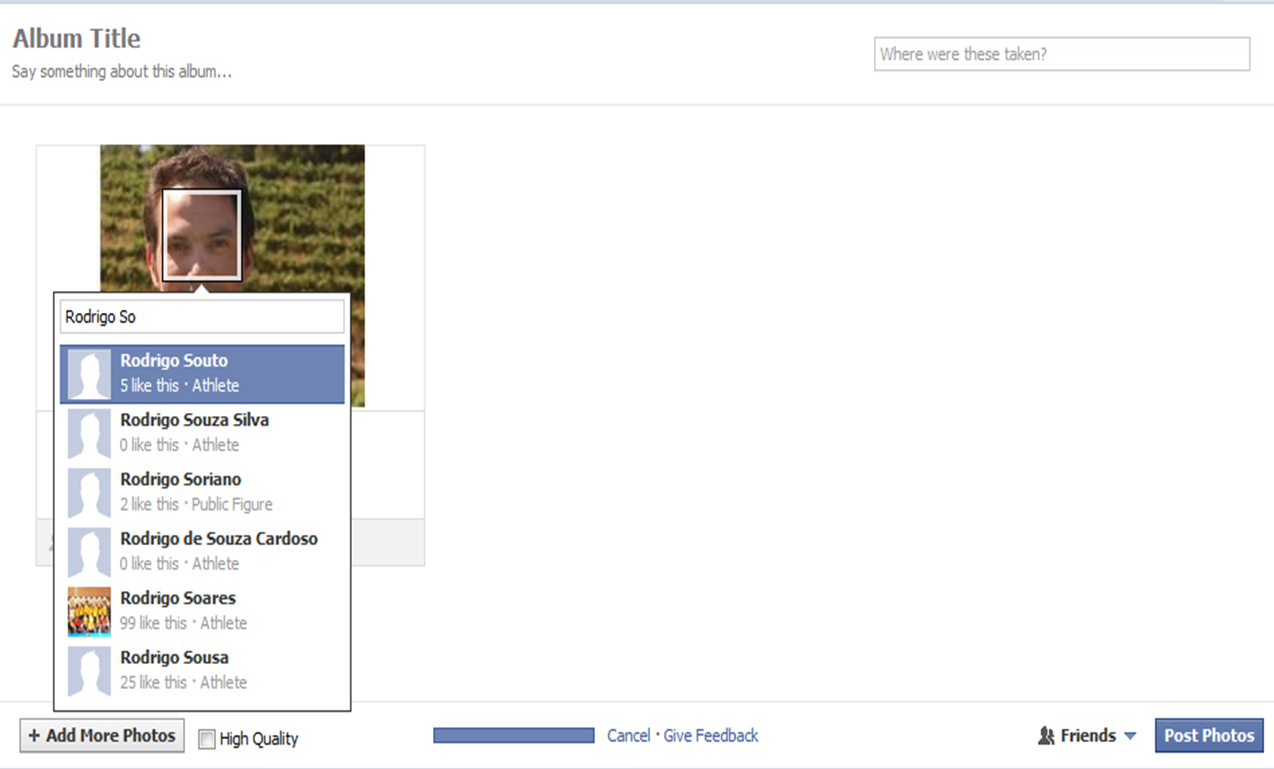
Then as I add a photo to my collection, Facebook prompts me to easily identify people and connect a name to a face while uploading photos:

After identifying a Facebook friend in a photo, that photo appears automatically on my friend’s profile and history pages.  Facebook makes it easy to use photos as objects of socialability.

Building on Digital Assets – The Mediating Objects of Socialability

The book Smart World by Richard Ogle does an excellent job of building on the themes of the power of interacting laws that I first encountered with the application BOIDS.  Brian Eno in his book A Year with Swollen Appendices describes the rules that he sees tying his own generative music with applications like BOIDS: “A by-the-by: I’ve noticed that all these complex systems generators (such as ‘Life’ and ‘Boids’ (the flocking one) and ‘The Great Learning’) have something in common – just three rules for each.  And these three rules seem to share a certain similarity of relationship: one rule generates, another reduces, another maintains (or a tendency to persist).  I suppose it’s obvious, really, but perhaps it’s not trivial to wonder if those three conditions are all you need to specify in order to create a complex system generator (and then to wonder how those are actually being expressed in complex systems we see around us).”

The rules however need something to operate on – digital artifacts or digital assets.  This section looks at the power and complexity of simple rules operating on digital assets in the context of socialability.

Ogle’s Nine Laws are:

  1. The Law of Tipping Points
  2. The Law of the Fit Get Rich
  3. The Law of the Fit Get Fitter
  4. The Law of Spontaneous Generation
  5. The Law of Navigation
  6. The Law of Hotspots
  7. The Law of Small World Networks
  8. The Law of Integration
  9. The Law of Minimal Effort

As I looked at successful web sites and software products that have emerged over the last 20 years, I began to see a pattern emerge – building from digital assets rather than financial or physical assets.  I call the pattern r2NDA for recombinant reflective networked digital assets.  The challenge is now to extend the r2NDA concept to embrace Ogle’s nine laws.

The best software products and web sites aren’t just about code, they also include ways to extend the code either through content or plug-ins.  Digital assets can be as simple as a record in a database or as complicated as a browser plug-in or as derivative as analytics on unstructured text to create a structured digital asset.  A networked digital asset is the start of creating a value web by linking my digital assets through the network with someone else’s digital assets.  Recombinant implies that I am able to recombine either my digital assets or networked digital assets to provide increased value to the user.  Finally, reflective has several meanings.  The simplest meaning is to create a mirrored space, much like the person-to person (P2P) technologies are doing today.

Groove is an example of a technology that mirrors collaborative spaces on peer computers rather than on servers.  The next level of reflection is to pay attention to the pattern of user interactions to discern a higher order intent.  For example, Amazon.com may notice that a person is buying several books on management and begin to figure out that someone has gotten a promotion.  The system could test that assumption directly and then start suggesting hardware or software to purchase, other books, or possibly seminars to attend.  The last meaning of reflection is similar to what Donald Schon describes in The Reflective Practitioner, where not only do you feed back from actions and their consequences to the next set of actions to take, but you also feed back to your theory about what is taking place.  This type of reflection enables double loop learning.

If we take a look at the Books section of Amazon.com we can deconstruct the website from an r2NDA perspective:

From a digital asset standpoint, we can start a long list of the digital assets that Amazon.com has just on the books section.  Here is just a partial list of the assets:

  • Customer demographic information like name, shipping address, bill to address
  • What topics I’m interested in like:  business and investing, computers and internet, health, mind and body.
  • Order transaction history
  • Ratings of books that were purchased or are owned
  • Reviews of books
  • Database of information about books, both books in print and out of print
  • Cover images for each book
  • Inventory status for each book
  • Selling history of each book

With a well developed site like Amazon, the list of digital assets can go on and on.

To see the effect of recombinant, we start looking at the ways in which Amazon begins to make recommendations.  The book recommendations are made by looking at others who have bought the same book and seeing what they also purchased (collaborative filtering).  Another way of recombining assets is to look for demographic indicators – people like you are also buying XYZ book.  While there is not a clear example of reflection, we are starting to see the capabilities for humans to reflect on the underlying assets through the introduction of related lists of books whenever one does a search. Searchers can also rate other user reviews as to how helpful they were in selecting a given book.

Finally, from a networked digital asset standpoint we see a couple of examples.  Within Amazon, digital assets are networked from store to store.  The system comes up with messages like people who bought this book also liked these CDs or DVDs.  Perhaps, the most useful networking of assets is connecting the user to UPS for package tracking of an order.  When Amazon acknowledges an order it also provides the tracking number and a linkage to the UPS site so that the user can check to see where the package is on its journey from Amazon to the specified delivery site.

To get a better feel for how others use digital assets, use the r2NDA descriptive model to look at 3-4 websites.  I would recommend doing a full deconstruction of one of the Amazon store sites all the way through to the ordering and delivery assets that are kept.  Then I would look at two other classes of sites:  financial investing and trading, and travel sites with an airline that you have frequent flyer relationships with.  If you get a chance, pay particular attention to any mapping or analysis tools that might be present like Fidelity and Smartmoney.com are providing.  What are the r2NDAs used to supply the market map at SmartMoney.com?

As a brainstorming or design tool, r2NDA is particularly helpful at the innovation stage.  The sequence that one should think through the r2NDA in order to be prescriptive is:

  • Identify the Digital Assets
  • In what ways can the Digital Assets be recombined
  • What other Digital Assets can I network my Digital Assets to
  • For a given user, reflect on the pattern of usage to determine higher order intents or goals on the part of influencers, purchasers and users.

Perhaps, the biggest step forward for the kinds of software tools that we want to build is to have the software itself be reflective so that it can learn as it interacts with users.  For example, in the early use of Attenex Patterns, each of the attorneys constantly developed new strategies for how to identify clearly non-responsive and clearly responsive documents.  These strategies need to be rapidly shared with the other attorneys doing the initial review on that case.  Over time we want to figure out how to incorporate these strategies into the system so that more of the analysis can be done automatically.  The r2NDA approach is another version of the content with context that builds on mediating objects of socialability.

Posted in Content with Context, Human Centered Design, social networking, Transactive Content, User Experience | Tagged , , | 1 Comment

The Map – You are Here!

While on our round the world in 21 days trip, my wife and I were eagerly looking forward to a reunion with an Australian exchange student who had lived with my family during our senior year in high school.  Our Qantas flight was several hours late arriving in Perth and we nervously wondered whether we would be able to find the bush pilot that Trevor had arranged to fly us to his sheep and wheat ranch near Kununoppin, Western Australia.  As we wearily made it through customs, we looked up and saw a pilot with a WELCOME SKIP AND JAMIE sign.

With a hearty “Good on ya, mate!”, he grabbed our bags and headed for the small tail dragger Cessna 140 parked on the ramp.  We climbed in and were treated to a beautiful low level sightseeing trip across Western Australia.  The pilot shouted to us that Trevor was sorry that he couldn’t make it, but there was a brush fire in the district where their ranch was and all the mates were busy helping put out the fire.  Having recently read The Thorn Birds, we hoped that they got the fire under control pretty quick.

We arrived at what looked like a dirt strip far from any signs of civilization and the pilot dropped quickly to a rough landing.  We didn’t see any visible signs of welcome, but there was an old battered white UTE (pickup truck for us Americans) parked at our end of the field.  I crawled out of the Cessna and walked over to the UTE.  On the front seat there was a note and a map.  In the note, Trevor apologized for not being able to meet us as they still hadn’t gotten the fire under control.  “I’ve left you a map to get to the house.  See you there soon,” directed the note.

So with a little trepidation as it was rapidly getting dark, we waved good-bye to the bush pilot, threw our bags into the back of the UTE and were ready to find Trevor’s Western Australia ranch house.  I turned on the overhead light, looked at the map and was quickly dismayed.  Trevor had clearly marked where his house was, but there was no indication on the map as to where we were.

If you don’t know where you are or where you are going, any road will take you there.

Posted in Content with Context, Learning, Teaching, User Experience | Leave a comment

A Wine Lover’s Christmas

My loving bride gave me a wonderful Christmas gift – Note Cards with the 12 days of Christmas from a wine lover’s perspective:

I particularly liked the first comment “A Pinot in a Pear Tree” as Pinot Noir (especially from Archery Summit) is my favorite wine varietal.  Of course, most wine lover’s who have made it to the Walter house for a “Riedel Wine Glass Tasting” would argue that the Twelve Snobs Sniffing might be more appropriate.

Posted in Humor, Wine | Leave a comment

Best Non-Fiction Books Read or Re-Read in 2011

Through the continued development of the Amazon Kindle app for the iPad, it was a lot easier figuring out the best non-fiction books for 2011.  With the capability of highlights and notes going to the Amazon cloud and Amazon tracking how many highlights and notes there are for each book, it was easy to see which books really captured my attention.

Each of the books that made the list had other key attributes:

  • The book had to have some framework or process that affected how I consult, mentor or teach
  • The book had to stimulate emails to colleagues to recommend that they read and then enter into a discussion about the merits of the book
  • The book had to have the potential for making my most recommended book list.

For a book to rank high on the list, it had to have a high number of highlights and notes and have more of the top three attributes.

While most of the books were published in 2011, there were a couple that were published earlier that I needed to re-read as part of selecting the book for my graduate courses.  I enjoy the many new insights from a good book the second or third time around.  Much like the philosophical question “can you step into the same river twice?“, no non-fiction book is ever the same the second time around.

Top 10 Non-Fiction Books I Read or Re-Read in 2011

  1. Demand: Creating What People Love Before They Know They Want It by Adrian Slywotzky and Karl Weber.
  2. Now You See It: How the Brain Science of Attention Will Transform the Way We Live, Work and Learn by Cathy Davidson
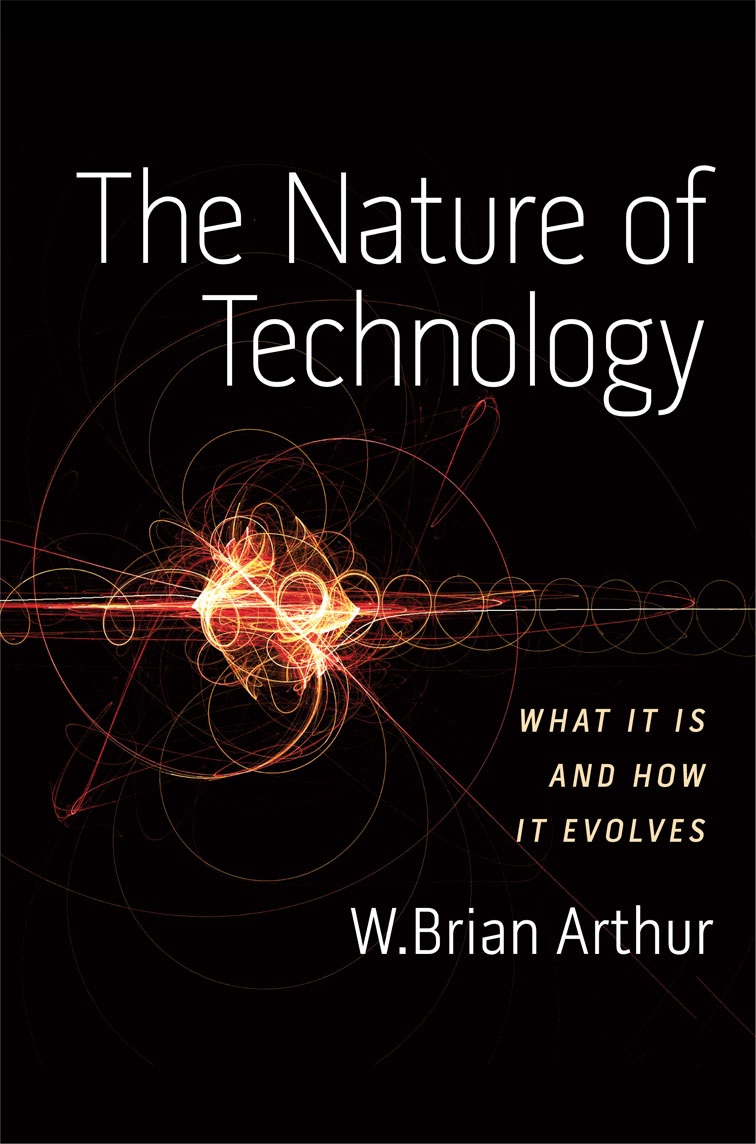
  3. The Nature of Technology: What It Is and How It Evolves by W. Brian Arthur
  4. The Filter Bubble: What the Internet is Hiding from You by Eli Pariser
  5. Visual Complexity: Mapping Patterns of Information by Manuel Lima
  6. The Accidental Creative: How to be Brilliant at a Moment’s Notice by Todd Henry
  7. What I Didn’t Learn in Business School:  How Strategy Works in the Real World by Jay Barney and Trish Gorman Clifford
  8. Boomerang: Travels in the New Third World by Michael Lewis
  9. Living with Complexity by Donald Norman
  10. Agency Mania: Harnessing the Madness of Client/Agency Relationships for High-impact Results by Bruno Gralpois

Demand: Creating What People Love Before They Know They Want It

Adrian Slywotzky is one of my favorite business authors writing several books on profitability and profit patterns.  With this book, he ventures beyond pure business models to explore the arenas of design and user experience as key differentiators for product with extraordinary demand.

For a business professor, consultant, and prolific writer about business, this book explores the critical role of user research in all phases of his six pillars of creating demand.  Slywotzky describes demand as:

“Demand creators spend all of their time trying to understand people. . . By watching how people actually behave in their own worlds, and by talking to them constantly, demand creators figure out how to solve the big and little hassles we all face—and they make our days easier, more convenient, more productive, and simply more fun. They seem to know what we want even before we do. They wind up creating things people can’t resist and competitors can’t copy.

“Yet they almost never succeed on the first try. They know that real demand comes from connecting the dots between the human factors and a quirky, ever-shifting combination of other elements: financial and emotional costs, social norms, infrastructure, product design, patterns of communication, and many more. It comes from understanding how all these factors interact in complex, unpredictable, and counterintuitive ways. And it comes from a way of thinking that makes the leap from trying to convince people to buy something to human understanding, to seeing the world through the eyes and emotions of the customer. A dozen cylinders have to click into place before the vault door swings open. But when it does, wonderful things happen—for all of us.”

Sound familiar.  This description is the world of human centered design partially described in a previous post.  Human centered design has the four stages of user research, prototypes, value (viability and human values), and user experience.  Slywotzky in his own words and through his own research has incorporated all of these processes in his six steps that all great demand creators follow:

  1. Make it magnetic
  2. Fix the hassle map
  3. Build a complete backstory
  4. Find the triggers
  5. Build a steep trajectory
  6. De-Average

In addition to the six steps, he emphasizes the importance of the launch, the portfolio and the linkage to scientific discovery and the future of demand.

If you’ve ever wondered why Netflix outperformed Blockbuster or why the Prius generates far more demand than the Honda Civic Hybrid, grab this book and start designing for demand for your company.
Now You See It: How the Brain Science of Attention Will Transform the Way We Live, Work and Learn

In the middle of all of the articles about how the internet and Google are making us stupid, Cathy Davidson provides a compelling alternative story about how the Internet is making us more human.  Through the combination of her research at Hastac, the MacArthur Foundation, and her own teaching at Duke University, Davidson provides actionable visions of the future of education and the future of work.  In the process of this work she has launched controversial projects such as giving iPods to the Freshman Class of 2003 as an educational experiment and suggesting a radical way of assessment in the university class of the future.

Several colleagues and I at the University of Washington Bothell are exploring innovation in the university.  Davidson’s research illustrates several qualities that are desirable in an idealized design.

Starting with a reference to the attention blindness experiment of the gorilla who moves through a group passing basketballs, Davidson argues that “attention blindness is the fundamental structuring principle of the brain, and I believe that it presents us with a tremendous opportunity.”   She goes on to assert:

“The twentieth century has taught us that completing one task before starting another one is the route to success. Everything about twentieth-century education and the workplace is designed to reinforce our attention to regular, systematic tasks that we take to completion. Attention to task is at the heart of industrial labor management, from the assembly line to the modern office, and of educational philosophy, from grade school to graduate school. Setting clear goals is key. But having clear goals means that we’re constantly missing gorillas.”

“In this book, I want to suggest a different way of seeing, one that’s based on multitasking our attention—not by seeing it all alone but by distributing various parts of the task among others dedicated to the same end. For most of us, this is a new pattern of attention. Multitasking is the ideal mode of the twenty-first century, not just because of our information overload but because our digital age was structured without anything like a central node broadcasting one stream of information that we pay attention to at a given moment. On the Internet, everything links to everything and all of it is available all the time, at any time. The Internet is an interconnected network of networks, billions of computers and cables that provide the infrastructure of our online communication. The World Wide Web lies on top of the Internet and is, in effect, all the information conveyed on the Internet.”

In addition to an evidence based glimpse into the future, Davidson shares her many links into social media for exploring this new world.  Through her enthusiasm I finally stepped my toe into the social media river (and no, it is never the same river twice) to follow several of her most useful generators of links to what is happening in the future of education.  Check out ToughLoveforX and enter his stream of over 80,000 tweets.

The Nature of Technology: What It Is and How It Evolves

In 1996, Brian Arthur published an article in the Harvard Business Review titled “Increasing Returns and the New World of Business“.  This article radically changed the way that I approach the design of a product.  When I design a product today, I am always asking myself “can this product lead to an increasing returns business?”  What led me to the article was a news report that a federal judge had disallowed the acquisition of Intuit by Microsoft based on the argument set forth in Arthur’s article.  In all my years of dealing with the legal industry I had not heard of an academic idea that had gone from publication to influencing litigation in a few short months.

In 1998, I heard that Arthur was giving the Stanislaw Ulam Memorial Lectures at the Santa Fe Institute on “Digitization and the Economy”, so I enticed several of my colleagues to spend a few days in Santa Fe, NM listening to Arthur’s lectures.  We were quite intrigued but weren’t sure there was anything actionable from the lectures.  We had to wait 12 years for the seeds of those lectures to show up in a paradigm changing book – The Nature of Technology.

As Thomas Kuhn did for the evolution of science in his book The Structure of Scientific Revolutions, Arthur does for the evolution of technology.

“Most of us do not stop to ponder technology. It is something we find useful but that fades to the background of our world. Yet—and this is another source of wonder for me—this thing that fades to the background of our world also creates that world. It creates the realm our lives inhabit. If you woke some morning and found that by some odd magic the technologies that have appeared in the last six hundred years had suddenly vanished: if you found that your toilet and stove and computer and automobile had disappeared, and along with these, steel and concrete buildings, mass production, public hygiene, the steam engine, modern agriculture, the joint stock company, and the printing press, you would find that our modern world had also disappeared. You—or we, if this strange happening befell all of us—would still be left with our ideas and culture, and with our children and spouses. And we would still have technologies. We would have water mills, and foundries, and oxcarts; and coarse linens, and hooded cloaks, and sophisticated techniques for building cathedrals. But we would once again be medieval.

“Technology is what separates us from the Middle Ages; indeed it is what separates us from the way we lived 50,000 or more years ago. More than anything else technology creates our world. It creates our wealth, our economy, our very way of being.

“What then is this thing of such importance? What is technology in its nature, in its deepest essence? Where does it come from? And how does it evolve?

“These are the questions I will ask in this book. . .

“I will build the argument piece by piece from three fundamental principles. The first will be the one I have been talking about: that technologies, all technologies, are combinations. This simply means that individual technologies are constructed or put together—combined—from components or assemblies or subsystems at hand. The second will be that each component of technology is itself in miniature a technology. This sounds odd and I will have to justify it, but for now think of it as meaning that because components carry out specific purposes just as overall technologies do, they too qualify as technologies. And the third fundamental principle will be that all technologies harness and exploit some effect or phenomenon, usually several.”

Arthur moves from his theoretical definitions of technology to the more practical guidance for how to evolve technologies.  His chapter on the “Mechanisms of Evolution” provides a blueprint for any technologist to envision creative ways to innovate in their particular domains.  His solutions are an excellent context for the 40 principles of Triz for innovation proposed by Genrich Altshuller as a result of his analysis and study of the corpus of patents.

If you are looking to innovate with technology, The Nature of Technology is the best starting point and a terrific context for employing the Triz principles.
The Filter Bubble: What the Internet is Hiding from You

I no longer know what I would do without Google as the search engine of my memory.  As we get more and more of the shallow and the deep web indexed, so much of what I previously needed to remember is readily available in the Googleplex.  Now I can focus on the larger concepts and wrestling with the details of the particular idea I focus on, while at the same time spending my brain cells on the relationships between ideas.

However, what I didn’t realize is the extent that Google is so customizing what it presents to me based on their 57 signals, that no two of us see the same information.  Pariser does an excellent job of presenting both the positive and dark side aspects of what customized search engines are doing to our ability to form any kind of consensus, particularly on the larger issues of the day.

“Few people noticed the post that appeared on Google’s corporate blog on December 4, 2009. It didn’t beg for attention—no sweeping pronouncements, no Silicon Valley hype, just a few paragraphs of text sandwiched between a weekly roundup of top search terms and an update about Google’s finance software.

“Not everyone missed it. Search engine blogger Danny Sullivan pores over the items on Google’s blog looking for clues about where the monolith is headed next, and to him, the post was a big deal. In fact, he wrote later that day, it was “the biggest change that has ever happened in search engines.” For Danny, the headline said it all: “Personalized search for everyone.”

“Starting that morning, Google would use fifty-seven signals—everything from where you were logging in from to what browser you were using to what you had searched for before—to make guesses about who you were and what kinds of sites you’d like. Even if you were logged out, it would customize its results, showing you the pages it predicted you were most likely to click on.

“Most of us assume that when we google a term, we all see the same results—the ones that the company’s famous Page Rank algorithm suggests are the most authoritative based on other pages’ links. But since December 2009, this is no longer true. Now you get the result that Google’s algorithm suggests is best for you in particular—and someone else may see something entirely different. In other words, there is no standard Google anymore.”

What I particularly appreciated about Pariser’s point of view is reminding me that any form of search is a matter of focusing on signals.  It is at the heart of what we did with Attenex Patterns.

Pariser does a good job of looking at “The Race for Relevance” and “The User is the Content.”  He points out the difference between Google’s Page Rank and Facebook’s EdgeRank.  PageRank uses the citation linking of the World Wide Web to adjust for relevance while Facebook uses your social graph to determine relevance.  Most of my counseling of software startups is to make sure they pay as much attention to the user generated content as they do to their own content.

Visual Complexity: Mapping Patterns of Information

For years, Manuel Lima has collected interesting and visually stunning graph diagrams on his website.  In 2011, he published the book in hard copy only.  The book is so beautiful I hate to mark it up, but lacking a Kindle edition my only resort is to make notes in the margin of the many ideas this book generates given my life long interest in visualizations and visual analytics.

I loved his introductory sentence:  “Visual Complexity looks at the intersection of two key techno-cultural phenomena of our time:  networks and visualization.  Both were relatively unknown only fifteen years ago but have since moved to the forefront of our social and cultural lives.”

In his information visualization manifesto, Lima proposes the following ten aspirational directions:

  1. Form follows Function
  2. Start with a Question
  3. Interactivity is Key
  4. Cite your Source
  5. The power of Narrative
  6. Do not glorify Aesthetics
  7. Look for Relevancy
  8. Embrace Time
  9. Aspire for Knowledge
  10. Avoid gratuitous Visualizations

While at Attenex, we developed visualizations of semantic networks, social networks, event networks, financial transaction networks, and geolocation networks as part of our visual analytics work for legal electronic discovery.  Lima provides scores of examples of each type of network, and more importantly the intersection of these types of networks.

The Accidental Creative: How to be Brilliant at a Moment’s Notice

Teaching courses on design and business, I am always on the lookout for good books about design, the design process, and innovation.  The Accidental Creative provides insights into how anyone can exercise their innate creative abilities.  Todd Henry has taken his experience as a creative consultant and made them available for the rest of us.

Many authors like Ken Robinson talk and write about how schools kill creativity through the way that we educate and the subjects that we emphasize.  Henry sets the stage for understanding the “create on demand” world that we now live in:

Creative work comes with a unique set of pressures.”

“We’re compensated for the ideas we generate, the value we create, and the problems we solve, and though we may be good at what we do, many of us may feel at least a little out of touch with the mysterious process by which any of this happens. On some days, ideas spring forth effortlessly, and we feel poised to attack any problem that comes our way. On others, we struggle with a single obstacle without any significant momentum. It can be frustrating to be held responsible for something we have so little control over, especially in the marketplace, where our career success is directly tied to our ability to generate great ideas consistently.

“Many of us assume that our creative process is beyond our ability to influence, and we pay attention to it only when it isn’t working properly. For the most part, we go about our daily tasks and everything just “works.” Until it doesn’t. We treat our creative process like a household appliance. It’s just expected to work quietly in the background, and we lose sight of how much we depend on it until the day we’re stuck with dirty socks.

“Adding to this lack of understanding is the rapidly accelerating pace of work. Each day we are faced with escalating expectations and a continual squeeze to do more with less. We are asked to produce ever-increasing amounts of brilliance in ever-shrinking amounts of time. There is an unspoken (or spoken!) expectation that we’ll be accessible 24/7, and as a result we frequently feel like we’re ‘always on.’ And because each new project starts with a blank slate, we feel like we have to prove ourselves again and again. No matter how successful we’ve been in the past, each new project elicits the question: ‘Do I still have it in me?'”

Henry then goes on to talk about the challenge of working in creative teams, advice which I regularly pass on to my students and to innovative entrepreneurs:

“Creative teams face two conflicting pressures: to produce timely and consistent work, and to produce unique and brilliant work. The pull between these two expectations creates a tension like that from two people pulling on a rope. When this pull—between possibilities and pragmatics—becomes too strong, the rope is taut, eliminating the peaks and troughs of productivity required do our best creative work.

“We are constantly forced to choose between striving to improve the quality of our work and driving it to completion. This dynamic manifests itself in three tensions: the time-versus-value tension, the predictable-versus-rhythmic tension, and the product-versus-process tension. . . .”

“As a creative worker, you’re not really paid for your time, you’re paid for the value you create.”

The remainder of the book suggests many strategies and practices for becoming an accidental creative.

What I Didn’t Learn in Business School:  How Strategy Works in the Real World

One of the core principles we lived by at Attenex as we developed our value based pricing strategy, was to make sure that each participant in our value chain could be very profitable.  In reviewing hundreds of business plans, teaching hundreds of MBA and design students, and mentoring entrepreneurs, I discovered that most business professionals understand very little about the value chain that they participate in.

To help with their education, I developed several diagrams that illustrated the eDiscovery value chain we participated in, the value based pricing at each stage of the value chain, and the total revenue generated by the collection of participants at each stage of the value chain.  After gaining understanding of where we participated in the value chain I then pose the question “if you were the executive team at Attenex, what strategy would you pursue for growth in this value chain?”  The discussion is always lively and a delight as the “students” have the insight light bulb go on when they relate the Attenex value chain to their own value chain.

Jay Barney takes the original notion of Michael Porter‘s Value Chain several steps further by making the understanding of one’s value chain into an actionable set of strategies and tactics.  He describes the VRIO framework as:

“First, is a strategy valuable? Does it increase a firm’s revenues or reduce its costs compared to not pursuing the strategy? Providing value to customers above and beyond what competitors offer is usually the most obvious way to increase a firm’s revenues. Eliminating waste from operations or changing the firm’s business model to make it more efficient is the quickest route to cost reduction, although location decisions, improvements in quality, and other strategic choices contribute to both top-line and bottom-line value-add. Obviously, strategies that aren’t valuable can’t be a source of competitive advantage.

“Second, does a firm possess unusual skills or other assets that this strategy would utilize? This is the question of rarity—if many firms all have the ability to execute the same strategy, then that strategy will probably not be a source of advantage. This doesn’t mean that valuable, but common, strategies aren’t important. Lots of firms have created economic value through valuable but common strategies. Firms shouldn’t expect, however, to gain advantages from these strategies—they are only a source of competitive parity, the table stakes that a firm has to ante up to be able to compete.

“On the other hand, valuable and rare strategies can be a source of at least a temporary—and sometimes very lucrative—advantage. In fact, numerous firms “make their living” by implementing a series of strategies, each of which is only a source of temporary advantage.

“Third, how long will it take other firms to imitate your strategy? Strategies that are hard to imitate—assuming they are also valuable and rare—are more likely to be a source of longer-lasting competitive advantages. If, on the other hand, competitors can begin to imitate a firm’s valuable and rare strategy as soon as it becomes public, then that strategy will create only temporary advantages.

“I had learned that a firm’s strategies can be difficult to imitate for several reasons. Some strategies rely on assets that may be protected by patents. Or maybe the execution of a strategy requires skills that took a particular firm many years to develop. Maybe their execution depends on trusting relationships among a firm’s managers, between a firm and its suppliers, or between a firm and its customers which are often difficult and time-consuming for others to replicate. Sometimes it can even be difficult for competing firms to describe exactly why a particular firm has an advantage. Obviously it is hard to imitate what you can’t even describe! Whatever the reasons, firms that implement valuable, rare, and costly to imitate strategies will often be able to gain more sustainable advantages.

“The fourth question focuses on organization—is a firm organized to execute and protect its sources of advantage? According to my professors, organization—things like a firm’s reporting structure, management controls, and incentives—enables firms to realize the full potential of its strategies. But the question of organization often hadn’t required an answer, since I found that answering the first three questions in this framework was usually enough to crack a case.”

Barney’s book is a welcome addition to helping business professionals understand how to think about the business ecosystem that they are a part of and if they have a choice only enter value chains where each participant can be profitable.  Barney’s work is a nice complement to Mack Hanan’s observation that you cannot grow your own business, you can only grow someone else’s business.  Both of these insights are difficult revelations for most entrepreneur’s to hear.

Boomerang: Travels in the New Third World

For many years, I’ve been a Michael Lewis fan.  He has the capability of being optimally ignorant to explore such diverse areas as financial trading on Wall Street, the making of an Internet Company, the transformation of baseball scouting, and the making of a professional football left tackle.  Some of his books are downright scary and some are wonderful human triumphs over adversity.  Boomerang is definitely in the scary category.

Just when I thought it might be safe to start investing again, Lewis explains that we have a long way to go to dig out of the financial meltdown of 2008 because of the absurdity of the many different ways that Europeans are acting with their own banking crises.  Of particular pain is that while the US Federal Government can issue debt, cities and municipalities cannot.  All around us we are seeing cities on the verge of bankruptcy.  His story of Vallejo, CA, which I often drive through on the way to Napa and Sonoma is a sobering lesson for us all.

The example that stopped me short was a symptom of the Irish financial disaster:

“A few months after the spell was broken, the short-term parking lot attendants at Dublin Airport noticed that their daily take had fallen. The lot appeared full; they couldn’t understand it; then they noticed the cars never changed. They phoned the Dublin police, who in turn traced the cars to Polish construction workers, who had bought them with money borrowed from the big Irish banks. The migrant workers had ditched the cars and gone home. A few months later the Bank of Ireland sent three collectors to Poland to see what they could get back, but they had no luck. The Poles were untraceable. But for their cars in the short-term parking lot, they might never have existed.”

Boomerang is a powerful collection of short essays country by country and municipality by municipality that provides insights into the trends that are behind the evening news.  According to Lewis, we are a long way from finding our way out of the international human excesses of the financial meltdown.

Living with Complexity

Don Norman is one of my favorite lovable curmudgeons.  He is wonderfully insightful and a joy to both read and listen to when he is in lecture mode.  He can also contradict himself over the years, one of the potential pitfalls of a well known author.  In several of his early books he extolled the virtues of simplicity.  With Living with Complexity he seems to change his point of view.  My sense is that he has expanded his view of the seeming tension between simplicity and complexity.

He looks at this problem through a few definitions:

“Why is our technology so complex?” people continually ask me. “Why can’t things be simple?” Why? Because life is complex. The airplane cockpit is not complex because the engineers and designers took some perverse pleasure in making it that way. No: it is complex because all that stuff is required to control the plane safely, navigate the airline routes with accuracy, keep to the schedule while making the flight comfortable for the passengers, and be able to cope with whatever mishap might occur en route.

“I distinguish between complexity and complicated. I use the word “complexity” to describe a state of the world. The word “complicated” describes a state of mind. The dictionary definition for “complexity” suggests things with many intricate and interrelated parts, which is just how I use the term. The definition for “complicated” includes as a secondary meaning “confusing,” which is what I am concerned with in my definition of that word. I use the word “complex” to describe the state of the world, the tasks we do, and the tools we use to deal with them. I use the word “complicated” or “confused” to describe the psychological state of a person in attempting to understand, use, or interact with something in the world. Princeton University’s WordNet program makes this point by suggesting that “complicated” means “puzzling complexity.”. . .”

“Why has the term “technology” come to refer primarily to items that cause confusion and difficulty? Why so much difficulty with machines? The problem lies in the interaction of the complexities of technologies with the complexities of life. Difficulties arise when there are conflicts between the principles, demands, and operation of technology with the tasks that we are accustomed to doing and with the habits and styles of human behavior and social interaction in general. As our technologies have matured, especially as everyday technologies have come to combine sophisticated computer processing and worldwide communication networks, we are embarking upon complex interactions.

“Machines have rules they follow. They are designed and programmed by people, mostly engineers and programmers, with logic and precision. As a result, they are often designed by technically trained people who are far more concerned about the welfare of their machines than the welfare of the people who will use them. The logic of the machines is imposed on people, human beings who do not work by the same rules of logic. As a result, we have species clash, for we are two different species, people and technology. We are created differently, we follow different laws of nature, and each of us works according to invisible principles, hidden from the other, principles that harbor unspoken conventions and assumptions.”

From a human centered design perspective, this tension between simplicity and complexity and complicated is at the heart of the user research needed to figure out what is truly desirable (the “got to have” functionality).

Agency Mania: Harnessing the Madness of Client/Agency Relationships for High-impact Results

Bruno Gralpois is a deeply experienced marketing professional who has spent equal amounts of time on the advertising agency side of the business and the client side of the business.  Through my colleague, Katherine James Schuitemaker, I had the privilege of meeting Bruno as he was putting the finishing touches on his book Agency Mania.

Based on our conversations, Bruno asked me if I would write the Afterword to the book.  I had no idea what an Afterward was, but I told him I’d be happy to do a draft.  He could then decide whether it might be acceptable.  What I put in the Afterward is the best recommendation I could make for this book:

“Perspective is worth 80 IQ points.” Alan Kay, Xerox Dyanabook, Apple Mac, Disney Imagineer

“Where was Agency Mania thirty years ago when I first needed the deep expertise embedded in this book?  As a young product development manager of a software product that became a $1 billion a year business for Digital Equipment Corporation, I first encountered our marketing department and the advertising industry at a boutique ad agency on Madison Avenue.  I had no idea what to expect or ask for or any criteria for recognizing good or bad creative services.

“Over the years as I progressed from a product development manager to a senior executive and to the CEO position of a range of enterprise software and consumer software businesses, I never was comfortable with the results I was getting from the large portion of my budget going to marketing and advertising.  When it came to advertising, I never found a good surrogate for my lack of experience or inability to judge talent and their results (or lack thereof).  With Agency Mania, I have the tools to work with marketing teams to set appropriate expectations for a given agency project and the ability to probe agency talent and their results early in a project to achieve desired results.

“While Agency Mania is targeted at marketing professionals working at advertisers and agencies, it is just as valuable for any executive managing those marketing professionals and most especially for those executives managing product development.  The first rule of good management is to “expect what you inspect.”  For those executives not trained in marketing, it is difficult to figure out what are the appropriate expectations of advertising let alone know how to inspect important projects.  The first eleven chapters provide a wealth of “inspect” questions along with a “top five” best practices at the end of each chapter.

“For non-marketing senior executives, the “Brave New World” chapter describes an exciting new world of digital marketing that screams all at once – Opportunity, Complexity, Challenge, High Risk, High Reward.  As another important industry transforms to all “digital” everything changes, not just be a little, but by a lot.

“At the center of the change is the transform of the Agency-Client-Media Troika to an ecosystem where the consumer is an equal player in the “conversation” and brand experience.  As the author points out the conversation expands from a “brand to consumer” world to include a “consumer to consumer” world.  All of a sudden the consumer becomes a producer not just of valuable content, but also of raw data, and in some cases software applications that surround the content and data.  The consumer is no longer just a consumer but a producer or “prosumer.”

“The Nike example at the beginning of the “Brave New World” chapter is an excellent example of an ecosystem that began by putting a computer in a running shoe to instantaneously adjust the performance of the shoe to fit the demands of a particular workout and terrain.  The minute the computer was a part of the physical shoe then it was a simple matter to communicate the data to an iPod to make it easy to then upload the information to a database where the prosumer can set goals and monitor performance.  The availability of lots of actual data from millions of prosumers then lets Nike or the prosumer change and tailor the performance of a custom designed running shoe or custom tailor the performance tuning of the shoe.  And if the system can go that far, why not change the music on the iPod to be in tune with where the prosumer is in the workout – calm music for warming up or warming down changing to rock music as the pace of the workout increases.  This virtuous cycle becomes rich fodder for the agency talent to mine to find a myriad of audience segments to further tune product offerings and brand experience offerings.”
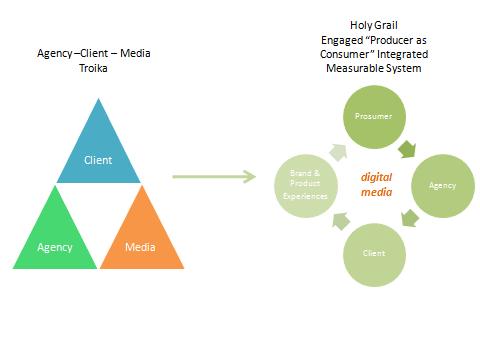
“Bruno Gralpois does an excellent job describing the inclusion of the engaged consumer as a first class citizen in the distribution of brand experiences and he hints at where this new digital world could really go – the inclusion of agency talent at the beginning of the product development cycle rather than at the end.  Human centered design professionals and user experience design professionals are dramatically changing the product development process by getting product teams to focus on the customer needs early and often in the process.  Yet, these professionals are not nearly as skilled as agency talent in capturing the consumers’ emotions, creating engaging stories, and embracing and energizing brand principals and experiences.  Executives should be asking “how do we make the best use of agency talent throughout the product development process” not “how do we cut costs?”  It’s about making sure that products are desirable from the very beginning of product development to ensure early emotional engagement on the part of the prosumer.

“As traditional products become more “digital” the opportunities to include two way communication in the product and new venues for “brand experiences” show up in the unlikeliest places.  As home heating and air conditioning and electrical systems start including digital components, a new or remodeled  house now has a plethora of LCD devices displaying rudimentary information to the consumer.  Yet, these systems can have simple sensors connected to the internet to identify problems long before a failure occurs.  Currently these manufacturers are looking at these information sources as an opportunity to get a little more maintenance revenue, but what if they became a backbone for a whole thoughtful infrastructure like the Nike example.  What if these display devices and systems became an outlet for “green advertising” and every day sustainability awareness and education.

“In the midst of this insurmountable opportunity, lies a forest of risks and difficult issues at the heart of which is “who owns what?”  As the creative work of the agency moves from the relatively simple world of copyrights and trademarks to the digital world of data and identity privacy and software patents, negotiating who owns what becomes extremely complex with lots of billable hours to expensive lawyers.  Mr. Gralpois alludes to the challenges of contracting in the relatively simple world of traditional media which become much worse when trying to protect valuable intellectual property related to software (see the recent position paper from AAAA on “Software and Software Tools:  Ownership and Use Contracting Considerations When Creating Digital, Online and Mobile Content”).  The patent process is an expensive arena to participate at the cost level and in the learning required of the agency software development teams.  Then as the prosumers enter this complex IP world simple user licenses may no longer apply as litigation risks of those who appropriate the user generated content and software and designs increase.  The challenge of just tracking what IP is being used at any one time can seem daunting.

“While the complexity of the advertiser-agency relationship is challenging, adding the prosumer’s rights into the mix is quite confusing.  For the prosumer, the ability to design a new Nike shoe is a huge value add, but what happens if Nike puts that design into mass production?  Is the prosumer owed a royalty stream for their design?  Who would be listed as the inventor for a patent on a new “collaborative” prosumer design?  Many industries invest millions of dollars in “freedom to operate” searches to avoid future patent litigation.  Will advertisers and agencies need to do the same kinds of expensive searches for high profile software based advertising?  Will we see agencies banding together to invest in Intellectual Ventures types of patent holding consortiums to reduce the risks associated with technology development?  Who owns the data that Nike shoes generate about the physical workouts and health of a consumer?  Does this data need to be protected with the same care as medical records?  The answers to these questions must be a part of the intellectual property strategy of the digital agency.

“IP creation, protection, contracting, valuation, brokering, and management become new skills that both the advertiser and the agency must develop as part of the agency management process.  These skills ultimately need a new breed of software due to the sheer volume of content and software applications that need to be tracked.

“The pace of change in the relationship of the new tetrad of agency-client-digital media-prosumer is just beginning.  The old proverb “may you always live in interesting times” is an apt description of the “brave new world” of agency management.

“Throughout the book, I felt that Bruno Gralpois was my personal mentor guiding me through the labyrinth of how to manage the marketing department and agencies to achieve the business results I expect.  I am very appreciative that Bruno Gralpois asked me to review his book as it has changed my view of marketing and advertising from something cloaked in creative mystery to something that can be managed.”

Reading through the book gave me the knowledge and confidence to participate more broadly in marketing discussions that as a business strategist, entrepreneur, and technologist I’d previously stayed quiet.  For those entrepreneurs who have a difficult time understanding why they should spend a lot of their time profiling their users and paying attention to user generated content, I point them to the “Brave New World” chapter.

Content with Context

The books on this list cross a wide range of topics including marketing, learning, technology evolution, creativity, and many business frameworks.  They also deal with the global economy that we now live in and what it takes to be successful creating products, services, and new ventures.  One of these days, I will not only be able to review and recommend such excellent resources but also provide “content with context” so that these books are not just static but instant “just in time” advisers for your current innovation.

Posted in Amazon Kindle, Content with Context, Human Centered Design, iPad, Knowledge Management, Learning, Quotes, User Experience, Value Capture | 3 Comments