Being a Citizen – Jury Duty

Rule of Law

Two months ago, the dreaded jury duty notice showed up in the mail.  Uggh.

I am ashamed to say that my first response was “How do I get out of this?” Then the integrity part of me realized that this is one of the few times I can participate in what it means to be a US Citizen. From past experience, I’ve learned that there is never a good time to serve as there is always something more important. So I filled out the form and sent it in. If I’d read the form carefully, I would have noticed that you can now do this online.  Wow, the Washington Court system has come into the Internet age.

Time flew by and it was time to journey to Port Orchard in Kitsap County to report for duty. The jury waiting room had undergone an upgrade since my last visit 10 years ago. The bailiff and assistants were incredibly cordial and thanked us over and over again for doing our civic duty. The cynic in me looked around the room and wondered why all these losers couldn’t get out of jury duty (stop it Skip). However, my keen observational skills noticed that there was a preponderance of older people and young females. Oops, I am now one of those older people.

We were informed that our case today was a criminal domestic violence case.  We then had to watch a video about the legal process and our role as jurors.  They’d upgraded the DVD production values since the last time I’d reported for jury duty. They also provided us with a brochure that described the same kinds of things.

We found out that there we would be serving on a six person jury in the Kitsap County District Court case. Then we were each handed numbers to pin to our lapels.  While there were 30 of us present, I had a relatively low number. I started wondering what my odds were of actually being selected to serve.

Soon we were marched up to the court room and introduced to all the players – the judge, the prosecutor, the defense attorney, the defendant, and the court clerk. Unlike the Law and Order experience, this court room was pretty cramped.  Unexpectedly, the lawyers and defendant were seated at the same table staring right at us – up close and personal.

With my keen observational skills, I noticed that they’d done a significant upgrade of the technology in the court room.  Instead of a court reporter, everything was going to be recorded. Both the judge and the court clerk had two very large LCD displays with all kinds of information that I couldn’t quite read.  They must have read my recent blog post on the productivity boost you get with multiple monitors. Not!

The judge asked us a set of general questions to determine if any of us should be dismissed for cause.  The judge kept pointing out that being dismissed either for cause or as a result of a peremptory challenge was not a reflection on us personally. As the judge asked whether any of us knew any law enforcement court personnel, I was reminded of my good friend Katherine’s story of her jury experience. As her jury selection dragged on, the judge was getting more and more frustrated with the lawyers and the prospective whiny jury prospects.  When he got to the “do any of you know” question, Katherine raised her hand.  The judge rather testily asked her who she knew in the court system.  She answered “You, your honor. You are my next door neighbor.” After the courtroom stopped convulsing in laughter, the judge sheepishly dismissed her.

No such luck for me today. I know hundreds of lawyers (my daughter and son-in-law at the top of the list) from my ten years building and selling eDiscovery software, but I don’t know any law enforcement officers or court personnel.

Then it came time for the lawyers to ask us their questions. The prosecutor got up and started with the general question about whether we were all comfortable with being able to make a decision beyond a reasonable doubt. He shared that there was a lot of confusion about what “beyond a reasonable doubt” means. As an example, he asked “Do any of you have a reasonable doubt that I graduated from law school?” We all raised our hands and laughed. The wise guy in me wanted to shout out “I hope it was a good law school.” Then I realized that I had no idea if he was a lawyer. I was making the assumption that lots of other people had checked on his qualifications in order for him to be in the courtroom. Even this easy question wasn’t so easy.

Through the rest of the morning and after lunch, the lawyers asked us questions related to our qualifications to be on the jury. One of the prospective jurors with a lower number than me shared that he was worried about his small business while he was on jury duty. After several followup questions he was allowed to leave. Slowly but surely the defense attorney got around to me.

He asked me what I did and I shared that I was a software business executive. He asked me if I was going to have the same problem as the other small business owner. I shared that I wasn’t going to be distracted as I had arranged my schedule to be available for the week.  However, it was clear that I got a black mark on his peremptory challenge list.

While I wasn’t eager to be on the jury and enjoyed the earlier back and forth comparing jury duty with going to the dentist, I also was interested in serving to see what the experience was like.

As the juror numbers were called out for the six person jury, I wasn’t selected. I had answered something wrong or wasn’t the right type. Now I was hurt. I wasn’t good enough to serve on this jury. While I was relieved that I would get the rest of my week back and would be able to attend several of the UW Bothell Innovation Week Forums, I was bummed.

So many are called, so few can serve.

As I emailed my family to let them know that I was dismissed from jury duty for the week, one of my daughters immediately replied and asked what I said so that she could use the same thing to get dismissed from her jury duty in California later in the week. I wish I knew.

As I drove back home, I reflected on this wonderful country we live in with its rule of law. It can be frustrating and unruly at times, but being called for jury duty is another one of those reminders that US citizenship is a privilege.

Posted in Citizen, User Experience, Values | Leave a comment

Observing Users for Software Development

“You can observe a lot by just watching.”  Yogi Berra

Too many years ago, I sat in a sterile conference room at DEC mesmerized by the lecture being given by the talking head on the video, Russ Ackoff.  Ackoff was defining the difference between analysis and synthesis and was using as an example designing the best car.  In describing analysis, he talked about most people starting by benchmarking the best parts at every location in the best cars.  But you notice if you have all of the certifiably best parts, they won’t even go together to build a running car.  He then went on to emphasize that to design well you must start with a process of synthesis.

Synthesis starts first by understanding the context of the system under study.  You then go up to understand the system that contains the system that you are interested in, looking at the collection of systems that make up the containing whole.  You then work out how these systems interact with your system under study.  Only when you’ve figured out how the containing whole system works can you understand the system you want to design for.

As good analytical types, the Extreme Programming (XP) and Agile founders used a process of analysis to come up with the principles and practices of XP.  Their starting point was working against software development teams always being blamed for late delivery of software that wasn’t very usable.  In the end, they did a great job of solving for the problems of the software development team, but they didn’t design in the context of the whole problem.  For example, there is no equivalent of Xtreme Marketing or Xtreme Customer.  The XP designers pushed all of those problems onto a customer representative who would sit with the development team and TELL them the necessary requirements.  The customer representative becomes cut off from the richness of their work context and the development team is reduced to HEARing what is needed to be built.

Research studies on adult learning make clear that the best way to learn is to experience the topic directly.  Instead of telling me how to pick up a baseball bat and strike a pitched ball, show me how to do it.  Then let me quickly try it myself.  Learning can then quickly accelerate if there is an experienced coach operating from a rich framework of how different individuals can master striking the ball.  The coach operating from a mental image of how that person’s physique and skills could best accomplish the task can then give pointers on how to best move from one’s current capabilities to the ideal.

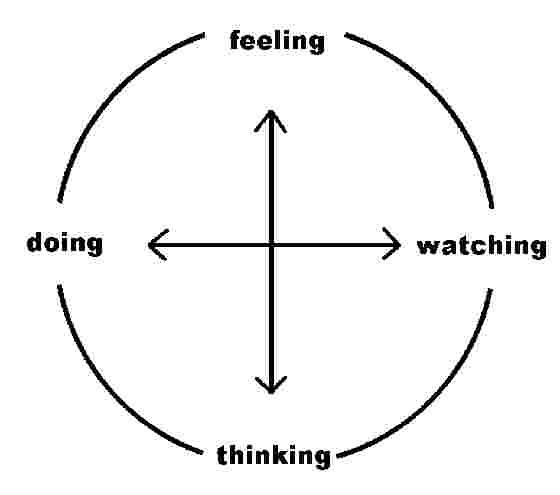
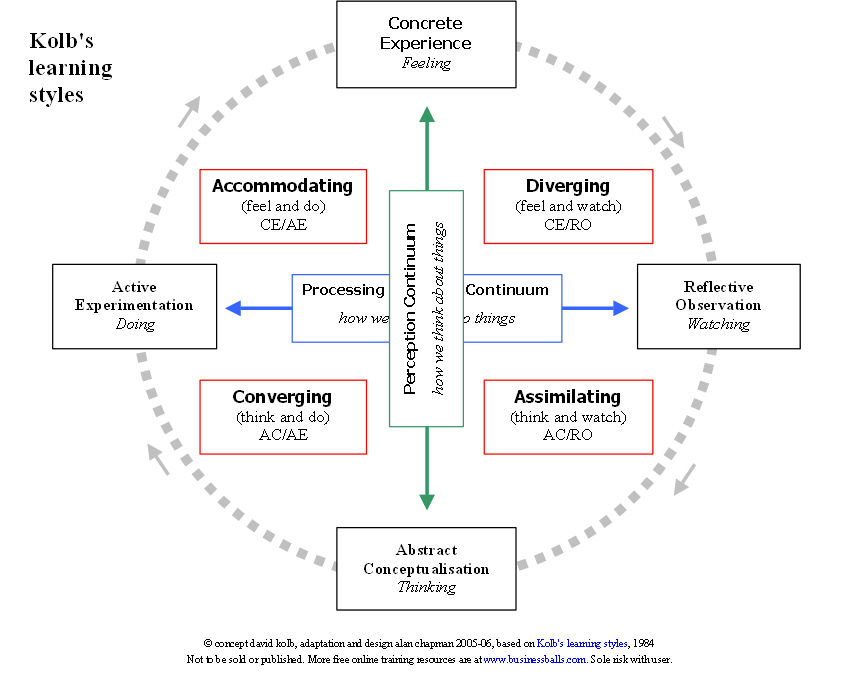
David Kolb is one of the leading researchers on adult learning.  A summary of the process and learning styles is:

“Much of our traditional learning experience has led us to believe that we learn best by listening to experts. It has been found, however, that learning that results in increased self-awareness, changed behavior, and the acquisition of new skills must actively engage the individual in the learning process. In particular, adults have been found to learn more effectively by doing or experiencing.
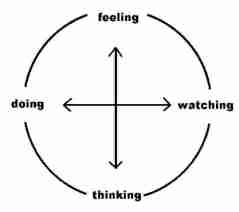
Kolb Learning Styles

Adult learning specialist, David Kolb, has described this learning process as a four-phase cycle in which the learner: (1) does something concrete or has a specific experience which provides a basis for (2) the learner’s observation and reflection on the experience and their own response to it. These observations are then (3) assimilated into a conceptual framework or related to other concepts in the learner’s past experience and knowledge from which implications for action can be derived; and (4) tested and applied in different situations.

The adult learner assimilates useful information into their personal “experience bank” against which future learning events will be compared and to which new concepts will be related. Unless what is learned can be applied to actual work or life situations the learning will not be effective or long lasting.

People responsible for designing learning events should keep these phases in mind as they develop ways to help the learner understand and be able to use the new knowledge and/or skill.”
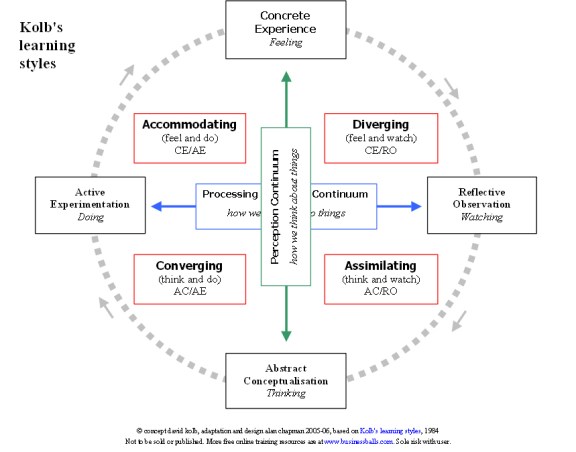
Kolb's Learning Styles

Recent cognitive science research is showing that not only is experiencing a better way to learn, but also how that experience is gained.  My daughter, Liz Walter Shelly, makes this research concrete by illustrating how best to learn to climb a rock wall:

Monkey see lets monkey do

“Watching expert climbers actually can improve your performance…

“What’s the most important muscle for climbing?” my instructor asked for the fifth time. “Your brain,” we dutifully chanted in unison, still a bit skeptical. Yeah, yeah, your brain is important, but our instructor’s splayed limbs demonstrated that he certainly wasn’t hurting for other muscles. Meanwhile on the ground, my forearms were burning after one climb up the 8m wall. (Though in my defense, it was the one with the crazy incline). Still only a beginner, I drool at the nutters on the Banff mountain climbing films and wonder at whether I’ll ever get up the nerve to tap in my own piton, or go on a multi-pitch climb.

“A springboard diver in my past life, I recently caught the climbing bug, and would much rather be trying to crimp my fingers around some miniscule hold than actually working on my dissertation. To alleviate my guilt, I decided to look for links between this thrilling sport and my journal article reading. During my grad student day-job, I study the human visual system. Unfortunately, I can’t tell you why sunsets are so breathtaking, or why you can be looking directly at your keys and still not see them. However, I can tell you a little bit about how it is that we translate a visual image into an action. More importantly, the scientific community at large is starting to understand how it is that just by viewing expert performances, we can subsequently improve our initial athletic attempts.

“Back in 1995, a couple of researchers noticed that the same brain areas active when a monkey reached for a grape were also active when the monkey saw another person reach for the grape. Hmmm, that’s interesting – what you do and what you see are linked at a fundamental neural level. Subsequent experiments found that individual cells in the front parts of the brain seemed to represent complex actions (e.g. reaching, grabbing) no matter whether it was the monkey that moved, or a nearby person who reached for the reward while the monkey simply watched. Furthermore, the cells had preferences for different actions – some brain cells were interested in reaching, some in tearing, while still others preferred bashing or poking. A couple of years ago, another group of researchers found that human brains are activated differently when watching someone else perform movements that they can also do (say, ballet dancers watching ballet performances), versus when watching people performing movement sequences at which they’re not expert (say, a rock climber watching a ballerina). Hmm, that’s interesting – so what you can do influences how you see.

“I’ve always maintained that I dove better during the years that I was “second-fiddle” on the team. Those years at practice I had the pleasure of watching my expert teammates nail dive after dizzying dive, while I struggled to keep up with the number of flips and twists. Lucky me though – as I had the visual reinforcement of their excellence, my brain learned to pattern my own movements from theirs, allowing me to improve by leaps and bounds (excuse the pun). In climbing, one of the most important things any beginner can do to improve her performance is to spend hours watching the pros (or really anyone a decimal-rating or two better). Someone actually studied this for his dissertation already and found that beginner climbers shown a video of an expert climbing a route did better on that route themselves than those shown a video of a novice climber. So, what you see influences what you can then do. At some level this is old news – of course you should watch experts – only a scientist would find something miraculous in any of this. However, the fact that we know that the exact same brain areas are engaged in observing as well as producing motions will allow us to better train athletes, mentally as well as physically.

“In many athletic programs (no matter the specific sport), video technology has taken over practice, allowing athletes to see their performances immediately after they’re executed. My former diving coach would TiVo each practice – allowing us to dive, watch what we just did, and then hop back up and try to improve on it. This helped for some aspects of the dive; for example, I never would believe that my feet came apart during twisters unless I saw it on tape! However, some of the recent research suggests that, while watching yourself is good and all, it’s watching folks better than you that will have the beneficial impact on your brain circuits.

“One last kicker – another set of studies investigating mental imagery found that simply imagining moving one’s finger increased muscle strength in that particular finger. Extrapolating from this suggests that just thinking about yourself ascending that route may actually help you develop the strength to do it. So all those athletic loons that you see staring up at the chalk marks on the wall, making small movements here and there as they decide on foot placement, are really teaching their brain what to expect on the way up. In short, much of the neuropsych research suggests that the best time to train your brain is while you’re resting your muscles. Stare at the wall. Really scrutinize your fellow climbers (well, the good ones, anyway). Of course, any decent athlete knows all of this at an instinctual level already. But hey – you’ve now got a great excuse to hang out and watch the experts for an extra hour as your muscles recuperate… Of course to see if you’ve learned anything, you’ve got to get out there and actually climb it.”

By removing the customer’s context and any direct experience of their total problem/opportunity, the XP development team cuts off significant information streams.  One of the first things I learned in my ten years of studying and teaching at the Institute of Design (ID) of the Illinois Institute of Technology, is that humans are very inarticulate at describing how they perform some complex behavior or what they might need in order to improve it.  It’s one of the many reasons why interviews or focus groups do not lead to successful designs.  At ID, students are taught to observe, observe, observe.  They quickly learn that humans are extremely articulate in their actions and behaviors.  You just have to observe them.

A core technology in observing people is the use of video ethnography.  That’s a big social science phrase for simply videotaping people in the context of their actual work so that you can study, deconstruct, and share the results with others.  This technique is a staple of athletic teams from young children to professionals.  Yet, it is little used in business where it proves to be even more valuable.

My first introduction to the power of video ethnography was on my first visit to ID.  Over my 40 years of building and managing software product development, I’ve searched for a way to design a product right the first time.  I’ve looked in hundreds of places for that magic elixir.  I’ve been frustrated out of my gourd with all the usability (UX) professionals who tell me my product sucks after I build it, but have nothing to say when I start to design.

Then in 1992 while visiting the Institute of Design of the Illinois Institute of Technology, my views on design were transformed by a five minute video from a student class project.  This video was my first introduction to the power of user observation.  Sitting in a miserable concrete walled classroom on the 13th floor of a non-descript research building over looking some of the worst slums of South Chicago, I could barely hear the nervous student introducing his project.  It had something to do with improving the ability of the business traveler to work in a hotel room.  As someone who usually travels 150,000 air miles a year and spends >50 nights per year in hotel rooms, he had my attention, if not my expectation that he could shed any light on a frustrating environment.

The student created a relatively simple task for a male and female pair of business colleagues.  The pair had to create a business report in a hotel room, and then type the results into their laptop PC.  In the process they had to confer with other employees over the phone to get information for the report.  The student would videotape their activities in the hotel room for later analysis.  The first several minutes of the videotape showed the awkward dance of the professional colleagues trying to find a work surface that would accommodate their needs, while avoiding the cultural taboos associated with the only work surface available – the bed.

The pair searched in vain for something that would work and yet the bed remained the only place that is large enough, was convenient to the phone, the power outlets and the available light.  The pair finally concludes that the bed is the only viable place and they start to lay their papers and computers on the bed.  They then realize that there is no comfortable place to sit.  The single chair in the room is too high for the bed surface.  Yet, it hurts to kneel on the floor and it is awkward to sit on the bed without disturbing the papers and computers.  Throughout all of this trial and error, the male and female are trying not to invade each other’s personal space so that they don’t cross the line into intimacy.

After five minutes of trying to work, the pair throws their hands up and quits the exercise.  They cannot get work done in that environment.  I was amazed at how completely the five minute video transformed my experience as a business traveler from unnamed frustration with a hotel room as a work environment to being able to clearly articulate my frustrations.  And in that moment, a solution space opened up for tens of ways to transform the business traveler’s hotel working experience.  No interviews were needed.  No audio was even present on the videotape.  Just watching the interactions said it all.  The student also showed some interviews with business travelers that provided no insights on either the problems or the solutions as a counterpoint to the power of user observation.  Even though we might be experienced business travelers, we are not usually conscious about what bothers us to be specific about the problems.

Even more impressive was that the video was generated by a Master’s student as part of his first seven week course on user observation.  Over the years one of my first tests of a method or process is how quickly can a student pick up a process or a technique.  I have seen many techniques where the inventor or teacher could reliably perform great work, but none of their students could master the technique.  Clearly, here was a process that was both powerful and could be mastered quickly.

Performing user research is relatively easy.  In its simplest form it is just finding an appropriate place to observe users and then make notes on a pad of paper.  In its most complex form it is being able to have video cameras and recorders in place so that a team of researchers which typically include anthropologists and social scientists can extensively review the interactions captured for deep analysis with formal methods.

Examples of the professional use of these techniques come from McDonalds, Amoco, and Personal Health Connections.  About ten years ago, McDonalds was interested in understanding why Taco Bell locations were up to 50% more profitable per store than were similarly located McDonalds stores.  The Doblin Group was engaged to research this topic and was able to instrument several McDonalds locations and a few Taco Bell locations with several cameras.

After viewing hundreds of hours of videotapes and generating several insights and hypotheses as to what was going on, one of the anthropologists came up with a curious difference.  At Taco Bell, the store was laid out such that all of the servers spent most of their time either face on to the customers or sideways to the customers.  While at McDonalds, servers spent greater than 85% of their time with their back to the customer.  Doblin Group coined this observation “Backs and Butts”.  If you recall the last several times you visited a McDonalds, the backs and butts of the servers tend to be quite large and unattractive.

So with this insight and hypothesis, the Doblin Group set out to test the notion in a few remodeled McDonalds.  Almost overnight the revenues and profits increased in these locations to levels higher than what Taco Bell was seeing and considerably higher than stores laid out in a traditional McDonalds style.  The good news is that the researchers proved their case; the bad news was that McDonalds was unable to depart from their tradition of “this is the way we design our stores.”  It turns out that most of the McDonalds management was home grown and had started as servers or cooks in a local McDonalds.  They weren’t about to change the formula that had made them quite wealthy.

Doblin Group was commissioned by Amoco to figure out ways to make their retail locations more profitable.  It turns out that gasoline is sold pretty much the same by all oil companies and the margins are pretty much the same.  Amoco asked if there was a way to dramatically improve profitability by observing the ways that users buy gas.  While Doblin did a very systematic overview of the retail operations and came up with a system of innovations that is breathtaking in its scope and inventiveness, it was the interaction at the gas pump that captured my imagination.

Similar to McDonald’s Doblin fitted a gas station with cameras from just about every angle.  One of the things they noted was the dance that users went through to figure out how much gas they were putting into the car.  Users were contorting themselves in all kinds of ways to keep their eye on the pump handle and the gas flowing into the car as well as try to eye how much money was cranking away on the pump display.  The Doblin folks called this the “gas pump watusi” after a dance step popular at the time.  The solution was pretty straightforward – move the gauges to the gas pump handle itself.  Similarly, the social scientists observed that after filling the car themselves that most people made a trip to the rest room to wash off their hands.  So they located wash stands at every gasoline island.

Based on these observations and several similar ones, Amoco built four service stations to these specifications in Indianapolis, IN.  Immediately these stations generated 2-4 times the revenue of similarly located Amoco and competitor stations and were hundreds of percent more profitable.  The bad news was that Amoco underwent a reorganization and subsequent acquisition by BP and the innovations were never brought to life on a wide scale.

At Personal Health Connections (PHC), user observation was accomplished with several subjects who agreed to help us understand the process of dieting and weight management that they used.  A simple camera study and weekly interview process was carried out over three weeks.  The patterns of change fell into three very distinct categories:  planners, trackers, and storytellers.  Planners took a top down approach to losing weight.  They established a goal and developed activities that would help them lose weight and then monitored their results daily.  Trackers were just the opposite.  They took a bottom up approach which started with the monitoring of their daily weight and activities.  Based on tracking what they actually did, they slowly started to generate some goals that would fit their activity pattern.
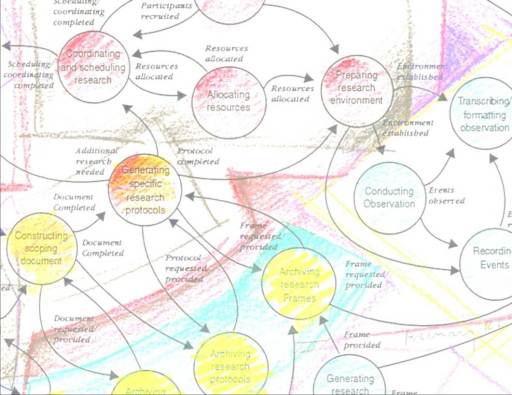
PHC User Research Model

The third category of users was the story teller.  They wanted their information presented to them in the form of stories and all of their goal setting and tracking was done in the form of telling stories.  Each activity had a cast of characters, action, a plot, and an ending.  We quickly realized that the design of the website had to accommodate all three user types and that one design probably wouldn’t work for all three.  If you look at many of the best web sites today you will see functionality that appeals to each of these types of users.  What we did at PHC was to have a quick diagnostic in our first interactions with a user to let us understand which type they were and then we accommodated their need with an appropriate user interface.

The hardest of these types to accommodate is the story teller.  It is relatively easy to present information to the user in the form of stories, but much more difficult to take what appears to be unstructured text and make sense of it.  That’s one of the many reasons I’m excited about the technology we worked on at Attenex.

With computer based products one of the challenges is not to confuse user observation with usability.  Both are important but they are different.  User observation is about situating a user’s actions in the context of their daily life and understanding the Whole Process that is required to meet their intent or goals.  The observations ground themselves in a structure of observation, contention (does the observation lead to a positive or negative consequence), and what user value or values are supported or not by the users actions.  Usability tends to be focused more narrowly on how the computer program functions match the users understanding and expectations.  The big ideas that will lead to 10X productivity improvements are most likely to come from user observation.

As I reflect on the last 40 years of product development, the pattern that continually repeats is how well the first sets of prototypes for a product unconsciously employ the techniques of user observation and human centered design.  For many startups the need for their product arose out of the frustrations of the founders with existing ways of doing things or by observing some frustrated user segment trying to accomplish some task that the founders had the insight to do better, faster and cheaper.

As the deadline pressures grow and the need to generate revenue grows, designers and developers tend to quit observing users on a regular basis.  I am constantly amazed at how just small doses of user observation lead to such profitable insights.  For at least the first year of Attenex, we had the gift of being closely and intimately co-located with Preston Gates and Ellis.  A top priority for a company is setting up the infrastructure and processes so that observing users as they go about their daily work is an integral part of the product development and business development process.

As you go about the world looking for opportunities to find that “latent unmet need” use your observational skills to “see what really matters.”


Posted in ALL-IN-1, Attenex, Attenex Patterns, Design, Human Centered Design, Innovation, Software Development, User Experience | 5 Comments

Integrity – Easily Lost, Hard to Regain

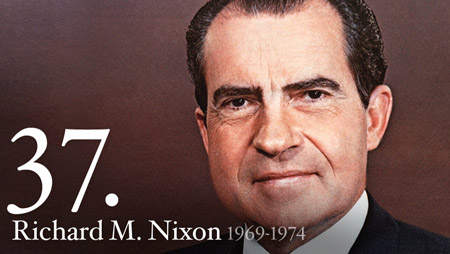
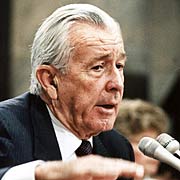
In writing the blog post on “Succumbing to the Ultimate Power Trip,” I was reminded of a bookend to this experience. One of the more interesting players in the Watergate affair was Egil “Bud” Krogh. Bud was the 32 year old Nixon White House staffer who was put in charge of the Special Investigation Unit (The Plumbers) which led to the Watergate Scandal.

Egil "Bud" Krogh

Bud’s story is wonderfully captured in his book Integrity: Good People, Bad Choices, and Life Lessons from the White House. I was fascinated by the Watergate break in and Bud’s role in it, but had lost track of him.  A couple of years ago, my colleague Marty Smith from Attenex days, invited my wife and I to dinner with several other families and Bud Krogh.  I had no idea that Bud lived in Seattle and had been practicing law here.  Marty shared that Bud had just written a book about his experiences and was starting on a book tour.  I immediately ordered the book to be better prepared for the dinner.

As one who values integrity but struggles to meet my own high standards, I was enthralled with the book. With the distance of time in writing this book, Bud captured so wonderfully his own aspirations, his integrity lost, and the life long struggle to regain his own integrity.

Wrapped around Bud’s story is also the story of Richard Nixon. Bud revealed many different sides to Nixon that I’d never read about. Chapter 7 in the book relates the amazing story about Nixon going to the Lincoln Memorial in the midst of Vietnam war demonstrations.

The interesting correlation with Bud’s story is I had come up to DC with my roommates from Duke University to protest that weekend, but we didn’t stay on the Capital Mall.  We spent the night with my roommate who lived in Silver Spring, MD.  So I missed this moment of history.  When Bud and I were talking about the event at dinner, all of a sudden he looked over at me and said “You were there weren’t you?”  I nodded.  And then with a gleam in his eye, he asked if I was on the “other side” like his current wife.  “Of course,” I shared.

Here is a glimpse of Nixon from Chapter 7:

“Although Richard Nixon was important to me as an authority figure, I became much closer to him personally when I followed him during one of the most moving, bizarre, and potentially dangerous ventures of his presidency. For the first time, I observed him in a crisis mode digging deep into his reservoirs of intellect and emotion. What I saw him say and do that day affected me strongly and bound me more closely to him than ever before. The episode began with an alarming message from a Secret Service agent.

“‘Searchlight is on the lawn!’ I looked up in shock as these tense words about the location of ‘Searchlight,’ President Nixon’s Secret Service code name, crackled over the loudspeaker in the Service’s command post in the Old Executive Office Building. It was 4:15 A.M. on May 9, 1970.

“A few hours before, in the evening of May 8, the president had explained in a news conference why he had ordered a military “incursion” into Cambodia. His comments had added fuel to the firestorm of frustration and rage among tens of thousands of students and other antiwar activists around the country. Those activists and students who lived closest to the District of Columbia were headed directly to the capital to vent their anger and grief. We had good reason to fear a violent and possibly lethal confrontation.

“The president’s news conference the night of May 8 followed the tragedy at Kent State University in Ohio just a few days before on May 4. The Kent State protest, like others on campuses throughout the country, was organized after news of the president’s decision to attack Cambodia first became public knowledge on April 29. At Kent State, Governor John Rhodes had called up the National Guard to help maintain order on the campus. When the inevitable clash occurred, young, frightened National Guardsmen, who had been issued live ammunition, fired on a rock-throwing group of angry students, killing four of them. The picture of one girl kneeling next to the bodies and looking up in shock and anguish had already been widely reprinted, searing the minds of millions around the country. The Kent State killings were a painful and forceful reminder to me not to allow our government defenders to overreact and precipitate a worse tragedy. In The Haldeman Diaries, former chief of staff Bob Haldeman noted that when Nixon heard the news about the Kent State killings on May 4, he was “very disturbed.” He was “afraid his decision set it off.” Haldeman and the president talked that day about how they could get through to the students but came up with no plan.

“I had just come into the command post to ensure that preparations to fortify the EOB and the White House were completed in preparation for the potentially violent protest that was brewing outside. Right after the first Secret Service announcement that “Searchlight is on the lawn” came a second: “Searchlight has asked for a car.” These two announcements made no sense to me and sounded extremely ominous. The president was supposed to be asleep in the White House residence. All of our security precautions were predicated on keeping him safe within the White House grounds. Not once in our crisis management group meetings did anyone envision the possibility that the president would venture out on his own during this volatile, potentially incendiary day. Certainly not two hours before dawn. . .

“Right after the second announcement that the president had called for a car, I phoned the White House signal operator and asked him to ring John Ehrlichman immediately. When John answered and mumbled, “What’s up?” I told him that the president was at large and had called for a car. “Go over to the lawn and see if you can render assistance.” “Yes, sir!” I answered and then warned the Secret Service duty officer that I was going to be moving at speed over to the West Wing. I ran across West Executive Drive, sprinted past the White House police desk inside the ground-floor West Wing entrance, took the steps two at a time up to the first floor, and arrived at the Rose Garden lawn just in time to see the president’s limousine disappear out the south entrance next to the Northwest Gate.

“After checking quickly with the Secret Service agent on duty, I learned that the president was heading to the Lincoln Memorial. I called Ehrlichman to let him know the president’s destination and then immediately called for a car and directed the driver to take me there. After a high-speed ride, we arrived at the Memorial about four minutes later and stopped right behind the president’s limousine, which was idling against the curb on the street between the Reflecting Pool and the Memorial. I ran up the steps but then slowed down when I saw the president talking with a group of students just inside the Memorial to the front and right of the famous statue of a brooding Lincoln sitting in a chair. It was still dark.

“President Nixon was talking earnestly to about eight or ten students who had formed a loose circle around him. Manolo Sanchez, Nixon’s valet, and Dr. Tkach, the physician who usually accompanied the president, were standing off to the side. Dr. Tkach looked tired and very worried. Other students were gradually moving over to join the circle when they realized who was there. Most disturbing, I counted only four Secret Service agents in the president’s detail-a frighteningly small number for such a potentially dangerous situation. They were positioned around him so that they could maintain a 360-degree observation. I could tell from their faces that they were as fearful as I was. As Nixon wrote later, “I have never seen the Secret Service quite so petrified with apprehension.” He certainly got that right.

“From the back of the circle of students, I leaned in closer to observe the president and hear what he was saying. As I wrote later that day, “It appeared that he was trying very hard to reach out and into the students, to communicate with them…. He did carry the conversation for the most part … but this was necessary as the students themselves had hardly anything to say, and were too stunned to respond at all. His manner was reminiscent of the campaign where he would go into a group of people, shake hands and comment on those things which popped into his mind.”

“And a lot popped into his mind. The vast range and mastery of the subjects he discussed was monumental. That he could offer these ideas around 5:00 A.M. after just an hour of sleep made it an even greater tour de force of intellect, compassion, and focus. Although I could not hear every word he spoke, I was awed and moved by what I did hear. All of my previous meetings with the president had been somewhat formal briefings in the Oval Office or the Cabinet Room. This was the first time I had heard the president speak extemporaneously and straight from the heart.

“In a memo Nixon dictated on May 13 about “what actually took place at the Lincoln Memorial,” he expressed frustration that neither Ron Zeigler (who didn’t join our traveling group until we were just leaving the Capitol) nor I got a clear understanding of what he was trying to communicate. He felt that we were too focused on the practical aspects of the visit-when he got up, how he looked in reaching out to the students, what he had for breakfast-than what was really important. He wrote that his staff “are enormously interested in material things, what we accomplish in our record … [but] very few seem to have any interest and, therefore, have no ability to communicate on those matters that are infinitely more important-qualities of spirit, emotion, of the depth and mystery of life which this whole visit really was all about.”

“The important thing was to communicate deeply significant ideas about our country, its problems, and their lives to students who might never have a chance to see and hear a president again. He told the students that his favorite spot in Washington was right there-the Lincoln Memorial at night.

“He then asked if any of them had seen his press conference. Because most of them had been traveling the night before to get to D.C. to protest against him, only a few hands went up. He said that he was sorry they had missed it because he had explained during the conference that his ‘goals in Vietnam were the same as theirs-to stop the killing and end the war to bring peace. Our goal was not to get into Cambodia by what we were doing but to get out of Vietnam.'”

The whole book is just incredible reading. Bud and I got about 30 minutes to ourselves during the picnic dinner.  He talked about many things he couldn’t put in his book about Nixon and the enigma that he was.

I also wanted to know how Bud could possibly make it through the prison sentence.  He shared that he took one book with him to prison – Frankl’s Man’s Search for Meaning which is one of my favorite books.  I was also fascinated to understand how as a convicted felon he could get reinstated to the practice of law.  Chapters 11 and 12 described his long process to readmission to the Washington State Bar.

Donald Rumsfeld

However, what really galvanized the discussion is how many of the Richard Nixon and Ronald Reagan advisers were invited back by Donald Rumsfeld to provide advice on how George W. Bush should deal with the mess in Iraq.  Bud was astounded at their arrogance and unwillingness to take any input from the folks who had made a mess with Nixon.  Bud was appalled as he watched the same patterns repeat even when he’d pleaded with the Bush folks not to make the same mistakes.

After the dinner with Bud, I was in DC a couple of weeks later for a conference.  I spent several hours one evening seated in Lafayette Park trying to imagine then president George W. Bush walking down to the National Mall to meet with demonstrators.  How much the world has changed in 40 years.

Bud’s book is an incredible story and the man is even more interesting (actually both Bud and Nixon).

Posted in Content with Context, organizing, Relationship Capital, social networking, Values | 3 Comments

Succumbing to the Ultimate Power Trip

While at lunch with a colleague the other day, we got to talking about different aspects of power.  I asked if my lunch partner had ever experienced the “power trip” that is the White House environment. “No, why?” was the answer. So I shared my own small introduction to the White House experience as an example of how easy closeness to power changes your behavior.

In the late 1970s, I read every book I could find about what went wrong with the “best and the brightest” that were running the White House during the Nixon years.  I couldn’t understand how such supposedly ethical men could mess up and create the Watergate scandal.  Woodward and Bernstein’s All the Presidents Men was one of the key books but there were lots of others like Jeb Stuart Magruder’s An American Life: One Man’s Road to Watergate.

While I could understand the stories at one level, I still didn’t understand how these professionals could go so astray so quickly. Then in one short week, I got my own glimpse of how being at the seat of US power – the White House – can change your behavior so quickly.

One Friday night in 1985 while heading up the development of DEC’s ALL-IN-1 in Charlotte, NC, I got a call which started with “this is the White House calling.”  I immediately hung up the phone because I didn’t have any time for joking around.  The phone rang again and started “don’t hang up this is indeed the White House calling.”  I still wasn’t having any of it so hung up again.  The phone rang for the third time and I decided to play the game to get done with it.  These two guys got on the phone (the next week I found out they were two captains seconded from the Pentagon) and demanded that I get on a plane and come up to DC that night to install ALL-IN-1 on their VAX machine in the Old Executive Office Building.

I told them “No, that is not how we work.”  I told them I would be up Monday morning.  I shook my head and went back to work.  Over the weekend I laughed and realized they could send the IRS and FBI after me.  What was I thinking?

Don Regan

So Monday morning I go up to DC and meet with these two young military eager beavers.  It turns out that Don Regan had just been named Chief of Staff for Ronald Reagan and when he got to the West Wing he was appalled to find out that there were no computers, only typewriters.  From his days on Wall Street, Regan couldn’t imagine how any organization could function with out computers.  So he yelled and somebody at the Pentagon came running and assigned the two captains to make an “office automation system happen.”

The two captains hired a truck and went over to NASA and wheeled out one of DEC’s largest VAX/VMS 780 machines and brought it to the Old EOB.  They then called up the number two executive at DEC, Win Hindle, and asked him what software they should run. Hindle suggested they give me a call and that ALL-IN-1 was the software that they needed.  I spent the morning with them trying to understand what their needs were.  Their goal was to get the system up and running so they could demo the software to Regan at the end of the week.  Everything out of their mouths was Regan ordered this and Regan ordered that.

As usual, a lot of things weren’t working.  So I got on the phone and started calling for help – back to the team in Charlotte and to our support folks in Massachusetts.  Nobody was paying any attention to me and the Captains were breathing down my neck.  Here I was seated in the Old EOB at the center of US political power and it took about 3 hours for me to become like everything I’d read about the best and the brightest at the Nixon White House.  Everything was god awful important and I wanted immediate answers and expected immediate actions.  In three short hours I’d become one of “them.”

The other thing that fascinated me is how little security there was in the Old EOB.  I just had to show my drivers license to get in.  I was escorted to the computer room but nobody stayed with me.  I could wander the halls with ease.

We worked round the clock for a couple of days and then while waiting for software to install, I asked the captains how long they’d known and interacted with Regan.  They looked at me sheepishly and finally confessed “Well, actually we’ve never met or talked to him.  The demo on Friday is going to be the first time we will meet with him.”

I looked at them and went “You mean you’ve been jerking me around all week and telling me Don Regan demanded this and Don Regan demands that and you’ve never even met the man?”

Not looking at me, they said “Yes, that’s right.”

I picked up the phone and called the local DEC office and asked if they had somebody that was trained on ALL-IN-1 and had a security clearance and was used to dealing with government agencies.  They did indeed.  So I politely asked them to get the person over to Old EOB as soon as it was reasonable.  I turned to the Captains and said “You don’t need me.  I’ve arranged for somebody who is used to dealing with your power trips to come help out.  I’m headed back to North Carolina to get back to developing the next version of ALL-IN-1.”  And I walked out shaking my head at how quickly I had become one of them.

The postscript to this story was a couple of years later the Ollie North Iran-Contra affair blew up because of an email that wasn’t deleted when Ollie hit delete.  The email software was ALL-IN-1.  We put the automatic archiving feature in as a way to distinguish our software from our competitors.  We thought every user knew that.  Clearly Ollie didn’t.  For many months we lived in fear that the press would point out that it was DEC’s ALL-IN-1 software that was used.  I don’t think it ever became public.

Since that time when I am at my patient best and in the middle of the vortex of power environments of senior executives asking me to do something “immediately,” I pull out the Deming “5 Whys” to get the back story on why we are being asked to do something. It amazes me how this simple process can calm things down and get at the intent of what is needed versus a “knee jerk” demand.

Posted in ALL-IN-1, Content with Context, organizing | 1 Comment

Easy Productivity Boost – Multiple Monitors

Seeing this NY Times article, I was reminded of one of our key recommendations for boosting productivity in eDiscovery – make sure each lawyer reviewer has multiple monitors. From a capital investment standpoint, multiple monitors are very inexpensive and pay for themselves in a matter of weeks. From the study at the University of Utah:

“At the very least, Professor Anderson said, more monitors cut down on toggling time among windows on a single screen, which can save about 10 seconds for every five minutes of work. If you have more than one monitor, he said, “You don’t have to toggle back and forth. You can take in everything with the sweep of an eye.'”

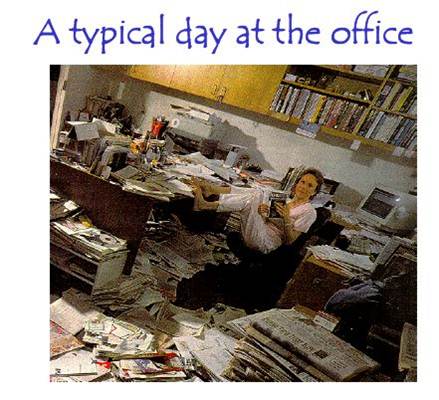
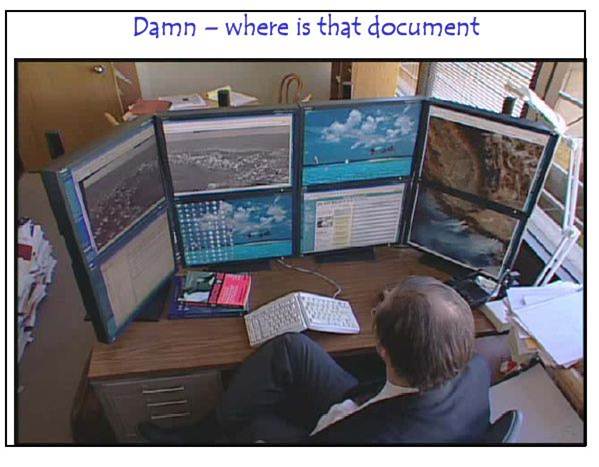
John Seely Brown used to make the point about multiple monitor productivity by showing Esther Dyson’s office versus Stu Card’s office.

A typical day at Esther Dyson's Office

I had eight screen envy when I saw Stu’s setup (I only had three monitors at the time).

Stu Card's Desktop Command Center

However, if you look closely at Stu’s setup in the lower left you can see the documents he moved off the desktop for the photo shoot.  Indeed, multiple monitors aid productivity but they never get rid of the paper.

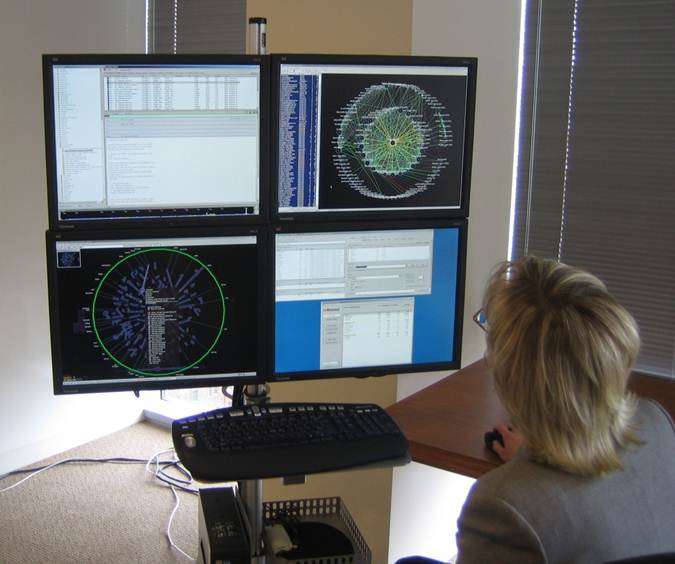
At Attenex, we recommended at least three screen for productivity and always demoed our product on a four screen system:

Attenex Patterns Demo System

So for a quick productivity boost, add an extra monitor.

Now the next technology boost I want to see is to get the benefit of the terrific resolution of iPads across multiple displays.

Multiple iPads Ganged Together?

Keep dreaming Skip.

Posted in Attenex Patterns, Big Data, Content with Context, Human Centered Design, iPad, User Experience | 1 Comment

Idealized Design Qualities for a University

In many ways our universities are a four hundred year old anachronism.  In the last twenty years with the expansion of the Internet for content, connections, and communications, the world of learning is in a different state.  As Brynjolfsson and McAfee point out in Race Against the Machine, with computing we are on the second half of the chessboard.

So knowing what we know now, how would we re-design the university if we could start from scratch.  Russ Ackoff suggests starting an Idealized Design process with the articulation of the qualities you would like to bring into being for the system under study.

The following is my list of qualities for the new university:

  1. Learner centered design.  Everything about the new university is aimed at creating life long learners.
  2. Project Centered learning.  Using the “collaboration by difference” promoted by Cathy Davidson, the primary mode of learning is to engage the students in real world projects. The projects would be diverse horizontally (multiple disciplines from the digital humanities to eScience to the arts) and vertically (undergraduates, graduate students, post-docs, and professors).
  3. Computational foundation. Building on the 4th “R” recommendation of Cathy Davidson, each student would develop a computational competency.
  4. Content and context come forward to replace the structural forwardness of today’s university. Students will be assessed on the competencies they build rather than the credit hours they attend (see Jennifer Turns comments on structural forward aspect of the university).
  5. Students as teachers. The person who learns the most in the classroom is the teacher. Change the role of the student as passive learner to active teacher.
  6. Tangible knowledge production and “publishing” as core competency. Instead of “make work” artificial assignments, the students and professors should use all contact time to “produce” digital media content (including the physical realm with 3D printing).
  7. Focus on the development of critical thinking skills. Move up the learning hierarchy from rote multiple choice assessment learning to critical thinking.
  8. Systems thinking. In addition to learning the skills of analysis, students should learn to see and think in terms of systems.
  9. No walls and no silos. Instead of constructing sterile classrooms, we should be building virtual environments that are supported by project meeting spaces (virtual and physical) and eating/gathering spaces. Multi-disciplinary teams should have project spaces and shared cooking/eating spaces. Instead of the silos of narrow knowledge departments, organizing should occur around real world projects.  (See MG Taylor Corporation examples of built environments for project and innovation teams.)
  10. Art producing. Make art together every day.

What is your list of the qualities you would want to have for an idealized design of the university?

Posted in Content with Context, Human Centered Design, Idealized Design, Innovation, Intellectual Capital, Knowledge Management, Learning, organizing, Teaching, University, User Experience | Leave a comment

Growth Partners

Growth Partner

Working with startup entrepreneurs, I am often asked “What else should I be thinking about?” Invariably the answer is “what are you doing to create growth partners?”

The experienced startup entrepreneurs will think through and develop plans for a channel strategy to get to market.  Yet, most entrepreneurs don’t think in terms of growth partners in the insightful way that Mack Hanan has published for 20 years.

Mack Hanan in Competing on Value describes the importance of a Growth Partner:

“How can you grow your business?

“You cannot.

“You can only grow someone else’s business.  His business growth will be the source of your growth.  By growing, he will force growth back upon you because he will want you to grow him again.

“The businesses you can grow have a name.  They are called your major customers.  Their growth must be the objective of your business.  The capabilities you require to grow them must be your asset base.

Growth requires a partner. A growth partner is a special kind of customer.  He is a customer whose costs you can significantly reduce or whose profitable sales volume you can significantly increase.  In one or both of these ways, you can improve his profits.  This is the basis for his growth.  It is also the basis for his contribution to your own growth.  As the two of you grow each other, you will become mutually indispensable.

“If you cannot grow a customer, you cannot partner him.  You can continue to do business with him, buying and selling, but the maximized profits of growth will elude both of you.  If all your cusotmers are buyers instead of growers, you will be a slow-growth or no-growth business.  None of your customers will be growing you because you will not be growing them.”

It is a joy for me to see the “Ah Hah!” expression after a few moments of thought on the part of the entrepreneur.  Until this moment of comprehension, I think most entrepreneurs believe they are in control of their own business. Hanan’s simple question “How can you grow your business?” with the counter-intuitive response “You cannot” is an eye opener for the entrepreneur.

As you think about your business, who are your growth partners? How are you helping them grow their business every day?

Posted in Idealized Design, Innovation, organizing, Relationship Capital, Value Capture | 3 Comments

Visuals Speak to Me – Quite Loudly as it Turns Out

I am a very visual person, although I have more of an ability to recall those things I’ve seen rather than being very good at creating visuals.

This week my cup overfloweth with colleagues and students pointing me to some great uses of visualization – Amazon Books and VisualsSpeak.

Dan Becker, a student in Professor David Socha’sEvidence Based Design” course at UW Bothell sent a pointer to a new service to visualize book linkages from the Amazon data feeds.  He’d come across the service in an article on mediabistro.  So I cranked it up and as a test put in Russ Ackoff’s name as a test.  It was with amazement that I saw what feels like a good portion of my business library of books come out in the diagram.  I particularly love the rank ordering and information on any specific selected book.

Ackoff Books on Amazon

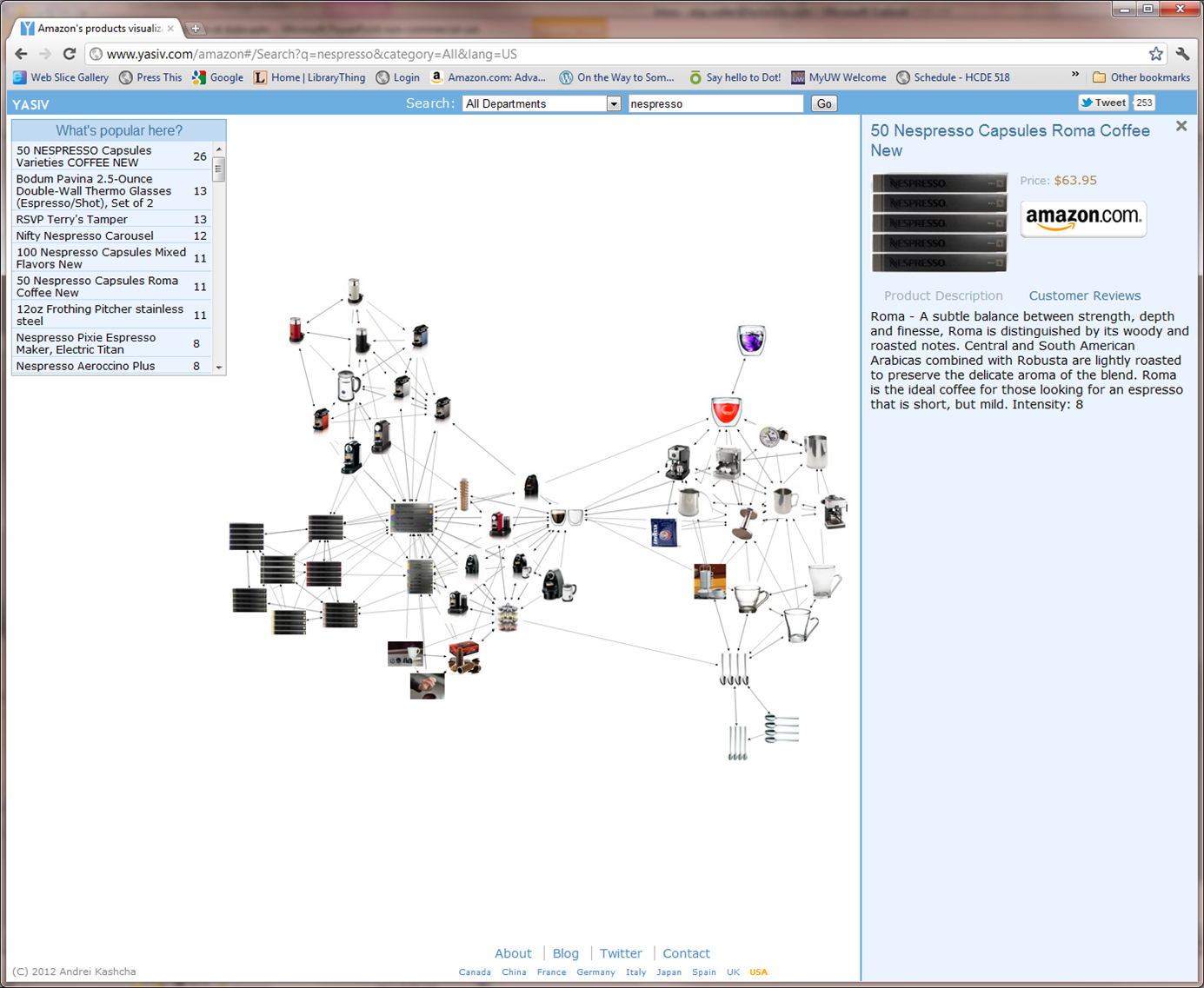
The developer, Andrei Kashcha, rapidly responds to user feedback and a recent innovation allows you to bookmark the feature and when you are at an Amazon product page you can click on the visualize option to see what the product is related to.  It was a hoot to visualize all of the Nespresso products at Amazon:

Nespresso on Amazon

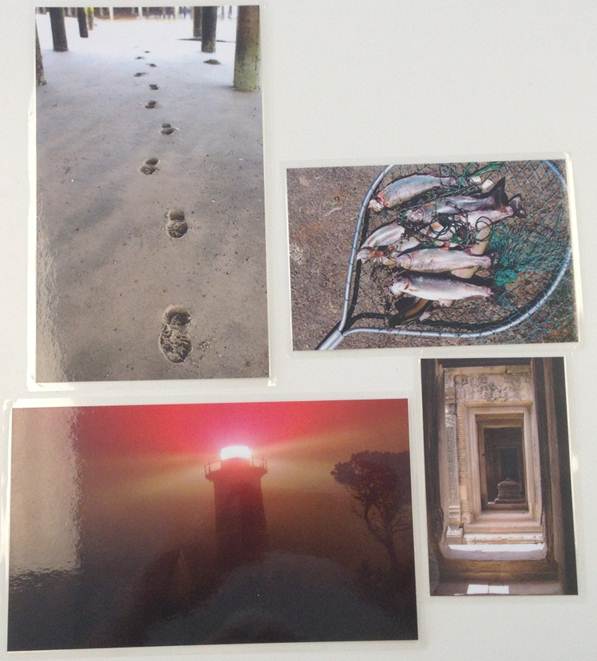
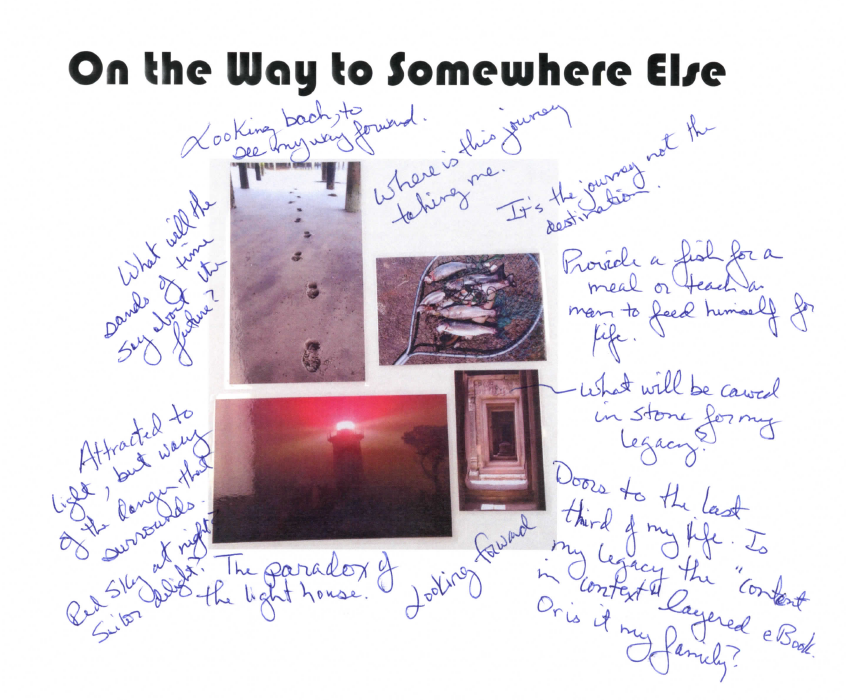
As part of a team visioning process last weekend, Sylvia Taylor introduced the VisualsSpeak Image Set. She spread out 200 images on a couple of tables.  The idea was for each of us to explore the question of “What we want for our future?” and then find in a few minutes the images that spoke to us.  Then we were to arrange the images to be able to tell a story. I selected the four images below:

What does Skip want in the future?

I wanted to take my photo editing tool and resize some of the photos so I could get the layout I wanted, but this was a one size fits all. So I arranged the photos in a “Z” eye movement arrangement.  The story I told went something like:

“I am standing in the present looking backwards at my footprints in the sands of time at the journey that I’ve been on for these sixty years.  As I turn around to look at my future, I see the ‘net of knowledge’ that reminds me that my passion in life is teaching others to ‘fish’ like the old Chinese Proverb ‘Give a man a fish and he won’t starve for a day.  Teach a man how to fish and he won’t starve for his entire life.’

“In teaching others about their future path, I try to be the light that is both attractive and yet warns of the surrounding dangers. Yet, as I walk through the doors of the years, I can now glimpse the end game of live.  I wonder what the carving in the stone over the final resting place will have to say about my life’s legacy.”

Sylvia suggests we take a picture of our images so that we can print them out and do additional work reflecting on what those images mean.  A couple of days later, I print out the images and write what comes immediately to mind.

What I want?

Amazing.  The visuals really do elicit a different set of thoughts and ideas than what is coming out of my “writing my way into existence.” I start thinking of this process as “visualizing my way into existence.”

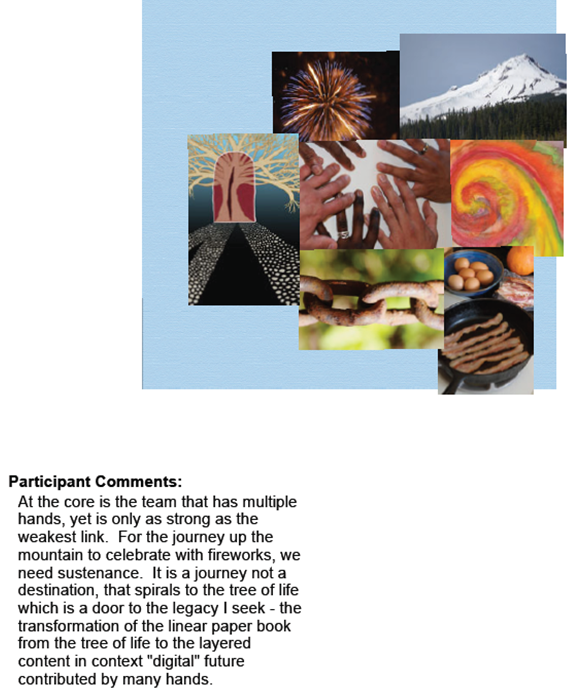
I am interested in trying out the online version as Sylvia shared that the ImageCenter has images of paintings that the founder Christine Martell created.  I was secretly hoping that I would have the same images to choose from so that I could recreate what I did with the Image Set and be able to resize the images.  However, the images were completely different.  OK, Skip, go with the flow.  So I picked the same question we’d used at the start of the group envisioning process “What do I want in the future?” Out came the following (see full PDF):

What do I want in the future?

I couldn’t believe how easily the text flowed out of the images to describe what I was thinking and feeling in the moment. However, the rest of the team that participated in the group exercise will notice some related imagery to the group future visual we produced – many hands, sustenance, and the tree of life.

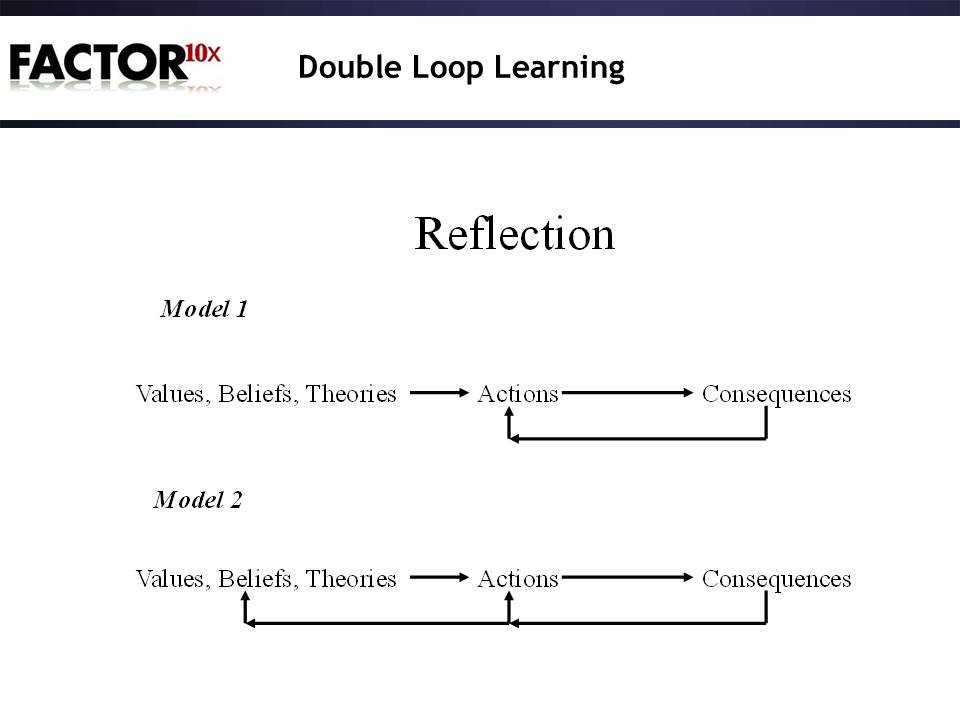
The VisualsSpeak images, process and tools fit all my criteria for a good process – it is quick, it is creative, it brings together the visual, auditory, and kinesthetic, and it reflects my inner state.  The process meets Chris Argyris definition of double loop learning that Schon describes in The Reflective Practioner: How Professionals Think in Action.

Double Loop Learning

It must be the unseasonable warm sunshine that is suffusing Seattle the last couple of days that is creating the context for all of these wonderful visuals and visualizations to show up.

The visual world is speaking loudly today.

Posted in Content with Context, Human Centered Design, Idealized Design, Learning, Nature, organizing, Visual pattern Language, Working in teams | 4 Comments

Walter’s Laws

While creating and developing ALL-IN-1, I wrote down my first law of software development – “Any product not used by its developers ain’t worth squat.” In building our system, we depended on ALL-IN-1 to coordinate the work among the developers. We used our product every day. When we looked at our internal and external competitors, it was clear that the developers of the systems were not users.  Our competitors systems were neither useful or usable as a result.

Over the years, I accumulated other laws of software development and of business. While laws are a bit presumptuous, principles or heuristics just don’t have the same level of pithiness.

The following are the current collection of laws with a little bit of explanation.

  1. The usefulness of any product is directly proportional to its use by its developers. The Southern Version of this law is:  “Any product not used by its developers ain’t worth squat.”
  2. Version 2 of any application is a pseudo Javascript compiler.  The application developers get confused over who is the customer – an end user or another software developer.
  3. The version 1.5 of any application product is a replacement for whatever the current desktop metaphor is.
  4. When in doubt about what do to next, start at the end goal and work back to the present.  This law is a derivative of Russ Ackoff’s Idealized Design where Russ points out that in artificial intelligence terms it is very difficult to do forward chaining to solve a problem.  Backward chaining works much better.
  5. Words mean something but almost never the same thing to different people. Words are the ultimate abstraction.  A movie is never as good as the book.  A product never looks like the specification.

    Interpreting User Needs

  6. When the process you are doing isn’t working, reverse the steps.  Most of us learn a change process that Bob Biller describes as bedrock – hold a system steady for long periods, make massive changes all at once, and then bring the system back to steady state.  Biller describes a better process for environments which change rapidly – swamp mode.  Here you make small changes all the time, much like you would traverse a swamp.
  7. If you are agonizing over picking the optimum choice from a list, implement all of them (move from either/or to BOTH/AND).  Time after time I see software engineers spend days to weeks trying to figure out by themselves (without involving real users) what is the best choice.  By implementing all of the possible ways (usually takes far less time building than trying to decide), choice is preserved until you do get the product in front of real users.
  8. If you can’t decide which option to pick, pick any of them and get started, but be specific.  Ken Olsen’s variant:  When in  doubt JUST TRY!
  9. Produce your product or service every day even during development. Worry about real problems, not artificial ones. Keep the sense of urgency high. Keep the focus on producing value high.  Get paid for the product that is produced. Enable continuous improvement.
  10. Never assume you are the top or bottom application.  Assume the computer is a valid user too. This law is a reminder to make sure that all of the functionality you implement can also be used by other developers.
  11. Open architectures always win, particularly plug in architectures.  The power of others being able to add value provides far more rapid growth than your own development team.  Imagine our surprise when we did the Aldus-Adobe merger when we revealed our respective product revenue streams.  Industry pundits estimated the size of the photo editing market at $15M.  With their plug-in architecture, Adobe was generating >$250M a year – and no one knew.
  12. Integrating applications are a bitch – ALL-IN-1, PageMaker.  You are at the mercy of every other developer and their product release cycles that you are trying to integrate with.  Filters are always out of date.  Testing is a combinatorial impossibility.  The V1 integrating application always looks terrific, but the lifecycle costs of continuing to maintain the product are horrendous.  This law is all about dependency management.  V1 attracts a hot market if done right; but things get combinatorially harder in future versions.
  13. Integrating applications always suck.  They are never good at any function.  The balance of integration versus good functionality versus interaction with other programs always gets done wrong (there is never a right mix for a large enough audience).
  14. When developing a comprehensive system specification which includes APIs, always develop the authoring tool as well.  Authoring tools are always left out in a race to get the product out, but it is the authoring tool which points out the holes in your API and system definitions.
  15. Messages and communications are not media neutral.  The translation between media helps sharpen your ideas and content.  There is a two way flow between what you are trying to communicate and the form you communicate it in. For example, the thesis student projects are generated in multiple media at the Institute of Design – slide show, video, brochure, and 16 page paper.  Doing the thesis in multiple media helps the student understand their ideas much better.  If you want people to edit for ideas and content do it on a crummy printer (low resolution and fidelity).  To edit for typos, do it on a laser printer (high resolution and fidelity).  If you want business executives to understand product concepts do sketches and storyboards, not high resolution prototype applications.
  16. Ends/Means Confusion. When you are with a customer it is easy to focus on Ends.  When you are not, you get immersed in Means.  Picking the customer(s) is the art form to developing a successful product.  Find tangible surrogates for the development team to always have the customer present in any design or product development activity.
  17. If an organizational function or role is not represented in a meeting, their input will be sorely missed. It’s not who is present that is important; it’s who is missing.
  18. Life is a medium scale number problem. Large scale number problems can be treated statistically.  Small scale numbers can be treated analytically.  Most wicked and difficult problems in business are medium scale number problems.  Most professionals convert a medium scale number problem into a large scale number problem and try to sub-optimize everything.  Goldratt brilliantly showed how to convert a medium scale number problem into a small number problem with his Theory of Constraints.

As I shared the list of laws with colleagues, Andy Cargile graciously added the laws that he has accumulated to the list:

  1. Whenever you are brainstorming for solving a problem, always do one pass at reframing the problem and solving it orthogonally.
  2. If you have to explain how to use the interface to the user (who has basic knowledge), it’s not designed well enough yet.
  3. Open systems are a bitch in practice – in “theory” everything “should” work with everything else. Or, the equivalent: have the vendor prove the compatibility of their “open system” instead of you.
  4. In evaluating products, you have to “build” something similar in each one (versus just playing) or you’ll miss the gotchas.
  5. The first people to talk to in redesigning/enhancing an app is the customer service (answer line) folks. They can point out all the problems (without trying to fix them).
  6. Committees can’t create good names. Corrollary: Margaritas can (get away from the day to day work environment).
  7. If one person says it sucks, get a second opinion. If two say it sucks, you have some problems to deal with. If three say it sucks, it sucks.
  8. Beware the functional demo to executives (they’ll plan to ship it in a week).
  9. In estimating, it’s the tasks you forget that kills the schedule, not the individual task estimates being off.
  10. Let the resource doing the task tell you how long it will take.
  11. Have your mom test a system for you (or other completely uninvolved and uninitiated person); you’ll learn something.
Posted in ALL-IN-1, Content with Context, Software Development, WUKID | 2 Comments

Organizations Don’t Tweet, People Do – Euan Semple

Once you figure out how to dip your “knowledge net” into the stream of search engines, blogs, Facebook, LinkedIn and Twitter, the world just shows up at your doorstep (oops, I mean browser window).  Well, sort of.  It helps a lot to have great colleagues who keep pointing out where the gold nuggets are.

A couple of years ago, Mason White pointed me to Pinhawk Legal Technology Daily Digest. He explained that of all the resources that he has come across this daily email provided the best and quickest summary of what was important to read in the area of eDiscovery and Knowledge Management.  Over the last couple of years, this is one of the few daily emails that I read religiously.

While you could lose yourself for hours if you clicked through all of the resources, the editor does a great job of highlighting the three or four blog entries that drew his attention the previous day.  The amazing thing is that the quality of the blog has stayed high even through a change in editors.

I usually end up clicking through to one of the highlighted articles each day.  On January 30, 2012, the entry that caught my eye was “Jack Vinson talks about Euan Semple’s book Organizations Don’t Tweet, People Do.” As I am in the process of trying to understand the role of Twitter in my online knowledge streams, the title caught my eye. In the first couple of paragraphs, I realized that I needed to get Semple’s book.

So I switched over to the Amazon Kindle iPad app and ordered the book.  Instant gratification is such a wonderful thing.

I felt right at home as I started into the book with its introduction by Andrew McAfee, whose book Race Against the Machine, I’d just finished. To my wonderful surprise, Semple frequently quotes David Weinberger who I’d recently reconnected with after reading his book Too Big to Know.

The more I read, the more I realized that Euan must have been living in my head the last ten years.  Rarely, do I come across a writer who not only has had similar experiences, but who is eloquently able to express those experiences in text. So many of my experiences and thoughts just stay jumbled up and never make it through my typing fingers to the keyboard.

Jack Vinson set expectations appropriately that this wasn’t a book about Twitter or technology:

“Funny enough for a book with this title, the book really isn’t about Twitter – or any other specific service.  Twitter simply serves as the most familiar vehicle to have a discussion around how we operate in the world of blogging and forums and Twitter and Facebook and all the other social services that are out there.  And how we need to operate has been changing for a while – it’s just that there have been too many people with a hierarchical or command-and-control mindset to be able to see it.”

The book was exactly what I was looking for to understand the organizational implications of social media and the impact on both individual contributors and management in the age of the blog.

Then I realized that I needed to understand who Jack Vinson was and tracked back to his biography and website.  Low and behold he has a strong background in knowledge management and Theory of Constraints.  I’d been writing a lot about both lately so I sent off an email and yet another conversation has started.  I can’t wait to make my spring trip back to Boston to meet with Jack and other colleagues from my invisible university.

One of the measures I used to determine what my top books from 2011 would be is how much I highlighted and made notes within the book.  It’s clear that Semple’s book will make the Top 10 as I made at least 116 highlights and 17 notes.  I made so many highlights that Amazon would only show me a portion of them because “for some books the publisher allows only a limited percentage of a book to be ‘clipped’ and stored separately from the main body of the book, as normally happens when you add a highlight. If you exceed this limit then you will see fewer highlights on this website than you actually marked on your Kindle.”

My favorite chapter in Semple’s book was “Writing Ourselves Into Existence.”  The book title comes from a quote of David Weinberger’s from The Cluetrain Manfiesto.  The phrase and the chapter captured exactly what I’ve been doing the last three months – finding my voice so I can write the layered digital media text I am working on. Euan summarizes the chapter:

“Developing your own skills and knowledge has never been easier. In fact it has never been more in our own interests to build skills and capabilities as the world of work becomes more unpredictable. The web gives us access to all sorts of wonderful resources for learning but it does more than this. It helps us understand ourselves and the world around us in context. It helps us make sense of things. It helps us ‘be’ more. There is something about the process of blogging that makes you more self-aware. You become more thoughtful about yourself and your place in the world. In the reactions of others to your writing you get a different perspective, possibly for the first time, on how others see you.”

Semple combines this insight with arguing that the Internet with emails, blogs, Facebook, and Twitter is exploding a renaissance of writing literacy back into society.  More people are writing AND publishing more than ever in history.

Being able to name what I am doing as “writing myself into existence every day” is so liberating.

The wonderful surprise at the end of the book is Semple’s impassioned plea for us to open our eyes to what the Internet and the web are enabling in today’s workplaces:

“Some time back David Weinberger wrote that the motivating force behind the internet was love. It was the basic human desire to connect that made it all hang together. At the time I admired his idealism and indeed bravery at being so open about something we have all been trained to dismiss as at best personal and at worst a sign of weakness.

“In contrast I have just finished reading Joel Bakan’s The Corporation in which he exposes the fact that corporations are legally bound to do just one thing – maximise shareholder value and that in fact to be motivated by higher ideals, or indeed love, could be considered detrimental to that overriding purpose if it impacts the bottom line in anything but a positive way.

“Where did all this come from, where did the idea that the most powerfully motivating force in the world had nothing to do with business? We spend most of our adult lives in the workplace and at work we bring about the most important and long lasting changes to our society and our planet – and yet we are not encouraged to talk in terms of love. OK we just about get away with “loving our job” or “loving success” but start talking about loving colleagues or loving customers and you’ll have people running for the door. And yet isn’t this what makes great people and great places tick? A deep sense of connection with each other, a depth of purpose beyond the everyday that sees customers as more than merely stepping stones on the way to returning that value to the shareholders? . . .

“Maybe love does have a place in business after all. Maybe more and more of us will start to have the courage to begin to talk about what really matters to us about work and our relationships with each other and to push back the sterile language of business that we have been trained to accept. Maybe we will realise that accepting love into the workplace reminds us of the original purpose of work – not to maximise shareholder value but to come together to do good things, to help each other and hopefully to make the world a better place. Maybe. …

“Oh and by the way if the above is too new age and namby pamby for you I reckon social computing is capable of taking 25% out of the running costs of most businesses – so there!”

What a way to end the book with the intertwining of workplace and love.  What a concept.

Would we have more great leaders working in great teams producing great results if we regularly wrote ourselves into existence with love in our hearts and minds? That is a super question for this Super Bowl weekend.

Posted in Content with Context, Knowledge Management, Learning, organizing, Relationship Capital, social networking, User Experience | 4 Comments